
[Jane:] A few months ago I had what I thought was a revelation: all those people who were spending their evenings and weekends shuttling their children to sports practices and games, dance classes and riding lessons and swim meets, must really like this stuff. They must think it was fun and enjoy sharing their passion with their children! It had to be like when I garden or bake with my kids, or read them books I love, or tell them about the proto-Indo-European voice system! (Don’t laugh, it’s important context for Latin deponents.) So the next time a mom I know was complaining about getting her kids out the door for flag football practice, conveniently scheduled for (1) rush hour and (2) dinnertime, I smiled and asked, “Are you guys big football fans generally?” I was all set to inquire about their family’s favorite team, the differences between college and professional ball, how different flag football is from tackle and whether they intended to make the switch when her boys were older — but she grimaced and shook her head. No, she said, not really. They watched the Super Bowl but that was about it. “Ah,” I nodded sagely. “But the kids are into it?” (Lord knows I’ve indulged my children’s enthusiasm for things I don’t care about.) No, she said, not particularly. But they needed a sport for the fall.
I didn’t ask why. I wish I had, because I’m sincerely curious — these were busy, active kids, actually in the process of racing around the playground with their buddies while the adults chatted, so it’s not as though they needed organized sports to keep them from merging with the couch cushions — but at the time it seemed rude and pushy so I changed the subject. Now, obviously not everyone is like this mom: some people, including Tim Carney, really do love sports and delight in sharing that love. But the truth is, people are obsessed with signing their kids up for stuff. Carney calls it the Travel Team Trap, and it’s probably most evident in youth sports culture, but it shows up everywhere. Your kid likes to write? Find a creative writing class! Having fun with chess? Quick, hire a tutor! My local rec center even offers courses in Dungeons & Dragons, taught by a real live professional nerd, because apparently eating Doritos in your mom’s basement while your friends mock you for touching the Sphere of Annihilation isn’t good enough any more.
And it’s a vicious cycle, because all these official activities crowd out informal play. If the artsy kids in your neighborhood are taking a musical theater class half an hour away, there’s no one to join your kids in pulling out the dress-ups and staging a drama of their own. If everyone is off at soccer practice, you can’t meet up at the park to kick the ball around. Sorry, Zerubbabel can’t come over and play Legos this week, he’s got his STEM Makers class on Wednesday and then Thursday afternoon is junior robotics team … Soon even the families who want a more relaxed, unprogrammed life are signing their kids up for things because it’s the only way they’ll ever see their friends.
There’s nothing wrong with formal instruction in its place, especially for things where technique really matters: the world needs basketball coaches and piano teachers, too. And sometimes it’s just fun! A big stage with lights and music and real costumes scratches an itch that Mom’s old prom dress and a dinosaur mask (“Velociraptorella”, currently in previews off-off-off-Broadway) just can’t touch. But when we regard these things as potentially interesting and entertaining, rather than absolutely vital to our children’s well-being, we can make sane tradeoffs about them. A day-trip to the awesome museum in a neighboring city is also potentially interesting and entertaining, but nobody thinks you’re a bad mom if you spend the weekend doing something else.
And what’s more, the push for legible achievement over experience, without regard for what’s good for your family — or even, apparently, whether your kids like it — robs them of the opportunity to motivate and direct their own lives. Basketball practice three times a week surely does more for your jump shot than a pickup game at the local park, but in the long term the ability to take ownership of your time, make and keep plans with your friends, sort out interpersonal disagreements, etc. are going to be a lot more useful. (And, sorry, I’m still stuck on this D&D thing: the threat of your friends losing interest and wandering off to play foosball instead is a much greater incentive to become a good DM than anything you could learn in a class.)
But it’s not actually surprising that people parent like this, because it’s how they grew up: today’s moms and dads are yesterday’s Organization Kids.1 Their image of the good life is tallying up achievement points on some great celestial board. And no wonder they’re desperate to tally up points for their kids, too: they think their futures depend on it! In fact, every time I bring this up, someone tells me that Harvard is full of kids whose parents drove themselves crazy coordinating travel sports schedules and private school dropoffs and chess tutors — all of which is true, and some of which is probably even causal. (Nobody appreciates achievement points tallied up on a great celestial board like a college admissions office.) But a lot of it is also because that’s how smart, conscientious, upper-middle-class parents are expected to raise their kids, and the best way to get into Harvard is to be the offspring of smart, conscientious, upper-middle-class people. (It also helps if they’re neither white nor Asian.)
Jane and John Psmith, “JOINT REVIEW: Family Unfriendly, by Timothy P. Carney”, Mr. and Mrs. Psmith’s Bookshelf, 2024-10-14.
- I hadn’t reread the article since I was in college, but revisiting it now it’s an amazing artifact. “No one is political, no one protests.” Things change!
September 22, 2026
QotD: Organized activities for children versus informal play
September 16, 2026
QotD: Squeaky bum time
I blinked at them. “We’ve entered … what?”
“Squeaky bum time”, they repeated, as if this was a perfectly normal phrase that everyone uses. “You know, when it’s so tense you’re clenching.”
The first time I heard this phrase, I nearly fell off the couch laughing.
But now?
Now I find myself using it during American sports, muttering it to myself during tense moments, while my American family would have no idea what I’m on about.
This is what happens when you live in a British-American household. Your vocabulary becomes a delightful jumble that sounds slightly off to everyone.
Marianne Jennings, “Squeaky Bum Time and Other British Phrases I Never Knew I Needed”, An American’s Guide to British Life, 2025-10-05.
August 20, 2026
“It is not strength difference that leads schoolboy teams to regularly beat women’s national sporting teams”
It’s a common observation that teenage boys’ teams can compete — and beat — professional or national competitive womens’ teams in many sports. I’d always assumed that greater male muscle mass and overall strength were the primary reason for this, but Lorenzo Warby points out that strength differences do not completely explain the competitive disparity:
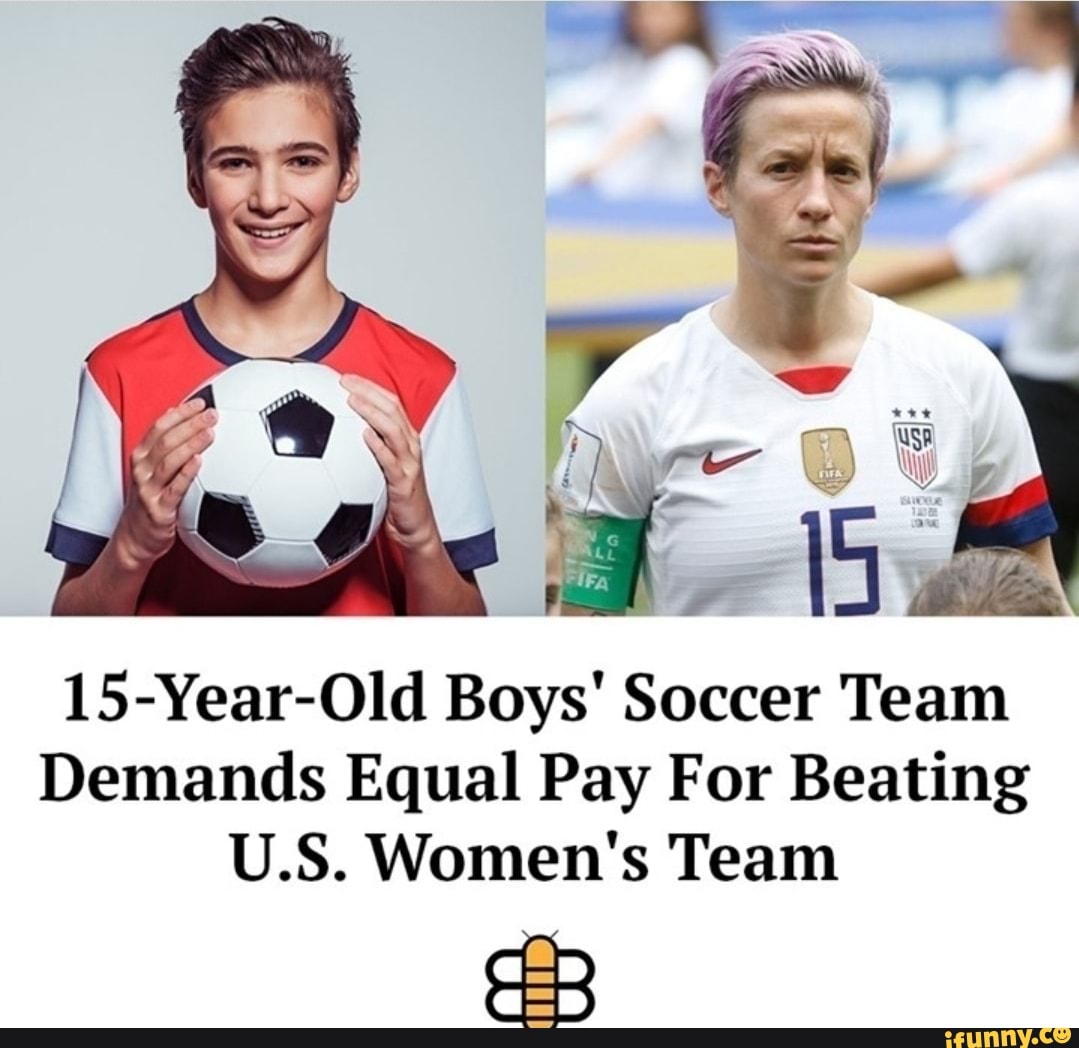
Babylon Bee pokes fun at the US Women’s Team
Social media provides the technology to strongly increase the social signalling and the shunning and shaming that moralises disagreement in service of shared status games. To put it another way, social media upscales social/relational aggression that attacks people’s social standing on the basis of ostentatious moral or social concern.
Because believing X is such performative way of grading people, believing-X makes you a good person creates purity-spirals as people up-the-ante to make their signal — their moral piety display — more salient and reduce competition for positions. It also attracts and empowers the personality disordered — specifically Cluster B’s — as believing-X makes you a good person requires so little to join the status game and advantages those who are manipulatively unrestrained. In other words, it acts as a negative character test, that selects for people of bad moral character.
The inability to admit ever being wrong goes with the moralising of disagreement and identity-through-belief.
Social media does not enable the up-scaling of physical aggression, although it does enable the transmission of threats of such. By contrast, social media — with its electronic mobbing — is a very effective medium for emotional or relational aggression. As women, the physically weaker sex, are particularly inclined to be quite protectively self-deceptive about their own aggression — it is “just” moral or social concern — that leads to both intense aggression and denial of its existence: “there is no such thing as cancel culture”/”it is just a shift in moral, in social, concern”.
Screenshot
Social media can be particularly toxic for adolescent girls. Adolescents often lack a settled or robust sense of self, tend to be very wrapped up in how other people see them, and have a weak sense of their effect on others. All this is even more so for people-focused adolescent girls, who are both particularly prone to engage in — and be vulnerable to — emotional or relational aggression and to seek socially-protective identities. It is plausible that growing up with the excesses of social media increases support for control of speech, including making hate speech a live issue.
More things-focused boys are much more likely to retreat into playing games (both online or physical games) or some other physical activity. The greater female focus on people makes adolescent girls more vulnerable to social media-generated aggression, identity confusion and comforting cognitive refuges and conformism; the greater male focus on things creates a divergence between young male and female perspectives, aggravated by the strong female social preference for other females.
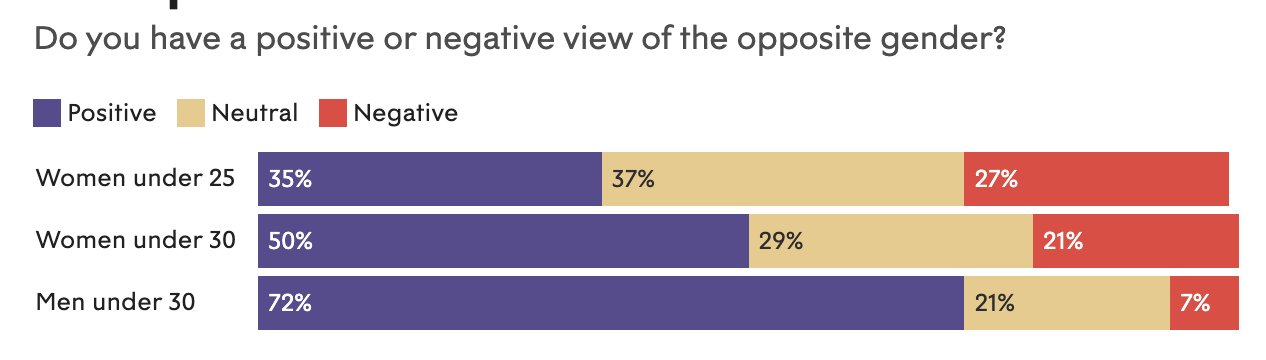
Survey of British women done for The New Statesman.
Due to strong, even at times intense, sex-differentiated selection pressures, in human evolution, human males are systematically better at forming and operating teams than women. Among women, it is the most masculinised personalities — lesbians and tomboys — who tend to be better at teams and teamwork, though they are still generally not as good at it as men.
The operating principle is that men are more likely to suppress their emotions to perform their designated role (in a team, in an organisation). Women are more likely to subordinate their designated role (in a team, in an organisation) to their emotions. Hence, for example, women and girls are more likely to be aggressive towards fellow team members during a game than are men and boys. Hence also — as we will see — male-dominated institutions have been better at catering for women and girls than female-dominated institutions have been at catering for men and boys.
It is not strength difference that leads schoolboy teams to regularly beat women’s national sporting teams. From adolescence on, boys and men are systematically stronger than girls and women of the same age: but even a fit 14 year old boy is not likely to be stronger than a fit, athletic 21 year old sportswoman. It is difference in male and female cognitive and behaviour patterns that leads to teenage boys sporting teams beating national women’s teams.
Institutions — to be functional — generally have to been scaled-up teams. That women are systematically worse at teams than men means that the feminisation of institutions and organisations tends to degrade their functionality. For example, female “emotions-as-threat” tone-policing makes it harder to generate trust, as people curate their interactions. Men and boys make outrageous jokes and rib and insult each other to test whether the others will fold under pressure. The social flattening of tone policing generates much more uncertainty, because it produces far less revealing information, so less trust.
The more differences of opinion are seen as threat, insult or moral failure, the more destructively conformist the institution or organisation is likely to be. This both acts to block feedback and enable the entrenchment of structures of conformist not-noticing.
One way out of this is to have strong standards in favour of truth and robust use of evidence. This, in turn, requires willingness to enforce such standards, which many women find emotionally confronting to do, as they are far more primed to read emotions as threat. Retreating from enforcing standards and boundaries on the grounds of being “inclusive” gives emotional — and so moral — cowardice a warm inner glow via a patina of self-righteousness. An emotionally-comforting retreat from enforcing standards then aids the entrenchment of emotionally-comforting opinion conformities.
That women tend to be self-deceptive about their own aggression — passing it off as moral or social concern — can be highly corrosive to the internal operation of an organisation or institution. In particular, it can be an effective way to block inconvenient information or concerns. All of this makes an information-restricting conformity likely to develop, and become entrenched, within an organisation as it becomes more female-dominated while making it less functional in enforcing standards, so delivering services.
Women are much less likely than men to have friends of lower socio-economic standing — as those of lower social standing are generally not a good social return on the emotional investment that female friendships are based on. Given the biological expense of human children, focusing on getting a good social return for one’s emotional investment was a successful reproductive advantage. For more team-oriented men, one never knows when someone of lower socio-economic status might be useful on your team.
Feminisation — that is, the increasing pervasiveness of more female-typical behaviour patterns — thus raises issues of weakening social solidarity. One of the striking things about contemporary Western societies is how little active concern that female university graduates show for people, including other women, of lower socio-economic status within their own societies. They have very little sense of how very different the experience of women in very different social milieus can be, and they do not socialise with such women to find out.
July 4, 2026
In the “early Victorian period … drinking whisky was the modern-day equivalent of licking hallucinogenic toads”
Scotland was terra incognita to the English for far longer than one might think, even though the two kingdoms shared a monarch as early as 1603. On his Substack, Ed West shows how modern day Scotland has long since emerged from the mysterious shadows of the past:

“Scotch whiskies” by Chris huh is licensed under CC BY-SA 4.0 

 .
.
In his highly entertaining history of alcohol and the British, Empire of Booze, Henry Jeffreys observed how one effect of the Napoleonic Wars was to make Scotland a popular destination for English holiday makers. What with the continent being isolated and everything, there weren’t many more exotic places for the richer, more adventurous traveller to visit.
The country was until then largely unknown to many people south of the border, something also true of its trademark drink. “Highland and lowland whisky in the early 19th century would have been a mystery to the majority of Englishmen”, Jeffreys writes: “In the literature of the Georgian and early Victorian period it’s apparent that drinking whisky while in Scotland was the modern-day equivalent of licking hallucinogenic toads while in the Amazon or eating rancid whale in Iceland”.
The conflict with revolutionary France proved to be a great boost to Brand Scotland, and not just because of the limits it placed on rival destinations, but also for the dash that the Scots cut on the field. This culminated with a momentous scene in which “the Highland regiments dazzled the French when the Allied armies marched into Paris”.
Here they wowed both friends and enemies alike, and Sergeant Thomas Campbell of the Grenadier Company recalled how the Tsar even personally “examined my hose, gaiters, legs, and pinched my skin, thinking I wore something under my kilt, and had the curiosity to lift my kilt up to my navel, so that he might not be deceived”. Thanks to the likes of the Black Watch and Gordon Highlanders, the Scots had arrived on the global stage, and no one would ever forget Die Damen aus der Hölle (Ladies from Hell) as German troops would later call Highlanders.
This period of upheaval and war – the birth pangs of true modernity — was marked by a growing craze for Highlandism, “a peculiar phenomenon where lowland Scotland, a predominantly settled mercantile society, took on the trappings of the Highlander as a way of differentiating themselves from Englishmen who they were now yoked to in the Union”.
Previously viewed as menacing, the Highlanders had been tamed by the defeat of the Jacobites and the Clearances that followed, making this once-feared Gaelic culture now safe for English speakers to adopt as their own. Much of this was driven by the romantic imagination of Edinburgh’s Walter Scott, who helped shape both Scottish national identity and the 19th century resurgence of medievalism. Perhaps more than literature, however, Highlandism was boosted by the region’s most famous export — whisky. As Jeffreys writes: “The growth of Scotch coincided with the birth of Highlandism”.
The development of Brand Scotland was also helped by a man widely regarded as Britain’s greatest buffoon and waste of space, the former Prince Regent. Historian John Plumb described a hugely influential visit by the now George IV in 1822, where: “He paraded Edinburgh in the kilt, resplendent in the Royal Stuart tartan and flesh-coloured tights, and yet managed to keep his dignity. The Scots loved it! Quaintly enough, George IV had struck the future note of the monarchy … Be kilted! Be sporans! Be tartans! Riding up Princess Street … To the roaring cheers of loyal Scots, he was showing the way that the monarchy would have to go if it were to survive an industrial and democratic society.”
It was the start of a beautifully symbiotic relationship, with the Royal Family immersing themselves in Highlandism ever since, spending much of their summer holidays there and helping to project an ideal of a region famed for its dramatic countryside, castles, distilleries and golf courses. They’re not alone: Donald Trump, whose mother hailed from the Isle of Lewis, has a noted fondness for the old country, even if this is not always reciprocated, and no doubt many more of his compatriots will be making the pilgrimage in the coming year thanks to the country’s newest brand ambassadors. These are, of course, another occupying force of Scots, the fans of the national football team who followed their country’s brief recent appearance at World Cup.
The Scots in Boston marched as proudly as their ancestors. Their bagpipers serenaded the opposition. Some even turned up at a wedding. They came to watch the Boston Red Sox, which one local described as “the best thing that’s happened in years”. They attracted many neutrals, including a duck. Folk songs were written about them. Everyone loved them, even if some struggled to understand them.
The Boston Globe published a full-page letter thanking them. One local reported how Scotland fans leaving Boston was “almost like a day of mourning for the Americans“. After they left, Massachusetts State Senator Paul Feeney made an emotional farewell, thanking them for visiting children’s hospitals and donating money to local charities: “You’ve been great, courteous guests, you’ve been polite and you’ve been fun and I don’t want that to end”. He invited them to return next year, by which time Glasgow will be twinned with Boston. Indeed, Scottish fans so impressed the Bostonians that the city changed its zoning laws, not an easy task in America. They may even have solved the fertility crisis. Indeed, the Tartan Army charm offensive in Boston has been so overwhelming that I half suspect it’s some sort of devious RICU operation.

June 30, 2026
A World Cup “first” – no new stadiums built just for WC matches
The 2026 World Cup broke new ground in several different ways, not least of which was that none of the venues for matches were built just for the tournament:
The 2026 World Cup is one for the books, a tournament of firsts. The first to be hosted by three different countries—United States, Mexico, and Canada. The first to feature 48 teams. The first time a single country, Mexico, has hosted the World Cup three times. The first time one stadium, the Azteca, opens a World Cup for the third time. The first time the final will stage a halftime show. And the first time since USA 1994 that no stadiums were built exclusively for the occasion. And while many stories are worth covering with the World Cup, let’s talk about stadiums.
World Cups, like many major competitions, face backlash for their heavy government funding, because once the fans leave, the citizens are stuck footing the bill. For most of these international tournaments, the model is first to build stadiums for the sole purpose of hosting, and then to figure out what to do with them afterward—that’s where most of the funding goes. South Africa built Cape Town Stadium from scratch in 2010, and it barely survives today as a rugby and concert venue, rebranded DHL Stadium. Brazil, the 2014 host, spent more than $3 billion on 12 stadiums, with its priciest venue, the Mané Garrincha in Brasília, a city with no major club, ending up as a parking lot for buses. While 2026 seems to have broken the pattern, at least for now, 2030 and 2034 already have preparations underway and are, in fact, building stadiums. But this time, not one venue was built for the occasion. Every stadium already existed: NFL stadiums in the United States, soccer grounds in Mexico, multi-use venues in Canada. It almost seems like the responsible version.
Almost, because even when you don’t build a stadium, hosting still sends a bill. Take Monterrey, where the stadium is privately owned and was renovated by FEMSA. Public money went elsewhere. Governor Samuel García’s administration poured billions of pesos into the city’s metro — 25 billion pesos — for three new lines to carry fans from the airport to the stadium, but it won’t be finished until 2027, a year after the fans have gone home. And in the weeks before kickoff, the government raised walls along the avenues tourists would travel, in order to hide the poor neighborhoods. Regios called them the walls of shame. It is the whole logic of the tournament in miniature: cover what you would rather the world not see. This isn’t new; hiding the poor before the international crowds arrive is an old Olympic habit.
Most of the stadiums today carry a corporate name, and because of that, most assume that the money behind them was private, too, but it wasn’t. Most US venues for the World Cup are publicly owned, all three Mexican stadiums are private, and both Canadian venues are public. Of the 30 stadiums that normally host NFL teams, only three were built entirely with private money. The rest took public subsidies, even as the name on the façade says otherwise. This wasn’t always the model.
Through much of the last century, private money built and ran arenas, and public funding for them was almost unthinkable. The shift is fairly recent. As historian Frank Andre Guridy tells it in his book The Stadium, grounds that once carried the names of places and local stories became corporate billboards. This modern wave is usually traced to 1985, when Sacramento developer Gregg Lukenbill sold the naming rights to the Kings’ new home to the Atlantic Richfield Company, and ARCO Arena was born. Naming rights themselves go back further, to Rich Stadium in Buffalo in 1973, but it was only after ARCO that the practice became the rule. Today, nearly every arena in the country answers to a sponsor.
June 15, 2026
European World Cup tourists in the US
On the social media site formerly known as Twitter, Larry Correia notes that Europeans’ reactions to visiting the United States changes once they get out of the big cities:
The posts from World Cup Europeans seeing actual America has been great. The shock and awe is hilarious.
I think it’s because their perspective has been based on TV shows (overwhelmingly set in LA or NYC, which get everything wrong about the rest of the nation because the writers are usually provincial liberal dorks who despise the rest of the country) and when they do come here as tourists it is to the same handful of tourist places. Which are always artificial, weird, and crowded.
It turns out that when you get away from our big stupid blue cities, and all the societal decay that comes from liberals not being able to govern worth a shit, America is actually really awesome.
I’ve been to 45 US states. I’ve enjoyed all of them. Even the blue ones, once I’m away from the parts that are entirely paved where lawless crazy people are allowed to shit in the streets and threaten everyone. It’s just a collapse of leadership, and democrats being inept, not giving a fuck as long as they’re still getting paid, or actively rooting for society’s destruction because they’re deluded morons who think they’re going to build a socialist utopia from the ashes.
America has managed to isolate that retarded shit tier philosophy mostly to our big blue city liberal enclaves, where lawless dumb shit can rule, while the rest of us live relatively normal lives, and our politics are primarily based on keeping those assholes away from our stuff as much as possible.
But the cool Europeans have been trapped on a continent where that philosophy rules EVERYWHERE. They’ve got nowhere to escape from their mediocre control freaks. Their shocking discovery that normal sane people can still just do things, and make things, and build, and have fun, and be safe, and raise their kids, is what’s making this whole thing fun.
I don’t follow soccer, futbol, whatever. But I am cheering on some Europeans right now. 😀
Update: Fixed broken link.
June 12, 2026
The mystical powers of climate change, is there anything it can’t do?
In Canada, all problems are now blamed on US President Donald Trump. It’s a fantastic get-out-of-trouble move for politicans like Prime Minister Mark Carney, Ontario Premier Doug Ford, and even mayors of towns and cities across the Demented Dominion. But even the malign powers of the Bad Orange Man seem puny in comparison to the amazing powers of — gasp! — CLIMATE CHANGE:
Every now and then I suspect there is a game played by bored elites to see which of them can get away with the most asinine “climate change” claim. There have been some doozies: lack of UFOs, “climate change” anxiety, increased sugar consumption, engineering short people. On and on and on ad infinitum.
Today we meet what could be the winner in the contest. Experts are claiming World Cup matches could be slower. Now instead of ninety-plus minutes running around ending in zero-zero ties and dramatic shootouts, we’ll get ninety-plus minutes of somewhat slower running around ending in zero-zero ties and dramatic shootouts. Because “climate change”.
Seems to me, though, that if we really wanted to save time, we could have all matches begin at the shootouts. The whole tournament could be over in a day. Take that, “climate change”!
Here’s the claim, appropriately announced on a PR site, a site whose specialty is juicing dull and dubious headlines: “Climate Central finds climate change has increased the likelihood of heat that could slow players for 97 of the 104 matches, threatening game speed and fan safety.”
What will happen to the other 7 matches they don’t say. Probably they will end in shootouts.
Details:
Previous research shows temperatures above 82.4°F can reduce sprint frequency, total distance covered, and recovery time, impacting not only player performance and safety, but also match tempo, tactics, and overall style of play.
Previous researchers discovered — and stay with me, here — that when it’s hot outside people outside in the heat act like people act when it’s hot out.
Where would we be without previous researchers?
[…]
As you have surmised, we don’t have to believe any of this: the scenarios are all silly, proving that the stunning new research is purely performative, a way to signal the vices and predilections of the researchers. As proof, we oblige the PR site which asks us to quote this:
As global temperatures continue to rise, driven by the burning of fossil fuels, the 2026 World Cup could become another example of how climate change can disrupt sports and traditions people cherish, forcing a reevaluation of how the game is played.
This is all ridiculous, and only saved by the charge of falsity by adding that “could.” Meaning might, which also means might not.
They also provide this quote they ask us to re-quote:
Alex Jacobs, professional player formerly with the Jamaican Premier League:
Heat is not new. But extreme heat — made more likely by heat-trapping pollution driving climate change — might just be a difference maker in this summer’s edition of the biggest sporting event on the planet.Way these quotes work is that either the PR firm, or the organization employing the PR firm, write them for victims, who are sought out and asked to sign on. The people allowing their names to be used are, of course, fully responsible for the words used, and even often believe them. But there’s no mistaking that stilted prose of the manufactured quote. Nobody talks like this. This prose is not conclusive, but whenever you see it, it’s a darn good reason to dismiss the claims made.
Of course, using a highly visible public event to advance the climate change agenda is nothing new, they’ve literally been doing it for decades now. Media outlets have always had a bias toward the most dramatic outcome, if only for marketing purposes — “if it bleeds, it leads” — but even the more skeptical outlets have drifted in the climate hysteria direction over time:
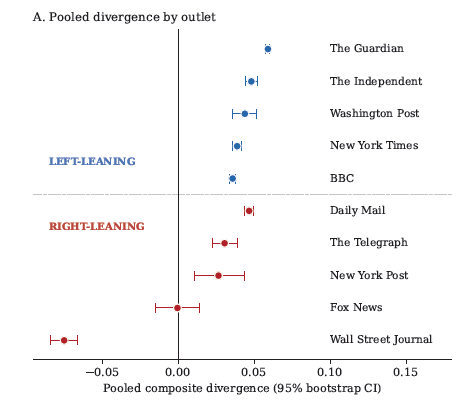
We have complained many times that the public is presented with a picture of climate science systematically biased towards alarmism. And it’s not just our anecdotal impression. We have data, in the form of a new study from the US National Bureau of Economic Research saying the government delegates who write the IPCC Summary for Policy Makers (SPM) overstate the science in the underlying report, and then the media further overstates what’s in the SPM. The study authors used multiple AI systems to extract key scientific statements in every IPCC Assessment Report since 1990, track how they were summarized and what the accompanying media coverage said. Using a statistical model they measured the way the statements get changed or twisted at each stage. There were some surprising results and some unsurprising. Unsurprisingly the data showed the UK Guardian has by far the most climate coverage of all major media outlets and is also the most biased. Another unsurprising result is that the overall media bias regarding the severity of climate change has been consistent over time. A surprising result (to many, but not to us) is that the only major media outlet exhibiting precisely zero bias was Fox News. Otherwise most right-leaning outlets adopted the left-leaning outlets’ alarmist bias as of 2007, again unsurprising to us. And there’s much more.
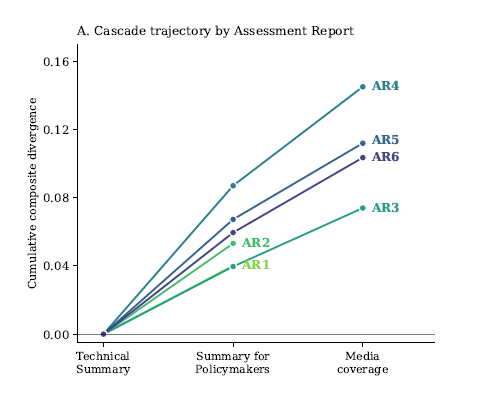
The authors identified three forms of bias: severity, in which a summary picks the upper end of a range of claims, uncertainty, in which a summary downplays caveats and qualifiers, and scenario in which worst-case scenarios get foregrounded. They used a numerical scale from -2 to +2 that captured bias in either direction: a positive number indicated that the summary was biased towards alarmism and a negative number indicated a bias in the opposite direction. Then they averaged the bias measures together and measured them at two stages in the game of telephone. The “TS-to-SPM” stage compared statements in the author-written Technical Summary to how they were worded in the government-written Summary for Policymakers. The “SPM-to-media” stage looked at how statements in the SPM were then reported in the press. The authors examined the TS-to-SPM stage for every IPCC Assessment Report from 1990 to 2023. They only looked at the SPM-to-media stage from the 2001 Third Assessment Report (AR3) because that’s as far back as their media library went.
[…]
That’s right, folks. Even the right-leaning outlets have also gone in for alarmist bias, at least since 2007. Indeed, the media’s bias converged in size and direction over time, as shown in this chart:
For the AR3 in 2001, right-leaning outlets on average understated the climate findings while left-leaning outlets overstated them. But thereafter both sides shared the alarmist bias. Which reflects the success of alarmist activists in the post-An Inconvenient Truth era (2006) driving skeptical voices out of the media. That campaign didn’t eliminate bias, it only replaced one form by another, with the result that the overall media landscape became entirely one-sided.
The uniformity of the bias can also be seen in this chart:
The right-leaning outlets in red are about as bad as the lefties in blue, except for Fox News which is the only outlet with no measurable bias and the Wall Street Journal which had an overall negative (anti-alarmist) bias.
June 9, 2026
Stop buying stadiums for billionaires!
ReasonTV
Published 6 Feb 2026Sports subsidies suck.
If sports is a trillion dollar industry, with billionaire team owners and millionaire players, and hundreds of thousands of enthusiastic fans, and weird pervert mascot creatures, why is the government giving them your money?
May 31, 2026
How Sports Illustrated devolved into AI slop
Ted Gioia generously pulls an article out from behind the paywall for the benefit of cheapskates like me. It’s on the deliberate destruction of Sports Illustrated:
Imagine if sports journalism were like an actual sporting competition — and the best team wins.
In that kind of contest, could any periodical in history surpass this lineup:
- William Faulkner reports on a hockey game.
- Robert Frost covers baseball.
- Carl Sandburg offers golfing tips.
- John Steinbeck contributes a story about fishing.
- Ernest Hemingway writes on bullfighting.
This sounds like an editor’s fantasy. But these are actual stories and bylines from Sports Illustrated.
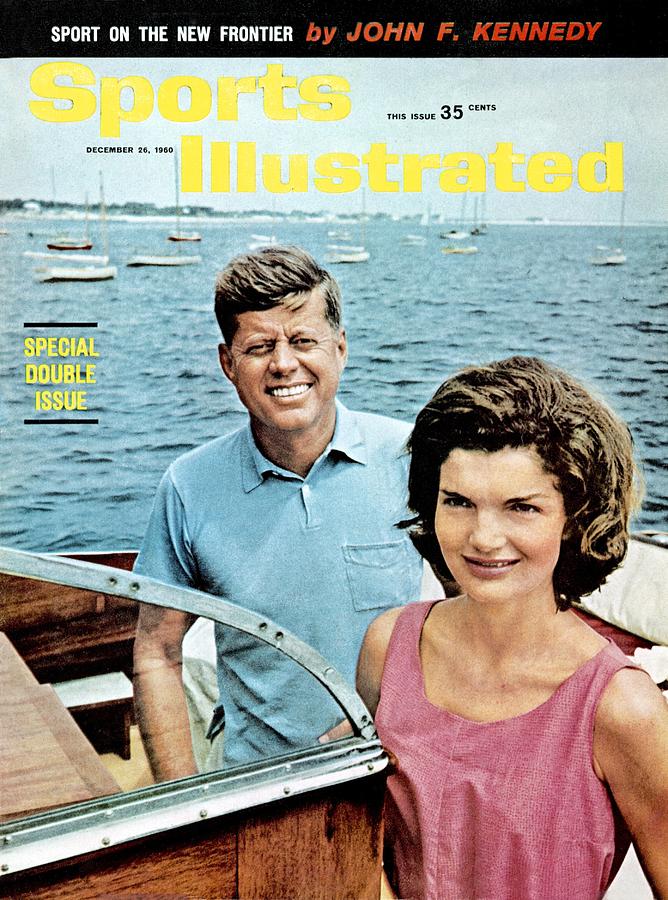
For a period of fifty years, this magazine set the gold standard for sports journalism. Nobel and Pulitzer winners wrote for them. Sports Illustrated even convinced John F. Kennedy to write a freelance article. In fact, that was one of the first things JFK did after getting elected president.
How do you kill a brand as powerful as Sports Illustrated?
It’s easy, you can do it in one just one move. You just need to embrace the most exciting, futuristic technology of the 21st century.
That’s what Sports Illustrated did. The world’s most respected sports magazine gave up on Hemingway and Faulkner, and started publishing AI slop. The editors clearly wanted to hide this — they pretended that the articles were written by actual human beings. They even created fake bios with photos for the non-existent authors.
When a journalist from Futurism asked them about this, they quickly deleted everything.
But the damage was already done. The magazine’s reputation was on the mat, like those bloodied boxers it had covered over the decades.
Just 55 days later, Sports Illustrated announced that it was laying off most of its workforce. The media reported that Sports Illustrated would stop operations completely.
A few months later, a new publisher stepped in as savior. But there wasn’t much to save — at least as a journalism business.
The latest move happened yesterday. The new owner laid off 12% of its workforce, including several of the remaining skilled journalists from the pre-AI era. Some of them are in desperate shape.
Former SI journalist Jeff Pearlman now mocks the magazine as an “empty vessel for selling sh*t to idiots and for getting people to gamble away their money on sports”.
It’s now a brand name, he insists, with nothing behind it.
That’s all Sports Illustrated is. It’s a name. It’s something to put on cruise ships. It’s something to put on clubs. It’s something to put on popcorn. Literally, there’s a Sports Illustrated popcorn.

May 10, 2026
How to Make Nazi Germany Look Normal – Death of Democracy 15 – Q4 1936
World War Two and Spartacus Olsson
Published 9 May 2026How did Hitler use the 1936 Berlin Olympics to make Nazi Germany look peaceful — while preparing the country for war?
Berlin, September 30, 1936. Under the Olympic flame, Nazi Germany staged one of the most successful propaganda spectacles of the twentieth century. Foreign visitors saw order, ceremony, technology, pageantry, and athletic triumph. But behind the facade, the regime hid antisemitic persecution, rounded up Sinti and Roma, intensified police repression, intervened in the Spanish Civil War, and moved toward a massive new war economy.
In this episode, Spartacus Olsson looks back at the third quarter of 1936: the Berlin Olympics, Jesse Owens’ victories, Hitler’s secret war memorandum, the Four-Year Plan, Nazi propaganda, Germany’s growing involvement in Spain, and the dictatorship’s attempt to sell peace to the world while preparing for conquest.
The Olympics gave Hitler international validation. The Four-Year Plan revealed what he truly intended.
In this episode:
– How Nazi Germany sanitized Berlin before the Olympic Games
– How the regime temporarily hid antisemitic violence from foreign visitors
– How Sinti and Roma were forced out of sight before the Games
– How Jesse Owens challenged Nazi racial mythology on the track
– How Hitler moved Germany toward a war economy
– How the Four-Year Plan tied German recovery to rearmament
– How Germany’s intervention in Spain marked a new stage of escalation
– How propaganda, spectacle, and controlled media helped normalize dictatorshipThis is not just a story about the 1936 Olympics. It is a story about how authoritarian regimes use spectacle, national pride, media control, and international complacency to hide what they are becoming.
Never Forget.
April 9, 2026
The NFL’s “Rooney Rule”
As the NFL in its modern incarnation exists as an exception to the normal rules governing corporate structure under US law, you can readily imagine that the NFL’s legal teams are extremely sensitive to the changing winds at the federal level. At a time that the federal government was emphasizing providing employment equity, the NFL scrambled to implement a hiring solution that gave black coaches a better chance of being hired for head coaching opportunities. The winds have shifted recently and the NFL risks being caught on the wrong side of evolving legal decision-making:

In a recent interview with the New York Times, Tampa Bay Buccaneers head coach Todd Bowles said he “absolutely” believed that he was sometimes brought in by NFL teams just to check the “Rooney Rule” box.
The Rooney Rule is an NFL policy instituted more than two decades ago that requires teams to interview — though not to hire — at least one minority candidate when hiring new coaches.
The rule was designed to increase the number of minority head coaches in the NFL, a goal it has failed to achieve. For years, it has been a source of moral controversy, but new developments suggest it may now be a legal issue for the league.
Last week, Florida Attorney General James Uthmeier (R) sent a letter to the NFL calling the Rooney Rule “blatant race discrimination“, adding that hiring decisions should be based solely on merit.
Though the NFL says it believes its policy “is consistent with the law” and promotes fairness, others have indicated the Rooney Rule may be on the chopping block, given recent legal challenges to other forms of racial preferences.
“There’s no question that the environment has changed in recent years“, said Pittsburgh Steelers owner Art Rooney II, the son of Dan Rooney, for whom the rule is named. “We do have an obligation to make sure that our policies comply with the laws, whatever the law is, and whatever the changes in law might be.”
Art Rooney didn’t specify the laws the NFL may not be in compliance with, but he might have been referring to last year’s Supreme Court ruling in Ames v. Ohio Department of Youth Services. In that decision, the court unanimously ruled that separate standards for minority and majority plaintiffs seeking redress for racial discrimination were illegal.
The ruling undercut the ability of organizations to use race or sex in hiring decisions — even for ostensibly benign or diversity-promoting purposes — because majority-group plaintiffs are now allowed to sue under the same legal standard as minority groups.
As I wrote at the time, the Ames decision was likely to be a wrecking ball to diversity, equity, and inclusion initiatives, which employers had used for years to discriminate against majority ethnic groups (and non-focus minorities, such as Asians), in violation of Title VII of the Civil Rights Act.
February 28, 2026
Just when you think Canada can’t get worse … it gets worse
Unlike most other Anglosphere countries, Canada does not have a resurgent right wing in domestic politics — we barely have a right wing at all — and the governing Liberal Party is constantly trying to steal sitting opposition MPs to achieve a majority of seats in Parliament. It’s no wonder that Alberta’s separatist movement has been active the last few years. In case you still have an optimistic view of Canada’s present and future, here’s a long “state of Canada” post from John Carter that will probably increase the numbers signing up for free euthanasia (“MAID” in Canadian):
The US is now leading Canada 3-0 in international hockey. If you count the Stanley Cup as an occasional international match, a Canadian team hasn’t won since 1993. For a country that has long practically defined itself as the Hockey Nation, this is especially humiliating. Given the continual year-round repetition of the Elbows Up mantra, this is the kind of thing a Roman augur would have interpreted as a portent of divine disfavour.
Months, you say? Oh dear.
Consistent with that interpretation, Canada’s recent humiliations have not been limited to sportspuck losses. What follows is a snapshot in time, headlines from a country beset by interlocking economic, demographic, spiritual, and political crises, a country which has not had good news in so long that it has forgotten what optimism even looks like.
Item: Canada recently watched the worst school shooting in Canadian history, and the second-worse mass shooting after the infamous 1989 Montreal Massacre in which “Mark Lepine”1 shot 14 female engineering students. The shooting took place in Tumbler Ridge, British Columbia, a small rural village in the country’s north, and claimed the lives of 10 people including the shooter, his mother, his brother, and several students. Dozens of others were injured. It soon turned out that the murderer was a trannie whose brain had been twisted into a psychotic pretzel by psychedelics, legal weed, SSRIs, and the gender woo he was force-fed at school, at home, and on Reddit. This has led to it being referred to as the Tumblr Shooting. Naturally, both the Royal Canadian Mounted Police and the Canadian media went out of their way to respect the shooter’s pronouns in all reporting and official communications. The media even made sure to give the shooter an AI filter glow-up, so that he could be remembered as the pretty girl we all know he really was deep down inside.
After a desultory and hilariously unsuccessful attempt at scolding the public that the problem wasn’t trannies, but guns or whiteness or something (blessedly, they couldn’t say “men” this time), the Canadian media just dropped it, though not before the government flew the flag at half mast.
Which is how this happened.
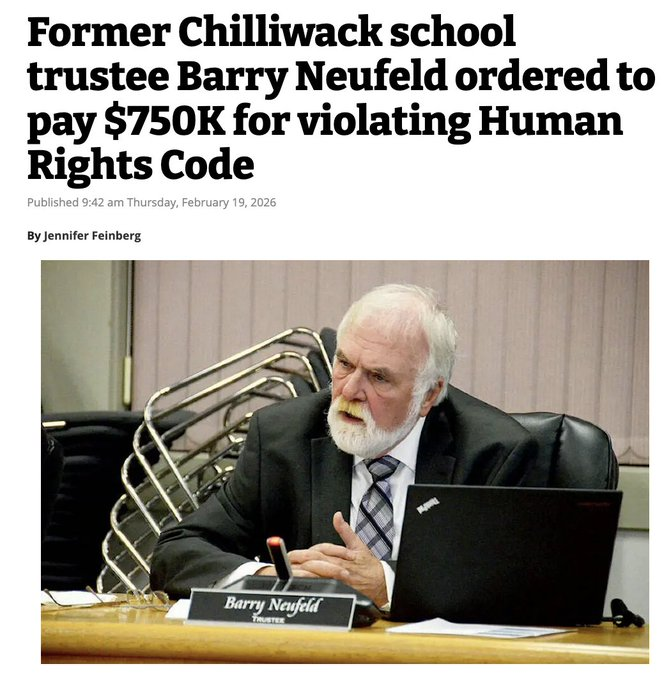
Item: A former school board trustee in Chilliwack, British Columbia, was fined $750,000 for failure to respect pronouns. Shooting up a school is bad, but misgendering is unforgivable.
[…]
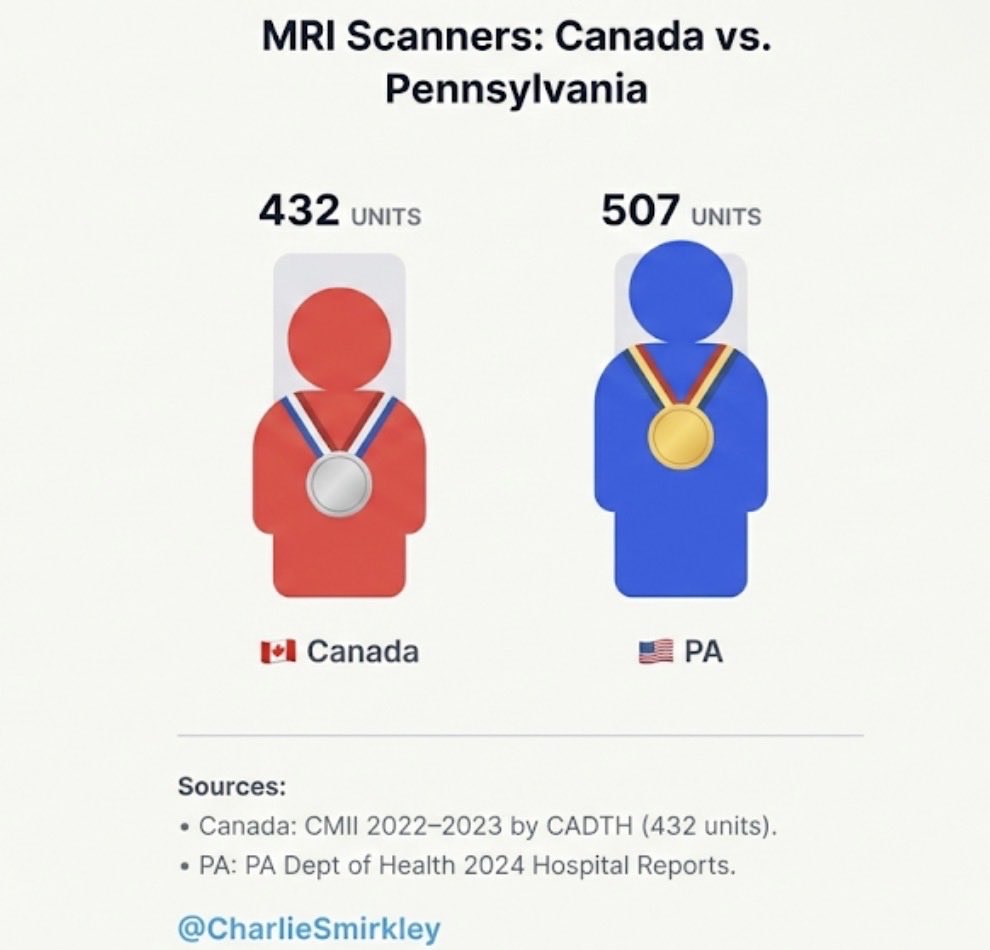
Item: A xeet went viral in which a leaflib tried to fact check an American poster making fun of 18-month MRI wait times by pointing out that she’d only had to wait six months, prompting widespread mockery from incredulous Yanks.
Pennsylvania, which has about 1/3 of Canada’s population, has more MRIs than all of Canada put together. The Canadian mind cannot comprehend, etc.
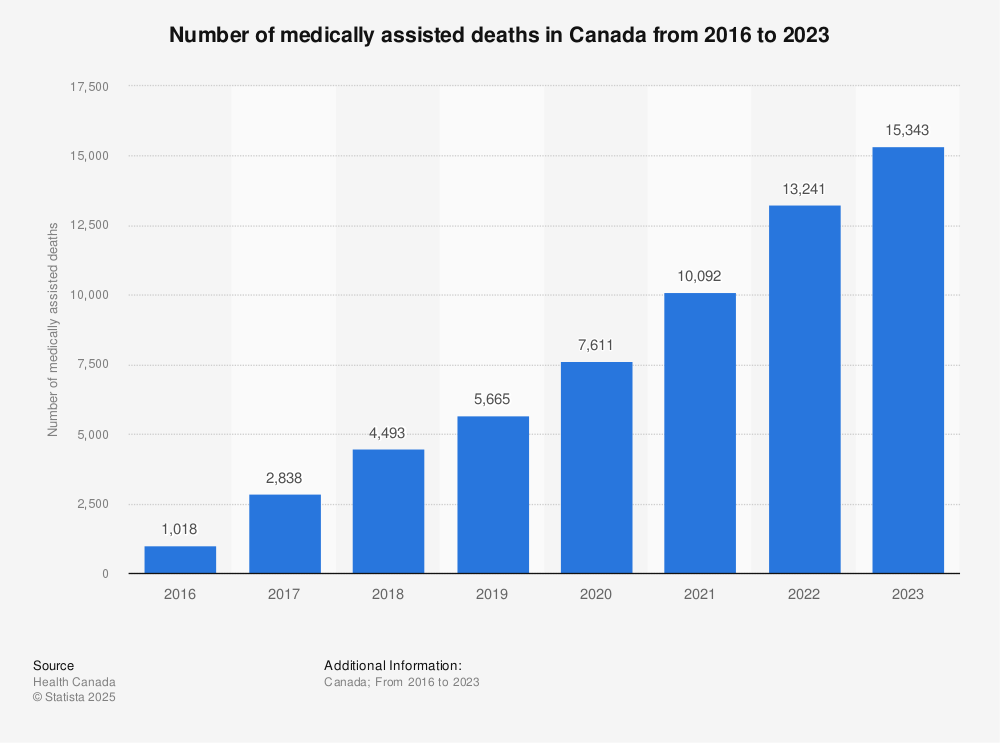
Item: Euthanasia via Canada’s Medical Assistance in Dying (MAiD) program now accounts for 1 death in 20 in Canada. The overwhelming majority, around 96%, of MAiD recipients are white, despite white Canadians comprising 86% of Canadians in the elderly demographic that dominates assisted suicide participants.
Since 2016 over 76,000 Canadians have been killed by MAiD. Moreover, the program is accelerating: the death toll in 2024 was the highest on record at 16,499. Annual death tolls have risen by around a few thousand every year since the program started, with no sign of stopping. Canada is expected to hit 100,000 MAiD deaths by summer.
Item: While most MAiD victims are elderly and infirm, this is not true in every case. Recently it came out that a 26-year-old man was euthanized, simply because he was depressed over his diabetes-induced blindness. His family allege that he doctor-shopped until he found one who would kill him (she has apparently killed several hundred others).
MAiD was originally billed as an easy, painless out for people with terminal illnesses, a dignified death that would spare them a few months of pointless agony. It’s now being extended to people whose imminent death is not reasonably foreseeable. Several Canadian Armed Forces veterans have been offered MAiD in lieu of treatment for injuries sustained in the course of their service.
The primary goal of MAiD is almost certainly to reduce pressure on Canada’s overstretched public health care system whilst simultaneously reducing the fiscal burden of pensioners on the federal budget. Someone looked at the financials, and concluded that unfunded liabilities were going to bankrupt the country when the boomers reached their 80s. Therefore the government is talking them into killing themselves. However, while they’re at it, they might as well expand the program to hasten demographic replacement within the younger sectors of the population pyramid.
- Née Gamil Gharbi, a detail the Canadian media successfully kept from us for decades as it didn’t fit their narrative that “men” are the problem, rather than men from … certain places.



February 20, 2026
Stephen A. Smith as a Democratic Trump
It’s been noted many times that the Democratic Party has had a logjam of aged boomers at the top of their “bench” for future leadership positions. This is a serious problem for the self-described “Party of Youth”, that they have remarkably few viable Gen X, Millennial or Gen Z rising stars who might be future presidential candidates. Donald Trump took the political insiders by surprise in 2015/16, because he was an outsider with no political track record but a huge media profile. He may be the template that Stephen A. Smith hopes to follow on the Democratic side:
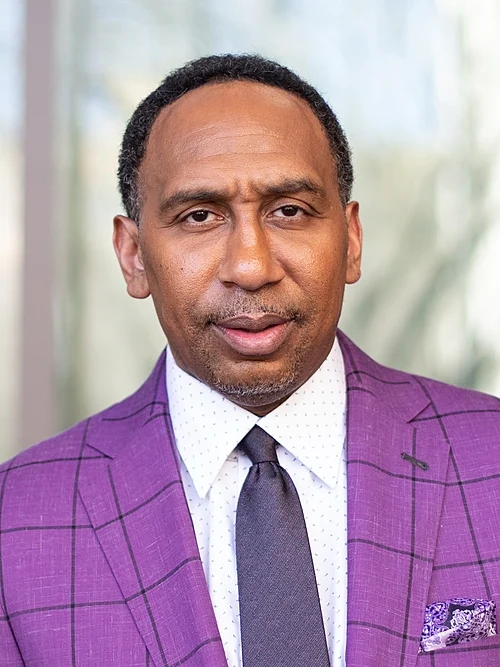
Stephen A. Smith at The Moody College of Communications, 23 January 2021.
Wikimedia Commons.
Stephen A. Smith is flirting with a run for president. In a recent CBS News interview, the telegenic ESPN commentator openly entertained the possibility of seeking the Democratic nomination in 2028. He offered additional comments on policy that were striking in their normalcy. He dismissed the idea that racism defines contemporary American life, rejected “defund the police”, and emphasized economic flourishing as the surest path to social stability.
Smith has a gift for performance, a fondness for hyperbole, and a resume devoid of elective office. Historically, that would have made him an unorthodox fit for the White House. But since Donald Trump’s 2016 election, those facts do less to disqualify a figure than to clarify his potential appeal.
And Smith seems to be taking the possibility seriously. His CBS interview builds on previous comments criticizing politicians who support income caps or engage in class-war rhetoric, framing prosperity as a moral and civic good, and condemning the Democratic Party’s excesses on cultural matters like transgenderism. In these comments, Smith captured the sensibility of millions of voters who feel alienated by the ideological vocabulary of contemporary Democratic politics.
While it’s tempting to write off Smith’s flirtation as unserious celebrity theater, that impulse overlooks the weakness of the Democratic field. Kamala Harris enters the cycle as the nominal frontrunner, but her standing reflects name recognition more than enthusiasm. Gavin Newsom commands attention through media savvy and partisan combativeness but carries the burden of California’s abysmal policy record. Other prospective contenders — none of whom have managed to crack double-digit support — may offer competence without excitement or excitement without coalitional appeal.
A primary defined by such choices creates space for an outsider, especially one who can command attention and articulate a distinct political persona. Smith lacks the accumulated baggage of conventional politicians. Even more importantly, he speaks like someone accustomed to unscripted confrontation. Two decades of live television have trained him to think quickly, read audiences, and project conviction. While such skills cannot substitute for governing experience, they matter a great deal in an era where voters evaluate authenticity and affect alongside ideology.
In fact, Donald Trump demonstrates that a candidate who pairs ideological flexibility with rhetorical aggression can reshape a party. Trump softened Republican orthodoxy on entitlement reform, health care, and even social issues — like gay marriage, guns, and abortion — at various points. Yet he maintained the loyalty of a base that valued his willingness to fight. That in turn forced GOP insiders to capitulate to many of his views. Smith shares Trump’s intensity, and could by the same method push the Democrats to moderate.
At the same time, his nascent platform could complicate Democratic coalition politics. The party’s donor and activist classes exert powerful pressure against moderation. These interests remain influential in candidate recruitment, messaging, and resource allocation. That influence often produces nominees who align with activist priorities even when those priorities diverge from median Democratic voter preferences.
February 12, 2026
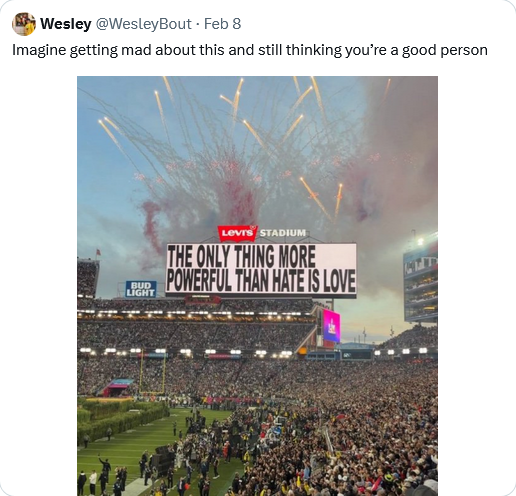
“Imagine getting mad about this and still thinking you’re a good person”
On the social media site formerly known as Twitter, Christian Heiens responds to a typical rage-baiting “we’re all good people except those evil right wingnuts” post:
Every invocation of “universal love” is always invoked to legitimize a very particular form of hatred.
The Left does this thing where it denies the existence of its own ideology as being political at all. It’s just “love”. It’s just morality-as-politics, or simply “being a good person”.
And Leftists insist this is all they’re doing, even as they engage in the most aggressive and ruthless forms of politics imaginable.
Nothing is ever depicted as a power struggle between competing worldviews. It’s always a crusade against social ills, pathologies, and evil itself.
“Conservatism” doesn’t exist to these people. There’s no legitimate opposition, only a criminal element that has to be destroyed because Leftists have already declared themselves to be the universal manifestation of morality, peace, kindness, love, progress, and everything that is good and just in this world.
But everyone can see just how utterly hypocritical these people are. We continuously see examples of these same people exhibiting the most immoral, disgusting, and downright evil manifestations of hatred and violence against people and factions that they despise.
They just call it “love” as they do these things.
Meghan Murphy has a similar point on progressive delusion and its domestic variant, Canadian delusion:
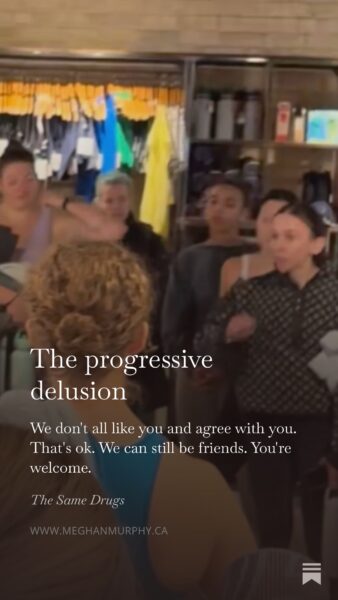
The phenomenon of progressive delusion is very much like the phenomenon of Canadian delusion. Both groups go about their lives presuming that everyone not only respects and admires them, but sees them as they see themselves: 100% right.
There is zero doubt in the minds of progressives and Canadians that the entire world envies their intelligence — they are the most informed, the most invested in The Science, the most rational, and the most educated. Not only that, but they view themselves as the kindest, most compassionate, and most polite.
Should a progressive deem not to ostracize, scream at, or punch a person who dares hold non-left political views, they consider themselves very generous. Imagine! They, a Correct and Good, allowing a Hateful, Stupid, and Wrong to share the same air as them.
The assumption that everyone around them bases their lives and relationships on political parties, activist movements, and propaganda that has been consistently wrong for at least a decade is strange. Imagine buying the Covid scam hook, line, and sinker, or repeating “Transwomen are women” ad nauseam for five+ years, and still assuming you and your “side” are right about everything. Imagine continuing to insist that the “good” side is that side that advocated for child sterilization, forced the elderly to die alone in hospitals on account of a cold, and banned people from the internet and public life for speaking truths we all acknowledge are true now, but were not your party line a few years ago.
I hate to break it to you, but you are the bad guys, not us.
January 27, 2026
QotD: “Two world wars and one World Cup!”
“Don’t let’s be beastly to the Germans,” Noël Coward had jeered in 1943. “It was just those nasty Nazis who persuaded them to fight.” It hadn’t been true then, of course, and the wartime generation still hadn’t quite forgiven the Germans, not only for their crimes against humanity, but for bouncing back faster than the British in the 1950s.
Erhard’s “economic miracle” had rubbed salt in the wounds of a nation that had sacrificed its status as a great power in order to save Europe. And now that same Europe had cold-shouldered the British, excluding us not once but twice from their new “economic community”. In the 1960s and 70s it was often the British, not the Germans, who felt despised and rejected. After 1966, Germanophobic football fans would chant “Two world wars and one World Cup”, but that was mere bravado. Everyone knew that the boot was now firmly on the other foot — and in many British eyes, it was a jackboot.
Daniel Johnson, “How I discovered Germany”, The Critic, 2020-08-02.


