Quotulatiousness

May 4, 2026

Our genetic heritage and our culture

On Substack, Helen Dale and Lorenzo Warby look at our genetic inheritance and how it continues to shape our culture:

From Wikipedia:

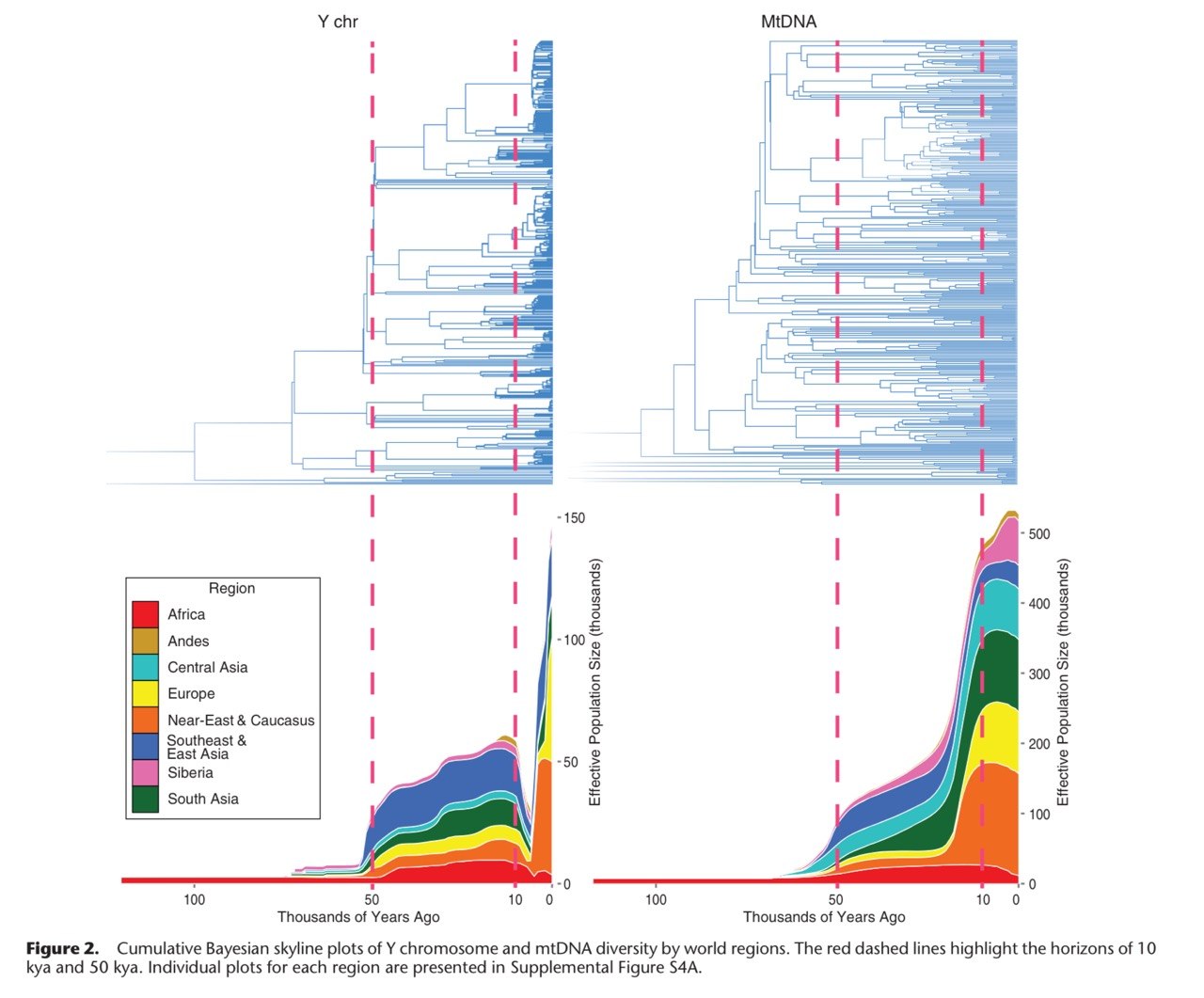
    The Neolithic Y-chromosome bottleneck refers to a period around 5000 BC where the diversity in the male y-chromosome dropped precipitously across Africa, Europe and Asia, to a level equivalent to reproduction occurring with a ratio between men and women of 1:17. Discovered in 2015, the research suggests that the reason for the bottleneck may not be a reduction in the number of males, but a drastic decrease in the percentage of males with reproductive success in Neolithic agropastoralist cultures, compared to the previous hunter gatherers.

The development of farming and then animal herding greatly increased the number of humans — which continued to have evolutionary consequences for our species — and created productive assets (farms and animal herds) worth fighting over. Successful male teams (typically organised as clans) wiped out unsuccessful male teams and took their women as spoils.

Hence, there is a dramatic bottleneck in male lineages but not in female lineages. This pattern stopped with the development of chiefdoms and especially states, though not so much on the Steppes, whose states were more like super-chiefdoms and where intense competition over resources (and women) continued.1

This had consequences. A major one is that the male expression of human genes became dramatically better at forming and maintaining teams — as there was drastic selection pressure for that — but the female expression of human genes did not.

This is why young schoolboy sporting teams regularly crush adult women’s national teams in team sports such as soccer. It is not that schoolboys have the strength advantage over women associated with adult men (they are often not particularly advantaged around age 14-15). It’s simply that human males are much more likely to “get” teamwork at a visceral level.

At least some of the differences in the statistical distribution of cognitive traits between men and women comes from this genetic bottleneck’s intense selection pressure differences. This is particularly clear in social patterns. For instance, men readily form hierarchies — often using physical cues such as height to do so.

Men focus on roles, suppressing or otherwise managing their emotions to do so. They regularly test each other — hence ragging each other, making appalling jokes, etc. Such mechanisms generate trust, as they test whether you will fold under pressure, whether one can say outrageous things and still get support. Hence the popular quip:

    Men insult each other but they don’t mean it. Women compliment each other but they also don’t mean it.

Men roast each other as tests because so much male interaction is about teamwork, and the roles and reliability that requires, while women typically look to emotional connection. Given that the latter requires a lot of interaction to build up trust, yes, female friendships can be quite intense, but relations between human females can also be viciously unstable and fissile.

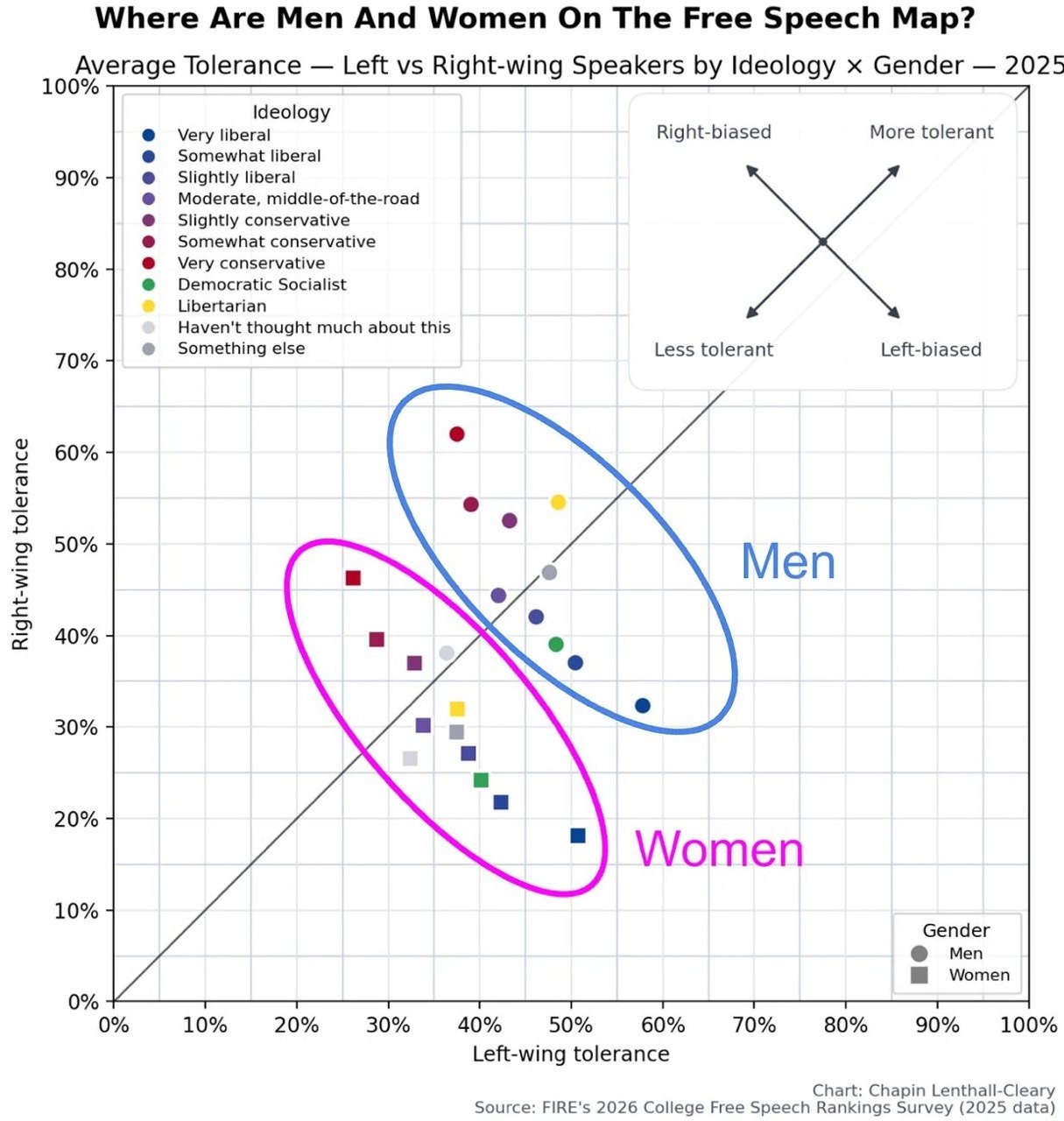
These differences have other social consequences. Men are notably more positive about free speech than women, because men often see speech as a test while women are more likely to see it as a threat. As universities have feminised, the male-female differences on free speech among students have become more pronounced. Men are systematically more tolerant of alternative points of view than are women.

Orwell’s famous comment in his novel 1984:

    It was always the women, and above all the young ones, who were the most bigoted adherents of the Party, the swallowers of slogans, the amateur spies and nosers-out of unorthodoxy.

Was a great novelist doing what great novelists do: noticing.

As part of the teamwork focus, men tend to be the social solidarity sex while women are not. Women are much less likely to have friends of lower socio-economic status than are men. For women, such friends are much less likely to be worth the emotional investment. For men, they may be useful members of a future team.

As institutions, occupations and public discourse become more feminised, there has been a shift in patterns of language. A massive study of patterns of language use found a dramatic shift since the 1980s, such that:

    our results suggest that over the past decades, there has been a marked shift in public interest from the collective to the individual, and from rationality toward emotion.

All this means that male-dominated institutions and spaces will be generally better, often much better, at generating and managing feedback than female-dominated spaces. When people note that feminising institutions and occupations have a strong tendency to become less functional, it is precisely because they are worse at generating and managing feedback, and at generating and maintaining trust.


  1. This paper attempts to explain the extreme narrowing of surviving male lineages by the adoption of patrilineal systems and polygyny. While the shift to patrilineal systems in itself does increase unequal lineage success—as does polygyny—much of the point of the shift to patrilineality was precisely that warriors who grow up together are better warrior teams.
  2. Moreover, there is considerable evidence of violence after the shrinkage of male lineages dramatically slowed — and then reversed — with the development of chiefdoms, and especially states. These suppressed violence, but not patrilineality or polygyny. In many societies, polygyny actually intensified with the rise of states.

    The bottleneck effects continued to echo down populations. The extraordinary reproductive success of particular male lineages is associated either with pastoralist violence and conquest and/or early state creation. Further, the notion that the majority of male lineages just passively accepted their reproductive exclusion flies in the face of a huge amount of evidence — especially as the examples of very successful pastoral lineages occurred in societies with notoriously high levels of violence, including as raiders, such as across the Steppes and in Ireland.

    Moreover, polygyny is associated with higher rates of violence, single-spouse marriage with higher social cohesion. Nor was the creation and maintenance of states typically a peaceful process: periodic violent peaks in Chinese history, for example, were extraordinary. It was precisely the creation of a reproductively-excluded underclass that provided so much of the impetus for the banditry and mass peasant revolts that are such a feature of Chinese history. So, while patrilineality and polygyny were definitely factors in the wildly differentiated success rates of male lineages, considerable levels of violence and contestation over resources and women — that selected in favour of male teamwork — were clearly also very much in play.
Public housing perpetuates the poverty it was supposed to cure

Filed under: Britain, Bureaucracy, Government, Politics — Tags: , , , — Nicholas @ 04:00

In The Critic, John Wills explains that public housing organizations, like any organization with perverse incentives, will never solve the problem of providing enough housing for those who cannot afford it:

Homes Fit for Heroes – Dagenham
“These are typical examples of the housing on the Becontree Estate. Initially 25000 homes were built by the London County Council between 1921 and 1934. These homes fit for the heroes of WW1 had all mod cons gas, water and electricity with inside toilets and bathrooms. A further 2000 homes were built before WW2. The Becontree estate was the biggest council estate in the world.”
Image and description from geograph.uk. Photo by Glyn Baker – CC BY SA 2.0

There is a moment, familiar to anyone who has spent serious time inside a housing association, when the institutional logic becomes impossible to ignore.

Perhaps you are sitting in a meeting, reviewing the organisation’s performance: voids are down, rent arrears are within tolerance, development pipeline is healthy and the regulator is satisfied. By every measure the sector uses to evaluate itself, things are going well.

Outside the window, however, the waiting list has not reduced. The families in temporary accommodation are the same families (or families very much like them), who were there five years ago. In short, the problem the organisation was created to solve is precisely as large as it was when the meeting began.

Despite these demonstrable facts, nobody in the meeting thinks this is strange. Nobody considers the organisation a failure. The metrics are, after all, fine.

I spent a decade working at a senior level in housing associations. I left as I became disillusioned with a model that has evolved to measure everything except the thing that matters.

The founding logic was sound enough: postwar Britain faced a housing crisis that was specific, urgent and — crucially — finite. Tens of thousands of homes had been destroyed or damaged, men had died in enormous numbers, and a baby boom was placing acute pressure on stock that was already inadequate before the war started. Social Housing was therefore a rational response to a bounded problem: build homes, house people and alleviate a crisis that would, in time and as a result of the initial centralised effort, resolve itself. You might also apply the same logic to slum clearance a decade later: deplorable housing stock needed replacing, and the state needed a mechanism to do it. The model remained defensible so long as everyone understood that success meant crossing a defined finish line.

However, nobody thought to define that finish line. The problem here is that once you remove the time horizon from an organisation tasked with solving a problem, the organisation’s survival becomes contingent on the problem’s persistence, not its resolution. This is not a conspiracy and it requires no bad actors, nor even a conscious decision to perpetuate matters. It is simply what institutions do when the incentives are wrong. As a thought-experiment, imagine that the eradication of smallpox had been incentivised not by the goal of total global elimination, but instead by vaccines administered, clinics built or healthcare workers employed. What would the probability be of us continuing to battle smallpox into the 21st Century? I cannot be certain, but suspect it would be considerably higher than nil.

The regulatory framework for social housing has compounded the error rather than correcting it. Regulators, quite reasonably, dislike hoarded capital. A registered social landlord (RSL) sitting on large reserves and doing nothing with them is, from a regulator’s perspective, a problem to be solved. The solution the sector has converged on is growth — more stock acquired, more homes built, larger balance sheets, bigger organisations and more services and people employed to deliver them. The key metric of a healthy RSL is therefore its size: which is to say, the scale of the problem it exists to address. (To test this proposition, ask someone in housing to describe their organisation. The chances are the first words out of their mouth will be the number of homes they manage). An organisation genuinely succeeding in its mission — one that is housing fewer people because fewer people in its area of operations need housing — under the current framework would look like a failure. It would be encouraged to merge with a larger, more “successful” neighbour, which is to say one that has accumulated more evidence of unresolved housing need.

Chief Narcissist of the Supreme Court of Canada

Filed under: Cancon, Law, Media, Politics — Tags: , , , , — Nicholas @ 03:00

On the social media site formerly known as Twitter, David Knight Legg explains why the Chief Justice should recuse himself from deliberation on an upcoming Supreme Court case involving the Freedom Convoy 2022:

Canada’s Chief Justice Richard Wagner has installed a lifelike bronze bust of himself in our highest court.

It should be called “Narcissus Canadiannus

– There is no precedent for something this vulgar in the history of the Court. It should be taken down. Richard fancies himself.

– Richard also fancies his own opinion on things. He violated legal due process and the Court’s reputation by publicly accusing the Convoy — who protested backwards federal Covid policies that were soon dropped — of “anarchy” and “hostage taking”.

Now that the Convoy’s freedom of speech, assembly and due process rights have been asserted by lower courts the Supreme Court has to consider the appeal of the federal govt and weigh the rights of citizens against the decision of the federal government to impose the Emergencies Act to suspend those rights.

Wagner’s lack of judicial discretion in the first instance makes his recusal from such an important rights-defining case important because it signals not just fairness in the content of the decision but in the way the decision gets reached by the highest Court.

He has already shown his bias. Any decision against the convoy poisons the integrity of the Court if he remains present.

But Richard — the man with the bust of himself in our Court — doesn’t imagine himself under the law he imposes on others. He hasn’t completed any graduate work in law or published any academic work in law, philosophy or jurisprudence so it’s hard to know how he justifies himself in these matters.

Ironically, he has a reputation for warning others — including those far more qualified in formal jurisprudence than he is — not to critique Canadian judges like himself or their (increasingly bizarre and politicized) decisions.

But, from the Magna Carta onwards, Richard should know that in law as in politics dissent is democracy.

The dissent of the Convoy and the growing critique of Richards own bizarre behaviour and inability to articulate a judicial philosophy is exactly what’s needed to save Canada — and the Court’s reputation as a place where justice — not the ego of the Justices — is at stake.

Richard should recuse himself. And remove that vulgar bust from the Supreme Court.

#SCC #RuleOfLaw

Melanie in Saskatchewan also has concerns, expressed as an open letter to the Chief Justice:

To Chief Justice Richard Wagner,

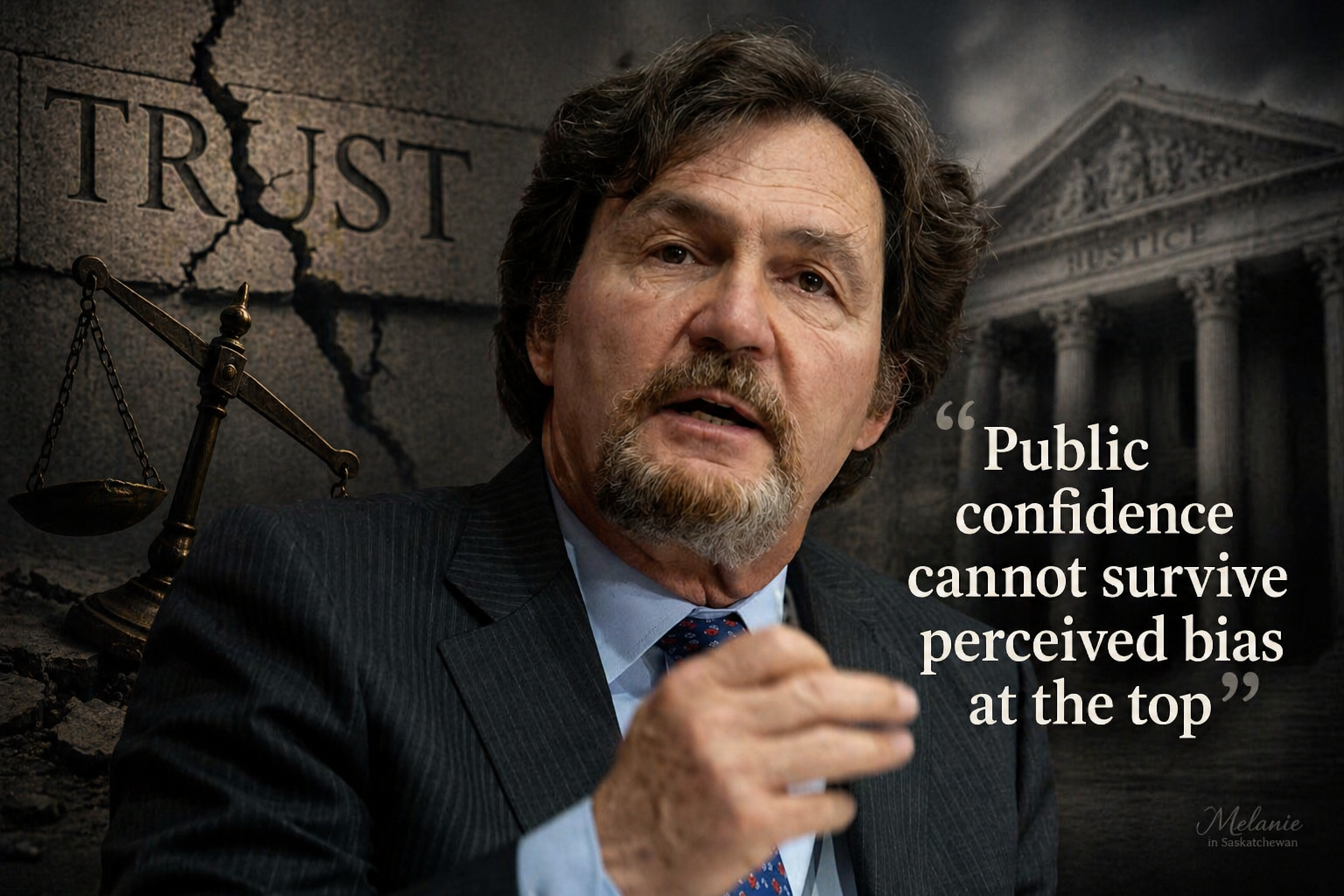
Your refusal to recuse yourself from the Emergencies Act appeal, as reported in the National Post, is not a demonstration of judicial confidence. It is a failure of judgment at a moment that demanded restraint.

Image from Melanie in Saskatchewan

You have justified your decision on the basis that your prior public comments did not address the specific legal questions before the Court. That argument may satisfy a narrow, technical reading of judicial conduct. It does not satisfy the standard Canadians are entitled to expect from the Chief Justice of the Supreme Court.

The governing principle is not whether you commented on the precise statutory interpretation of the Emergencies Act. It is whether a reasonable and informed person would conclude that your previously expressed views could influence your assessment of the case.

You publicly characterized the convoy as the “budding start of anarchy”, described residents as being “taken hostage”, and spoke in terms that conveyed clear condemnation of the events and participants. Those were not neutral observations. They were judgments about the nature, legitimacy, and perceived threat posed by the very situation now under review.

This appeal is not a retrial. It does not exist to rehear evidence or relitigate the convoy as though the past can be reset. Appellate review in Canada is focused on whether the law was correctly interpreted and properly applied to established facts, with significant deference given to the findings already made by the lower courts.

That distinction matters.

[…]

As Chief Justice, you are not merely a participant in this case. You are the steward of the reputation of the Supreme Court of Canada itself. That reputation rests not on assertions of impartiality, but on decisions that demonstrate it beyond reasonable doubt. In choosing not to recuse yourself under these circumstances, you have not strengthened that reputation. You have placed it at risk, at a time when public confidence in national institutions is already fragile. The damage may not be immediate, but it is real, and it is yours to own.

Gentleman’s Relish (Patum Peperium) – Weird Stuff In A (Sort Of A) Can #142

Filed under: Britain, Food, History — Tags: — Nicholas @ 02:00

Atomic Shrimp
Published 16 Aug 2020

Here’s something I have been meaning to feature on the channel for a little while — it’s a savoury anchovy paste that has been in continuous production in England since 1828 — the Georgian Era.

For more information about this product, start here: https://en.wikipedia.org/wiki/Gentlem…

The music for the spoon segment is called “Forever Yours” by Wayne Jones – from the YouTube Audio Library

QotD: Saint Hillary

Filed under: History, Media, Politics, Quotations, USA — Tags: , , , — Nicholas @ 01:00

If Michael Kelly can rise from the grave, this will be the week. He’s been summoned.

Kelly was the most relentlessly savage chronicler of the Clinton administration, and of the Clintons personally, but his opening shot was so subtle you had to squint to see what he was doing. In a long feature story that appeared in the New York Times Magazine in May of 1993 under the that’s-not-a-compliment title, “Saint Hillary”, Kelly very quietly mocked Hillary as a preening know-it-all who didn’t know much of anything. He wrote that she represented “the message of the preacher”, with a way of speaking that delivered a stream of moral lectures, as if she had the authority and the wisdom to direct others in the act of moral reconstruction. If you click on the link and read the whole story, you’ll want to watch for the transitional paragraph, the switch from mostly description to mostly derision. It begins with the words, “It is at this point that some awkward questions arise”. Next paragraph: “If it is necessary to remake society, why should Hillary Rodham Clinton get the job?”

It becomes less kind from there. Kelly described a meeting between Hillary Clinton and the progressive Jewish editor and activist Michael Lerner, who (Kelly says) offered a vision of “unintentionally hilarious Big Brotherism”. And then: “The reason Lerner’s proposals for the application of the politics of meaning focus so heavily on bureaucratic irrelevancies is the same reason Mrs. Clinton is struggling still with words”. Self-delusion, unawareness of political realities, hard-headed self-importance, unaware bumbling in an unearned sense of certainty. A moralizer, but not moral, unwise but committed to the appearance of wisdom.

Remember, this story appeared in 1993, in the opening months of the Clinton presidency. Michael Kelly was opening a political era with a dismissal, rolling his eyes at the Clinton project as it began. “Saint Hillary”, they called it. The New York Times used to publish things like this.

Chris Bray, “Saint Hillary the Bluntly Obtuse”, Tell Me How This Ends, 2026-01-30.

Update, 5 May: Welcome, Instapundit readers! Have a look around at some of my other posts you may find of interest. I send out a daily summary of posts here through my Substackhttps://substack.com/@nicholasrusson that you can subscribe to if you’d like to be informed of new posts in the future.

Powered by WordPress