PeriscopeFilm
Published 23 Jun 2026This animated film by John Sutherland Productions was commissioned by the National Association of Auto Manufacturers. Your Safety First is a promotional piece for 21st Century Cars, told from the perspective of a person in the year 2000 looking back on the history of automobile safety. The cartoon humorously compares the dangerous, early days of cars with the safety-focused, modern vehicles of its time. The cartoon was directed by George Gordon, and animated by Ken O’Brien, George Cannata, Fred Madison and Cal Dalton. The story was written by Norman Wright. Note: this cartoon has been noted as a precursor to the animated TV series The Jetsons, which borrowed heavily on the ideas presented in the cartoon including a three-hour work day, automated flying cars, and robotic arms performing most tasks.
0:00 Main titles. The film’s host, a man from the year 2000, introduces a segment on the history of the automobile, beginning with an early 20th-century car.
4:47 The film highlights the dangers of early cars, including a lack of doors, frequent flat tires due to poor tire retention rings, and a complete absence of shock absorbers, which made for a very bumpy and unsafe ride.
5:32 Early cars had poor acceleration and weak, unreliable gas or oil headlamps, making night driving hazardous.
5:47 The vehicles offered little protection from the elements, as they lacked tops and windshield wipers.
6:03 The film shows the danger of the hand crank starter, which often failed, and the unpredictable nature of the car’s individual parts, which could fail without warning, causing accidents.
6:35 The film transitions to the rapid improvements made to cars over the years.
6:42 It lists early safety innovations, such as stronger wheels, demountable rims, doors, tops, windshields, and wipers. The driver’s seat was moved to the left for safer passing, and the electric starter replaced the hand crank.
7:33 The film continues to show the development of safety features over the decades, including pressed steel wheels, stop lights, rearview mirrors, four-wheel hydraulic brakes, and rubber-covered pedals.
7:51 Safety glass and all-steel bodies and tops are presented as major improvements in passenger protection. Shock absorbers are highlighted for smoothing out bumpy roads.
8:30 The film states that, in addition to physical improvements, manufacturers developed research and testing techniques to build safer cars. It shows various “torture tests” designed to find weaknesses in parts.
9:31 Manufacturing processes also improved, with each car undergoing over 2,000 inspections before leaving the factory.
9:48 The film returns to “Grandpa” in the year 2000, showcasing his reliable, safe, and comfortable car. It lists a final set of advanced safety and convenience features, including safety door locks, automatic transmission, a low center of gravity for stability, and tubeless tires.
10:46 Modern features like wraparound windshields and larger rear windows increased visibility. Sealed-beam headlamps improved night driving, while power brakes and power steering made driving easier and safer.
11:27 The film concludes by asserting that the safety of the driver was and will continue to be the primary goal of automobile manufacturers. The host, Grandpa himself, states he is “going on 117” thanks to the easy, modern living made possible by safe cars.
(more…)
October 20, 2026
Your Safety First (1956) – Automotive safety cartoon that inspired The Jetsons
September 30, 2026
That “far-Right” fantasy that “never really existed”
Gawain Towler responds to the claims of a British MP that the nostalgic view of the rural life in England that George Orwell praised is something that the “far-Right” will try to capitalize on even though, she says, it “never really existed”:
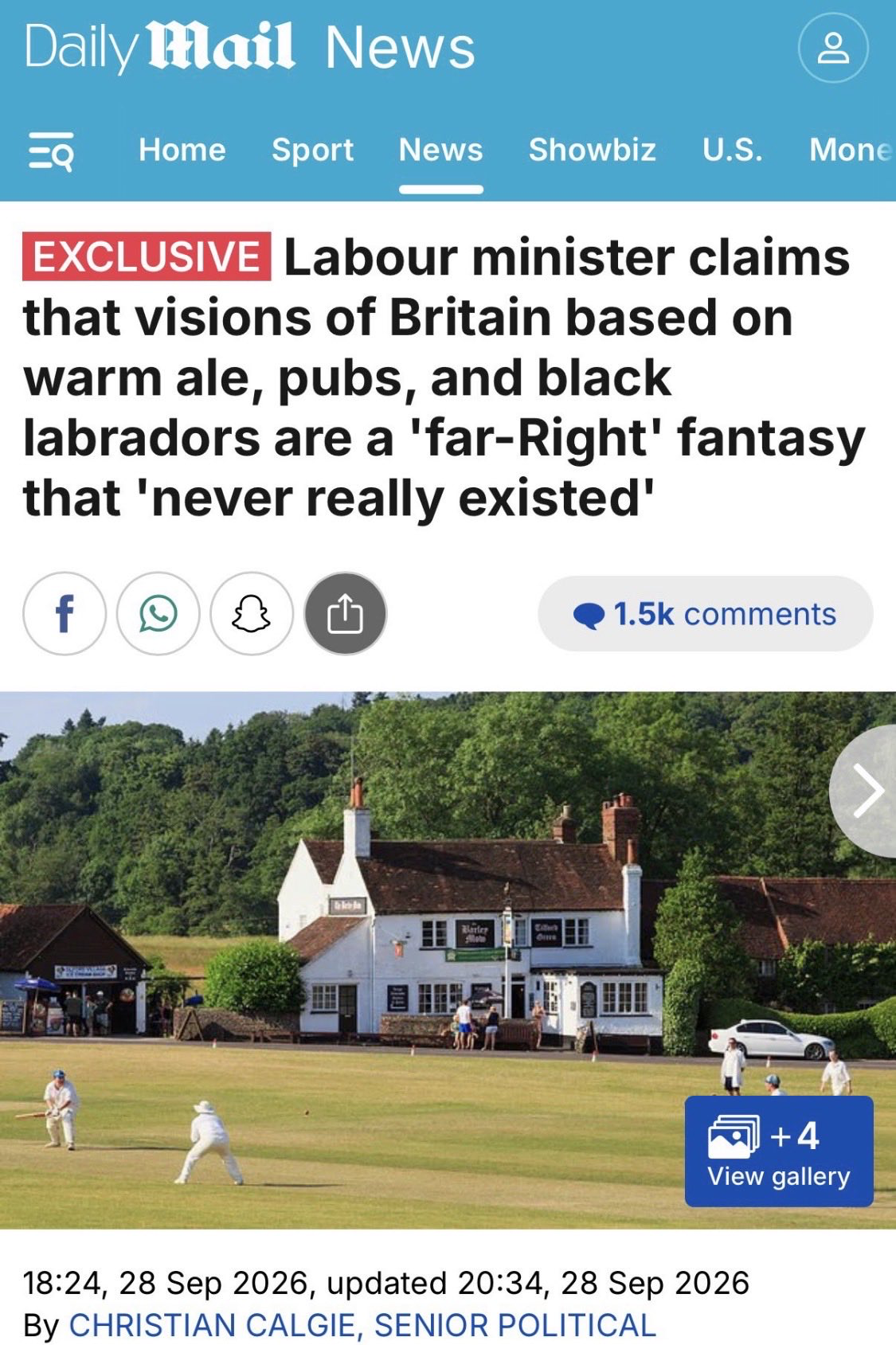
I was going to go to bed, but the malevolent inanity that is Jenny Riddell-Carpenter MP has riled me. She has disturbed my sleep, because she says that she cannot sleep. She told a Labour fringe meeting in Liverpool today what keeps her awake, and it was not rural bus cuts or the last shop closing in a Suffolk village. It was her own voters. She fears the far right will fight the next election on “a nostalgic vision of Britain that never really existed“, one of “warm ale, a black Labrador by your feet in a pub that doesn’t exist, and with symbolism of fox hunting all around them“.
A pub that doesn’t exist. The Minister for Nature represents Suffolk Coastal. Allow me to draw her a map.
Adnams brews in Southwold, just inside the protected landscape of the Suffolk Coast and Heaths, and the town is in her seat. From there a rowing-boat ferry crosses the Blyth to Walberswick for a pound, worked by a family that has pulled the oars for generations. The Bell on the far bank is six hundred years old and lets dogs in. The Cross Keys at Aldeburgh has served drink since 1540, and the Crown at Snape is a fifteenth-century inn with its own allotment. Most MPs would put these places on the constituency Christmas card. Ms Riddell-Carpenter prefers to tell a hall in Liverpool they are a far right hallucination.
Her non-existent warm ale has a pedigree she ought to recognise. She must be thinking of John Major in 1993, but he lifted it from George Orwell, who had written of “old maids biking to Holy Communion through the mists of the autumn morning“. Orwell was a socialist who spent years at his parents’ house in Southwold. The fantasy she fears was written by a man of the left, in her constituency. She clearly doesn’t know.
Then comes the sentence that gives her away. Labour, she said, must make the case for “what we believe rural communities look like“. Not what they are. What Labour believes they look like. The countryside is not to be listened to but corrected, its shape agreed at a fringe meeting and posted back to the people who live in it. When they describe their own lives, the pub, the dog, the Saturday match, their MP hears Ladybird nostalgia and smells fascism.
Cricket will be next on the charge sheet. Yoxford plays at Grove Park beside St Peter’s church and fields girls’ sides at under-11, under-13 and under-15, alongside women’s teams. At Orford the Sudbourne Hall ground drained well enough to save every home game in a previous sodden summer, and women’s sessions ended with a Pimm’s at close of play. This is the reactionary idyll that haunts her nights. It is busy doing, on a village green, what her party only issues press releases about.
She cannot plead ignorance, which makes it worse, no culpable. Her family moved to Martlesham Heath when she was seven, and she went to Woodbridge School. At eighteen she left and did not come back until the voters sent her. The years between went to London, to SOAS (oh brother), to the housing developer L&Q and to the lobbying trade, where she rose to run Cratus Group. Her husband still works in London social housing. She came home remembering every pub by name and having learned in town to be embarrassed by all of them. She now chairs the Labour Rural Research Group, which is a little like putting a vegan in charge of the pork pie.
A rural minister’s job is to carry the countryside’s case into Whitehall. This one carries Whitehall’s sneer back out and waits for the applause. Nobody who talks about her own patch like this can be trusted to defend it when a solar farm or a trail-hunting ban comes over the hill. She will side with the department and call it progress. She will be wielding the new Landuse Framework that tokenises the countryside, and she hates what exists before.
September 26, 2026
QotD: The game of Marbles
The rumor went around that trains were throwing steel ball bearings from their wheels. Genuine steelies! Somebody said they saw one that a kid from Detroit brought up. So big that you couldn’t close your fist around it. Nobody else saw it, though.
Nevertheless, we scoured the tracks for endless hours, turning over every likely pebble that caught the sun. No steelies. I did amass a small collection of spikes that had worked their way loose from the ties. Never did figure a use for them. But they were cool.
The game was marbles. Way we played it in upper Michigan was to draw a chalk circle on the cement or scratch one on the sand with a stick, sometimes we even used a length of string. The battleground was set. The players approached cautiously if their stock was low or boldly if their marble bag brimmed.
One boy against one boy. Man against man. A test of skill and mental grit. Incidentally, only boys played against boys, girls against girls: this was back in the day when adults didn’t burst a spleen for kids noticing the obvious differences in the sexes. Besides, boys were daring and cavalier. They were out for conquest. Girls would sometimes — this still baffles me — agree to play to a draw! Even if one girl would outright win she wouldn’t claim her prize. Bizarre creatures.
First boy, if he was a pro, placed his middle finger against his thumb and then snapped it at his marble, aiming to smack it into his opponent’s. If he hit it, he got to keep it. No time outs, no I-wasn’t-readies, no whimpering. Newcomers and cowards could be identified by the anemic way they smacked their marble, say by giving it no more than a half-hearted push with their forefinger.
Strategy was obvious. If you were the better shooter, you attacked attacked attacked. Go right after the other guy. Intimidate him. Like Nelson, ignore all subtleties and blaze away. Cagier boys took advantage of the braggarts and only pretended to be cautious. They let their opponents open with a bold shot or two, answering with a shot away as if in retreat, then when the other boy’s shot would miss and stop close by, the jig was up.
And that was the problem. Too bold and your shots would come close, too close. Countless times the marbles would stop an inch away. It was a goner. This is why it made sense to shoot hard; over-shooting was hardly a risk. Unless you in a sudden-death match where shooting outside the lines meant an automatic loss.
Most of us neither lost too many nor gained too many. But a few kids were easy pickings. Every day they’d come with a new small bag (these were sold in grocery and “dime” stores) and lose them. Rich kids.
Unless by prior agreement, only even matches were allowed. Cat’s eye against cats eye were the lowest, entry-level bouts. Cats’ eyes, for those monumentally ignorant of Americana, are the clear marble with the squiggly, colorful aberration running through the center. These were the general stock, like ten-year-old used cars; useful, but unloved. Why, you could find spare cat’s eye rolling around behind the home room teacher’s desk. What counted was quantity.
Perries, probably a corruption of puries, solid colored beauties. These were always just a shade smaller than the cat’s eyes. Perries, though coveted, had a tendency to chip, sometimes even crack open when hit hard. Clears were solid glass, no color. Steelies were polished ball bearings. I only ever saw two of them. Not the railroad kind, but small ones from who-knows-where. They were said to be unbeatable, which is why we latched onto any rumor of a source.
Then came the boulders, the double-sized version of the normal marble. One of these was worth five to ten of the regular kind, depending on availability. Boulder-on-boulder matches were always closely attended. They were rare, too, especially when they featured perries. (I have since learned boulders are called “shooters” in other areas. But all our marbles were shooters.)
We used to empty our marble bags and compare, holding our treasures up to the light for the kind of close scrutiny used by gemologists sizing up wedding rings. Oddities such as pea-sized perries occasionally showed up. These were said to be from China, then still a mysterious land.
I don’t guess kids play marbles anymore. Unless there’s a marble “app” for their cell phones. But it now makes sense that my favorite adult game is petanque.
William M. Briggs, “Marbles!”, Science Is Not The Answer, 2026-06-23.
September 23, 2026
Doctor Who – the early Doctors
One of my earliest memories of television involve a BBC children’s TV show that began in 1963: Doctor Who. My mother claims I watched every episode from behind the settee, but I wouldn’t let her turn it off even though I was clearly terrified. I was young enough that I don’t remember particular stories — I don’t even remember being surprised when the actor portraying the lead character suddenly changed from William Hartnell to Patrick Troughton. After my family came to Canada, I only occasionally caught an episode on TV, and I don’t think I saw anything produced after the late 1980s, so all the modern casting choices (and the controversy) passed me by.
Millennial Woes provides a helpful guide to the show from the first episode through to the late 1980s, which may be of interest to some of you:

Several people have asked me to write a guide to Doctor Who, so here it is. I think most readers will be familiar with the show so I won’t waste time introducing it. Suffice it to say, we’re talking about a somewhat silly family sci-fi show, but one that frequently had soul, style, humour, and a lot of warmth. As with so much contemporaneous TV drama, Doctor Who had charm that seems to be simply impossible to achieve nowadays.
This guide is a difficult one to write because there are simply so many stories to survey, and because the show has multiple eras which are very distinct — almost different TV shows altogether. (Broadly, I would say the eras are 1963-69, 1970-81, 1982-87, and 1988-89.)
[…]
Something you will notice is that I talk about the incidental music almost as much as the stories themselves. I find Doctor Who‘s music, across the various eras, very stimulating and enjoyable in its own right. (This indicates how big a part it must play in the show itself.)
The First Doctor was played by William Hartnell. This was Doctor Who at its very beginnings, in 1963, so it is radically different not only from the modern 2005 show but even from the Pertwee era seven years later, by which time TV production had advanced in leaps and bounds.
I must confess to being barely acquainted with Hartnell’s era, having watched only four or five stories in total. It is too slow-moving for my tastes. However, I can certainly recommend one episode …
“An Unearthly Child”
This is the very first episode. Though it is technically the first of a four-part story, it is really a “standalone” episode to set up the programme. The introduction of now-iconic elements is beautifully done. Everything at this stage seems darker and more mysterious than it will later be. The Doctor is secretive, unfriendly and sinister. The TARDIS is scary and doesn’t seem reliable, its first “flight” being a genuinely unnerving experience.
The atmosphere is terrific throughout. The whole thing is in grainy black & white reminiscent of a 1930s horror film. It is excellent, in my opinion. Had the show continued in this vein it would probably have been much shorter-lived but less lightweight. I guess things are always better while they still have their mystery.
The Second Doctor was played by Patrick Troughton. He was perhaps the most talented — as an actor — of the men who played the role in the classic era. His turn on the character is much more playful and irreverent than Hartnell’s. I am again very unfamiliar with the era, so am somewhat at a loss for recommendations.
“The Three Doctors”
This is a cheat since this story is actually in the Third Doctor’s era, but I think the Second really dominates proceedings so it feels appropriate to cite this story as one of his. You get a strong sense of how different he is from the Third, whom Troughton effortlessly upstages. And it’s a good story.
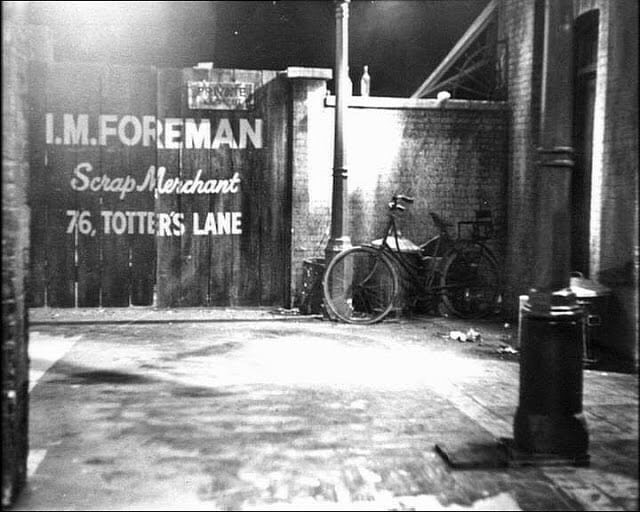
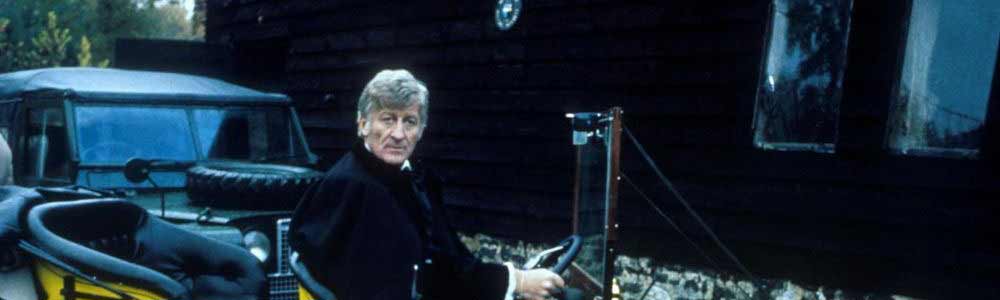
The Third Doctor was played by Jon Pertwee, then known mostly for comedy work. During most of this era the Doctor is confined to Earth, working as “scientific advisor” to UNIT led by the Brigadier, and battling his Timelord nemesis the Master. A lot of the stories are 6 or 7-parters, formats that work very well; there is more world-building than in the 4-parters, which start to seem slightly lacking by comparison.
The third was perhaps the least “alien” incarnation of the Doctor. You can easily imagine him being a heroic leader in the Empire or a maverick figure in British government or business, up to about 1970 (after which such mavericks were tamed or filtered out by bureaucracy). Aristocratic but still practical and “a man of action”, he is constantly innovating and questioning, and being frustrated by the lack of imagination in the lesser men around him. But he is very much a man, not an alien. That choice was probably dictated by Pertwee’s own personality, and it would be reversed when his successor arrived.
Nevertheless, this era was a peak for Doctor Who. The storytelling is very competent, the production style has real charm and the acting (RP galore!) is consistent and endearing. All of this means the stories bear rewatching, remaining enjoyable time after time.
In terms of choice, you can hardly go wrong with this era. The only bad stories are “Carnival of Monsters” and “The Mutants“, with the rest being uniformly great fun.


QotD: The EU as a modern Habsburg Empire
The irony is, of course, that Germany is once again by far the strongest power on the continent. Its interests are complex and no doubt contradictory: it wants the rest of Europe to continue to import its goods, but it does not want to fund, or mutualise, the debts that allow it to do so. The southern countries would like to either to mutualise the debts, or inflate them away by debasing the currency, but Germany will allow neither of these solutions to the imbalances within Europe. There would be no better way to re-awake German nationalism than follow the prescriptions of the southern nations; on the other hand, resentment of Germany will grow if they are not followed.
The author acknowledges the problems within Europe in his last chapter, up till which he has treated Europe as if it were one big happy family with a population gaily marching in unison behind its leadership. The truth is quite otherwise, which is why an example must be made of Britain. But the likelihood is that the more integration there is, the greater will be the tensions, both between and within countries. There is a class within countries that benefits mightily from the present arrangements, which in my opinion explains the paradox of Catalan, Flemish, and Scottish nationalism: for all these nationalisms are firm adherents to the ideal of European Union, namely a dilution of national sovereignty even greater than that which their nations already possess. Again to put it crudely, the leadership of these movements want their place not in the sun, but at the trough. They are pied pipers to their populations.
The book ends by quoting that old Mephistophelian, François Mitterand, to the effect that “Nationalism means war”. And of course this is true if by nationalism is meant an exaggerated and militant love of one’s own country and a hatred of, or disdain for, all other countries, particularly neighbouring ones. Yet at the same time, nation states — at least some of them — have been the only large-scale states able durably to protect the freedom of their populations. Moreover, if nationalism means war, it does not follow that supranationalism means peace. The European Union may be a Yugoslavia in the making, without a Tito to hold it together. As José Manuel Barroso, once President of the European Commission, former Maoist student leader and then Goldman Sachs executive (the thirst for power being the golden thread that runs through this diverse career) put it, Europe — using the word to mean the European Union, which is now more or less standard — is an empire, though of a new kind.
Perhaps not so new, in fact: a kind of Habsburg Empire without the charm and aesthetic sensibility. From the right it is attacked as a socialist enterprise, from the left as a neo-liberal one: corporatist is the word for it, that happy union between regulatory bureaucracy and large corporations.
Theodore Dalrymple, “European Empire, Fractured”, Law & Liberty, 2020-11-10.
September 5, 2026
60th Anniversary of Star Trek: A Very Brief Look Back
Feral Historian
Published 4 Sep 2026On September 8th 1966, Star Trek premiered and has since reflected shifts in American popular culture from the Vietnam era to today. It hasn’t always been good, but it has been a ride. Perhaps one that has come to an end.
00:00 Intro
04:32 A New Trek
06:15 Overlap
09:04 Stuck In Itself
10:00 Enterprise
12:37 JJ
13:28 Trek TodayThe link for Sean Munger’s video: • Star Trek and the Vietnam War (Part I)
Obviously this is not a statement of agreement with every point in that video.🔹 Patreon | patreon.com/FeralHistorian
🔹 Ko-Fi | ko-fi.com/feralhistorian
🔹 and Merch! | feral-shop.fourthwall.com
🔹 Oh, and book 2 of Stellar Drift is out. https://www.amazon.com/dp/B0GTVXK4CN
September 1, 2026
QotD: “Down-line clear …”
On one occasion, noticing us waiting by the gates, the signalman slid open his window and asked us if we’d like to come up and see inside the signal box. I was up those stairs almost before he’d finished his sentence and he treated us both to a conducted tour of a fascinating and beguiling little empire.
When bells started ringing, he explained about the bell code system and announced that there was a cross-country passenger train about to pass through Stanford, without stopping, on its way to Rugby. Suddenly, he asked me: “Would you like to signal this train through the station?”
“Gosh, yes! Of course I would!”
The sequence started by closing the gates on the level crossing. These were the traditional, heavy timber gates, rather than the comparatively minimal lifting-barriers seen today. They were opened and closed by turning a huge ship’s wheel-type contraption in the signal box and it took all my strength, plus more than a little help from the signalman, to turn it sufficiently to get the gates completely closed. This reliance on a direct mechanical linkage is the reason why the signal box had to be immediately adjacent to the gates.
Next, it was the signals, which were operated by a system of wires opposed by counterweights. The signalman showed me which levers to pull. I had to pull with all my might to get that red upper-quadrant signal to rise. Pulling the yellow distant signal “off” took even more effort, because its greater distance from the signal box meant that the wire was very long indeed. All these tasks were completed solely by manual devices without any mechanical assistance. It was a technology which hadn’t changed since Victorian times.
After what seemed like a long wait, the train eventually appeared in the distance and I felt so proud, hearing it whistling a greeting. Actually the whistle is a warning device, but I was only eight and I was convinced that the driver was saying “thank you” as he steamed through the station past the signal box, courtesy of my hard work.
And just as it had been with the farm horses, it would not be long before Dr Beeching would sweep away rural railways, together with the way of life which went with them and make such experiences as this impossible.
Whenever I see a railway these days, with everything surrounded by high steel fences, their vertical pales topped with barbarous triple-spikes and further surmounted with coils of barbed wire, together with notices threatening huge fines for trespass, I’m reminded of just how lucky I was to grow up in a time when a signalman could invite a child and his father to join him and give them a singular experience which they would both remember for the rest of their lives.
Brian Meredith, “A 1950s childhood, Part 2: ‘Down-line clear …'”, The Conservative Woman, 2026-05-31.
August 23, 2026
QotD: “I found a million dollar baby in a five and ten cent store”
I once asked a friend in the French music biz how the song went over there. I hummed him the tune and he sang me the French lyrics and, although I can’t recall any of them, I remember they were entirely different from the English words. It’s not just the five-and-ten that’s hard to translate or the million dollar baby. But the concept of finding the latter inside the former is also very American. There are a ton of Mitteleuropean operettas in which the prince or duke or count wanders into the streets in disguise and falls in love with a serving wench, but the serving wench usually turns out to be a Countess or Margravine or some such also wandering around in disguise. Even the British are prone to this syndrome (Spring In Park Lane, etc). But in an American song the shop girl is a genuine shop girl, and she’s still a million dollar baby. That’s what makes it American.
In the Sixties, by the way, you could have found a future billion dollar baby in a five and ten cent store: Sam Walton, founder of Wal-Mart, got his start in retail as a franchisee at a Ben Franklin’s, founded in 1920 by the Butler brothers, who’d been in the five-and-dime business since the 1870s. I’m not saying “I Found a Million Dollar Greeter in the Big Box Store at the Strip Mall on the Edge of Town” would be as big a hit, but there is an historical continuity from the Butlers to Wal-Mart.
Mark Steyn, “I Found a Million Dollar Baby (in a Five and Ten Cent Store)”, Steyn Online, 2020-10-25.
July 29, 2026
1960s British Army Recruitment Film | Cold War Training & Life Inside the Army
Militaria Collectors Network
Published 23 Mar 2026Step back into the 1960s and experience how the British Army trained the soldiers of the Cold War era. This rare archival recruitment film offers a fascinating look at military life, basic training, and the wide range of technical and career opportunities available to new recruits during a time of global tension and rapid modernisation.
From infantry drills and weapons training to engineering, communications, and education programmes, this film highlights how the British Army prepared men for both combat and skilled professions. Whether you’re interested in Cold War history, military training, or vintage government films, this is a unique glimpse into a defining period of British military history.
📽️ In this film:
– 1960s British Army basic training
– Infantry tactics and weapons familiarisation
– Technical trades and career paths
– Cold War-era military strategy and preparation
– Life as a British Army recruit
(more…)
July 21, 2026
Business idea – socialist-themed holiday camp
This idea is a banger, but it won’t attract the audience who really could benefit from the experience: the camp experience is what they want you to have, not for themselves.
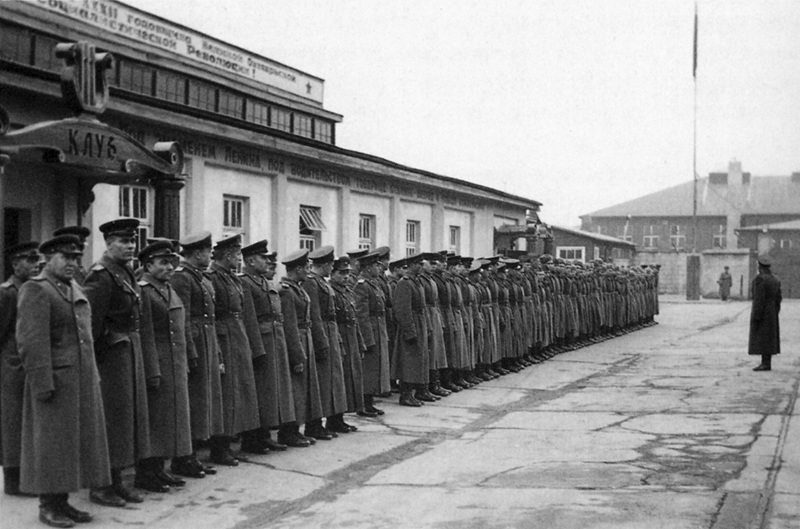
New startup idea: a socialist-themed holiday camp where affluent Westerners pay premium prices to experience the system they keep voting for.
Picture it. You arrive at Camp VS (Virtue Signal) and hand over your passport (you won’t need it, exit visas take eleven years to process). Staff assign you to a concrete panel block, 320 square feet, shared with two other families you’ve never met. The heating works from 6 to 8 a.m. The elevator works never. Authentic Khrushchyovka construction, guaranteed.
Your daily itinerary: Wake at 5 a.m. Stand in the bread line until noon in minus 15 Celsius. The bread runs out at 11:40, but the queuing builds character, and character is the only thing not in shortage. Afternoon activities include a second line for toilet paper (there is no toilet paper) and a mandatory lecture on how the shortages prove capitalism sabotaged the harvest.
For guests seeking the deluxe package, we offer the Gulag Experience: rock-busting in a quarry under armed supervision, with optional whipping for anyone who fulfills less than 110 percent of quota. Aleksandr Solzhenitsyn wrote 1,800 pages about this amenity. Rave reviews, in a sense.
Every fourth guest works as an informant. You won’t know which one. Complaining about the food earns you a midnight interview with camp security, and the food gives you plenty to complain about: it’s cabbage. All of it. Abolish market prices and you abolish economic calculation, so nobody can know what to produce, in what quantity, or for whom. The planners guess. The planners guess cabbage.
Checkout is where the theme really lands. You can’t. The wall around the camp faces inward, and East Germany shot 140 people at theirs between 1961 and 1989 to keep paying customers from leaving the workers’ paradise.
The irony here is that this business would only survive under capitalism, because it needs voluntary customers, market prices, and profit signals to exist at all. Run it as an actual socialist enterprise and within a year the camp has no bread, no rocks, and no guests. Just like the original.
July 18, 2026
The current state of play in the Russo-Ukrainian War of 2022
I don’t make a habit of sharing reports from the ongoing fighting in Ukraine, as the war has ground on (how do you say “short, victorious war” in Russian?). It’s not that I’m not interested, it’s that trustworthy sources are vanishingly thin, and most coverage is either hyper-pro Ukraine or hyper-pro Russia … so assessing events is somewhere between difficult and impossible for those of us without our own satellite and espionage networks. kulak, on the other hand, has been paying attention and does have some insights that are worth considering:
One could be forgiven for thinking that there is something deeply wrong with the Russian State and Vladimir Putin in particular.
Every 1 to 3 months some new unprecedented Ukrainian asymmetric attack hits Russia’s homeland in ways almost tailor designed to provoke an escalation, outrage the populace, and leave the Russian Government humiliated at the loss of face.
The “Crocus City Hall” (it’s a civilian music venue not an actual city hall) attack in Moscow was killed 151 and injured 600+ Civilian music fans in an “ISIS” terrorist attack … That everyone knows was funded, coordinated, and enabled by Ukraine (and the CIA). Right down to the assailants passing through Ukraine, and being on camera collecting their discarded firearm magazines (presumably because the manufacturer stamps would tie them to their backers) …
This was huge Russian News, and the specific band whose audience was targeted is also significant.
Piknik is a massive hit Russian 80s band. Now, Students of history will note that Russia was still communist in the 80s. They’ve been around forever, and are generally inoffensive and middle of the road (they were mainstream under the USSR)… They’re kind of a weird gothic slavic prog-rock blend of Phil Collins and the Tragically Hip. And they’re huge … Individual videos with 10s of millions of views on Youtube … As big as any hit western 80s band and lots of cultural fondness in the Russian imagination.
(Presumably it hits harder if you can appreciate Russian)
This matters because their core demographic are Russian boomers who are Nostalgic for their Soviet Childhoods, but are also established and content in Modern Russia … Ie. Putin’s Core demographic.
This would be like if you attacked a Hamilton performance or a Bono concert in the west. That’s the regime’s core supporters right there. That’s a knowledgeable and incisive cut that actual Muslim foreigners wouldn’t know or care to hit … But that Slavic Ukrainians and calculating CIA planners trying to apply pressure or destabilize Russia into escalation would know and salivate at.
Likewise Ukraine explicitly attacked Russia’s Nuclear Strategic Bomber fleet in Operation Spider Web, assets that were not used in the Ukraine war, and indeed were basically irrelevant to the conflict … But are core to Russia’s nuclear triad and the stability of the global nuclear balance of power … Again basically begging for a massive escalation and almost certainly making Russian Generals and Strategic planners break out in a cold sweat until they assessed the damage.
Beyond this there have been prominent assassinations of Russian Generals … In Moscow. And assassination attempts on Putin himself …
In addition to the destabilizing Ukrainian counter-invasion of Russia, and escalating strikes on Moscow itself.
The thing to understand is that none of these have been conventionally advantageous for Ukraine. The Invasion of Russia stretched their forces, the Assassinations if anything probably cycled in younger, more competent, hungrier generals, attacking Moscow Boomer civilians probably gave a massive morale spike to the outraged Russian populace … These strikes on Russia have infuriated Russians and made them call for blood.
This is in many respects THE OPPOSITE of what you’d normally want to do as a smaller country fighting a larger that hasn’t fully mobilized. Usually you want to exhaust a larger force that’s half committed or politically divided, without getting them to up their commitment or causing them to unify. Think of Vietnam … The Vietnamese wanted Americans to get tired of fighting them and get demoralized at the idea of ever “winning”, fight amongst themselves, then wind down and withdraw. If in 1972 Vietnamese terrorists had attacked the Superbowl and killed hundreds of American civilians on US soil … that’s actually one of the few things that could have united American in 1972 or gotten America to commit to another 5 years in Vietnam at that point.
It would have greatly damaged American prestige … Moscow or China might have liked that … But from Vietnam’s perspective where they want America to wander elsewhere, it’d lock in years of misery.
So that’s weird … but weirder has been Putin’s Reaction: Nothing. Basically no counter-escalation. Certainly nothing that’s made Zelensky sweat and hesitate at sending more drones at Moscow.
Indeed many sympathetic commentators both in Russia and the West have been screaming their frustration at Putin that he hasn’t suitably punished these insults to Russian Honor or restored Russian deterrence … Or merely enforced baseline international norms around targeting heads of state, civilians, and Strategic nuclear assets in a non-nuclear conventional war.
Russia has hundreds of these Tornado systems.
It’s not as if Russia lacks conventional options. Kiev is RIGHT THERE. Hell, If the Russians really wanted the Tornado MLRS (Multiple Launcher Rocket System) has a range of 200km, fires thermobaric warheads or White Phosphorus rounds, and could hit Kiev from Russian Ally Belarus …
Without even debating the extent of air-cover, and to what extent Ukrainian Air Defense is intact (or to what extent the US can supply them with interceptors) … Putin has the capacity to firebomb Kiev on the scale of Dresden if he wanted to, from the ground. He’s not lacking in conventional, nuclear, and every other kind of escalatory option.
And yet he’s not escalated … And his retaliations have been as close as possible to the bare minimum he could get away with to not be overthrown for treason.
So what the hell is wrong with Putin?



June 21, 2026
How Britain Made the L1A1 SLR: archive film with intro by Jonathan Ferguson
Royal Armouries
Published 21 Jan 2026Following last week’s look at the very first L1A1 SLR ever produced (1957), we’re sharing a remarkable Royal Small Arms Factory (RSAF) Enfield archive film, shot in the 1960s, showing the key stages of L1A1 manufacture and a rare glimpse of the original Enfield pattern room.
Then we step back and let the film speak for itself, nearly an hour of pure production and engineering process.
0:00 Intro
3:05 Enfield + Pattern Room
3:57 Planning & Tooling
4:37 Rifle body: Heat treat → Machining → Inspection
18:16 Barrels: Drilling, Rifling, Plating & Production line
34:28 Housing/Trigger, Furniture & Magazines
50:16 Assembly → Proofing/Testing → Packing & Dispatch
(more…)
June 13, 2026
The intellectual dangers of “nostalgia economics”
Mani Basharzad explains that although resurgent socialist beliefs are a bad sign, there’s actually a worse danger to modern economies that isn’t a coherent ideology but all the more potent because of it:
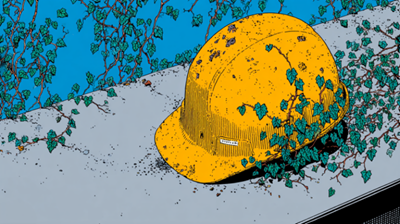
Custom image by FEE
If someone asked me what the most dangerous economic ideology is, many would expect an Austrian to give a typical answer: Marxism, socialism, or Modern Monetary Theory. Yet I believe there is another way of thinking that is even more pervasive. It is not a coherent body of ideas like those ideologies. Rather, it is a sentiment so widespread and socially accepted that it threatens not merely economic freedom, but our very understanding of progress itself. I call it “nostalgia economics”.
Recently, the singer Sting suggested that the rise of toxic masculinity is partly the result of the “loss of manual jobs”, claiming that because many men no longer use their hands and physical strength in their daily work, unhealthy masculine traits are on the rise. Like many commentators on the political left, he also blamed Margaret Thatcher for Britain’s economic transformation. “Britain’s wealth was created in the coalfields and the steel towns and the mill towns and the shipyards”, Sting said. “All of those skill sets were thrown on the scrapheap … for Thatcher’s dream of a service economy.”
This is nostalgia economics in action. A global celebrity whose music can be streamed instantly on another continent, who earns income through digital platforms, and whose career depends on modern communications and services, criticizes the very service economy that makes his success possible.
A person in thrall to nostalgia economics will take the blessings of progress for granted while romanticizing a past that never truly existed. Imagine living in the world of Charles Dickens: you would not have had access to a typewriter for much of your life, if at all, since it was only commercialized in the late 19th century. More importantly, you would not have had access to electricity. The conveniences we now consider basic would have been unimaginable luxuries.
The economic historian Norman Stone illustrated the extraordinary pace of modern progress through the experience of the novelist Henry James:
In 1895 the novelist Henry James acquired electric lighting; in 1896 he rode a bicycle; in 1897 he wrote on a typewriter; in 1898 he saw a cinematograph. Within very few years, he could have had a Freudian analysis, travelled in an aircraft, understood the principles of the jet-engine or even of space-travel.
Had Sting been alive in 1890, a world tour would have looked very different. A journey from London to New York would have taken more than a week rather than a few hours. International audiences, instant communication, and global entertainment markets would have been beyond imagination.
The glorification of manual labor is one of the most overrated ideas in modern political discourse. This tendency is not confined to the left. Ambitions to revive manufacturing employment through government policy often draw on the same nostalgic impulse. But what exactly are we trying to return to?
Perhaps literature offers a more honest answer than politics. Oscar Wilde observed that “all unintellectual labour, all monotonous, dull labour” involved unpleasant conditions. He went even further, commenting that “there is nothing necessarily dignified about manual labour at all, and most of it is absolutely degrading”.
The reality of industrial labor was far harsher than many modern observers imagine. In Britain, workplace fatalities have fallen dramatically over the last century: fatal injuries to employees dropped from around 4,400 a year early in the 20th century to around 200 a year by the end of the century. Coal mining, one of the occupations most frequently romanticized today and the first industry Sting evoked, exposed workers to constant danger and disease. Throughout the 1950s and 1960s, coal workers’ pneumoconiosis (“black lung”) claimed well over a thousand lives annually. What would a laborer enduring dangerous conditions, long hours, and chronic health risks have given for an air-conditioned office job?
One thing Sting did identify is that men generally do need more physical activity in their lives both for general physical health but also for mental health.
May 31, 2026
How Sports Illustrated devolved into AI slop
Ted Gioia generously pulls an article out from behind the paywall for the benefit of cheapskates like me. It’s on the deliberate destruction of Sports Illustrated:
Imagine if sports journalism were like an actual sporting competition — and the best team wins.
In that kind of contest, could any periodical in history surpass this lineup:
- William Faulkner reports on a hockey game.
- Robert Frost covers baseball.
- Carl Sandburg offers golfing tips.
- John Steinbeck contributes a story about fishing.
- Ernest Hemingway writes on bullfighting.
This sounds like an editor’s fantasy. But these are actual stories and bylines from Sports Illustrated.
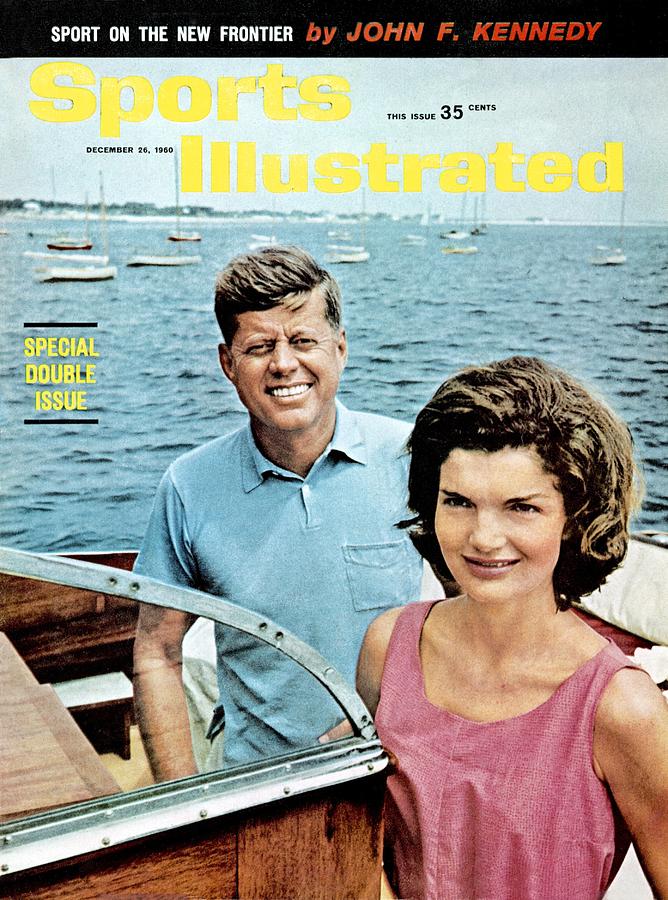
For a period of fifty years, this magazine set the gold standard for sports journalism. Nobel and Pulitzer winners wrote for them. Sports Illustrated even convinced John F. Kennedy to write a freelance article. In fact, that was one of the first things JFK did after getting elected president.
How do you kill a brand as powerful as Sports Illustrated?
It’s easy, you can do it in one just one move. You just need to embrace the most exciting, futuristic technology of the 21st century.
That’s what Sports Illustrated did. The world’s most respected sports magazine gave up on Hemingway and Faulkner, and started publishing AI slop. The editors clearly wanted to hide this — they pretended that the articles were written by actual human beings. They even created fake bios with photos for the non-existent authors.
When a journalist from Futurism asked them about this, they quickly deleted everything.
But the damage was already done. The magazine’s reputation was on the mat, like those bloodied boxers it had covered over the decades.
Just 55 days later, Sports Illustrated announced that it was laying off most of its workforce. The media reported that Sports Illustrated would stop operations completely.
A few months later, a new publisher stepped in as savior. But there wasn’t much to save — at least as a journalism business.
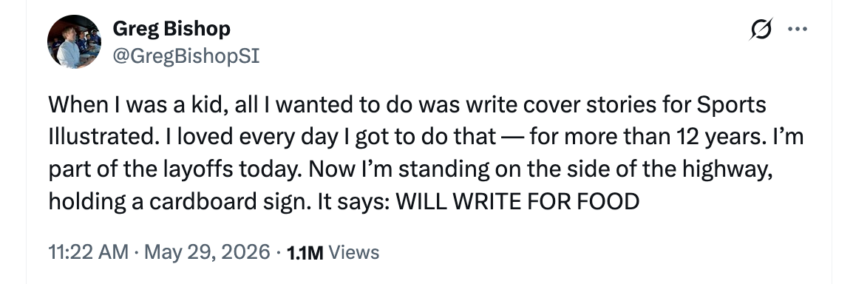
The latest move happened yesterday. The new owner laid off 12% of its workforce, including several of the remaining skilled journalists from the pre-AI era. Some of them are in desperate shape.
Former SI journalist Jeff Pearlman now mocks the magazine as an “empty vessel for selling sh*t to idiots and for getting people to gamble away their money on sports”.
It’s now a brand name, he insists, with nothing behind it.
That’s all Sports Illustrated is. It’s a name. It’s something to put on cruise ships. It’s something to put on clubs. It’s something to put on popcorn. Literally, there’s a Sports Illustrated popcorn.
May 28, 2026
“Seamen tend to be wary of authority, unless it is wisely exercised”
In UnHerd, Peter Hitchens considers the plight of the Royal Navy, much diminished from its years (centuries, actually) of greatness:

Our own Royal Navy is famous for its mutinies, in HMS Bounty in 1789, at Spithead and the Nore in 1797, and most recently at Invergordon in 1931. It is a curious organisation, its hammocks once filled by the cruel Press Gangs kidnapping innocent men and forcing them to sea and possible death, its discipline for many years enforced by the cruel cat o’ nine tails and the occasional shooting of an admiral to encourage the others. But it stood between us and the world, without trying to take over the state, and it was very beautiful, and many of us loved it. In London and the big seaport cities, bluejackets in their Edwardian uniforms were still a common sight in my childhood. They were reassuring, not overbearing. Since 1901, when horses failed at the task, Navy men have pulled the gun carriage on which Royal coffins (and Churchill’s) have rested at state funerals, an extraordinarily moving sight. These were our defenders, upon whom, as Charles II’s Articles of War first proclaimed, “under the Good Providence of God, the safety, honour and welfare of this realm do chiefly depend”.
In an era when soldiers were often despised, or even feared, sailors were not. Think of Kipling’s 1890 poem “Tommy”, intended to change the drunken delinquent reputation of Queen Victoria’s redcoats:
For it’s “Tommy this, an’ Tommy that, an’ Chuck him out, the brute!”
But it’s “Saviour of ‘is country” when the guns begin to shoot.In George Orwell’s perfect novel Coming Up for Air, Edwardian civilians are appalled when a young man signs up for the Army: “‘Well now! Listed for a soldier! Just think of it! A fine young fellow like that!’ It just shocked them. Listing for a soldier, in their eyes, was the exact equivalent of a girl’s going on the streets.”
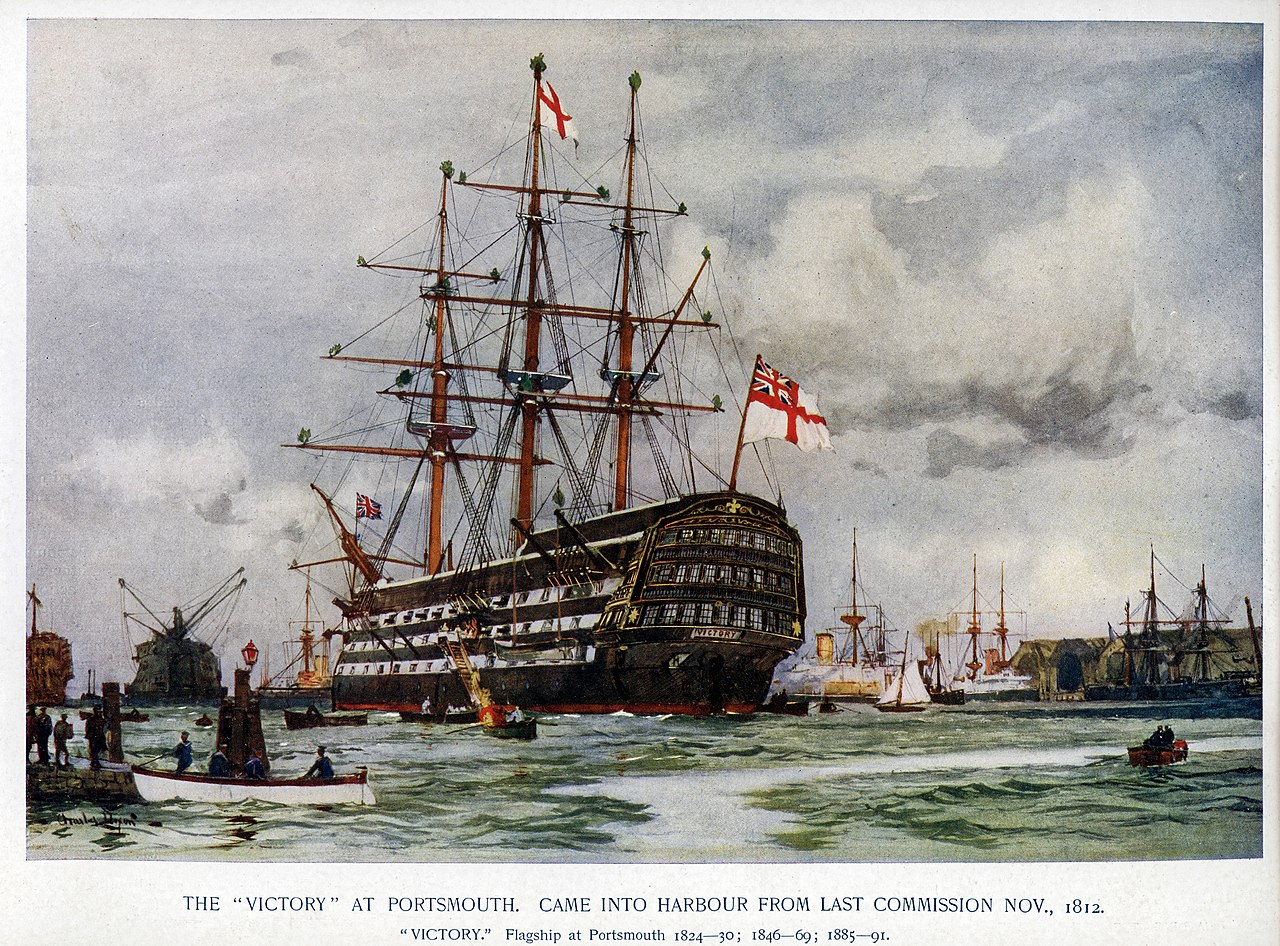
“HMS Victory in Portsmouth Harbour”
Painting by Charles Edward Dixon (1872-1934) via Wikimedia Commons.But sailors, possibly because they were at sea so much, were idealised as “hearts of oak” manning the wooden walls (and later the steel walls) of England. And the same was true for officers, credited above all with the great victory at Trafalgar in 1805, which secured national safety and prosperity for the rest of that century. They had a reputation for taciturnity and bluffness, which never does anyone any harm, and they often lived up to it. The fictional Jack Aubrey, in Patrick O’Brian’s witty and clever books about the Napoleonic wars, is a perfect rendering of this type. They tell terrible jokes. They don’t say much, just “Kiss me, Hardy” (Nelson as he died); “There seems to be something wrong with our bloody ships today, Chatfield” (Beatty at Jutland, as British warships repeatedly blew up under German fire); and “Continue to engage the enemy” (Warburton-Lee at Narvik, dying on his bridge after smashing up Hitler’s destroyer fleet and so making a cross-Channel invasion impossible).
And so the word “Navy” had, for many years, a useful commercial magic if you were selling something a bit manly and bluff, such as Navy Cut tobacco and Navy Rum, or even Senior Service cigarettes. But it did not have the yelling, martinet character of the Army. I have never yet seen a naval officer’s uniform that fits properly, and when sailors are marched aboard their ships (does this still happen?), the drill is far from pernickety. Close contact with the Navy — both my parents were in it, and so were most of their friends, some of my schoolteachers and many of the parents of my schoolfellows — revealed a dry, faintly sarcastic view of the outside world which had never been to sea. Even my mother, an ocean-going snob who would die of shame if she heard me use the word “toilet”, had mastered the sarcasm of the fleet. More than once I jumped with surprise when I heard her icily remarking about some inadequate if feeble attempt at recompense. “Well, that’s damned nice of him”, she’d say, which, for a Fifties married middle-class woman in a respectable suburb, was going it a bit.