
I’ve written many times that the real culprits here aren’t the Boomers, but the Silents. Pick any obnoxious “Boomer” who did whatever in The Sixties™, and it’s Build Back Brandon to one that the “Boomer” in question was born in the 1930s. Which makes sense for a lot of historical reasons, but simple chronology will do: If we take as read that The Sixties™ started with the Port Huron Statement, then The Sixties™ started in 1962. The Baby Boom started in 1945, meaning that the very oldest Boomers were still in high school in 1962. They might’ve enthusiastically embraced every word — then again, they might not — but they surely didn’t write one letter of it.
Further, what could they really do? The voting age was 21 until 1971, and as hard as this is to hear, voting was just as pointless back then as it is now. St. Kennedy only won through massive voter fraud, and that was 1960. As John Derbyshire used to say, if the American People had been consulted on anything of importance since then, the USA would still be a White Christian nation … and yet, here we are.
Tweedledum and Tweedledee put on a better show back in the days, but the Uniparty was still the Uniparty. America’s ruling caste caught religion back in the 1920s, and on the long view, you could make a pretty robust argument that Mustache Guy and the Anime Club actually did us a huge fucking favor — left to his own devices, President-for-Life Roosevelt would’ve ushered in the USSA by the late 1930s, with the enthusiastic support of all the Beautiful People on both sides of the Uniparty.
… hats off to you [Isoroku Yamamoto] — you and your dipshit friends bought us a few decades. Decades we squandered, of course, but that’s not your fault. It’s not anyone’s fault, unless you think the boys on the Higgins boats should’ve shot their officers, turned the ships around, and conducted a massive air, land, and sea invasion of every faculty lounge and radio station in America … and even if you do think that, what are you going to do about it?
As for Gen X, we were no better. I can’t blame the Boomers for running with it, any more than I can blame myself for running with our thing. I spent most of college, for instance, getting drunk and chasing tail. Chasing tail is bad, full stop — I should’ve been saving it for marriage, with all that implies — and while getting drunk isn’t bad every now and again, I didn’t do it every now and again. I lived a life as dissolute as any Boomer’s, and while I was equally powerless to change anything in the broader culture, I could’ve been a much better person … but I wasn’t.
Severian, “Friday Mailbag”, Founding Questions, 2022-09-23.
October 12, 2026
QotD: Blame the “Silent generation” for The Sixties™, not the Boomers
October 2, 2026
Generational incomprehension
On Substack Notes, GenX Anecdotes expresses the frustration a lot of Gen X/Generation Jones folks have felt in their dealings with Millennial and Gen Z co-workers, supervisors, and managers:
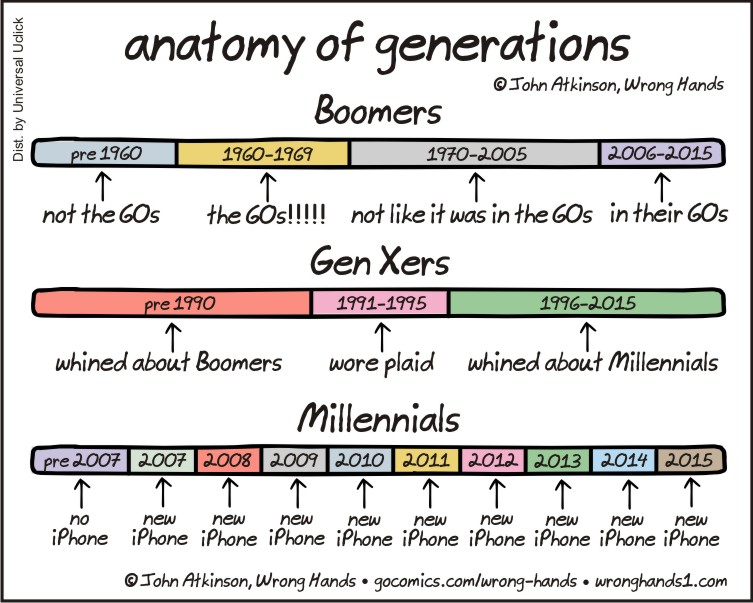
Experience tells me that I need to add an eye-catching graphic to every non-video post, but finding appropriate images is sometimes difficult. I hope GenX Anecdotes won’t mind me using yet another meme instead of something more sober and appropriate to her point.
One of the things people tell you when you are young about getting old is how quickly it sneaks up on you.
What they don’t tell you, is that it’s not linear or obvious. It’s not like you have a specific moment where you think “OK. NOW I am middle aged”. It doesn’t work like that. You remain “you”.
You might change your outlook over time. You might get wiser (hopefully) and more content with who you are. You might have more serious responsibilities. More experiences and memories to draw upon. But you’re still YOU.
For me, I don’t really feel like I’m that much “older” going about my day-to-day business doing my thing. I actually still feel quite young in myself in many ways.
It’s how the world greets you that’s different. And that’s when little things will remind you. It gives you a kind of shocking “jolt”.
Being around younger people is what really brings it home. And I don’t mean kids or young teens. I mean young adults. Or even adults in their 30s who tell you they feel “old”.
I am in my mid 50s.
When someone in their late 20s or 30s tells me what year they were born it blows my mind.
When they were born in a year that I clearly remember, feels like last month to me, and when I was well into adulthood, that’s when it really hits home.
Also, it’s how younger people view you and act around you.
In my last job, most people were in their 20s and 30s.
I won’t lie. Some of them treated me like garbage. Like I didn’t exist.
I was a bit of a “cute” novelty to them. Like “aaawww bless her”.
I had the misfortune of being “trained” in one of my part-time jobs I had when my daughter was in junior school, by a 20 something. The job was a local convenient place holder during school hours.
What she was showing me was very “basic” and tedious. But if I questioned anything about it like “why can’t we just do this instead? Surely that would make more sense?”
She looked at me, not like someone who had 30 plus years experience working in different industries who might have a point. But someone “old” and passed it, who didn’t understand.
Like a silly backwards old woman who had no idea.
The amount of times I would say “Yeah. I DO get it. I am just wondering why it’s done this way? It seems a bit impractical?”
She looked at me blankly. Like I was asking her why water is wet …
I learned to just shut up and do the bloody tedious thing in the convoluted, dumb way. Because … because … that’s how it’s done.
Then I knew all those 20/30 year olds just saw me as an annoying old relic who “didn’t understand” how things worked.
I was there about a year before moving house.
I couldn’t wait to leave.
One of the HR women hauled me in at one point to give me an “appraisal”. There I was with a 20 something asking me if I was “happy at work” and going through other annoying questions on her ipad.
She obviously was irritated that I wasn’t taking the whole fake charade “seriously” enough. She wanted me to give her bullshit standard answers that she could tick a box to.
But I kept saying things that weren’t “tick box” worthy.
And that just signified further to her that “I didn’t understand” what was going on.
Oh I understood.
I just didn’t want to play along.
And just to emphasise how insane this whole scenario felt.
She still lived with her Mum and Dad and had soft toys on her desk.
That’s what getting “old” feels like.
September 4, 2026
QotD: My generation
That’s why one of the weirdest things about getting older is realizing just how much of what you took for granted as part of the permanent furniture of the world was actually highly transient: The Iron Curtain. Guitar rock. Your own hopes and dreams and ambitions. Sometimes they all come wrapped together like a package deal, and failing at one makes it seem like you’ve failed at it all.
Andrew Potter, “Eddie Van Halen, Bill and Ted, and mourning a generation”, The Line, 2020-10-14.
May 21, 2026
Evaluating the Boomers’ complaints from the Zoomers’ point of view
As a dirt-poor boomer (or Generation Jones-er as some term us extra-late boomers), I don’t have a lot of sympathy for others in my age cohort who complain about their kids and grandkids not getting ahead when they’re occasionally back in Canada from their second or third extended exotic foreign vacation since before the snow fell last fall. (It’s been more than a decade since the last time we were able to take any kind of vacation … and that was just a week’s driving holiday to South Carolina.) The Zoomers (and Millennials, and even some of the Gen X’ers) have valid complaints that the boomers generally are not capable of understanding, as John Carter explains:
I’m going to have a little rant, here, so I’ll start by emphasizing: Not All Boomers. Look, my mother is a boomer, and I love her dearly, in large part because she represents the opposite of so many boomer stereotypes. Many of you reading this are boomers; I know this because you’re in the comments, writing some of the best comments, you can ask anyone, the very best comments, everyone says it, it’s true. I know full well that much of what follows doesn’t apply to you, because you’re the good ones, the exceptional ones, the few, the proud So, please, do not take any of this personally.
With that said.
The shouting match broke down along the expected lines. Boomers – including spiritual boomers – loudly agreed with O’Leary’s remarks. If you only spend $2 a day on lunch, they insisted, the resulting $26 a day that you save adds up to $9490 a year; after 5 years, you’ve got the down payment for a $250,000 house. Checkmate, you financially illiterate layabouts!
Zoomers, millennials, and Gen-X replied that $250,000 will get you a leaky shack in rural Arkansas with black mold in the unfinished basement; that by the time you save up the money for the down-payment, that shack will be going for $500,000; that recent immigrants receive government assistance to get onto the property ladder (along with preferential employment) and so do not have to spend years of their lives saving up at all. Disaffected youth (and these days, that is just ‘the youth’) generally heaped scorn on the idea that it’s even possible to save in this economy, or that there’s anything worth saving. “If you live on instant noodles and margarine sandwiches for twenty years, you too, my son, can one day afford a van down by the river.”
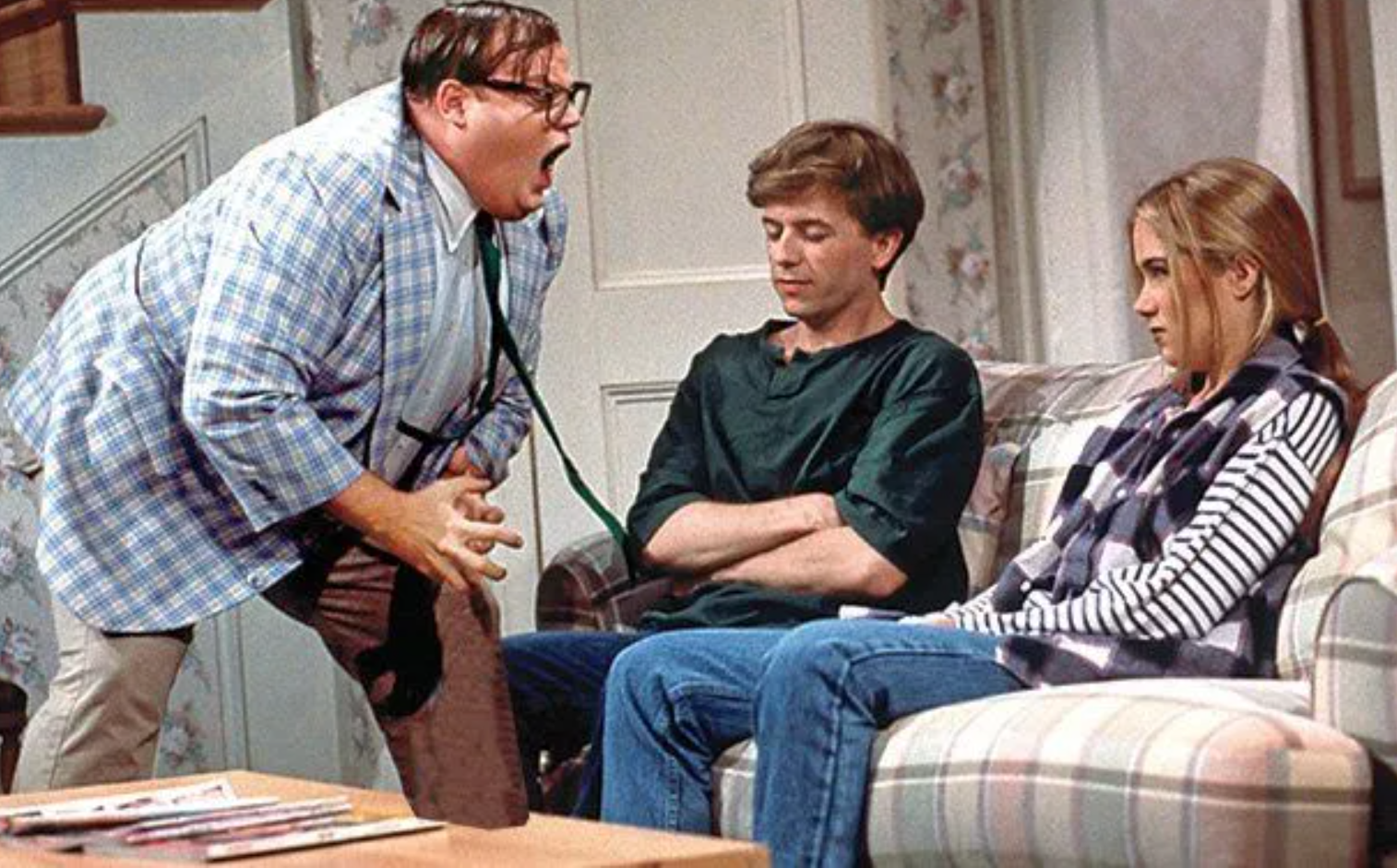
As an aside, isn’t it incredible how fashion has barely changed since Chris Farley did this skit on SNL back in 1993? Stuck culture is everywhere.
Image and caption from Postcards from BarsoomI can see both sides of this. I tend to live frugally myself, not so much because I consider it virtuous but out of simple necessity. Throughout my 20s and 30s I was a career student living paycheck-to-paycheck, as a result of which I became very accustomed to cooking my meals and buying only what’s necessary. I’ve never once used DoorDash or Uber Eats. I buy my clothing at thrift stores, only purchase a new laptop once every decade or so, and have somehow managed to avoid racking up much in the way of debt … and by ‘somehow’ I mean that I’ve never owned a house or a car, partly because I changed continents too regularly to make such big-ticket purchases practical or necessary, but mostly because I couldn’t afford them. Even finishing my doctorate did not really bring anything you could call prosperity in its wake: my first position was for the princely some of just over USD30,000 per year. By the time I reached the median national income in my late 30s, I’d gotten so accustomed to frugal living that money started piling up in my account just because I had no idea what to do with it, and little inclination to spend it because I was honestly just happy to not have to worry about budgeting to make rent. That turned out to be very helpful when DEI came for my career track; I lived on those savings for a couple of years after.
[…]
There was a famous Stanford experiment called the Marshmallow Test which measured time preference in young children. A child would be left in a room with a single marshmallow on the table. They were of course free to eat the marshmallow, the experimenter would tell them, but if they didn’t, then later on they would get a second marshmallow. Children with high time preference – meaning that they strongly prefer the immediate reward to the hypothetical future reward – would cram the marshmallow into their candy-holes without a second thought. Children with low time preference – meaning that they value the future at a similar or even higher level to the present – would patiently wait, and be rewarded with a second marshmallow. These children were then followed, and it was demonstrated that the children with low time preference demonstrated better life outcomes: they maintained higher grades, were less likely to fall into debt, were less likely to develop drug addictions, were less likely to get pregnant before marriage, were less likely to get fat, and so on. All of which makes sense. The capacity to endure present pain – by studying, dieting, working out, what have you – in order to obtain a better future outcome is obviously going to be linked to better outcomes.
How would a smart kid react if the experimenter failed the marshmallow test?
For instance, say the experimenter simply lied. There was no second marshmallow; the child waited for nothing. Or, even worse, the first marshmallow was snatched away, and replaced with two marshmallows, each one half the size of the original? Or a third the size? Here are your two marshmallows, sucker, joke’s on you. What would the results be if, after this experience, the children were tested a second time? I don’t know if such an experiment has ever been conducted, but the outcome is not hard to guess. Every single one of the children, whether they’d passed the marshmallow test the first time or not, would scarf down the marshmallow the moment it was in front of them.
The capacity for low time preference may be largely innate, but whether it expresses or not is entirely a function of social trust. In order to defer gratification for a greater future reward, one must believe that there is a reasonably high chance of that reward manifesting. The less likely the future reward becomes, the more steeply a rational actor will discount the future.
I don’t want to minimize the hardships that boomers endured when they were young. Boomers worked hard, and they didn’t enjoy the same conveniences that we enjoy now. They fought in the Vietnam War (well, about 3% of them), they spent most of their lives under a nuclear sword of Damocles, they suffered through the oil shock and stagflation in the 70s, they were punished by double-digit interest rates in the early 80s, and they spent their working lives trying desperately to stay one step ahead of the skyrocketing inflation that was unleashed when Bretton-Woods fell apart and the last vestigial support of the gold standard was kicked out from under the brrrring money printer.
But, despite all of that drama, the one thing boomers could generally rely upon was that – so long as thermonuclear annihilation was averted – things would generally get better. Technology would advance. Working conditions would get safer. The special effects in movies would become more convincing. Houses would get larger. Cars would get nicer. Air conditioning would get quieter. The environment would get cleaner. Society would become more just. The world would become freer and safer for democracy. And so on and so forth. Baby boomers have enjoyed a charmed life such as no other generation has known: free of major wars, full of technical wonders, in which whatever difficulties you might endure now, you could generally count on the future being a better place. For the boomer, deferred gratification always had a payoff.
For the zoomer – and the millennial, and generation X – this has simply not been the case. After 9/11 a police state panopticon settled over society. The 2008 real estate crash pulled the rug out from under the millennials, after which real-estate got ZIRPed to the Moon. Mass immigration pumped real estate demand further, while undercutting wages and rendering public spaces steadily more alienating, unpleasant, and dangerous. Black Lives Matter immolated quaint notions of racial harmony. DEI threw young white men, their careers, their futures, and their unborn children to the wolves. COVID stole two years from young people’s lives so that old people could feel safe from the coof. Now, AI^2 (Artificial Intelligence + Actual Indians) means that the only thing the young expect in their future is gig work in the sex trade industry (until robots take that, too).
April 1, 2026
Generation Jones and the Temple of Boom(ers)
Wee Nips
Published 19 Sept 2025Generation Jones and the Temple of Boom(ers) explores the fascinating differences — and surprising overlaps — between Baby Boomers, Generation X, and the often-overlooked Generation Jones.
Were you too young for Woodstock but too old for grunge? Stuck between disco and Nirvana? You might just be a Joneser.
In this video, we’ll compare:
🎵 The cultural touchstones of Boomers, Gen X, and Jonesers
📉 The low points in history that shaped each generation’s outlook
💰 The economic conditions that defined their opportunities
🧠 The attitudes and stereotypes that still stick today
Generation Jones isn’t just a footnote — they’re the missing link between the optimism of the Boomers and the skepticism of Gen X.
0:00 Introduction
1:38 Definitions
2:42 Cultural Touchstones
3:38 Low Points in History
4:53 Economic Conditions
5:42 Social and Attitude Differences
6:38 Humorous Stereotypes
7:09 Overlaps and Connections
8:02 Closing
(more…)
March 1, 2026
Generation Jones EXPLAINED: The Lost Generation Nobody Talks About
Wee Nips
Published 29 Jun 2025Born between 1954 and 1965? You might be part of the forgotten generation — Generation Jones — wedged awkwardly between Boomers and Gen X.
In this video, we break down what it means to be a Joneser, why we’re all still jonesing for something better, and how our weird hybrid powers (like remembering phone numbers and setting up Wi-Fi) just might save the world.
If you’ve ever used aluminum foil on rabbit ears or fixed a TV by smacking it, this one’s for you.
February 7, 2026
Food hang-ups by generation
Around the early to mid-80s, I started to notice trends in the kind of health information being pushed by the mainstream media. One of the big topics of the day was the dangers of … eggs. Eggs were so dangerous that “experts” were warning adults to avoid eating more than one or two per week. Three was the absolute limit and you were dicing with death if you went over that “healthy” limit. Then, a few years later, eggs were “the perfect food” and we weren’t eating enough of these formerly abominated death pills. A few years after that, OMG! Apples, people, apples! Danger, danger, danger! That was around the time I stopped putting any credence into health reporting in the media. However, as Lisa De Pasquale points out, food issues have been an ongoing struggle for each succeeding generation:
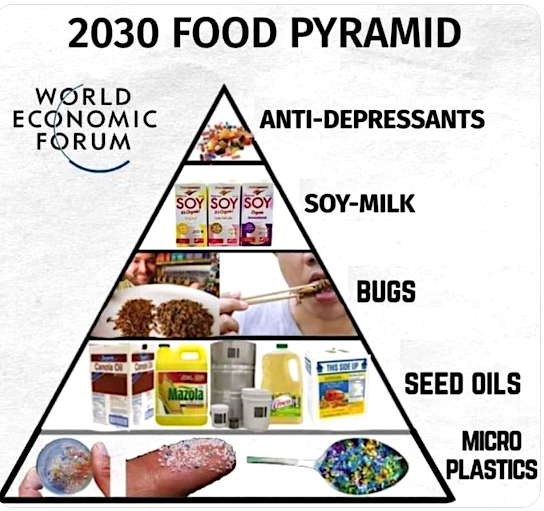
In the ’80s, the ultimate healthy Boomer breakfast was a bran muffin. There were also various cereals like Grape-Nuts and Raisin Bran. There definitely wasn’t room for their parents’ bacon and eggs unless you had a death wish. Boomers settled on eggs as the devil’s snack when the American Heart Association warned in the 1960s that people shouldn’t consume more than three eggs per week. Like social distancing six feet from others during COVID and eight 8oz glasses of water per day, the recommendation wasn’t based on science, but on being a simple number Americans could remember.
Thanks, but this Gen Xer will stick to getting my 8,675,309 steps per year as my guiding fitness principle.
[…]
The Millennial Food Pyramid
Level One: Genetically Modified Organism and Nonorganic Foods — Use Sparingly
While Gen X was at ground zero in doubting Big Food’s pyramid, our Millennial colleagues and kids really continued the battle. Like luxury logos, they seek out the organic and non-GMO labels. It’s a virtue signal of both their values and what they can afford. Erewhon smoothies, anyone?
Level Two: Various Overpriced Coffee Drinks — Two to Three Servings
Gen Xers link coffee to work and responsibility; caffeine is a tool to get through the morning. Millennials view coffee drinks as self-care. It’s about treating themselves to dessert any time of day — a major win for marketing executives.
Level Three: Charcuterie Boards, Wine, Hard Seltzers, Craft Beers — Three to Five Servings
Millennials love to entertain. Nothing shows sophistication and “adulting” in your 30s and early 40s like a charcuterie board. Lunchables upgraded! They came of drinking age at the same time as small-batch beers, American boutique wineries, and hard seltzers.
Level Four: Instagram-Worthy Food — Six to Eleven Servings
Camera phones leveled up the entertainment value of food consumption. Like organic labels, what Millennials eat signals their open-mindedness. As they get older, they straddle the line of wanting to be in on the trends (avocado toast and açai bowls) and the dive you haven’t heard of with authentic phở.
The Generation Z and Generation Alpha Food Pyramid
Level One: Real Meat, Dairy, and Peanuts — Use Sparingly
The Gen X and Millennial generations dabbled in veggie burgers, but Gen Z and Gen Alpha went whole lab-created hog into plant-based meats and milks, to the point that meat and milk no longer have a meaning until a company gets sued for using the words. To be fair, they are also embracing biohacking trends and ditching seed oils. Due to the growing prevalence of allergies, peanuts are a universal no-no food in public spaces.
Level Two: TikTok Recipes — Two to Three Servings
The term “recipe” is used loosely. I’ve come across a TikTok video for making a cream sauce from a block of cream cheese, water, and dried pasta. There is a positive aspect of trying these TikTok recipes, though: it prepares them for trying new things and for failure when a recipe doesn’t come out right.
Level Three: Food Delivery Service Meals — Three to Five Servings
Postmates, Uber Eats, Grubhub, and DoorDash are staples at mealtime. Following their surge during the COVID era as restaurants struggled to stay in business, accounts linked to their parents’ bank accounts became as common as sharing a cell phone plan.
Level Four: Gamer Food and Drinks — Six to Eleven Servings
Living next to a park has taught me one thing about Gen Z and Gen Alpha — they’re all inside. I mostly see neighborhood kids on Halloween, and every year, I recognize fewer and fewer costumes because they’re dressed as video game characters. Their snacks are manufactured for their attention span: quick hits of spicy, sour, or sweet while on pause. The gamer culture and H Mart remove barriers as Japanese snacks dominate.
So, where does this leave Gen X? We’re not immune to the powers of Big Food. In fact, recent research shows that ultra-processed food addiction began with us thanks to the explosion and availability of ultra palatable foods with added refined carbs and fats. StudyFinds reported researchers from the University of Michigan said, “Individuals who are now older adults were in developmentally sensitive stages during the 1970s and 1980s, precisely when tobacco-owned food manufacturers were shaping the market with addictive ultra-processed foods”.
January 28, 2026
QotD: 21st century generation gap
Niccolo Soldo, “Saturday Commentary and Review #197”, Fisted by Foucault, 2025-10-25.
September 19, 2025
QotD: The sub-generations of Generation X
Then there’s the group that was in high school in the late 1980s. I squeak into this group (barely). We’re the mid-Xers. The real “grunge” generation. If Dazed and Confused is a pretty decent late-90s approximation of late-70s high school kids, then the best description I can give you of a “grunge” kid is the movie Deadpool. Made in 2016, by guys who were born in the mid-1970s. That’s grunge, in a way Kurt Cobain couldn’t even imagine. Fourth wall breaks! Sarcastic asides about the fourth wall breaks! Profanity! Masturbation jokes! And snark, snark, snark — unrelenting snark, about everything, all the time. Every second of that movie screams “I can’t believe you fags are amused by this, but since you obviously do, here’s lots more! Choke on it!!!”
The writers obviously wanted to work on Buffy the Vampire Slayer, but Joss Whedon was too cool for them — imagine the twisted psyche of a person who thinks Joss Whedon is cool — and Sarah Michelle Gellar just laughed at them, so they made Deadpool out of spite.
Then there’s the late Xers. They were in high school in the late 1990s, which is why us oldsters call them “Millennials” (as the term is now used, it seems to mean “those born around 2000”, i.e. the generation just now getting out of college. We took it to mean “those who were just getting out of college around the turn of the century”). Obviously I use the Internet. I’m using it now, but I’m not on the internet, and I’m certainly not an Internet Person. The very late Xers are Internet People. The very first Internet People; they invented the concept of Internet People. Mark Zuckerberg (born 1984) is a late Xer. The people behind Twitter (Jack Dorsey born 1976; Biz Stone 1974; Evan Williams 1972) are mid-Xers; they were ahead of the curve.
Severian, “Addendum to Previous”, Founding Questions, 2022-02-24.
September 7, 2025
QotD: Generation X
The concept of “selling out” — and the degree to which that notion altered the meaning and perception of almost everything — is the single most nineties aspect of the nineties. The complexity, nuance, and application of the term sellout was both ubiquitous and impossible to grasp. Nothing was more inadvertently detrimental to the Gen X psyche.
Or, as I like to put it, we were so obsessed with “authenticity” that we took as our guru an exquisitely sensitive longhaired goof who fronted a band named after spooge. […] But Klosterman does have genuine insights sometimes:
The detail always noted in remembrances of the Bronco chase is the throngs of bystanders cheering for Simpson as the car rolled down the freeway, congregating on overpasses and holding makeshift cardboard signs proclaiming, “The Juice Is Loose”. It seemed perverse then and still seems perverse now. Yet this can also be understood as the primordial impulse of what would eventually drive the mechanism of social media: the desire of uninformed people to be involved with the news, broadcasting their support for a homicidal maniac not because they liked him, but because it was exhilarating to participate in an experience all of society was experiencing at once.
Sailer thinks that’s clever and perceptive, and I agree. Too bad you have to read some masturbatory bullshit about Zima to get to it.
Sadly, he doesn’t take that out a step (or, at least, he doesn’t get quoted doing so in Sailer’s review). Here’s Klosterman’s verdict on why Gen X, for all its faults, wasn’t so bad:
The enforced ennui and alienation of Gen X had one social upside: Self-righteous outrage was not considered cool, in an era when coolness counted for almost everything. Solipsism was preferable to narcissism. The idea of policing morality or blaming strangers for the condition of one’s own existence was perceived as overbearing and uncouth. If you weren’t happy, the preferred stance was to simply shrug and accept that you were unhappy.
True enough, but look: Of all the things that made the Boomers so fucking insufferable, right near the top was their utter inability to let go of their youth. Instead of seeing Forrest Gump as a metaphor so unsubtle, an anvil to the head seems sneakier, they thought it was a lighthearted celebration of a simpler, more innocent time. We knew better. Since they couldn’t let go of their youth, we made “being old and jaded long before our time” into our signature thing.
But where, my fellow alterna-dudes, is that attitude now, when it matters? We’re in the same position in 2022 as our parents were in 1992: Staring down the barrel of middle age, teeing off on life’s back nine, pick your metaphor. It’s time to put away childish things. Grow the fuck up already, the way we wish our parents would’ve done for us back in 1992. Instead, we’re letting our lunatic children smear their pathologies all over what’s left of America, because … ?
I know why Klosterman does it: That’s what they pay him for. What’s our excuse?
Severian, “A Meta-Review”, Founding Questions, 2022-02-24.
January 8, 2025
QotD: “Striver” lifestyles for each generation
That’s why everything was suddenly so Xxxtreeeeem!!! in the early 90s through the Naughts. We can’t afford to fly to Gstaad for a ski weekend, but we can buy a snowboard. Dad might be on Wife 3.0 at that point, and she’s younger than us, but our girlfriends — marriage is for squares — are so much more environmentally friendly. We can’t compete with their high-end clothes, so we’ll push for “business casual” in the office, homeless-casual in our personal lives (everyone can afford thrift store flannel). And so on.
The Millennials and Gen Z, lacking the wherewithal to do even that (what with the six figure college debt and all), invented the “persona striver” as their means of intra-group social competition. For the low low price of a smartphone and a data plan, you too can pretend to be The Most Interesting Persyn in the World online. I’m told there are entire subcultures online, “cottagecore” and the like, revolving around aping the style and mannerisms of prior eras. “Anonymous” seems to think that these kids are actually, physically doing this stuff — that the “cottagecore” lesbians really are moving into little houses on the prairie to bake bread by hand — but it’s obvious that’s not necessary, as this is an entirely online thing and Photoshop exists.
Either way, it’s sufficient for our purposes to note that the cost of entry keeps dropping, while the “totalization” (for lack of a better word) of the lifestyle keeps growing. An old-fashioned, conspicuous-consumption style striver was free to be an individual. Yeah, sure, they were all “yuppies”, but there were Protestant yuppies and Catholic yuppies (and atheist yuppies and everything in between). There were Liberal yuppies and Conservative yuppies (and Libertarian yuppies and everything in between). You might find the same few standard books on all their shelves — management meatball crap; the novels of Danielle Steele and Sydney Sheldon — the same way you’d find the same basic kinds of clothes in their closets, but there was still a lot of individual variety within those broad constraints. You could predict a few broad, superficial things about a yuppie from his business card, but there were no safe bets on anything else.
The lifestyle and persona strivers, on the other hand, are much more narrow. While the yuppie might go to Molokai this summer on vacation, next summer to Italy, because why not?, the lifestyle striver was pretty much trapped in his niche — it’s trail hiking or bust. And the persona striver can’t afford to go anywhere, so xzhey have to make up elaborate justifications for it (“by staying home and baking these muffins from an original 18th century recipe, I’m being completely carbon neutral”). It’s no accident, in the Marxist sense, that marathons and Crossfit and all that shit really took off after the turn of the century, as well as the whole “animal rescue” deal — it’s both a lifestyle and a persona, and it costs next to nothing, and you can, indeed must, do it all day every day.
Severian, “Striving for Revolution”, Rotten Chestnuts, 2021-08-11.
July 19, 2024
The rise of the reactionaries – Gen X poised to pounce and seize
Andrew Potter tries to explain why Gen X are much more likely to support conservative policies than the groovy fossil Boomers and the painfully Socialized Millennials and GenZ’ers:

Generation X Word Cloud Concept collage background
Best Motivation Blog: What Generation Is X
As North American politics continues its rightward lurch, it is becoming increasingly commonplace to note the outsized role of Gen Xers in pushing this trend. In 2022, a Politico essay tried to explain “How Gen X became the Trumpiest generation“. That same year, an essay in Salon lamented how “of course Gen X was always going to sell out and vote Republican”. Writing in The Line last year, Rahim Mohamed wondered “how Generation MTV became Generation GOP?” These aren’t outliers – there is a whole sub genre of cultural commentary devoted to trying to explain just why Gen Xers are so right wing, compared to both their Boomer predecessors and the Millennials and Zs who followed.
This raises a couple of questions, the first of which is: is it even true? And if so, why?
On the facts of the matter, it appears that members of Generation X are, on the whole, more conservative than other generations, and this is especially true in the United States. For the past three or four years, polls have consistently shown that Gen Xers are more likely to see the country as going in the wrong direction, more likely to disapprove of Joe Biden, and more likely to support Donald Trump and vote Republican, than any other generational cohort. And while every generation tends to become more conservative as it ages, it is a tendency that accelerated under Gen X.
Pollsters have found similar support for these trends in Canada. An Abacus survey conducted last August found Gen Xers had the highest level of support for the Conservatives, with 41 per cent of those surveyed intending to vote CPC. And just this past June, the pollster Frank Graves released a series of charts tracking sentiment in Canada on a number of issues, including national attachment, social cohesion, and voter intention. He found significant intergenerational discord, with members of Gen X showing the highest level of support for smaller government, and Gen X males having the highest level of support for the CPC.
So why is this the case? How did the generation that fought (and won) the first culture war against conservatives, that launched the antiglobalization movement, that made heroes out of left wing icons like Kurt Cobain and Naomi Klein, become the most right wing cohort of all? Did we follow our Boomer parents’ hippies-to-yuppies trajectory in selling out? Or is there something else at work, beyond crass financial self-interest?
There’s probably at least something to be said for the “crass self-interest” angle. Despite the long-standing claim to being the first generation to do worse than their parents, the truth is, Gen X is raking it in. Starting right around the pandemic, Canadian Gen Xers quietly overtook Boomers as the generation with the highest average household net worth. It may also explain why alone amongst the generations, members of Gen X list “cost of living” as their most salient political issue, in contrast with both the older and younger cohorts who identify things like climate change, health care, and the environment as the most important issues facing Canada.
May 2, 2024
QotD: Fomenting inter-generational hatred
“You’re in a heap o’ trouble, boy.” Or girl. What follows are the reasons — or at least the big ones — why you’re so thoroughly screwed, along with some suggestions for self-help at the end.
You tend to loathe Boomers and Generation X, I know. I don’t actually blame you for that, at least not entirely. Some of you, though, the Millennials who lump all the above together, without exception, strike me as singularly stupid and ignorant.
Moreover, the reasons you have for loathing them are somewhat misplaced. You tend to think — not without some reason — that the Boomers, especially, robbed their future, which is to say you, personally, to pay for largesse for themselves in the present.
It’s true enough, but it is neither the really awful thing they did to you nor does the complaint portray you in any particularly favorable light. “Those damned Boomers; they took everything and now there’s nothing left for us.” Yeah … you know what that sounds like? It sounds like the whining of one group of thieves over the success of a better or, in this case, merely luckier group of thieves who got to the big haul first. Yes, it really does.
Sorry, but the damage the Boomers and Xers did to you wasn’t primarily fiscal. No, no, the damage they did – or allowed – was to you, as a person. That’s the real crime. They didn’t just rob you of some money in advance. They didn’t just vote for a series of politicians and political programs and giveaways that ran the economy into the ground.
No, they stole from you — or allowed others to steal from you — some key elements of personhood, especially the ability to engage in critical, logical thinking. That’s right, you were not educated, whether in kindergarten or in the kindergartenesque, safe space segregated, snowflake sanctuary schools we call colleges and universities. Yes, these institutions of miseducation were supposed to teach you how to think. Instead, they taught you what to think and stunted your native ability to think. If you ever start to spout bright green feathers? Yes, this is the reason why; your teachers demanded that you become a parrot.
Tom Kratman, “It’s Up to You, Millennials. Deflect or Be Doomed”, Milo, 2017-12-06.
April 18, 2024
QotD: The intergenerational blame game
OK, Zoomer. Two can play this game. Keep in mind that the little magic trick I’m about to perform here does not mean I’m blaming your generation for any of these things, because I’m not a Generational Astrologist. I’m merely taking what you do and flipping the script:
Yours is the generation of “woke culture” and Antifa. As much as you yabber about how the Boomers let the culture slide into liberalism, atheism, and degeneracy, your generation is far less religious than the Boomers. You lean heavily socialist and encourage “punishment” for Halloween costumes you deem “offensive”. While the world is burning, the Zoomers’ top three voting issues are emotionally laden trifles such as “mass shootings, racial equality, and … treatment of immigrants”. You are far more anti-racist, anti-“hate”, and pro-LGBT than any generation that preceded you. This is not my opinion — it’s a statistical fact supported by every survey and poll I’ve ever seen.
Therefore, every Zoomer is personally responsible for Drag Queen Story Time and the fact that there’s no wall on the border, because you just sat there and LET it happen. Three trillion dollars have been added to the national debt since Trump’s inauguration, and you Millennials and Zoomers just sat there and LET it happen. The tech giants are doing purges of people for thoughtcrimes, while your generation hides behind goofy fake names and clown avatars and LETS it happen.
That’s because every member of every generation is 100% responsible for what happens on its watch. Get down on your knees and APOLOGIZE!
And if you don’t repent immediately and bend to my shaming tactics, you fucking deserve all the righteous pain the generations after you will rain down on your selfish head.
See how stupid that sounds when it’s applied to you?
People hate to admit they’ve been brainwashed. But sorry — you’ve been brainwashed.
Politicians enjoy a little generational warfare if it suits their needs. They’ll even instigate it. And as far as I can tell, this sudden emergence of a generational identity-politics civil war is a divide-and-conquer tactic that has worked wonderfully.
Jom Goad, “The Myth of Boomer Privilege”, Taki’s Magazine, 2019-11-03.
March 25, 2024
QotD: Generational politics
I’ve been making this point for years, but you’ve all been too busy projecting your guilt onto others and blaming them for all your problems to listen to me.
The reason I get fixated on certain topics is because they in some way powerfully reflect this theme of misplaced blame. This may burst quite a few of your bubbles, but the fact that I’ve focused on the endless bashing of whites for years is not a sign of how deeply in love I am with white people but rather a fascination with the fact they’re getting blamed for many things that demonstrably aren’t their fault. It’s the same reason I focus on the gender wars — men nearly aren’t as awful as they’re being depicted, and women are nowhere near as innocent as the current narrative says they are.
If you haven’t been paying attention, there’s been escalating intergenerational hostility across our fair land, and people are increasingly identifying with dumb, media-manufactured generational names — AKA Baby Boomers, Gen X, Millennials, and Gen Z — as if they were scientific categories that are predictive of human behavior rather than arbitrary designations along the lines of Virgo, Capricorn, Scorpio, and Leo.
It’s some weird new metastasized form of identity politics. And, since it comes with the turf, these groups are blaming each other for all that ails the world.
It’s dumber than astrology […] but this intensely stupid way of framing the world refuses to die.
Jom Goad, “The Myth of Boomer Privilege”, Taki’s Magazine, 2019-11-03.


