
The modern word “blockhead” […] was Lucy’s favorite label for the too-trusting Charlie Brown in the Peanuts comic strip. Lucy never tired of snatching away the football; Charlie fell for it every time. We all know the feeling: when you’re inching forward in the freeway exit lane, say, and another driver flies past and swerves onto the ramp at the last second; when your child has to complete her college-entrance exams within a designated time period, but your neighbor’s child gets twice as long because of a suddenly diagnosed “learning disability”; when you pay extra to have your pet travel in the airplane’s cargo hold but the yipping poodle across the aisle, an “emotional-support animal”, gets to ride on its owner’s lap for free. You didn’t know that you could get an emotional-support card just by claiming an anxiety disorder and paying a fee to an online agency? What are you — a chump?
What makes these indignities so infuriating isn’t just that a few people game the system. It’s that their selfish gambits work only because the rest of us follow the rules. If every driver mobbed the freeway exit from the passing lanes, traffic would come to a halt. The student who fraudulently obtains extra test time gets a leg up only if most other students stick to the original time limit. And if every pet were designated an emotional-support animal, airplanes and restaurants would become full-time menageries. (Some airlines have begun tightening rules on support animals for just this reason.)
Thousands of norms, rules, and traditions make civilized life possible. Some, like paying taxes or not littering, are enshrined in law. Others are informal. Most of us take pride in adhering to basic standards of etiquette and fairness, to say nothing of following the law. And we have a deep emotional investment in having the people around us follow these norms as well. There’s a reason that we call selfish, disruptive, or criminal behavior “antisocial”. We know that if everyone stopped paying their taxes, or started running red lights and shoplifting, our society would be on its way to collapse.
James B. Meigs, “The Chump Effect”, City Journal, 2020-11-15.
October 19, 2026
QotD: The “social norms” that enable society to exist
September 13, 2026
QotD: Naming “Cathay”
You may think you’ve never heard of the Khitans (Chinese: 契丹 or “qidan“), but you probably have, albeit indirectly. “Khitan” is their ethnonym within their own proto-Mongolic branch of the Altaic languages. In the Turkic languages a little further West, the same people are called “Khitai“. A splinter group of the Khitans who settled in Dzhungaria and Transoxiana called themselves the “Kara-Khitai” (Black Khitans), a name that should be instantly recognizable to anybody who played Age of Empires II. If you prefer Paradox map-painting games to more traditional RTS, they do also show up in the Crusader Kings series, resulting in memes like this one. Oh dear, where was I? Right, the Khitans. The word “Khitai“, via a continent-wide game of Chinese whispers (get it?), became “Cathay”, which the confused Europeans took as the name of the Middle Kingdom itself, finally resulting in the birth of a wonderful airline.
Right, the Khitans. There they were, grazing their flocks on the Greater Khingan Mountains, just bein’ a horde, doing horde stuff. Suddenly, opportunity fell into their laps: the Tang empire was unravelling. The bustling cities and ports of Northeastern China were sitting right there, defenseless, full of gold, and skilled craftsmen, and all the soft and delicate sensuality of settled life. It was about to happen again, right? The nomadic horsemen riding in from the wild steppe, pillaging the effete townspeople and becoming their masters, only to succumb to pleasure and become effete in turn, the endless cycle of history? How could it be avoided? Here is how Mote (yes, we’ve finally gotten to the book) describes their Catch-22:
… the Khitans probably saw quite clearly that when a steppe people by degrees gave up its nomadic mobility in exchange for the more comfortable sedentary life, it ran great risks of having to compete with the Chinese on their ground. Losing in that way their comparative advantage inevitably cost the nomads their cultural integrity; they slowly became just “little Chinese” … no steppe people on China’s borders could become sinified and survive, except by migrating into China and being absorbed — another form of extinction … the warning to nomadic peoples was clear: they must master the art of drawing resources from China without sacrificing their steppe integrity … The wealth that could be wrung from it could give mastery over all Inner Asia.
The Khitan response to this pickle was unlike any I’ve ever heard. Roughly half of the Khitan aristocracy, including the royal clan, immediately adopted Chinese customs,1 moved to the city, and began building a bureaucracy. The other half, including the clan that Khitan kings traditionally picked their wives from, stayed in the steppe and had nothing to do with any of this. They then established two governments, two sets of laws,2 two taxation regimes, two writing systems, two of everything. One was civilized, the other was barbarian. Two completely incompatible social structures living side-by-side, passing through each other, but never interacting. Like dark matter, or like life-forms with mirror chirality. As a Khitan subject, you belonged to just one of these systems (if you were low class, you were sometimes allowed to pick!), and only that system had any authority over you.
The only point of official contact between the two worlds was at the top, where the Khitan king spent half the year reigning as a Chinese-style emperor, and half of it touring around his nomadic subjects as Great Khan in a mobile court. The Khitans recognized that although the king was theoretically 50-50, extended exposure to civilization would tend to Sinify him over time, and his descendants even more so. This is why they mandated that every empress was a pure-strain barbarian from a wild clan. They expected these formidable women to wield influence over their sons and to ensure that as the years rolled past and the royal clan grew more and more Chinese, they would be replenished each generation with the barbarian perspective of their mothers. This totally worked, but also resulted in no end of conflict between the empresses and their palace retainers, who exemplified different worlds.3
Sometimes you read about a social or legal system, and you are just certain that it could not be stable. I had this reaction reading about the Spartan diarchy as a kid, and I had it again reading about the Khitans last year. But their system not only endured, it flourished, and eventually turned into the Liao Dynasty which ruled China for centuries. And it functioned basically as it said it would on the tin — the civilized parts of their empire keeping things efficient and organized, supporting craftsmen and tradespeople; while the Strategic Nomad Reserve was always there ready to be called on in times of war, and prevented the administration from getting too soft and decadent.
John Psmith, “REVIEW: Imperial China, by F.W. Mote”, Mr. and Mrs. Psmith’s Bookshelf, 2025-02-24.
- The decisive thing they actually did was to adopt surnames, which as James C. Scott will tell you is about the most forceful possible way to reject your barbarian heritage.
- The differences in laws could be extreme. For instance, under Chinese law, as in most “civilized” places, treason was punished with ultimate severity and brutality. But in many “barbarian” cultures, treason isn’t actually a huge deal (almost akin to a playground fight) and defeated rebels are customarily forgiven. The Khitans, again, simply did both. Traitors were executed if they lived under city law, and received amnesty if they were under tribal law.
- One such an empress, upon the death of her husband, was asked by a Chinese courtier if she would follow ancient custom and be buried alongside him. She responded: “I of course do not refuse to join the Emperor underground, but my children are young and the country has no leader, so I am not free to do that”. Then she ordered that her right hand be severed at the wrist to represent her within her husband’s tomb.
August 20, 2026
The Frankfurt School – The most destructive intellectual project of the 20th Century
People tend to underestimate how influential intellectual movements can be, as they rarely get outside attention until they’re deeply entrenched in the university system. The Frankfurt School‘s damage record is unmatched by any other intellectual movement of the era:
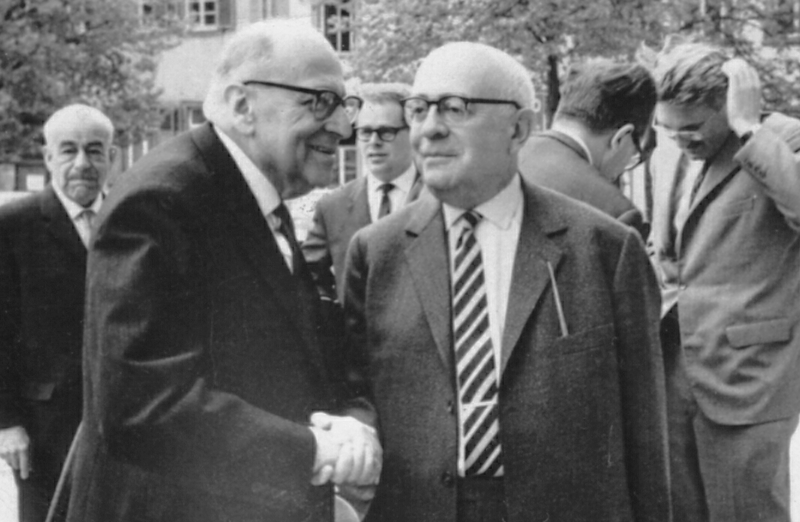
Notable members of the Frankfurt School in Heidelberg, April 1964 at the Max Weber-Soziologentag. Max Horkheimer is front left, Theodor W. Adorno front right, and Jürgen Habermas is in the background, right, running his hand through his hair. Siegfried Landshut is in the background left.
Photograph by Jeremy J. Shapiro via Wikimedia Commons.
The Most Destructive Intellectual Project of the Twentieth Century.
The Frankfurt School. You should know what it was, what it built, and why you are still living inside it.
1. The Institute for Social Research was founded in Frankfurt in 1923 and relocated to Columbia University in 1934 when Hitler came to power. The civilization they had decided to dismantle gave them refuge when another tried to kill them. They spent the next five decades producing the theoretical infrastructure for that dismantling. Western civilization itself was the problem: reason, the Enlightenment, the family, tradition, authority. Not reformed. Dismantled.
2. They called it Critical Theory – and the name is the program. Everything is to be criticized; nothing is to be built. In The Dialectic of Enlightenment (1944), Adorno and Horkheimer argued that Western reason — the reason that produced Newton and the rule of law — contained the seeds of Auschwitz. Not that reason had been misused, but that reason itself, taken to its conclusion, produces the death camp. This was not a critique of institutions. It was an indictment of the civilization itself.
3. Adorno gave them the psychological weapon. The Authoritarian Personality (1950) classified conservatism, religious faith, patriotism, and the traditional family not as political positions but as symptoms of a proto-fascist personality. If you believe in the nation or the father’s authority, you are pre-fascist. The opponent was no longer wrong – he was sick. You don’t argue with a pathology. You treat it. This made dialogue impossible. You don’t persuade someone who is wrong; you diagnose someone who is sick. Politics becomes therapy, and disagreement becomes pathology.
4. Marcuse gave them the political weapon. Repressive Tolerance (1965) argued that tolerating wrong ideas is itself oppression. True tolerance therefore requires suppressing intolerant ideas. The left decides which ideas are intolerant. Everyone else is silenced – not despite tolerance, but “in its name”. Censorship dressed in the vocabulary of liberation.
5. The generation that read Marcuse at Columbia, Berkeley, and Yale went on to run universities, media, foundations, NGOs, content moderation departments, and the EU regulatory apparatus. They implemented the argument sincerely because they had been taught it as philosophy. This was the Frankfurt School’s greatest achievement: it produced true believers.
6. French Theory picked up the tools and made them aesthetic. Foucault made the critique of power literary. Derrida made the critique of meaning philosophical. Deleuze made the critique of identity elegant. A political program became a cultural sensibility. You can argue with a program. A sensibility is in the air you breathe. By the time these ideas reached the American campus through the French conduit, they were no longer ideology. They were the water. The fish did not know they were wet.
7. A civilization stands on three pillars: truth exists and is accessible to reason; good is distinguishable from evil; and there is an inheritance worth transmitting. The Frankfurt School attacked all three – systematically and with considerable intellectual sophistication. It produced a generation that knows how to deconstruct and has forgotten how to build. That sees power everywhere and beauty nowhere. The ultimate achievement was to make destruction feel like progress. Every inherited institution became suspect; every constraint became oppression; every act of preservation became reactionary. Deconstruction became the default, while construction became something that needed to justify itself.
The answer is not another theory. It is the thing the Frankfurt School most feared: the builder who simply builds, the scientist who follows the evidence, the father who transmits what was transmitted to him.
The deconstruction machine runs on the assumption that nothing is worth building.
Prove it wrong.
Tell the truth, have courage, and build.
August 15, 2026
“Forestalling collapse is simple: all we need do is reinstate meritocracy within institutions”
John Carter discusses the ever-more-concerning collapse in basic competence in western societies, which left unchecked will absolutely lead to civilizational collapse due to the vastly complex interconnection of so many systems that we all depend on day and night:
Helen Andrews recently wrote an essay for Compact Magazine, titled The Racial Crossroads, which has been making waves for daring to use the verboten descriptor “race communism” for the acrimonious racial spoils system that has replaced meritocracy throughout the dying West. It’s very good. You should read it.
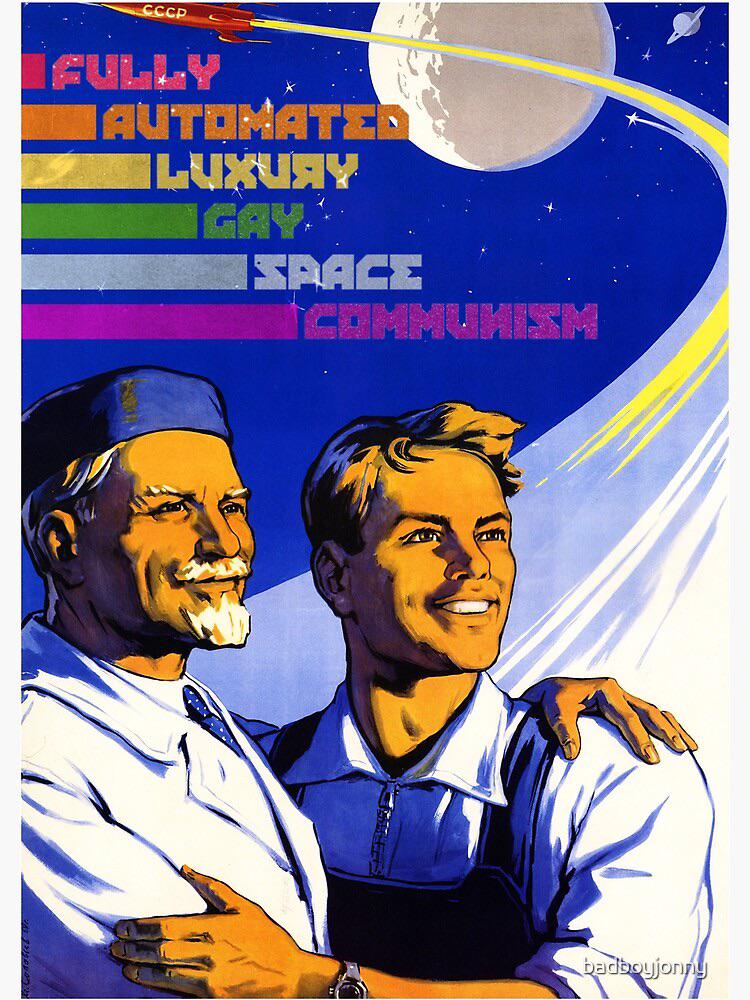
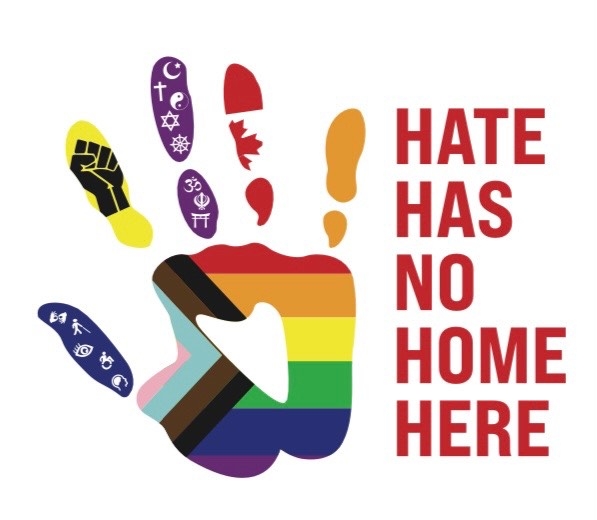
Personally, I prefer the more descriptive “gay race communism”. The progress pride flag is inseparable from the clenched Marxist fist of Black Lives Matter in regime iconography. Moreover, gay race communism is a deliberate subversion of the left’s own “fully automated luxury gay space communism” meme.
There are zero communists who actually look like this, gay or otherwise.
To be fair, Andrews introduces the concept as “gay race communism”, and even directly acknowledges its coinage by Twitter anon Drukpa Kunley. It wasn’t that long ago that conservative popularizers laundered ideas emerging from the anonosphere without attribution, as a means of hiding their origin and making themselves look more original, and Helen deserves credit for not doing this. Also to be fair, given the focus of Andrews’ piece, adding the “gay” to “race communism” could be seen as an unnecessarily inflammatory complication. It isn’t, but we’ll get to that in due time.
Andrews spends the first half of her essay detailing how the regulatory framework built by the Civil Rights Act created the cultural conditions for the rise of wokeness, affirmative action, and DEI initiatives. The official explanation given for anti-discrimination laws was that they were well-intended correctives to the legacy of slavery and Jim Crow. Affirmative action was to be an explicitly temporary measure to give American blacks a helping hand, with the understanding that – after a decade or at most a generation of assistance – they would no longer need a thumb on the scale. Once racism was defeated, we could all live in utopian colour-blind race-neutral Star Trek liberalism, judging one another by the content of our individual characters and no more concerned by the phenotypic differences of ancestral population groups than we are by sartorial quirks. Kumbayah and such. This isn’t an original argument: the same points have been made by Christopher Caldwell in his 2021 book The Age of Entitlement, and of course most directly by Richard Hanania in his 2023 book The Origins of Woke (whom Andrews doesn’t mention, possibly because everyone hates Hanania now).
The central point of Andrews’ essay is the following:
The old racial bargain is breaking down, due to a combination of changing demographics and a dawning realization that racial outcomes are not going to converge any time soon. One possible path forward is to throw out the old racial bargain and establish a new one based on equality under the law. The other possible path is to accept permanent racial favoritism at every level of society.
As Andrews sees it, the first problem with the Civil Rights regime is that it reifies the abstraction of equality into a legal presumption that there are no salient biological differences between human population groups. This simply isn’t true, but the assumption that it is true leads to the necessary conclusion that all differences in outcome between groups must be a consequence of discrimination based on irrational prejudice, rather than a natural result of inborn distinctions of cognitive capacity or behavioural profile. Biological differences are real and significant, but the make-believe that they are socially constructed and unimportant incentivizes a perpetual inquisition that dismantles society as it persecutes innocent people for ever more tenuous spectres of racism implicitly haunting the privileged depths of their incorrigbly white ids. This places institutions in an impossible quandary, since the only way to avoid being dragged into court in discrimination lawsuits is to preemptively discriminate in favour of protected groups, which is to say, against unprotected groups. Human resources departments have formed as a direct response to the legal sword of Damocles poised over every institution’s neck: their function isn’t actually to hire the best people, or to hire anyone at all, but rather to ensure that the employer won’t get sued for hiring people from the wrong groups, or not hiring the people from the right groups, or for allowing people from the right groups to get offended by things said by people from the wrong groups. A doctrine predicated on denial of reality must go to war with reality to preserve itself, and as the war on noticing grinds on the battlefront presses into ever more intimate corners of people’s lives, their public speech, their private speech, their silent thoughts, their very emotions.
Your emotions are illegal, chud.
The second problem Andrews identifies is demographic mission creep. When race communism first got rolling in the 50s and 60s, the focus was quite specifically on African-Americans, who had an arguable claim to restitution on the basis of their long period of bondage on the cotton plantations.1 White Americans largely agreed with that, and were trying to do the decent thing, to make up for the abuses and indignities suffered by the disadvantaged blacks.
The mass migration of the third world into the first upsets that balance. America is no longer a 90% white country with a small rump of Africans, but more like a 50% white country, with large and growing minorities from every benighted slum in the Global South … and every single one of those groups gets to classify itself as an oppressed racial minority from the Global Majority, and therefore help itself to the largess spilling forth from the cornucopia of white guilt. In the 70s and 80s affirmative action was largely no more than an annoyance for white Americans, but in the 2020s young American whites find themselves shoved aside in university admissions, in corporate hiring, in the availability of loans and grants for education, in the availability of venture capital, in promotions, and so on, with these opportunities being bestowed instead upon supposedly oppressed minorities who arrived five minutes ago and were never actually oppressed by white Americans.
[…]
Institutional collapse is a near certainty on this track. Our civilization is a staggeringly complex system of systems. Operating and maintaining those systems requires a high degree of competence. Competence has to be learned, but it can’t be learned by anyone. DEI pushes incapable people into key positions, while denying even the opportunity for training to the potentially capable. Eventually, the systems themselves begin to malfunction. Repair becomes impossible, because there’s no one who actually knows how to repair the systems: the ones working in the system are too stupid to understand it, while those who could have learned were locked out and therefore didn’t learn what they needed to know. One system breaks, causing a problem in another system, which leads to a problem in a third system, and soon cascading failures junk the entire machine. DEI – and by extension, Civil Rights – has precipitated a competence crisis, and Complex Systems Won’t Survive the Competence Crisis.
This complex systems collapse is already happening. Andrews uses the example of failures in airplane manufacturing, pilot training, and air traffic control that have made air travel that much more hazardous, and which seem to trace directly to DEI-motivated recruitment policies, although naturally it is difficult to verify this as the regime does everything it can to obscure such a connection. The general enshittification of the Internet is probably at least partly a result of less talented and less scrupulous Indians replacing white software engineers. Entertainment media has become ludicrously bad in direct proportion to the replacement of white male directors, showrunners, screenwriters, animators, artists, and programmers by women of pronouns. Academia is in the midst of a credibility collapse for exactly the same reason.
It is not hard to extrapolate this degenerative process out a generation or two. Instead of building cities on Mars, we will be bouncing over potholes on dirt roads. Tap water will have to be boiled, assuming water even comes from taps. Electricity will only be available a few days a week, and that in the good neighbourhoods. What did South Africans use for light before they had candles? Light bulbs. There are still liberals in South Africa, by the way.
Forestalling collapse is simple. All we need do is reinstate meritocracy within institutions.
Simple does not mean easy. Reinstating meritocracy is in fact ideologically impossible for the regime.
- The merits of that case can certainly be debated: white Americans have spilled rivers of their blood and mountains of treasure to end and make up for slavery, and when is enough enough?; the crime and dysfunction blacks have brought to American cities must surely be included against them in the accounting; the standard of living of the most low-down American hood rat is orders of magnitude better than that of his distant cousins in the shantytowns of Lagos, suggesting that if anything blacks should be grateful for free transport to the New World. Putting all of that aside, the fact remains that American blacks have a long history in America, and therefore have some claim to consideration.
August 6, 2026
Extreme political polarization
On the social media site formerly known as Twitter, Krzysztof Szczawinski sees the current extreme polarization of political views as being no longer merely ideological:

The Left and the Right are not two different ideologies. They have grown apart to become two different civilizations.
What characterizes a civilization is its relation to morality, to truth, to beauty, to wealth – and the relation of people to power and to reality itself. By this measure, the division is not political. It is civilizational. And Feliks Koneczny — the Polish scholar who mapped civilizational systems with greater precision than anyone before or since — described exactly this architecture a century ago.
The Right represents what remains of Western Latin civilization – the tradition that inherits Roman law, Greek philosophy, and Christian morality, and from that inheritance builds: individual liberty, equality before the law, orderly competition between individuals, free speech, private property, subsidiarity, classical beauty, monogamous marriage, the dual system of private and public law, and — most fundamentally — the primacy of morality over law. Not that law is the codification of morality, but that law must be consistent with morality. Power is not above ethics. What is wrong for the individual is wrong for the state.
The Left represents an amalgamation of what Koneczny called Byzantine, Turanian, and other eastern civilizational systems – characterized by centralism, the omnipotent state, the fusion of law and morality into a single power, and the subordination of the individual to the collective. In these systems, whatever power decrees becomes moral by definition. There is no external moral standard against which power can be judged. Hence the centralism, the bureaucracy, the etatism, the social justice that replaces individual justice, the family defined by the state rather than preceding it. And hence the violence, the lies, the censorship – because in a system where power is morality, opposition is not merely wrong. It is evil.
The most fundamental difference: in the Latin civilization, morality stands above law. In the Byzantine-Turanian systems of the left, there is only one law — which is simultaneously the moral code — and it is whatever the ruler decides. This is not a difference of policy. It is a difference of civilizational architecture. It runs all the way down.
Some will say a balance is needed – a yin-yang between order and creative destruction, between conservatism and progress. This was once true. It is no longer. The Left has ceased to be a force of renewal within Western civilization and has become a force for its demolition – operating not within our civilizational framework but against it, with incompatible rules and incompatible values. Different civilizations do not compete like tennis players who accept the same rules. They fight for power with no rules and all available means – violence, lies, and morally incompatible systems. Bringing a gun to a tennis match is not competition. It is conquest.
The good news: most people are not ideologically committed to either side. They are attached to prosperity, to safety, to beauty, to the life that Western civilization actually produces – and they can be brought back to it, once they understand what they are being asked to abandon. The civilizational argument, clearly made, is the most powerful argument available. Not left versus right. Not conservative versus progressive. Latin civilization versus its opponents. Freedom, morality above power, and the individual who cannot be reduced to a subject – versus the state that decides everything, including what is moral.
The good life versus the state oppression.
Once you see the civilizational map, the political map becomes legible. And once the political map is legible, the choice is not difficult.
June 11, 2026
QotD: Barbarism
Sometimes I worry that I’m turning into that guy but for barbarians. One of the very first reviews I wrote here was of James Scott’s The Art of Not Being Governed. That book is about the peoples who inhabit the rugged and hilly region of Southeast Asia known as Zomia, centered around the border between China and Laos. Scott is interested in the practices employed by the “barbarians” — the hill people — to resist domination by the much more numerous and organized “civilized” people living around them. He argues that many of the negative associations we have with barbarism — illiteracy, itinerancy, cousin marriage, religious messianism, and so on — are actually either deliberately adopted or emerge out of a process of cultural evolution that’s optimizing for ungovernability.
Zomia was an effective refuge from the state (in fact it still is — Dan Wang has a beautiful essay about fleeing to the exact same area to escape China’s zero-COVID policies). But what really stuck in my head from Scott’s book was the idea that barbarism is mostly a state of mind and a set of social practices and habits that could be employed anywhere. To be a barbarian is just to recognize that the world is full of forces vastly more powerful than you and coldly indifferent to your survival, be they criminal gangs, nation states, multinational corporations, fanatical social movements, artificial intelligences, or plain old egregores. When one of these entities turns its baleful gaze upon you, your options are to submit and be consumed, or go down fighting in a pointless last stand. But the barbarian chooses a different path — he hides in plain sight, adopts protective coloration, stays on the move, becomes an extremophile clinging to the marginal biomes and the “debatable lands”: a minnow living in crevices too poor and too narrow to interest the leviathans. And if worst comes to worst and he finds himself facing one of those monsters, then he makes himself as indigestible and unappealing a meal as he can manage.
That all sounds great, so why doesn’t everybody do it? The reason is that to be a barbarian carries serious costs. Some of those costs are material: the leviathans of the state, the corporation, etc., aren’t interested in your barbarian biome for a reason (probably because it kind of sucks). Other costs are intellectual and cultural: to be a barbarian is often to have no history or education (it can be used against you), and barbarian societies are often crippled and debased as a result. And some of the costs are psychological and spiritual: to live as a barbarian is to live as a hunted prey animal, always with a wariness verging on paranoia, building a protective shell around you that can make normal human relations even with close family impossible. Last year I read and reviewed the memoir of a modern American barbarian that makes all three of these forms of poverty all too apparent.
John Psmith, “REVIEW: Imperial China, by F.W. Mote”, Mr. and Mrs. Psmith’s Bookshelf, 2025-02-24.
- It isn’t actually ducks.
May 10, 2026
The state of Britain – “Where did it all go wrong?”
Reposted from Samizdata with Patrick Crozier’s kind permission. Parallels to the same period of history here in Canada or in Australia or New Zealand should be fully evident to my fellow former colonials:
The Britain of the mid-19th Century was the greatest civilisation that has ever existed. It had a mighty empire, a mighty navy, it had wiped out the slave trade and it was at the forefront of the Industrial Revolution, the greatest improvement in living standards in history. And now, as I write, it is hanging on by a thread: divided, debt-ridden and weak.
So, where did it all go wrong? Here – in reverse chronological order – is my list of the key dates:
2008. Reaction to the Financial Crisis.
Had the banks just been allowed to go bust and the banking regulation that reduced their numbers abolished we would not be looking at 20 lost years.1997. Opening the borders.
Allowing the establishment of hostile communities in your country is not a good idea.1987. Leaving the NHS untouched.
By 1987, the Thatcher government had privatised just about everything. Only the NHS and education were left. And they flunked it. Mind you it would probably have been electoral suicide.1969. Failure to defeat the IRA.
If you reward terrorism you get more of it.
[NR: Canada did defeat the FLQ‘s campaign of terrorism and murder … and then basically conceded everything short of full independence that the FLQ had demanded. This is a classic example of winning the war but losing the peace.]1965. Race Relations Act.
Keir Starmer is wrong. Britain does not have a “proud tradition of free speech”. But it did have some free speech. This act along with various successors outlawed some forms of speech. Those successors progressively outlawed freedom of association which might have gone a long way to taking the sting out of the Integration Crisis.
[NR: Enoch Powell’s “Rivers of Blood” speech seems ever more relevant to the daily lives of everyone in the west …]1964. Abolition of the Death Penalty.
I appreciate libertarians tended to be divided on this issue. We may have a lot to say about what the law should be but very little about what should happen when it is broken. But if you are going to end a long-standing tradition it had better work. It didn’t.
[NR: I used to be fully against capital punishment. I’m much less doctrinaire about it now. Some people cannot be rehabilitated, and capital punishment is a better solution than life in prison.]1963. Robbins Committee.
This led to the subsidisation of higher education and the subsidisation of student living costs. Where you get subsidy you get communism.
[NR: Universities have always been hotbeds of progressive thought. From the 1920s onward, they’ve been taken over by ideologues who want to utterly destroy western civilization … and we’ve been handing them ever more money to indoctrinate our young in their beliefs.]c.1948. Ending of the right to defend oneself with a firearm.
I got this from the late Brian Micklethwait but I haven’t been able to confirm it. Brian’s point was that if you couldn’t use guns to defend yourself there was very little point in having one and so it became easy for the state to ban them.
[NR: Canada is in the middle of yet another spasm of anti-gun hysteria triggered (you saw what I did there) by events in the United States. There are hopeful signs that Canadian gun owners may yet indulge in peaceful civil disobedience over the the latest attempts to disarm us.]1948. Nationalisation of rail.
Along with coal, steel and many others along the way. Losses, strikes, decline, waste, unemployment.
[NR: Patrick and I began communicating a few years ago when I asked him for additional information about both the 1920s forced consolidation of British railway companies into the “Big Four” and the subsequent full nationalization into British Railways. We clearly agree that this was, whatever its intentions, a bad move for both the railway companies and the nation at large.]1947. Town & Country Planning Act.
Pretty much stopped building anywhere where people might want to live. A huge contributor to putting home ownership out of the reach of millions.
[NR: I heard much more about the zoning issue from American libertarians, but the Town and Country Planning Act was a major leap in bringing government regulation into everyday life in Britain.]1931. Abandoning the Gold Standard.
Inflation and boom and bust became the order of the day.
[NR: In retrospect, this may have been Winston Churchill’s biggest blunder: putting Britain back on the Gold standard at the pre-WW1 rate of exchange.]1920s. Abolition of the Poor Law.
I mean to write about this one day but TL;DR while the Poor Law had many shortcomings it did at least keep people alive while keeping the costs down.
[NR: Orwell’s eloquent writing about the plight of the poor between the wars illustrate a lot of the negatives for the jobless poor of the interwar era. Far be it from me to claim Orwell was wrong … but he didn’t show the entire picture.]1922. Creation of the BBC.
A monopoly communist propaganda organisation using the most powerful media then in existence which non-communists were forced to pay for. What could go wrong?
[NR: The BBC was for a long time constrained in its advocacy for socialist ends, but they kicked off the traces at some point. Canadians will be more familiar with the power of state-sponsored media now that the Canadian government will be paying one-third of the salaries of all the mainstream print and broadcast media outlets … and the media have already transformed into sad parodies of Nazi German or North Korean state media.]1920. Beginning of the War on Drugs.
Other than the crime and changes to the drugs themselves (making them more dangerous than ever), the persistent failure of the War on Drugs gave the state the excuse for ever greater assaults on civil liberties.1918. Universal Adult Male Franchise.
This meant that people could vote themselves other people’s money. It very quickly led to the replacement of the (not very) Liberal Party by the (not-at-all liberal) Labour Party. Mind you, it should be pointed out that a lot of the damage was done well before.1910. People’s Budget et al.
In introducing the state pension, a state GP service and unemployment benefit this laid the foundations of the Welfare State that is currently doing such a good job of bankrupting the country.1910. Payment of MPs.
I put this one in tentatively. I would like to say it meant Members of Parliament no longer had to have made something of themselves but given that a large number of them came from rich families that is not quite true.1906. Taff Vale Judgement.
This effectively put trade unions above the law leading to endless strikes, uncompetitiveness, industrial decline and unemployment.
[NR: This was an understandable concession when unions were all in the private sector. Now that the plurality, if not outright majority of union members are government workers …]1890s. Death Duties.
Bit by bit this destroyed the aristocracy by forcing a fire sale every time the head of the household died. [And that did what exactly, Patrick? Summat! It did summat!]1875. Trade Union Act.
This allowed picketting or the intimidation of non-striking workers by trade unionists. I have to thank Paul Marks for bringing this one to my attention.1870. Forster Act.
This established state education along with all that went along with it such as indoctrination, poor quality education and the opportunity costs involved in children not being able to earn money or learn a trade.1845. Banking Act.
This began the extension of the Bank of England’s monopoly to the whole of the country.Anything I’ve missed?
April 26, 2026
The Ancient Greeks: 01 – What Made Them Special? (a): Origins, Collapse, and Reinvention
seangabb
Published 31 Jan 2026This section introduces the Greek world and challenges common assumptions about Greek civilisation.
It examines who the Greeks were, where they came from, and how fragmented their political and cultural world was. It then explores the collapse of Bronze Age Greece around 1200 BC and the long Greek Dark Age that followed, during which writing disappeared, monumental architecture ceased, and long-distance trade declined.
When Greek civilisation recovered around 800 BC, it did not restore the Mycenaean world. Instead, it reinvented itself, drawing on epic poetry and myth rather than historical memory.
A central argument of this section is that the later Greeks knew less about their own early history than we do, and that Greek civilisation was rebuilt not on continuity, but on reinvention.
April 20, 2026
Civilization-building is gendered, sorry ladies
On Substack, Janice Fiamengo explains why the very different strengths and weaknesses of men and women will always lead to what appear to be unequal results, and fighting against biology is always a bad idea:
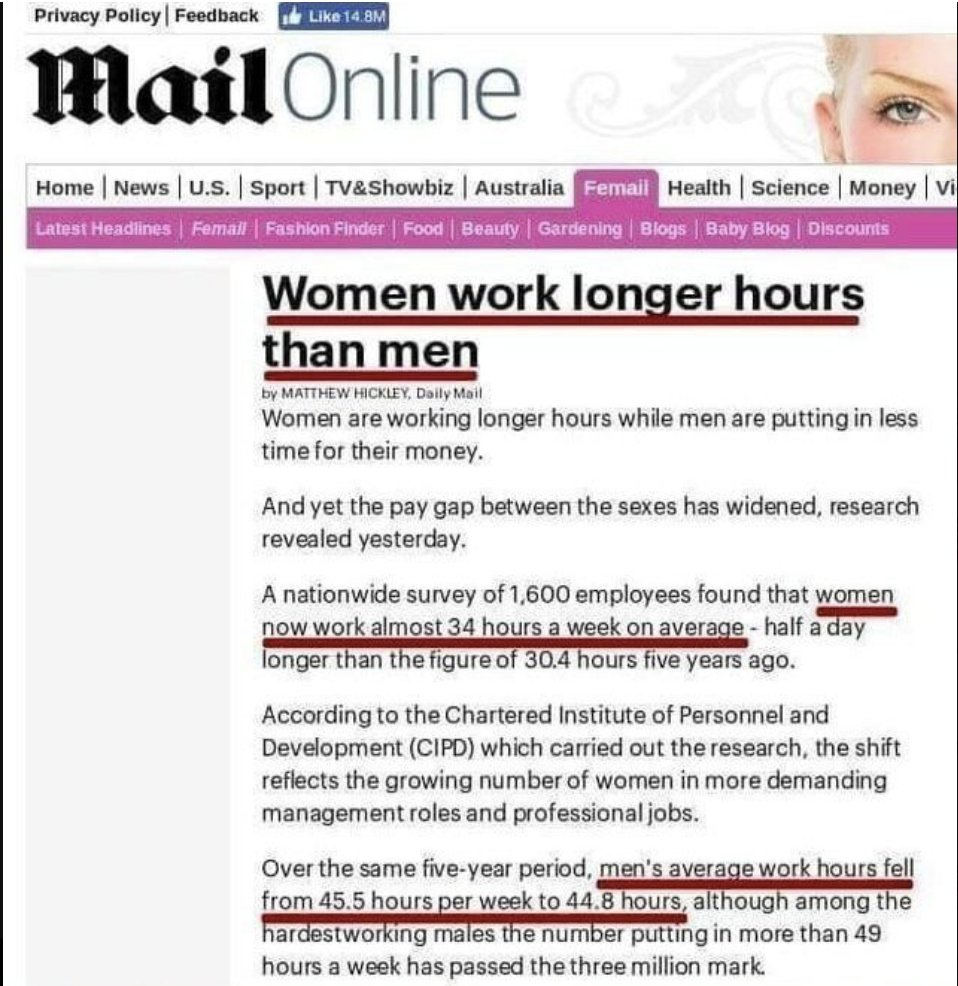
Even if the numbers don’t back it up, women feel that this is so true.
Social psychologist Roy Baumeister explored the relevant research in Is There Anything Good About Men (2010), a cautiously non-feminist book in which the author readily asserted that he, like most everyone else, prefers women to men. Women are more lovable, he claimed, and more pleasant to be around.
But he was not quite willing to accept the now-mainstream thesis that women can replace men in all areas of society.
His thesis is summed up in the book’s sub-title: How Cultures Flourish By Exploiting Men. Men are the foot soldiers of civilization as well as its leaders. They are the ones who make things work or make new things.
Men are the ones who must prove their utility to society. Their drive to be useful has powered centuries of back-breaking work, risk-taking, tool-building, self-sacrifice, and outstanding performance of a sort that has never been expected of women (and still isn’t).
Women in the main tend not to work as hard as men to succeed because they don’t have to. Women developed different strengths and tendencies.
Women’s strength, for good and ill, is in the inter-personal arena: not only in caring for those who are weaker but also in being cared for by those who are stronger. Women are good at reading people’s emotions and desires, and at expressing their own.
Men are not rewarded for expressing emotions and desires; men are oriented to acting, often under pressure to perform competently, in large groups and systems.
“The female brain,” according to Baumeister, “tends to be geared toward empathy, which includes emotional sensitivity to other people and deep interest in understanding them and their feelings. In contrast, the male brain is oriented toward understanding systems, which means figuring out general principles of how things operate and function together, and this applies to inanimate objects as much as social systems” (p. 85).
Baumeister supports his argument in a book-length exploration of men’s system-building. He shows how men are driven to work with, and in competition with, other men to make it possible for large numbers of human beings to live together in complex, efficient networks. The large social institutions that have characterized western cultures, from the army to churches, from corporations to unions, and from market places to police forces, give evidence of men’s system-building.
Women can work well within the systems that men devise, but they rarely devise new systems on their own. This is not because women are, on average, less intelligent than men (except at the very highest levels). It is because women’s motivations and sources of satisfaction are generally different from men’s.
Women’s contribution to culture in nurturing children, providing companionship, and looking after the family home has been a crucial one. But it does not drive innovation or invent new technologies.
Even the most intelligent women are rarely compelled, as highly intelligent men often are, to pursue scientific and other breakthroughs with the single-minded focus necessary for greatness. Often, as in the case involving Matt Taylor discussed above, many women do not seem to value or understand the nature and importance of such breakthroughs.
Women’s main contribution in the male civilizational sphere has been to lobby for admission and then to complain about, and work to undermine, the male culture of competitive excellence.
March 4, 2026
QotD: Socialism
Ivor Thomas, The Socialist Tragedy, 1951.
February 5, 2026
The Mote in God’s Eye: A No-Win Scenario
Feral Historian
Published 26 Sept 2025For whatever reason books by [Larry] Niven and [Jerry] Pournelle always end up being a lot harder to cover than I expect. It’s not that the core ideas are buried in dense convoluted storytelling or unusually compelling characters (often quite the opposite) but rather I think that the core ideas are always a little uncomfortable to face head-on. And Mote is great example.
Niven and Pournelle create a scenario not only of the cyclical rise and fall of a civilization, but one that through a combination of biological and cultural factors points to the impossibility of long-term coexistence between Humanity and the Moties.
00:00 Intro
01:26 Aristocracy and Contact
04:11 The Moties
08:48 Crazy Eddie
10:18 The Middle Path?
12:53 The Gripping Hand
(more…)
December 7, 2025
“Anglofuturism” – slogan or beacon of hope?
At Without Diminishment, Robert King argues for Anglofuturism as the most hopeful path forward from the morass all of the Anglosphere seems to be bogged down in:

(From the Ministry of Space, created by Warren Ellis, 2004.)
Born in the digital backwaters of podcasts and Substacks, Anglofuturism has climbed into public view like a rocket nearing the King Charles III Space Station, gathering both attention and indignation as it ascends.
The New Statesman mutters about it being rooted in “nostalgia“, while the far-left activist group Hope Not Hate insists it is something deeply sinister. Yet their agitation merely confirms a familiar sequence. First, they ignore you, then they laugh at you, then they fight you, and then you win.
At its essence, Anglofuturism is a project of civilisational renewal.
It begins with the conviction that Britain’s decline is not destiny but a decision, and the consequence of decades of political miscalculations that consider the national story to be over, Britain’s very own “end of history”.
Just turn on the news and you will see evidence for this everywhere. Strategic islands like the Chagos Islands surrendered to the vassals of hostile powers. A once-thriving energy sector crippled by the ritual self-flagellation of net zero policies, despite abundant North Sea oil resources.
The capital city of London, once envied for its composure, now deafened by the shrill chants of imported grievances, “From the river to the sea”. Britain was once a country whose streets were said to be paved with gold, according to the legend of Dick Whittington.
Today, they are paved with boarded banks, betting slips, and vape shops. The country’s future is already playing out in London, a place where the nation of Britain has faded into the idea of “the Yookay”. Britain is told that because it once colonised, it must now invite colonisation, that because it once conquered, it must now submit.
The result is a people bending ever lower in the hope of forgiveness from a self-appointed virtuous minority at home, and from the ever-growing numbers of strangers who now claim the country as their own.
Anglofuturism is the vanguard against this ideology. It insists that love of one’s civilisation is a duty, not a sin. It binds identity to optimism, and pride to ambition. It seeks to remind Britons that its best days may yet lie ahead, but only if it learns once more to have confidence in itself.
[…]
The policy of splendid isolation simply will not work for the twenty-first century.
Enter CANZUK, the proposed alliance of Canada, Australia, New Zealand, and the United Kingdom. Four constitutional monarchies, four democracies, and four maritime powers linked by law, language, and lineage. Together they would represent over 140 million people and a combined GDP exceeding $6 trillion. It would be a realm on which, once again, the sun would never set.
Our shared day of remembrance on November 11 is a reminder that we partake in traditions born of shared sacrifice.
Such a bloc would not be a re-creation of empire, but a confederation of equals who share the responsibilities of defence and trade, coordinating space and science, and projecting stability from north to south and east to west.
It could stand apart from American turbulence, Chinese authoritarianism, and European stagnation, and be a new civilisational pole rooted in innovation and freedom under common law. It could even be a new contender to lead the free world.
Britain is still a nation successful at exporting ideas like capitalism, liberalism, and, regrettably, Blairism. Anglofuturism could be its most powerful export to the Anglosphere yet.
For those of us at the edge of that world, in Cape Town, Perth, or Vancouver, the message of Anglofuturism is that our story is not over. Our civilisation may be weak, even fading, but it can be revived. Doing this will demand the same courage that built it, in the spirit of the pioneers and soldiers, the engineers and thinkers who shaped continents and defended freedom when it was under siege.
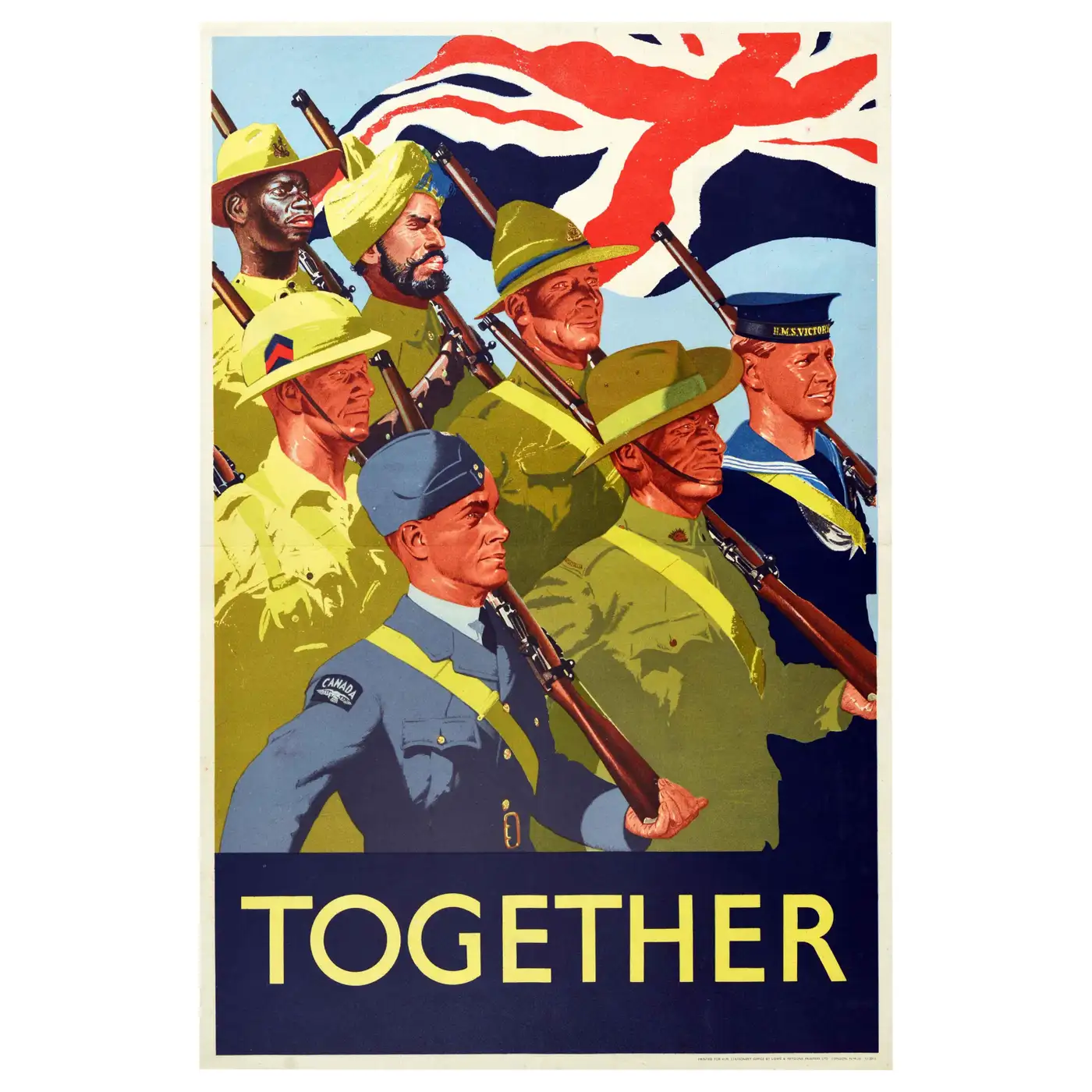
Like this, but better.
November 5, 2025
A minor gaming distraction
On the social media site formerly known as Twitter, Matt Gurney takes a few minutes while waiting for the impending catastrophe of the federal budget to be released to talk about a game I’m quite familiar with (and generally share his opinions on):
It’s budget day. My job is only going to get busy in the afternoon and evening. So now is a good time to inflict a non-news and non-political tweet on you. I want to talk to you all briefly about Civilization 7, which has had a troubled launch.
Some of you may follow me closely enough to know I’m a hardcore Civ fan. I’m a wannabe gamer. I love gaming. I could get really into gaming. But I don’t have the time. My preference is for games that are very deep and immersive and require hours of time for a single gaming experience. My life actually only enables me to basically do the opposite: a quick game on my phone that kills five or 10 minutes.
Civ is my guilty pleasure. I’ve played every major iteration of it since the first. And I was SUPER excited for the release of Civilization 7 earlier this year. The company that owns the rights, Firaxis, did a really interesting pre-release marketing job. They built a lot of buzz.
The game itself, which I obviously preordered and played on the day it released, was disappointing. It looked good, but it was very shallow. Every Civ iteration grapples with the challenge of needing to improve on/enhance the game experience compared to earlier releases, but also with the problem of complexity. If you just keep layering on new functions, you eventually make the game unplayable. So there’s a natural tension there. But 7 was still weirdly sparse. There were very basic user interface issues. Fonts were very small, colour choices led to a lot of struggle making out details. It all looked beautiful at a distance until you were actually trying to absorb any information, info necessary to effectively play the game, at a glance. It was impossible. Also, and this is a separate but related problem, some very basic functions and information necessary for gameplay simply wasn’t explained. You kind of had to intuit things.
There were big, structural changes to the gameplay as well. How the game works is very different from earlier iterations. These changes were very controversial — seemingly hated, to be honest. I didn’t actually hate them. I didn’t always love them, but I was pretty open minded to them and kind of liked some of the new mechanics.
But. Ahem. The game itself regressed in some key ways, compared to its predecessor, Civ 6. A small example: religious warfare. For non-players, in Civilization, you can control units for your empire and you move them around the map. Military units can fight other military units, and can seize and defend territory. Religious units were a totally different game mechanic that players would use to export their religion, and to prevent their own cities from being converted. It added a really fun and elegant layer to the game, and one that could be meaningful enough to swing outcomes in a big way.
Civ 7 just nerfed that. Religion is useless. Worse, it’s annoying.
The company has been very aggressive at rolling out updates to fix some of these issues. They’ve also been very open in communicating what they’re working on to the audience. I admire that. I really do. But the numbers don’t lie. Civ 7 is, today, drawing maybe 15-20% of the audience that Civ 6 did. (Using Steam Charts for those figures.) I don’t know if this is a flop for Firaxis, but it has to be a disappointment verging on a disaster.
They’re rolling out a lot of updates and new content to try and fix these issues. And I think they’re making strides. But, like, yikes. Every time they announce a new update, I’m shocked by how much of that stuff should have just been in the game in the first place.
I’m not a gaming expert, like I said. I wish. I’m also not an expert in gaming as a business. I’m just a guy who loves playing Civ. I’ve stuck with 7 since it was released and I’ve given every major update a fair chance. I’ve had fun playing the game. But I just can’t deny that 6 was much better, more playable, and more fun. And I don’t know how much more time the developer has before even hardcore fans like me just give up and go back to 6 permanently.
Anyway. This is what happens when all the news is due to come out later in a day.
Thank you for your attention to this matter!
Matt is more patient with Firaxis than I am, I have to admit. I downloaded and played Civilization VII on release day … played a few rounds of a couple of different civilization/leader combos … played one up to the new “change your entire civilization to a totally different one in a new age” mechanic, saved and quit the game. I’m sure I’ll play again at some point, but VII didn’t grab my attention and interest the way all the earlier iterations had done and I hate hate hate the swapping civilizations gimmick with a passion because it ruins my immersion in the civilization I’m trying to build. But I’m pretty far from being the target market for this game, so take my dissatisfaction with a shaker of salt.
October 18, 2025
QotD: Civilizational survival after the Bronze Age Collapse
Sometimes the answer is obvious. The Assyrians and Babylonians clearly survived the Collapse: if you compare their architecture, inscriptions, artwork, settlement patterns, and political structures from the Late Bronze Age to the Iron Age, they are recognizably the same people doing the same things and talking about them in the same way. The Egyptians, too, are plainly the same civilization throughout their (very long!) history, even if they were notably weaker and less organized after the Collapse. The Hittites, just as obviously, did not survive (at least not outside their tiny rump states in northern Syria). But the Greeks and the Phoenicians are both murkier cases, albeit in very different ways.
On the one hand, Mycenaean civilization — the palace economy and administration, the population centers, the monumental architecture, the writing — indisputably vanished. The Greeks painstakingly rebuilt civilization over several hundred years, but they did it from scratch: there is no political continuity from the Mycenaean kingdoms to the states of the archaic or classical worlds. And yet as far as we can tell, there was substantial cultural continuity preserved in language and myth. Admittedly, “as far as we can tell” is doing a lot of work here: Linear B was only ever used for administrative record-keeping, so we can’t compare the Mycenaeans’ literary and political output to their successors the way we can in Assyria or Egypt. We can’t be sure that the character, the vibe, the flavor of the people remained. But the historical and archaeological records of the later Greeks contain enough similarities with the descendants of the Mycenaeans’ Indo-European brethren that the answer seems to be yes.
By contrast, civilization never collapsed in central Canaan. No one ever stopped having kings, writing, building in stone, or making art. The Bronze Age population centers were continuously occupied right up to … well, now. And yet their way of life shifted dramatically, to the point that we call them by a new name and consider them a different people. Cline thinks this is a success story: borrowing an analytical framework from a 2012 Intergovernmental Panel on Climate Change report, he praises their “transformation”,1 which “include[d] actions that change the fundamental attributes of a system in response to actual or expected impacts”. (The Assyrians, by contrast, merely “adapted”, while the Egyptians barely “coped”.) But does there come a point when the change is so great, so fundamental, you’re no longer the same civilization? Can the Ship of Theseus really be said to have “survived”?
In the final section of his book, titled “Mycenaeans or Phoenicians”, Cline asks how we’ll react to the societal collapse we all sort of know is coming sooner or later. Our world just is too complicated, too interconnected, to survive a really massive shock (or, as in the Late Bronze Age, a “perfect storm” of smaller ones). Even the relatively mild disruptions of the past few years have revealed fragilities and vulnerabilities that we’ve done nothing to shore up since. Of course, he has an answer: Transform! Innovate! Flourish amidst chaos! Become a new iteration of yourself, like the bog-standard Canaanite cities that reinvented themselves as an Iron Age mercantile superpower and turned the Mediterranean into a “Phoenician lake”. But at what price?
Or, to think of it another way, what would you prefer for your society five hundred years from now?
Behind Door Number One: governmental collapse, abandonment of the population centers, dramatic reduction in societal complexity, and then a long, slow rebuilding where your time and your people are remembered only as myth — but when civilization is restored, it’ll be by people whose the desires, values, attitudes, and beliefs, their most basic ways of understanding the world, are still recognizably yours. They may have no idea you ever lived, but the stories that move your heart will move theirs too.
And behind Door Number Two: expansion, prosperity, and a new starring role on the world stage — but a culture so thoroughly reoriented towards that new position that what matters to you today has been forgotten. Do they remember you? Maybe, sort of, but they don’t care. They have abandoned your gods and your altars. Those few of your institutions that seem intact have in fact been hollowed out to house their new ethos. A handful of others may remain, vestigial and vaguely embarrassing. But boy howdy, line goes up.
Obviously, given our druthers, we’d all be the Assyrians: seize your opportunities, become great, but don’t lose your soul in the doing. But if it comes down to it — if, when the IPCC’s warning that “concatenated global impacts of extreme events continues to grow as the world’s economy becomes more interconnected” bears out, the Assyrian track isn’t an option — then I’d take the Greek way.
I don’t care whether, on the far side of our own Collapse, there’s still a thing we call “Congress” that makes things we call “laws”. Rome, after all, was theoretically ruled by the Senate for five hundred years of autocracy as all the meaning was leached from the retained forms of Republican governance. (Look, I’m sorry, you can call him your princeps and endow him with the powers of the consul, the tribune, the censor, and the pontifex maximus, but your emperor is still a king and the cursus honorum has no meaning when the army hands out the crown.) I don’t even really care if we still read Shakespeare or The Great Gatsby, although it would be more of a shame to lose those than the Constitution. But I do care that we value both order and liberty, however we structure our state to safeguard them. I care that we’re the sort of people who’d get Shakespeare and Fitzgerald if we had them around. Maybe we should start thinking about it before our Collapse, too.
Jane Psmith, “REVIEW: After 1177 B.C., by Eric H. Cline”, Mr. and Mrs. Psmith’s Bookshelf, 2024-07-08.
- “Transformation” is always a term worth taking with a pinch of salt because so often it’s a euphemism for “total civilizational collapse”. In the chapter on the Hittites, for example, Cline quotes one archaeologist to the effect that “[a] deep transformation took place in the former core of the empire around the capital Hattusa, resulting in a drastic decrease in political complexity, a shift to a subsistence household economy and a lack of evidence for any public institutions”. Relatedly, one of my children recently transformed a nice vase into a pile of broken glass.
In this case, though, Cline really does mean transformation.
October 17, 2025
Civilizational collapse is … female
On her Substack, Janice Fiamengo addresses the unpalatable contention that female power leads to civilizational disaster:
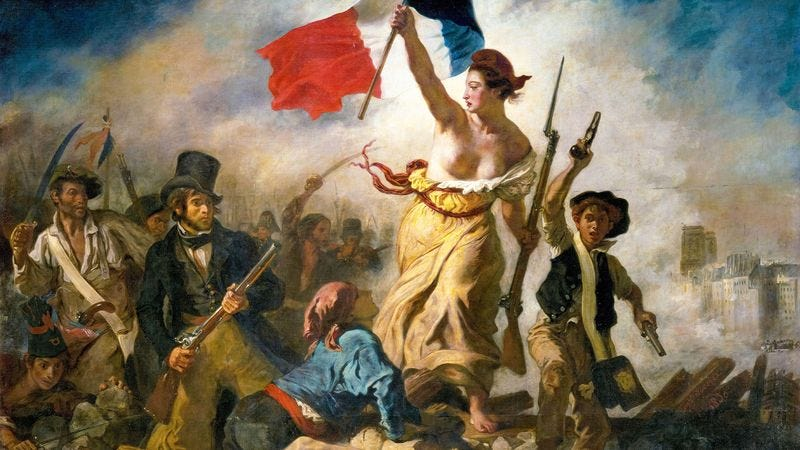
Liberty Leading the People by Eugene Delacroix
Multiple surveys (see, for example, with thanks to James Nuzzo, here, here, here, here, here and here) suggest that when women hold power, they pursue typically feminine preferences and policies. Female-led institutions become more oriented to social justice than objective truth. Feelings matter above facts, context above law, and victimhood above expertise.
Protecting and promoting the allegedly vulnerable — through censorship, shaming, coercion, or lawbreaking/lawfare — becomes a greater priority than excellence or impartiality. Truth-tellers find themselves cancelled, Nobel prize winners reduced to tears, laws and policies applied unequally, white men accused and vilified, criminals cossetted, mental illnesses affirmed, and destructive policies embraced. No one who has paid attention over the past 20 years can be surprised by the findings.
Moreover, our ability to discuss this feminine revolution in values is hampered by the very logic of the revolution, as I will show. Both women and men, deeply disinclined to “harm” women, fail to confront the problem adequately.
Two discussions of the subject — an essay by two social psychologists at Quillette and, more recently, a conference speech by a feisty conservative woman — draw a line under the seeming inevitability of the west’s collapse. Even faced with that alarming prospect, most pundits cannot bear to imagine an alternative to the female-led assault on our core institutions.
Cheering on Women’s Empowerment
A 2022 article in Quillette, “Sex and the Academy“, provides a stark illustration of my thesis. The subtitle rules out the very conclusion the data supports, with the authors emphasizing that “The inclusion of women in higher education is a great achievement for Western liberal societies. How is this changing academic culture?”
The “great achievement”, as it turns out, will almost certainly be a lethal one.
The article was written by two academics, Cory Clark and Bo Winegard, both PhDs in social psychology. Winegard, a male scholar, had an unfortunate run-in with academic orthodoxy that led to his loss of employment; Clark, a female scholar, has a secure academic position. Both authors express enthusiasm for the takeover of academia by women even as they point out its damaging consequences. Neither one advocates any form of resistance, no matter how mild, to feminine academia’s assault on truth.
Summarizing the results of many surveys, Clark and Winegard demonstrate that while a majority of men favor free speech and the advancement of knowledge over emotional comfort, a majority of women prefer conformity, safety, and the protection of victim groups’ feelings. Not all women are indifferent to the traditional underpinnings of western civilization (and not all men support those underpinnings), but the general trends are clear.
Women are significantly more likely than men to support the cancellation of controversial speakers or the suppression of controversial research.
Women also tend to favor the existence of snitch lines to report people who cause offence. Women are more supportive than men of diversity quotas that exclude white men from consideration for prizes, positions, and promotions. (It would be interesting to know how many white women support diversity quotas that exclude white women from consideration for prizes, positions, and promotions.)
[…]
Asserting that both sides are pursuing worthy goals, the authors downplay the shock value of the findings, which show that women are, overall, less interested in truth and accuracy than men are. Imagine assessing such a finding as anything but catastrophic. Imagine calling the disregard for truth moral.
In place of truth, women value a utopian ideology that they perceive — usually without any consistency or adherence to fact, but nonetheless granted by Clark and Winegard — as “morally desirable”. But morally desirable for whom, and to what end? The use of the phrase, a misnomer, demonstrates how thoroughly the authors themselves are in thrall to the corrosive feminine culture they examine.
There is nothing moral (or generally desirable) about the suppression of truth-seeking research when it conflicts — or is perceived to conflict — with an allegedly emancipatory social goal. There is nothing morally desirable or indeed “protective” about shouting down an academic speaker because of the alleged harm of the speech. Naturally, social justice proponents would be outraged if their speeches were shouted down or their research blocked and censored.
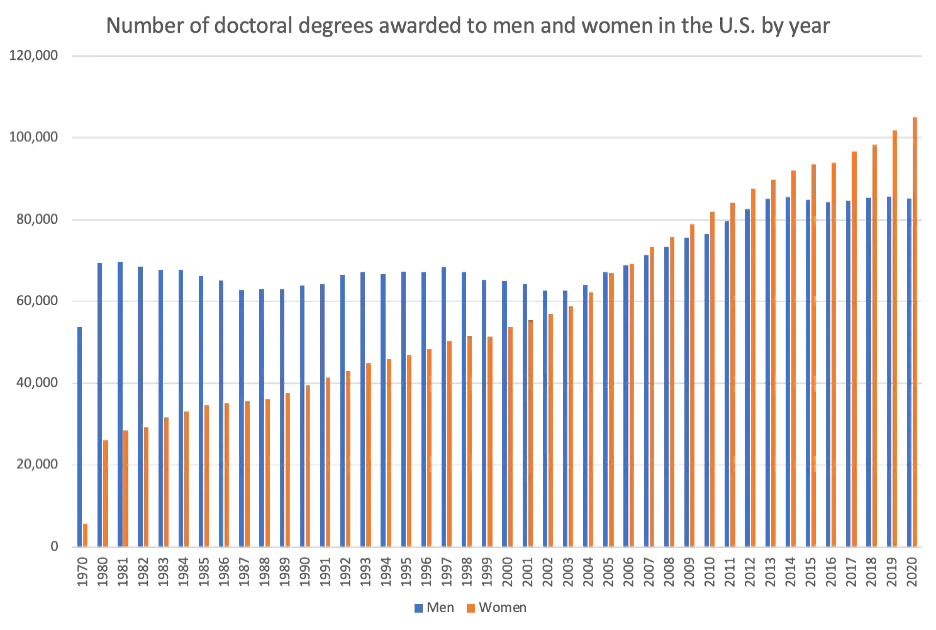

I saw a link to this Helen Andrews article which seems to go well with Janice Fiamengo’s article linked above describing the “Great Feminization”:
… Cancel culture is simply what women do whenever there are enough of them in a given organization or field. That is the Great Feminization thesis, which the same author later elaborated upon at book length: Everything you think of as “wokeness” is simply an epiphenomenon of demographic feminization.
The explanatory power of this simple thesis was incredible. It really did unlock the secrets of the era we are living in. Wokeness is not a new ideology, an outgrowth of Marxism, or a result of post-Obama disillusionment. It is simply feminine patterns of behavior applied to institutions where women were few in number until recently. How did I not see it before?
[…]
The substance fits, too. Everything you think of as wokeness involves prioritizing the feminine over the masculine: empathy over rationality, safety over risk, cohesion over competition. Other writers who have proposed their own versions of the Great Feminization thesis, such as Noah Carl or Bo Winegard and Cory Clark, who looked at feminization’s effects on academia, offer survey data showing sex differences in political values. One survey, for example, found that 71 percent of men said protecting free speech was more important than preserving a cohesive society, and 59 percent of women said the opposite.
The most relevant differences are not about individuals but about groups. In my experience, individuals are unique and you come across outliers who defy stereotypes every day, but groups of men and women display consistent differences. Which makes sense, if you think about it statistically. A random woman might be taller than a random man, but a group of ten random women is very unlikely to have an average height greater than that of a group of ten men. The larger the group of people, the more likely it is to conform to statistical averages.
Female group dynamics favor consensus and cooperation. Men order each other around, but women can only suggest and persuade. Any criticism or negative sentiment, if it absolutely must be expressed, needs to be buried in layers of compliments. The outcome of a discussion is less important than the fact that a discussion was held and everyone participated in it. The most important sex difference in group dynamics is attitude to conflict. In short, men wage conflict openly while women covertly undermine or ostracize their enemies.
Bari Weiss, in her letter of resignation from The New York Times, described how colleagues referred to her in internal Slack messages as a racist, a Nazi, and a bigot and—this is the most feminine part—”colleagues perceived to be friendly with me were badgered by coworkers.” Weiss once asked a colleague at the Times opinion desk to get coffee with her. This journalist, a biracial woman who wrote frequently about race, refused to meet. This was a failure to meet the standards of basic professionalism, obviously. It was also very feminine.
Men tend to be better at compartmentalizing than women, and wokeness was in many ways a society-wide failure to compartmentalize. Traditionally, an individual doctor might have opinions on the political issues of the day but he would regard it as his professional duty to keep those opinions out of the examination room. Now that medicine has become more feminized, doctors wear pins and lanyards expressing views on controversial issues from gay rights to Gaza. They even bring the credibility of their profession to bear on political fads, as when doctors said Black Lives Matter protests could continue in violation of Covid lockdowns because racism was a public health emergency.
[…]
The Great Feminization is truly unprecedented. Other civilizations have given women the vote, granted them property rights, or let them inherit the thrones of empires. No civilization in human history has ever experimented with letting women control so many vital institutions of our society, from political parties to universities to our largest businesses. Even where women do not hold the top spots, women set the tone in these organizations, such that a male CEO must operate within the limits set by his human resources VP. We assume that these institutions will continue to function under these completely novel circumstances. But what are our grounds for that assumption?
The problem is not that women are less talented than men or even that female modes of interaction are inferior in any objective sense. The problem is that female modes of interaction are not well suited to accomplishing the goals of many major institutions. You can have an academia that is majority female, but it will be (as majority-female departments in today’s universities already are) oriented toward other goals than open debate and the unfettered pursuit of truth. And if your academia doesn’t pursue truth, what good is it? If your journalists aren’t prickly individualists who don’t mind alienating people, what good are they? If a business loses its swashbuckling spirit and becomes a feminized, inward-focused bureaucracy, will it not stagnate?
If the Great Feminization poses a threat to civilization, the question becomes whether there is anything we can do about it. The answer depends on why you think it occurred in the first place. There are many people who think the Great Feminization is a naturally occurring phenomenon. Women were finally given a chance to compete with men, and it turned out they were just better. That is why there are so many women in our newsrooms, running our political parties, and managing our corporations.
On the social media site formerly known as Twitter, John Carter comments on Helen Andrews’ article:
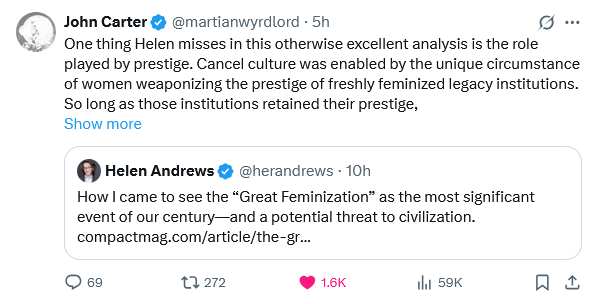
One thing Helen misses in this otherwise excellent analysis is the role played by prestige. Cancel culture was enabled by the unique circumstance of women weaponizing the prestige of freshly feminized legacy institutions. So long as those institutions retained their prestige, what the people who ran them said really mattered.
Unfortunately for the ladies (but luckily for civilization), this is self-limiting, because prestige is fundamentally an emergent property of masculine competence hierarchies. We see this demonstrated whenever a profession becomes coded as women’s work: its prestige immediately crashes. Feminists have complained about this for years, though of course they misunderstand the mechanism (prestige is a component of male sexual attractiveness, but not of female, and this is biologically hard-wired).
This prestige collapse is now affecting essentially every coopted, feminized institution — universities, news media, publishing houses, movie studios, large corporations, various government agencies, hospitals, courts, churches, all of them wield far less cultural power than they did even a few years ago. The only people who really care what these legacy institutions say are the women who took them over. To everyone else, the angry sounds they make are nothing more than background noise.
This is probably the main reason for the vibe shift. Once the prestige of feminized institutions declined below a certain threshold, their ability to enforce social consensus began to evaporate.
It’s also probably no accident that the Trump administration seems to care a lot more about what the anons of the Online Right say than it does about the opinion of the universities or the news media. All the intelligent young men got pushed out of the institutions, and those ionized particles of free male energy then began to self-assemble online into an ad hoc competence hierarchy where prestige is measured by clout rather than professional degrees, job titles, or institutional affiliations. The anon swarm is entirely informal, meaning that its outcomes are not amenable to antidiscrimination legislation or to procedural manipulation; you can screw with the algo all you want but you can’t actually force people to care what women say just because they’re women (thereby placing women into the position of openly trading in thirst, which gets them attention but certainly doesn’t mean that anyone has to pretend to take them seriously).
All that’s happened so far is that people’s attention has been redirected away from crazy woke females and towards the influencers of the online right. The fever has broken but society is a long way from recovered. The institutions are still under the control of crazy woke females, and this is extremely bad, especially because they are – for biological reasons related to childlessness — only going to get crazier as time goes on. Fortunately no one really cares what they say anymore, so as they throw tantrums as the institutions are reclaimed over the next decade or so, their protests won’t register as anything but irrelevant toddler noise.


