Quotulatiousness

June 27, 2026

“To quote the immortal Miles Gloriosus, ‘Even I am impressed’. It would be more merciful to just hang them.”

Filed under: Law, USA — Tags: , , , — Nicholas @ 05:00

On Substack, Tom Kratman discusses the recent trial and sentencing of a group of Antifa terrorists:

On 4 July, 2025, a group of ANTIFA engaged in a baited ambush outside an ICE facility, using fireworks and various riotous behaviors to entice out some members of law enforcement and shooting one of those.

They were quickly identified, in anything from some hours to two days. Of the presumed eleven of them on site, ten were also arrested within two days. Only Benjamin Song, the ringleader, managed to evade arrest for a while. Song, however, was captured within eleven days. Of those who were not present at the site but were part of the conspiracy, all were arrested within a few weeks. The total number of defendants is twenty-two, but six of those, so far, face only state charges.

Seven of the sixteen have already made plea bargains. So much for revolutionary solidarity. These have not yet been sentenced, though sentences of up to fifteen years in the big house can be expected. Of the nine who have already been tried in federal court, eight have been sentenced and one is pending. The eight sentenced, and their sentences, are as follows:

  • Benjamin Hanil Song: 100 years
  • Maricela Rueda: 70 years.
  • Cameron Arnold (aka Autumn Hill): 50 years.
  • Savanna Batten: 50 years.
  • Zachary Evetts: 50 years.
  • Bradford Morris (aka Meagan Morris): 50 years.
  • Elizabeth Soto: 50 years.
  • Daniel Rolando Sanchez-Estrada: 30 years.

Think about it, an average of fifty-six years and three months each. To quote the immortal Miles Gloriosus, “Even I am impressed”. It would be more merciful to just hang them.

Think, too, dear lefty, about how you would face that sentence.

So what can you, left-wing reader, take away from this incident? First and foremost, you should understand that you’re not going to get a lot of mercy in a federal court (and probably none from any southern state court) for this kind of behavior. Song and Rueda, for example, are somewhat unlikely ever to see the outside world again. Yes, there is time off for good behavior — Good Conduct Time, or GCT — in federal prison, but, Song, for example, will still serve eighty-five years even if he gets all of that GCT to his credit. There is another kind of mercy the Bureau of Prisons can grant, First Step Act sentence reductions, which can chop a sentence by up to fifty percent. However, since these convictions are for terrorism or terrorism-related crimes, FSA does not apply. Yes, Song is still going to stay in prison for at least eighty-five years.

Secondly, you should be very wary of ex-military types who might claim to know how to do things like train for, rehearse for, and conduct even comparatively simple operations like ambushes. It is hard to imagine a less competent ambush than the one run by Song. No, he had no idea what he was doing. We don’t know what Song’s (he was a Marine Reservist) MOS (Military Occupational Specialty) or even unit were, but the fact that that area has only artillery and aviation should have given the people he recruited some pause to reflect on how likely he was to understand how to do any of this or anything beyond, perhaps, shoot qualification on an administrative range. No, Marine REMFs,1 are still REMFs. Yes, they are REMFs who can to some extent shoot a rifle. This does not change them from REMFs. Yes, I know that few, if any, of you are knowledgeable enough even to suspect the difference between an MOS of tutu wearer and an MOS of cold-blooded killer. Take your ignorance into account, too, before taking direction from those who can talk the talk – or seem to you, in your incarnate ignorance, to be able to – but are unlikely to be able to walk the walk.

No, I am not going to tell you – and, yes, I definitely do know how to run an ambush – how it’s to be done properly. I will tell you that calling out “Get to the rifles”, as Song did, is not the way to do it.

Your movement probably has a bare handful of people who actually know what they’re doing, violence-at-scale-wise. So before signing your life away to someone claiming to be one of them, ask yourself, “What are the odds?” And then walk the other way. No, I’m not about to tell you how to tell the difference.


  1. Rear Echelon Mother Fuckers

June 12, 2026

Protests and riots send different messages to the PTB

Filed under: Britain, Government, Media, Politics — Tags: , , — Nicholas @ 03:00

While this is specifically related to the situation in Belfast, it applies to protests and riots generally:

The message of a protest is “we don’t like this”.

The message of a riot is “we don’t like this, and we’re able to do something about it”.

People who unconditionally call for peace and calm, regardless of the provocation, don’t fundamentally understand how politics works in the real world.

They do understand that the purpose of politics is to provide an alternative to violence, but that’s as far as their understanding goes. They don’t think through the implications, usually because they are quite comfortable with things as they are.

If politics is an alternative to violence, then politics is a proxy for violence.

And that means you have to dole out power in proportion to capacity for violence. Or someone’s going to figure out they can do better by flipping the table.

Monarchy wasn’t replaced by democracy because of fine-sounding philosophical ideals and eloquent documents declaring this or that.

Democracy happened because if you added rifling to the flintlock firearm, suddenly a individual farmer with a tube was the pinnacle of military technology, and now you had to keep all the farmers with tubes happy by giving them political power.

(Ancient Greek democracy had a similar relationship with the hoplite warrior.)

When political systems work well, for a while, the violence they represent becomes further and further from people’s minds, and those who can’t effectively commit or direct violence worm their way into power, and begin to take it away from those who can.

And they’ll defend their position by saying that violence is unthinkable, barbaric, always bad, must be disavowed at all costs, etc.

This isn’t some sort of high-minded principle on their part. It simply means one of two things. Either “the status quo works for me, so I don’t want you to upset it”, or “I suck at violence, and I don’t want to have to fight”.

They want young men demoralized, so that their artificial meritocracy of spreadsheets, or their non-meritocracy of patronage networks, can be protected from the natural meritocracy of conflict.

This means that riots aren’t actually for achieving any specific material aim. They are for reminding the comfortable that judges and bureaucrats and policemen have home addresses and families. And that violence is always on the table.

A protest would only send the message that the Irish don’t want to be ethnically cleansed. But the bureaucrats and judges and lawyers already know that. They just don’t care.

A riot reminds them that they have to care, because the Irish have a long tradition of doing something about it.

May 20, 2026

QotD: “Gilded Age” Robber Barons didn’t have access to what even working-class Americans have now

Filed under: Business, Economics, History, Quotations, USA — Tags: , , , , , , , — Nicholas @ 01:00

Where Marx really went wrong was — and I know this sounds flip, but I’m as serious as cancer — being born in 1818. He lived his entire miserable life in a world where “labor” really was a physical thing. The richest robber baron of the Gilded Age lived a far different life, materially, than the poorest serf-in-all-but-name working in his factories …

… but the robber baron knew he needed the serfs. Their relationship was purely dialectical. Without his factory hands, no robber baron. And in a strange but very real way, the higher up the food chain your Gilded Age robber baron went, the more he was dependent on his serfs for his lifestyle. J.P. Morgan is usually credited as being the first guy to become a Robber Baron purely through finance. Carnegie, Rockefeller, all those guys had most of their wealth in financial instruments, of course, but those financial instruments rested on control of a physical product — Carnegie Steel, Standard Oil.

I’m probably being unfair to Jay Cooke, the Michael Milken of his day, but since more people have heard of J.P. Morgan let’s roll with it. Even though Morgan’s wealth was entirely on paper — he was nothing but a securities trader — his lifestyle utterly depended on a battalion of servants. In a very real way, you yourself, right now, live much better than J.P. Morgan did in his heyday. And not just because you have aspirin, antibiotics, and air conditioning, three taken-for-granted things ol’ J.P. would’ve given half his kingdom for. But because you have more time. If you’re hungry, you can open the fridge or the microwave and have all the food you need in a matter of minutes.

J.P. couldn’t. J.P. had to deploy an army of servants every time he wanted a snack, and those servants were constrained by things like “availability of ice” and “when is the fishmonger at his stall”. You’re hungry at 2am, you jump in your car and get some Taco Bell. It takes ten minutes. J.P.’s hungry at 2am and it’s tough titty, J.P., your ass is going hungry. Because even though you’re the richest man in the world and have legions of manservants at your beck and call, Taco Bell just isn’t there. Even if someone had had the brilliant idea to create a Gilded Age Taco Bell, it still would’ve taken hours:

Wake up the manservant. Wake up the groom and stableboy. Hell, wake up the horse, then saddle the horse, ride to the drive thru window … which in this case means “the house of the guy who runs Gilded Age Taco Bell”. At which point he has to fire up the oven, start pounding the tortillas, send his own legion of valets and stableboys and whatnot out to get the refried beans …

And that’s the other thing, J.P. — you’d best not pull that shit too often, because those people know where you live. Not only do they know where you live, they live with you. Literally under the same roof. You want to sleep easy? You’d best not beat the servants too often, buddy.

There’s only so much “class consciousness” one can develop in that world. Oh yeah, J.P. thought of himself as one of the Masters of the Universe, there’s no denying that. But J.P. lived in what was still a brutally physical world, in a way we PoMo people really can’t grasp. If you can’t imagine what it would take to get some Gilded Age Taco Bell, maybe geography will do the trick. Ever seen Gangs of New York? Even if you haven’t, you’ve probably heard the name “Five Points”. The worst slum in America in the 19th century, and 19th century American slums were world class …

That was right down the street from Wall Street. Literally. I am not in any way joking, and if I’m exaggerating a little for effect when I say “J.P. could’ve hit Five Points with a five iron from his swanky digs on Central Park West”, I promise you I’m not exaggerating much. You can look it up for yourself. The main reason the Union rushed troops straight from the Gettysburg battlefield, and no-shit shelled parts of the city with gunboats, during the Draft Riots was because Five Points (et al) was right fucking there, and they might’ve gotten it into their heads to lynch a few Masters of the Universe. Rich man’s war, poor man’s fight, right? Let’s see how you like it, you bankster bastards …

The PoMo “information economy” removes all that. The other day I joked about colleges like Bennington and Goucher. I cracked some jokes, yeah, but I wasn’t really joking. Those places aren’t for us. Wall Street is still a physical location, but it might as well be on the dark side of the moon for all any of us have access to it. J.P. couldn’t beat the servants too hard, or too often. The modern equivalent of J.P. isn’t even aware that he has servants. He just clicks on a website, and stuff appears at his door. Like magic. Hell, it IS magic for all he knows, and he surely doesn’t care, because all that shit is his by right. He went to Bennington, after all. He has achieved full class consciousness.

All of which suggests, of course, that while Marx was wrong about the end state — the State will not, in fact, wither away — he might well have been right about the solution to the “contradictions of capitalism”, if you follow me. And if that makes me some kind of godless pinko Commie subversive, well … I’ve been called worse by better.

Anybody got the lyrics to La Marseillaise in English?

Severian, “On Losing the Cold War”, Founding Questions, 2022-07-02.

Update, 21 May: Welcome, Instapundit readers! Have a look around at some of my other posts you may find of interest. I send out a daily summary of posts here through my Substackhttps://substack.com/@nicholasrusson that you can subscribe to if you’d like to be informed of new posts in the future.

October 24, 2025

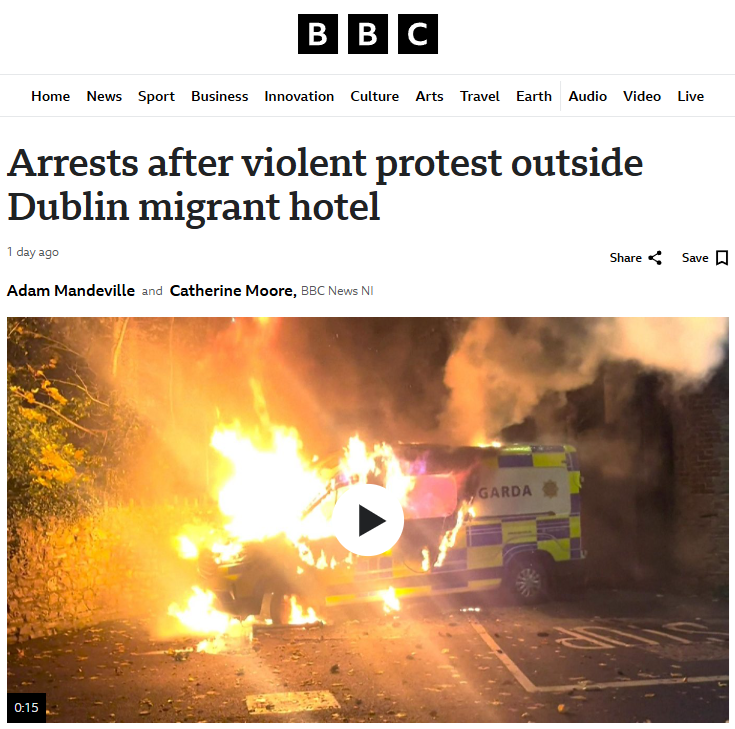
British and Irish media try to hide the crime that triggered Dublin riot

Filed under: Britain, Europe, Media, Politics — Tags: , , , , , , — Nicholas @ 03:00

In Spiked, Brendan O’Neill on the complicity of British and Irish media in trying to cover up the reasons behind the violence in Dublin outside a hotel housing migrants:

Last night, the BBC told one of the grossest lies of omission I have ever seen in the mainstream media. It published a report about the disturbances outside a migrant hotel in County Dublin and nowhere did it mention what triggered the riotous behaviour. Three hundred and eighty-seven words pumped into the gadgets of the masses, every one of them devoted to damning the “thuggery” of those who assembled at the hotel. Not one of the words – not one – addressed the thing that angered them.

What was that thing? It was the alleged sexual assault of a 10-year-old Irish girl by a failed “asylum seeker” on the grounds of the hotel. An alleged assault so serious that the girl was hospitalised. What’s more, this is a highly vulnerable girl in the care of the state. Maybe none of that matters to the BBC. Perhaps the alleged violation of a defenceless innocent by a man who was meant to have been deported from Ireland is immaterial to the aloof scribes of Britain’s public broadcaster. How else do we explain that they essentially redacted this information, one of the most salient parts of the story, from their initial dispatch on the fury gripping a community across the Irish Sea?

The irony of the BBC’s seeming indifference to the alleged horror that provoked last night’s disturbances is that it will compound the unrest on the streets. Indeed, it will confirm the sense that the media classes, in Dublin and beyond, give not one toss for the safety of people’s children or the validity of their own views on immigration. In so heartlessly erasing that girl from its early reportage, the BBC will have intensified the fiery anger of the very “thugs” it hates.

The disturbances made for unpleasant viewing. They took place outside Citywest Hotel in Saggart, a town in County Dublin about 12 miles from Dublin city. This is a hotel that just last month was sold to the state for €148million for the purposes of housing migrants. Then this week, an assault of the most appalling kind allegedly took place either on its grounds or in its vicinity. A girl was hospitalised, and a man in his thirties was arrested.

The details are distressing. The 10-year-old girl was in the care of the Irish Child and Family Agency. She reportedly absconded from staff during a recreational trip to Dublin city. She was reported missing to An Garda Siochana (the Irish police). She was later found close to Citywest Hotel and reported that she had been assaulted. As part of their investigations, the Gardaí have arrested a man who arrived in Ireland six years ago, who failed in his application for asylum, and who has been the subject of a deportation order since March.

Everyone must let the investigation take its course and the truth be ascertained. The anger of the people of Saggart is wholly understandable but riotous violence is never the answer. Cops outside Citywest were pelted with a volley of bottles. Brick walls were dismantled to turn into projectiles to hurl at the guards. At one point, Irish lads even charged the police lines with horse-drawn sulkies (carts). These were grim scenes, echoing the riot that rocked Dublin city in November 2023 following the stabbing of three children by a man from Algeria.

Not the Bee has some video clips of the scenes outside the Citywest migrant hotel.

Update, 27 October: Welcome, Instapundit readers! Please do have a look around at some of my other posts you may find of interest. I send out a daily summary of posts here through my Substackhttps://substack.com/@nicholasrusson that you can subscribe to if you’d like to be informed of new posts in the future.

October 11, 2025

QotD: Riot control tips

Filed under: Media, Military, Politics, Quotations, USA — Tags: , , , , , , — Nicholas @ 01:00

1. The press is not only the enemy; they must be presumed to be an utterly unprincipled and dishonest enemy. Anything and everything the riot control force does will be filmed and, if necessary, edited, to present it in the worst possible light. Therefore, they must have their own camera teams recording everything to both clear themselves of wrongdoing or spurious charges of indiscipline, as well as to discredit the press which will have edited the truth heavily. NB: There is no real limit to how dishonest the modern press can be and will be in support of the leftist agenda. There is no placating them. There is no degree of righteous conduct they will not twist into wrongdoing. There is thus no sense in trying to placate them, in trying to be nice, in tightly limiting violence, etc.; because they will lie about you and all those who want to believe their lies will.

2. Riot Control Women. They’re rather preposterous, in the main, if employed on the riot control line. It’s one of the reasons why MPs have for long been useless at riot control; they’re simply too heavily laden with women, who almost universally lack the size, strength, and aggressiveness for hand to hand combat with stone age weapons. Indeed, while the infantry and other combat and combat support unit in the old 193rd were excellent at riot control, the MPs – yes, I have seen it – were useless. Worse, riot control is a perfect environment to cause what the Israeli’s found out when they mixed men and women in the same units in their War of Independence; men will abandon the mission to succor one of their own women. This is the fault of the men, by the way, and not of the women, but it is even more the fault of the dogmatic shitheads of the left who refuse to see men and women for what they are.

3. Rioting women. I don’t care if you have a warrant for their arrest for murder, arson, mayhem, and massacre, plus cellulite and bad makeup, do not arrest or detain them at the scene. Shoot them if their conduct (to include dress) warrants it, but otherwise just push them away or wound them slightly and push them away. Why? Because, though ill-disciplined rabble, for the most part, the rioters are also mostly male and will also rush to the defense of “their” women. There is no better substitute for the cohesion and moral fiber a mob usually lacks than going after the women in the mob. They can turn ferocious very quickly, indeed, if you do.

And that’s all good and maybe it will get us through the summer, should it turn out as badly as it might, but, America, I suspect that you and the president are ultimately still going to need a dedicated, well trained, highly mobile, professional force for riot suppression.

Tom Kratman, The social media site formerly known as Twitter, 2025-06-11.

Update, 12 October: Welcome, Instapundit readers! Please do have a look around at some of my other posts you may find of interest. I send out a daily summary of posts here through my Substackhttps://substack.com/@nicholasrusson that you can subscribe to if you’d like to be informed of new posts in the future.

September 12, 2025

QotD: Modern riot-control gear

Filed under: Media, Military, Politics, Quotations, USA, Weapons — Tags: , , , , — Nicholas @ 01:00

What the well-dressed riot controller is wearing this year:

I’ve hinted already at my severe disenchantment with the riot control manual. Most of the following will tend to indicate some of why. Note that this is pretty military specific, but you all ought to know what’s happening, what should happen, and what isn’t happening with regards to riot control.

Head: Protection of the head involves also protection of the face, neck, and, especially, the eyes. The standard military issue Kevlar helmet is adequate for protecting the head from blunt force trauma and even some bullets . It does nothing for the face. There are shields that attach to the helmets to protect the face and which usually reach down enough for neck guard. However, after a cursory search or three for what’s on offer now, as with the old style ones I discussed previously, they can be blurred and ruined with solvents. Yes, this would seem to include polycarbonate as well; that’s how pieces of Lexan are glued together, actually. It’s a problem. Neither can I find a face shield that is glass over Lexan, though they may exist.

Moreover, while there are masks – nicely intimidating motorcycle rider masks, for example – that are black and which could have relatively cheap replaceable clear eyepieces made, they are close fitting, hence would interfere with donning the protective mask when it comes time to use RCA or when smoke from burning buildings gets to be a bit much. The only solution I can see is twofold: 1) Have a ready supply of extra face shields on hand, and 2) make the immediate penalty for attacking a mask with solvents a reasonably severe beating with some kicks and stomping.

Special Tip #1: If you’re using your issued helmets, troops and commanders, turn the camouflage band around so the rioters can’t see your name. This is for two reasons. One is to prevent personal retaliation against your men or their families. The other is to send a message the rioters will understand very clearly because they’re using anonymity for the same purpose, to stay out of court. In other words, the message you send is, “Get close enough to this soldier or policeman for him to hurt you and he will, all the more readily because you can’t identify him for civil suit or criminal complaint.

Chest: The current issue torso armor seems adequate for most threats it will encounter in riot control, but, at thirty-three pounds, strikes me as awfully heavy for an activity that is already about as physically intense as a battlefield, if not even more so. With an E-SAPI plate in front, that runs nearly to forty pounds, which is simply too damned much. There is room for some minor weight savings, as will be shown below, under “Protective Mask.”

There are lighter and quite likely better armor suites coming along or already on hand for the special operations folks, but if they are not available for a unit tasked for riot control, I’ll have to say, “Suck it up; wear the vests you have; keep about ten percent of your force in reserve, unarmored but ready and drilled to suit up in a hurry, to relieve people who become exhausted from the weight and heat retention.

Special Tip #2: You want the armor not only to protect your men, but also to protect them enough to keep them from losing their tempers and running wild. When they hurt somebody, it needs to be because the commander wants that somebody hurt, that the mission is advanced by that somebody being hurt, and not because of a breakdown in discipline.

Armament: For a number of reasons, I recommend against using bayoneted rifles. The downsides are numerous, so I’ll limit myself to a few. 1) They require both hands; this means that the riot controller cannot use a shield. 2) The act of fixing bayonets, all on its own, constitutes deadly force. Yeah, just fixing them. So you won’t be allowed to do it. 3) That means you end up with this bullshit:

https://en.wikipedia.org/wiki/Flower_Power_(photograph)

Instead, use batons. However, for that I have no less than two tips.

Special Tip #3: Grease the last eighteen inches or so of the batons with something non-water soluble, like Vaseline. No, this is not as an aid to anally raping the rioters with the batons, however tempting that may come to seem. Rather, it is to keep the rioters from snatching your batons away, which snatching encourages them to no end. If you don’t have petroleum jelly handy, thicker rifle lubricant, like LSA, can work, but spread it very thinly, so it doesn’t run.

Special Tip #4: Drive finishing nails into the ends of your batons and snip them off to leave about an inch sticking out. No need to sharpen the part sticking out; it’s sharp enough to penetrate and leave a painful puncture wound, whether directed at arms or torsos or thighs or groins (ouch!).

Shields: There are any number of makers of perfectly serviceable riot control shields, some of which are, although frightfully heavy, bullet proof. If you need bullet proof shields, I would suggest that you’re way past the point of suppressing a riot and already involved in a civil war. In that case, shoot back accordingly.

Assuming for discussion’s sake, however, that we aren’t quite at that point yet, the shields are extremely useful. They deflect rocks and bags of shit. They can cause a Molotov to go off somewhere other than on the riot controller or at his feet. They are, themselves, offensive weapons. As Suetonius said, just before kicking Boudicca’s Britannic ass: “Knock them down with your shields, then finish them off with your swords”.

The world being as it is, however, full of iniquity and injustice, when Battalion X of the YYth division gets alerted for riot control, the shields will probably not be available. A careful search by J4 will show that “They are either in Iraq or were left behind on Johnson Island, lest Greenpeace show up some day. Or maybe they were turned into a reef for some endangered fish. Who knows?” Hence, make your own. The example below was made by one of the handier troops of B-3/5 Infantry, Panama Canal Zone, in 1983. It’s just half inch plywood, 19 by 24 inches, though they can be cut larger to fit the larger troops, with arm straps cut from condemned nylon webbing and bolted on. The almost horizontal piece is one shoulder strap from the harness of nylon load bearing equipment, stapled on and serving as a shock pad for the arm. Yes, if you actually have to make something like these do not forget the shock pad. I’d recommend not painting them with unit insignia. We were, at the time, on testosterone overload and wanted people to know who was kicking their butts.

Note, a larger shield doesn’t necessarily protect more, it just moves more slowly to protect what needs protection. These shields are very light and, given the geometry of the matter, able to be moved very quickly indeed to protect any exposed part of the body, to include the thighs and crotch. Speaking of the …

Crotch: Move your/have the troops move their protective mask and carrier from the left hip to right in front of the family jewels. It won’t slow down donning the mask appreciably and it will save a little weight while providing adequate crotch coverage.

Tom Kratman, Twitter, 2025-06-09.

August 8, 2025

Germany’s Darkest Night Yet? – Rise of Hitler 21 – September 1931

Filed under: France, Germany, History — Tags: , , , , , , — Nicholas @ 04:00

World War Two
Published 7 Aug, 2025

September 1931: Berlin descends into chaos as Nazis unleash a violent pogrom on Jewish New Year — while the police stand by. The scandal of the Kurfürstendamm riot rocks Germany, but the month’s headlines don’t stop there: Hitler’s niece is found dead under mysterious circumstances, France’s leaders visit Berlin to a frosty reception, and Japanese troops invade Manchuria. Extremists surge at the polls as democracy teeters — can the Republic survive?
(more…)

June 24, 2025

Political violence increases as the power of the state increases

Filed under: Government, Media, Politics, USA — Tags: , , , , — Nicholas @ 05:00

Many people note that they don’t remember political conflicts being quite so nasty in years past as they are now, but the more power that accretes to the state the higher the perceived — and actual — risk of allowing the state to fall into the hands of your opponents. We’d be far better off if partisans would consider the possibility that the latest addition to state power they support will be used by their political opponents after the next partisan shift in electoral fortunes … if you fear this power in the hands of a Trump, you shouldn’t put it in the hands of a Biden.

As should be obvious to anybody following news about riots, assassinations, and arson attacks, politics have become far too important in America. With government large, growing, and reaching into every nook and cranny of our lives, Americans perceive politics as too much of a high-stakes game to lose. And so, they have divided into hostile camps to make sure their side comes out on top — and some turn ideological conflict into literal war.

A Surge in Political Violence

That point came home to me after Israel launched its preemptive attacks against Iran’s nuclear facilities. My wife’s rabbi (she’s Jewish and I’m not) called me and asked if I was willing to work security during services on Saturday. “No Kings” protests were planned across the country for the day, with the potential to turn nasty at the hands of people who insist anybody wearing a Star of David bears responsibility for the Israeli government’s actions. Tensions were already high after the Molotov cocktail attack on Jews in Boulder, the murder of two Israeli embassy staffers in Washington, D.C., and the firebombing of Pennsylvania Gov. Josh Shapiro’s official residence on the first night of Passover.

So, I spent much of Saturday standing in front of the synagogue, wearing a ballistic vest, with a pistol holstered on one hip and pepper spray on the other.

Underlining the point was that two Minnesota state lawmakers were targeted by an assassin the same Saturday — fatally in the case of one legislator and her husband. The day’s protests were predominantly, but not entirely, peaceful. That’s better than we’ve seen at recent protests against immigration enforcement that turned violent in Los Angeles and Portland, and at some pro-Palestine demonstrations.

That’s all recent. If we go back in time just a little, there’s the bombing of a fertility clinic by an “anti-natalist”; attacks on Tesla cars, dealerships, chargers, and owners by people opposed to Elon Musk’s temporary role in the Trump administration; and, notably, the murder of Brian Thompson, the CEO of UnitedHealthcare. The alleged assassin, Luigi Mangione, has become something of a celebrity.

“Targeted violence is becoming normalized online and in the real world,” warned a December 2024 report from the Network Contagion Research Institute, affiliated with Rutgers University. “Memes, viral content, gamification and the lionization of Luigi Mangione are constructing frameworks that endorse and legitimize violence, encouraging harassment and further acts of violence against corporate figures.”

The report added that “the spread and scope of justifications for murder have significantly eroded what was once a barrier between mainstream society and fringe online communities that supported violence and glorified killers.”

May 20, 2025

The Death of Marat

Filed under: France, History, Politics — Tags: , , , , , — Nicholas @ 04:00

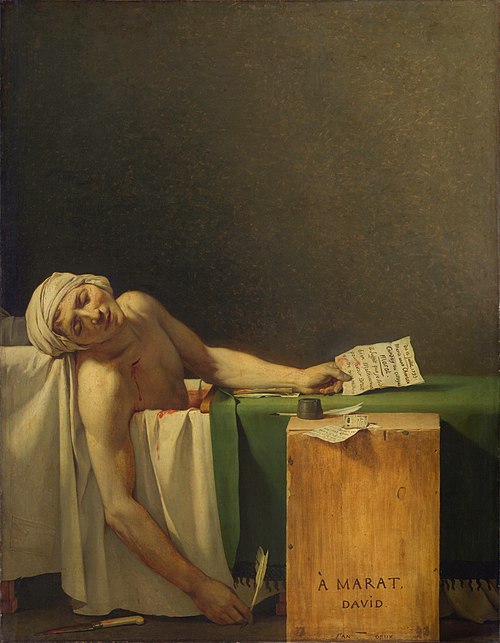
Daniel Jupp uses the famous Jacques-Louis David painting of the 1793 assassination of French revolutionary leader Jean-Paul Marat by Charlotte Corday to illuminate the twisted dealings of the various radical factions within the larger revolutionary movement:

La Mort de Marat (The Death of Marat) by Jacques-Louis David (1748-1825)
From the Royal Museums of Fine Arts of Belgium via Wikimedia Commons.

One of the most famous and celebrated works of art in European history is a painting about a political assassination. That painting is The Death of Marat (La Mort de Marat in French) by Jacques-Louis David. It was painted in 1793. David was already one of the most respected French artists of the 18th century, a leader of French Neoclassical art. He was also himself a political figure, a prominent member of the Montagnard faction (itself a subset of the Jacobins) and a member of the revolutionary Committee of General Security.

It’s an overtly political painting in every way, created by a man who was as much a French Revolutionary politician as he was an established and esteemed artist. It’s about a shocking political event, and it was crafted as an exercise in propaganda. […] The painting shows us Marat in his bath, immediately after being assassinated by Charlotte Corday on the July 13, 1793. It is a beautifully composed image of political martyrdom. Marat’s posture, for anyone with the slightest awareness of Western art traditions, immediately shows where the sympathies of the artist lie (and also, where the sympathies of the artist lie).

Marat’s pose is, of course, a deliberate mirroring of the pose of Christ in hundreds if not thousands of Western art traditional depictions of the Crucifixion. The pale, slim but muscular figure, marked by the assassin’s blade but in a manner that might be compared to the puncture wound inflicted by the Spear of Longinus or to the stigmata nail wounds of crucifixion on Christ himself, has that peculiar serenity in death that other artists place in depictions of Jesus. The blood is present as proof of supreme sacrifice, but artistically minimised, prevented from distracting from the clean, shining, almost marble-like flesh of the deceased, who is already a kind of heroic statue in repose, fixed for the admiration of the ages. The dead man has a gentle, compassionate smile on his lips, as if interrupted in the process of forgiving his murderer. The angle, the gentleness, the delicacy of it all suggests Christ-like self sacrifice, as if Marat has chosen his death knowingly, given his life willingly.

Here is the martyr of the Revolution. A new Christ, as good as the old one … if not better.

[…]

It’s at this point that we should mention the central dishonesties here. Christian self sacrifice and martyrdom is a very different thing to one politically radical extremist being murdered by another. Marat was, in reality, about as far away from this movingly gentle depiction of him as one could imagine. As one of the most radical and zealous figures of the Revolution, Marat was a lesson for the ages in the exact opposite way to the one that David depicts. He wasn’t a gentle figure of self sacrifice. He wasn’t a Lamb bringing Peace in the manner of Christ. He wasn’t an innocent. He was a brutal, grasping, rapacious sadist. He was one of the leaders of the storming of the Bastille, and that too has symbolic and practical importance – the terrible monarchical regime had hardly anyone in its most hated prison, whereas the Revolutionary “liberators” soon stuffed it full of their political enemies.

Even at a point where many murders were already being committed, Marat was noted as an unusually brutal proponent of Revolutionary excess. His assassin was from a rival, supplanted Jacobin faction, the Girondists. The Girondists too had supported the earliest uses of violence, riot and uprising within France, and were a “war party” who wanted to export the Revolution abroad and topple monarchical dynasties across Europe. These two factions did not really differ on whether you should murder your political enemies or not, but the Girondists were at times embarrassed by Montagnard violence when it was at its most indiscriminate. The Girondists tended to be the most intellectualised of the Revolutionaries. They were the writers of pamphlets and doctrines of great length and increasingly mind-numbing tediousness. Marat, although also a street-level gutter pamphleteer, was much more of a bloody handed man of action, more akin to a modern terrorist. But the two were aligned in the creation of the bloodshed, even if the Girondins wanted it to be more focused and controlled and ultimately directed outside France:

    Temperament largely accounts for the dividing line between the parties. The Girondins were doctrinaires and theorists rather than men of action. They initially encouraged armed petitions, but then were dismayed when this led to the émeute (riot) of 20 June 1792. Jean-Marie Roland was typical of their spirit, turning the Ministry of the Exterior into a publishing office for tracts on civic virtues while riotous mobs were burning the châteaux unchecked in the provinces.

The split between the two factions came to a head as a fall out from the September Massacres of 1792. Marat, a leader of the peasant sans-culottes mobs, was personally engaged in the orgy of bloodshed. Girondist leaders were alarmed, already sensing that previously aligned Revolutionaries or widespread mob violence could turn on them. Typically, the Girondists took defensive measures that were mainly concentrated on written statements, declarations or on bureaucratic ministries, whereas the Montagnards gradually took control of revolutionary militias and the people who were prepared to actually decide, at the point of a sword or via the barrel of a musket, who got killed and when. Neither side could be described as moderates, but one side were more ruthlessly pragmatic, which is why it was the Girondists who ended up being put on the execution lists of the Terror.

At the time that Corday assassinated Marat, Girondists had already been ousted from positions of power and arrested. Marat, along with Danton and Robespierre, was one of their three most prominent denouncers and enemies. Corday stated that she had “killed one man so that 100,000 could be saved”. It’s clear that she had hoped her action would save her arrested Girondin allies and personal friends, but it had the opposite effect and sealed their subsequent trial and executions.

May 10, 2025

“Train how you fight” – British plod edition

Filed under: Britain, Government, India, Media, Politics — Tags: , , , , , , , — Nicholas @ 04:00

At Restoration, Connor Tomlinson looks at how British police forces are training and what it tells us about who they think they’ll be fighting:

Britain’s police aren’t training to stop riots—they’re preparing to crush the public.

One of the infamous quotes from George Orwell’s Nineteen Eighty-Four is, “If you want a picture of the future, imagine a boot stamping on a human face — forever”. He forgot to add, “on TikTok”. Last Thursday, the Metropolitan Police posted a montage of officers at the Metropolitan Police Specialist Training Centre in Kent, undergoing riot training. The caption read, “Bricks, bottles and fire bombs – our officers prepare for every eventuality at the Met’s elite training centre in Gravesend so they can keep you safe. Stronger tactics means safer communities.” It seems they had one specific “eventuality” in mind, as the mock rioters were wearing the Union flag. There wasn’t a keffiyeh or “Only good TERF is a dead TERF” sign in sight.

But fear not. The same Met Police who defended now-proscribed group Hizb ut-Tahrir’s demonstration after October 7th, saying “The word jihad has a number of meanings“, now insist that “The fact one of the t-shirts has a union flag on it is entirely coincidental”. Well, that’s me convinced. In fact, the Met are exhausted by your conspiracy theories, writing that “It’s disappointing we are increasingly having to challenge this sort of misinformation which only serves to increase divisions and tensions”. But the plummeting public trust in Britain’s police and justice system are of its own making. Britain’s security state is setting itself in opposition to the largely law-abiding indigenous host majority, while gaslighting them about the non-existence of a two-tier justice system that favors tribal minorities.

One might think, as Sam Bidwell suggests, the police should preoccupy themselves with preventing street conflicts not between Britain’s indigenous host and immigrant populations, but between its Indian diaspora and Pakistani enclaves. On April 22, Pakistani Islamist group Lashkar-e-Taiba killed 26 and injured 20 more in Indian-controlled Kashmir. Both nations cancelled the other’s visas, and are in the process of expelling foreign nationals before they expire. Pakistan has suspended all trade with and air travel from India. Hindu nationalist Prime Minister Modi has warned, “India will identify, track and punish every terrorist, their handlers and their backers, [and] we will pursue them to the ends of the earth.”

Thanks to decades of mass immigration and multiculturalism, Britain is home to powerful Indian and Pakistani ethno-political lobbies. Around 3 million Indians and 1.9 million Pakistanis live legally in the UK. They are substantially younger than the white British host population, and already brought Leicester to an ungovernable standstill in 2022 when Muslims and Hindus rioted for a month over a cricket match. Last Friday, both factions gathered outside the Pakistani Embassy in London for a mixture of a protest and a dance-off, replete with Indian, Pakistani, Israeli, and Palestinian flags. Most alarming was when Colonel Taimur Rahat of the Pakistani military appeared to make a throat-slitting gesture toward Indian protestors.

Both subcontinental factions have sympathetic politicians. They weaponize domestic antidiscrimination law to pursue foreign policy goals: for example, listing the denial of an independent Palestine and Kashmir as an example of Islamophobia, in guidance adopted by local councils. Conservative-party candidates committed to a Hindu Manifesto at the last general election, promising to further liberalize visa rules for dependents and elderly parents of Hindus already in Britain. Indian-heritage cabinet ministers, like Priti Patel and Rishi Sunak, instigated an unprecedented rise in Indian migration after Brexit. Patel described these migrants as “living bridges”, using Prime Minister Modi’s term.

March 8, 2025

Murder in the Name of Democracy – War Against Humanity 002

The Korean War by Indy Neidell
Published 7 Mar 2025

The battles on the Korean peninsula started long before 1950. Today Sparty looks back at the uprising and insurgency on Jeju Island in 1948, the threat of Communist revolt, and the harsh reaction of the Korean government. This really was the war before the war.
(more…)

December 20, 2024

Election Fever – Rise of Hitler 08, August 1930

World War Two
Published 19 December 2024

August 1930 brings Germany to a critical juncture as parties prepare for the September elections. Amid street violence, bans on political uniforms, and soaring unemployment, the stakes couldn’t be higher. This episode unpacks the campaign strategies, shifting alliances, and rising tensions shaping the Republic’s future.
(more…)

August 10, 2024

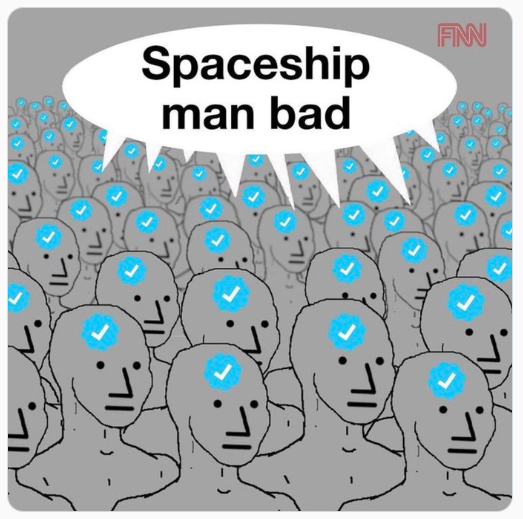
British NPCs have all downloaded the latest patch – “Spaceship Man Bad!”

Elon Musk is the new Emmanuel Goldstein for British NPCs:

I always knew Britain’s liberals were secretly illiberal. That our chattering classes who genuflect at the altar of “human rights” would happily snatch away the rights of anyone who says something offensive online. That these dwellers of the leafy suburbs who weep over the jailing of dissidents in China will chortle over the sacking or blacklisting of dissidents at home, whether it’s women who think you can’t have a knob and be a lesbian or ex-Muslims whose criticisms of Islam are a tad too salty. And yet even I’ve been shocked by their frothing rage against Elon Musk in recent days. By their priestly demands that X be censured and possibly even wiped from the web. It’s one of the most batshit things I’ve seen in ages.

It’s not enough to call this a “mask-off moment”. It’s more like the phoney liberals have ripped their masks to shreds and stomped them into the dirt for good measure. Their rage is linked to the riots currently rocking the UK. Musk’s own tweets, they say, not least his chatter about Britain being on the road to “civil war”, have helped to whip up the mayhem. Worse, his “free-speech absolutism”, as one “liberal” magazine snottily refers to it, has meant that every tosser with a smartphone has been able to tweet their inflammatory views on the riots and even to spread misinformation. In essence, says a writer for the Guardian, Musk has been “leading from behind on UK thuggery and race riots”.

Got that? The reason Britain is going to shit is not because of any internal rot but because a billionaire in Texas said “civil war” on the internet. Glad we cleared that up. Even worse than the great and the good’s shameless deflection tactics – where they try to pin the blame for their own failures on a foreigner with money – is their tinpot solutions to this supposed problem. It might be time, says that sexagenarian Marxian in a leather jacket, Paul Mason, to “pull the plug” on X entirely. Yesteryear’s tyrants smashed up printing presses and chased booksellers out of town – today’s want to switch off a website on which no fewer than half a billion souls regularly share their thoughts and feelings.

They really have taken leave of their senses. Musk’s “horrific version of Twitter” is “a bit like Paris under Nazi occupation”, says Peter Jukes of Byline Times, the preferred publication of rich liberals who’ve been in a state of red mist since the plebs voted for Brexit eight years ago. Just like Paris in the 1940s, says Jukes, some are fleeing Musk’s X, while others are sticking around to “work for liberation”. The narcissism of it. Imagine thinking that keeping your X account open so you can continue spouting bollocks in your echo chamber is as brave as when Parisians stayed in Paris to resist Nazi rule.

Any mention of the Nazis is usually a reliable sign of madness. And so it is with the outburst of Muskphobia among Britain’s influencers. Musk’s antics on X led “straight to” rioting in the UK, says Will Hutton of the Observer (my italics). Do they really believe this? Do they really believe the reason that young shirtless fella looted the Greggs in Hull is because Elon Musk said “#TwoTierKeir” on X? Apparently they do. And there’s only one solution. “Pass a bill closing down Twitter in the UK”, says barrister and arch Remoaner Jessica Simor. That she said this on Twitter at least provided us with fleeting comic relief amid the elite’s lunacy. Does she know she can deactivate her account? Can someone tell her?

It’s the haughtiness of Britain’s influential haters of Musk that is most irksome. Alastair Campbell accused Musk of talking “utter shite” about Britain and its riots. That’s big talk from the undisputed king of shite, the man whose BS about Iraq helped to start a war in which tens of thousands of Arabs perished. Look, I know Musk’s words hurt liberals’ feelings, but at least they don’t hurt people’s lives and limbs.

“Elon Musk’s menace to democracy is intolerable”, pronounced Edward Luce of the Financial Times. That’s the paper that regularly made the case for overthrowing the largest democratic vote in British history. “Democracies can no longer ignore” the threat posed by Musk’s X, says Luce. I don’t like the term dogwhistle, but this is a tyranny dogwhistle, isn’t it? It’s a nod and a wink at “democracies” to clamp down on the “menace” of unfettered online speech. Lewis Goodall of The News Agents – a podcast hosted by ex-BBC staff for whom the BBC wasn’t quite wanky enough – wonders if “unmediated platforms” like Musk’s X are “beyond redemption”. “Should we stop using it?”, he wonders. Please, yes.

February 1, 2024

Newfoundland – “We used to be a country”

In The Line, James McLeod outlines a difficult period for the Dominion of Newfoundland which ended up narrowly voting to join Canada rather than resume self-rule that they’d had up to 1934 when the Newfoundland House of Assembly abolished itself:

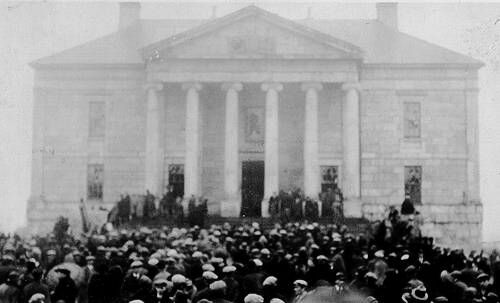
Great Riot of 1932 in front of the legislature, the Colonial Building, in Newfoundland.
Provincial Archives of Newfoundland and Labrador (Reference PANL A2-160), via Wikimedia Commons.

Before 1933, Newfoundland was proudly a dominion within the British empire. Under the Statute of Westminster, Newfoundland had the same legal status as Canada, New Zealand, South Africa and the Irish Free State.

Newfoundland was its own country. But it was a country in rough shape.

A year before the Amulree Report was published, a mob of about 10,000 people had gathered outside the Colonial Building in St. John’s. Families were living in destitution on six-cents-a-day government dole, and the government’s finance minister had just resigned and accused Prime Minister Richard Squires of personally lining his pockets with government funds.

The mob turned into a riot, which ultimately barged into the government building. Notably, the rioters briefly paused to observe a respectful silence when a brass band began playing “God Save The King”, but then they went back to rioting.

Squires fled on foot and went into hiding, and then emerged to call an election, which he lost in a landslide. During the campaign, one of his longtime allies, the prominent leader of the Fishermen’s Protective Union, openly wished for fascism.

“What is required for Newfoundland and what is most essential for the present conditions is a Mussolini,” said William Coaker.

Months later, with a new government, Newfoundland was on the verge of defaulting on its debt, and the British stepped in.

The vastly oversimplified version is that the British government was concerned that a member of the British Commonwealth defaulting on its debt could have major implications for the whole empire. So the British government bailed out Newfoundland, on the condition that a commission would be struck to investigate the island’s political and economic affairs. Lord Amulree, a British politician, was appointed as chair.

A year later, with the Dominion still teetering on the verge of bankruptcy, the Amulree Report was delivered. It contained this passage, with my emphasis added: “That it was essential that the country should be given a rest from politics for a period of years was indeed recognised by the great majority of the witnesses who appeared before us, many of whom had themselves played a prominent part in the political and public life of the Island.”

Amulree considered the possibility of some sort of national unity government, but could not get past the conclusion that, “Even if a National Government could be established on a basis which led to a suspension of political rivalry, the underlying influences which do so much to clog the wheels of administration and to divert attention from the true interests of the country would continue to form an insuperable handicap to the rehabilitation of the Island.”

In 1934, the Newfoundland House of Assembly voted itself out of existence. It was replaced by a “Commission of Government” which was just six unelected men, appointed by the British. Fifteen years later, Newfoundlanders narrowly voted to join Canada, although to this day conspiracy theories still linger about how democratic the referendum really was.

I am not a Newfoundlander, and I’m hesitant to make any sweeping statements about how Newfoundlanders relate to their own history. But for a decade, I worked as a journalist in St. John’s, covering politics and public affairs. The collapse of democratic self-rule in the 1930s still looms large in the collective identity of the province.

July 21, 2023

Country music world (and legacy media) convulsed by country song that isn’t woke

Filed under: Media, Politics, USA — Tags: , , , — Nicholas @ 05:00

There’s been a lot of wailing by the usual suspects about a recent video released by Jason Aldean for his song “Try That in a Small Town”, alleging all sorts of horrible things including promotion of lynching, outright racism, and inciting violence:

… writer Zachary Faria notes that the left is rabidly protective of Black Lives Matter. In fact, they’re so protective of it that they’ll take issue with criticism of literally anything that ever even happened at a Black Lives Matter protest.

Entire neighborhoods were burned to the ground? A small price to pay for social justice, at least in their minds.

So the idea of people standing up to them — warning them to try that in a small town — is despicable.

Remember that these are the same people who continue to accuse Kyle Rittenhouse of murder despite having been acquitted of the crime. These are the same people who call the kid a racist despite him having shot three white dudes. They say he acted unprovoked despite one trying to take his gun from him, another hitting him in the head with a blunt object, and a third literally pointing a gun at him.

Through it all, they act like Rittenhouse should have just rolled over and allowed his murder to happen, all because the cause of Black Lives Matter cannot be criticized.

Where Aldean sinned is because he, too, thinks ill of the riots that engulfed every major city in this nation.

He’s harkening back to a time when communities were full of people protecting one another. That’s a very good thing, and I’m someone who would love to see that happen again.

Instead, the people claiming that Aldean’s song is about lynching are telling on themselves.

There doesn’t seem to be any part of the song that says a thing about black people or anything like that. In fact, most of the people involved in the riots, at least as I saw them, seemed to be white. But the fact that this is where the leftists went tells us plenty. It tells us they think the only kind of person who would cross that line is a black person.

Older Posts »

Powered by WordPress