Quotulatiousness

June 18, 2026

The Rape Gang Inquiry Report

At The Bugscuffle Gazette, Ian expresses his disgust and contempt at the British government which has categorically failed to protect a quarter of a million girls and young women from sexual predators imported by that government, which then actively covered up the crimes. It’s impossible to put into words just how cowardly every politician, every police officer, and every “social worker” has been for decades in allowing these crimes to flourish:
Click the image to open the report PDF

I was not expecting to learn that the grooming gangs have been operating since 1955. Seventy-one years. At least two generations of British children have been savagely sacrificed on the altar of multiculturalism, willingly helped and encouraged by not only the State, but by our “Journalistic Betters”.

I was not expecting to learn that the victims number a quarter of a million. At minimum.

The least job of a society — the very minimal function expected — is the protection of the innocent and the defence of those who cannot protect themselves.

The Government of Great Britain — from the least to the highest — not only failed in this most minor of duties, but actively aided and abetted the destruction of the innocent and the depredation of the defenceless — with the enthusiastic assistance of “professional” “journalists”.

Seventy-one (71) years. Two-hundred and fifty-thousand (250,000) children raped. Trafficked. Tortured.

I don’t ever bloody well want to hear any English person tell me I don’t need guns again. “The police will protect you” you say, with that supercilious smirk. Read that report again — especially the part about the police failing to protect children, CHILDREN for God’s sake — and then get sodding bent.

I am furious. I don’t want apologies — I want officers executed. I want politicians hung in the public square, their possessions seized. I want journalistic edifices chained shut and set on fire.

I want the bloodshed and retribution visited upon those responsible, those who enabled, and those who willingly ignored to be of a level that will snarl softly to British people for ages to come:

“Do. Not. Fail. Again.”

Bastards.

On the social media site formerly known as Twitter, X Freeze summarizes some of the findings from the report:

Perpetrators:
~87% of convicted group-based CSE offenders had Muslim names. Estimates put the real figure at ~95% Muslim. Networks were almost entirely Muslim men — overwhelmingly Pakistani. Massively disproportionate to population share.

Enabled by honour-shame clan culture and Islamic doctrines that treat non-Muslim girls as available property: Muslim superiority over kuffar, al-walāwa-l-barā‘ enmity to non-Muslims, no fixed age of consent, and rules allowing sexual use of captives.

How the grooming worked:

Girls as young as 11 were befriended by young Muslim men who treated them like adults, supplied alcohol, drugs and cigarettes. They were collected in taxis from school gates, care homes and streets, taken to houses, flats, restaurants and hotels, then raped repeatedly by groups of men, passed between perpetrators, tortured, filmed, and told they were “white trash” or “kuffar” who deserved punishment. Many became pregnant while still children. Some were trafficked to the Middle East for Islamic marriage.

failure & cover-up

Every pillar of the state failed catastrophically for decades:

  • Police ignored reports, criminalised victims instead of perpetrators, destroyed evidence and bailed known rapists.
  • Social services placed children in trafficking hubs inside children’s homes, closed cases despite clear signs, and retaliated against whistleblowers.
  • NHS recorded genital injuries, multiple STIs in children as young as 13, and rape pregnancies — then discharged victims back to their abusers.
  • Schools saw older men collecting girls at the gates and heard disclosures, yet often excluded the victims rather than protecting them.
  • Politicians (especially Labour-controlled councils and the party nationally) denied knowledge, blocked or watered down inquiries, suppressed ethnicity data, and prioritised electoral support from Muslim voting blocs and “community cohesion” over child protection. Fear of being called “racist” paralysed action. Sadiq Khan repeatedly insisted there were no grooming gangs in London, despite the Metropolitan Police holding reports of girls being raped by groups of men in hotels and other locations across the capital.

On her Substack, Celina identifies the specific state failures that perpetuated what started as isolated, local crimes:

The central thesis of the Rape Gang Inquiry Report is unequivocal: the estimated 250,000 victims were the victims of a deliberate collapse of the British state’s safeguarding architecture. Across every crucial sector, the state chose institutional convenience over the lives of children.

The Police: Criminalisation and Complicity

The Inquiry documents how officers frequently arrived hours late to missing persons reports, actively discouraged parents from filing complaints, and routinely closed cases without conducting basic forensic or digital examinations.

The most pervasive failure was the ideological decision to view the victims as willing participants in their own destruction. Children like Chloe, found highly intoxicated in the cars of adult men, were labelled “prostitutes” making “lifestyle choices”. By framing the organised rape of children as consensual sex work, the police absolved themselves of the legal requirement to launch resource-heavy investigations into organised crime syndicates.

When victims or their families did provide actionable evidence, it was routinely mishandled, ignored, or actively destroyed. Ross, the father of a survivor named Phoebe, testified that vital digital evidence handed over to the police was inexplicably deleted from the device while in police custody. When Grace’s abusers repeatedly breached their bail conditions and stalked her family, the police took no action, rendering protective non-molestation orders entirely meaningless.

The bureaucratic responses were often farcical. In some instances, the only formal action taken by police was issuing “harbouring notices” to the men, pieces of paper warning them not to associate with the child. When the men inevitably ignored these notices, no further enforcement followed. Furthermore, the Inquiry uncovered a deeply entrenched “two-tier” policing system. While forces surrendered to the fear of disorder from certain communities, they aggressively targeted the victims and their families. Chloe was arrested in her pyjamas after her mother called the police for help, kept in a cell until 2:00 AM, and released onto the streets without transportation, leading directly to her being picked up by a gang member and trafficked nationwide.

Most disturbingly, the report highlights allegations of direct police complicity, referencing whistleblower accounts of “cop nights” where officers were allegedly active participants in the trafficking and abuse of girls using police vehicles. The revelation that an abuser could be legally accepted as an “appropriate adult” for Michelle during police questioning underscores a force either dangerously incompetent or wilfully blind to the dynamics of coercive control.

Social Services: Abandonment and Retaliation

If the police failed to enforce the law, social services failed to enforce basic humanity. Across multiple districts, social care systems identified the precise markers of severe exploitation, truancy, self-harm, sudden wealth, STIs, missing episodes and consistently chose to look away.

The Inquiry demonstrates that social workers frequently undermined protective parents, isolating children from their families and placing them in residential care homes and semi-independent units that functioned as drive-through delivery systems for the gangs. Children were centralised, making them easier targets.

Jane, a victim placed in semi-independent living at 16, was trafficked directly from her state-provided accommodation. When she disclosed the abuse and the exchange of money to the staff, she was told it did not constitute trafficking because she was over 16. The staff then blackmailed her, threatening to blame her for the exploitation if she complained further. Following a psychiatric hospitalisation, Jane discovered that all statutory care records from her placement had been mysteriously “lost or destroyed,” legally obstructing any path to future accountability.

When internal whistleblowers attempted to expose the ongoing grooming, trafficking, and financial abuse of children in these units, they were met with severe retaliation. An unnamed social worker who acted as an Interim Co-Manager testified that after raising concerns about untreated exploitation risks and unlawful housing practices, she faced sudden suspensions, the removal of payments, fabricated allegations, and career-ending professional isolation orchestrated by senior leadership to protect the council’s reputation. Social services actively punished those who tried to protect children.

Schools:

Teachers and school administrators observed older men waiting at the school gates to collect young girls in taxis. They noted sudden drops in attendance, drastic changes in behaviour, and physical exhaustion.

Instead of recognising these as textbook indicators of exploitation, schools responded with punitive measures that pushed the children further to the margins. When Chloe’s trauma manifested as truancy, the school repeatedly placed her in isolation, compounding her emotional distress and alienation. When Jen was bullied to the point of wetting herself because a teacher refused her access to the toilet, the school ignored her subsequent self-harm and suicidal ideation, failing to initiate any safeguarding response.

In the most tragic instances, schools actively protected the abusers to avoid scandal. When Rachel’s autistic daughter disclosed that she had been orally raped by a peer, the school failed to effectively safeguard her, allowing the alleged perpetrator to remain on the premises. She was subjected to relentless physical and online bullying by students linked to the abuser, which was filmed and shared online. The intimidation escalated until the twelve-year-old took a fatal overdose of colchicine, stating she “just wanted everything to stop”.

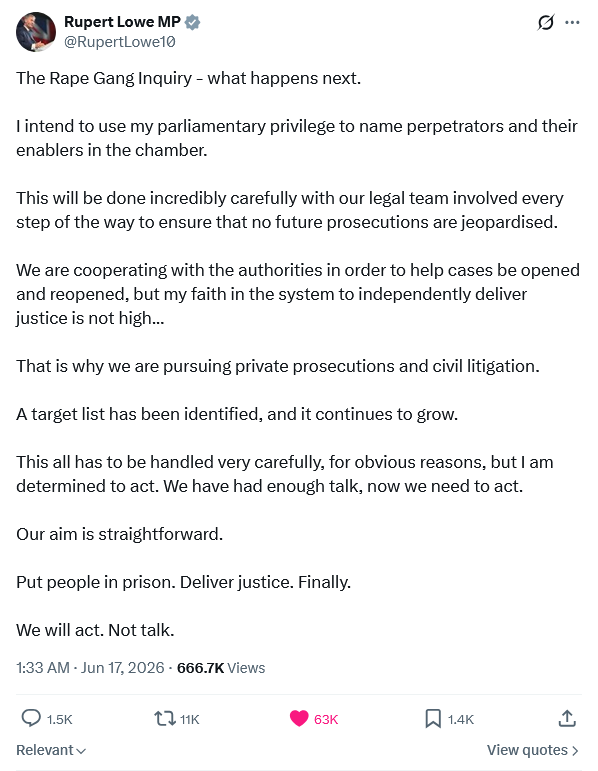
Rupert Lowe explains his next steps after the publication of the inquiry report:
March 16, 2026

Soviet Invasion of Afghanistan 1979

Filed under: Asia, History, Military, Russia — Tags: , , , , , , , — Nicholas @ 02:00

Real Time History
Published 24 Oct 2025

Christmas 1979. Soviet armor pours across the Afghan border towards Kabul as helicopters secure the mountain passes through the Hindu Kush mountains. In Moscow, the Politburo has decided to save Afghanistan’s communist government from collapse. Afghan rebels have taken up arms against the unpopular regime and control most of the countryside. But the Red Army leadership doubts it can pacify the country – so why did the Soviet Union invade Afghanistan?
(more…)

September 1, 2025

Who Killed Pakistan’s First Prime Minister, Liaquat Ali Khan? – W2W 42

Filed under: Asia, Britain, History, India, Middle East, USA — Tags: , , , , , — Nicholas @ 04:00

TimeGhost History
Published 31 Aug 2025

October 1951: Pakistan’s first Prime Minister is gunned down on stage, and the world is left asking — who ordered his death? Was it the British, the Americans, or his own allies in Pakistan? Dive deep into a tangled web of espionage, conspiracy, and Cold War politics as we follow the murder mystery that set the course for South Asia’s future.
(more…)

May 10, 2025

“Train how you fight” – British plod edition

Filed under: Britain, Government, India, Media, Politics — Tags: , , , , , , , — Nicholas @ 04:00

At Restoration, Connor Tomlinson looks at how British police forces are training and what it tells us about who they think they’ll be fighting:

Britain’s police aren’t training to stop riots—they’re preparing to crush the public.

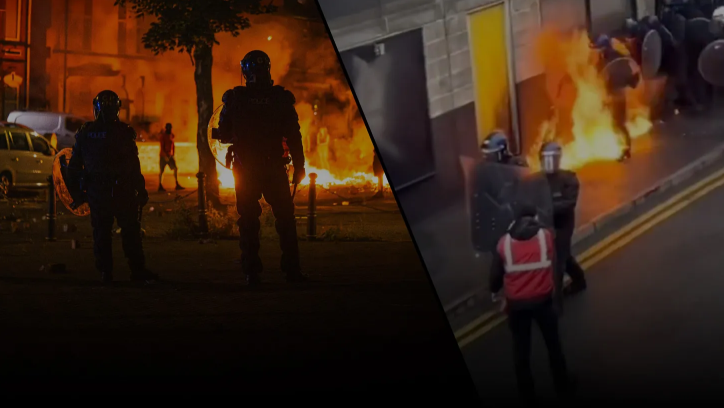
One of the infamous quotes from George Orwell’s Nineteen Eighty-Four is, “If you want a picture of the future, imagine a boot stamping on a human face — forever”. He forgot to add, “on TikTok”. Last Thursday, the Metropolitan Police posted a montage of officers at the Metropolitan Police Specialist Training Centre in Kent, undergoing riot training. The caption read, “Bricks, bottles and fire bombs – our officers prepare for every eventuality at the Met’s elite training centre in Gravesend so they can keep you safe. Stronger tactics means safer communities.” It seems they had one specific “eventuality” in mind, as the mock rioters were wearing the Union flag. There wasn’t a keffiyeh or “Only good TERF is a dead TERF” sign in sight.

But fear not. The same Met Police who defended now-proscribed group Hizb ut-Tahrir’s demonstration after October 7th, saying “The word jihad has a number of meanings“, now insist that “The fact one of the t-shirts has a union flag on it is entirely coincidental”. Well, that’s me convinced. In fact, the Met are exhausted by your conspiracy theories, writing that “It’s disappointing we are increasingly having to challenge this sort of misinformation which only serves to increase divisions and tensions”. But the plummeting public trust in Britain’s police and justice system are of its own making. Britain’s security state is setting itself in opposition to the largely law-abiding indigenous host majority, while gaslighting them about the non-existence of a two-tier justice system that favors tribal minorities.

One might think, as Sam Bidwell suggests, the police should preoccupy themselves with preventing street conflicts not between Britain’s indigenous host and immigrant populations, but between its Indian diaspora and Pakistani enclaves. On April 22, Pakistani Islamist group Lashkar-e-Taiba killed 26 and injured 20 more in Indian-controlled Kashmir. Both nations cancelled the other’s visas, and are in the process of expelling foreign nationals before they expire. Pakistan has suspended all trade with and air travel from India. Hindu nationalist Prime Minister Modi has warned, “India will identify, track and punish every terrorist, their handlers and their backers, [and] we will pursue them to the ends of the earth.”

Thanks to decades of mass immigration and multiculturalism, Britain is home to powerful Indian and Pakistani ethno-political lobbies. Around 3 million Indians and 1.9 million Pakistanis live legally in the UK. They are substantially younger than the white British host population, and already brought Leicester to an ungovernable standstill in 2022 when Muslims and Hindus rioted for a month over a cricket match. Last Friday, both factions gathered outside the Pakistani Embassy in London for a mixture of a protest and a dance-off, replete with Indian, Pakistani, Israeli, and Palestinian flags. Most alarming was when Colonel Taimur Rahat of the Pakistani military appeared to make a throat-slitting gesture toward Indian protestors.

Both subcontinental factions have sympathetic politicians. They weaponize domestic antidiscrimination law to pursue foreign policy goals: for example, listing the denial of an independent Palestine and Kashmir as an example of Islamophobia, in guidance adopted by local councils. Conservative-party candidates committed to a Hindu Manifesto at the last general election, promising to further liberalize visa rules for dependents and elderly parents of Hindus already in Britain. Indian-heritage cabinet ministers, like Priti Patel and Rishi Sunak, instigated an unprecedented rise in Indian migration after Brexit. Patel described these migrants as “living bridges”, using Prime Minister Modi’s term.

March 29, 2025

Why India and Pakistan Hate Each Other – W2W 015 – 1947 Q3

Filed under: Britain, History, India, Military, Religion — Tags: , , , , , , , — Nicholas @ 04:00

TimeGhost History
Published 23 Mar 2025

In 1947, the British divide the Raj into two nations, India and Pakistan, triggering one of the deadliest mass migrations in history. Sectarian violence between Hindus, Sikhs, and Muslims leaves at least 200,000 dead and displaces millions more. Hastily drawn borders turn neighbours into enemies. The partition’s bloody legacy will lead to decades of tension, war, and bloodshed.
(more…)

December 10, 2024

M47 – The Most Boring Tank Ever? | Tank Chat #178

Filed under: History, Military, USA, Weapons — Tags: , , , , , , , , — Nicholas @ 02:00

The Tank Museum
Published Aug 9, 2024

The US built M47 probably isn’t the most interesting tank in history – but it was a vital part of NATO’s Cold War tank force.

Rushed into production at the outbreak of the Korean War, it never saw active service with the US military and was quickly superseded by the M48.

But large numbers were supplied to US Allies around the world – with Germany, Belgium, Italy, Portugal, Jordan, Pakistan and Austria being among the most significant users.

Probably the most famous M47 crewman of all, Arnold Schwarzenegger, served on the tank during his National Service.

00:00 | Intro
01:05 | M46 Sees Service in Korea
02:56 | Development Problems – And a Stop Gap
10:57 | Short Lived US service
12:47 | But An Export Success
15:24 | M47 plugs the gap for the US Army – goes on to serve abroad
15:46 | The Tank Museum’s M47 Restoration Project
(more…)

November 12, 2022

Climate imperialism

Michael Shellenberger on the breathtaking hypocrisy of first world nations’ rhetoric toward developing countries’ attempts to improve their domestic energy production:

What’s worse, global elites are demanding that poor nations in the global south forgo fossil fuels, including natural gas, the cleanest fossil fuel, at a time of the worst energy crisis in modern history. None of this has stopped European nations from seeking natural gas to import from Africa for their own use.

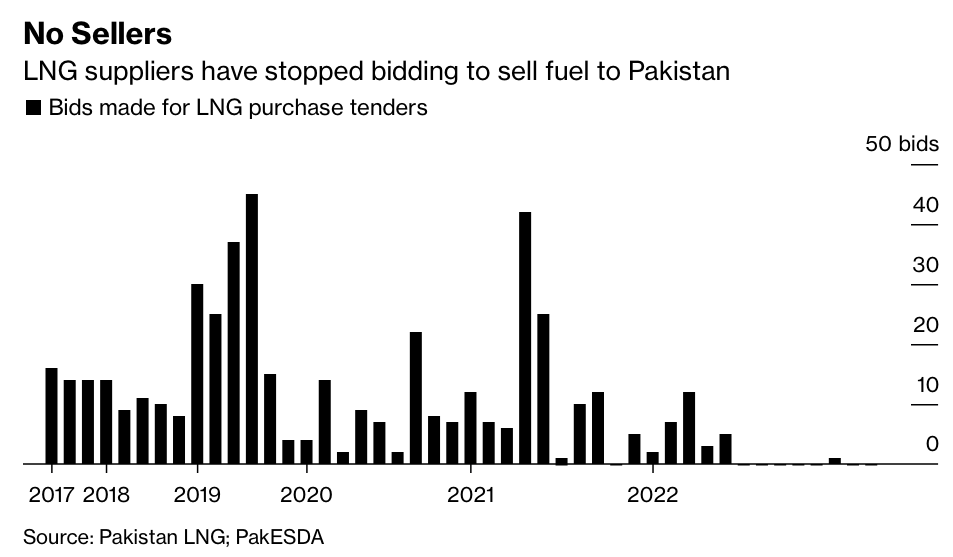
Rich nations have for years demanded that India and Pakistan not burn coal. But now, Europe is bidding up the global price of liquified natural gas (LNG), leaving Pakistan forced to ration limited natural gas supplies this winter because Europeans — the same ones demanding Pakistan not burn coal — have bid up the price of natural gas, making it unaffordable.

At last year’s climate talks, 20 nations promised to stop all funding for fossil fuel projects abroad. Germany paid South Africa $800 million to promise not to burn coal. Since then, Germany’s imports of coal have increased eight-fold. As for India, it will need to build 10 to 20 full-sized (28 gigawatts) coal-fired power plants over the next eight years to meet a doubling of electricity demand.

This is climate imperialism. Rich nations are only agreeing to help poor nations so long as they use energy sources that cannot lift themselves out of poverty.

Consider the case of Norway, Europe’s second-largest gas supplier after Russia. Last year it agreed to increase natural gas exports by 2 billion cubic meters, in order to alleviate energy shortages. At the same time, Norway is working to prevent the world’s poorest nations from producing their own natural gas by lobbying the World Bank to end its financing of natural gas projects in Africa.

The IMF wants to hold hostage $50 billion as part of a “Resilience and Sustainability Trust” that will demand nations give up fossil fuels and thus their chance at developing. Such efforts are working. On Thursday, South Africa received $600 million in “climate loans” from French and German development banks that can only be used for renewables. The Europeans hope to shift the $7.6 billion currently being invested by South Africa in electricity infrastructure away from coal and into renewables.

Celebrities and global leaders say they care about the poor. In 2019, the Duchess of Sussex, Meghan Markle, Prince Harry’s wife, told a group of African women, “I am here with you, and I am here FOR you … as a woman of color.” Why, then, are they demanding climate action on their backs?

September 1, 2022

Rotherham Borough Council proudly announces they will be the first “Children’s Capital of Culture”

Honest to God, you can’t parody the real world harder than it parodies itself:

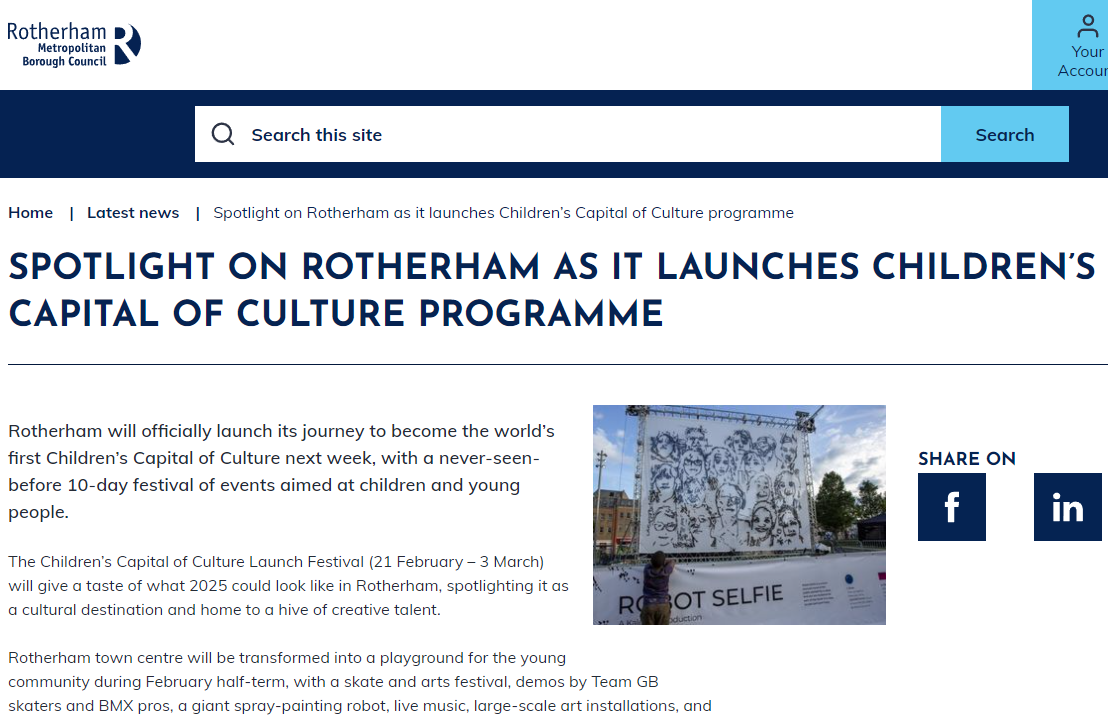
The news that the South Yorkshire market town of Rotherham would be the world’s first “Children’s Capital of Culture” in 2025 has been greeted by many as some kind of sick joke.

Rotherham is at the heart of England’s group-based child sexual exploitation crisis. In 2012, The Times revealed that a confidential 2010 police report had warned that vast numbers of underaged girls were being sexually exploited in South Yorkshire each year by organised networks of men “largely of Pakistani heritage”. South Yorkshire Police and local child-protection agencies were shown to have knowledge of widespread, organised child sexual abuse — but failed to act on this on-the-ground intelligence.

Rotherham borough council, South Yorkshire Police and other public agencies responded by setting up a team of specialists to investigate the reports. In 2013, an independent inquiry spearheaded by Professor Alexis Jay was launched. Her subsequent report into child sexual exploitation in Rotherham, published in 2014, made for awfully grim reading. It found that at least 1,400 children had been subjected to appalling forms of group-based sexual exploitation between 1997 and 2013. The report detailed how girls as young as eleven years of age — either in Year 6 or Year 7 of school — had been intimidated, trafficked, abducted, beaten and raped by men predominantly of Pakistani heritage.

Jay was also deeply critical of the institutional failures that had allowed organised child sexual abuse to flourish in Rotherham. The report concluded that there had been “blatant” collective failures on the part, firstly, of the local council, which consistently downplayed the scale of the problem; and secondly, on the part of South Yorkshire Police, which failed to prioritise investigating the abuse allegations. Indeed, the Jay Report found that the police had “regarded many child victims with contempt”. The inquiry discovered cases involving “children who had been doused in petrol and threatened with being set alight, threatened with guns, made to witness brutally violent rapes and threatened they would be next if they told anyone”. One young person told the inquiry that gang rape was a normal part of growing up in Rotherham. Just let that sink in — groups of adult-male rapists preying on vulnerable girls was normalised in an English minster town.

The Jay Report also took the local authorities to task for elevating concerns about racial sensitivities over the protection of the children in their care — an all-too-familiar element of the nationwide grooming-gangs scandal in England. As the Jay Report put it: “Several [council] staff described their nervousness about identifying the ethnic origins of perpetrators for fear of being thought as racist; others remembered clear direction from their managers not to do so”.

The safety and protection of the most vulnerable girls in society was sacrificed on the altar of state-backed multiculturalism and diversity politics. A recent report published after a series of investigations carried out by the Independent Office for Police Conduct (IOPC) under “Operation Linden”, found there were “systemic problems” within South Yorkshire Police that meant “like other agencies in Rotherham … it was simply not equipped to deal with the abuse and organised grooming of young girls on the scale we encountered”. South Yorkshire Police recently landed itself in further hot water after it was revealed by The Times that the police force was failing to routinely record the ethnic background of suspected child sexual abusers. For Rotherham, suspect ethnicity was missing for two in three cases.

July 15, 2021

QotD: Macaulay’s prescription for ruling India

Filed under: Britain, Education, Government, History, India, Quotations — Tags: , , , — Nicholas @ 01:00

In 1835 Thomas Macaulay had argued in his famous essay Minute on Education that “We must at present do our best to form a class who may be interpreters between us and the millions whom we govern; a class of persons, Indian in blood and colour, but English in taste, in opinions, in morals, and in intellect. To that class we may leave it to refine the vernacular dialects of the country, to enrich those dialects with terms of science borrowed from the Western nomenclature, and to render them by degrees fit vehicles for conveying knowledge to the great mass of the population.”

Macaulay was arguing that British Government should spend money on educating those it found under its rule. So it came to be as Britain ruled over the most heavily-populated and most valued part of its empire for another century.

Jawaharlal Nehru, the Prime Minister who led India to independence from Britain, studied at Trinity College, Cambridge, and at the Inner Temple, and was closely connected to the Fabian Society. Nehru’s rival, Muhammad Ali Jinnah, the founder of Pakistan, studied law at the Lincoln’s Inn, and was strongly influenced by English utilitarianism and French positivism. Nehru was an agnostic who requested a secular burial (this was denied him), while Jinnah was a gin-drinker whose religious attachments were more a matter of identity than belief.

Nehru and Jinnah led India and Pakistan to independence as the brown-skinned Westerners Thomas Macaulay had envisioned a century earlier. South Asian in appearance and pedigree, the leaders of these two nations nevertheless personified a fundamental truth about the Western orientation of the new Asian states. Pakistan was aligned with the United States, while socialist India was nominally non-aligned but clearly tilted toward the Soviet bloc. Though the populace of these nations were mostly illiterate, poor and detached from the cosmopolitan currents of the world, their elites were integrated among the English-speaking peoples. Nehru’s daughter, Indira Gandhi, attended Somerville College, Oxford. His grandson, Rahul Gandhi, whose mother is Italian, studied at Harvard and Trinity College.

Razib Khan, “Why the West lost India’s culture wars”, UnHerd, 2021-04-13.

November 3, 2020

QotD: Water pricing

Filed under: Asia, Economics, Environment, Government, Quotations — Tags: , , — Nicholas @ 01:00

Near all freshwater availability problems come from the fact that farmers get it cheap or for free, diverting it from much more valuable uses like keeping people alive if they drink it. This is true in California – we’ve actually cases of farmers using $400 of water to grow $100 of alfalfa – as it is in Pakistan. There are cases of people growing water hungry crops in near drought areas just because they get that water too cheaply.

[…]

Gaining revenue with which to build dams is useful, it most certainly is. But that’s not the only function of pricing. The cash to increase supply, great, but the very fact of charging will reduce demand. And we should be charging what it costs to produce the water too. So charges should cover 100% of the costs of the dams, not just 25%.

It’s entirely possible that charging that full cost will mean that no farmers want the water. OK, then we shouldn’t build the dam, should we? For if the value of the water – measured by what people will pay – is less than the cost of its provision, then that’s value destroying, providing the water. The dam makes us all poorer, therefore we shouldn’t build it.

The point here being – and it’s an important one – that prices affect both supply and demand. They’re what brings them into balance even. So, yes, charge for water, but not just so that we can pay to increase supply, also so that we, merely by charging, reduce demand.

Tim Worstall, “Pakistan’s Chief Justice Almost Right – Charge For Water, Not For Dams, But To Charge For Water”, Continental Telegraph, 2017-07-17.

September 4, 2020

QotD: Muhammad Ali Jinnah

Filed under: History, India, Religion — Tags: , , , — Nicholas @ 01:00

Born into a Shia mercantile family, Jinnah left for England after high school, where he studied law and acquired a love for parliamentary procedure. Thoroughly and poshly anglicized (200 Savile Row suits were found in his closet after his death), he returned to India before the First World War, armed with a fearsome reputation as a barrister so brilliant judges tried to avoid him, and committed to Hindu-Muslim unity. His English was exquisite, but he spoke no Urdu. Completely secular, Jinnah was so indifferent to his religion — he drank and ate pork — that he planned Pakistan’s inauguration-day banquet as a luncheon, unaware it was Ramadan (they changed it to dinner).

Jinnah’s political intentions are hotly contested. According to New York Times Pakistan expert, Jane Perlez, many Pakistan researchers contend Jinnah had no interest in an Islam-dominated state, but “used the idea of Pakistan as a mere bargaining chip for Muslim majority rights within a loosely united post-colonial India.” With no autobiography or recollections from close friendships for our guidance, Jinnah remains a shadowy historical player, a political loner with an indeterminate goal beside Nehru, Gandhi and Viceroy Lord Mountbatten.

It is quite possible, for example, that Jinnah created the Muslim League and employed the rhetoric of Islam (slogan: “Islam in Danger”) and started wearing native clothes to harness religious fervour to political ambitions never fully articulated. But we can’t ever know, as a lifetime of chain smoking caught up with Jinnah, and he died before the first (bloody) year of Pakistan’s existence was out.

In Jinnah’s first speech to his newly minted country, though, we have this strong intentional clue: “You are free. You are free to go to your temples, you are free to go to your mosques or to any other place of worship in this state of Pakistan. You may belong to any religion or caste or creed — that has nothing to do with the business of the state.”

Barbara Kay, “A celebrated figure today could well be the condemned sinner of tomorrow”, National Post, 2018-06-05.

August 8, 2020

The Cold War & Decolonization — History Summarized

Overly Sarcastic Productions
Published 7 Aug 2020

Keep safe and stylish with a Red-And-Blue facemask from Volante Design, or DONATE to help students in public schools receive high-quality masks for free — https://bit.ly/2DwE9O7

August of 2020 marks the 75th anniversary of the end of the Second World War. So I wanted to make a video about that. That was a bad idea…

What do you get when a Classically-Minded historian ventures about 2,000 years outside of their comfort zone? A mess. A well-intentioned mess is what you get. BUT a mess that we can learn from! So join me as we dig into the aftermath of the Second World War to analyze the origins of the Cold War and the decolonization of European Empires.

SOURCES & Further Reading: The Cold War by Gaddis, The Wars of French Decolonization by Clayton, British decolonization, 1946-1997 by McIntyre, The Cold War’s Killing Fields by Chamberlin, The Cold War: A Very Short Introduction by McMahon, and “Crash Course European History [Parts 42-47]” by Green.

This video was edited by Sophia Ricciardi AKA “Indigo”. https://www.sophiakricci.com/
Our content is intended for teenage audiences and up.

DISCORD: https://discord.gg/kguuvvq

PATREON: https://www.Patreon.com/OSP

MERCH LINKS: https://www.redbubble.com/people/OSPY…

OUR WEBSITE: https://www.OverlySarcasticProductions.com
Find us on Twitter https://www.Twitter.com/OSPYouTube
Find us on Reddit https://www.Reddit.com/r/OSP/

From the comments:

Overly Sarcastic Productions
1 hour ago (edited)
Some clarifications:
North Africa did of course see conflict, the Pacific did get occupied — even the places that didn’t (eg: India) still paid for the war. Damn double-negatives.

That weird Romania-Hungary-Russia border is a holdover from WWII. The border lasted until 1946 and was changed in 1947. Later in the video you’ll see the more familiar borders.

Indonesia declared Independence in 1945 (Like Vietnam), but the Netherlands didn’t withdraw until 1949, hence my mention of ’49.

July 5, 2020

History Summarized: Colonial India

Overly Sarcastic Productions
Published 4 Jul 2020

Start your free trial at http://squarespace.com/overlysarcastic and use code OVERLYSARCASTIC to get 10% off your first purchase.

Indian History has always been a story of peoples coming and going, but the subcontinent’s modern history takes that up to 11, with the arrival of Central Asian Mughals and boatloads of Europeans. See how India transforms from Medieval to Modern in this final act of our History of India.

SOURCES & Further Reading: The Discovery of India by Jawaharlal Nehru, A History of India by Michael H. Fisher (a lecture series by The Great Courses).

This video was edited by Sophia Ricciardi AKA “Indigo”. https://www.sophiakricci.com/
Our content is intended for teenage audiences and up.

Special thanks to Varda Alighieri for coaching me through my (hopefully serviceable) pronunciations!

PATREON: https://www.Patreon.com/OSP

MERCH LINKS: https://www.redbubble.com/people/OSPY…

OUR WEBSITE: https://www.OverlySarcasticProductions.com
Find us on Twitter https://www.Twitter.com/OSPYouTube
Find us on Reddit https://www.Reddit.com/r/OSP/

June 23, 2020

Pushback for Chinese aggression in the Himalayas

Filed under: China, India, Military — Tags: , , , , , , — Nicholas @ 03:00

In Quillette, Cleo Paskal outlines the Chinese military action last week and a few of the reactions in civil society:

The western portion of the Line of Actual Control, separating the Eastern Ladakh and Aksai Chin (map by CIA). In the Demchok sector, only two claim lines are shown. The line was the focus of a brief war in 1962.
Wikimedia Commons.

High in the Himalayan mountains, Chinese soldiers ambushed Indian troops this week, resulting in a brutal battle on the Indian side of their shared border. Twenty Indians were killed, while China won’t disclose its losses. It was the deadliest confrontation on the border in over 40 years. As a result, some Indian strategists are openly discussing recognizing Taiwan and providing more visibility to the Dalai Lama, state-owned telecoms are blocking Chinese equipment from 4G upgrades, and millions of Indians downloaded an app that helps remove Chinese apps from their phones (before Google removed it). All of this comes at a time when much of the world remains angry at China’s leaders for their initial handling of the COVID-19 crisis.

This week’s apparent provocation is part of a larger recent pattern with China. From the South China Sea, to Taiwan, to Hong Kong, Beijing has been seeking to change facts on the ground in a way that benefits its own strategic and economic interests. In a recent Atlantic Council discussion of the India-China border issue (convened before the latest fighting), senior American diplomat Ambassador Alice Wells summed the situation up well: “There’s a method here to Chinese operations. [A]nd it is that constant aggression, the constant attempt to shift the norms, to shift what is the status quo, that has to be resisted.”

For decades China has tried to expand its strategic reach along its de facto south-western border through the invasion of Tibet, land swaps with Pakistan, and war with India. To this end, China treats British Empire-era maps as political props to variously brandish or dismiss, as best suits Beijing’s goals. For example, it effectively accepted the 1914-era McMahon Line delineation in its border agreement with Myanmar, but rejects it with India.

The Line of Actual Control (LAC) separating China and India runs through rugged, high-altitude terrain that has witnessed multiple conflicts going back to the 1962 India-China border war. In recent weeks, there have been Chinese incursions at several points along the LAC, reportedly involving thousands of troops. In some spots, the Chinese military is digging in on the Indian side, while expanding its already considerable support infrastructure on their side of the LAC.

Delhi is particularly concerned about Chinese advances near India’s Daulat Beg Oldie (DBO) high-altitude military airfield, an essential Indian forward base that provides oversight of the strategic Karakoram Highway (KH) linking China’s western Xinjiang Autonomous Region with Pakistan, including the Gwadar Port on the Indian Ocean. It is a key component of the multi-billion-dollar China-Pakistan Economic Corridor.

January 10, 2020

QotD: Deciding what is “newsworthy”

Filed under: History, India, Media, Middle East, Quotations — Tags: , , , , — Nicholas @ 01:00

[…] the ripples of battle in their formal sense are guided by the presence of historians, and that means originally Westerners, and more recently in large part Europeans and Americans. And such distortions do not always play out in bias toward Westerners, especially in the present age. In April 2002 the Israeli Defence Forces entered the West Bank community of Jenin to hunt out suspected suicide-murderers, whose co-members had blown up hundreds of Israeli civilians over the prior year. Although fewer than sixty Palestinians were killed in Jenin — the great majority of them combatants — the world media seized upon the street fighting, dubbing it “Jeningrad” as if they were somehow the moral equivalent of one million Germans and Russians lost at Stalingrad. Yet just days after the Israeli withdrawal from Jenin, Pakistan squared off against India. The stakes were surely far higher: One-fifth of the world’s population was involved. Both sides were nuclear powers and issued threats to use their arsenals. In the prior year alone nearly four times more Indians and Pakistanis were killed than Palestinians and Israelis. By any calculation of numbers, the specter of the dead, the geopolitical consequences, or the long-term environmental health of the planet, the world should know all the major cities in Kashmir rather than a few street names in Jenin. And if the world sought to chronicle destruction and death in an Islamic city, then by any fair measure it should have turned its attention to Grozny, where an entire society of Muslim Chechnyans was quite literally obliterated by the Russian army.

The idiosyncracies of historical remembrance of battle do not hinge alone on the presence of a Socrates or Teddy Roosevelt in the ranks. Sometimes there are wild cards of culture and politics as well. In this case and at this time, the fact that Israelis fit the stereotype of affluent and proud Westerners abroad while the Palestinians were constructed as impoverished and oppressed colonial subjects brought to the equation the sympathies of influential Americans and Europeans in the media, universities, and government — the prominent and sometimes worrisome elites who determined to send their reporters, scholars, and diplomats to Jenin rather than to Islamabad or Grozny.

Victor Davis Hanson, Ripples of Battle, 2004.

Older Posts »

Powered by WordPress