Quotulatiousness

August 1, 2026

The invasion of Ceuta

Filed under: Africa, Europe, Government — Tags: , , , , , — Nicholas @ 06:00

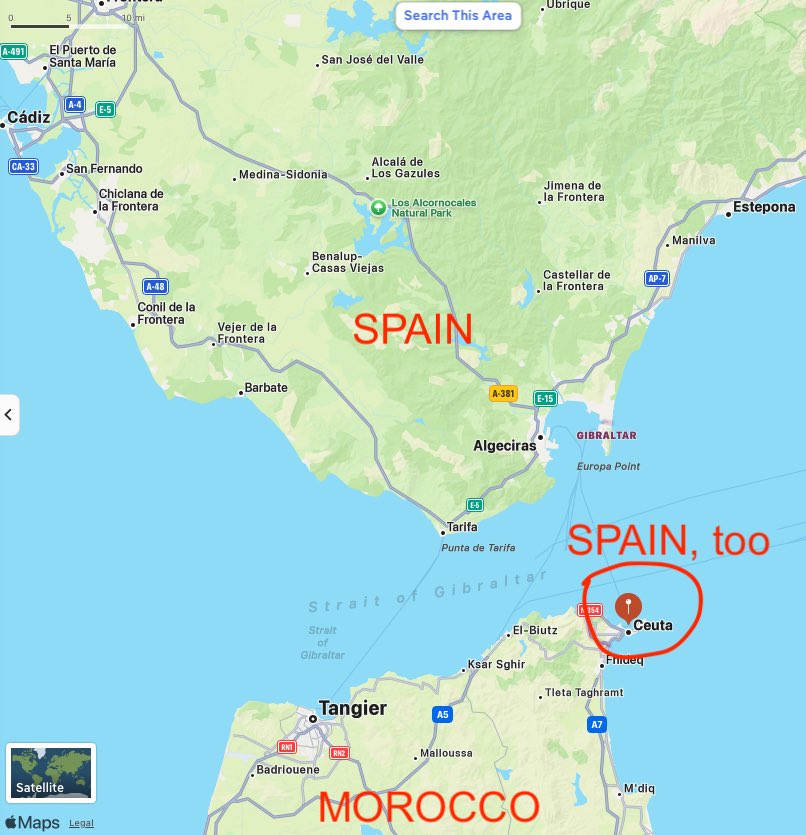
In the last 48 hours vast numbers of people have learned that Spain still has territory on the African continent, as Morocco enables thousands of young men to cross into the Spanish city of Ceuta. The Spanish government has, to time of writing, refused to declare a state of emergency or to send military forces to assist the municipal authorities in Ceuta. In Spiked, Brendan O’Neill thinks this heralds the end of globalism:
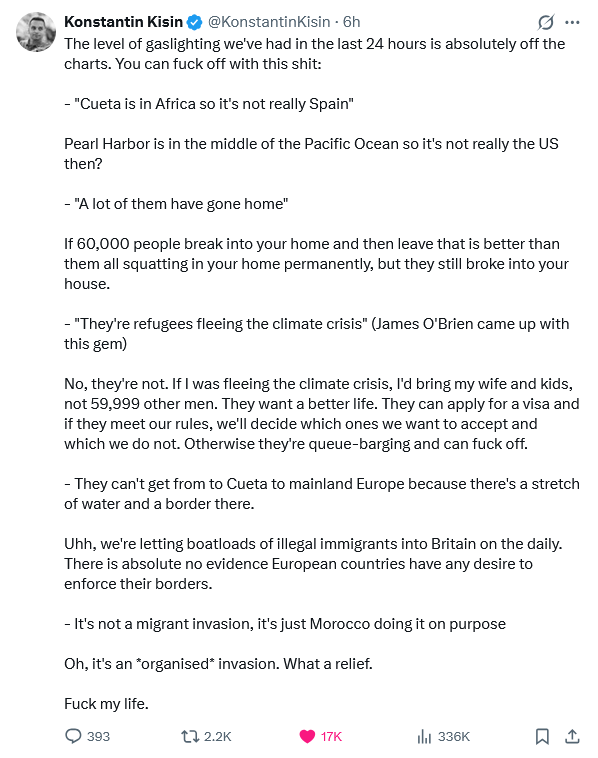
Can we say “invasion” now? What other word is there for the rough intrusion of tens of thousands of young men into the sovereign territory of a foreign nation? Surely not even the sappiest leftist in his tattered keffiyeh and “Refugees Welcome” t-shirt would describe the thuggish gatecrashing of an independent nation as “asylum seeking”? That might be the one and only upside to the extraordinary events in Ceuta yesterday: the death, at last, of euphemism. The impossibility of any longer dressing up the West’s suicidal abandonment of its borders as “kindness”.

The scenes from the Spanish enclave at the tip of North Africa are staggering. An estimated 49,000 people, mostly Moroccans, mostly men, gleefully intruded upon the territory of the Spanish kingdom. That’s around the same number of people who illegally sail to Britain in a year. They scaled border gates and overwhelmed those charged with protecting Spanish lands. Viral clips show men punching the air as they swarm the enclave, clearly thrilled with their incursion into a sovereign state. Even the Spanish press is feeling the death of euphemism. “Ceuta, invaded”, says the front page of ABC, a newspaper of record, alongside an image of thousands of men streaming along Ceuta’s beach.

The mass storming of Ceuta has focused the minds even of Spain’s fatally apathetic ruling class. All of Ceuta’s parties, both right and left, have called on Madrid to send in the army to reinforce the border with Morocco. Spanish PM Pedro Sánchez promised an “immediate response“. Yet even if the Spanish manage to tame this searing crisis of sovereign rule – and that’s a big “if” – the lessons of it should reverberate not only across Spain but all of Europe. For the fall of Ceuta exposes the lethal strain in globalism. It speaks – screams in fact – to the chaotic trashing of sovereignty, democracy and our very way of life that globalism and its gold-collared acolytes have brought about.

The storming of Ceuta shatters the falsehoods of the left. For years, “progressives” gaslit the public, insisting that the men illegally crossing our borders are “vulnerable people” who are “seeking asylum”. Like Big Brother, they expected us to reject the evidence of our eyes and ears and accept that these swaggering blokes from Eritrea or Afghanistan are the wretched of the Earth requiring our love and care and four-star hotels. Ceuta dismantles that lie. The whole world can see there are virtually no women and children in those mobs. The whole world knows Morocco is not ravaged by war or hunger. From now on, every utterance of the phrase “asylum seeker” should invoke noisy, angry scepticism.

The Ceuta crisis also confirms that the moral cowardice of the modern state is like a red rag to hostile actors. It is undeniable that Pedro Sánchez’s lunatic granting of asylum to illegal immigrants emboldened these Moroccan men to pour into soft-touch Spain. In January this year, Sánchez bypassed parliament and issued a royal decree to regularise virtually all “undocumented migrants” on Spanish territory. Almost 1.2million illegal arrivals applied for this regularised status that would grant them the right to reside in Spain, to work there and to enjoy unfettered access to healthcare and education.

The cope is strong in progressive commentators:
Why UK crime victims’ families always sound so similar talking to the media

Filed under: Britain, Government, Media — Tags: , , , , , — Nicholas @ 05:00

On Substack Notes, John Carter linked to an article about the British Home Office’s “nudge unit” who, among other things, coax and cajole the families of murder victims to avoid any hint that they blame the perpetrators for the loss of their loved ones:

This is incredible. I always wondered how family liaison officers from RICU or the CRS reliably got the families of victims murdered by political or racial terrorists to provide such anodyne, don’t look back in anger public statements. I figured in most cases it would be concern trolling, with legal threats held in reserve.

This lays the technique bare, using interviews conducted both with victim’s families and former police officers. Liaison officers serve as anesthetic patches that get slapped on the open wounds of the migration war. They apply therapeutic techniques to calm and reassure the families, establishing dependent relationships and using the trust they build to guide them away from saying anything inflammatory when the time comes to speak to the public. If families become noncompliant in this respect, they’re threatened with causing a mistrial should they speak too openly about their feelings.

That isn’t all RICU does, of course. “Communications” includes a huge propaganda arm, which uses every tool at its disposal, including battalions of fake social media profiles. You have to wonder how much of the culture war of the last decade or more was pure hallucination.

The article in question is by David Shipley for the Pimlico Journal:

RICU, the Home Office’s Research Information and Communications Unit, is often the subject of much attention online, particularly around its role in the consistently bland calls for “unity” after horrific acts of violence. Many people online suggest that either the Unit itself, or the “specially trained officers” (Victim Liaison Officers or Family Liaison Officers) must threaten victims and their families to ensure their compliance with approved messaging. This always struck me as unlikely — widespread coercion would surely have leaked by now. There was also good reason to be sceptical of the efficacy of behavioural science applications to government. And yet public statements by those victims and their families are remarkably consistent.

So I was delighted when, a couple of months ago, Pimlico Journal asked me to investigate RICU and victim liaison properly. In order to do so, I studied historic statements, publications and coverage of RICU and spoke with victims’ families, some of whom are named in this piece and former police officers, none of whom are named, with knowledge of the Victim and Family Liaison units. What I discovered is fascinating and far more insidious than the imagined coercion. This article provides an overview of RICU’s history, goals and methodology, followed by details from those interviews. I hope it sheds some light on this murky area of the state’s “communications management”.

RICU was established in 2007 “under the Prevent strand of [the UK government’s] CONTEST strategy” with its stated goal being to “understand and counter terrorist and extremist ideologies to reduce the risk to the UK, its citizens and its interests overseas”. Giving evidence to MPs in 2009, Charles Farr, a former SIS officer, and head of the Office of Security and Counter Terrorism, who set RICU up in 2007, said the unit is “responsible for advising the rest of government [and] officialdom, from a brigade commander in Helmand province through to a chief constable in Yorkshire, about how they wish to characterise the threat we face and describe the response that we are making and, secondly, rather different, they are responsible for challenging the propaganda which comes to us from al-Qaeda and associated groups — generally not from people in this country; usually from the incessant 4,500 websites that are in one way or another associated with radical Islamist terrorist organisations around the world”.

The unit embraced convenient lies from the start. Part of their strategy was to send advice to “local authorities, people working on community cohesion projects, local police, neighbourhood policing teams” and “the Chief Constable” that they should nottalk about Islamic terrorism, not because in certain circumstances that is an inaccurate description but because the language admits of a number of interpretations which are not always helpful to us“.

RICU was also always concerned with the whole of British society — while Farr said the unit decided to “start” with Muslim communities, he told MPs that he did “not want to give the impression that RICU’s sole purpose is to communicate with Muslim communities in this country. It is not.” So by 2009 a unit existed which had “about 35 people” working for it, “and a bit of the private sector in there to advise us on aspects of communications”, which was telling every arm of the state, along with much of civil society, that they should lie about the nature of the threats the country faced, to serve the state’s perceived interests. It was also already building wide and deep relationships within many parts of the state, including policing.

What has it become, in the 17 years since Charles Farr gave his evidence?

In 2011, when the government reviewed Prevent, it found that RICU’s communications sometimes “erred in seeking to make language acceptable to some in Muslim communities, at the expense of candour”. The unit was described as having “a central role in developing counter-ideological or counter-narrative work”, although its track record was described as “mixed”. It was directed to take “more care … to identify credible partners to develop powerful and specific narratives across a range of communications channels, especially on the internet“. Despite these criticisms, the state chose to “retain RICU, largely in its current form”, but with the expectation that it would produce “much sharper and more professional counter-narrative products” — there was also a commitment to “continue to work with social media enterprises” in the battle against “propagandists and radicalisers” including those whose “propaganda work” might be illegal under “race and religious hatred legislation”. The shift is notable — Farr’s commitment that RICU would work across the whole of British society is clearly underway, with Islamic terrorism and radicalisation no longer the main focus.

More recently, RICU has long been the subject of much discussion on social media, and of occasional interest in the mainstream press. It’s often accused of being behind the anodyne calls for unity and calm issued by public bodies, victims and their families after the latest “Yookay” Event in which a migrant has done something appallingly violent. Not unrelatedly, it is generally the right who are more vocal in their criticism of RICU, and it is regularly suggested that they threaten families into sticking to the regime-approved line.

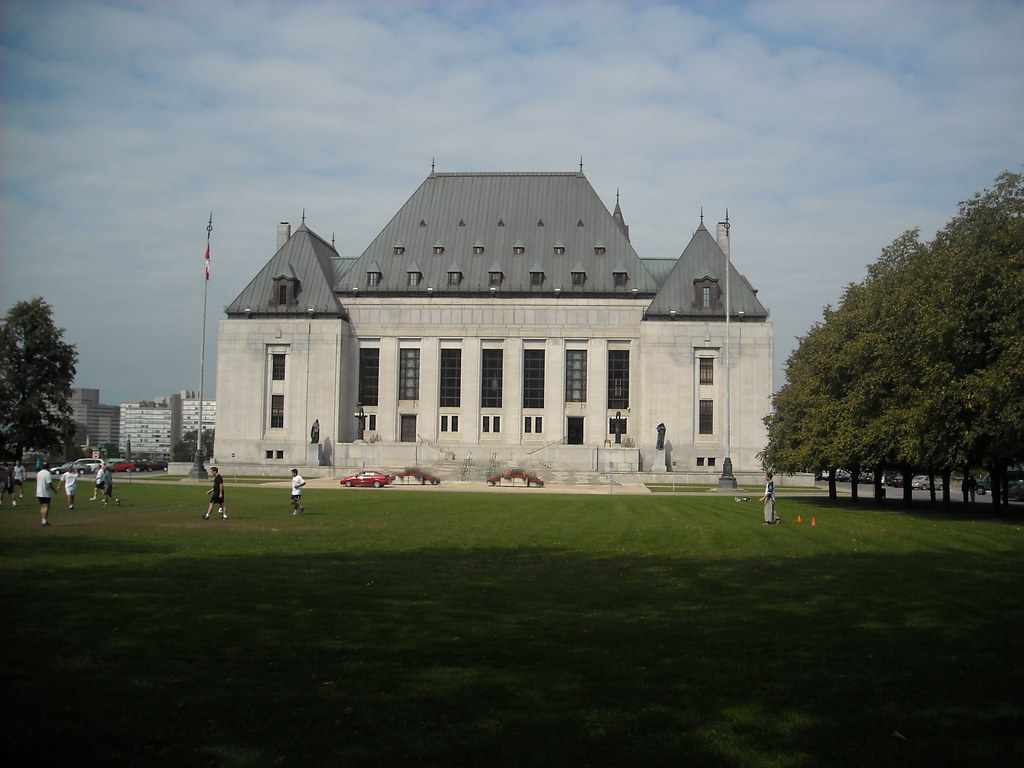
Supreme Court of Canada surprisingly rules against the federal government

Filed under: Cancon, Government, Law — Tags: , , , , , — Nicholas @ 04:00

For the last ten years, it’s been a running joke that the federal government’s conflicts of interest would, at most, result in a $500 fine and an insincere promise not to do it again. Because that’s pretty much what has been happening since the early years of the Trudeau government. In a shocking development, however, the Supreme Court of Canada kicked over the apple cart and struck down the relevant section of the Conflict of Interest Act which the feds had found so useful over the years:

So the Supreme Court of Canada just did something almost no one in Ottawa expected. They ruled against the government. Unanimously. On a case the people who run this country spent five years trying to kill.

Yesterday the Court, in a decision written by Chief Justice Richard Wagner, said section 66 of the Conflict of Interest Act is unconstitutional. That was the clause designed to keep the federal Ethics Commissioner’s rulings largely beyond the reach of the courts. Errors of fact. Errors of law. None of your business. Parliament put a lock on the door and the Supreme Court just kicked it in.

This is not some abstract legal theory. This is the shield that protected Mario Dion’s May 13, 2021 report clearing Justin Trudeau in the WE Charity scandal. That clearance is no longer sealed. Stage 2 of Democracy Watch’s case now goes forward at the Federal Court of Appeal. The actual mistakes in that report finally get examined in open court.

You remember the scandal. Summer of 2020. The Trudeau government hands WE Charity a near-billion-dollar sole-source deal to run the Canada Student Service Grant program. WE had deep family connections to the Prime Minister. Sophie Grégoire Trudeau volunteered as an ambassador and hosted a podcast for them. Margaret Trudeau and Alexandre Trudeau had collected hundreds of thousands of dollars in speaking fees. Justin Trudeau himself had been a regular at their events for years.

The optics were so bad even Trudeau eventually admitted there was an appearance of conflict and that he should have recused himself. Bill Morneau got dinged. Dion cleared the Prime Minister.

Democracy Watch filed for judicial review in June 2021. They pointed to four specific problems with Dion’s ruling.

First, Dion refused to find a real or potential conflict of interest. He had previously defined private interests to include social and political interests. The grant advanced Sophie’s standing with WE and the family’s political brand. Dion simply ignored his own earlier reasoning.

Second, he claimed the Conflict of Interest Act does not cover apparent conflicts, only real or potential ones. That is not what the statute says. The purpose clauses and the prohibitions in sections 4 and 6 are broader. A Federal Court of Appeal decision from 2009 already confirmed the Act reaches appearances. Dion’s own report noted that recusal is always advisable when an appearance exists. Trudeau had already conceded the point.

Third, Dion would not find that Trudeau and the Kielburger brothers were friends. The Act prohibits furthering the private interests of friends. Craig Kielburger had publicly called Trudeau a friend. Trudeau had described them the same way in a speech. The relationship was not distant. Dion waved it away.

Fourth, he refused to apply the broad prohibition against improperly furthering another person’s private interests. In his earlier SNC-Lavalin report, Dion treated violations of the Prime Minister’s own ethical code as improper. That code specifically bans appearances of conflict. Dion carved the law into pieces to reach the result he wanted.

These are not technicalities. They go to whether the Ethics Commissioner enforced the statute Parliament wrote or rewrote it to protect the Prime Minister.

Then the system did what the system always does. The Attorney General of Canada, not the Ethics Commissioner, defended the ruling in court. The same government whose Cabinet is regulated by the Commissioner gets to defend the Commissioner when he clears those same people. Classic.

Homelessness isn’t the real problem … it’s feral humans

Filed under: Health, Media, Politics, USA — Tags: , , , , — Nicholas @ 03:00

Many well-meaning people see “homeless” individuals on the street and think the problem is that these individuals don’t have homes. An obvious solution occurs: we’ll just give them homes so they won’t need to sleep rough on the streets. What a great idea! With the best of intentions! What could possibly go wrong?

The real problem isn’t that there aren’t enough homes … some of those “homeless” people on the street actually do have places to sleep but for one reason or another choose not to. The real problem for most of them is that they’ve gone feral:

If you give problems the wrong names, you can’t understand them.

If you can’t understand problems, you can’t fix them.

There are almost no homeless people in America. There are only feral humans.

A homeless person is someone whose distinguishing feature is not having a home. I was homeless once, for a day, when the lease on one apartment expired before the next one was cleaned, repaired, and ready.

I parked a moving van full of my worldly possessions at my university, and slept on a couch in the student commons.

That’s “homeless”.

“Feral” is when a human cannot live within society, or comply with the basic expectations required for membership.

Yes, they do not have homes.

But this is not their distinguishing feature. Because they also don’t have jobs, sanity, sobriety, manners, morals, or hygiene.

Which is why they do not have homes.

If you give them a house, because you think they are “homeless” rather than “feral”, then they will simply repeat, within that structure, the same feral behavior.

And soon that structure will be uninhabitable.

Which, for certain people, is the whole point.

A man whose job is to sell 3d printed houses isn’t trying to fix the feral-human problem. He’s trying to sell 3d printed houses.

And it’s one hell of a lot easier to sell them to bureaucrats who aren’t spending their own personal money.

It doesn’t matter if 3d printed houses suck to live in. It doesn’t matter if the feral humans trash them. Nobody in this equation cares about the feral humans, even the feral humans themselves.

And nobody in this equation cares about the taxpayers. If the feral humans are still feral, then the 3d house grifters can sell more gimmick houses, and the bureaucrats can spend more of someone else’s money.

If a violent political upheaval becomes necessary, this will be very unpleasant for everyone involved, but at least afterwards, we will all be able to use the feral humans, bureaucrats, and grifters to fertilize the garden of new homes.

Which will be made out of bricks.

Update, 2 August: Welcome, Instapundit readers! Have a look around at some of my other posts you may find of interest. I send out a daily summary of posts here through my Substackhttps://substack.com/@nicholasrusson that you can subscribe to if you’d like to be informed of new posts in the future.

Eugene Stoner’s Future Assault Rifle Concept (F.A.R.C.)

Filed under: History, Military, USA, Weapons — Tags: , , , , — Nicholas @ 02:00

Forgotten Weapons
Published 6 Mar 2026

After developing the AR-15 with Armalite, Eugene Stoner worked for a number of different companies. In 1972 he co-founded Ares Inc, where he and his partners worked on a wide variety of weapons platforms. Their work included rapid-fire cannons and full-fledged artillery as well as small arms. The first of those small arms was the Future Assault Rifle Concept — FARC. This was a gas piston, rotating bolt 5.56mm rifle design with a number of interested elements. The FARC-1 was a concept on paper only, leading to production of a few FARC-2 and FARC-3 prototypes. The project was cancelled in the wake of the end of the Vietnam War as funding for such things was much less readily available.
(more…)

QotD: The “tiers” of US post-secondary education

Filed under: Education, Quotations, USA — Tags: , , — Nicholas @ 01:00

First, there are at least three tiers of “higher ed”, and “publish or perish” only applies to the top level. And by “top level” I mean strictly by volume, the size of the student body. You want tenure at Ohio State (student body pushing 70,000), you’d better publish your ass off, because Ohio State (etc.) are what’s called “Research-1” universities. That is, they exist to do research. I know, I know, they’ve got a Latin motto that says something about citizenship and character development and whatnot, but fuck all that. Their money comes from grants, so you better be cranking out the research.

Level two is your SPLACs [Small Private Liberal Arts College (the denizens of a SPLAC are of course Splackavellies, in honor of the stupidest song of the 1990s, which is an amazingly high bar)]. The Ivy League schools are SPLACs, and the rest of them are their lesser (sometimes extremely lesser) imitators. You don’t need to publish squat to get tenure at Yale or Harvard if you bring something else [visible diversity, for example] to the table.

The third level is the junior college level. They call themselves “community colleges” in most cases — can’t use junior, it’s able-ist or age-ist or some shit-ist — but you know what I mean. Lots of kids do their first two years at one, getting all the BS “liberal arts” requirements out of the way before they transfer to Ohio State (etc.) to do their major classwork, so lots of History (etc.) profs work at JuCos. (This is the way to do it if you feel you must go to college for some reason, which 90% of the time you mustn’t).

I’ve done time at all three, because of academia’s worst-kept secret: Something like 75% of ALL classes, nationwide, at all levels and in all disciplines, are taught by non-tenure track faculty. Lots of these instructors are grad students, who will theoretically go on to get tenure-track jobs, but there’s a vast floating pool of scab labor known as “adjunct professors”, and I was one of those — a guy with a PhD who isn’t on the tenure track …

… and now never will be, because “adjunct professor” is like “sex worker” — yeah, it’s theoretically just a job now, but good luck getting hired to do anything else once it’s on your resume.

In my case that was by choice, as I loved my field, I loved teaching, but I did NOT love all the rest of the shit that goes along with university employment, and since I had (and have) an ad libitum gig that pays the bills I could follow my bliss, as they said back in the Sixties (I’m told). And since all eggheads are tech-illiterate I was able to do a lot of “online ed”, too. Which is the easiest money you’ll ever make as a professor (yep, I was one of those guys, not University of Phoenix but similar, and y’all, I have stories … oh, how I have stories. Everything you think about “online ed” is true, in spades. If you’re a few credits shy of that AA degree and just need a rubber stamp, then by all means go that route. If not, the University of YouTube has you covered).

Severian, “Friday Mailbag”, Founding Questions, 2022-07-01.

Powered by WordPress