
Many well-meaning people see “homeless” individuals on the street and think the problem is that these individuals don’t have homes. An obvious solution occurs: we’ll just give them homes so they won’t need to sleep rough on the streets. What a great idea! With the best of intentions! What could possibly go wrong?
The real problem isn’t that there aren’t enough homes … some of those “homeless” people on the street actually do have places to sleep but for one reason or another choose not to. The real problem for most of them is that they’ve gone feral:
If you give problems the wrong names, you can’t understand them.
If you can’t understand problems, you can’t fix them.
There are almost no homeless people in America. There are only feral humans.
A homeless person is someone whose distinguishing feature is not having a home. I was homeless once, for a day, when the lease on one apartment expired before the next one was cleaned, repaired, and ready.
I parked a moving van full of my worldly possessions at my university, and slept on a couch in the student commons.
That’s “homeless”.
“Feral” is when a human cannot live within society, or comply with the basic expectations required for membership.
Yes, they do not have homes.
But this is not their distinguishing feature. Because they also don’t have jobs, sanity, sobriety, manners, morals, or hygiene.
Which is why they do not have homes.
If you give them a house, because you think they are “homeless” rather than “feral”, then they will simply repeat, within that structure, the same feral behavior.
And soon that structure will be uninhabitable.
Which, for certain people, is the whole point.
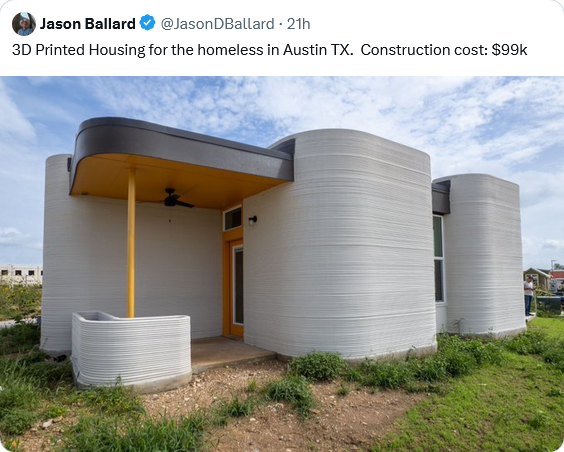
A man whose job is to sell 3d printed houses isn’t trying to fix the feral-human problem. He’s trying to sell 3d printed houses.
And it’s one hell of a lot easier to sell them to bureaucrats who aren’t spending their own personal money.
It doesn’t matter if 3d printed houses suck to live in. It doesn’t matter if the feral humans trash them. Nobody in this equation cares about the feral humans, even the feral humans themselves.
And nobody in this equation cares about the taxpayers. If the feral humans are still feral, then the 3d house grifters can sell more gimmick houses, and the bureaucrats can spend more of someone else’s money.
If a violent political upheaval becomes necessary, this will be very unpleasant for everyone involved, but at least afterwards, we will all be able to use the feral humans, bureaucrats, and grifters to fertilize the garden of new homes.
Which will be made out of bricks.
Update, 2 August: Welcome, Instapundit readers! Have a look around at some of my other posts you may find of interest. I send out a daily summary of posts here through my Substack – https://substack.com/@nicholasrusson that you can subscribe to if you’d like to be informed of new posts in the future.



[…] BEEN SAYING THIS FOR YEARS: Homelessness isn’t the real problem … it’s feral humans. […]
Pingback by Instapundit » Blog Archive » BEEN SAYING THIS FOR YEARS: Homelessness isn’t the real problem … it’s feral humans. — August 2, 2026 @ 03:00
I’m in the residential property rental business and once agreed with the Salvation Army to rent a unit to a supposedly reformed homeless man. They agreed to guarantee his rent for a year and cover any damage.
He was good for 2 months then…strange visitors, noises and smells at odd hours, complaints from other tenants about that and his awful dirty smelly appearance. Then a missed rent payment which Sally Ann promptly made good but it turned out they had given him the rent money.
Then a lot of noise and finally he just disappeared. I went through the legal rigmarole to get into the unit and found trash and dirt everywhere, a broken sink and smashed drywall. The stove top and oven were pristine, never used as far as I could tell.
Sally Ann paid me about $1,500.00 to repair the place.
Never again.
I saw him living on the streets afterwards for a while then gone. Dead? Moved to a different neighbourhood or city? Who knows.
Comment by Fred Zed — August 2, 2026 @ 04:45
Thank you for clarifying the terrible reality.
People of good will need to read this to disabuse themselves of their kind delusions.
Comment by Margaret — August 2, 2026 @ 08:05
It’s the same dynamic with all social welfare efforts: The LAST thing the system wants is people who can take care of and provide for themselves. More homeless and more welfare means more money for the people handing it out. They are rewarded for making the problem WORSE.
Comment by John — August 2, 2026 @ 11:19
There was a green area in the city where I live where I could do a 7 mile power walk during the winter when hiking was unavailable. There was a public rest room at one end where I would take a leak. One day I went in it and saw someone had crapped in the sink, which was right next to the toilet. I never used that facility again. I stopped walking there the end of that winter because of the increased feral human population.
These are not normal people who happen to be down on their luck, like the hobos of the 1930’s. These are truly feral humans and all of the social programs designed to help them are really grifting operations scamming the tax payers.
Comment by Abelard Lindsey — August 2, 2026 @ 11:29
When you can make money by working to “solve” the homeless crisis, the last thing you want to do is actually solve it.
It used to be relatively easy to commit people with serious mental issues to hospitals or other mental health institutions. But after some serious civil rights abuses, we pretty much emptied those institutions over half a century ago. And while we were throwing these people out into the street, we started closing down cheap, single-room occupancy hotels (AKA “flophouses”). maybe it’s time we brought both of those back.
Comment by Bill Roberts — August 2, 2026 @ 12:55
‘The real problem for most of them is that they’ve gone feral” <– No. A large minority are mentally ill/non-functionally addicted, about one third. Most simply cannot find employment which pays enough for a home where they are.
The solution to a good half or more of the "homelessness crisis" is to prevent the interference of local governments via zone and building codes, from the construction of housing these people can afford, and even build equity in.
Comment by Talia Perkins — August 2, 2026 @ 15:13