One thing Trump does better than any other politician is finding ways to send his opponents crazy. It’s not a skill I’d want to have myself, but it’s amazing how Trump can do or say something outrageous … and pretty much every time his opponents take the bait and make themselves even more ridiculous in trying to react to his provocations. Like randomly renaming Lake Ontario by executive order:
I don’t think Carney has Trump Derangement Syndrome, the citizens who vote for him do. Carney knows this, he counted on it to win the election. Elbows up was about preparing Canadians for a breakdown in relations with the U.S. – A breakdown that Carney and the other Laurentian elites who run things in Canada saw as inevitable. To anyone paying close enough attention, Carney is the de facto new leader of the globalists (the WEF mob). He ascended to that position at the moment he became the Canadian prime minister. Trump and the MAGA movement, on the other hand, are the singular force in the world effectively opposing globalism as it has emerged in the post-WWII “rules based order”.
This effectively places Canada at the center of an existential global struggle. However, we are not only at the center, but oppositionally set against the most powerful nation the world has ever seen, locked in a “trade war” with the largest economy in the history of humanity. Pardon my use of acronymic French as I blurt out an unruly “WTF!”
I am sure Carney has read The Art Of The Deal and knows how to win diplomatically with Trump – which is all one needs to read to gain the key insights prerequisite to mutually successful negotiations with the orange one. But Carney is not interested in mutually beneficial trade relations with the U.S. because that would mean tacit support for the American led reset of global political economy (which of course follows from America’s new economic policy, because yes absolutely America is that powerful), or put another way, it would mean Carney supporting the thing which is opposing the thing that he actually supports.
Elbows up Canadians have been manipulated by the most cynical government in the history of Canada. Carney is a smooth operator but a cunning wirepuller. He has essentially pulled the wool over the eyes of a malinformed citizenry who have been fed an endless diet of state-sponsored anti-American, Anti-Trump, and Anti-Poilievre propaganda since at least the final scenes of the Trudeau premiership set the stage for Carney the globalist show closer.
[…]
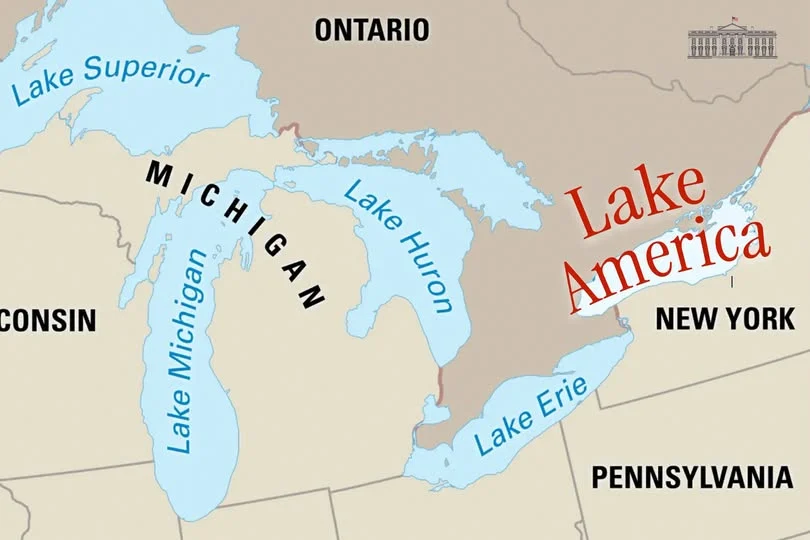
And at last we come unceremoniously to the supreme troller who has cast his line in the newly anointed Lake America. He is fishing for a major catch of Canadian TDS, and he is bound to fill his nets. Indeed, Trump has signed an executive order officially changing the name of Lake Ontario to Lake America. Canadians are of course triggered and are whining insufferably. I think it is funny, and I like that for once an Indian name is being changed to a European one. Trump is the greatest troller in the history of trolling. However, the move is a serious one, in twenty years the world will be flooded with maps and globes that label the former Lake Ontario as Lake America, in spite of the impotent protestations of butt hurt Canadians. America has vastly more power in this world, if they want our lake known as Lake America it will be so. Canadians who have a hard time accepting this simply have no clue about the dynamics of power.
Carney’s response to Trump’s redesignation of the lake was replete with a self-own only one as invested in a globalist “new world order”, and oblivious to actual domestic concerns could muster. He posted the following to X:
The name Lake Ontario comes from the Wendat word Ontari’io, which, appropriately, means “the lake is beautiful, the lake is big”.
The name is more than 400 years old, predating both the Confederation of Canada and the Declaration of Independence of the United States of America.
We know that America is changing. Their trading relationships, their foreign policies, their national monuments, their hydronyms.
Canadians also know that naming reality means calling it Lake Ontario – then, now and always.
A hilarious response to this which appeared on X was posted by Miranda Veracruz de la Jolla Cardinal, which I am assuming is a parody account since Miranda was a recurring character in the 1980s sitcom Married With Children. MVdlJC wrote:
“How dare Trump rename Lake Ontario!”
“Anyways, here I am at Sankofa Square …”
If that is not the cat’s pajamas then I have no idea what type of a response to Carney’s boundless smugness would adequately compliment a feline’s slumber. Carney says that Canadians know about “naming reality”, yet how many unpronounceable aboriginal terms have been grafted over the real names of Canadian places in the past decade or so.