
Quotulatiousness

August 16, 2026

In Ontario, bike lanes are not a “human right”, thank goodness

Filed under: Cancon, Government, Law, Media, Politics — Tags: , , , , , — Nicholas @ 05:00

On his Substack, Brian Lilley celebrates two recent developments in Ontario that — unlike so many others in the last several years — align with common sense:

Last year I wrote about the horrible court decision put out by “Justice” Paul Schabas on bike lanes being a Charter right. I put “Justice” in quotations because as I described at the time, the decision was so horrible and so political that it wasn’t worthy of an Ontario court.

Today, the Court of Appeal of Ontario agreed with me. As I wrote in my Toronto Sun column, they didn’t just overturn the ridiculous decision by Schabas, they excoriated him and his ruling.

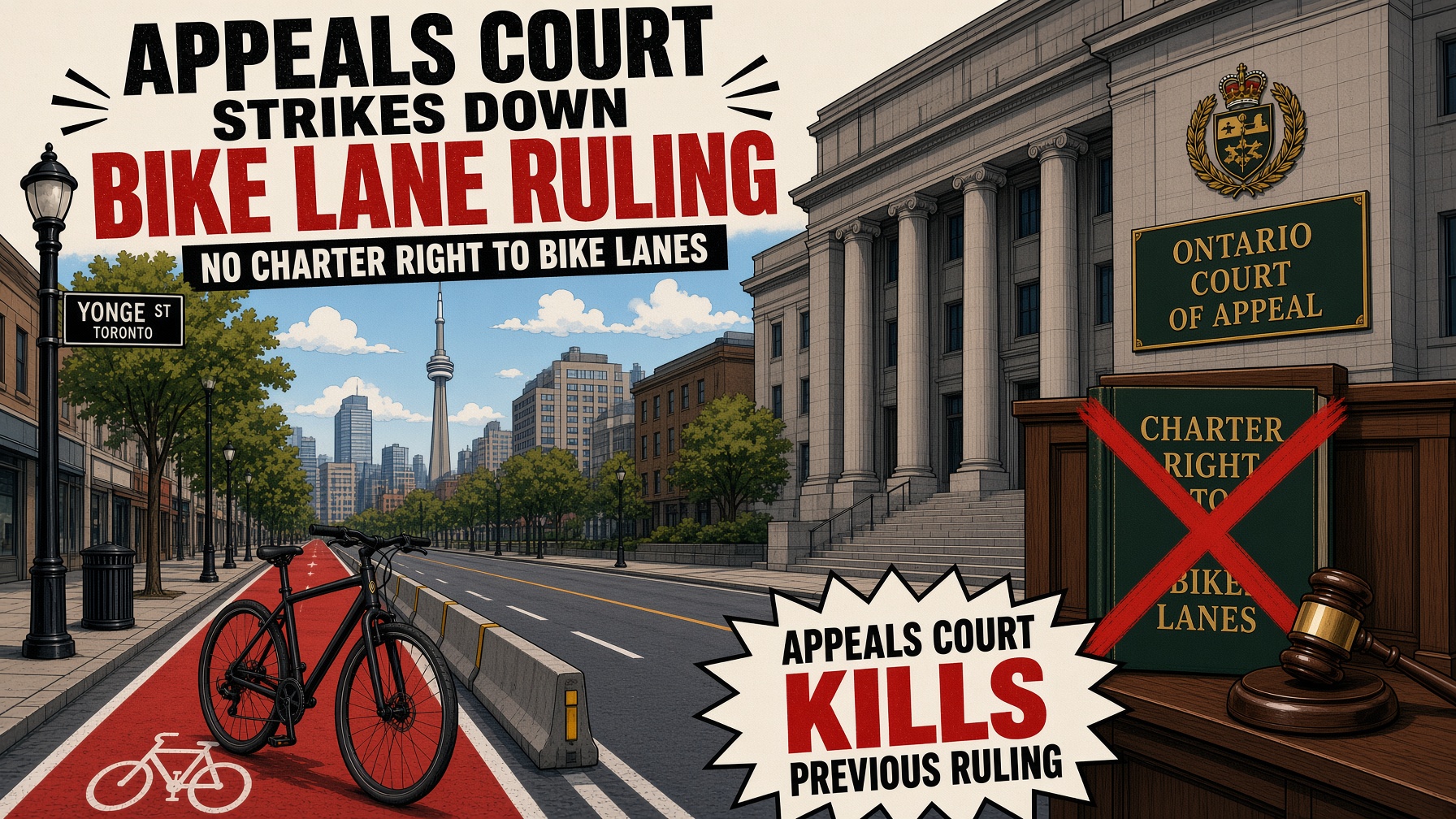
AI-generated image from Brian Lilley

I quoted different sections of the appeals court ruling in my column, and trust me it was tough to choose which parts to quote in such a brilliant decisions. Here, I want to quote from early in the ruling, paragraphs 3-5.

    [3] The application judge’s decision presents as a straightforward application of orthodox s. 7 principles. But the application of those principles, divorced from a broader understanding of the constitution of which they are a part, has led to a surprising outcome: the conclusion that routine legislation regulating road usage is unconstitutional.

    [4] Something has gone wrong.

    [5] The application judge erred in law in interpreting and applying s. 7. But his decision is wrong in a more profound sense, for it subverts a fundamental principle of our democratic constitutional order: a legislature cannot bind its successors. Legislatures in the Westminster tradition are free to undo legislation by amending or repealing it as they see fit. That is the nature of democratic lawmaking in our constitutional order. Of course, all laws are subject to the Charter, but this does not preclude the amendment or repeal of legislation the legislature was under no constitutional obligation to have passed in the first place. Amendment or repeal of legislation may breach the Charter only if the breach can be established independent of the prior state of the law.

There is so much to digest here, but I am glad to see judges — who come from different backgrounds and were appointed by both the Harper and Trudeau governments — agree on fundamental principles. That should be a given, we shouldn’t think about such things, but today, we can’t those fundamentals for granted.

The idea that one Parliament, or legislature, cannot bind the hands of another is fundamental to our system. If I pass a law saying that wearing blue on Tuesdays is illegal and the next Parliament passes a law saying that it isn’t, the more recent law takes precedent.

Yes, I used a ridiculous example on purpose, but just to prove a point. It’s sad that so many people, including those who report and comment on politics, aren’t familiar with this basic concept on the role of Parliament.
And the other reversal of an absurd policy:

Last month there was a tribunal ruling in Ontario that said people in the country illegally were still entitled to welfare. I wrote about it at the time and said it was a crazy ruling that the Ford government needed to deal with.

They promised to do so at the time and on Thursday announced that they had.

Friday morning I was forced to write about the ridiculous take by the Toronto Star‘s “senior immigration reporter” Nicholas Keung. It seems, based on his stories, that Keung has never met someone he doesn’t think should be in Canada.

I’ll say as the son of immigrants, who grew up in an area where kids with parents who had Canadian accents were the strange ones, most immigrants don’t back illegals getting welfare.

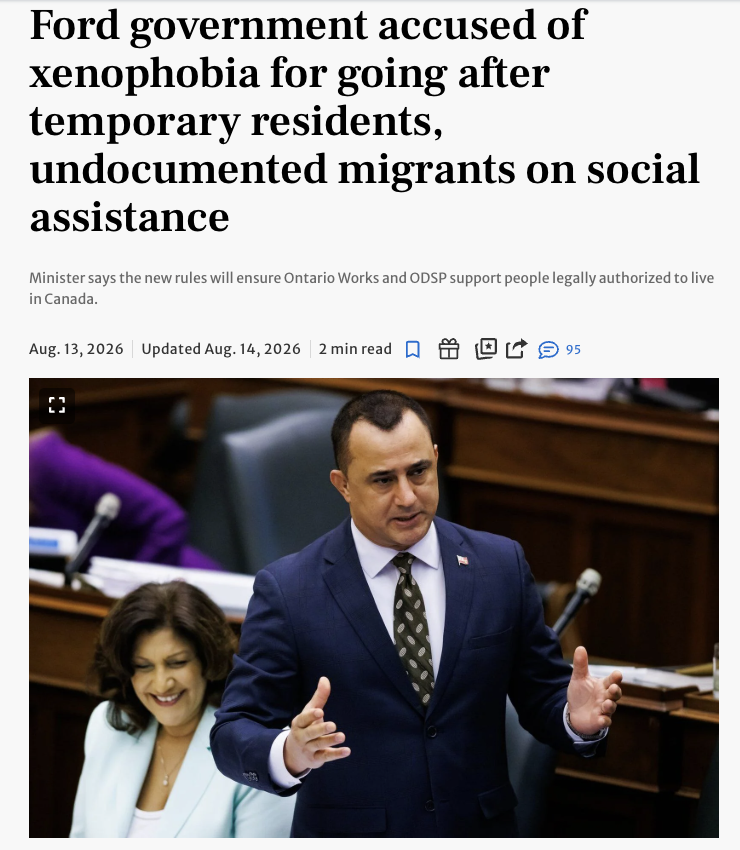
Still, this was the Star‘s headline on the story.

As I point out in my Sun column, Parsa is himself an immigrant having come from Iran with his family as a child.

But sure, the Star‘s “senior immigration reporter” smears him as racist.

Let me explain something to you. When a reporter says “experts” say and they only find experts from one side, that is them finding the people they agree with to say what they want said.

How Not to Be A Nazi – Death of Democracy 28 – Epilogue

Filed under: Germany, History, Military, WW2 — Tags: , , , , , , — Nicholas @ 04:00

World War Two
Published 15 Aug 2026

Nazi Germany destroyed democracy in weeks, launched a war that killed tens of millions, and carried racial persecution to industrialized mass murder. But after 1945, Germans and Europeans faced another question: how could they prevent it from ever happening again?

In this final, independently viewable epilogue to Death of Democracy, Spartacus examines how West Germany transformed the lessons of dictatorship and war into the Grundgesetz — a constitutional system built around human dignity, enforceable rights, federalism, judicial independence, social stability, and a democracy empowered to defend itself.

We trace how the Federal Republic combined lessons from Weimar, the United States, Britain, Austria, France, and other democratic traditions; how Konrad Adenauer’s generation tied Germany to a new European order; and how the same determination to restrain power and prevent another continental war eventually shaped the European Union and the Lisbon Treaty.

Finally, we ask how well those democratic fortifications are holding in 2026 — and return one last time to the diarists, victims, witnesses, supporters, and resisters whose voices guided us through Germany’s descent into dictatorship.

From the comments:

@spartacus-olsson
12 hours ago

Thank you for joining me on this adventure. I hope it has been eye-opening. If you watched to the very end, you will know that I’m soon launching a World War 2 Trivia board game – I’ve been super punny and named it World War IIrivia (2rivia with Roman numerals).

After so many years of studying this and sharing it in the darkest possible way, I felt it was time to look at the whole affair in a way that’s fun, social, and still educational. So a couple of months ago I came up with something. It turned out to be one of those moments when the work seems like extra fun. Before I knew it, I was spending my sleepless nights on the idea, sketching rules in Word, writing questions into lists in Excel, designing the game in Photoshop, testing gameplay against myself, and redesigning. And then there it was — an actual game. It’s a game for both novices and experts, with some unexpected twists and turns. If you’re interested in this period of history and enjoy a night of board games, this is for you. Stay tuned for more updates about the launch.

Once again, many, many thanks to all of you for watching. Thank you to Iryna, Astrid, Anna, and Clara for your great work on the series. Thank you to the TimeGhost Army members for enabling me to do this. With that, as Mr. Murrow would put it:

Good Night and Good Luck,
Your Spartacus

Understanding Canadian politics

Filed under: Cancon, Media, Politics — Tags: , — Nicholas @ 03:00

To an outsider, the ins and outs of Canadian politics must seem quite illogical — and for lots of good reasons — but L. Wayne Mathison offers an explanation that may help:

I think the “constraints” framework explains a surprising amount of Canadian politics.

Canada increasingly governs as though good intentions can overrule physical and economic limits.

We want more housing, but often ignore land-use rules, permitting delays, skilled-trade shortages, infrastructure capacity and construction costs.

We want better health care, but governments can promise “universal access” far more easily than they can produce doctors, nurses, operating rooms, diagnostic machines and hours in the day.

We want rapid population growth, while pretending housing, roads, schools and hospitals will expand at the same speed.

We want reliable electricity while making major generation and transmission projects harder to build.

We want higher wages and stronger public services while giving far less attention to productivity, capital investment and the businesses that ultimately generate the income being taxed.

This is where I think the constrained versus unconstrained distinction is useful.

Politics often treats shortages as failures of compassion or policy design. But sometimes the problem is much simpler: you cannot legislate resources into existence.

I learned that farming. You could have the best plan in the world, but weather, machinery, labour, soil, interest rates and time still had the final vote. Reality didn’t care how sincere you were.

Government faces the same rule.

This doesn’t mean government is useless, and it doesn’t mean every left-wing idea ignores constraints or every conservative understands them. Plenty don’t. But Canadian policy would improve dramatically if every proposal had to answer one basic question:

What are the real-world bottlenecks, and what happens when we hit them?

You can redistribute money. You can rewrite regulations. You can announce targets.

You cannot redistribute houses that haven’t been built, doctors who don’t exist, electricity that hasn’t been generated or productivity that hasn’t been created.

Eventually the physical world collects its bill.

The Ancient Greeks 04 – The Persian Invasion 2 – Logistics and Diplomacy

Filed under: Greece, History, Middle East, Military — Tags: , , , , , , , — Nicholas @ 02:00

seangabb
Published 24 Mar 2026

Greece: A Brief History, c.700 BC – 500 AD

How do you move an empire to war? This lecture examines the extraordinary logistical and diplomatic preparations behind Xerxes’ invasion of Greece. We explore how the Persian Empire assembled one of the largest armies in ancient history and the immense challenges of supplying and coordinating such a force.

At the same time, we examine the diplomatic pressure placed on the Greek states, including demands for submission and the divisions this created within the Greek world.

– The scale and organisation of the Persian army and navy
– Supply lines, engineering, and preparation
– The bridging (and scourging) of the Hellespont
– Persian diplomacy and the demand for “earth and water”
– Greek responses: submission, neutrality, and resistance

This lecture shows that the invasion was not simply a military campaign, but a vast imperial operation combining force, intimidation, and political calculation.

QotD: The “Marian reforms” were not a thing

Filed under: Europe, History, Military, Quotations — Tags: , , , , — Nicholas @ 01:00

We can then return to our list at the beginning:

  • Cohorts: Experimented with before Marius, especially in Spain. Marius uses cohorts, but there’s no evidence he systematized or standardized this or was particularly new or unusual in doing so. Probably the actual breakpoint here is the Social War.
  • Poor Volunteers Instead of Conscripted Assidui: Marius does not represent a break in the normal function of the Roman dilectus but a continuation of the Roman tradition of taking volunteers or dipping into the capite censi in a crisis. The traditional Roman conscription system functions for decades after Marius and a full professional army doesn’t emerge until Augustus.
  • Discharge bonuses or land as a regular feature of Roman service: Once again, this isn’t Marius but Imperator Caesar Augustus who does this. Rewarding soldiers with loot and using conquered lands to form colonies wasn’t new and Marius doesn’t standardize it, Augustus does.
  • No More equites and velites: No reason in the source to suppose Marius does this and plenty of reasons to suppose he doesn’t. Both velites and equites seem to continue at least a little bit into the first century. Fully replacing these roles with auxilia is once again a job for our man, Imperator Caesar Augustus, divi filius, pater patriae, reformer of armies, gestae of res, and all the rest.
  • State-Supplied Equipment: No evidence in the sources. This shift is happening but is not associated with Marius. In any event, the conformity of imperial pay records with Polybius’ system of deductions for the second century BC suggests no major, clean break in the system.
  • A New Sort of Pilum: No evidence, probably didn’t exist, made up by Plutarch or his sources. Roman pilum design is shifting, but not in the ways Plutarch suggests. If a Marian pilum did exist, the idea didn’t stick.
  • Aquila Standards: Eagle standards pre-date Marius and non-eagle standards post-date him, but this may be one thing he actually does do, amplifying the importance of the eagle as the primary standard of the legion.
  • The sarcina and furca and making Roman soldiers carry things: By no means new to Marius. This is a topos of Roman commanders before and after Marius. There is no reason to suppose he was unusual in this regard.

So the Marian reforms … were not a thing. Functionally none of what is described as happening in them was new or unique to Marius. Indeed, the most substantial reforms are either things that were already changing (and which Marius seems to have had little role in) or things which had not yet changed but which would, under Augustus. Indeed, one of the problems with the assumption of a Marian reform is that it takes a whole lot of changes which were more likely a package of reforms under Augustus and pulls them forward in time to Marius, doing some damage to our understanding of both figures.

But Augustus makes much more sense as the figure doing many of those organizational changes. For one we have sources actually telling us he did them, from the standardization of military service (Dio 54.25.6), the creation of retirement bonuses and the aerarium militare to fund them (Dio 54.25.6 again, but also Res Gestae 17), and the radical expansion and formalization of the auxilia as part of the Roman army (Tac. Ann. 4.5). The one thing missing is citizenship-for-service, which we can see emerging under Tiberius, the next emperor immediately after Augustus. And it makes sense because Augustus is, by necessity, doing a bunch of other things with the legions too. He’s instituting a whole new command structure, with dedicated legionary commanders (the legatus legionis) serving under his own provincial commanders (legati Augusti) with imperial procuratores handling the former role of the quaestors. Also, the legions get their citizen cavalry (though a quite small detachment of it) back too.

So instead of thinking, “Marian reforms” – which were, I must stress, not a thing – you ought to be thinking about a period of tactical, organizational and institutional change beginning in the second century, accelerating in the first century and then finally being instituted as a comprehensive set of reforms and formalization by Augustus, not by Marius, which codified a lot of change that had already happened over that long period. A long process with a punctuation mark at the end rather than a singular moment of reform associated with a singular Roman general.

Alright. Now one of you go and fix the Wikipedia entry.

Bret Devereaux, “Collections: The Marian Reforms Weren’t a Thing”, A Collection of Unmitigated Pedantry, 2023-06-30.

Powered by WordPress



