The Rest Is History
Published 7 Sep 2026What shocking, unprecedented act did Sulla commit with his legions after having his ambitions frustrated once more by his bitter rival, the tribune Marius? How did Marius escape capture and death? And, would Marius retaliate …?
Join Tom and Dominic as they unfold the mounting rivalry between two Roman generals — Marius and Sulla — as they battle for ultimate control of the empire, and Sulla takes a fateful step that will change the fate of the Republic forever …
0:00 Sulla: The First Roman General to March on Rome
4:31 Marius Seizes Sulla’s Command
11:47 Sulla Marches on Rome
19:50 Mithridates: Rome’s Great Enemy in the East
23:25 The Massacre of the Romans in Asia
26:46 Athens Revolts Against Rome
30:34 Rome’s Generals Become Warlords
34:38 Pressure
35:46 Marius: Fugitive and Outlaw
41:02 Rome Descends Into Political Violence
45:13 Marius Raises a Private Army
48:15 Marius Returns to Rome
49:06 Marius’s Seventh Consulship and Death
51:44 Sulla Goes to War in Greece
53:40 The Siege of Athens
56:59 Sulla Storms Athens
59:51 Sulla Faces Mithridates’ Army
1:00:48 Sulla Makes Peace with Mithridates
1:03:33 Sulla’s Revenge on Athens
1:04:58 Rome’s First Civil War Looms
September 8, 2026
Sulla Seized Rome… Then Marius Returned for Revenge | Rome’s First Civil War
September 4, 2026
Marius Saved Rome … Then They Turned To His Greatest Rival | Rome’s First Civil War
The Rest Is History
Published 3 Sep 2026What was the ancient city of Rome actually like in the first century BC? Who was Lucius Cornelius Sulla, another great, but aristocratic, Roman general who would clash with Gaius Marius in a totemic struggle termed the Social War? And, who were the terrifying Germanic tribes amassing on the borders of the empire, potentially spelling its doom …?
Join Tom and Dominic as they discuss Rome’s apocalyptic threat from the North, Marius’ wars in defence of the empire, and the rise of his greatest adversary: Sulla.
0:00 Rome’s Most Unlikely Saviour
4:25 The Barbarian Threat to Rome
9:15 Rome’s Catastrophic Defeat
14:04 Marius Rebuilds the Roman Army
16:48 Marius Takes on the Teutones
19:36 The Cimbri Are Annihilated
23:41 Marius Becomes Too Powerful
27:00 The Rise of Sulla
31:02 Sulla’s Ruthless Ambition
35:05 Amazon
36:15 The Extraordinary Wealth of Roman Italy
42:49 Italy’s Second-Class Citizens
46:18 The Social War Erupts
50:44 Rome Fights Back
52:35 Sulla Becomes Rome’s New Hero
56:05 A New War in the East
58:18 Mithridates Takes on Rome
1:02:00 Marius Makes His Comeback
1:04:39 Violence Erupts in Rome
1:07:01 Marius Takes Sulla’s Command
As Tom and Dominic mention during this episode, there’s a members-only bonus episode discussing the (much contested) “Marian reforms” of the Roman army with … Bret Devereaux who is a strong proponent of the notion that the Marian reforms were not a thing.
September 1, 2026
Marius: The Outsider Who Rose to Command Rome’s Army | Rome’s First Civil War
The Rest Is History
Published 31 Aug 2026Who was Gaius Marius, one of the two men who would shape the fate of Rome in the first century BC? Why was his road to fame, fortune, and political greatness, from total obscurity, so dangerous? And, would Marius be the man to face down the existential threat facing the empire during this period?
Join Tom and Dominic as they launch into one of the greatest struggles in the history of Rome, as two titanic generals and politicians clash over hegemony of the empire, in an age of tumult.
0:00 Gaius Marius: Rome’s outsider
6:13 Marius goes to war
12:09 Climbing Rome’s political ladder
18:35 Amazon
19:45 The Roman Republic turns violent
27:00 Marius takes on the aristocracy
31:45 War with Jugurtha
37:53 Marius betrays Metellus
40:12 Marius becomes Consul
44:28 A new threat approaches Rome
45:09 Marius meets his future rival: Sulla
August 16, 2026
QotD: The “Marian reforms” were not a thing
We can then return to our list at the beginning:
- Cohorts: Experimented with before Marius, especially in Spain. Marius uses cohorts, but there’s no evidence he systematized or standardized this or was particularly new or unusual in doing so. Probably the actual breakpoint here is the Social War.
- Poor Volunteers Instead of Conscripted Assidui: Marius does not represent a break in the normal function of the Roman dilectus but a continuation of the Roman tradition of taking volunteers or dipping into the capite censi in a crisis. The traditional Roman conscription system functions for decades after Marius and a full professional army doesn’t emerge until Augustus.
- Discharge bonuses or land as a regular feature of Roman service: Once again, this isn’t Marius but Imperator Caesar Augustus who does this. Rewarding soldiers with loot and using conquered lands to form colonies wasn’t new and Marius doesn’t standardize it, Augustus does.
- No More equites and velites: No reason in the source to suppose Marius does this and plenty of reasons to suppose he doesn’t. Both velites and equites seem to continue at least a little bit into the first century. Fully replacing these roles with auxilia is once again a job for our man, Imperator Caesar Augustus, divi filius, pater patriae, reformer of armies, gestae of res, and all the rest.
- State-Supplied Equipment: No evidence in the sources. This shift is happening but is not associated with Marius. In any event, the conformity of imperial pay records with Polybius’ system of deductions for the second century BC suggests no major, clean break in the system.
- A New Sort of Pilum: No evidence, probably didn’t exist, made up by Plutarch or his sources. Roman pilum design is shifting, but not in the ways Plutarch suggests. If a Marian pilum did exist, the idea didn’t stick.
- Aquila Standards: Eagle standards pre-date Marius and non-eagle standards post-date him, but this may be one thing he actually does do, amplifying the importance of the eagle as the primary standard of the legion.
- The sarcina and furca and making Roman soldiers carry things: By no means new to Marius. This is a topos of Roman commanders before and after Marius. There is no reason to suppose he was unusual in this regard.
So the Marian reforms … were not a thing. Functionally none of what is described as happening in them was new or unique to Marius. Indeed, the most substantial reforms are either things that were already changing (and which Marius seems to have had little role in) or things which had not yet changed but which would, under Augustus. Indeed, one of the problems with the assumption of a Marian reform is that it takes a whole lot of changes which were more likely a package of reforms under Augustus and pulls them forward in time to Marius, doing some damage to our understanding of both figures.
But Augustus makes much more sense as the figure doing many of those organizational changes. For one we have sources actually telling us he did them, from the standardization of military service (Dio 54.25.6), the creation of retirement bonuses and the aerarium militare to fund them (Dio 54.25.6 again, but also Res Gestae 17), and the radical expansion and formalization of the auxilia as part of the Roman army (Tac. Ann. 4.5). The one thing missing is citizenship-for-service, which we can see emerging under Tiberius, the next emperor immediately after Augustus. And it makes sense because Augustus is, by necessity, doing a bunch of other things with the legions too. He’s instituting a whole new command structure, with dedicated legionary commanders (the legatus legionis) serving under his own provincial commanders (legati Augusti) with imperial procuratores handling the former role of the quaestors. Also, the legions get their citizen cavalry (though a quite small detachment of it) back too.
So instead of thinking, “Marian reforms” – which were, I must stress, not a thing – you ought to be thinking about a period of tactical, organizational and institutional change beginning in the second century, accelerating in the first century and then finally being instituted as a comprehensive set of reforms and formalization by Augustus, not by Marius, which codified a lot of change that had already happened over that long period. A long process with a punctuation mark at the end rather than a singular moment of reform associated with a singular Roman general.
Alright. Now one of you go and fix the Wikipedia entry.
Bret Devereaux, “Collections: The Marian Reforms Weren’t a Thing”, A Collection of Unmitigated Pedantry, 2023-06-30.
June 23, 2025
QotD: Recruiting and organization under the “Marian reforms”
Sallust reports that Marius, “after he saw that the spirits of the plebs were aroused, he swiftly loaded ships with supplies, pay, weapons and other requirements; with them he ordered Aulus Manlius, his legate, to set out. Meanwhile himself he enrolled soldiers, not according to the mos maiorum [‘the customs of the ancestors’] from the census classes, but making use of whoever wished to go, mostly the capite censi [‘those counted by heads’ = the propertyless poor or proletarii]” (Sall. Iug. 86.1-2, trans mine). Plutarch repeats this report, that Marius violated custom by enrolling men who didn’t meet the property qualification for military service (Plut. Mar. 9.1).
There are a few oddities here to start, though. First, Sallust quickly notes that this resulted in Marius having an army rather larger than what the Senate had actually authorized (Sall. Iug. 86.4) and that’s actually quite a neat detail that may explain part of what’s going on here because this has, in a way, happened before. In 134, Scipio Aemilianus was elected consul for the second time (illegally, again) with a mandate to end the frustrating Roman war against the Celtiberian stronghold of Numantia in Spain. The Senate, however, denied Scipio authorization to raise fresh troops, to which Scipio responded by enlisting some 4,000 volunteers to replenish his legion; Appian says this was done with the consent of the Senate, but Plutarch’s brief note on it sure implies Scipio Aemilianus is end-running around Senatorial efforts to stifle him (App. Hisp. 84; Plut. Mor. 201A-B). And this too was hardly the first time for this sort of end-run; Scipio Africanus (what is it with Scipiones!?) back in 205 agitated for his invasion of Africa to end the Second Punic War and was given the province of Sicily with authorization to go to Africa if he thought it necessary, but the Senate registered its displeasure by refusing to let him levy troops, at which point – wait for it – Scipio took volunteers, equipping and financing his force through the socii and even building a fleet that way (Liv. 28.45.9-12).
In short, the Senate sometimes tried to trim the sails of generals it was displeased with – and Marius reportedly had gotten elected on a campaign platform of “to hell with the Senate” (Sall. Iug. 84.1) – by limiting the size of their armies or refusing to allow them to conduct a levy. And since 205 (a century before Marius), popular generals had occasionally juked this effort by the Senate by instead calling for volunteers, which the Senate could not stop. Marius is not doing something new in taking volunteers to supplement an army through the levy.
He also doesn’t keep doing it. After Marius wins in Africa with his volunteer-supplemented army (the bulk of which of course were still recruited through the dilectus under Metellus), he returns to Italy to take over the war against the Cimbri and Teutones but he doesn’t keep up the volunteer force, instead taking command of his predecessor Rutilius Rufus’ normally levied army (Front. Strat. 4.2.2). In practice, Marius probably took volunteers in part for that first army because the Senate was diverting available levy manpower towards the early phases of the Cimbric War (or at least that was a convenient excuse to kneecap him) – a series of costly military disasters for Rome which likely soaked up much of the manpower the Senate was willing to raise. Once Marius has access to that “primary” stream of manpower generated through the dilectus, he uses it and seems to stop using volunteers.
But what of recruiting the capite censi? Well, that isn’t quite new either, although it surely wasn’t typical. For one, it wasn’t that the poor absolutely never served; Polybius notes that the capite censi served in the fleet (Polyb. 6.19.2). But we also see non-assidui (assidui being the term for those wealthy enough to be liable for normal conscription) in a range of other emergencies. Livy reports in 329 a “crowd of sellularii [men who work sedentary trades, literally, ‘stoolsmen’], a type least suited for military service, were called into the army” (Livy 8.20.4), though the historicity of this report is questionable given the early date. In 296, Etruscan entrance into the Third Samnite War causes a draft of “not only the freeborn or the iuniores took the oath, but cohorts were made of seniores and centuries of freedmen” (Livy 10.21.4). Gellius (16.10.1) quotes Ennius reporting the proletarii were pulled into the armies in 280, presumably in response to Pyrrhus’ victory at Heraclea. And during the Second Punic War the Romans pulled out all of the stops, recruiting debtors and men convicted of capital crimes (Livy 23.14.3), enrolling slaves into the army (called the volones; you free them first and then draft them, Livy 27.38 and 28.10, Val. Max. 7.6.1) and as noted above, taking volunteers more generally.
As an aside, if you are wondering why the Romans seem in some of these to skip recruiting freeborn capite censi and go straight to freedmen and enslaved people, I think there are two answers here for this period. First, many of the available freeborn poor are probably already in service in the fleet. Second, there probably aren’t that many of them. Recall our chart of Roman social classes – the capite censi in the third century is quite small, almost certainly outnumbered by enslaved persons in Italy. But the population of Italy was rising over the third and especially second century and without adding new farmland, those new freeborn Romans may have swelled the ranks of the capite censi, leading to a much larger propertyless class by the late second century or the first century.1 Consequently, there may have been a lot more capite censi worth recruiting by Marius’ day, when Rome no longer needed to keep a large navy at sea (not facing any naval powers in its wars) and the number of capite censi having risen.
Finally, Marius does not mark the end of the Roman dilectus! Evidently Roman conscription persisted at least to the end of the Roman civil wars, as Suetonius reports Augustus (perhaps when he was still Octavian) inflicting the traditional penalty of being sold into slavery for draft-dodging on a Roman eques who cut the fingers off of his two sons to make them ineligible for military service (Suet. Aug. 24.1). Indeed we have attestations of the dilectus in 55, 52, 50, 49, AD 6 and AD 9.2 Even once the army is fairly clearly primarily a volunteer force, at least notionally the ability to hold a levy when necessary to fill the ranks remained “on the books” and Trajan (r. 98-117 AD) holds at least one levy because he punishes a father for the same reason Augustus had done (Dig. 49.16.4.12). So the traditional dilectus remained a thing Roman leaders could do well into the empire. In practice it seems safe to assume the system by the mid-first century is substantially ad hoc, as the census straight up doesn’t happen from 69 BC to 28 BC, which would make it hard to actually enforce the property requirements. But the process doesn’t stop in 107 and there’s no reason to suppose from 107 to 69, with the census being regularly conducted, that most annual levies were not conducted along traditional property lines.3
So the most we might say is that a one-time crisis expedient in earlier periods slowly becomes a standard way to supplement legions and then the standard way to recruit them, with the old normal method of the dilectus instead becoming the unusual way to supplement in a crisis. It’s unclear exactly when that shift-over point happens, but it sure isn’t in the career of Gaius Marius, who sits clearly in the “volunteers as a crisis response” side of the issue.
And what of the notion that Gaius Marius introduced both citizenship as a reward for service as a regular bonus and also that he instituted the paying of soldiers at the completion of a campaign to render them loyal? Well on the latter point, the Romans had been distributing spoils to the soldiers at the end of a campaign as a lump-sum payment since the beginning. This is exceedingly well reflected in Livy’s accounting of the years from 201 to 167 (where we have a nice continuous burst of Livy), see for instance Livy ::deep breath:: 30.45, 31.20, 33.23, 33.37, 34.46, 34.52, 36.40, 37.59, 39.5, 39.7, 40.34, 40.43, 40.59, 41.7, 41.13, 45.40, 45.43.4 And the idea that Roman victories might seize land which would then be settled as Roman coloniae, creating new land for Roman settlers was also not new (Wikipedia has a convenient list of Roman coloniae). So Marius is simply promising to do a thing Roman commanders regularly did, essentially saying, “serve with me, because I’m going to win and victory will make us rich”. Which is exactly the reason volunteers rushed to serve with Scipio Africanus and Scipio Aemilianus: they anticipated a lucrative victory for such well-regarded commanders.
And by now you may well be asking, “but wait, then when does the system change?” Because after all, I said that by the early empire, we can pretty clearly see an army primarily composed of professional, long-service volunteers who receive substantial retirement bonuses and are permanently stationed on the frontiers. Who is responsible for that? And in response, I give you, this guy.
It’s Augustus. It was always Augustus. Or at least I should say that is my view, given the evidence. Older scholarship – I think here of Keppie (1984) in particular – tended to assume that because most of the big changes happened with Marius (but we’ve seen they don’t) that Octavian/Augustus probably made only minimal changes to the military system he inherited from Julius Caesar. I don’t think that’s correct. I think if we look at the evidence in more detail it becomes clear that Augustus is the “break” (though not a clean break by any means) and that in fact we need to start regarding Augustus as a military reformer of some significant scale rather than merely the codifier of a Caesarian military system (though he probably does that too).
Augustus, after all, institutes regular bonuses for discharge, establishing a treasury funded by a regular tax to meet the expense rather than simply promising that he would win a lot and so soldiers would get rich off of their share of the booty (Res Gestae 17). And it’s not hard to see the problem he’s responding to – the massive military buildup of the Roman civil wars had left Octavian, as the victor, with the red-hot potato of hundreds of thousands of soldiers who were promised the spoils of victory, including large numbers of men who didn’t win but who, if not settled down somehow would disrupt the state (RG 3). Earlier in the civil wars, Octavian had used proscriptions and land confiscations to solve this problem but as emperor, he needed a permanent solution, thus the establishment of the aerarium militare and its discharge bonuses (praemia). Before that, you simply had generals promising to feast their soldiers off of the property of the vanquished; the civil wars had only changed that in that the vanquished were now Romans. It also establishes a standard length of service, creating that professional, long-service army.
There’s a related issue which is the fate of the citizen equites and the velites. Caesar’s armies in Gaul seem to have neither, so the assumption was that the shift to recruiting proletarii meant that these wealth-based distinctions (the richest Romans serve as equites, the poorest as velites) dropped away, leaving a uniform heavy infantry legion. And in a schematic it makes sense: both roles are absorbed by the auxilia and indeed Caesar makes use of a lot of Gallic cavalry auxiliaries. But as François Gauthier recently pointed out,5 it’s not all clear that the velites really did vanish in the late-second/early-first century. Cicero still refers to to them writing in the 40s (Cic. Fam. 9.20; Brut., 271) and their apparent absence in Caesar’s writing may well just be an accident of Caesar’s avoidance of technical language. Caesar doesn’t generally talk about hastati or triarii much either; he prefers milites (“soldiers”). Likewise, it’s clear the citizen cavalry – the equites – survived Marius; as Jeremiah McCall notes, we have good evidence for citizen equites at least as late as the 90s BC and suggests the citizen cavalry probably vanished in the 80s as a result of the Social War and Sulla‘s Civil War.6 It surely did not happen in 107 or 104.
Meanwhile the auxilia as a mature part of the Roman army really only emerge under Augustus, and not even right at the beginning of his reign either. Roman armies needed cavalry and light infantry to function, so once again we may not be looking at a clean break but rather a period of transition as a result of some generals preference for (non-Italian) allied or auxiliary cavalry and light infantry and the formalization of that system not in 107 with Marius but again in 27 with Augustus.
Marius is also sometimes credited with the idea of extending citizenship to non-citizens who served, which is a catastrophic misreading of one episode in his career. For one, this gets read as meaning that Marius extended citizenship to all of the Italians in his army or that he made it standard to do so. Note for instance this line pulled from Wikipedia:
Finally, Marius granted citizens of the Italian allies (Etruria, Picenum, etc.) full Roman citizenship if they fought for Rome and completed a period of service in the Roman army.
[Dated] 6/25/2023, specified in the hope this page changes to be less wrong.
And that’s very much not right either. We have evidence for only a handful of citizenship extensions by Marius. In particular, of his army he extended citizenship to just two cohorts (c. 1,000 men) from Camerinum (Plut. Mor. 202D, Cic. Pro Balbo 46.). I can only assume this gets misunderstood because some writers don’t know their unit sizes, but Marius had 32,000 men in his army at Vercellae (101 BC), probably something like half of which were socii. These two cohorts were a comparatively tiny fraction. Marius also seems to have selected a very small number of his other socii veterans for citizenship (Cic. Pro Balbo 48), but there was no blanket grant of citizenship. Of course there wasn’t, this issue remained substantially unsolved until the Social War (91-87BC); if Roman levies had been calmly minting new citizens out of thousands of Italians through the 90s, there would hardly have been a cause for the Social War.
Instead, citizenship as a reward for service is an artifact of the imperial period and the auxilia. The Roman use of non-Roman, non-socii troops to supplement their armies was not new, but it emerged as a formalized, permanent part of the Roman army not during the civil wars – where such units where both ad hoc but also not nearly so numerous – but under the reign of Augustus, coming to form about half of the army by the end of his reign (Tac. Ann. 4.5; on the emergence of the auxilia, see I. Haynes, Blood of the Provinces (2013)). Indeed, as Haynes notes (op. cit. 49), it is actually only under Tiberius (r. 14-37) that we get direct evidence of citizenship grants to auxilia and the practice even then seems at least somewhat irregular (though it comes to be regularized).
In short that, the notion that Gaius Marius instituted the pattern of granting citizenship to serving non-citizens on discharge is simply wrong; that’s not in our sources. That doesn’t become consistent until Tiberius well over a century later. Gaius Marius did recruit volunteer capite censi into his army once but didn’t make a habit of it and as such isn’t a major reformer so much as a key step in a slow process of change which reaches its decisive point probably under Augustus, more than half a century after Gaius Marius died. He wasn’t the first to do either thing, whatever our sources say.
Bret Devereaux, “Collections: The Marian Reforms Weren’t a Thing”, A Collection of Unmitigated Pedantry, 2023-06-30.
1. For more on the dynamics of this, see N. Rosenstein, Rome at War (2004), as this is part of his central argument.
2. For textual references, see Brunt, Italian Manpower (1971), 636-7.
3. We do not know how that process would have accounted for the massive expansion of the Roman citizen class due to the Social War. But evidently it did!
4. These were happily already compiled by Brunt, op. cit., 394.
5. “Did velites Really Disappear in the Late Roman Republic?” Historia 70 (2021).
6. J.B. McCall, The Cavalry of the Roman Republic (2002), 100-113..
September 30, 2024
Sulla, civil war, and dictatorship
Adrian Goldsworthy. Historian and Novelist
Published Jun 5, 2024The latest instalment of the Conquered and the Proud looks at the first few decades of the first century BC. We deal with the final days of Marius, the rise of Sulla, the escalating spiral of civil wars and massacres as Rome’s traditional political system starts breaking down.
Primary Sources – Plutarch, Marius, Sulla, Pompey, Crassus, Cicero and Caesar. Appian Civil Wars and Mithridatic Wars.
Secondary (a small selection) –
P. Brunt, Social Conflicts in the Roman Republic & The Fall of The Roman Republic
A. Keaveney, Sulla – the last Republican
R. Seager, Pompey the Great: A political Biography
October 22, 2023
QotD: The changes in Roman legionary equipment attributed to the “Marian reforms”
For the pilum, Plutarch says that Marius designed it to incorporate a wooden rivet where the long metal shank met the heavy wooden shaft, replacing one of the two iron nails with a wooden rivet that would break on impact, in order to better disable the shield. The problem is that the pilum is actually archaeologically one of the best attested Roman weapons with the result that we can follow its development fairly closely. And the late, great Peter Connolly did exactly that in a series of articles in the Journal of Roman Military Equipment Studies1 and while the design of the pilum does develop over time, there’s simply no evidence for what Plutarch describes. The “broad tanged” pilum type could have been modified this way, but we’ve never found one actually so modified; instead the pila of this type we find all have rivets (two of them) in place (where rivets are preserved at all). Moreoever, most pila of that “broad tanged” type, both before and after Marius, have the edges of that broad tang bent over at the sides, which would prevent the sort of sliding action Plutarch describes even if one of the rivets broke. Meanwhile, by the first century there are three types of pila around (socketed, broad-tanged and spike-tanged) only one of which could be modified in this way (the broad-tanged type), and that type doesn’t dominate during the first century when one might expect Marius’ new-style pila to be in use. In practice then the conclusion seems to be that Plutarch made up or misunderstood this “innovation” in the pilum or, at best, the design was adopted briefly and then abandoned.
On to the aquila. Now, it is absolutely true that the aquila, the legionary eagle, became a key standard for the Roman legions. Pliny the Elder notes that before Marius it was merely the foremost of five standards, the others being the wolf, minotaur, horse and boar (Plin. HN 10.16). But even a brief glance as legionary standards into the early empire (see Keppie (1984), 205-213 for an incomplete and somewhat dated list) shows that bulls, boars and wolves remained pretty common legionary emblems (alongside the eagle) into the empire. The eagle seems to have been something of a personal totem for Marius (e.g. Plut. Mar. 36.5-6) so it is hardly surprising he’d have emphasized it, the same way that legions founded by Caesar – or which wanted to be seen as founded by Caesar – adopted the bull emblem, quite a lot. But this is a weak accomplishment, since Pliny already notes that the eagle was, even before Marius, already prima cum quattuor aliis (“first among four others”), and so it remained: first among a range of other emblems and standards. Though of all of the things we may credit Marius with instituting, this perhaps gets the closest, if we believe Pliny that Marius further elevated the eagle into its particular position.
Then there is the institution of the Roman marching pack and the furca to carry it, such that Marius’ soldiers became known as “Marius’ mules” because he made them carry all of their own kit rather than, as previous legions had supposedly done, carrying it all on mules. Surely this extremely famous element of the narrative cannot be flawed? And Plutarch sort of says this, he notes that, “Setting out on the expedition, he laboured to perfect his army as it went along, practicing the men in all kinds of running and in long marches, and compelling them to carry their own baggage and to prepare their own food. Hence, in after times, men who were fond of toil and did whatever was enjoined upon them contentedly and without a murmur, were called Marian mules” (Plut. 13.1; trans. B. Perrin). Except that doesn’t say anything about instituting the classic Roman pack that we see, for instance, depicted on Trajan’s column, does it? It just says Marius made his men carry their baggage and prepare their own food, leading to the nickname for men who did toil without complaint.
The problem is that those two things – making soldiers carry their baggage and cook their own food (along with kicking out camp followers) – are ubiquitous commonplaces of good generalship with instances that pre-date Marius. P. Cornelius Scipio Aemilianus does exactly this – getting rid of camp servants, wagons and pack animals, making soldiers cook their own food and kicking out the camp followers – according to Appian in 134 when he besieged Numantia (which fell in 133, App. Hisp. 85). And then Q. Caecilius Metellus, Marius’ own former commander, does the exact same thing in 109 when he takes command against Jugurtha in North Africa, kicking the sutlers out of the camp, getting rid of pack animals and private servants, making soldiers cook their own food, carry their own rations and their own weapons (Sall. Iug. 42.2; note that Sallust dies in in the 30s BC, 80-odd years before Plutarch is born, so Plutarch may well be getting this trope from Sallust and then attributing it to the wrong Roman). Critiques of generals who issued rations rather than making their soldiers cook or praise for generals who didn’t remained standard into the empire (e.g. Tac. Hist. 2.88; Hdn. 4.7.4-6; Dio Cass. 62.5.5). In short this trope was not new to Marius nor was it new to Plutarch’s version of Marius; it was a standard trope of generals restoring good discipline to their soldiers. Plutarch even hedges noting another story that the term “Marius’ mules” might actually have come how well Marius as a junior officer got along with animals (Plut. Mar. 13.2)!
Well, fine enough, but what about the idea that state-issued equipment is emerging in this period? Well, it might be but our evidence is not great. As noted when we discussed the dilectus, Polybius implies – and his schematic for conscription makes little sense otherwise – that the Romans are in that period buying their own equipment. He also notes that the quaestors deduct from a soldier’s pay the price of their rations (if they are Romans; socii eat for free), their clothing and any additional equipment they need (Polyb. 6.39.14). It makes sense; if a fellow forgot a sword or his breaks, you need to get that replaced, so you fine him the value of it and then issue him one from the common store.
Now Keppie (1984) assumes this system changes during the tribunate(s) of Gaius Gracchus (123-2) and you can see the temptation in this idea. If Gaius Gracchus shifts equipment to being issued at state expense, then suddenly there’s no reason not to recruit the landless proletarii (discussed below) opening the door for Marius to do so (discussed below) and fundamentally transforming the Roman army into the longer-service, professional form we see in the empire. The problem is that, well, it didn’t happen. First, we have no evidence at all that Gaius Gracchus did anything related to soldier’s arms and armor; what we have is a single line from Plutarch that soldiers should be issued clothing at state expense with nothing deducted from their pay to meet this cost (Plut. C. Gracch. 5.1). The assumption here is that this also covered arms and armor, but Plutarch doesn’t say that at all. The more fatal flaw is that we can be very, extremely sure this reform didn’t stick, because we have a bunch of Roman “pay stubs” from the imperial period (from Egypt, naturally) and regular deductions vestimentis, “for clothing” show up as standard.2 Indeed, they show up alongside deductions for food and replacement socks, boots and so on, exactly as Polybius would have us expect. Apart from the fact that this is presumably being done by a procurator instead of a quaestor (a change in the structure of administration in the provinces run directly by the emperor), this is the same system.
Now there are reasons to think that at least some equipment was state supplied or contracted (even if it may have been billed to the accounts of the soldiers who got it). Scipio creates a public armaments production center in Carthago Nova in 210, but this may be a one off. Seemingly more centralized production of arms under contract are more common in the late Republic and by the imperial period we start to see evidence of fabricae which seem to be central production sites for military equipment.3 But we have no hint in the sources of any sudden reform to this system. It may well be a gradual change as the “mix” of personal and state-ordered equipment slowly tilts in favor of the latter; the system Polybius describes could accommodate both situations, so there’s no need for a sudden big shift. Alternately, the preponderance of state-produced equipment might well be connected to the formalization of a long-service professional army under Augustus. Even then, we still find pieces of equipment in Roman imperial sites which were clearly personal; soldiers could still go and get a fancy version of standard kit, stamp their name in it and call it theirs. All I think we can say with any degree of confidence is that self-purchased equipment seems to be the norm in Polybius’ day whereas state-issued equipment seems to be the norm by the end of the first century. But Marius has nothing to do with it, as far as we can tell and no ancient source claims that he did.
Oh and by the by, if you are picking up from all of this (and our discussion of Lycurgus) that Plutarch is a difficult source that needs to be treated with a lot of caution because he never lets the facts get in the way of a good story … well, that’s true.
Bret Devereaux, “Collections: The Marian Reforms Weren’t a Thing”, A Collection of Unmitigated Pedantry, 2023-06-30.
1. “Pilum, Gladius and Pugio in the Late Republic”, JRMES 5 (1997), then “The Reconstruction and Use of Roman Weaponry in the Second Century BC”, JRMES 11 (2000) and then “The pilum from Marius to Nero – a reconsideration of its development and function”, JRMES 12/13 (2001/2).
2. On this, see R.O. Fink, Roman Military Records on Papyrus (1971).
3. On all this, see Bishop and Coulston, Roman Military Equipment (2006), 233-240.
October 6, 2023
QotD: The “Marian Reforms” to Roman legions
In short, the things that are supposed to have happened here are:
- (Tactical-Organizational) A shift in battle tactics from the two-century maniple (c. 120 men) to the six-century cohort (c. 480 men) as the primary tactical unit on the battlefield,1 as well as the primary organizational unit of the Roman army. Elements of the older Polybian legion persist in names and titles.
- (Organizational) A shift from poorly paid conscript soldiers drawn from Rome’s propertied class (the assidui) drawn up through the dilectus to the use of volunteers drawn from Rome’s property-less poor (the proletarii or capite censi) who served as effectively professional soldiers, lacking any other means of subsistence.
- (Organizational) The practice of granting land and/or citizenship to Roman soldiers on discharge as a regular feature of Roman service.
- (Organizational) The end of the light infantry velites and Roman citizen cavalry (the equites) as part of the legion, as a product of the next point making such wealth distinctions unimportant.
- (Logistical) The introduction of state-supplied equipment (in place of self-supplied equipment) which enabled the mass-recruitment of the proletarii, as they no longer needed to be able to afford their own equipment, as part of a reform ascribed by some scholars to Gaius Gracchus (trib. 123-2).
- (Equipment) The introduction of a new design of pilum with a wooden rivet designed to break on impact with enemy shields (Plut. Mar. 25).
- (Equipment) The prioritization of the aquila, the eagle standard, over other standards in the legion (Plin. NH 10.16), often framed as the aquila fully replacing these other standards.
- (Equipment) The introduction of the furca, a Y-shaped pole for carrying the soldier’s pack (the sarcina), leading to better legionary logistics.
As we’re going to discuss, some of these things happened – but not because of Marius – and some of them didn’t happen at all. So how on earth did this idea of a big “Marian Reform” end up so pervasive in how we (used to) understand the Roman army of this period? The answer really has a lot to do with gaps (lacunae) in our sources. For the early second century, we have two really quite good sources on Roman military activity, Livy and Polybius. But both give out by mid-century,2 leaving us relatively blind until Julius Caesar‘s comentarii (de Bello Gallico and de Bello Civili) suddenly give us a massive infusion of information as we can see Caesar’s army functioning often in quite minute detail.
And we see what seem to be quite different armies! Caesar is using cohorts as tactical and operational units, rather than maniples. His armies don’t seem to have any citizen cavalry in them and they seem to be very loyal to him; he’s using a lot of non-citizens in auxiliary roles in a way that we know will become very standard in the imperial period (eventually making up half the army by Tiberius‘ reign). And indeed, moving forward, the legions of the early empire end up a lot more visible to us, both because of the literary evidence (Tacitus!) and also because, as they become more stationary on fixed frontiers, they leave forts and inscriptions and other evidence we can see far more clearly than the ever-moving armies of the Roman Republic.
And then into that there is Gaius Marius. Remember that our sources in this period are a bit patchier, without a strong continuous narrative (but with a lot of sources so we generally have someone for most of it). But Marius gets a lot of focus because of his roles in the civil wars and his spectacular seven consulships, and the one thing we are told quite clearly about him is that in 107 when he raised his first consular army he broke tradition by accepting volunteers from the proletarii (Sall. Iug. 86.1; Plut. Mar. 9.1). The temptation then to see that substantial change (which, to be clear, our sources are exaggerating for reasons I’ll discuss in a moment) as connected to all the other changes from the “Polybian” legion to the “Caesarian” legion and thus to assume that Marius is doing all of them, reading far too deeply into a few lines of Sallust and Plutarch (the latter not generally a particularly good guide on military affairs).
And I should note finally at the outset that this all also plays into a tendency in our sources generally: ancient authors really like narratives where one particular aristocrat can be credited with making major reforms or innovations as an expression of their particular virtue. We’ve talked about this with Lycurgus, but it shows up consistently with rulers supposedly introducing new weapons and new practices as big, top-down reforms that, on closer inspection, turn out to be gradual changes we can see signs of happening over quite some time. It’s an understandable if irritating bias of habit for authors whose purpose in writing is the education of aristocrats on how to be leaders – every big change has to be a product of the character and leadership of aristocrats (even when it wasn’t). Plutarch, especially, of all ancient authors, loves these sorts of just-so stories and guess who we are heavily reliant on for the life of Gaius Marius? But until relatively recently, historians were often far more willing to accept these sorts of just-so stories than they should have been (in part because late 19th and early 20th century historians shared some of those same assumptions about elite leadership and in part because singular reforms make for compelling stories).
Bret Devereaux, “Collections: The Marian Reforms Weren’t a Thing”, A Collection of Unmitigated Pedantry, 2023-06-30.
1. Note that the size of the century has changed, from 60 to 80 as well.
2. Polybius’ history, already incomplete as we have it, ends, while Livy’s continuous narrative which originally went through the first century cuts out almost completely in 167, leaving us with just summaries of his work.
August 10, 2019
Sulla’s dictatorships
In New York magazine, Andrew Sullivan portrays the current state of the American Republic in light of the late history of the Roman Republic:
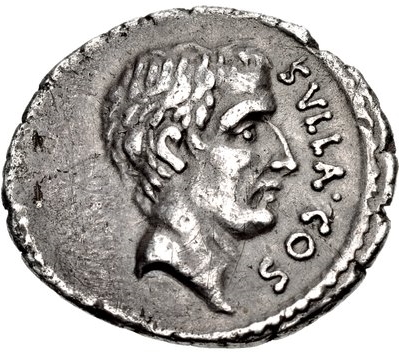
This 54 B.C. coin bears the portrait of the dictator Sulla. The moneyer was Q. Pompeius Rufus, the grandson of Sulla and his home would likely have had portraits of their famous ancestor. Thus, although posthumously struck, the portrait on these coins is probably an accurate representation.
Photo by CNG via Wikimedia Commons.
… zoom out a little more and one obvious and arguably apposite parallel exists: the Roman Republic, whose fate the Founding Fathers were extremely conscious of when they designed the U.S. Constitution. That tremendously successful republic began, like ours, by throwing off monarchy, and went on to last for the better part of 500 years. It practiced slavery as an integral and fast-growing part of its economy. It became embroiled in bitter and bloody civil wars, even as its territory kept expanding and its population took off. It won its own hot-and-cold war with its original nemesis, Carthage, bringing it into unexpected dominance over the entire Mediterranean as well as the whole Italian peninsula and Spain.
And the unprecedented wealth it acquired by essentially looting or taxing every city and territory it won and occupied soon created not just the first superpower but a superwealthy micro-elite — a one percent of its day — that used its money to control the political process and, over time, more to advance its own interests than the public good. As the republic grew and grew in size and population and wealth, these elites generated intense and increasing resentment and hatred from the lower orders, and two deeply hostile factions eventually emerged, largely on class lines, to be exploited by canny and charismatic opportunists. Well, you get the point.
After the overthrow of the monarchy, the new Republic went from strength to strength, struggling against and generally beating and absorbing other city states in the Italian peninsula, eventually rising to face the challenge of Carthage, the dominant power in the western Mediterranean. The eventual Roman victory over Carthage left Rome the superpower of its age, able to dominate and control even the remaining “great” powers of the eastern Mediterranean world. One of the costs of military dominance was an over-reliance on its citizen armies, which eventually changed the entire economy of the Republic, switching from largely small-holding farmers (who were subject to legionary service) to larger slave-worked farms that displaced the families of free citizens from their lands. The result was a constant inflow of impoverished rural citizens to the urban centres, especially Rome itself.
The newly enlarged urban poor found champions to push for reforms to aid them in their plight, the first of whom was Tiberius Gracchus (Extra Credits did a short video series on the Brothers Gracchi: Part I, Part II, Part III, Part IV, Part V, and an extra commentary video). The defeat and death of the Gracchi brothers by agents of the Patrician order led, as you might expect, to yet more polarization and further violent political struggle. This process was hastened by the conflict between Marius and his former protégé Sulla:
As the turn of the first century BCE approached and wars proliferated, with Roman control expanding west and east and south across the Mediterranean, the elites became ever wealthier and the cycle deepened. Precedents fell: A brilliant military leader, Marius, emerged from outside the elite as consul, and his war victories and populist appeal were potent enough for him to hold an unprecedented seven consulships in a row, earning him the title “the third founder of Rome.” Like the Gracchi, his personal brand grew even as republican norms of self-effacement and public service attenuated. In a telling portent of the celebrity politics ahead, for the first time, a Roman coin carried the portrait of a living politician and commander-in-chief: Marius and his son in a chariot.
A dashing military protégé (and rival) of Marius, Sulla, was the next logical step in weakening the system — a popular and highly successful commander whose personal hold on his soldiers appeared unbreakable. Tasked with bringing the lucrative East back under Rome’s control, he did so with gusto, prompting a somewhat nervous Senate to withdraw his command and give it to his aging (and jealous) mentor Marius. But Sulla, appalled by the snub, simply refused to follow his civilian orders, gathered his men, and called on them to march back to Rome to reverse the decision. His officers, shocked by the insubordination, deserted him. His troops didn’t, soon storming Rome, restoring Sulla’s highly profitable command, and forcing his enemies into exile. Sulla then presided over new elections of friendly consuls and went back into the field. But his absence from Rome — he needed to keep fighting to reward his men to keep them loyal — enabled a comeback of his enemies, including Marius, who retook the city in his absence and revoked Sulla’s revocations of command. Roman politics had suddenly become a deadly game of tit for tat.
When Sulla entered Rome a second time, he rounded up 6,000 of his enemies, slaughtered them en masse within earshot of the Senate itself, launched a reign of terror, and assumed the old emergency office of dictator, but with one critical difference: He removed the six-month expiration date — turning himself into an absolute ruler with no time limit. Stocking and massively expanding the Senate with his allies, he neutered the tribunes and reempowered the consuls. He was trying to use dictatorial power to reestablish the old order. And after three years, he retired, leaving what he thought was a republic restored.
Within a decade, though, the underlying patterns deepened, and nearly all of Sulla’s reforms collapsed. What lasted instead was his model of indefinite dictatorship, with the power to make or repeal any law. He had established a precedent that would soon swallow Rome whole.
April 16, 2017
Damnatio memoriae
The Latin in the title is a modern construction, but it describes a fairly common way that Romans would (to borrow from Orwell) push memories down the memory hole, including even former Emperors:
In the Soviet Union, Josef Stalin didn’t just defeat his political enemies – he purged their memories from existence. Photographs were altered and history texts changed to eliminate any trace of those who stood against him, a practice that inspired George Orwell to write 1984. But Stalin was far from the first leader to erase his enemies. The ancient Romans, too, tried to erase people from history – even Emperors.
A new show on now at the British Museum explores the use of memory sanctions against Roman emperors and their families in antiquity. It also evaluates the physical treatment of objects deemed “pagan” or heretical in the Christianized empire of Late Antiquity.
But what was the point of “damnatio memoriae“? And can you ever fully expunge someone from the historical record?
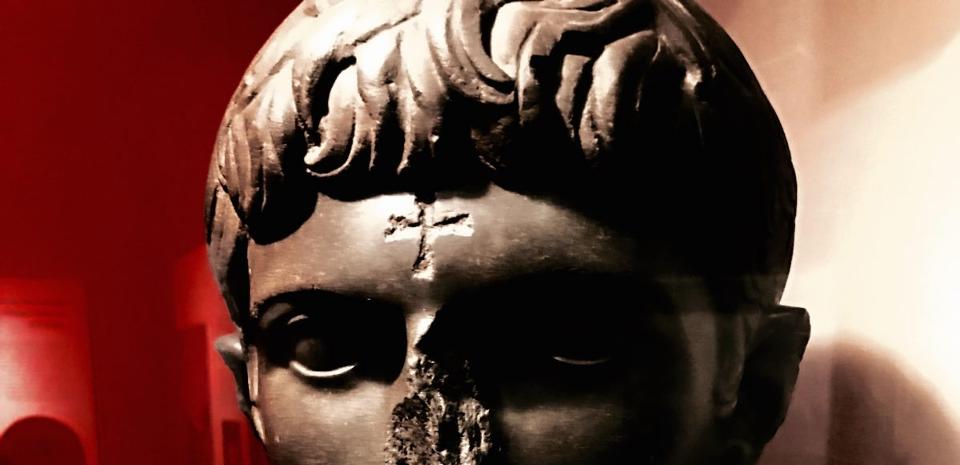
A Basanite bust of Germanicus that has a series of cuts around his ear, a shorn nose, his right ear chipped away and a cross etched on his forehead. The bust is on display now at the British Museum. (Photo by Sarah E. Bond)
The British Museum is currently displaying an exhibit on ancient memory sanctions called: “Defacing the Past: Damnation and desecration in imperial Rome.” It is a fascinating look into the ways in which we interact with objects as a proxy for the actual person. It is also a look into what ancient historian Harriet Flower has called the “art of forgetting.” Although such sanctions are often called “damnatio memoriae,” this is a modern Latin phrase and thus a construct that did not in fact exist in antiquity. Use of the term suggests a monolithic way in which Romans could legally damn the memory of a disgraced or unpopular Roman emperor, when in fact there was no one term for such sanctions or even a fully systematized procedure for it. What we have today is instead the material remnants of various senatorial, imperial, and ecclesiastical decrees — as well as a number of personal choices.
Sanctions against the commemoration of a person could take many forms in ancient Rome and can be traced back to the Republican period. The dictator Sulla had the statues of his rival, Marius, pulled down. He also banned the display of wax imagines carried in funeral processions. We are told by Plutarch (Caes. 5) that the nephew of Marius, Julius Caesar, displayed these wax casts of Marius’ face for the first time in the funeral for his aunt Julia in 69 BCE. Julia had been Marius’ wife and was Caesar’s aunt. The disgraced general and his consorts were earlier declared hostes (enemies) of the Roman state, but their memory was clearly not forgotten. The absence of the imagines under Sulla had in fact always been conspicuous, rather than a tactic that led to the erasure of their deeds or memory.