The Rest Is History
Published 7 Sep 2026What shocking, unprecedented act did Sulla commit with his legions after having his ambitions frustrated once more by his bitter rival, the tribune Marius? How did Marius escape capture and death? And, would Marius retaliate …?
Join Tom and Dominic as they unfold the mounting rivalry between two Roman generals — Marius and Sulla — as they battle for ultimate control of the empire, and Sulla takes a fateful step that will change the fate of the Republic forever …
0:00 Sulla: The First Roman General to March on Rome
4:31 Marius Seizes Sulla’s Command
11:47 Sulla Marches on Rome
19:50 Mithridates: Rome’s Great Enemy in the East
23:25 The Massacre of the Romans in Asia
26:46 Athens Revolts Against Rome
30:34 Rome’s Generals Become Warlords
34:38 Pressure
35:46 Marius: Fugitive and Outlaw
41:02 Rome Descends Into Political Violence
45:13 Marius Raises a Private Army
48:15 Marius Returns to Rome
49:06 Marius’s Seventh Consulship and Death
51:44 Sulla Goes to War in Greece
53:40 The Siege of Athens
56:59 Sulla Storms Athens
59:51 Sulla Faces Mithridates’ Army
1:00:48 Sulla Makes Peace with Mithridates
1:03:33 Sulla’s Revenge on Athens
1:04:58 Rome’s First Civil War Looms
September 8, 2026
Sulla Seized Rome… Then Marius Returned for Revenge | Rome’s First Civil War
September 4, 2026
Marius Saved Rome … Then They Turned To His Greatest Rival | Rome’s First Civil War
The Rest Is History
Published 3 Sep 2026What was the ancient city of Rome actually like in the first century BC? Who was Lucius Cornelius Sulla, another great, but aristocratic, Roman general who would clash with Gaius Marius in a totemic struggle termed the Social War? And, who were the terrifying Germanic tribes amassing on the borders of the empire, potentially spelling its doom …?
Join Tom and Dominic as they discuss Rome’s apocalyptic threat from the North, Marius’ wars in defence of the empire, and the rise of his greatest adversary: Sulla.
0:00 Rome’s Most Unlikely Saviour
4:25 The Barbarian Threat to Rome
9:15 Rome’s Catastrophic Defeat
14:04 Marius Rebuilds the Roman Army
16:48 Marius Takes on the Teutones
19:36 The Cimbri Are Annihilated
23:41 Marius Becomes Too Powerful
27:00 The Rise of Sulla
31:02 Sulla’s Ruthless Ambition
35:05 Amazon
36:15 The Extraordinary Wealth of Roman Italy
42:49 Italy’s Second-Class Citizens
46:18 The Social War Erupts
50:44 Rome Fights Back
52:35 Sulla Becomes Rome’s New Hero
56:05 A New War in the East
58:18 Mithridates Takes on Rome
1:02:00 Marius Makes His Comeback
1:04:39 Violence Erupts in Rome
1:07:01 Marius Takes Sulla’s Command
As Tom and Dominic mention during this episode, there’s a members-only bonus episode discussing the (much contested) “Marian reforms” of the Roman army with … Bret Devereaux who is a strong proponent of the notion that the Marian reforms were not a thing.
October 29, 2024
QotD: The Roman Republic after the Social War
The Social War coincided with the beginning of Rome’s wars with Mithridates VI of Pontus – the last real competitor Rome had in the Mediterranean world, whose defeat and death in 63 BC marked the end of the last large state resisting Rome and the last real presence of any anti-Roman power on the Mediterranean littoral. Rome was not out of enemies, of course, but Rome’s wars in the decades that followed were either civil wars (the in-fighting between Rome’s aristocrats spiraling into civil war beginning in 87 and ending in 31) or wars of conquest by Rome against substantially weaker powers, like Caesar’s conquests in Gaul.
Mithridates’ effort against the Romans, begun in 89 relied on the assumption that the chaos of the Social War would make it possible for Mithridates to absorb Roman territory (in particular the province of Asia, which corresponds to modern western Turkey) and eventually rival Rome itself (or whatever post-Social War Italic power replaced it). That plan collapsed precisely because Rome moved so quickly to offer citizenship to their disgruntled socii; it is not hard to imagine a more stubborn Rome perhaps still winning the Social War, but at such cost that it would have had few soldiers left to send East. As it was, by 87, Mithridates was effectively doomed, poised to be assailed by one Roman army after another until his kingdom was chipped away and exhausted by Rome’s far greater resources. It was only because of Rome’s continuing domestic political dysfunction (which to be clear had been going on since at least 133 and was not a product of the expansion of citizenship) that Mithridates lasted as long as he did.
More than that, Rome’s success in this period is clearly and directly attributable to the Roman willingness to bring a wildly diverse range of Italic peoples, covering at least three religious systems, five languages and around two dozen different ethnic or tribal identities and forge that into a single cohesive military force and eventually into a single identity and citizen body. Rome’s ability to effectively manage and lead an extremely diverse coalition provided it with the resources that made the Roman Empire possible. And we should be clear here: Rome granted citizenship to the allies first; cultural assimilation only came afterwards.
Rome’s achievement in this regard stands in stark contrast to the failure of Rome’s rivals to effectively do the same. Carthage was quite good at employing large numbers of battle-hardened Iberian and Gallic mercenaries, but the speed with which Carthage’s subject states in North Africa (most notably its client kingdom, Numidia) jumped ship and joined the Romans at the first real opportunity speaks to a failure to achieve the same level of buy-in. Hannibal spent a decade and a half trying to incite a widespread revolt among Rome’s Italian allies and largely failed; the Romans managed a far more consequential revolt in Carthage’s North African territory in a single year.
And yet Carthage did still far better than Rome’s Hellenistic rivals in the East. As Taylor (op. cit.) documents, despite the vast wealth and population of the Ptolemaic and Seleucid states, they were never able to mobilize men on the scale that Rome did and whereas Rome’s allies stuck by them when the going got tough, the non-Macedonian subjects of the Ptolemies and Seleucids always had at least one eye on the door. Still worse were the Antigonids, whose core territory was larger and probably somewhat more populous than the ager Romanus (that is, the territory directly controlled by Rome), but who, despite decades of acting as the hegemon of Greece, were singularly incapable of directing the Greeks or drawing any sort of military resources or investment from them. Lest we attribute this to fractious Greeks, it seems worth noting that the Latin speaking Romans were far better at getting their Greeks (in Southern Italy and Campania) to furnish troops, ships and supplies than the Greek speaking (though ethnically Macedonian) Antigonids ever were.
In short, the Roman Republic, with its integrated communities of socii and relatively welcoming and expansionist citizenship regime (and yes, the word “relatively” there carries a lot of weight) had faced down a collection of imperial powers bent on maintaining the culture and ethnic homogeneity of their ruling class. Far from being a weakness, Rome’s opportunistic embrace of diversity had given it a decisive edge; diversity turned out to be the Romans’ “killer app”. And I should note it was not merely the Roman use of the allies as “warm bodies” or “cannon fodder” – the Romans relied on those allied communities to provide leadership (both junior officers of their own units, but also after citizenship was granted, leadership at Rome too; Gaius Marius, Cicero and Gnaeus Pompey were all from communities of former socii) and technical expertise (the Roman navy, for instance, seems to have relied quite heavily on the experienced mariners of the Greek communities in Southern Italy).
Like the famous Appian Way, Rome’s road to empire had run through not merely Romans, but Latins, Oscan-speaking Campanians, upland Samnites, Messapic-speaking Apulians and coastal Greeks. The Romans had not intended to forge a pan-Italic super-identity or to spread the Latin language or Roman culture to anyone; they had intended to set up systems to get the resources and manpower to win wars. And win wars they did. Diversity had won Rome an empire. And as we’ll see, diversity was how they would keep it.
Bret Devereaux, “Collections: The Queen’s Latin or Who Were the Romans, Part II: Citizens and Allies”, A Collection of Unmitigated Pedantry, 2021-06-25.
September 30, 2024
Sulla, civil war, and dictatorship
Adrian Goldsworthy. Historian and Novelist
Published Jun 5, 2024The latest instalment of the Conquered and the Proud looks at the first few decades of the first century BC. We deal with the final days of Marius, the rise of Sulla, the escalating spiral of civil wars and massacres as Rome’s traditional political system starts breaking down.
Primary Sources – Plutarch, Marius, Sulla, Pompey, Crassus, Cicero and Caesar. Appian Civil Wars and Mithridatic Wars.
Secondary (a small selection) –
P. Brunt, Social Conflicts in the Roman Republic & The Fall of The Roman Republic
A. Keaveney, Sulla – the last Republican
R. Seager, Pompey the Great: A political Biography
March 21, 2022
Republic to Empire: Sulla A Failed Reaction
seangabb
Published 10 Feb 2021In 120 BC, Rome was a republic with touches of democracy. A century later, it was a divine right military dictatorship. Between January and March 2021, Sean Gabb explored this transformation with his students. Here is one of his lectures. All student contributions have been removed.
(more…)
May 23, 2020
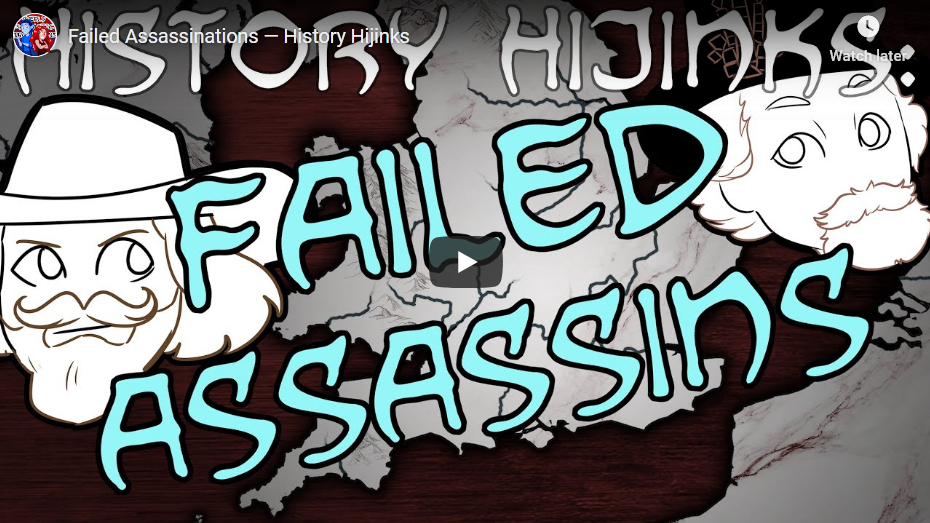
Failed Assassinations — History Hijinks
Overly Sarcastic Productions
Published 22 May 2020If videogames have taught me anything, it’s that an assassin can solve a lot of problems. But sometimes plans fall apart, and sometimes it’s for the absolute DUMBEST reasons.
SOURCES & Further Reading: A History of Venice by Norwich, Rebellion by Ackroyd, The Poison King by Mayor.
This video was edited by Sophia Ricciardi AKA “Indigo”. https://www.sophiakricci.com/
Our content is intended for teenage audiences and up.PATREON: https://www.Patreon.com/OSP
DISCORD: https://discord.gg/h3AqJPe
MERCH LINKS: https://www.redbubble.com/people/OSPY…
OUR WEBSITE: https://www.OverlySarcasticProductions.com
Find us on Twitter https://www.Twitter.com/OSPYouTube
Find us on Reddit https://www.Reddit.com/r/OSP/