Quotulatiousness

August 5, 2026

Canada decides to treat online opinions as matters for police enforcement

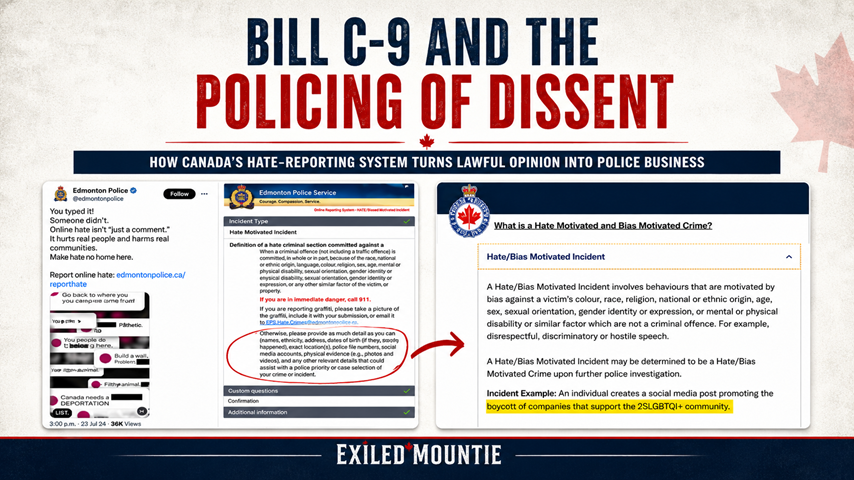
It’s never a good sign when my region features in a news story, like this post from Exiled Mountie, discussing Canada’s Bill C-9 and the way it encourages local police forces to treat lawful online speech as a matter for police involvement:

As I watch the reaction to Bill C-9 unfold in real time on social media, I cannot help but think that another important line has been crossed in Canada.

Most of us saw the writing on the wall months ago and tried to warn others by screaming it from the rooftops. But as with Covid, nobody listened, and we were probably called racists for doing so. So here we are, another important battle lost.

From a legal point of view, we are now becoming almost indistinguishable from the system in the UK, and that’s a frightening thought.

In the UK, police have recorded non-crime “hate” incidents against schoolchildren for classroom insults, despite no criminal offence having taken place. The system finally became so absurd that the British government recently announced that it would scrap the practice in order to stop police wasting their time on petty arguments. Just imagine the absurdity of this: police resources being tied up over petty squabbles in the schoolyard!

We have now entered a time where the government has extreme control of our speech.

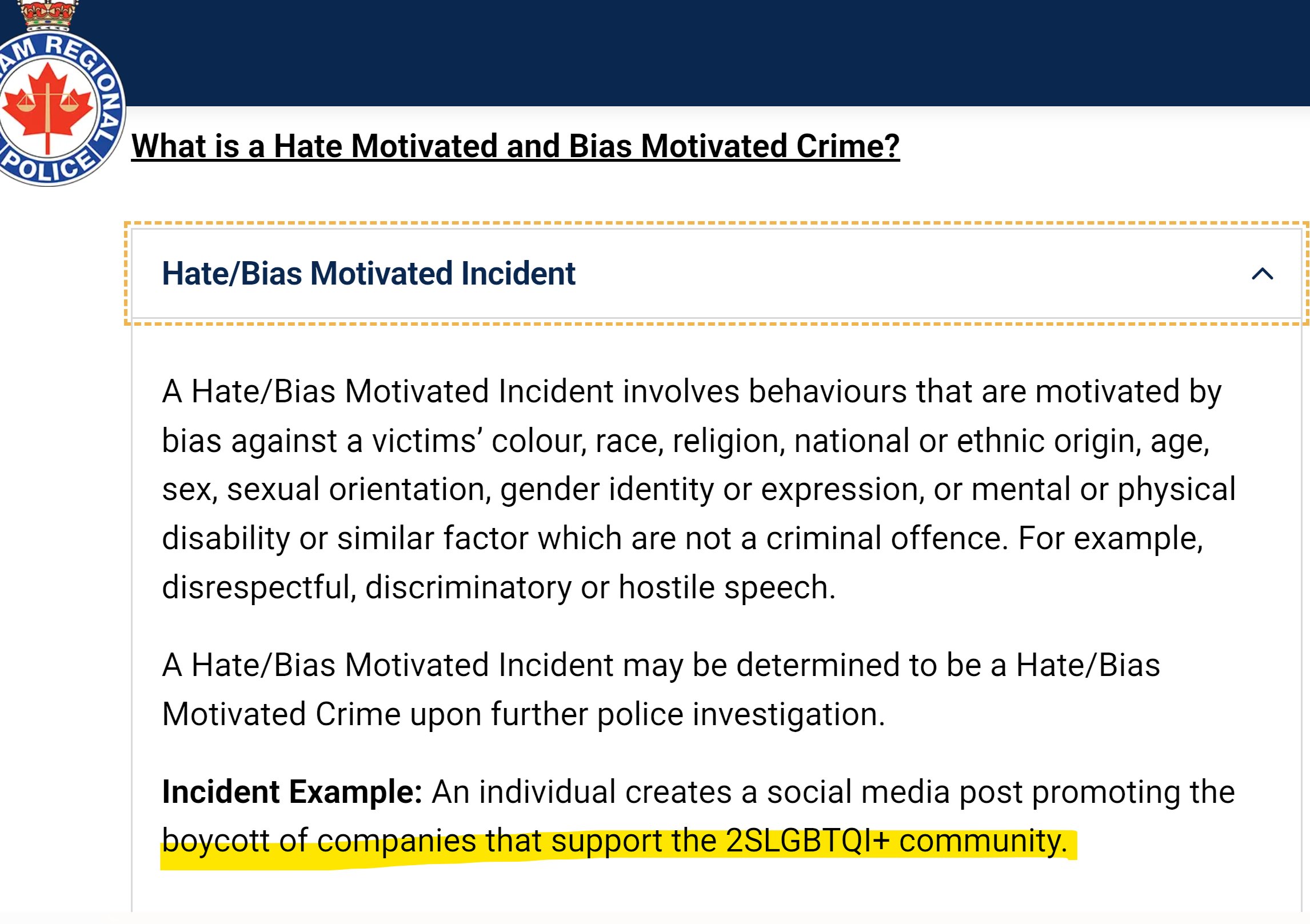
So much so, that we’re even being warned that criticizing or boycotting a company based on moral or ethical reasons can be treated as a hate incident, even when police openly acknowledge that no criminal offence has occurred. From there, the matter can still be reported and subjected to further police investigation to determine if the elements of a hate crime are met.

Ladies and gentlemen, welcome to the twilight zone. We have arrived in the progressive future the Left has been pushing for so long, and it sucks.

The danger here is not only what will eventually result in charges. It is that police are inviting complaints and opening the door to police attention over expression that is not criminal at all.

Durham Police openly acknowledges that these so-called hate or bias incidents are not criminal offences. Yet it still encourages people to report them and even uses the lawful boycott of companies supporting the 2SLGBTQI+ community as an example.

The Korean War Week 111 – Will Stalin’s Nightmare Come True? – August 4, 1952

The Korean War by Indy Neidell
Published 4 Aug 2026

The UN conducts a massive bombing raid on the North Korean capital Pyongyang this week, and in the field, the bloody fight for Old Baldy continues. Behind the scenes, though, Presidential Candidate Dwight Eisenhower’s foreign policy guy John Foster Dulles is advocating for massive retaliation — in Korea and beyond — against all Communist states, to do more than simply “contain” them.

Power corrupts, but unaccountable power attracts bureaucrats

Filed under: Bureaucracy, Europe, Government — Tags: , , — Nicholas @ 03:00

We used to joke around election time that no matter who you voted for, the government always got in. Gallows humour, because it’s quite literally true. Enough people can get angry about the government in power and vote out the politicians … but the politicians aren’t the one implementing the policies that get people upset. The permanent bureaucracy barely notices when the government changes because the government rarely manages to get anything done that the civil service doesn’t want to do. It’s actually worse in Europe, because the politicians are even more mere figureheads than they are in the Anglosphere:

Christine Lagarde and Ursula von der Leyen

Nobody grows up dreaming of a career shuffling directives around Brussels.

Those jobs always fill with the same type of person: people drawn to power for its own sake, the ones who crave authority without ever answering for it. Bureaucracy doesn’t attract the best. It selects for the worst, then shields them when they inevitably screw up.

Hayek named this in The Road to Serfdom. His chapter “Why the Worst Get on Top” spelled out the logic. Unchecked power appeals most to the people least troubled by wielding it.

Mises found the engine underneath. In a market, a bad decision shows up as a loss, and losses remove you. Bureaucratic management faces no such test. Fail to fix a problem and you keep your job, then collect a bigger budget and a larger staff to keep failing with. The incentive runs backwards: waste earns you more, and the machine grows on its own.

Look at the European Union. Ursula von der Leyen presides over the Commission, the body that proposes almost all EU law. No European voter ever put her there. Heads of state handed her the post in a 2019 backroom deal and waved her through parliament. Christine Lagarde runs the European Central Bank, setting monetary policy for more than 340 million people and steering the value of the money in their pockets. She faced no voters for the job either.

You can throw out your national government every few years, but nothing above it moves, the apparatus stays. The unelected keep their offices, their pensions, their power, untouched by the only check ordinary people have.

This is the design, not a flaw in it. The people with the most control over your money and your future are the ones you are not allowed to fire.

I, Claudius (MCMLXXVI). Show Me The Way To Go Rome

Filed under: Books, Britain, History, Media — Tags: , , , , , , — Nicholas @ 02:00

Stam Fine
Published 3 Apr 2026

Stam Fine Reviews looks at the landmark 1976 classic BBC series I, Claudius based on the books by Robert Graves. I, Claudius is a sprawling epic looking at four emperors, Augustus, Tiberius, Caligula, and Claudius. Claudius had a limp, stammered and facial tics but was a survivor when everyone else around him was murdered.

I, Claudius is an influential series, even in places you don’t expect it (The Sopranos, Dynasty, Succession).

Note: The Romans didn’t use the letter ‘U’ at the time unless you upgraded your subscription to Roman+. I do not presently subscribe to Roman+.

Stars Derek Jacobi, Sian Phillips, Brian Blessed, George Baker, Patrick Stewart, Ian Ogilvy, Simon MacCorkindale, Margaret Tyzack, Patrica Quinn, John Hurt, and many more.

0:00 Introduction
0:33 Veni, vidi, Google Translate usus sum.
1:15 Technical Difficulties.
1:34 I, Claudius Take Two.
4:09 Augustus and Livia
5:50 Claudius
8:05 Tiberius
10:55 Caligula
13:14 Emperor Claudius
16:00 From Book to BBC2
19:11 Cast
21:24 Legacy

I, Claudius
I, Clavdivs
I Claudius

QotD: “This is why English spelling is a disaster”

Filed under: Books, Britain, History, Quotations, Technology, USA — Tags: , , , , — Nicholas @ 01:00

In the 1300s the Black Death swept through England and killed somewhere between a third and half of the entire population. Entire villages emptied. Labour shortages reshaped the economy. And the survivors started moving. Massive waves of migration poured into London and the southeast from every corner of the country, bringing with them dozens of regional dialects that had never been in the same room before.

And somewhere in that collision of accents and dialects, something shifted. Literally. The vowels started moving.

Between roughly 1400 and 1700 every single long vowel in the English language changed how it was pronounced. It’s called the Great Vowel Shift. Before it happened, English vowels worked the way vowels work in Italian or Spanish. The letters did what they looked like they should do. “Bite” was pronounced “beet”. “House” was pronounced “hoos”. “Name” was pronounced “nahm”. “Knight” was pronounced “k-nicht” with a guttural sound at the end like you were clearing your throat. English was phonetic. The spelling matched the sounds. It made SENSE.

And then it didn’t.

All the long vowels began migrating upward in the mouth. The tongue positions shifted higher and higher over the course of about 300 years. And the vowels that were already at the top had nowhere left to go so they broke apart into two sounds. “Ee” became “eye”. “Oo” became “ow”. A 300-year linguistic pileup that nobody voted on and nobody agreed to. It just happened. And it happened during the worst possible window of time.

William Caxton brought the printing press to England in 1476. One of the most important technological developments in the history of communication. And it arrived RIGHT IN THE MIDDLE of the Great Vowel Shift.

Caxton started standardizing English spelling based on how words sounded at that exact moment. Printers needed consistency. They needed to pick a spelling and commit. So they did. But the sounds kept changing after the spelling was already locked in. The vowels were still moving. The consonants were still dropping. And the printed page couldn’t keep up.

We had ONE CHANCE to get English spelling right and we fumbled it at the worst possible moment.

This is why English spelling is a disaster. It’s not random. It’s not lazy. It’s a snapshot of a language mid-transformation that got frozen in place by a new technology and was never corrected. Every word you have ever misspelled, every silent letter that made you feel stupid, every time you stared at “knight” and thought why is there a K in this. You used to pronounce that K. You used to pronounce that GH. Those sounds died 500 years ago and the letters are still standing there like gravestones. English spelling is full of ghosts.

That’s why “food” and “good” and “blood” are spelled almost identically but sound completely different. In Chaucer’s time around the 1390s they all rhymed. In Shakespeare’s time around the 1600s they still rhymed but with a different vowel. And then sometime after that they each went their own separate way and the spelling just stood there watching like it had given up entirely.

And HERE IS THE THING. Other languages went through similar vowel shifts. German had nearly identical changes happen to its long vowels around the same period. And German just updated its spelling. They adjusted the orthography to match the new pronunciation. Like reasonable people. English looked at the same problem and said no. We’re going to keep the old spelling. Everyone will simply have to deal with it. Every person who has ever stared at “though” and “through” and “thorough” and “thought” and wondered why four words that look almost identical are all pronounced differently? Collateral damage. Five hundred years of collateral damage and we just accepted it.

Ok so that’s the vowels. That’s the background. Now we get to the accents and this is where I lost my mind.

The single biggest difference between standard American English and standard British English today is something called rhoticity. This is a real linguistics term even though it sounds completely made up. Rhotic speakers pronounce the R sound in words like “hard” and “car”. Non-rhotic speakers drop it. “Hard” becomes “hahd”. “Car” becomes “cah”. That one feature is doing like 80 percent of the work when your brain hears someone speak and categorizes them as British or American.

Here’s what nobody told you.

In 1776 everybody was rhotic. Americans AND the British. Both sides of the Atlantic pronounced their Rs. The fancy non-rhotic accent that we now think of as THE British accent, the one you hear in your head when someone says “British accent”, the one every villain in every movie has? That accent did not exist yet. It developed in the late 18th and early 19th centuries when the upper classes in southern England started dropping their Rs as a prestige marker. A fashion statement. And then it spread downward through society and outward through the Empire.

The accent we associate with the British Empire is actually newer than the American Revolution.

I need to say that again because it didn’t land the first time I heard it either.

The accent that we think of as “British” is newer than the country that broke away from Britain. Americans didn’t lose the British accent. The British lost the British accent. Americans are the ones who kept it.

Emma, “The Plague That Broke English (And Why the Founding Fathers Didn’t Sound British)”, Past Life, Present Cleavage, 2026-04-03.


Powered by WordPress