Quotulatiousness

April 16, 2026

The EU has managed to revive smuggling as a viable career

Filed under: Bureaucracy, Europe, Government, Law — Tags: , , , , — Nicholas @ 04:00

We’ve all read reports on how bold and forward-focussed the European Union is, but do we give them equal credit for their diligent efforts to revive dying industries?

Title page of a book covering the trial of seven smugglers for the murder of two revenue officers. In the preface the author says “I do assure the Public that I took down the facts in writing from the mouths of the witnesses, that I frequently conversed with the prisoners, both before and after condemnation; by which I had an opportunity of procuring those letters which are herein after inserted, and other intelligence of some secret transactions among them, which were never communicated to any other person.”
W.J. Smith, Smuggling and Smugglers in Sussex, 1749, via Wikimedia Commons.

In late March, European Union (E.U.) officials announced they had taken down a five-country cigarette-smuggling operation and seized over 40 tons of tobacco products. The ambitious network reportedly transshipped the cigarettes far and wide to obscure their sources and destinations, while also hiding them in hidden compartments built into cargo containers. Why would smugglers go through such effort to move perfectly legal products, and why would the authorities care? In Europe, as in the United States, the answer is the same: sky-high taxes.

Smuggled Smokes in Hidden Compartments

In announcing its efforts against the smuggling network operating in Italy, France, Poland, Switzerland, and the U.K., the European Public Prosecutor’s Office, which worked with international law enforcement agencies as well as police in all five countries, noted the smugglers used “maritime and commercial routes designed to evade customs inspections”, passed shipments “through Georgia, Kenya, the Netherlands and Turkey, in order to hide the true origin of the illicit goods”, and that “false bottoms were used as hidden compartments built into containers to conceal the tobacco”.

At the conclusion of the investigation, “enforcement activities were carried out at the Port of Genoa, leading to the seizure of close to 41 tonnes of manufactured cigarettes, with an estimated loss of customs duties, excise duties and VAT exceeding €10 million”.

Absolutely nothing motivates government officials like the extraction of taxes from the public. And lots of tax money is at stake when it comes to cigarettes.

Taxes Make Up Most of the Price of Cigarettes

This month, the Tax Foundation, which has a branch in Brussels, reported that “cigarette smokers in the European Union pay far more in excise taxes than they do for the cigarettes themselves”. Report authors Jacob Macumber-Rosin and Adam Hoffer wrote that excise taxes in the E.U., which are intended to deter smoking as much as to raise revenue, start at the equivalent of $2.11 per pack and that the “total excise duty is at least 60 percent of the national weighted average retail price”. Value-added taxes are tallied after excise duties are levied.

“The highest tax in the EU is levied in Ireland at €10.71 ($12.58) per pack of 20 cigarettes, followed by France at €8.09 ($9.51) and the Netherlands at €7.77 ($9.13)”, they added.

April 13, 2026

Young Canadians don’t have the resources to “buy their way out”

Filed under: Cancon, Economics, Government — Tags: , , , , — Nicholas @ 03:00

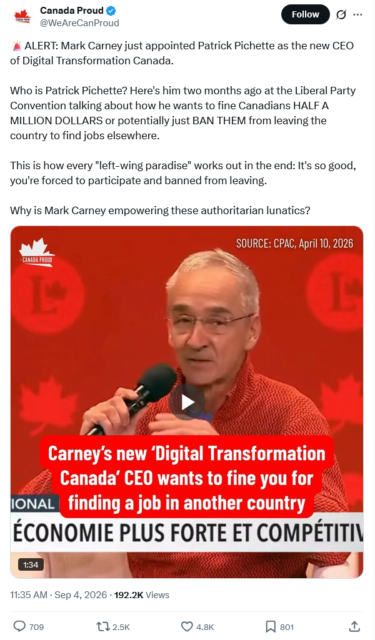
On the social media site formerly known as Twitter, John Carter points out the screamingly obvious fact that it’s insane to propose imprisoning young Canadians in a dying economy if they can’t scrape up half a million dollars to escape:

First, young Canadians don’t have shit. They definitely don’t have half a mil to pay the boomers in extortion fees so that they can leave the country.

Second, how are they planning to enforce this? Charge $500k for a passport? What stops the US from just offering amnesty? Ottawa can’t tell Washington what visas it can and cannot offer.

Third, and what makes this malicious boomerfap especially piquant, young Canadian professionals don’t leave because they especially want to. Wanderlust aside, most would prefer to remain close to family and friends.

They leave because they don’t have a choice. The Canadian state is set up to restrict opportunity to the point of nonexistence. Canada is a country that strangles ambition in the crib. As the old joke goes, if Musk had stayed in Canada he’d be a mid-level financial manager at CIBC (with any possibility of further promotion eliminated by the all-of-society DEI imperative).

Canada invests an absurd amount into educating its youth. It then refuses to allow them to use their training. So they leave. The University of Waterloo is one of the best engineering schools on the planet; virtually all of its graduates end up in the Bay area. Because the alternative is sitting on their hands or trying to get a job in the Ministry.

It would be a mistake to see Canadian investment in education as intended for the benefit of Canadian youth, by the way. Like everything else in Canada’s political economy, this is a subsidy to a Liberal Party client group, in this case the academics and administrators staffing the universities. The primary purpose of the universities is providing sinecures to liberals; the secondary purpose is indoctrination of the youth with liberalism; the third, to launder liberal ideas through intellectual channels. Whether the kids learn anything, or whether they can use whatever useful knowledge they acquire to (lol) better themselves or (lmao) “build the country”, is not a priority.

If it were not for the Laurentian Elite running the country into the ground, if young Canadians were not sabotaged at every step of their lives, then there would be no brain drain problem.

But as usual, boomerlibs would rather punish the youth to try and fix the problems the boomerlibs caused.

If you haven’t been paying attention to the progressive hellscape that Canada is becoming, here’s the wife of the Prime Minister boasting to the Liberal convention in Ottawa about how wonderful things are in Soviet Canuckistan:

It would make perfect sense for new grads to look for greener pastures, wouldn’t it? Which is why the Liberals want to force them to stay here, of course.

April 11, 2026

QotD: Kingdoms were not “nations” in the Middle Ages

Filed under: Europe, History, Media, Quotations — Tags: , , , , — Nicholas @ 01:00

Medieval kingdoms and Early Modern states were both built around the personal holdings of individual rulers. For instance, to talk of “Austria” or “Burgundy” in the 1400s as states/countries/governments is to engage in a degree of anachronism. There was no Austrian state, merely the collection of lands either owned or controlled by whoever the reigning Habsburg was at the time. Likewise, Burgundy in, say, 1440 was not a coherent entity, it was simply the collection of lands that Philip the Good (Duke of Burgundy, but also Duke of Brabant, Limburg, Luxemburg and Lothier, Count of Artois, Flanders, Charolais, Haniaut, Holland and Zeeland, and the Margrave of Namur). The “kingdom” was thus not a permanent, durable entity so much as a collection of possessions the same way my personal “library” is not permanent building but just a term for “books I happen to own right now”.

It is thus a bit odd that the regions of Westeros are seen by its inhabitants as being clear and unchanging. For instance, the Reach has borders, those borders do not move and everyone in those borders is loyal to House Tyrell. This is not how medieval rule works. The borders of, say, France, shifted over time (some places we consider “obviously” part of France were added only quite late, like French Flanders or Provence) as the ability of the French king to control those regions changed. For long periods of the Middle Ages, large parts of France were effectively controlled by the Kings of England (because they were also Dukes of this or that French duchy).

The idea that France, or Germany or Italy was a distinct, permanent entity with its own existence apart from a given royal family – more than just a space on a map – which comprised a people, their language and the government of those people, this is a modern phenomenon. Indeed, one may argue, it – that is, the nation-state – is the modern phenomenon.

Bret Devereaux, “New Acquisitions: How It Wasn’t: Game of Thrones and the Middle Ages, Part III”, A Collection of Unmitigated Pedantry, 2019-06-12.

February 23, 2026

Grand Strategy of the Roman Empire PART TWO

Filed under: Books, Europe, History, Military — Tags: , , , , , , — Nicholas @ 02:00

Adrian Goldsworthy. Historian and Novelist
Published 27 Aug 2025

This should have posted earlier this morning, but for some reason did not.

This is the follow up to last week’s discussion of grand strategy, looking at the reactions and criticisms of Luttwak’s ideas, followed by some of my own thoughts.

February 18, 2026

QotD: Defending the borders of the Roman Empire

Filed under: Books, Europe, History, Military, Quotations — Tags: , , , , — Nicholas @ 01:00

As Luttwak notes, modern historians and military theorists have a tendency to sneer at linear defense lines.1 In fact, some historians of ancient Rome actually blame the decline and eventual collapse of the empire on all the “wasted” energy spent building frontier fortifications. The argument against such “cordon” defenses is that for a given quantity of military potential, spreading it out equally along a perimeter and trying to guard every spot equally dilutes your strength. This makes it easy for an attacker (who picks the time and location of the battle) to concentrate his forces, create a local advantage, and break through.

The thing is, approximately none of this logic applied in the Roman situation. First of all, as we’ve already noted, a huge fraction of the threats the Romans faced were “low-intensity”: border skirmishes, slave raids, pirates and brigands, that sort of thing. Static fortifications, walls and towers, are often more than sufficient for dealing with these problems. Paradoxically, that actually increases the mobility and responsiveness of the main forces. If they aren’t constantly running back and forth along the border dealing with bandits, that means they can respond with short notice to “high-intensity” threats (like major invasions and rebellions) that pop up, and are probably better rested and better provisioned when the emergency arrives. So, far from diluting their strength, a lightly-manned series of linear fortifications actually enabled the Romans to concentrate it.

Secondly, those linear fortifications can also be very useful when that major invasion shows up, even if they are overrun. A defense system doesn’t have to be impenetrable in order to still be very, very useful. One thing it can do is buy time, either for the main army to arrive or for some other strategic purpose. The defenses can also act to channel opposing forces into particular well-scouted avenues of attack, or change the calculus of which invasion routes are more and less appealing. Finally, in the process of setting up those defenses, you probably got to know the terrain extremely well, such that when the battle comes you have a tactical advantage.

[…]

The third, and perhaps most important, reason why the Roman frontier fortifications were actually very smart is that they were carefully designed to double as a springboard for invasions into enemy territory. Luttwak coins the term “preclusive defense” to describe this approach. The basic idea is that an army can take bigger risks — pursue a retreating foe, seize a strategic opportunity that might be an ambush, etc. — if it knows that there are strong, prepared defensive lines that it can retreat to nearby. Roman armies were constantly taking advantage of this, and moreover taking advantage of the fact that the system of border fortifications was also a system of roads, supply lines, food and equipment storage depots, and so on. The limes were not a wall that the Romans huddled behind, they were a weapon pointed outwards, magnifying the power that the legions could project, helping them to do more with less.

John Psmith, “REVIEW: The Grand Strategy of the Roman Empire by Edward Luttwak”, Mr. and Mrs. Psmith’s Bookshelf, 2023-11-13.


  1. I, an ignoramus, assumed this was all downstream of the Maginot line’s bad reputation, but Luttwak says it’s actually the fault of Clausewitz.

January 25, 2026

Grand Strategy of the Roman Empire – Part ONE, the start of the debate

Filed under: Europe, History, Military — Tags: , , , , , — Nicholas @ 02:00

Adrian Goldsworthy. Historian and Novelist
Published 20 Aug 2025

Following on from videos about military planning under the Republic, and about forts and garrisons, today we will begin to look at one of the big debates in the study of the Roman army and the Roman empire — did the Romans plan in a rational and informed way how to secure and defend their empire for the long term future. In short, did the Roman emperors and their advisors have a Grand Strategy which informed their decisions. This time, we will think about how this all started, and in particular Edward N. Luttwak, The Grand Strategy of the Roman Empire (1976), which really kicked off and did much to shape the debate.

January 9, 2026

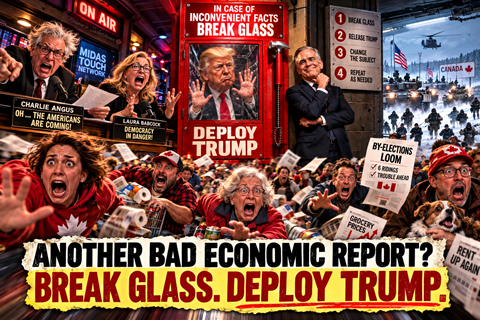
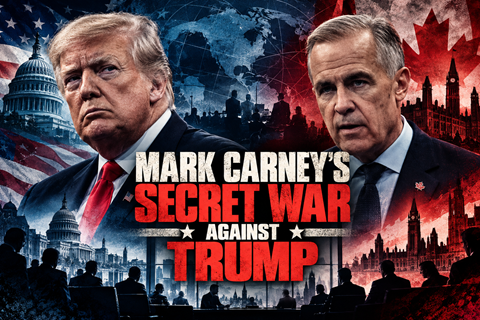
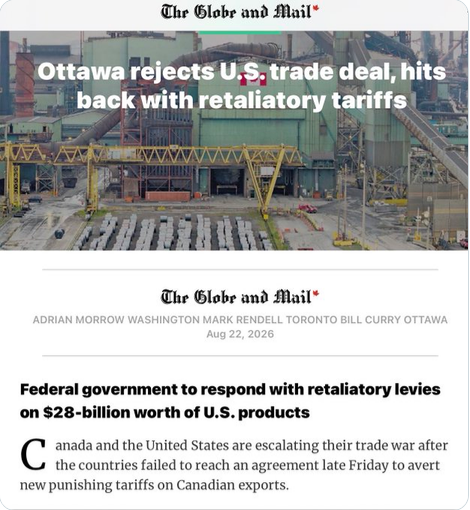
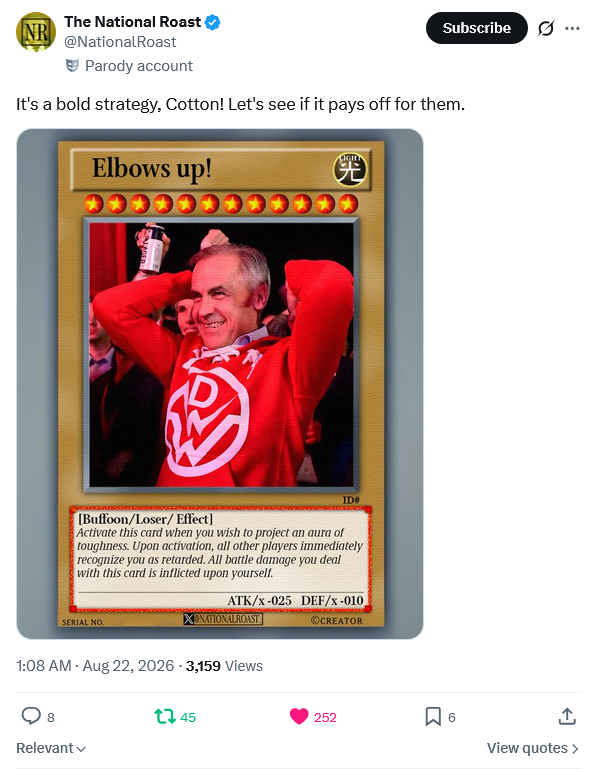
Mark Carney’s play-acting on the international stage

There is no way that Canada can make itself economically independent of the United States, no matter how much wishcasting power is exerted to persuade anti-American boomers who habitually vote Liberal. Our entire economy is oriented to serve the vast market to our south, and we’ve been freeloading on our own military because the Americans have been willing to take up the slack and — until recently — not castigate our leaders for their fecklessness. It was bad under Justin Trudeau, but it’s actually gotten worse under Mark Carney’s leadership. Trudeau was performative and loved to play to the world media, but Carney seems to actually believe that he can reverse the entire direction of the Canadian economy by jetting around the world and bad-talking Donald Trump. The Canadian economy has been stalled for ten years now, and if Trump finally loses patience with our idiotic elites, it’ll go into free-fall.

On the social media site formerly known as Twitter, James E. Thorne points out just how few cards Carney actually has in his hand:

Mark Carney’s and Canada’s Dangerous Refusal to Face Reality.

Mark Carney and most Canadians are behaving as if Canada is an independent pole in a multipolar order, when the world he actually inhabits is a hierarchy being brutally clarified by Washington. Trump’s revamped National Security Strategy and the “Trump Corollary” — asserted through the seizure of Nicolás Maduro and open threats toward Cuba and Colombia, make plain that the United States now treats the Western Hemisphere as an American security estate, not a debating society among equals.

In that framework, Canada is not a co-author of the rules. It is a dependency inside the U.S. sphere, structurally lashed to American markets, finance and supply chains. AND after decades without a serious sovereign industrial or energy strategy, Canada is at best a weak Middle Power, that has for decades squandered its competitive advantage through proformative politics and virtue signalling.

In this era, the Western Hemisphere is now a “secure production platform” for American industry and technology, defined not by territorial control but by ownership, access and compliance. The Trump doctrine logic is clear and blunt yet internally coherent: if the Western Hemispheres natural resources and supply chains are secured, the economic and geopolitical dividends will follow.

Carney’s answer to the Trump Doctrine, however, remains the same “City-of-London” orthodoxy that produced him: more proformative political grandstanding, more process, more declarations, more meetings, and more boondoggles.

The Greenland consulate, rhetorical red lines over annexation, the flying around the world, and ritual protests against U.S. action in Venezuela all presume that we still live in the post WWII rules based order. We do not! Will live in the era of the Trump Doctrine, and no we can’t wait it out. And in this era, Greenland will not be allowed to be under the influence of Russia or China.

Thucydides warned that “the strong do what they can and the weak suffer what they must”. Carney’s tragedy is that he quotes the rules-based order while presiding over a country whose economic structure is colonial and whose security ultimately depends on the very power he is theatrically chastising. Posturing without power is not prudence. It is provocation without a plan. And yes it’s dangerous.

The irony is that Carney understands all of this perfectly well, which only sharpens the question: what, exactly, is he doing by posturing as a rules-based equal in a hierarchy where he knows Canada lacks the hard power to back his stance?

December 26, 2025

The US-Mexican border

Filed under: Americas, History, Humour, Military, USA — Tags: , , , , — Nicholas @ 03:00

An amusing exchange on the social media site formerly known as Twitter:

    Ordnance Jay Packard Esq. @OrdnancePackard

    Hey @LineGoesDown, interesting your little map includes the Comancheria, a vast section of that northern green area that Mexico never set foot in because they’d get their shit pushed in by the Comanche.

    It was only after the Mexican-American war that the United States put a stop to the Comanche using Mexico like an ATM.

It’s actually even funnier than that.

The reason Mexicans kept getting their shit pushed in by the Comancheria was gun control.

No, seriously. It was Spanish colonial policy to keep the population disarmed and rely entirely on deployment of the military to keep order and prevent Indian incursions. Mexico inherited this.

This was impossible. The land was vast. State capacity and the military were overstretched. The Comanches were too mobile. Result: misery and massacre.

Americans, inheriting the British colonial policy of everybody bring your own guns and form militias, didn’t suffer as badly. Raiders more often went where the soft targets were, and that meant the disarmed ones in the Mexican zone.

This is also why Alta California was so sparsely settled that Spanish and Mexican control over it was at best nominal. Anglo settlers were culturally and politically much better equipped to hold the territory, making the Mexican session eventually inevitable.

ESR, The social media site formerly known as Twitter, 2025-12-25.

Update, 28 December: Welcome, Instapundit readers! Have a look around at some of my other posts you may find of interest. I send out a daily summary of posts here through my Substackhttps://substack.com/@nicholasrusson that you can subscribe to if you’d like to be informed of new posts in the future.

November 21, 2025

QotD: Why did the (western) Roman Empire collapse?

Filed under: Europe, History, Military, Quotations — Tags: , , , , — Nicholas @ 01:00

But if the Roman Empire (in the West) went down fighting, why did it collapse? Of course there is no simple answer to that question. The mass migrations of the fourth and fifth century clearly played a very large role, but then the Romans had defeated other such migrations (recall the Cimbri and the Teutones) before. There are strong indicators that other factors, unrelated to our current topic were also at play: the empire had been economically weakened by the Crisis of the Third Century, which may have disrupted a lot of the trade and state functions that created the revenue to fund state activity. At the same time, the Crisis and the more challenging security situation after it meant that Roman armies grew larger and with them the burden of paying and feeding the soldiers which further hurt the economy. Meanwhile, long exposure to Roman armies on the frontiers of the empire had begun to erode the initially quite vast qualitative advantage the Romans enjoyed; the gap between Roman and “barbarian” military capabilities began to shrink (although it never really vanished altogether in this period). But some of the causes do bear on our topic but in quite the other direction from what the Niall Fergusons of the world might assume.

Let’s start with the foederati.

After the Constitutio Antoniniana, there was no longer much need for the auxilia, as all persons in the empire were citizens, and so the structure distinction between the legions and other formations fades away (part of this is also the tendency of the legions in this period to be progressively split up into smaller units called vexillationes, meaning that the unit-sizes wouldn’t have been so different). But during the fourth century, with frontier pressures building, the Romans again looked for ways to utilize the manpower and fighting skill of non-Romans. What is striking here is that whereas in some ways […] the auxilia had represented almost a revival of the attitudes which had informed the system for the socii, the new system that emerged for using foreign troops, called foederati (“treaty men”) did not draw on the previously successful auxilia-system (which, to be clear, by this point had been effectively gone for more than a century). Instead, the Romans signed treaties with Germanic-speaking kings, exchanging chunks of (often depopulated, war-torn frontier) land in exchange for military service. Since these troops were bound by treaty (foedus) they were called foederati. They served in their own units, under their own leaders, up to their kings. Consequently, all of the mechanisms that encouraged the auxilia to adopt Roman practices and identify with the Roman Empire were lost; these men might view Rome as a friendly ally (at times) but they were never encouraged to think of themselves as Roman.

The reason for this different system of recruitment seem to be rooted in financial realities. The Roman army had already been expanded during the Crisis of the Third Century and only grew more under Diocletian and Constantine, probably by this point being between 400,000 and 500,000 men (compared to 300,000-350,000 earlier in the empire). Moreover, Diocletian had opted to reform the empire’s administration with a much more intensive, top-down, bureaucratic approach, which imposed further costs. Taxes had become heavy (although elites were increasingly allowed to dodge them), the economy was weak and revenues were short. The value of the foederati was that the empire didn’t have to pay them; they were handed land (again, in war-torn frontier zones) and expected to use that to pay for their military support. At the time, it must have seemed a brilliant work-around to get more military power out of a dwindling tax-base.

(I feel the need to note that I increasingly regard Diocletian (r. 284-305) as a ruinous emperor, even though he lacked the normal moralizing character flaws of “bad emperors”. While he was active, dedicated and focused, almost all of his reforms turned out to be quite bad ideas in the long run even before one gets to the Great Persecution. His currency reforms were catastrophic, his administrative reforms were top-heavy, his tax plan depended on a regular census which was never regular and the tetrarchy was doomed from its inception. Diocletian was pretty much a living, “Well, You Tried” meme. That said, to be clear, Diocletian wasn’t responsible for the foederati; it’s not quite clear who the first foederati were – they may have been the Franks in 358, which would make Julian (as a “Caesar” or junior-emperor under Constantius) the culprit for this bad idea – he had a surplus of those too.)

The problem, of course, is right there: the status of the foederati made it impossible for them to ever fully integrate into the empire. They had, after all, their own kings, their own local laws and served in their own military formations. While, interestingly, they would eventually adopt Latin from the local population which had already done so (leading to French, Spanish and Italian) they could never become Roman. That wasn’t always their choice, either! As O’Donnell (op. cit.) notes, many of these foederati wanted to be “in” in the Roman Empire; it was more frequently the Romans who were busy saying “no”. It is striking that this occurs in a period where social class in the Roman world was generally calcifying. Whereas citizenship had been an expanding category, after the Constitutio Antoniniana, the legal categories of honestiores and humiliores (lit. “respectable” and “humble” people, but in practice, “wealthy” and “commoners”) largely replaced citizenship as the legal dividing lines of Roman society. These were far less flexible categories, as economic social mobility in the ancient world was never very high. Even there, the tax reforms of Diocletian (with some “patches” under Constantine) began, for tax purposes, to tie tenant farmers (“coloni“) to their land, essentially barring both physical and economic mobility in the name of more efficient tax collection in a system that strongly resembled later medieval serfdom.

Nevertheless, the consequence of this system of organization was that as often as the foederati provided crucial soldiers to Roman armies, they were just as frequently the problem Roman armies were being sent to address. Never fully incorporated into the Roman army and under the command of their own kings, they proved deeply unreliable allies. Pitting one set of foederati against the next could work in the short-term, but in the long term, without any plan to permanently incorporate the foederati into Roman society, fragmentation was inevitable. The Roman abandonment of the successful older systems for managing diverse armies (on account that they were too expensive) turned the foederati from a potential source of vital manpower into the central cause of imperial collapse in the West.

Bret Devereaux, “Collections: The Queen’s Latin or Who Were the Romans, Part V: Saving and Losing and Empire”, A Collection of Unmitigated Pedantry, 2021-07-30.

October 16, 2025

The Mexican-American War 1846-48

Filed under: Americas, Government, History, Military, USA, Weapons — Tags: , , , , , , — Nicholas @ 02:00

Real Time History
Published 16 May 2025

In the early 19th century, the United States and Mexico share a massive cross-continental border, but US settlement in Mexico, expansionist ideals and religious differences put the young republics on a collision course. As tensions boil over into bloodshed, the tiny, inexperienced US army marches to a war which will forge the modern United States.

Chapters:
00:00 Texas Republic
05:06 Declaration of War
07:03 The US Army
09:26 British Muskets in the Mexican Army
16:19 The Mexican Army
18:24 The Battles of Palo Alto and Resaca de la Palma
21:38 California and New Mexico
25:11 US Volunteers
28:40 Battle of Monterrey
33:03 Expanding the War
36:59 The Pedregal Battles
40:18 Battles for Mexico City
43:42 Treaty of Guadalupe Hidalgo
45:14 Legacy
(more…)

October 9, 2025

QotD: Ontario and the Loyalists

Filed under: Cancon, History, Quotations, USA — Tags: , , , , , , — Nicholas @ 01:00

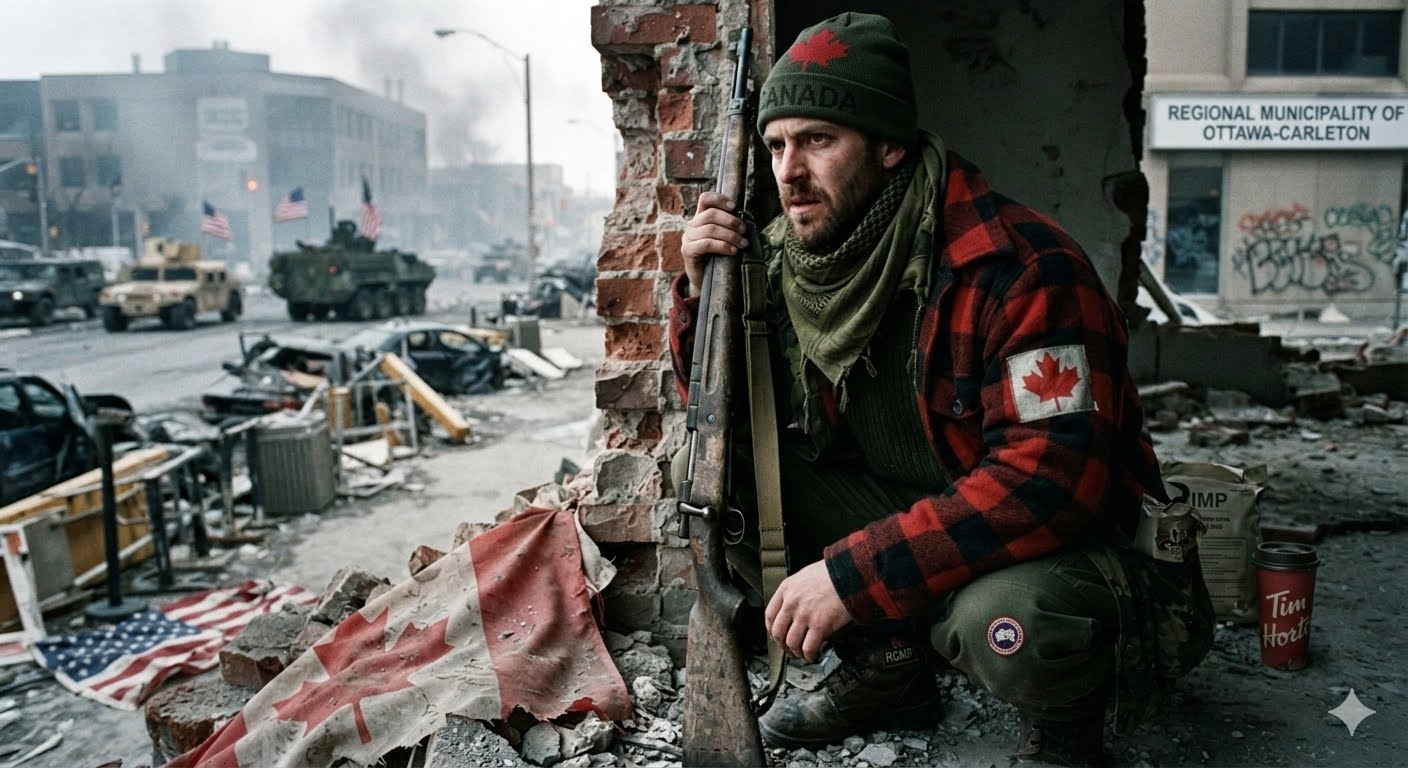
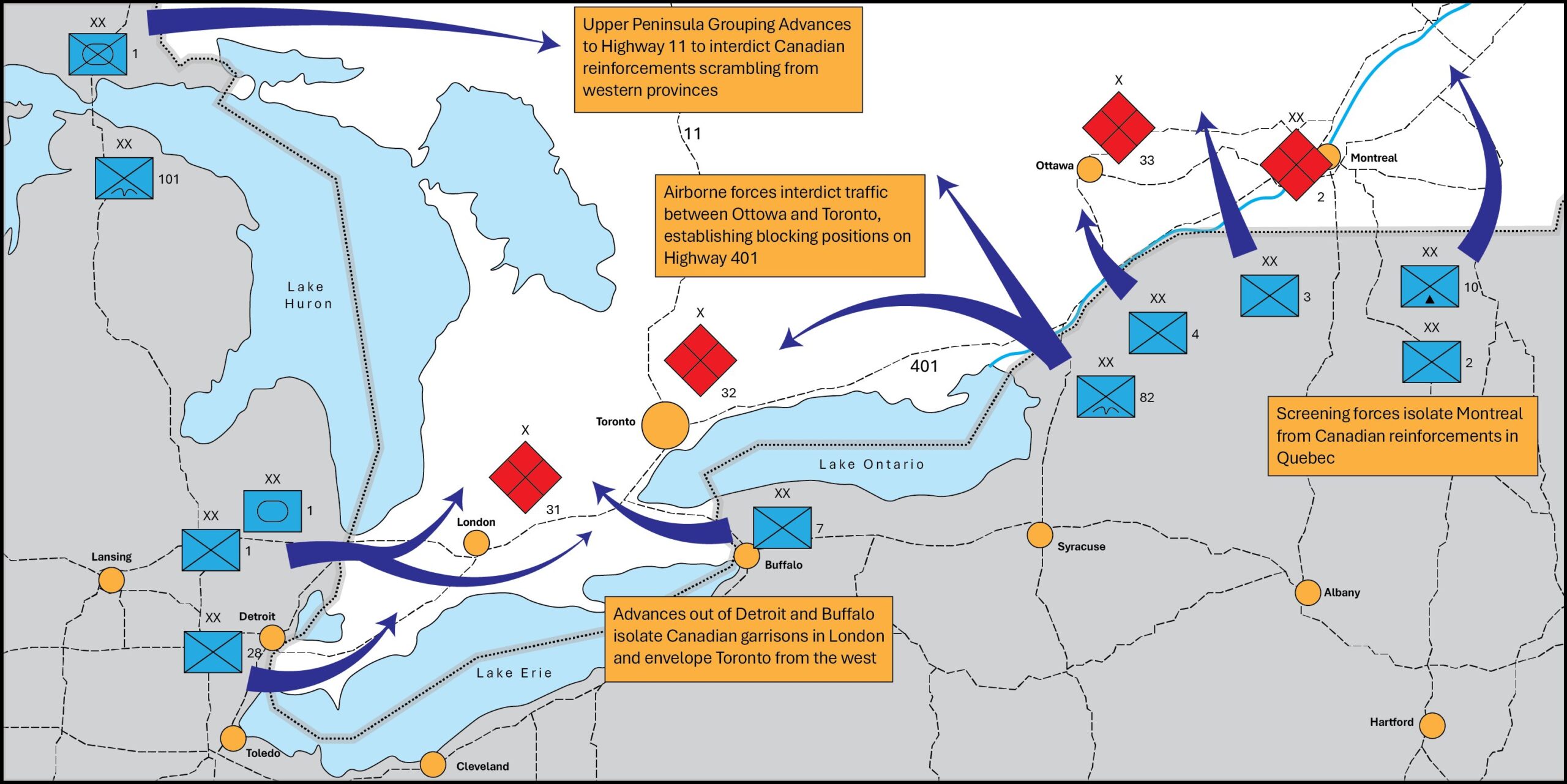
The Province of Ontario is the most populous province in Canada, home to 38.5% of Canada’s national population as of the 2021 census. Located in Central Canada, it is the political, economic, and cultural heart of the country. Its capital, Toronto, is the nation’s largest city and financial centre, while Ottawa, the national capital, lies along Ontario’s eastern edge. Ontario is bordered by Quebec to the east and northeast, Manitoba to the west, Hudson Bay and James Bay to the north, and five U.S. states to the south — Minnesota, Michigan, Ohio, Pennsylvania, and New York — mostly along a 2,700 km (1,700 mi) boundary formed by rivers and lakes in the Great Lakes–St. Lawrence drainage system. Though Ontario is the second-largest province by total area after Quebec, the vast majority of its people and arable land are concentrated in the warmer, more developed south, where agriculture and manufacturing dominate. Northern Ontario, in contrast, is colder, heavily forested, and sparsely populated, with mining and forestry serving as the region’s primary industries. But Ontario is more than just a province; it is the crucible of English-speaking Canada.

In 1784, after the American Revolution, Loyalist settlers arrived with intention, bringing with them the legal traditions, religious institutions, and steadfast allegiance to the Crown that had shaped their former world. They sought to uphold a civilisational order rooted in monarchy, Church, and Law, and to establish a society founded on duty, hierarchy, and restraint. From these early Loyalist settlements, beginning at Kingston, a distinct political and cultural tradition emerged. It was neither British nor American. It became the foundation of a new people.

Today, the descendants of these settlers form the core of an ethnocultural identity known as Anglo-Canadian. Numbering over ten million across the country, and more than six million in Ontario, Anglo-Canadians are known for their enduring institutions: constitutional monarchy, common law, Protestant-rooted civic morality, and a national ethos shaped by loyalty and order. This cultural framework shaped Ontario’s development across every sphere of life.

Loyalists built the province’s schools, banks, and legal systems. They established its early industries, including agriculture, forestry, mining, and railroads, and later came to dominate the professional sectors of law, education, public administration, and finance. Their shining city, Toronto the Good, became the centre of Canadian banking and corporate life, while small towns across the province were anchored by courthouses, parish churches, and grain elevators.

Language and schooling played a central role in shaping the Anglo-Canadian character. Ontario’s education system, from common schools to universities, was built to transmit British values, civic order, and the English language. Protestant denominational schools and later public grammar schools taught the children of settlers to read scripture, study British history, and speak in the elite formal register of English Canada. Institutions such as Upper Canada College, Queen’s University, and the University of Toronto became pillars of elite formation, producing the clergy, lawyers, teachers, and administrators who carried the culture forward.

Culturally, Anglo-Canadians preserved a rhythm of domestic and seasonal life rooted in British tradition but adapted to the northern landscape. Autumn fairs, apple bobbing, and harvest suppers marked the calendar in rural communities. Roast beef, butter tarts, mincemeat pies, and tea with milk became the everyday fare of farmhouses and urban kitchens alike. Sunday observance, cenotaph ceremonies, school uniforms, and service clubs reflected a moral seriousness and civic sense inherited from the Loyalist project. It is this tradition that formed the structural spine of its political and cultural development.

Fortissax, “Loyal she Began, Loyal she Remains”, Fortissax is Typing, 2025-07-07.

September 16, 2025

Fenian Needham Conversion: Just the Thing for Invading Canada

Filed under: Britain, Cancon, History, Military, USA, Weapons — Tags: , , , , — Nicholas @ 02:00

Forgotten Weapons
Published 10 May 2025

The Fenian Brotherhood was formed in the US in 1858, a partner organization to the Irish Republican Brotherhood. The groups were militant organizations looking to procure Irish independence from the British, and they found significant support among the Irish-American immigrant community. In November 1865 they purchased some 7500 1861- and 1863-pattern muskets left over from Civil War production, and used them to invade Canada in April 1866. The idea was to capture the country and then trade it to the British in exchange for Irish independence … but the invasion went quite badly. The Fenians briefly held Fort Erie, but were pushed out after a few hours and largely arrested by American forces.

The Fenians’ muskets were confiscated, but all returned by the end of 1866 in exchange for promised Irish-American support of embattled President Johnson. By 1868, the group was making plans for another attempt at conquering Canada. This time they would have better arms — they obtained a disused locomotive factory in Trenton NJ and set up the Pioneer Arms Works to convert 5,020 muskets into centerfire Needham Conversion breechloaders. These were given chambers that could fire standard .58 centerfire ammunition, or the .577 Snider ammunition that the Fenians expected to be able to procure once in Canada. Most of the guns also had their stocks cut, to allow them to be packed in shorter crates for transit. These usually have a distinctive “V” cut in the stock, which was spliced back together before use.

When the second invasion came in April 1870, it was again a failure. Only 800-1000 men turned out of the 5,000+ expected. They were scattered among several different muster points on the border, and the Canadians were once again aware of their plans. The most substantial fight was at a place called Eccles Hill, where the Missisiquoi Home Guard was ready and waiting for them with good Ballard rifles. Upon crossing the border, the Fenians were soundly defeated.

This second time, the guns were confiscated and not returned. Instead, the Watervliet Arsenal sold them as surplus in 1871. They were purchased by Schuyler, Hartley & Graham for commercial resale, and thanks to that several hundred remain in collector hands today.
(more…)

September 2, 2025

Too much empathy can be more dangerous than too little

Filed under: Cancon, Europe, Health, USA — Tags: , , , , , — Nicholas @ 03:00

Spaceman Spiff explains why boundaries matter, in so many different areas of modern life:

Empathy is a virtue many strive to demonstrate. But few will discuss its downsides. Why it is not universally good or useful. How it can be misdirected.

In some situations it is lethal. It can reflect a suicidal urge we now see in Western nations.

Much empathy in society is in fact sentimentality, which is dangerous. Sentimental ideas about mixing cultures, elevating poor performers through quotas, or tinkering with traditional gender roles have real world effects.

With such an emphasis on empathy, which many think of as niceness, we overlook the need for boundaries to maintain a functioning society.

This is the issue at the heart of much that is damaging us today.

Individual rights

We live in an era that champions individual rights to an almost autistic degree. This is a product of Western liberalism, which now seems to be entering its terminal phase as its effects ultimately destroy what made Western societies strong.

Since an individual’s rights trump everything we cannot easily enforce boundaries our ancestors could take for granted. Try challenging a gay pride parade or transgender material in schools on the grounds of public decency and the least you can expect is to lose your job.

Profound changes have happened just in the last few decades and all in the name of individual rights. The erosion of boundaries on behaviour is one of the most visible aspects of this.

Physical boundaries

The concept of boundaries is almost universal and spans everything from the mundane to the spiritual.

Most countries recognize the right to private property and inherent within this is the notion of boundaries. My car is mine and no one else’s, for example.

This is applied to our homes and gardens. These are ours and defendable from theft. Ultimately this in turn includes a neighbourhood or locale, even a region or state. All these things have visible boundaries that demarcate where they begin and end.

Most famously this applies to national borders, a traditional form of boundary in use for thousands of years. Failing to enforce this barrier is national suicide. The world is not like us and if it comes to us we will look like the world in return. Borders keep the barbarians out.

Everyone instinctively grasps these kinds of boundaries. We close our windows and have locks on our doors because of this understanding.

Using boundaries to exclude others feels natural.

Cultural boundaries

Less explicitly visible are cultural boundaries, often transmitted via tradition and convention. We have spent the last century attacking many of these as old fashioned, with little pause to consider why tradition emerges in the first place.

Marriage between men and women. Complementary gender roles. Sexual mores kept private. The sanctity of childhood, its innocence protected from intrusion.

As we removed constraints in the name of progress we destroyed much of the glue that held our societies together. We are now watching things unravel as people marry less and produce fewer children. We see widespread mental illness and anguish as the few basic certainties of life are destroyed in the name of progress.

People don’t know who or what they are when cultural boundaries are deleted. Women, men, natives, newcomers, the working class. Who are we really without some certainties in life?

August 23, 2025

“Trump … sees transshipment and nearshoring as sneaky workarounds”

Filed under: China, Economics, Government, Politics, USA — Tags: , , , — Nicholas @ 05:00

At the Foundation for Economic Education, Jake Scott explains Donald Trump’s latest anti-trade moves:

President Donald Trump’s executive order of July 31st, effective August 7th, has upended global trade dynamics in a single stroke. Slapping a 40% tariff on all “transshipped goods” — products rerouted through third countries to dodge US duties — this is merely the natural development of his evolving protectionist agenda.

Just a week after the order, the move is a clear shot at China’s sprawling manufacturing empire, which has long exploited methods like transshipment and “nearshoring” to skirt American tariffs in general, and Trump’s tariff policies in particular.

While applied globally, China stands to take the biggest hit (and likely already is), with its vast factory networks and knack for rerouting goods through Southeast Asia, Mexico, and beyond. This isn’t just a tariff hike; it’s a calculated escalation in Trump’s ongoing crusade to reshape US trade policy and the global economy in the United States’ favor. But ripple effects that bruise consumers are already visible — and this move is likely to strain relationships with key allies as well.

The new tariffs build on Trump’s first-term strategy — so extensive that it now has a Wikipedia entry — when he wielded America’s economic heft like a sledgehammer to renegotiate or smash trade deals he deemed unfair. Back then, Chinese firms sidestepped US tariffs by setting up shop in countries like Vietnam and Mexico, funneling goods through these hubs to mask their origins.

This nearshoring strategy buoyed many economies that had pre-existing arrangements with the United States or were treated more favorably than China, such as Canada and Latin American nations. It is also seen as a natural part of globalization: shipping parts from where they are constructed (like China), assembling them in developing nations (like Mexico), and then exporting to high-value markets (like the United States). Nearshoring has a long history, but the fragility of extended global supply chains was exposed in the Covid pandemic; since then, manufacturers have sought to mitigate their damage.

The US trade deficit with China (roughly $295 billion) has long been a sore point for Trump, who sees transshipment and nearshoring as sneaky workarounds. The 40% duty on these goods, layered atop existing tariffs, aims to plug this loophole. As Stephen Olson, a former US trade negotiator, noted in the New York Times, China will likely view this as a direct attempt to “box them in”, potentially souring already tense talks.

August 12, 2025

German-Soviet Invasion of Poland 1939

Real Time History
Published 8 Aug 2025

Germany and the Soviet Union both regarded the Polish state as a creation of the post-WW1 system, and both had claims on Polish territory. In the summer of 1939, Adolf Hitler decided to invade Poland in a fait acompli against the Allies. In a secret agreement between Germany and the Soviet Union they agreed on dividing up the Polish state and Eastern Europe.
(more…)

Older Posts »

Powered by WordPress