Quotulatiousness

September 19, 2026

Internal migration patterns in the United States

Filed under: Bureaucracy, Business, Economics, Education, Politics, USA — Tags: , , , , , — Nicholas @ 03:00

It’s become a commonplace to see yet another tech company pulling up stakes and leaving California … and the state government seems determined to get rid of many of their biggest economic contributors with new legislation to make life harder for companies and wealthy individuals (see the second item, for instance). But it’s not just California losing population to other states:

Universities in the NCAA Southeastern Conference.
Map from Wikimedia Commons

Americans have long expressed their political preferences at the ballot box and their economic preferences with moving vans. Increasingly, they are expressing a third preference — where their children attend college — and the destination looks remarkably like the other two.

In 2025, North Carolina gained more than 84,000 residents from other states, more than any state in the union. Texas added over 67,000. California lost more than 229,000, and New York lost nearly 138,000, continuing a migration that has by now acquired the character of a rout rather than a trend. Yet few have noticed that the same states drawing families and factories are drawing something else: students, and with them, the institutions built to educate them.

For most of the 20th century, the hierarchy of American public higher education was as fixed as the Electoral College map of a one-party era. Berkeley, Michigan, Wisconsin — these were the names invoked when a public university wished to be mentioned in the same breath as Harvard. They remain formidable.

But formidable is no longer synonymous with singular.

Consider what the Southeastern Conference, or SEC — an organization whose reputation was built on forward passes rather than research grants — has quietly assembled. Texas A&M enrolls more than 79,000 students, a figure that would have seemed a typographical error a generation ago (see here and here). The University of Florida enrolls roughly 56,000 (see here, here, and here). Collectively, SEC institutions now educate more than half a million students, with total enrollment around 620,000 (see here and here), a statistic that ought to interest university presidents in blue states rather more than it apparently does.

This is not the result of some coordinated Southern strategy hatched in a statehouse. Universities are lagging indicators of demography, not leading ones. States that attract families acquire, in due course, college students. States that generate jobs retain their graduates rather than exporting them, as Rust Belt states have exported so much else.

States that welcome capital acquire, eventually, the tax base with which to build ambitious public institutions. Ambition, it turns out, is portable. The family that leaves Illinois for Tennessee brings its expectations for its children along with the furniture, and both eventually find a permanent address in Knoxville or some other city in the Volunteer State.

Affordability, too, plays its part, and Americans have noticed that a nationally respectable degree from a Southern flagship costs a fraction of what state flagships elsewhere demand for a comparable credential, at a moment when the public’s confidence in the value of a degree generally has become, to put it charitably, provisional.

One of California’s most impactful proposed pieces of legislation has been their “Billionaire tax”:

California’s proposed “billionaire’s tax” on the assets of wealthy state residents enjoys a slim lead in the polls leading up to the midterm elections, though so do two measures that, if they draw more votes, could render the scheme unenforceable. That makes for a high-stakes battle as many prosperous Californians are already fleeing to escape a tax that could force them to surrender ownership stakes in companies they’ve founded. Even if it doesn’t pass, a new report warns that the proposal is based on faulty research and could do vast economic damage.

[…]

The Wealth Tax Scheme Is Based on Unusual Accounting

Now, a new report finds the proposed wealth tax is not only dangerous for California’s economic prospects; it’s also based on bad research. According to the report’s author, Independent Institute research fellow Kristian Fors, “this proposal has been heavily influenced by the work of UC Berkeley professors Emmanuel Saez and Gabriel Zucman to justify the concept of wealth taxation”. Saez and Zucman have generated news headlines with their claims that the wealthy are undertaxed in comparison to lower-income Americans. But as Fors points out, the estimate that drew so much news coverage claimed that “the overall tax rate for the top 400 richest households in the nation was 23 percent”, while just a year earlier, Saez and Zucman “estimated that the top 1 percent paid an overall tax rate of approximately 36 percent; the authors found a share of 41 percent for the top 0.001 percent of earners in the most recent year of their survey, a category encompassing billionaires and high multimillionaires”.

The discrepancy, according to Fors, comes from how the economists treat corporate income taxes. Conventional analysis assumes that corporate taxes burden shareholders, workers, and consumers as the tax gets passed on. That results in the earlier estimate of a 41 percent tax rate for the wealthiest. To reach their much lower 23 percent estimated rate, Saez and Zucman used a non-standard analysis — and while the results of that approach won news coverage, they weren’t subject to peer review.

“Saez and Zucman’s empirical work on the California billionaire tax proposal retains these same unconventional accounting practices from 2019 without addressing their conflict with the mainstream corporate tax incidence literature,” cautions Fors.

The Independent Institute report observes that privacy laws prevented Saez and Zucman from drawing on personal income tax and other financial records. They relied on the Forbes 400 list, and “a 2010 study by a group of IRS statisticians found that the Forbes 400 dramatically overestimates the net worth of individuals in their lifetimes when compared to probate records of their estates after death”. Adjusting for that discrepancy produces estimates of “an average effective tax rate of 38 percent between 2018 and 2020, as compared to the 24 percent claimed by Saez and Zucman for this period”.


July 8, 2026

QotD: The Wilmot Proviso

Filed under: Americas, History, Quotations, USA — Tags: , , , , , , — Nicholas @ 01:00

The details of the procedural shenanigans aren’t important. The thing to know is, the Wilmot Proviso made official and on-the-record what everybody knew, but was desperate to keep sub rosa: The Mexican War was a war for slavery. Specifically, it was a war for Texas (and California), which was a massive new slave state. And since pretty much all territory captured from Mexico after the inevitable US victory would be below the old Missouri Compromise line, slavery would be legal in all of it under the Compromise.

The Wilmot Proviso attempted to scotch that, which forced the Senate, at least, to come right out and say it. People always underestimate the power of words and symbols, and professional historians are among the worst offenders. With the newer generations of pros it’s ideological enstupidation that causes it, but the older folks were almost as bad. It’s a structural issue — we rely on documents, so even though “the temper of the times” is real obvious in the aggregate, unless you can pin it down to specific statements in archival sources it’s hard to make your case.

If it helps, think of the couple whose marriage is obviously on the rocks. They fight constantly, they all but live separately, everybody knows their relationship is doomed … but when one of them finally comes out and says “I want a divorce”, things often change radically. Temporarily, most often, but how many people have you seen suddenly make all-out efforts to patch things up only after somebody finally says the D-word?

You can hear the capital letters in their voices. Before, all that stuff — romantic weekend getaways and the like — were attempts to “get back on track” or “spice things back up” or whatever. As soon as someone says Divorce, though, all those things become capitalized — we’re Saving Our Marriage.

The Wilmot Proviso was like that. Somebody finally said the D word.

Severian, “1846-1861”, Founding Questions, 2022-06-25.

July 2, 2026

QotD: The US federal election of 1848 and the resulting inevitability of the US Civil War

The Election of 1848 was an attempt to address the lingering issues from the Mexican War. The Treaty of Guadalupe Hidalgo ceded vast territory to the US, again almost all of it (except for northern California) below the Missouri Compromise line (a line of latitude above which slavery was prohibited, theoretically under the terms of the Northwest Ordinance of 1787). There was no question about Texas’s status as a slave state, but what about the rest of it? Specifically, what about California, which thanks to a massive gold rush was soon to pass the threshold for admission?

The Democrats’ candidate, Lewis Cass, pushed the idea of “popular sovereignty” in the territories. It wasn’t a bad move — since California was the only soon-to-be-state up for grabs, and since some parts of California are above the Missouri Compromise line, let them decide the terms on which they want to enter the Union. The problem with that, obviously, is that the Senate could become radically unbalanced very quickly, depending on how fast the rapidly-expanding population of the territories got their act together. Iowa and Wisconsin had just entered the Union (1846 and 1848, respectively), as free states under the Compromise. They were counterbalanced by Florida and Texas (both 1845), but obviously the balance was very delicate.

Cass was of course defeated (by Mexican War hero Zachary Taylor), so wrangling over California continued. Taylor wasn’t the greatest leader anyway, and when he died in office he was replaced by everyone’s favorite placeholder, Millard Fillmore. Fillmore gets an undeserved rep for incompetence; in reality, he was exactly the kind of president the Second Party System was designed to produce, even though he was never elected to the office. Most real political power before the Civil War was at the state level, so the President was supposed to be the steward and figurehead of his Party, not a strong national leader. (You can still see echoes of this as late as the early 20th century — William Howard Taft supposedly said “I forgot I ever was President;” he was much more concerned with his reputation as Chief Justice of the Supreme Court).

But slavery was a federal issue, indeed THE federal issue. In the absence of strong leadership at the top — and again, in all fairness to Fillmore and the rest, the system was designed to prevent strong Presidential leadership — it fell to Congress. Which a) is where it should’ve been, under the federal system the Founders designed; but b) meant that it was guaranteed to be a cock-up, because like all debating societies Congress was dominated by Very Clever Boys.

Worse, the immediate antebellum Congresses were dominated by the Very Cleverest Boy of them all, Stephen Douglas. I don’t think there has ever been a Cleverer Boy in American politics than Stephen Douglas, which is really saying something. (A case could be made for Lyndon Johnson, I suppose, and look how that turned out). Douglas’s signature “legislation” was the Compromise of 1850, which did a lot of things, including bringing California into the Union as a free state. It’s easy to get lost in the historical weeds here, so I’m keeping this deliberately superficial. Here are the highlights:

    First, it’s important to note that nobody except Stephen Douglas knew they were voting on “the Compromise of 1850”. You have to hand it to the bastard, it’s a really slick piece of politics. He put together a whole bunch of bills, horse-trading parts of each of them among the competing factions to cobble an overarching program together. Nobody would’ve voted on an omnibus bill called “The Compromise of 1850”, but when the dust settled and all the votes were tallied on a bunch of separate measures, that’s what emerged.

    Second: Douglas swiped Lewis Cass’s idea of “popular sovereignty” for the new territories (New Mexico and Utah) carved out of the Mexican Cession. At the time, this looked like a band-aid, a procedural quick-fix — those territories wouldn’t be coming into the Union as states anytime soon, and since cotton doesn’t grow so well in the desert it didn’t matter that much anyway. “Popular sovereignty” was just a way to kick the can down the road. Please note, however, that now the precedent was set: The Missouri Compromise is now officially a dead letter, though nobody will come right out and say it.

    Third: The Fugitive Slave Act essentially federalized slave-catching. The details aren’t important; the principle is. The US government is now officially the enforcement arm of what many folks were openly calling “the Slave Power Conspiracy”.

    Fourth: What looked like a purely symbolic measure, outlawing the slave trade in Washington DC. Here again, we misunderestimate the power of symbols at our peril. The practical effect of this was nil, since DC is tiny and if you wanted to buy slaves, the big markets literally right across the road in Maryland and Virginia would be happy to sell you some. But look at the glaring contradiction — Federal marshals can (and will, and did) dragoon local law enforcement into catching runaway slaves on the planters’ behalf, but the slave trade itself is outlawed in the Capitol’s sacred precincts, because freedom.

The term “fake and gay” hadn’t been invented yet, but since the Compromise of 1850 was the product of the Very Cleverest Boy of all, it was by definition fake and gay, and you can see it clearly with the DC slave trade ban.

So Very Clever was he, that he torpedoed his own signature achievement just four short years later in order to make a buck. Some Chicago railroad boys had him on the payroll, and while the details of the Kansas-Nebraska Act don’t matter, the principle very much does. Remember “popular sovereignty?” It didn’t matter in Utah or New Mexico; it mattered very much in Kansas, where fanatics from both sides flooded into the territory in order to vote.

Think about what kind of guy would uproot his entire life to move across state lines just to vote on shit, and Bleeding Kansas suddenly makes sense.

Here again, one is tempted to blame the President for not showing leadership, and Franklin Pierce and James Buchanan have well-deserved reps as do-nothings … except again, “doing nothing” was pretty much the President’s job description back then. That’s not to let them entirely off the hook — James Buchanan was very much a Current Year Democrat, in that even though he wouldn’t actually take any action he couldn’t stop shooting his mouth off; you have to get well into the 20th century to find a major political figure who stepped on his own dick as hard and as often as James Buchanan.

Finally, the coup de grace, the Dred Scott decision. I’m going to stop with this one, because even though things like John Brown’s Raid and the Caning of Sumner are important, they follow, as it were, from the logic laid down by Dred Scott. Some kind of Really Bad Shit was inevitable after that ruling; the precise form of the Really Bad Shit was incidental (n.b. the Caning of Sumner preceded Dred Scott (May 1856 vs. March 1857), but they were very much of a piece).

Here again, it’s easy to get lost in the details, so here are the two big takeaways:

First, Dred Scott was decided correctly as a purely legal matter. The issues surrounding the case were as broad as possible, but the narrow issue at law was this: In granting Dred Scott standing to sue in a federal court, the State of Missouri had implicitly granted him United States citizenship, which is the sole prerogative of Congress. It’s in the Constitution and everything, and back then the guys on the Supreme Court actually bothered to read the fucking thing, so they ruled against Scott on those very narrow grounds (from which all else flowed, legally).

But that’s the second big takeaway: Chief Justice Roger Taney didn’t stop there. If you only got Dred Scott in school, you got the stuff Wiki spends most of its time on — the whole bit about Taney ruling that blacks aren’t, and never can be, citizens of the United States. But the truly important part is this:

    Now, … the right of property in a slave is distinctly and expressly affirmed in the Constitution. … Upon these considerations, it is the opinion of the court that the act of Congress which prohibited a citizen from holding and owning property of this kind in the territory of the United States north of the [36°N 36′ latitude] line therein mentioned, is not warranted by the Constitution, and is therefore void.

In other words, not just the Missouri Compromise, but the Compromise of 1850, and indeed the very possibility of compromise over slavery, is now officially unconstitutional. Slavery is now de facto legal everywhere in the United States, because any law prohibiting it runs afoul of the 5th Amendment as interpreted by Dred Scott.

What other outcome could there be at that point? Flip the script in 1860 — let the Democrats have their shit together, and the Republicans split three ways. Stephen Douglas is now President, and while that’s a truly horrifying prospect (never, ever let a Very Clever Boy occupy the big chair), the outcome would’ve been the same, or near enough — it’d be the Yankee fanatics in the North seceding, not the Slave Power Conspiracy in the South, but somebody was calling it quits.

Severian, “1846-1861”, Founding Questions, 2022-06-25.

November 17, 2025

What did Cowboys Eat on the Open Range?

Filed under: Food, History, USA — Tags: , , , , — Nicholas @ 02:00

Tasting History with Max Miller
Published 10 Jun 2025

Slow-cooked pinto beans and dense cast iron skillet cornbread

City/Region: United States of America
Time Period: 1896

The cook for a cattle drive, often called “cookie”, was usually a former cowboy himself, having aged out of the profession by 25. They’d wake up around 3:00 AM to get breakfast ready, then pack up and drive ahead about 15 miles to prepare supper.

These beans are very simple, and surprisingly delicious. Honestly, the garlic doesn’t do a whole lot (who only uses half a clove?), but they’re still very good. Feel free to use however hot a red pepper you like, and the beans are a perfect accompaniment to the Chuck Wagon Cornbread (below). Mighty fine, indeed.

    FRIJOLES.
    1 cup Mexican beans.
    1/2 clove garlic.
    1 long red pepper.
    1 thin small slice bacon.
    Soak beans over night; boil slowly until soft—from eight to ten hours. Add red pepper, garlic, and bacon, and bake.
    — Manual for Army Cooks, 1896

(more…)

October 16, 2025

The Mexican-American War 1846-48

Filed under: Americas, Government, History, Military, USA, Weapons — Tags: , , , , , , — Nicholas @ 02:00

Real Time History
Published 16 May 2025

In the early 19th century, the United States and Mexico share a massive cross-continental border, but US settlement in Mexico, expansionist ideals and religious differences put the young republics on a collision course. As tensions boil over into bloodshed, the tiny, inexperienced US army marches to a war which will forge the modern United States.

Chapters:
00:00 Texas Republic
05:06 Declaration of War
07:03 The US Army
09:26 British Muskets in the Mexican Army
16:19 The Mexican Army
18:24 The Battles of Palo Alto and Resaca de la Palma
21:38 California and New Mexico
25:11 US Volunteers
28:40 Battle of Monterrey
33:03 Expanding the War
36:59 The Pedregal Battles
40:18 Battles for Mexico City
43:42 Treaty of Guadalupe Hidalgo
45:14 Legacy
(more…)

August 31, 2025

Military-Issue Colt Model 1839 Paterson Revolving Rifle

Filed under: History, Military, USA, Weapons — Tags: , , , , , — Nicholas @ 02:00

Forgotten Weapons
Published 23 Apr 2025

The first rifle made in Sam Colt’s Paterson NJ factory was the 1837 “ring lever” rifle. These were rather fragile and underpowered and while they were used successfully in the First Seminole War, they needed improvement. Colt set about doing this with his 1839 pattern, which was more robust and more powerful. It had six chambers of .525″, with much greater powder capacity than the first Colt revolving rifles. A total of about 950 were made before the Paterson company failed in 1842, and nearly 700 of those were military sales. The US War Department bought 360 (including this example), the Republic of Texas bought 300, and the State of Rhode Island bought 46 — the rest were sold to private companies or individuals. Despite its improvements, though, the 1839 revolving rifle was still not a mature design and was not successful enough to keep Colt in business.

Colt 1837 Ring-Lever Rifle: Sam Colt’s Paterson No1 Model Carbine

Colt 1847 Walker Revolver: 1847 Walker Revolver: the Texas Behemoth
(more…)

June 29, 2025

A parent reviews “Alpha School”

Filed under: Education, Technology, USA — Tags: , , — Nicholas @ 03:00

At Astral Codex Ten, an anonymous reviewer offers his views on a new “AI-powered” school that claims radically better results for children than traditional schooling methods:

Unbound Academy website screencap

In January 2025, the charter school application of “Unbound Academy“, a subsidiary of “2 Hour Learning, Inc“, lit up the education press: two hours of “AI-powered” academics, 2.6x learning velocity, and zero teachers. Sympathetic reporters repeated the slogans; union leaders reached for pitchforks; Reddit muttered “another rich-kid scam“. More sophisticated critics dismissed the pitch as “selective data from expensive private schools”.

But there is nowhere on the internet that provides a detailed, non-partisan, description of what the “2 hour learning” program actually is, let alone an objective third party analysis to back up its claims.

[…]

Unfortunately, the public evidence base on whether this is “real” is thin in both directions. Alpha’s own material is glossy and elliptical; mainstream coverage either repeats Alpha’s talking points, or attacks the premise that kids should even be allowed to learn faster than their peers. Until Raj Chetty installs himself in the hallway with a clipboard counting MAP percentiles it is hard to get real information on what exactly Alpha is doing, whether it is actually working beyond selection effects, and if there is anyway it could scale in a way that all the other education initiatives seemed to fail to do.

I first heard about Alpha in May 2024, and in the absence of randomized-controlled clarity, I did what any moderately obsessive parent with three elementary-aged kids and an itch for data would do: I moved the family across the country to Austin for a year and ran the experiment myself (unfortunately, despite trying my best we never managed to have identical twins, so I stopped short of running a proper control group. My wife was less disappointed than I was).

Since last autumn I’ve collected the sort of on-the-ground detail that doesn’t surface in press releases, or is available anywhere online: long chats with founders, curriculum leads, “guides” (not teachers), Brazilian Zoom coaches, sceptical parents, ecstatic parents, and the kids who live inside the Alpha dashboard – including my own. I hope this seven-part review can help share what the program actually is and that this review is more open minded than the critics, but is something that would never get past an Alpha public relations gatekeeper:

  1. Starting Point: My Assumptions: how my views on elite private schools, tutoring and acceleration shaped the experiment (and this essay). WHAT is the existing education environment.
  2. A Short History of Alpha: from billionaire-funded microschool to charter aspirations. HOW Alpha came to be.
  3. How Alpha Works Part 1: Under the Hood: What does “2-hour learning” actually look like – what is the product and the science behind the product? HOW is Alpha getting kids to learn faster (Spoiler: “Two hour learning AI learning” closer to three hours, with a 5:1 teacher:student ratio and zero “generative AI”).
  4. How Alpha Works Part 2: Incentives & Motivation: The secret sauce that doesn’t get mentioned in the PR copy, but I have discovered is at least as important as the fancy technology. The “other HOW” that no one is talking about.
  5. How Alpha is Measured: Effectiveness: The science says it should work, but how do you measure if it is working? How is the vaunted “2.6x” number calculated? WHAT data is Alpha using to make its claims and what does that data actually say?
  6. Why this time might be different: Most promising educational initiatives fail to have impact when expanded beyond their initial studies. Bryan Caplan might argue this is because most education education is just signaling anyway (“The Case Against Education“). He also argues that most parental interventions have no impact (“Selfish Reasons to Have More Kids“) – He claims that how kids turn out is a combination of genetics and non-shared environment (randomness; nothing to do with parenting choices). How can we reconcile Caplan’s buttoned-up data with the idea that the “parenting choice” to educate your kids differently (like with Alpha) might result in different outcomes than would be expected from genetics alone? WHY could Alpha work?
  7. What Comes Next? The Scaling Problem: The Alpha founders have a vision of completely re-inventing the way the world serves education. But even if Alpha works, it is up against a history of education programs that were never able to scale. It is also going to face resistance for being “weird”. WHAT comes next?

After twelve months I’m persuaded that Alpha is doing something remarkable — but that almost everyone, including Alpha’s own copywriting team, is describing it wrong:

  • It isn’t genuine two-hour learning: most kids start school at 8:30am, start working on the “two-hour platform” sometime between 9am-930am and are occupied with academics until noon-1230pm. They also blend in “surges” from time to time to squeeze in more hours on the platform.
  • It isn’t AI in the way we have been thinking about it since the “Attention is all you need” paper. There is no “generative AI” powered by OpenAI, Gemini or Claude in the platform the kids use – it is closer to “turbocharged spreadsheet checklist with a spaced-repetition algorithm”
  • It definitely isn’t teacher-free: Teachers have been rebranded “guides”, and while their workload is different than a traditional school, they are very important – and both the quantity and quality are much higher than traditional schools.
  • The bundle matters: it’s not just the learning platform on its own. A big part of the product’s success is how the school has set up student incentives and the culture they have built to make everything work together

… Yet the core claim survives: Since they started in October my children have been marching through and mastering material roughly three times faster than their age-matched peers (and their own speed prior to the program). I am NOT convinced that an Alpha-like program would work for every child, but I expect, for roughly 30-70% of children it could radically change how fast they learn, and dramatically change their lives and potential.

March 4, 2025

“Rare metals” are not really rare at all

Filed under: China, Economics, Government, Politics, Technology, USA — Tags: , , , — Nicholas @ 03:00

On the social media platform formerly known as Twitter, John Ringo explains why the US doesn’t exploit its own vast reserves of “rare metals”:

I love every single time someone goes ‘CHINA HAS A LOCK ON RARE METALS! WE NEED TO ALLY WITH COUNTRY X TO GET RARE METALS! WE NEED RARE METALS!’

The US has huge deposits of pretty much everything we need. Lithium? Got it. Neodymium? Got it. Silver? Spades. Montana’s practically made of it.

The reason we don’t mine it here is the stupid ways our laws are written and allowing the Chinese to play us.

There’s an area in TX that has as much neodymium as the Chinese deposits that supply 98% of the world’s neodymium. (Critical material in rare earth magnets which are in turn critical in … so many things. Drones. Electric cars. Etc.)

There’s even a registered mine. Which was open.

Why is it closed?

The Chinese drop the prices below production cost (dumping) every time they open. Then jack the price and play political games with it when it closes.

There’s a silver mine in Montana (critical in modern solar) which has been trying to open for FIFTEEN YEARS.

Why can’t it open?

Tied up in environmental lawsuits because Congress won’t amend the EPA act that allows anyone to sue for any reason whatsoever and damn having mining or manufacturing WE DON’T NEED THAT WE NEED TO SAVE THE WORLD!

AND SLAVA UKRAINE YOU MAGA BASTARDS! TRUMP IS PUTIN’S COCK HOLSTER! WE NEED TO MANUFACTURE MORE WEAPONS TO SEND TO UKRAINE BUT ONLY IN A PERFECTLY ENVIRONMENTAL FASHION!

‘Environmental’ emphasis on the ‘mental’.

Autarchy is the idea of a country neither importing nor exporting. Just keep everything in the country. Ourselves alone.

A few have tried it from time to time. India did at one point.

Nobody can do it. There’s ‘something’ that you need from outside.

Except the US. We more or less need some tropical stuff. Like coffee, tea, sugar. Palm oil. (Super important in soap.)

But we can, in reality, even dispense with tree rubber. We can make it all from artificial.

Which comes from oil.

And we have enough oil. Thank a fracker. We’ve got enough oil in Southwest Texas to supply the WORLD for a thousand years.

(Touch expensive compared to Persian Gulf. But the price is constantly coming down.)

All we need to do is change laws, and we can almost go it without any other country. Without import or export.

I’m not suggesting we do.

But I am suggesting we dedicate some serious attention to things like China manipulating trade to ensure they have a lock on rare metals.

That we prioritize internal production.

That we decouple critical issues from other countries.

Cause the way the world is going, we’re reaching a point we’re gonna have to go it alone and if we have allies and trade partners, I’d suggest they be in the Western Hemisphere.

Cause those fuckers cross the pond be crazy.

Fifteen years ago, Tim Worstall explained why China’s rare earth monopoly won’t stand up in the long run.

May 31, 2024

How To Install a Pipeline Under a Railroad

Filed under: Railways, Technology, USA — Tags: , , — Nicholas @ 02:00

Practical Engineering
Published Feb 20, 2024

I’m on location to document the installation of a water transmission line below two railroad tracks.

Huge thanks to our project partners!
Owner: Crystal Clear Special Utility District
General Contractor: ACP
(more…)

February 5, 2024

Sitzkrieg on the southern border

Filed under: Government, Media, Politics, USA — Tags: , , , , — Nicholas @ 04:00

Glenn “Instapundit” Reynolds on the stand-off between Texas governor Greg Abbot and President Joe Biden over the flood of illegal immigrants coming across the US-Mexican border:

So the war over the border between Texas and the Biden Administration is now in the “Sitzkrieg” stage. Texas Gov. Greg Abbott has essentially declared war on illegal immigration. He invoked Article I Section 10 of the United States Constitution, which forbids states from declaring war except when “actually invaded” (or in such imminent danger as to admit of no delay) and, by implication, allows them to declare war when that happens. He also invoked the Guarantee Clause of Article IV, which requires the federal government to protect the states against invasion.

Abbott’s legal argument is that since he’s being invaded, he’s entitled to respond, and since the federal government is defaulting on its obligations it has no business – it’s basically stopped from – complaining. There was a lot of huffing and puffing at the time, with members of Congress calling on President Biden to federalize the Texas National Guard and the like, but basically, nothing happened. The Supreme Court vacated an injunction forbidding the Border Patrol from cutting the barbed wire that Texas had installed along the border, but – contrary to many media reports – didn’t rule that what Texas had done was illegal, or order Texas to stop policing the border.

Now not much is going on. The big complaints about immigration are mostly coming from outside Texas, places like New York City where illegal immigrants beat police with impunity, being released without bail after being arrested. (The usual endgame for this sort of thing in other societies has been death squads, organized either by police or by police-adjacent groups, taking out those whom the legal system cannot or will not control; we’ll see what happens in New York City.)

But next month Texas’s law allowing the state to apprehend and effectively deport illegals will go into effect, and that’s when the sitzkrieg is likely to end. Following are my (very) preliminary thoughts.

To me what’s astonishing is how unpopular with everyone the immigration policies of the Administration – and a good chunk of the GOP – are. Open borders are unpopular with blacks, whites, rural and urban voters, and, really, just a vast bipartisan majority. But like “climate change”, another priority of the ruling class without matching popular support, the borders stay open.

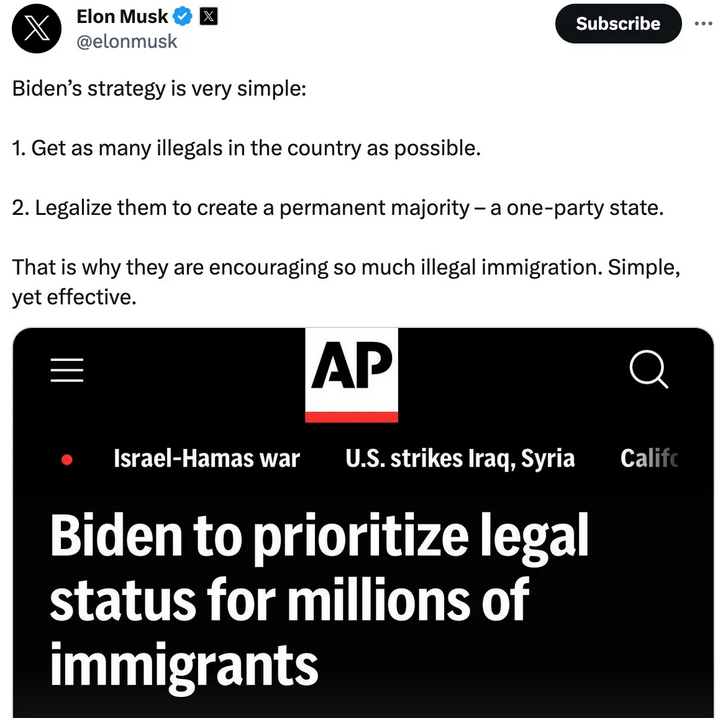
Why? Because our ruling class seeks, in Bertolt Brecht’s famous phrase, “to dissolve the populace and elect another”. As Elon Musk tweeted:

Musk’s comments met with the usual outrage, but Democrats have pretty much touted this as the plan for years. Indeed, it goes back to Ruy Teixeira’s “Emerging Democratic Majority” strategy, though it’s been accelerated in recent years. (And Teixeira himself has retreated from that plan). Sure, naturalization takes years – though they may speed that up, as it’s just a matter of statute – and there have also been some moves to allow non-citizens to vote anyway. Think that’s unlikely? Maybe, but how many things are happening these days that seemed impossibly unlikely a few years ago? And it’s a long game; a bunch of Democratic voters in 5 or 6 years will suit them fine.

January 27, 2024

Flashpoint: Texas

Filed under: Government, Media, Politics, USA — Tags: , , , , , — Nicholas @ 04:00

Theophilus Chilton wonders if you’re ready for a full-blown Constitutional crisis:

I’m sure that by now, we’re all aware of what is continuing to take place down in Texas. Far from backing down in his standoff with FedGov over the seizure of Shelby Park in Eagle Pass and subsequent expulsion of federal agents, Gov. Abbott has directed the state’s National Guard to continue interdicting illegal immigrants. Indeed, in response to the recent SCOTUS decision allowing the Feds to dismantle the razor wire Texas installed, they’ve simply installed more, in direct defiance of the wishes of the Regime. The Regime has now responded by giving Abbott and Texas an ultimatum — restore control of the park to the Federal government by the afternoon of January 26, or … well … something. Whether the governor ultimately continues to tell the Feds to get bent remains to be seen, but so far the trend is looking pretty good.

Of course, it helps that — for once — Republicans across the country have actually found a little courage to support doing what’s right. As of writing this, the Republican governors of 25 other states have all issued statements of support for Texas’ position. Hence, there are now an outright majority of states whose executives (who control their various National and State Guards) are publicly backing Texan efforts to secure our border. Many of these governors have explicitly cited the Biden administration’s continued abandonment of the federal government’s constitutional duty to protect the several states from invasion and the constitutional right of the states to act in their own defence as sovereign entities in their own right.

Needless to say, this is a constitutional crisis that would not have been conceivable even twenty years ago (well, except for this one movie that seems to have been amazingly prescient). Since 1865, the doctrine of absolute federal supremacy has been in force and the balance of power between the state and national governments has inexorably trended in Washington, DC’s favour. Occasional spurts of opposition to the contrary, most of the previous incipient talk by states about “reining in the federal government” generally proved to be all words and no action. On a few things (e.g. marijuana legalisation), the Regime allowed states to “oppose” federal policy if these were policies that the Regime wanted to change anywise but couldn’t “officially” at the federal level. But on anything that was a true Regime priority, FedGov brooked no dissent. So it is now, but the calculus has changed. What would have been impossible in 2003 is now on the verge of happening in 2023.

This all highlights the fundamental illegitimacy of our current federal government. There is no moral or legal case to be made to justify the actions of the Biden administration. The federal Constitution both enjoins the federal government to protect the states from foreign invasion (which being overrun with millions of foreigners breaking our laws most certainly counts as) and also grants the states the right to protect their own borders and sovereignty. Instead of doing this, the Biden administration has been purposefully inviting hordes of migrants to enter this country. Indeed, this is being encouraged in contravention to statutory federal law as well. Further, if Texas Attorney General Ken Paxton is correct (and he almost assuredly is), the administration has even been partnering with criminal cartels to smuggle illegals into this country. All in all, there is absolutely no justification to be credibly made for the Regime’s actions and anyone who supports them are in opposition to the Constitution, the laws, and the people of this land.

Despite the fevered ravings of various progressive “Christians” on social media, the moral argument for allowing the Regime to throw the gates open is nonsense. Indeed, the whole attempt to craft a “biblical” argument for open borders is simple-minded and ignorant of the relevant scriptural and historical context. Simply put, the Bible’s approach to “the stranger” falls into line with common ancient Near Eastern and Mediterranean modes of hospitality that were meant to “tame” the foreigner and integrate him into a society, thus preventing him from causing disruption to that society. If that couldn’t be accomplished, then the “inhospitable foreigner” was either to be expelled or eliminated. Needless to say, this applied only to individuals or small family groups — large masses of foreigners attempting to enter an ancient country would have been rightly recognised as an invasion and dealt with accordingly.

However, the illegitimacy of the current Regime and its actions alone can’t explain why the Republicans have closed ranks so precipitously. After all, Republican politicians are not exactly known for their intestinal fortitude when faced with opposition of any kind. Yet, even Northeastern moderate squishes like New Hampshire’s Chris Sununu have signed onto supporting Texas in this. Something changed that has caused the GOP, almost as a whole, to support this, either openly or tacitly.

January 5, 2024

Qatar’s Aggies

Filed under: Education, Middle East, USA — Tags: , , , , — Nicholas @ 03:00

In The Free Press, Eli Lake discusses the deal between Texas A&M and the Qatari government that gives the Qatar Foundation — run by the Qatari royal family — full ownership of any intellectual property developed at the Qatari campus of the university:

Texas A&M’s Nuclear Engineering and Science Center in College Station, Texas.
Photo via Texas A&M

What does Qatar get for its investment in U.S. universities? The answer may surprise you. In addition to the prestige and the influence of affiliating one’s national philanthropy with elite schools, Qatar is also accumulating the kind of technical research that was once the prize of American universities.

Consider Texas A&M University, one of the best places in the country to study nuclear engineering. Last month, The Free Press obtained exclusive access to a copy of the latest contract between Texas A&M and the Qatar Foundation that shows all of the intellectual property developed at the university’s campus in Doha belongs to the Qatar Foundation, a national philanthropy owned by the country’s royal family.

“The Qatar Foundation shall own the entire right, title, and interest in all Technology and Intellectual Property developed at (Texas A&M University Qatar) or under the auspices of its Research Program, other than those developed by non-TAMUQ employees and without financial support from the Qatar Foundation or any of its affiliates,” says the contract, dated May 25, 2021.

This kind of arrangement is common for large research universities in America. But TAMUQ is not your ordinary university. It is entirely funded by the Qatar Foundation. Kelly Brown, a spokeswoman for Texas A&M, told me that Qatar “pays for all faculty and staff salaries” as well as the physical campus, labs and equipment, housing, transportation, and travel allowances for professors.

It’s no small matter. The intellectual property generated by Texas A&M University in Qatar, or TAMUQ, includes highly sensitive research in a variety of fields ranging from computer science to bioengineering. Last year, TAMUQ inked an agreement to develop projects with a subsidiary of Barzan Holdings, Qatar’s largest arms manufacturer.

Andre Conradie, the CEO of the joint venture between Barzan and Germany’s Rheinmetall, said at the time, “This partnership will encourage the development of technological and operational capabilities to enhance military protection.”

As one of the country’s premier schools in nuclear engineering, Texas A&M has access to two nuclear reactors in Texas not affiliated with the U.S. government. In December, the National Nuclear Security Administration renewed a contract for the university, along with the University of California and Battelle Memorial Institute, to manage the Los Alamos National Laboratory, which involves oversight of teams who design and maintain nuclear weapons for the U.S. government.

October 25, 2023

1847 Walker Revolver: the Texas Behemoth

Filed under: History, Military, USA, Weapons — Tags: , , , , — Nicholas @ 02:00

Forgotten Weapons
Published 18 Nov 2015

The Colt 1847 Walker revolver was a massive 4 1/2 pound handgun made for Samuel Walker of the US Mounted Rifles (he also served with the Texas Rangers) as a way to equip mounted troops with greater firepower than single-shot carbines. The Walker was the first true martial handgun made by Colt, and despite its problems (nearly a third of the guns procured by the military would be returned to Colt for repairs, and more than a few literally blew up) it would save Colt from bankruptcy after the commercial failure of his Paterson revolver of 1836.

Only 1100 of these guns were made, 1000 for the military and a further 100 for commercial sale. The military ones were issued to five companied of Mounted Rifles, and can be identified by their factory unit marks for Companies A through E (this particular gun is a Company A one). Roughly half of them were delivered in time to see active use in the Mexican-American War, but all of them would see use for many years later in the hands of the US military, the Texas Rangers, the Confederate military, and in civilian hands. The design would evolve into the Colt Dragoon revolvers and ultimately lead to the 1851 Navy and 1860 Army designs — arguably the most iconic muzzle loading revolvers ever made.

http://www.Patreon.com/ForgottenWeapons

May 17, 2023

Texas Chili & The Chili Queens of San Antonio

Filed under: Food, History, USA — Tags: , , , , — Nicholas @ 04:00

Tasting History with Max Miller
Published 16 May 2023
(more…)

September 7, 2022

Tamale Pie: What did WW2 Food Ration Stamps Look Like?

Filed under: Food, History, USA, WW2 — Tags: , , , — Nicholas @ 02:00

YesterKitchen
Published 3 Nov 2019

I hope you enjoy this special trip back in food history!! WW2 brought food rationing to America and American housewives needed recipes to accommodate the scarcity. Never fear, warm, hearty dishes such as this were created to feed the nation. This Tamale Pie is classic war ration cooking and is just YUM!
(more…)

Older Posts »

Powered by WordPress