Quotulatiousness

June 17, 2026

Why California’s high speed train system will probably never be finished

This is an older post from March, but nothing in it has significantly changed … the legal and regulatory structure of Californian governance will ensure that what work gets done on the high speed rail infrastructure will only be done at the slowest speed yet at the highest possible costs:

The California high-speed rail authority, literally owns thousands of parcels of land that are in various stages continued litigation, tenant improvements, eviction, and constant maintenance.

For example, there are many homes and apartment complexes in the plant path that have been purchased years ahead of construction. Removing those tenants is a slow and expensive process. (let’s ignore the extra stress on housing that all of these destroyed properties are causing)

In some cases, these are low rent apartments with a lengthy eviction process. During that process, the state of California is the landlord and has to maintain the property codes the same as any other landlord. This means repairs, adding smoke detectors, fixing roofs, vegetation management, landscaping, paying off tenants to leave early, boarding up Windows, constant trash cleanups, towing vehicles etc.

But the High Speed Rail Authority doesn’t just have to maintain these properties at normal cost. Every single bit of that work has to be done at California prevailing wage rates. The work can only be done through qualified contractors that have passed through a long series of idiotic mazes to qualify to perform the work.

An average rate per hour (charge rate) for a worker to perform any service on these properties is approximately $200 an hour for labor only. The cost go up for specialized work, like electricians, plumbers, or machine operators.

Properties that are literally worthless are being maintained at huge expense just so the next round of homeless transients can break into the property and cause more damage. For reasons I can’t explain, the process to finally demo and remove the structures takes years.

I’m only mentioning the tip of the iceberg regarding my firsthand knowledge.

Completely separate from those outlandish costs are the inflation caused by the construction. The prevailing word on the street is that nothing is getting done. The truth is that a lot is getting done and none of it efficiently.

The amount of concrete being poured daily and monthly to build gigantic overpasses for both the rail and roadways is not understood. In these work areas, every concrete mixing company is fully scheduled out and cannot offer building materials for other basic services such as building a house often times for weeks when the average lead time for many of these services used to be one day. And that’s just the schedule, never mind the huge cost increases from straining the supply chain and labor pool.

The amount of concrete and steel that has gone into the structures so far is massive.

Dozens and dozens of new water wells have been dug just for dust control. Thousands upon thousands of acres of highly productive tree fruits and nuts have been torn up and shredded.

Utility scale solar fields have been uprooted and sometimes relocated at extravagant costs.

Every type of business you can imagine has gone through either a closure, relocation, or a long-term tenant agreement with the rail authority. In some cases, it’s just a buyout where the business closes its doors forever. The owners get something all of the workers get nothing.

Don’t get me started on how thick the layers of bureaucracy are for these minute tasks that occur on all of these properties.

The inefficiency is far beyond your wildest dreams. In many cases, this is not related to fraud in any way it’s just absolute ignorance, red tape, and failed leadership.

June 14, 2026

The “Dissolution of the Universities” draws ever closer

Filed under: Economics, Education, Media, Technology, USA — Tags: , , , — Nicholas @ 05:00

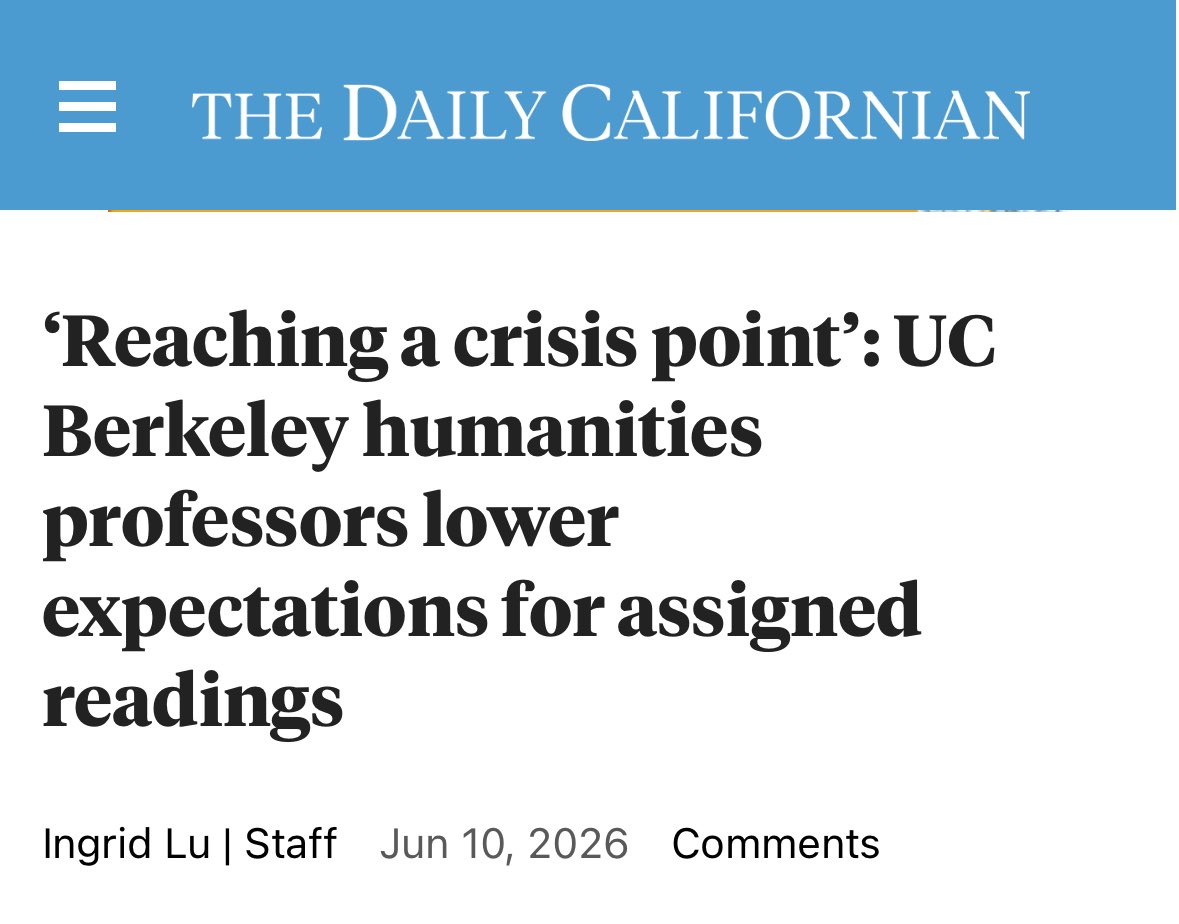
On the social media site formerly known as Twitter, Steve McGuire reacts to more news about the conscious dumbing-down of modern university programs:

A Berkeley history professor said he’s gone from assigning 100 pages of reading per week to 35.

Another “said the earliest version of the … course he taught required seven full books, while his most recent iteration exclusively consisted of excerpts”.

“We are now reaching a crisis point where if the number (of pages) goes down further, it’s unclear to me whether my discipline of history can really be taught”, the first one said.

To which John Carter responds:

The academic death spiral is something to behold.

Demographics are steadily reducing the size of the student body, squeezing finances and driving bankruptcies.

At the same time, standards collapse is destroying the quality of the students the universities admit.

We’re already at the point where it’s common knowledge that a degree signals essentially nothing about intellectual ability. AI is exacerbating this, since cheating is so easy now.

Kids are already starting to forgo university, since they don’t think the cost of the credential is justified. That cuts even more deeply into the number of students universities can attract.

Universities respond by reducing standards even further (thereby accelerating brand destruction), by reducing tuition (which cuts even more deeply into budgets), and by firing professors in low-enrollment majors (reducing program variety, especially in the small seminars that are generally the most rewarding experiences for students).

[…]

“How can this be reversed?”

It can’t. There are pathways for individual institutions to revive themselves, even to prosper, but the sector as a whole is cooked. The death spiral is driven by prestige collapse as well as the demographic cliff, and intellectual prestige is inversely correlated to the size of the student body. More students means lower standards. That is especially true with a demographic cliff.

The only way to survive this crisis is ruthless elitism. Stop trying to edutain the fat middle of the bell curve, and refocus on the right tail. Become a place where the smartest people gather, and from which anyone who isn’t a 2-sigma outlier is excluded. This makes the school an arena in which intellectual iron can sharpen against iron. Elitism restored, prestige follows.

Next, eliminate the 500 person intro lectures. Admin loves these, since the high student:teacher ratio makes them cash cows. But they’re functionally no better than watching YouTube videos. Refocus on small seminars. This offers value that the Internet can’t.

Schools that take this path will restore or build reputations that will enable them to survive. However, they won’t be large. There is no future in which huge institutions keep tens of thousands of professors and administrators on payroll.

Update, 15 June: Welcome, Instapundit readers! Have a look around at some of my other posts you may find of interest. I send out a daily summary of posts here through my Substackhttps://substack.com/@nicholasrusson that you can subscribe to if you’d like to be informed of new posts in the future.

May 13, 2026

A quick look at the race to be the next governor of California

Chris Bray somehow seems to find the election coverage by a multi-decade veteran Los Angeles Times political reporter to be, dare I say, lacking just a little objectivity and honest analysis:

Robin Abcarian has been a professional journalist for four decades, mostly at the Los Angeles Times. She’s spent her adult life writing about politics. So go read her column about the last gubernatorial debate in California. Here’s how it opens:

    What am I looking for in a new California governor?

    Like a big chunk of the state’s voters, I’m not exactly sure.

You can already tell you’re in the hands of an experienced professional. There aren’t really any big issues or anything in California right now, so how would you zero in on something you would want from someone who wants to lead the state’s executive branch, right? It’s all just a shrug and a guess.

Then she recites: This candidate said X, and this other candidate said Y. And she tells you which of the recited things she likes: I like X. I do not like Y. She doesn’t analyze or argue or contextualize: she just says I like that one and I do not like that one. The effect is that you’re watching someone wander barefoot through a field of statements and either make “ooooh, pretty” sounds or “ick, yucky” sounds with a kind of vibration from her brain stem. Billy likes blue balloons, they are pretty. Becky loves pink balloons, they are even prettier! She can’t explain any of it, though she attempts some explainy noises, and then it gets worse:

    I know who I don’t like, though.

    Every time I see Republican Riverside County Sheriff Chad Bianco, with his Tom Selleck mustache, I can’t help thinking he should play a lawman on TV.

  1. Should Chad Bianco become the governor of California?
  2. He has a mustache

CHAD BIANCO WISHES TO BE THE GOVERNOR BUT ACTUALLY HE APPEARS TO BE VERY MASCULINE THINK ABOUT IT

Have I mentioned that Robin Abcarian has a graduate degree in journalism? You can see how her education sharpened her mind.

She adds that Bianco has said some deeply disturbing and disqualifying things, and then she gives an example: “A lack of affordable housing has nothing to do with homelessness, Bianco has said repeatedly”. Gasp!

Instead, outrageously, he claims that homelessness has something to do with “drugs and mental illness”.

It is very bad to say this. Why is it very bad to say this? She doesn’t explain, but it’s very bad to say it. Homeless people are all just fine, and they would immediately be okay if you just gave them a house, because the whole crisis is just affordability. Drugs and homelessness!?!? In CALIFORNIA!?!?!? What are you even talking about!?!?

This woman is a journalist in Los Angeles, where you can experience psychotic episodes in the street next to an encampment by driving to lunch.

By the way, this video of homeless people on Skid Row smoking fentanyl right next to the LAPD’s Central Division station? I drove over there this afternoon, and yes. Open drug dealing, drug overdoses, ambulances running day and night, bodies in the street, police station.

Let’s have a look at Abcarian’s analysis of Katie Porter, whose marriage quite notoriously ended with her husband accusing her of once expressing an (apparently frequent) rage by dumping a boiled pot of mashed potatoes on his head, part of a pattern of what he described as an abusive relationship. Abcarian:

“I’ve always liked Porter and her famous white board. I don’t believe snapping at your staff or a reporter is disqualifying, and I’m glad she’s been able to joke about the leaked video that damaged her campaign.”

I like Katie Porter. She is nice. People say she yells a lot, but that is okay. She makes jokes about when she yells at people who work for her. That is funny! She is funny and nice.

Decades on the payroll of a major American newspaper. Will a candidate be an effective governor? “I’ve always liked Porter.” Thanks for your analysis, Robin.

And then finally, big finish, watch how aggressively obtuse this person is. Just watch. It’s a gold medal performance.

First she discusses the attacks on Democratic frontrunner Xavier Becerra. The other candidates are criticizing him because “on his watch at HHS, the Office of Refugee Resettlement lost track of 85,000 migrant children”. Abcarian acknowledges what happened next, when “many of the minors, mostly teenage boys, were exploited by sponsors, who illegally put them to work in various factories, food processing plants and as roofers”. So she has explicitly discussed migration as a source of human trafficking and exploitation.

Then she says that Tom Steyer won her heart by promising to shut down ICE and prosecute ICE agents. Here’s Abcarian’s complete discussion of the way she feels about Steyer promising not to enforce immigration laws: “Could it be I’m falling in love?”

  1. Unmanaged migration across borders is human trafficking and exploitation, often of children
  2. My uterus is a little gushy over this candidate who says he’ll block the enforcement of immigration laws and shut down the agency that enforces immigration laws

Does she notice that she did this? Does she notice the one-two punch of talking about tens of thousands of minors trafficked across the border to be exploited and then the immediate wine aunt pivot to this ooh-he’s-so-cute swooning about Dreamy Tom Steyer promising to not let anyone enforce immigration laws?

My position regarding the high-cultural-status AWFL and biologically male pseudo-AWFL, in media and politics and academia and NGOs, is that none of them notice themselves at all. They have noises that they’re been trained to make, and they make the noises. Warm and wonderful unhoused neighbors. Warm and wonderful trans kids. Warm and wonderful immigrants. They have categories that they purr about, because one purrs about those categories or else one is a Trump person who belongs in a trailer park. It’s been purely automatic for years and years.

April 13, 2026

Trump is behind the falling population of LA County!

Filed under: Government, Media, Politics, USA — Tags: , , , , — Nicholas @ 05:00

Chris Bray walks us through the tortured logic that leads the venerable Los Angeles Times to attribute the demographic slide evident in Los Angeles County to the Bad Orange Man:

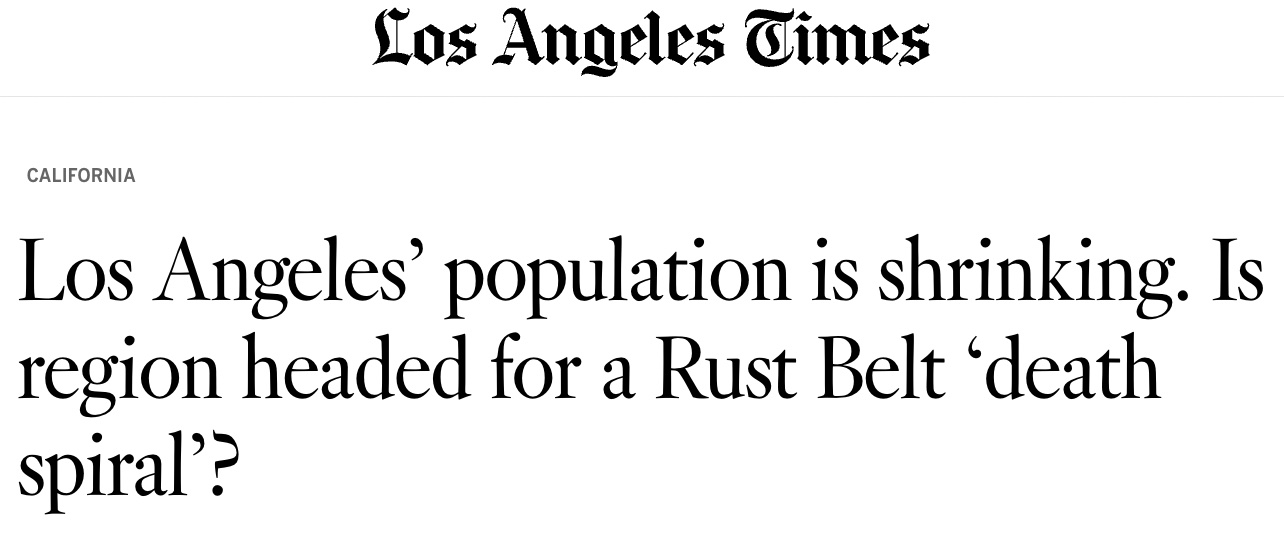
Los Angeles County is bleeding people, sliding into population decline faster than anywhere else in the country. But don’t worry, the local newspaper is on the case!

Screenshot

After a careful examination of the matter, the Los Angeles Times is able to assign blame to — wait for it! — a certain VERY BAD ORANGE MAN.

    While conservative critics of L.A. have rushed to frame the population loss as a “mass exodus” of people fleeing rampant crime, high taxes and inadequate services, the reality is more complex.

    Los Angeles is by far the nation’s largest county, with 9.7 million people — nearly double the next largest, Cook County, Ill. In that sense, it’s not surprising that it saw a severe drop in population after the Trump administration rolled out a flurry of executive orders and new legislation aimed at restricting immigration. L.A. County is a historic hub for immigrants from Latin America and Asia, and a place where 1 in 3 residents is an immigrant.

If you read the story, you’ll see the name Trump several times, like a coven chanting the name of an enemy around the caldron. But definitely for sure don’t listen to those bizarre right-wing conspiracy theories about “high taxes and inadequate services”, noooooooo, that’s a huge lie, trust the wisdom of the local newspaper.

After a large and historic neighborhood ceased to exist because of a wildfire that rekindled after the Los Angeles Fire Department didn’t fully extinguish an earlier fire in dense, dry hillside brush, CNN produced a long story on the disaster of the city’s firefighter staffing. Small sample, describing a memorandum from then-Fire Chief Kristin Crowley: “In the memo, which the city has since removed from its website, Crowley wrote that the city’s population had grown from about 2.5 million in 1960 to nearly 4 million in 2020. Yet the city has fewer fire stations today than it did back then, even as firefighters respond to a call volume that has quadrupled.”

A little less than a year and a half after that fire, the Los Angeles Police Department looks like this:

The last time a mean old white male Republican was the mayor, which is very bad and hateful, the city built up the police department, with a goal of having 10,000 officers. They actually hit that number in 2013, during the opening moments of the reign of Mayor Yogapants, then began shrinking soon after. Now we have very wise and progressive leaders, so the city is good.

[…]

So taxes are soaring, fire and police staffing are down, fat dumb communists want to crush basic city services a lot more to free up plenty of social justice cash, and some MEAN RIGHT-WING CONSPIRACY THEORISTS bizarrely claim that people are leaving Los Angeles because they pay high taxes for increasingly poor services. My goodness, these people will just believe anything! OBVIOUSLY WHAT’S REALLY HAPPENING IS THAT DONALD TRUMP IS VERY BAD, the professional journalists explained.

March 18, 2026

Virginia sees California’s tax schemes and says “hold my beer”

Filed under: Bureaucracy, Business, Government, USA — Tags: , , , , — Nicholas @ 03:00

In The Freeman, Erik W. Matson pleads with the Virginian government not to “California our Commonwealth”, as the new governor keeps cribbing tax policies from Gavin Newsom’s playbook:

The state seal of Virginia. I am told that the motto Sic semper tyrannis does not actually stand for “Thus always to taxpayers”, all appearances to the contrary.

In 1966, fresh off four busy years of touring, the Beatles returned to the UK to discover they were on the brink of bankruptcy. Their earnings had placed them in the top tax bracket, putting them at the mercy of the Labour government’s 95% supertax. George Harrison, in response to this tyranny, penned the lyrics to what became the first track on their next album Revolver: “Taxman”.

    Let me tell you how it will be
    There’s one for you, nineteen for me
    ‘Cause I’m the taxman

Harrison’s words resonate across the pond today, especially for those living and working in the state of California. Consider the recent case of Sam Darnold, quarterback of the Seattle Seahawks. Darnold earned $178,000 for winning Super Bowl LX in February 2026, which was played in Santa Clara — and promptly found himself owing California $249,000, thanks to the state’s so-called “jock tax“. For almost three decades, the state has had the highest top marginal income tax rate in the US. Capital gains in California are treated — and taxed — as ordinary income, pushing many into higher tax brackets. At the state and local level, California features a garden variety of invasive taxes and surcharges to fund everything from tourism to mental health support initiatives. Add to this the recently proposed 2026 Billionaire Tax Act, which would impose a one-time 5% tax on the worldwide net worth of California residents worth more than $1 billion. The act would also amend the state constitution to remove the cap on taxes on intangible property (and likely cost the state $25 billion!).

California’s predatory tax regime, sadly, seems increasingly familiar to those of us living in the Commonwealth of Virginia. Thanks to the initiatives of the new governor Abigail Spanberger, Virginia is barreling down a trail of “California-ization.” In some sense, as Adam Johnston has recently discussed, our California-ization has been underway for over a decade, largely due to the influx of legal and illegal immigrants to the deep-blue suburbs in Northern Virginia. But it has entered a new and more aggressive phase under Spanberger, a former member of Congress’s Blue Dog Coalition who, two months in, is governing like anything but. Spanberger and her administration are openly attempting to gerrymander the Commonwealth’s congressional map in an effort to wipe out the state’s Republicans. They have also proposed an expansive set of truly California-esque taxes, subsidies, and regulations antithetical to liberty, prosperity, and “affordability.”

In January, City Journal‘s Judge Glock catalogued some of Spanberger’s initial ideas for governance, including her desire to subsidize housing for state employees and low-income residents and regulate the Commonwealth towards carbon neutrality. Unsurprisingly, the bulk of her ideas would, as Glock says, “drive up expenses for one group of consumers in order to benefit another group deemed more deserving”. If Spanberger’s officially announced agenda from November 2025 is any indication, the “more deserving” include smokers (taking a tactic straight from California’s playbook), solar farms, and scofflaw tenants (compare California’s 2019 Tenant Protection Act!).

Since the convening of the General Assembly, Virginia Democrats’ wildest dreams have metastasized into a concrete body of legislative proposals that promise at once to limit Virginians’ freedoms and nickel-and-dime us into oblivion. House Bill 978, for example, introduces new taxes on:

    recreation, fitness, or sports facilities; nonmedical personal services or counseling; dry cleaning and laundry services; companion animal care; residential home repair or maintenance, landscaping, or cleaning services when paid for directly by a resident or homeowner; vehicle and engine repair; repairs or alterations to tangible personal property; storage of tangible personal property; delivery or shipping services; travel, event, and aesthetic planning services; and digital services.

Building on the architecture of the widely unpopular vehicle tax (which, despite what Spanberger proposed during her campaign, is likely here to stay), House Bill 557 proposes local personal property taxes on electric-powered lawn equipment — including mowers, trimmers, blowers, and chainsaws — used to maintain “commercial, public, or private gardens, lawns, trees, shrubs, or other plants”. These suggested taxes on electric-powered equipment complement a proposal in House Bill 881 encouraging the regulation and even outright banning of gas-powered leaf blowers — again following the lead of California.

February 24, 2026

What did Prisoners eat at Folsom in 1925? – Lamb Curry & Beans

Filed under: Food, History, Law, USA — Tags: , , , , — Nicholas @ 02:00

Tasting History with Max Miller
Published 26 Aug 2025

Lamb curry with onions and carrots served with white bread and plain pinto beans

City/Region: Folsom, California
Time Period: 1916-1933

Folsom Prison is infamous, but the food doesn’t sound like it was all that bad, though there was plenty of watery gruel made from the water salt pork had been soaked in, and if you were in solitary confinement, you got a diet of bread and water with beans every third day. Meals weren’t all terrible, though. A 1925 menu show foods like Hamburger Steak with Brown Gravy, Split Pea Soup, and Lamb Curry & Rice, which is what we’re making here.

In the 1920s, a lot of the cooks were using military manuals, so that is where the base of this recipe comes from, along with a list of ingredients from a commissary report from 1933.

It’s actually quite good, though I would add as much as double the amount of curry powder as was specified in the historical recipe. The beans are a little plain, but that’s to be expected.

    382. Beef, curry (for 60 men).
    Ingredients used:
    20 pounds beef.
    1 1/2 ounces curry powder.
    Cut the beef into 1-inch cubes and place in a bake pan; cover with beef stock or water; season with salt, pepper, and curry powder. When nearly done, thicken slightly with a flour batter. Serve hot.

    Manual for Army Cooks, 1916

    LAMB CURRIE and RICE
    1160 pounds Mutton
    830 ” Rice
    300 ” Onions
    400 ” Carrots
    1 bottle Curry
    Commissary report from Folsom Prison, February 1, 1933

(more…)

January 22, 2026

California considering a new way to kill the golden goose

Filed under: Economics, Government, Politics, USA — Tags: , , , , — Nicholas @ 03:00

When I first heard about California’s proposed “Billionaire Tax” I thought it was a joke — nobody could be that economically illiterate. But I was wrong and the state really does seem to want to make their state economy a new case study in economics courses of the future. J.D. Tuccille explains why the tax, if implemented, is likely to impact a lot more folks who don’t rank as plutocrats:

California’s potential adoption of a one-time 5 percent “billionaire tax” on the net worth of high-value individuals is already sending wealthy residents fleeing for the exits. By one estimate, at least a trillion dollars has moved beyond the reach of state officials. But a new analysis says the tax may be even more onerous than advertised. Californians may need to get used to the sight of moving vans leaving the state.

Give Us 5 Percent of Everything You Own

Sponsored by a chapter of the Service Employees International Union, the proposed billionaire tax is set to appear as an initiative on the California ballot in November. According to the summary approved by state Attorney General Rob Bonta, the measure “imposes one-time tax of up to 5% on taxpayers and trusts with covered assets valued over $1 billion; covered assets include businesses, securities, art, collectibles, and intellectual property, but exclude real property and some pensions and retirement accounts”. If passed, the tax would apply to people resident in California as of January 1, 2026 — a retroactive element bound to be challenged in court.

[…]

Five Percent Understates the Pain

“The 2026 Billionaire Tax Act, a California ballot initiative, would ostensibly impose a one-time tax of 5 percent on the net worth of the state’s billionaires,” notes Jared Walczak for the Tax Foundation. “Due, however, to aggressive design choices and possible drafting errors, the actual rate on taxpayers’ net worth could be dramatically higher. One particularly momentous policy choice has the potential to strip the founders of some of the world’s largest companies of their controlling interests and force them to sell off a significant portion of their shares.”

According to Walczak, there are many ways in which the initiative creates situations under which “tax liability would be vastly more than 5 percent of net worth”. He focuses on six of them: valuations based on voting interests; assessment rules that can overvalue privately held businesses; excessive underpayment penalties that encourage overvaluing privately held businesses; anti-avoidance rules that tax more than the amount of transfers; provisions on spousal assets and debt to relatives that would tax nonresidents’ assets; and deferrals that would tax wealth that no longer exists.

As an example, Walczak points to the initiative’s means for valuing voting shares that aren’t publicly traded. DoorDash founder Tony Xu owns 2.6 percent of the company but controls 57.6 percent of voting rights. The initiative specifies, “the percentage of the business entity owned by the taxpayer shall be presumed to be not less than the taxpayer’s percentage of the overall voting or other direct control rights.”

That means Xu could be taxed on his voting rights rather than his economic stake in the company. That turns a $2.41 billion ownership interest into a $4.17 billion tax liability. It could force the conversion of voting shares to common stock for sale (subject to capital gains tax), and loss of control of the company.

The other provisions examined by Walczak also impose potential tax liabilities far beyond the 5 percent claimed by the initiative’s sponsors.

Charles Fain Lehman explains that the proposed tax will end up making everyone in California worse off:

… If you pick up all of Google’s employees and put them in Texas — where some of California’s billionaires might look to relocate — then one might assume they would be just as productive.

That would be a reason for non-Californians to be relatively sanguine about the wealth tax’s effects. Yes, it will be bad for California fiscally. But the titans of technology and entertainment can just set up shop in a red state and continue their work unabated.

But what if cities themselves have some additive effect? What if there’s something special about Los Angeles or San Francisco per se? What if the specific concentration of human capital in a specific place yields more than the output you’d expect if you put that same capital in a different place?

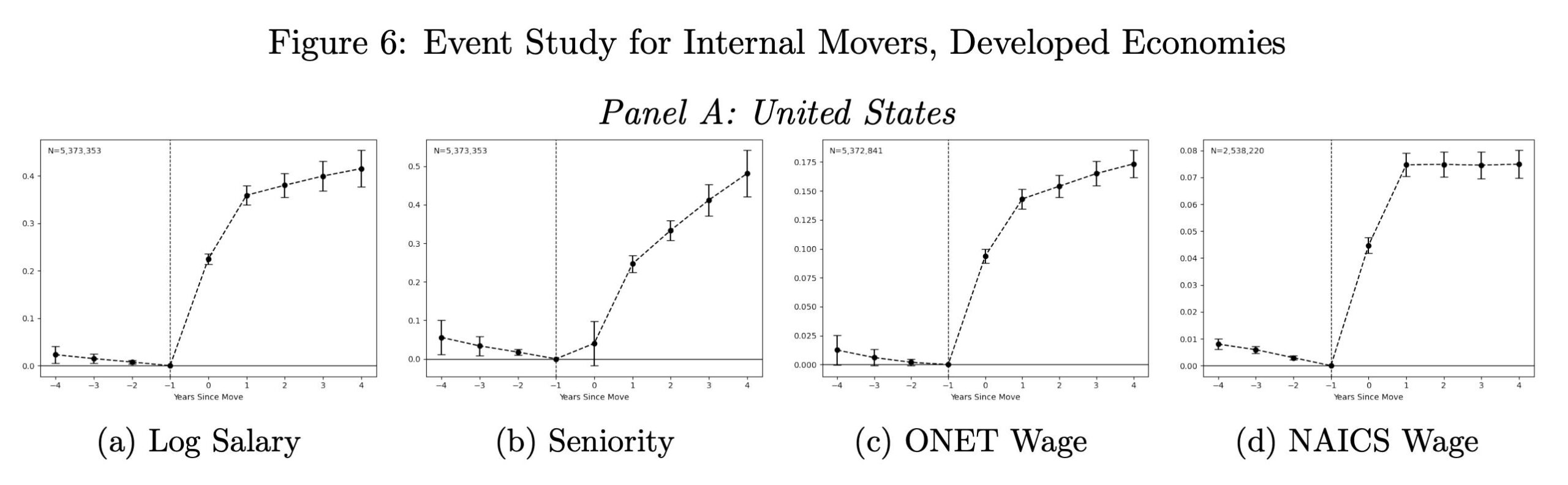
Source: Bhalothia et al, fig. 6.

As it turns out, that’s exactly what happens. Take recent research from economists at UC San Diego and Northwestern University. They use data on over 500 million LinkedIn users across 220,000 cities worldwide to ask how moving from one city to another affects an employee’s wages (a measure of their productivity). Because they observe the same people moving multiple times, they can disentangle the effects on wages of moving to a given city from the qualities of the people moving between cities.

The results are remarkable. The authors estimate that 93 percent of global wage variation is attributable to city effects, rather than to the qualities of workers themselves. That effect shrinks when you’re talking about movement within the developed world — someone moving from Bangalore to San Francisco gets a bigger wage bump than someone moving from Omaha to San Francisco, for example. But even looking at movers within their own developed country, cities explain something like 30 to 50 percent of the variance in wages.

In other words: it’s not just that people with better skills move to otherwise more desirable cities. Cities themselves make people worth more — meaning that they also increase total productivity and output, and therefore make the economy stronger.

How can it be that where you work is so important for how much you produce? The basic answer is what economists call agglomeration effects, the gains that come when firms cluster together. Agglomeration effects come, in general, from lowered barriers to exchange — of material goods, but also of ideas. Lots of start-up founders move to San Francisco because that’s where they can meet other start-up founders, and be on “the cutting edge” of what’s happening in their field. That’s only possible in a specific physical place.

Even if you put all the start-up founders in the same new part of Texas, moreover, they would still be worse off. Agglomeration economies come also from local culture and supportive industry infrastructure. Los Angeles as a city is built to support entertainers; San Francisco is built to support programmers. If you move those industries to Miami or Austin, neither city will be able to offer the same amenities — which is why both have struggled in their efforts to replace their Californian counterparts.

In other words: if California’s major industries leave California, they can’t be rebuilt somewhere else. Dismantle Silicon Valley, and you can’t just put it back together in Miami. We’ll still have technology companies, sure. But all else equal, they will be less productive than they would have been if they had stayed put. And we’ll all pay the price.

January 13, 2026

“In a world in which stylistic innovation is no longer possible, all that is left is to imitate dead styles”

Filed under: Government, Media, Politics, USA — Tags: , , , , — Nicholas @ 04:00

Chris Bray was travelling the other day and therefore subjected himself to watching the “news” on television. He now relates “the Fall of Soygon” from that painful experience:

Minneapolis is [Current Thing], and a significant part of the population is for that. Standard reference, insert own text:

BLACK LIVES MATTER FREE PALESTINE NEW PROGRAM LOADING.

The point of the performance is the performance, like art that exists only to comment on the meaning of art. They’re borrowing: “Hence, once again, pastiche: in a world in which stylistic innovation is no longer possible, all that is left is to imitate dead styles, to speak through the masks and with the voices of the styles in the imaginary museum”.

I’m briefly on the road in California, and watched television news last night. A protest in Fresno stood up to those bastards from ICE, who embody American imperialism and also something that George Orwell told us, details unclear. But then, almost inevitably, a protester told the television camera that he also marched across the Edmund Pettus Bridge on Bloody Sunday, and now he’s protesting again against the Trump administration and all its enablers, “who are trying to take our country away from us”.

Of course, something something Selma something something. “Selma envy”, the performative seeking, the wish to be a soldier in a great cause: insert great cause here. George Wallace was apparently also opposed to widespread Somali social welfare fraud, the great beating heart of the Civil Rights Movement. All causes are the same cause. “I’m against this situation that is happening”, the protesters explain. Arresting someone who has a deportation order is functionally identical to beating people who march against segregation, because in a world in which stylistic innovation is no longer possible, all that is left is to imitate dead styles. Monday, rage in the streets, Tuesday, rage in the streets, Wednesday, rage in the streets …

The Minneapolis circle jerk is producing endless video of middle-aged white leftist women doing THE SAME performance, endlessly, like there are a thousand pieces of footage that all show the same moment with different faces. Here, go watch one. Come back when you’re done.

Update, 15 January: Welcome, Instapundit readers! Have a look around at some of my other posts you may find of interest. I send out a daily summary of posts here through my Substackhttps://substack.com/@nicholasrusson that you can subscribe to if you’d like to be informed of new posts in the future.

December 11, 2025

US Democrats, like Canadian Liberals, love performative gestures but ghost on delivery

Filed under: Cancon, Media, Politics, USA — Tags: , , , , , , — Nicholas @ 05:00

I’ve remarked many times that Canada’s federal Liberals love themselves some photo ops, sound bites, ribbon-cuttings, and making announcements in front of temporary stages … they can’t help themselves, they’re what happens to theatre kids who don’t have to grow up. The American Democrats seem to be falling into the same pattern of “putting on a show” rather than implementing policies that address whatever the declared problem really is:

In 2015, the City of Los Angeles announced an ambitious plan (led by the person we then referred to as Mayor Yogapants) to completely eliminate traffic deaths by 2025. It was a vision: Vision Zero, they called it. Ten years later, traffic deaths in Los Angeles have doubled. A wonderfully progressive local government announced a plan to eliminate something, so we got much more of that thing. A community group, @peoplesvisionzero, is now trying to carry out some version of the failed plan with guerilla traffic engineering, sneaking new safety infrastructure into place without city permission. Recent result:

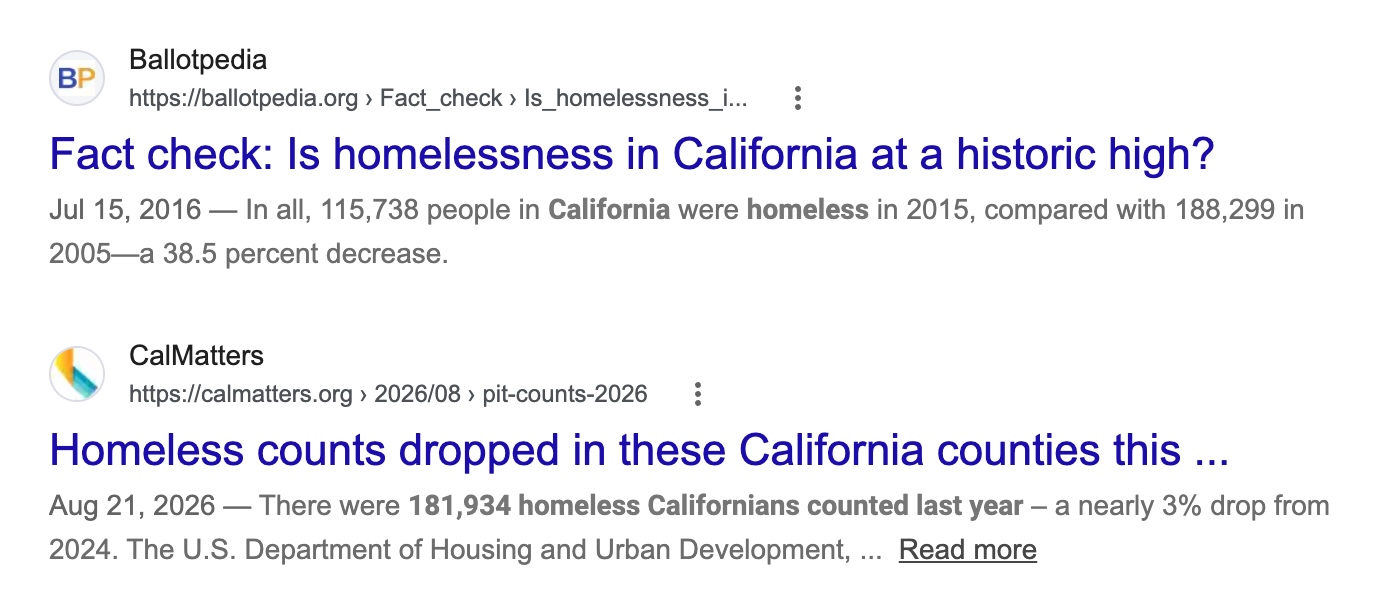
In similar fashion, Gavin Newsom announced his ten-year plan to end California homelessness in 2008. I struggle with the math, but there’s a possibility that we’ve passed the ten-year mark since then. […]

Theater-kid governance is the empty-to-the-point-of-ruin declaration of a symbol-desire, a performance about what we want and don’t want. It doesn’t do anything; it’s a posture, not an action. To the extent that it does do any actual thing in physical reality, it creates pots of money to be looted by NGOs and metastasizing government bureaucracies.

Infamously, when California audited $24 billion in state homelessness spending last year, auditors couldn’t track where a bunch of the spending went, or figure out what it had paid for. See also the growing scandal over Somalian immigrant social services fraud in Minnesota. Facial expressions are made. Symbols are invoked. Money goes … somewhere. It’s a show, with a rich loot bucket, not an actionable set of policies that produce positive trends toward declared goals. By the way, it’s been fifteen years since the Obama administration and a Democratic-majority Congress made healthcare affordable.

California infrastructure is a persistent disaster, because the California legislature and our sociopathic idiot governor are deeply invested in signaling about warm and wonderful trans kids and standing up to Mean Orange Hitler. They don’t stoop to highways and bridges — they’re much too progressive. Related, the increasingly sharp near-term projected decline of fuel production in California is becoming a national security problem in a state that needs to gas up a lot of military traffic. The state performs constantly against Big Oil and its mean climate change agenda, and somehow keeps losing refineries. The endless symbol-gestures cause the loss of real things.

December 4, 2025

The Swiss vote overwhelmingly against a new wealth tax

Filed under: Europe, Government, Politics, USA — Tags: , , , — Nicholas @ 04:00

As the California government wants to impose a new wealth tax, it’s worth checking how similar schemes are viewed in other jurisdictions. The Swiss voters were given an opportunity to scalp their very richest citizens and permanent residents with a proposed wealth tax, but it went down with 78% voting against it:

“Switzerland on Sunday overwhelmingly rejected a proposed 50% tax on inherited fortunes of 50 million Swiss francs ($62 million) or more, with 78% of votes against the plan, an outcome that even exceeded the two-thirds opposition indicated in polls,” Reuters reported this week.

All Swiss cantons already tax assessed gross worldwide assets, minus debts and with exceptions, making it one of the few countries in the world to retain a wealth tax. But competition among cantons keeps the tax burden relatively low and, as the Tax Foundation notes, “the Swiss wealth tax acts as a substitute for a capital gains tax and an estate tax, which are common in other countries”. The referendum would have imposed an additional and very steep national tax.

This was actually the second recent failed attempt to impose a national wealth tax on inheritances. Seventy-one percent of Swiss voters rejected a 2015 proposal for a 20 percent tax on estates and gifts of over 2 million francs. The revenues would have been earmarked for old-age pensions.

‘Inequality in Opulence is Better than Equality in Poverty’

The 2025 tax scheme openly played to envy. It was targeted at combating “inequality” by seizing half the assets of the rich and allocating proceeds to offset the climate damage they allegedly cause.

Finance Minister Karin Keller-Sutter opposed the proposal, warning that “many wealthy people would simply emigrate to avoid the tax and keep their wealth”. She also pointed out that while all but two of the country’s 26 cantons tax inheritances, “the people have abolished inheritance tax for children and spouses in many cantons”. She added, “I think it is right that what was developed in the nuclear family can be passed on”.

Philosopher Olivier Massin, a professor at the University of Neuchâtel, criticized the motivation driving much of the campaign for the tax. He wrote that “inequality is by nature neither good nor bad” and that envy is the main driver of egalitarianism. “Envy being inglorious, we grimace in indignation, making what is ultimately only the expression of resentment a moral cause.”

Massin added that “inequality in opulence is better than equality in poverty”.

And Switzerland is undoubtedly “opulent” — or, at least, prosperous — with a per capita gross domestic product of $103,669 as compared to $85,809 for the U.S., according to the World Bank. It builds that wealth with a second-place score in the current Index of Economic Freedom (the U.S. is now ranked at 26), suggesting that less government meddling in economic matters is the best way to increase prosperity.

November 27, 2025

Lack of talent is no obstacle to music success … even before Auto-Tune

Filed under: History, Media, Technology, USA — Tags: , , , , , — Nicholas @ 05:00

One of the reasons I like Ted Gioia’s Substack is that even when I’m not overly interested in the topic of any particular post, I usually learn something:

I’ve tried to identify the turning point — the moment when the rules changed. By my measure it happened one night in 1958.

Let’s revisit that fateful day …

One Friday evening in 1958, record producer George Avakian sat down in front of his TV set, and watched an episode of the popular detective show 77 Sunset Strip. This chance incident would have surprising ramifications in the music business for decades to come.

A few minutes into the episode, the record producer decided that one of the actors on the show looked and talked like a rock star. His name was Edd Byrnes and he played a hipster character named Kookie.

Kookie parked cars at a Hollywood nightclub in the show, and acted very cool. He had the right look and said witty hipster-ish things. The TV audience loved him, especially younger viewers.

Check Kookie out and decide for yourself.

There was just one tiny problem. Byrnes wasn’t a musician.

But Avakian didn’t worry about this. “I was sure that kids would like his talk and his looks, especially a way he had of looking out of the corner of his eye,” he later recalled. “And — the real clincher for his popularity with kids — parents would loathe him.”

They didn’t have Auto-Tune back then, but studio engineers had a few tricks to fix vocal imperfections. They knew how to splice together different takes, or make slight alterations in tape speed.

But when Byrnes did an audition for the label, it was bad. It was scary bad. This promising rock star had no sense of pitch. He had no range. He couldn’t even stay in rhythm with his accompanist.

No technology could fix this mess.

Record producer Avakian was no fool. During an illustrious career, he worked with Louis Armstrong, Duke Ellington, Miles Davis, Dave Brubeck, Sonny Rollins, and Keith Jarrett, among others. He had collaborated with genius, and now he had someone on the opposite end of the spectrum.

Maybe this situation is commonplace nowadays, but back in 1958 the record business believed in something called musical talent. Avakian’s bold decision to ignore that variable marks a historic moment in our culture.

Anybody else would have walked away from this looming disaster. They would have feared not just commercial failure but a tainted reputation. You don’t want to be the exec to greenlight a recording by somebody with zero musical ability.

But in a moment of brilliant insight, Avakian decided that Kookie didn’t need to sing, he could just rap. Of course, rapping wasn’t even a concept back in those days. But it sorta existed without a name. Deejays at radio stations often introduced a song by speaking in a hip tone of voice over the intro to a song.

Kookie would do the same. He would speak or rap his part, while somebody else did the actual singing. Connie Stevens, another Hollywood talent with the right look — and a slightly better voice — could handle the actual vocals.

October 16, 2025

RIFfing the US federal workforce

Filed under: Government, Media, Politics, USA — Tags: , , , , — Nicholas @ 03:00

In Reason, J.D. Tuccille considers the impact of the US government shutdown on the federal civil service:

“Lincoln Memorial During Government Shutdown 2013” by Flickr user reivax is licensed under CC BY-SA 2.0 .

As promised — or threatened, if you wandered over to Reason by accident — the Trump administration has started using the government sort-of-shutdown as an opportunity to engage in mass layoffs of federal employees. In the game of chicken between Republicans and Democrats over just how much the government should overspend and on what, the losers so far appear to be some of the almost 3 million Americans who thought federal employment would be a comfortable way to collect a paycheck.

Setting thousands of former government workers loose to seek jobs elsewhere — preferably not involving money forcibly extracted from taxpayers — is a step in the right direction.

Shutdowns Are (Mostly) Political Theater

As we all should know by now, government shutdowns are largely political theater. National parks and museums are closed to inconvenience the public into believing something big is happening even as taxes keep getting collected and government enforcers continue twisting arms to make sure people comply with laws and rules that never should have been imposed.

The Brookings Institution’s David Wessel pointed out last week, “the Justice Department said 90% of its employees would be exempted from the furlough” and “the Department of Homeland Security said in its 76-page contingency plan that roughly 95% of its nearly 272,000 employees would remain on the job if a shutdown occurred”. Agencies accomplish this by defining “essential” employees who remain on the job in the broadest way possible.

Paychecks may be delayed during the shutdown. But after it ends, “employees who were required to perform excepted work during the lapse will receive retroactive pay” and “employees who were furloughed as the result of the lapse will receive retroactive pay for those furlough periods” according to the Office of Personnel Management. Basically, all federal employees eventually get paid whether they continue to work or are sent home for the duration of the “shutdown”.

An Opportunity To Reduce the Federal Workforce

At least, that’s how it usually works. This time is a little different because the Trump administration came into office promising to downsize the federal government. The Department of Government Efficiency (DOGE) was supposed to accomplish that goal, but the shutdown offers another opportunity. Even before furloughs began, the Office of Management and Budget (OMB) sent out a memo noting:

    With respect to those Federal programs whose funding would lapse and which are otherwise unfunded, such programs are no longer statutorily required to be carried out. Therefore, consistent with applicable law, including the requirements of 5 C.F.R. part 351, agencies are directed to use this opportunity to consider Reduction in Force (RIF) notices for all employees in programs, projects, or activities (PPAs) that satisfy all three of the following conditions: (1) discretionary funding lapses on October 1, 2025; (2) another source of funding, such as H.R. 1 (Public Law 119-21) is not currently available; and (3) the PPA is not consistent with the President’s priorities.

The White House is apparently taking this opportunity seriously. “Around 4,200 employees were laid off in total on Friday,” reports Eric Katz of Government Executive. The biggest cuts were at the Department of the Treasury (1,446 employees) and the Department of Health and Human Services (between 1,100 and 1,200 employees). The Department of Education, which President Trump proposes to totally eliminate, also experienced layoffs (466 or nearly 20 percent of its remaining workforce), as did the Environmental Protection Agency, Homeland Security, and Housing and Urban Development.

Everything this administration does seems to involve a bit of chaos, and the latest rounds of reductions in force are no different. While hundreds of employees of the Centers for Disease Control and Prevention (CDC) were included in the layoffs, some were fired by accident and immediately rehired.

Chris Bray notes that — stop me if you’ve heard this before — a district court judge has ruled that the President doesn’t have the power to do, well, pretty much anything to do with the federal workforce (what is it with the executive branch thinking they have powers that haven’t been explicitly approved by the judiciary?):

After a just absolutely bizarre hearing in a Northern California federal court, a judge has forbidden the Trump administration from laying off government employees. The hearing may have been held in the Court of the Red Queen: After Counsel to the Assistant Attorney General Elizabeth Hedges argued that she wasn’t going to get into the legal merits of the Trump administration’s layoffs because the court lacked jurisdiction and the plaintiffs hadn’t met the legal standards for filing a lawsuit, Judge Susan Illston warned that, actual quote, “This hatchet is falling on the heads of employees all across the nation and you’re not even prepared to address whether that’s legal?” Getting laid off is a hatchet attack, so we skip the arguments about ripeness and standing. It’s emotionally dire, a thing that feels very bad. Judges talk like this, now. OH GOD COUNSEL THIS IS LIKE A THING WITH A KNIFE THAT WOUNDS ME. Objection, your honor, inadequate trigger warning. […]

Illston declared the existence of a temporary restraining order from the bench, and I’ve been waiting for her written order to land on PACER. It’s here, and it’s … very … Well, okay: It has a lot of feelings. […]

Opening paragraphs, first page:

Note that the first paragraph frames federal RIFs as historically unprecedented, while the second paragraph frames the current federal RIFS as not ordinary: different than the way RIFs are usually conducted. So this is unprecedented, but it has happened before, and the problem with the unprecedented thing is that it’s not being done the way the thing that has never been done before is usually done.

But anyway, a reduction in force of federal personnel during a shutdown is “unprecedented in our country’s history”. Of course, a reduction of force alone is not at all unprecedented, and the Clinton administration reduced the size of the federal bureaucracy by about 400,000 people. Illston doesn’t articulate a reason why reducing the bureaucracy during a shutdown is worse, or a reason why Clinton RIFs were good but Trump RIFs are a violent hatchet attack, but she clearly feels it. Of course, during a shutdown, the agencies being shrunk have no approved funding, so it would seem to make more sense to be careful about personnel costs, but this argument means that I just hurt people with a hatchet.

Above all, note that the argument out of the gate is a normative argument, not a legal argument. This is unprecedented! This is not ordinary! If a judge feels that something is a little off, she can order it stopped.

The Mexican-American War 1846-48

Filed under: Americas, Government, History, Military, USA, Weapons — Tags: , , , , , , — Nicholas @ 02:00

Real Time History
Published 16 May 2025

In the early 19th century, the United States and Mexico share a massive cross-continental border, but US settlement in Mexico, expansionist ideals and religious differences put the young republics on a collision course. As tensions boil over into bloodshed, the tiny, inexperienced US army marches to a war which will forge the modern United States.

Chapters:
00:00 Texas Republic
05:06 Declaration of War
07:03 The US Army
09:26 British Muskets in the Mexican Army
16:19 The Mexican Army
18:24 The Battles of Palo Alto and Resaca de la Palma
21:38 California and New Mexico
25:11 US Volunteers
28:40 Battle of Monterrey
33:03 Expanding the War
36:59 The Pedregal Battles
40:18 Battles for Mexico City
43:42 Treaty of Guadalupe Hidalgo
45:14 Legacy
(more…)

September 30, 2025

“San Francisco [is] a sort of market-segmented scheme [extracting] the basic comforts of civilization and licensing them back as upgrades”

Filed under: Health, Politics, Quotations, USA — Tags: , , , , , , — Nicholas @ 03:00

On the social media site formerly known as Twitter, Devon Eriksen describes the very comfortable lives of the very wealthy, who can support any kind of luxury beliefs because they never have to face the consequences that “the poors” who ape them do:

Dear sir,

I am not a filthy poor, and therefore conditions on the street level in Portland do not matter to me.

I drive my Jaguar to nice restaurants, give it to the valet to park, then go inside and order a fancy treat. So long as the valet parks my car, and the waiter brings my fancy treat for me to consoome in peace, I am utterly unaffected by conditions ten blocks away.

While I am technically forced to acknowledge that other humans exist — otherwise who would park my car or prepare my fancy treat? — I am not actually forced to consider what their lives are like.

And if you try to force me to confront this, I will simply point out that you are a filthy poor, who is unable to live a lifestyle that insulates you from this sort of unpleasantness.

At which point I don’t have to pay attention to you, loser.

Okay, here’s what’s really going on.

At a recent gathering in San Francisco, I listened to the tech bros I was dining with and their complaints about spending a million dollars a year on security teams, and a thought occurred to me, which I shared with the congregation.

I observed that San Fransisco, and perhaps other cities as well, seemed to be a sort of market-segmented money extraction scheme whereby the basic comforts of civilization are systematically removed from the environment, and then licensed back as upgrades to those who can afford them.

In Tennessee, it doesn’t cost me a thing to not be murdered for what I write online. Sure, I have a metric fuckton of extremely high-powered weapons and the skills to use them, but let’s be honest … I own them on principle, not because I would be murdered without them.

In SF, saying right-of-center things online while not being murdered costs a million dollars a year.

It probably costs slightly less than that to have zero drugged-out and/or schizophrenic bums urinating on your porch, but again, in Tennessee, this is a free service that comes with the “Western Civilization” package.

Also, it doesn’t cost anything go to a drugstore where nothing is locked behind glass, and be told “have a nice day” by someone at the register who actually means it.

And I’m told there is some sort of mythical beast called “graffiti”, but I have to go online to find out what it looks like.

In short, the argument that “civilization is just fine because I can still buy my way out of trouble” doesn’t hold any water, because it ignores the fact that you have to buy your way out of trouble, because civilization is shrinking.

You can’t have civilization without ass-kickings.

And if you forget that, you start having to buy your way into ever more and more exclusive clubs where the uncivilized can’t afford to go.

Until they figure out that they don’t have to pay, they can just push their way past the doorman. At which point you must be prepared to kick ass again.

All civilization rests on pillars made of violence. You are in danger until the moment you understand this.

Chris Bray also responded to the Nicholas Kristof take:

Now, here’s the hugely respectable New York Times columnist Nicholas Kristof, a very important Pulitzer Prize recipient, explaining from the heights of his journalistic perch what’s really happening in Portland:

This is as flawless a summary of the progressive cathedral classes as you could possibly manage: “‘Hell’ does not serve Pinot Noir this good”.

  1. Portland street journalist: Portland is a public graveyard
  2. Progressive New York Times columnist: Akshully, the Pinot Noir is exquisite

It’s time to shove these people onto a barge and tow them out to sea.

Like Karen Bass describing the open-air drug market of MacArthur Park as a sylvan paradise full of happy children and wonderful families having picnics, Oregon Governor Tina Kotek explained this week that Donald Trump is bizarrely intervening in a utopia, and for crying out loud look at this facial expression:

No one has ever been more lost than this. Your average good urban liberal is more insane than a psych ward full of psychotics. Akshully, the Pinot Noir is delightful. We are burdened with the existence of high-status people who have departed from earthly reality, and we can’t afford them.

Update, 1 October: Welcome, Instapundit readers! Please do have a look around at some of my other posts you may find of interest. I send out a daily summary of posts here through my Substackhttps://substack.com/@nicholasrusson that you can subscribe to if you’d like to be informed of new posts in the future.

August 20, 2025

California’s ever-receding High Speed Rail dream

Chris Bray provides an on-the-ground update of California’s ultra-expensive high speed rail project which still has yet to deliver a single passenger from one station to another after nearly 20 years of funding:

Start with a description: “In 2008, California voters approved $9.95 billion of state bond funding as seed money to build an 800-mile high-speed rail (HSR) network connecting Los Angeles and San Francisco, and the Central Valley to coastal cities, at speeds of up to 220 miles per hour, with an expected completion date of 2020.”

Construction started in 2015. Pause for a moment and really notice the date.

Ten years later, the project has consumed $18 billion, and an effort to connect Los Angeles and San Francisco has turned into a much more modest “Phase One” plan to connect the cities of the Central Valley, well east of the coast. The modest declared cost of the proposed LA-to-SF bullet train now looks like this for the much shorter line: “a cost range of $89 billion to $128 billion.” The Trump administration has declined to provide more federal funding for the project, but California is suing to try to keep the federal spigot open.

[…]

Famously, the California High-Speed Rail Authority has been posting pictures of its huge construction successes on social media:

See, that’s … almost a whole rail line for a bullet train. Obviously!

So!

If you ever find yourself in Fresno, and I sincerely hope you don’t, the structures that have been built for “high-speed rail” are surprisingly easy to access. There are several places where those structures aren’t fenced in or guarded. At all. […] So when you see this:

…it’s not that hard to just head up onto the thing. It’s also very dangerous, legally dubious, and something you definitely shouldn’t do. Since it’s an elevated construction site, there are a lot of places without guardrails where you can just fall off the thing, and it’s a long way down.

Everyone see this part: Don’t go up there. It’s dangerous. You can fall and die. […] But if you were to climb up onto the thing, which you absolutely should never do, you would see a whole bunch of this:

That’s a section at the northern end of Fresno, looking south.

Of course, California isn’t the only jurisdiction struggling to complete big infrastructure projects: Toronto’s long-awaited Crosstown LRT project got started in 2007 and still has no confirmed completion date, although a faint possibility exists that a portion of the line may open later in 2025.

Older Posts »

Powered by WordPress