
As we’ve seen, the evidence – largely archaeological evidence, by the by (Liebeschuetz thus fits with many other historians in the “decline and fall” counter-reformation in relying heavily on archaeological data) – suggests that urban centers declined markedly beginning in the fourth century, with that decline accelerating as the empire crumbled. That of course raises the fairly obvious question: where did all of the people go? One possible theory is that the population mostly ruralized, moving out of the city and into the countryside. That might even suggest a positive change, if one accepts the view that ancient cities were mostly “consumer” cities which didn’t produce much value but instead survived off of taxes and rents extracted from the countryside. In that view, the decline of cities could simply be a product of the collapse of systems of exploitation as the political order which maintained them weakened.
It’s a plausible theory and the only problem with it is that it doesn’t appear to have actually happened.
Here the key archaeological method is what is called “field survey“. While readers are probably more familiar with the intensive excavation work done at famous sites like Pompeii or Vindolanda, one tool archaeologists have to study the past is to survey large areas, sometimes by air, sometimes by on foot, sometimes with ground penetrating radar, in an effort to map out larger scale settlement patterns in the past than would be possible by labor-intensive single-site excavation work. Dateable remains (pottery most often) allow for archaeologists to get a rough sense of the dates in which sites were inhabited and in some cases building remains and the like can give some sense of what kind of settlement was present. The “error-bars” on some of this data can of course be large, but they offer a tool for tracking long-term changes in land use patterns. On the flip side, these sorts of studies really become valuable only when you have a lot of them to create a robust data-set over a fairly large area that lets you adjust for purely local patterns and distortions. Fortunately in much of the former Western Roman Empire and especially in Roman Italy (where these studies are very important for the study of Roman demography and agriculture) we’ve hit the tipping point where there is enough archaeological data to begin reaching for conclusions.
Now there is an immediate difficulty with using this kind of evidence, which is that for reasons we’ll get to in a moment (though they are reasons that tend to also be bad for the “change and continuity” argument), we have a major confounding variable here: site visibility. Our ability to see a site, archaeologically, is heavily dependent on factors like building material and the quantity of imperishable goods (especially pottery) that people are using. For reasons we’ll get to, compared to, say, second century AD communities, sixth century AD communities tended to build their buildings in far more perishable (and thus less visible) materials (like wood) and also tended to use a lot less imperishable household goods. Consequently, it is substantially harder to see a sixth century village than it is to see a second century villa.
Nevertheless, the decline is so marked and so consistent as to strongly suggest there is something real here. R.P. Duncan Jones (in “Economic Change and the Transition to Late Antiquity” in Swain and Edwards (eds) Approaching Late Antiquity (2006)) assembles some of the site data from around the empire; there is unsurprisingly a lot of regional variation (with some regions, like Syria, actually moving against trend), but in the western Empire (except N. Africa; decline there comes later) the trend is fairly clear, with site numbers declining (often drastically by half or more) beginning in the late third or fourth centuries. Bryan Ward-Perkins in The Fall of Rome notes a field study outside of Rome in which the number of sites declines by three quarters. Site data accumulated like this isn’t often very chronologically precise, so we’re dealing with centuries, not decades, but the clear trend suggests rural population decline, not an urban population ruralizing. To be visible to us in this way, the decline must have been quite severe.
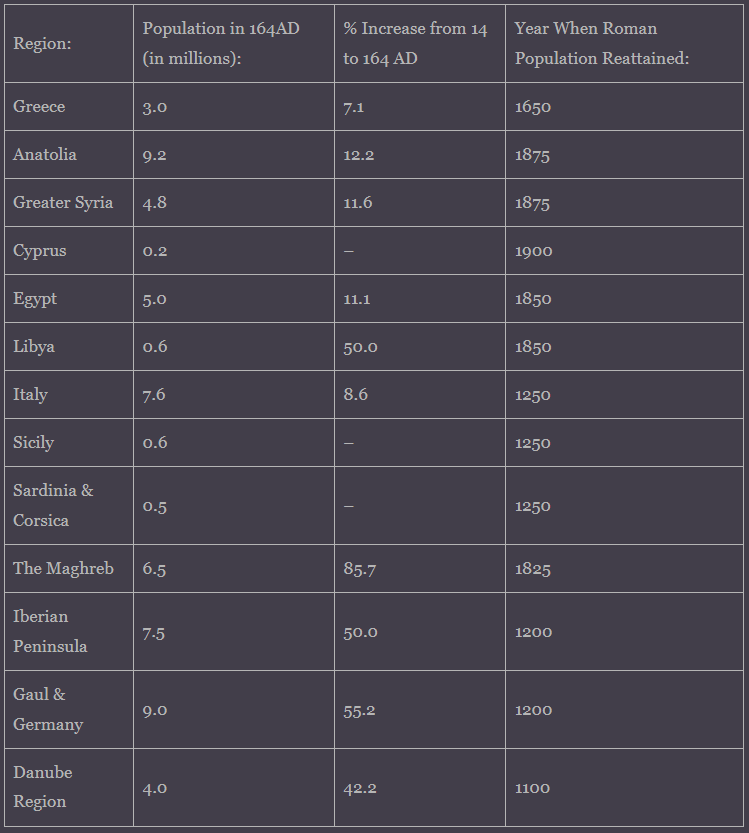
To give a sense of the scale of the decline, here is an abbreviated version of a chart from Bruce Friar’s “Demography” chapter in the second edition of the Cambridge Ancient History, which breaks down the estimated population of the Roman Empire by region and adds the dates when each of those regions got back to their Roman-era population:
Chart from Frier, “Demography” CAH2 XI (2000), 814. Some of these figures would likely see some revision today, mostly downward revisions of growth combined with upward revisions in population reflecting a somewhat (but generally not massively) higher estimated pre-Roman population.
Note that the decline in the East was, as noted last time, both later and generally slower. The reason for the later times to reattain Roman population here in many cases is that the major medieval Islamic population centers were further East (e.g. Baghdad under the Abbasids) placing them outside the traditional bounds of the Roman Empire, but also that the Roman East was much more urbanized and densely populated compared to its land area than the Roman West in the second century (or at any time during the Roman Period) so the “population to attain” bar on the East was much higher. After all, the cities of places like Syria or Egypt were in many cases centuries or even millennia old when the Romans showed up.Now the long times there to regain the Roman population can be a bit deceiving (and are very approximate). For reasons we’ll get into shortly, population growth from 600 to 900 or so in Europe was very low, so the issue here isn’t that the decline was so steep that it took many centuries to recover from, but rather that the decline was from a high population equilibrium to a low population equilibrium, both of which were, under their own conditions, stable (if that is confusing, don’t worry, we’ll delve more into it in a moment). Second, the apparent gap between places that “caught up” before 1300 and those that “caught up” after it is smaller than it looks, because of course the mid-1300s represent a massive population discontinuity over the entire broader Mediterranean world due to the Black Death such that a lot of those places “catching up” in the 1200s probably fell behind again due to the plague and then caught up again in the 1400s or early 1500s.
But this now raises two related questions: first, why did population decline so sharply and second, what was the impact on quality of life that resulted? The old answer to the first question was of course “the barbarians killed everyone” but as we’ve seen, while the fifth century was a violent time, the violent discontinuities were not that extreme. Surely the violence of the period has something to do with some of this declining population, but as noted, the underlying population (with their language and religion) didn’t much change (and the raw number of “barbarians” coming over the frontier was, in demographic terms, fairly small). Most of those Roman cities decayed, rather than being burned. But if the “barbarians” didn’t kill everyone, what did and why did that somehow have a negative impact on the survivors? The answers to these two questions are actually linked in that they depend on the same evidence, so that is where we will go next.
Bret Devereaux, “Collections: Rome: Decline and Fall? Part III: Things”, A Collection of Unmitigated Pedantry, 2022-02-11.
June 4, 2026
QotD: Demographic decline in the late western Roman Empire
June 3, 2026
QotD: Rhodesia and the suicide of the West
The story of Rhodesia is not only a regional tragedy, it is a civilisational warning. It is the story of a state that was functional, prosperous, and militarily superior, yet was dismantled not by its enemies in the bush, but by the “kith and kin” of its own civilisational bloc. It serves as a controlled experiment in the “Suicide of the West” , illustrating what happens when a civilisation loses the will to defend its own outposts and succumbs to a “politics of cultural despair“.
Today, as the nations of Europe and the Anglosphere grapple with their own crises of identity, demographic replacement, and institutional decay, the Rhodesian experience has moved from the periphery to the centre of conservative analysis. The arguments made by Ian Smith (former Prime Minister of Rhodesia) and his contemporaries, no longer appear as the reactionary pleas of a dying regime. Instead, they appear as the desperate warnings of men who saw the abyss before the rest of the world was willing to look.
The Philosophical Crisis and the Suicide of the West
To understand the fall of Rhodesia, one must look not to the Zambezi Valley, but to the intellectual salons of London and the university campuses of the United States. The doom of the settler state was engineered by a profound shift in the Western psyche, a shift identified by the philosopher James Burnham as the “Suicide of the West.”
James Burnham’s thesis, articulated in his 1964 classic Suicide of the West, provides the essential diagnostic framework for the Rhodesian tragedy. Burnham argued that liberalism had mutated into an ideology of Western suicide, a system of belief that systematically dismantled the defences of its own civilisation while valorising its enemies. In the context of Rhodesia, this manifested as a perverse diplomatic double standard. As the American economist Milton Friedman observed after his visit to Salisbury in 1976, the West seemed intent on destroying a pro-Western, anti-Communist state that upheld property rights and the rule of law, while simultaneously “welcoming the ministers of the Gulag Archipelago with open arms”.
Friedman explicitly linked the Rhodesian situation to Burnham’s concept, noting that the sanctions imposed on Rhodesia were a clear act of self-immolation by the Western powers. By strangling Rhodesia, the West was not advancing human rights, it was handing a strategic victory to Soviet and Chinese proxies (ZAPU and ZANLA) and signalling to the world that loyalty to the West was a liability. The Rhodesian settler, who had fought for the British Empire in two World Wars, found himself cast as the villain, not because he had changed, but because the West had lost faith in its own legitimacy.
Celina 101, “We are all Rhodesians Now”, Celina’s Substack, 2026-01-31.
May 23, 2026
The inevitable collapse of Rhodesia
Celina outlines the key reasons Rhodesia was never likely to avoid the collapse of its ruling class regardless of outside pressures or embargoes:
Rhodesia as a country vanished in 1980, yet it has returned online in fragments, whether that be restored bush-war footage on YouTube, memorial websites, photographs of men in army short-shorts holding their rifles or a growing online group of conservative influencers speaking about the destruction of Western civilisation.
I believe Rhodesia continues to remain intriguing to people because it condensed several modern traumas into one: decolonisation, the collapse of settler sovereignty, the Cold War, guerrilla war, sanctions, and the spectacle of a militarily capable state losing politically. It survives in the imagination because it appears, to admirers and enemies alike, as an unusually concentrated test of whether a highly organised White minority can hold a country once history, demographics, and international legitimacy have begun to run against it.
The case of Rhodesia is more haunting the closer one looks. Rhodesia was not a failed state in the crude sense, like many African nations. It had an efficient bureaucracy, a productive commercial economy, a coherent White political class, and security forces widely regarded as formidable. Yet its doom lay not principally in incompetence, but in structure.
“Demographics are destiny” is often used as a slogan. In Rhodesia it was a structural fact. At the moment of Rhodesia’s Unilateral Declaration of Independence in 1965, about 230,000 Whites governed a total African population of roughly 4.2 million, meaning the ruling minority amounted to about 5 percent of the whole. The state was trying to preserve European political control without ever having become a European-majority society. That was the original wound.
Rhodesian officials understood the problem clearly. From the early colonial period, administrators and settler pressure groups openly pursued the creation of a “white man’s country”, publicising opportunities in Britain and South Africa, subsidising immigration, distributing land, and hoping to expand the European population fast enough to secure political permanence. Some settlers stated the logic bluntly: the only satisfactory final solution would be for Europeans to outnumber Africans. But even in the high-settlement decades, the project never came close to achieving that outcome.
By the 1960s the imbalance had become impossible to ignore. Josiah Brownell’s book The Collapse of Rhodesia: Population Demographics and the Politics of Race showed how deeply Rhodesian politics became organised around the fear of “racial swamping”. The 1969 census reported 228,040 whites, around 15,000 fewer than previously estimated, and opponents of the government attacked the drift in ratios from 17.5 Africans per European in 1962 to about 22 to 1 in 1969. More devastating still, that same census showed a net increase of only 7,000 whites since 1962, against a net increase of roughly 980,000 Africans.
Nor was immigration the easy answer. Between 1955 and 1979, Rhodesia received 255,692 immigrants but lost 246,047 emigrants. On average, about 4.6 percent of the white population arrived each year and 4.1 percent left. That is a staggering level of population churn for a community already too small to feel secure. It meant that Rhodesia was not only numerically weak; it was socially and psychologically fragile, dependent on a white population that was transient.


April 30, 2026
China’s weaker-than-it-seems strategic position
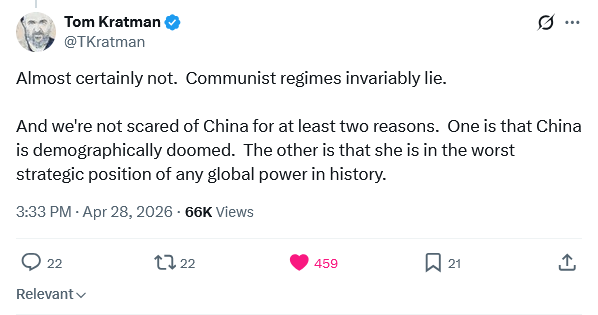
On the social media site formerly known as Twitter, ESR expands on a post by Tom Kratman about the strategic weakness of the current Chinese government:
Tom didn’t explain his second assertion, but it’s important so I’m going to do it.
China is in the worst strategic position of any great power in history because it is critically dependent on resources it has to import, and it doesn’t have control of the sea lanes over which it imports them.
China is neither food nor energy self-sufficient. It needs to import pork from the United States, grain from Africa, coal from Australia, and oil from the Middle East to keep its population fed and its factories running.
Naval blockades at about three critical chokepoints (Hormuz, Malacca, Sunda) would cripple the Chinese economy within months, possibly within weeks. China does not have the blue-water navy required to contrast control of those chokepoints. The moment any first-rate naval power or even a second-rate like India decides China needs to be stopped, it’s pretty much game over.
As a completely separate issue thanks to the one-child policy, Chinese population probably peaked in 2006 and has been declining ever since. Every year in the foreseeable future they will have fewer military-age males than they do now. Most of those males are only sons; their deaths would wipe out entire family lines, giving the Chinese people an extremely low tolerance for war casualties.
Then there’s the glass jaw. The Three Gorges Dam. Which is already in some peril even without a war — you can compare photographs over time and see that it’s sagging. If anyone gets annoyed enough to pop that dam thing with a bunker-buster or a pony nuke, the resulting floods will kill millions and wipe out the strip of central China that is by far the country’s most industrially and agriculturally productive region.
The Chinese haven’t fought a war since 1971. They lost. Against Vietnam. The institutional knowledge that could potentially fit their army for doing anything more ambitious than suppressing regional warlordism does not exist.
I could go on. But I think I’ve made Tom’s statements sufficiently understandable already.
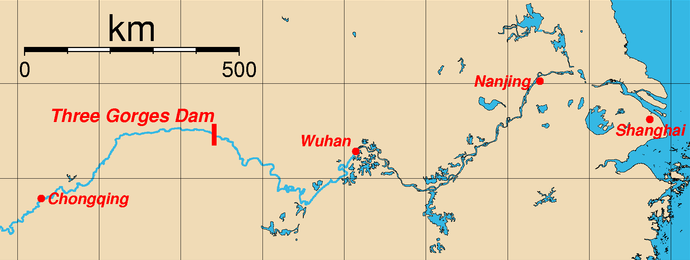
The position of the Three Gorges Dam on the Yangtze River in Hubei Province, showing the major cities downstream of the dam.
Image by Rolfmueller via Wikimedia Commons.
And Tom Kratman responds:
Almost perfect; you missed four tricks.
1. People, when we talk about blockading China, imagine that we’re talking about a civilized stop and search. Uh, uh; we will designate a no go zone and sink without further warning anything that enters it.
2. Our blockade will be distant, well out of range of those Oh-they’re-just-too-terrible-for-words (but never tested) DF-21s. [Wiki] (You did sort of address this, but not in so many words.)
3. We can blow the levees on the Yellow River, too, to kill many millions more and destroy still more industry (it flows above ground).
4. China not only doesn’t have the navy to contest with us, it can never have that navy. Why not? Because there’s only so much wealth to go around; China is surrounded on all sides by enemies with anywhere from decent to quite good armies, any or all of which might take a stab (pun intended) at carving China up like a turkey. They must put a lot more money and effort and manpower into stymying those than they can ever put into meeting us and Japan.
April 13, 2026
Trump is behind the falling population of LA County!
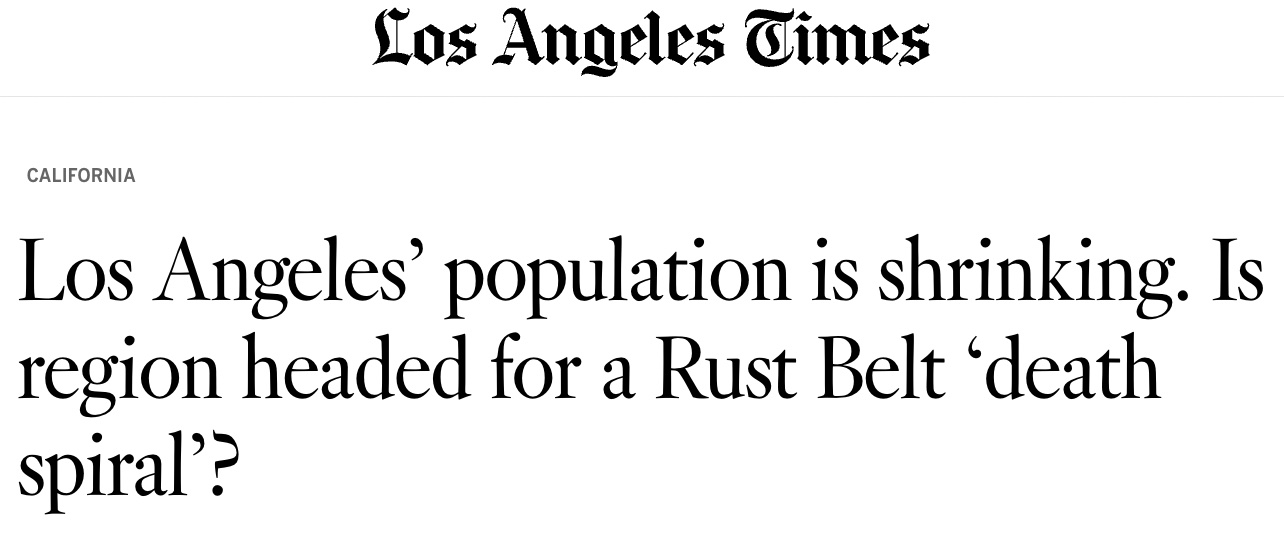
Chris Bray walks us through the tortured logic that leads the venerable Los Angeles Times to attribute the demographic slide evident in Los Angeles County to the Bad Orange Man:
Los Angeles County is bleeding people, sliding into population decline faster than anywhere else in the country. But don’t worry, the local newspaper is on the case!
Screenshot
After a careful examination of the matter, the Los Angeles Times is able to assign blame to — wait for it! — a certain VERY BAD ORANGE MAN.
While conservative critics of L.A. have rushed to frame the population loss as a “mass exodus” of people fleeing rampant crime, high taxes and inadequate services, the reality is more complex.
Los Angeles is by far the nation’s largest county, with 9.7 million people — nearly double the next largest, Cook County, Ill. In that sense, it’s not surprising that it saw a severe drop in population after the Trump administration rolled out a flurry of executive orders and new legislation aimed at restricting immigration. L.A. County is a historic hub for immigrants from Latin America and Asia, and a place where 1 in 3 residents is an immigrant.
If you read the story, you’ll see the name Trump several times, like a coven chanting the name of an enemy around the caldron. But definitely for sure don’t listen to those bizarre right-wing conspiracy theories about “high taxes and inadequate services”, noooooooo, that’s a huge lie, trust the wisdom of the local newspaper.
After a large and historic neighborhood ceased to exist because of a wildfire that rekindled after the Los Angeles Fire Department didn’t fully extinguish an earlier fire in dense, dry hillside brush, CNN produced a long story on the disaster of the city’s firefighter staffing. Small sample, describing a memorandum from then-Fire Chief Kristin Crowley: “In the memo, which the city has since removed from its website, Crowley wrote that the city’s population had grown from about 2.5 million in 1960 to nearly 4 million in 2020. Yet the city has fewer fire stations today than it did back then, even as firefighters respond to a call volume that has quadrupled.”
A little less than a year and a half after that fire, the Los Angeles Police Department looks like this:
The last time a mean old white male Republican was the mayor, which is very bad and hateful, the city built up the police department, with a goal of having 10,000 officers. They actually hit that number in 2013, during the opening moments of the reign of Mayor Yogapants, then began shrinking soon after. Now we have very wise and progressive leaders, so the city is good.
[…]
So taxes are soaring, fire and police staffing are down, fat dumb communists want to crush basic city services a lot more to free up plenty of social justice cash, and some MEAN RIGHT-WING CONSPIRACY THEORISTS bizarrely claim that people are leaving Los Angeles because they pay high taxes for increasingly poor services. My goodness, these people will just believe anything! OBVIOUSLY WHAT’S REALLY HAPPENING IS THAT DONALD TRUMP IS VERY BAD, the professional journalists explained.

March 20, 2026
The BBC is cheerleading Britain’s “baby bust”
In The Conservative Woman, Dr. Tony Rucinski reports on a recent BBC programme that clearly takes a dim view of parenting:

ON March 13 – the Friday before Mother’s Day – the Centre for Social Justice published Baby Bust, a report projecting that 600,000 British women alive today may miss out on motherhood they actually wanted. Nine in ten young women still hope to become mothers. The ONS confirms the total fertility rate fell to a record low of 1.41 in 2024. The CSJ calculates a “birth gap” of 30 per cent, with 831,000 people turning 50 in 2024 but only 595,000 babies born.
You probably did not hear about it. No identifiable standalone BBC News website article or feature covering the report has appeared. Our national broadcaster had other priorities. Namely a 1,500-word feature headlined “Like a trap you can’t escape: The women who regret being mothers“. It promoted the piece on social media, where it drew hundreds of critical replies. Instead of covering a demographic crisis, the BBC gave prominent space to a piece whose own evidence undermines its thesis – and thus revealed something important about the role it plays in the very crisis it should be reporting.
Its maternal regret article relies on a 2023 study conducted in Poland which estimates some 5 to 14 per cent of parents regret their decision to have children, a review article which synthesises several methodologically incomparable surveys – different countries, different age groups, different question wordings.
The more important point is its arithmetic. If 5 to 14 per cent of parents experience some regret, then 86 to 95 per cent do not. But the BBC devoted a feature-length article to the minority experience and ignored the majority one entirely. The lead case study featured is of a pseudonymous woman, Carmen, who came from a background of violence and dysfunction. But further data unsurprisingly finds the regret rates to be higher among single parents than married ones: 27.3 per cent versus 9.8 per cent. And that adverse childhood experiences, depression, and anxiety were also strongly associated with parental regret.
The BBC’s article however did not mention marriage once. Even the therapists quoted made the case against the BBC’s framing without apparently realising it. They repeatedly stated that regret often reflects “isolation, exhaustion, or lost identity” – failures of support, not failures of motherhood as a vocation.
The far larger and more painful form of regret that the BBC also ignored is the regret of women who wanted children and never had them, the highest figures among those who experienced fertility treatment failure. Or the similar regret found among couples whose fertility treatment did not result in a child. Or that involuntarily childless women’s regret intensifies with age.
The CSJ’s huge figure of 600,000 “missing mothers” just did not fit the narrative the BBC wants to tell.
Nor is this an isolated editorial misjudgment. Between 2023 and 2026, the BBC published a series of prominent features sympathetic to negative experiences of motherhood or to child-free lifestyles, among them: “I felt like a freak because I didn’t want children” (April 2024). “The adults celebrating child-free lives” (February 2023). “True cost of becoming a mum highlighted in new data on pay” (October 2025).
In the same period, not a single piece of the BBC’s coverage of Miriam Cates – the most prominent parliamentary advocate for pro-natalist policy – featured conversion therapy, smartphones and the trans debate, or substantially addressed her work on demographics or declining birth rates.
March 1, 2026
Generation Jones EXPLAINED: The Lost Generation Nobody Talks About
Wee Nips
Published 29 Jun 2025Born between 1954 and 1965? You might be part of the forgotten generation — Generation Jones — wedged awkwardly between Boomers and Gen X.
In this video, we break down what it means to be a Joneser, why we’re all still jonesing for something better, and how our weird hybrid powers (like remembering phone numbers and setting up Wi-Fi) just might save the world.
If you’ve ever used aluminum foil on rabbit ears or fixed a TV by smacking it, this one’s for you.
January 23, 2026
QotD: The peasant – historically, the overwhelming majority of humanity
We’re actually doing two things in this series. First, of course, we’ll be discussing what we know about the patterns of life for peasant households. But we’re also laying out a method. The tricky thing with discussing peasants, after all, is that they generally do note write to us (not being literate) and the writers we do have from the past are generally uninterested in them. This is a mix of snobbery – aristocrats rarely actually care very much how the “other half” (again, the other 95%) live – but also a product of familiarity: it was simply unnecessary to describe what life for the peasantry was like because everyone could see it and most people were living it. But that can actually make investigating the lives of these farming folks quite hard, because their lives are almost never described to us as such. Functionally no one in antiquity or the middle ages is writing a biography of a small peasant farmer who remained a peasant farmer their whole life.1 But the result is that I generally cannot tell you the story of a specific ancient or medieval small peasant farmer.
What we can do, however is uncover the lives of these peasant households through modelling. Because we mostly do have enough scattered evidence to chart the basic contours, as very simply mathematical models, of what it was like to live in these households: when one married, the work one did, the household size, and so on. So while I cannot pick a poor small farmer from antiquity and tell you their story, I can, in a sense, tell you the story of every small farmer in the aggregate, modelling our best guess at what a typical small farming household would look like.
So that’s what we’re going to do here. This week we’re going to introduce our basic building blocks, households and villages, and talk about their shape and particularly their size. Then next week (hopefully), we’ll get into marriage, birth and mortality patterns to talk about why they are the size they are. Then, ideally, the week after that, we’ll talk about labor and survival for these households: how they produce enough to survive, generation to generation and what “survival” means. And throughout, we’ll get a sense of both what a “typical” peasant household might look and work like, and also the tools historians use to answer those questions.
But first, a necessary caveat: I am a specialist on the Roman economy and so my “default” is to use estimates and data from the Roman Republic and Roman Empire (mostly the latter). I have some grounding in modelling other ancient and medieval economies in the broader Mediterranean, where the staple crops are wheat and barley (which matters). So the models we’re going to set up are going to be most applicable in that space: towards the end of antiquity in the Mediterranean. They’ll also be pretty applicable to the European/Mediterranean Middle Ages and some parts – particularly mortality patterns – are going to apply universally to all pre-modern agrarian societies. I’ll try to be clear as we move what elements of the model are which are more broadly universal and which are very context sensitive (meaning they differ place-to-place or period-to-period) and to the degree I can say, how they vary. But our “anchor point” is going to be the Romans, operating in the (broadly defined) iron age, at the tail end of antiquity.
Bret Devereaux, “Collections: Life, Work, Death and the Peasant, Part I: Households”, A Collection of Unmitigated Pedantry, 2025-07-11.
- And, as we’ll see, these societies generally have almost no social mobility, so extremely few – functionally none – of the sort of people who write to us will have ever been peasant farmers.
January 20, 2026
Mark Steyn on demographics, Trump, and Greenland
Mark Steyn was warning about demography in the west twenty years ago, and at the time he was dismissed as a crank. Now, not only have the demographic forecasts matched what he predicted, they’re actually worse:

As noted yesterday, twenty years ago this month — January 2006 — The Wall Street Journal and The New Criterion published the first draft of what would become the thesis of my bestselling book, America Alone.
The Journal headline sums it up:
The sub-head makes plain what’s at stake:
The real reason the West is in danger of extinction.
And the lead paragraph spells it out:
Most people reading this have strong stomachs, so let me lay it out as baldly as I can: Much of what we loosely call the Western world will not survive this century, and much of it will effectively disappear within our lifetimes, including many if not most Western European countries.
Two decades ago that scenario was dismissed as “alarmist” by the bleepwits of The Economist. Today it is assumed by elites of all stripes, from the authors of the new US National Security Strategy …
Trump warns Europe faces “civilizational erasure” in explosive new document
… to peer-reviewed papers positing that all Western European nations other than Portugal and micro-states such as Andorra will become majority Muslim …
… to the Deputy Leader of Britain’s supposedly “populist” party reacting to news that native Anglo-Celts will become a minority in the UK by 2063 — and in England rather sooner than that:
I’ll be long gone by then.
So, in the twenty years since my Wall Street Journal essay, the ruling class has gone from “alarmism” to “yeah, it’s happening, but maybe not until 2100” to “okay, it’s a fait accompli, but what’s the big deal?” As to Richard Tice being long gone, which is devoutly to be wished, 2026 to 2063 is thirty-seven years — or Whitney Houston to now.
This is why nobody cares about the pleas of the “expert” class to save the “rules-based international order”, which is a long-winded way of saying “1950”. Trump, for one, is moving on:
The obsession with Greenland, so bewildering to US “allies”, derives from America’s need for an Israeli-style “Iron Dome”, which, as the mighty builder of Trump Tower, the President has upgraded to a “Golden Dome”. Why would he seek such a thing? Because in this scenario America’s Israel …and Western Europe is Gaza, the West Bank, Lebanon, Syria and Iran.
Twenty years ago, my eventual book-length argument was summarised in the Toronto Globe and Mail by the eminent “political scientist” William Christian as “quite possibly the most crass and vulgar book about the West’s relationship with the Islamic world I have ever encountered“. Professor Christian has evidently led a sheltered life: he was born in the Queen Charlotte Islands, which are now officially known as “Haida Gwaii”, a bollocks name invented in hopes of appeasing “the Haida nation”; it turns out that these days nowhere is really that sheltered, don’t you find?
But just because something is “crass and vulgar” doesn’t mean it’s not correct. It’s certainly straightforward. The western world is going out of business because it’s given up having babies. The mid-twentieth-century welfare state, with its hitherto unknown concepts such as spending the first third of your life in “education” and the last third in “retirement”, was carelessly premised on mid-twentieth-century fertility rates, and, as they collapsed, the west turned to “migrants” to be the children they couldn’t be bothered having themselves. The condition of your maternity ward may be “crass and vulgar”, but it’s not a speculative prediction.

eugyppius discusses the European response to President Trump’s public statements about Greenland:
Eager to
make an epic display of retardationdemonstrate resolve and independence in the face of these sudden American ambitions on Danish territory, a variety of European countries announced they would send soldiers to Greenland in a display of “military solidarity” with Denmark. Germany sent a grand total of 13 or 15 soldiers (reports vary) to defend the icy island against the Americans. They departed on a matte grey A400M Atlas military transport with plenty of press on hand for photographs. You could almost hear Wagner’s “Ride of the Valkyries” between the lines of the press coverage.
Alas, the Eurotards also did not want to possibly in some hypothetical world perhaps overstep by maybe potentially creating conditions for anything that might conceivably be interpreted by the Americans as a show of force on Greenland itself, so the Luftwaffe A400M landed politely in Denmark, thousands of kilometers away from the disputed territory. From there, all the soldiers boarded a completely non-threatening commercial airline to Nuuk, Greenland’s capital. While this was happening, German Defence Minister Boris Pistorius desperately assured the press that it was a purely routine and preplanned mission.
The next thing to happen, while our soldiers were sitting in Greenland for no reason, was that all these efforts to make a statement while not really making a statement to avoid annoying the Americans backfired, in that the Americans got annoyed anyway. U.S. President Donald Trump announced on Truth Social that all participants in this publicity junket would be slapped with punitive 10% tariffs, to be increased by 1 June 2026 to 25% tariffs, “until such time as a Deal is reached for the Complete and Total purchase of Greenland.”
Hours after Trump posted this note, the Greenland weather soured and our soldiers cancelled an “exploratory tour” they had planned for Sunday afternoon and returned to the Nuuk airport to fly home a few hours ahead of schedule. This lent the impression that Trump’s wall-of-text Truth Social post had scared them into a retreat from Greenland, inspiring hours of social media mockery. In the end we did succeed in making a statement, if not precisely the one we had intended.


Update, 21 January: Welcome, Instapundit readers! Have a look around at some of my other posts you may find of interest. I send out a daily summary of posts here through my Substack – https://substack.com/@nicholasrusson that you can subscribe to if you’d like to be informed of new posts in the future.
January 7, 2026
More anti-anti-boomer discussion from Scott Alexander
I linked to Scott’s original article last month and thanks to the interest it generated (and perhaps my clickbait-y headline) it got linked at Instapundit thanks to Sarah Hoyt. Scott got a lot of feedback on his post and shares some of that here:
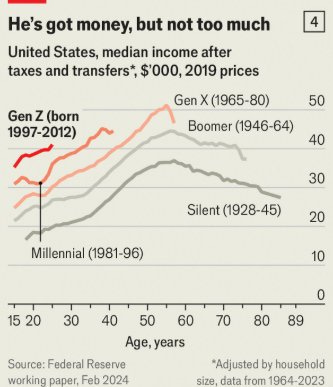
“… Millennials and Generation Z have more money (adjusted for inflation ie cost-of-living, and compared at the same age) than their Boomer parents, to about the same degree that the Boomers exceeded their own parents. This is good and how it should be. The Boomers have successfully passed on a better life to their children”
First, I wish I’d been more careful to differentiate the following claims:
- Boomers had it much easier than later generations.
- The political system unfairly prioritizes Boomers over other generations.
- Boomers are uniquely bad on some axis like narcissism, selfishness, short-termism, or willingness to defect on the social contract.
Anti-Boomerism conflates all three of these positions, and in arguing against it, I tried to argue against all three of these positions — I think with varying degrees of success. But these are separate claims that could stand or fall separately, and I think a true argument against anti-Boomerists would demand they declare explicitly which ones they support — rather than letting them switch among them as convenient — then arguing against whichever ones they say are key to their position.
Second, I wish I’d highlighted how much of this discussion centers around disagreements over which policies are natural/unmarked vs. unnatural/marked.
Nobody is passing laws that literally say “confiscate wealth from Generation A and give it to Generation B”. We’re mostly discussing tax policy, where Tax Policy 1 is more favorable to old people, and Tax Policy 2 is more favorable to young people. If you’re young, you might feel like Tax Policy 1 is a declaration of intergenerational warfare where the old are enriching themselves at young people’s expense. But if you’re old, you might feel like reversing Tax Policy 1 and switching to Tax Policy 2 would be intergenerational warfare confiscating your stuff. But in fact, they’re just two different tax policies and it’s not obvious which one a fair society with no “intergenerational warfare” would have, even assuming there was such a thing. We’ll see this most clearly in the section on housing, but I’ll try to highlight it whenever it comes up.
I’m in a fighty frame of mind here and probably defend the Boomers (and myself) in these responses more than I would in an ideal world.
[…]
1: Top Comments I Especially Want To Highlight
…
Sokow writes:
[The anti-Boomer] take has been imported in part from the EU + the UK where the pension system is not the same. https://en.wikipedia.org/wiki/State_Pension_(United_Kingdom)#Pensions_Act_2007
There is a lot of similar things in France that I could dig up, such as all attempts to tax benefits being defeated.
Many Europeans chimed in to say this, including people whose opinions I trust.
I find this pretty interesting. We all know stories of American opinions infecting Europeans, like how they’re obsessed about anti-black racism, but rarely worry about anti-Roma racism which is much more prevalent there. I’d never heard anyone argue the opposite — that the European discourse is infecting Americans with ideas that don’t apply to our context — but it makes sense that this should happen. I might write a post on this.
Kevin Munger (Never Met A Science) writes:
Hating Boomers (and talking about hating Boomers) is uninteresting and I agree morally dubious.
But it is *emphatically* false that “Boomers were a perfectly normal American generation”. They have served far more terms in Congress than any generation before or since (and we currently have the oldest average age of elected officials in a legislative body IN THE WORLD other than apparently Cambodia), they have dominated the presidency (look up the birthdate of every major party candidate since the 2000 presidential election…), they controlled the commanding heights of major companies, cultural institutions (especially academica).
They are a historically *unique* generation, for three intersecting reasons: 1. They are a uniquely large generation 2. they came of age as the country and its institutions were maturing 3. they are sticking around because of increased longevity. These are analytical facts, and they produce what I call “Boomer Ballast” — a concentration of our societies resources in one, older generation that increases the tension we are experiencing from technological innovation. Our demography is pulling us towards the past, the internet is pulling us into the future, and this I think is the major source of the anti-Boomer frustration.
On the specifics of social security and why we might think Boomers have played things to their advantage (not bc they’re specifically evil but bc they have the political power to do so) — the key thing is that they have prevented forward-thinking politicians from fixing the inevitable hole in social security that comes from our demographic pyramid. It would have been relatively painless to increase the rate or incidence of the social security payroll tax at any point in the past 25 years, the looming demographic cliff was obvious and the increased burden could’ve been shared more equally. Instead, they prevented reforms and all of the fiscal pain from demographic shifts will be borne by younger generations.
I agree this is a strong argument, and part of why I think it’s helpful to separate the three points I mentioned at the beginning.
RH writes:
We [Boomers] did [vote for ourselves to pay higher taxes and get fewer benefits]. My lifetime SS benefits will be 20-25 percent less than they would have been under previous law, and I voted for that. My SS tax rate went up itself, and has been well over 15% since the changes took effect, and the cap on earned income subject to that went up a lot. And I voted to accept all that because it was projected to be sufficient.
Then the immigrant haters decided we needed fewer workers in the country, or at least fewer paying SS taxes, so they slowed legal immigration and pushed illegals into the underground economy, so they don’t pay taxes to support social security. And social security is going to get whacked again, plus the evils the SS system was intended to alleviate — people too old to work and too poor to live — will return.
I think this says something profound about politics. The problem is less that there’s some group of people who don’t believe in fairness, but that fairness is very hard to calculate.
Suppose RH is right (I haven’t checked), and that Social Security would be sustainable with lots of immigration. Then whether Boomers are paying “their fair share” or not depends on whether immigration is good or bad (a hard question!), and on whether we think of high vs. low immigration as the natural unmarked state of the universe (such that immigration opponents must “own” closed borders and compensate the losers), and on what kind of compensation the losers from closed borders deserve.
Someone else commented by saying we could solve all of these problems without inconveniencing either the Boomers or the young by just increasing taxes on a few ultra-rich people. The ultra-rich could reasonably say they didn’t create this problem and it’s unfair to tax them for it. But so could the Boomers and the young! So whose “fair share” is it?
November 8, 2025
All cultures are not equal, especially when it comes to crimes like rape
On the social media site formerly known as Twitter, Dr. Sydney Watson responds to a post on feminists blaming all men for the actions of some men from other cultures:
Jessica Pin @jess_ann_pin
It bothers me so much when some feminists act like men are just as misogynist and violent everywhere.
That’s not true. Men from some cultures are absolutely worse than others.
I’m not saying there is a genetic difference. But there are definitely cultural differences, and we need to be careful about who we let in.
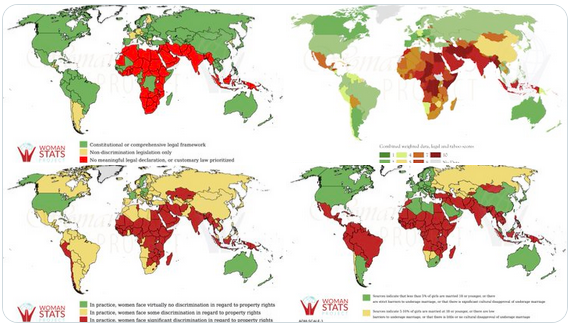
[Full sized images in the linked post]
I don’t know how to explain this succinctly —
But, ages ago I watched this series about prisons around the world. There were a few episodes that focused on prisons in African countries – how the prisons ran, what people were charged with etc.
What stood out to me was that over 50% of the male prisoners were there for some sort of sex crime – rape, sexual assault, child sexual abuse etc.
What was even worse was that, when asked about why they committed these crimes, a lot of the men said things about how they were “teaching the woman a lesson” or raping her was some sort of “punishment.”
And I couldn’t help but think, “well, that checks out. Given how these men from these places come to Western countries and rape women.”
People might not like hearing that, and the less evolved among us chalk it up to “racism” (lol) but if someone comes from a culture that views rape as a form of punishment for unruly women, then why would that viewpoint suddenly change when their feet hit British/Swedish/Canadian soil?
If, culturally, you view women as barely people, why on earth would you suddenly start because you’re in a new place?
Point being – it’s utterly mad to put women and girls at risk because people don’t want to admit that some cultures are horrible. I’m tried of pretending that all cultures are equal when they’re so obviously not.
Update, 10 November: Welcome, Instapundit readers! Please do have a look around at some of my other posts you may find of interest. I send out a daily summary of posts here through my Substack – https://substack.com/@nicholasrusson that you can subscribe to if you’d like to be informed of new posts in the future.
October 22, 2025
QotD: The supposed land crisis Tiberius Gracchus wanted to solve
What they assume is taking place is that the wealthiest Romans – who have, in fact, grown fantastically wealthy from Rome’s overseas wars – have used that wealth to acquire most of the land, either buying up the small freeholds of smaller Roman farmers or getting the leases for that public land. Meanwhile, the Roman small farmer class does most of Rome’s fighting and so the assumption – by Appian – is that these guys are being ground underfoot by heavy military deployments, although as best we can tell, military deployments in the 150s, 140s and 130s are substantially lighter than those from 218-168 (but they’re also in less profitable, more difficult places like Spain, put a pin in that). Those wealthy Romans then work the land not with free laborers, but with slaves, because Roman conquests – remember, we’re at the tail end of Rome’s “iron century” of conquests from 264 to 148 – have brought enormous numbers of enslaved laborers to Italy. Those poor Romans, now displaced, have no land and flock to Rome and are no longer liable for the Roman census.
Except notice the data points being used to come up with this story: the visible population of landless men in Rome and the Roman census returns. But, as we’ve discussed, the Roman census is self-reported, and the report of a bit of wealth like a small farm is what makes an individual liable for taxes and conscription.
In short the story we have above is an interpretation of the available data but not the only one and both our sources and Tiberius Gracchus simply lack the tools necessary to gather the information they’d need to sound out if their interpretation is correct.
All of which now, at last, brings us to the scholarship of the last several decades which has, by and large, concluded that Tiberius Gracchus probably misunderstood the nature of Roman social and economic problems in the late second century and as a result applied the wrong solution.2 The initial problem is that the above model assumes a basically stagnant Italian population: you’re just shifting people around, not generating new people. But survey archaeology shows growing urban centers and new land coming under cultivation, suggesting a modestly rising population, a conclusion reinforced by demographic modeling which recognizes the likely marked decline in military mortality in the back half of the second century. Moreover, the vast expansion of villa estates we ought to be seeing in this period really only comes later, in the first century BC and the first two centuries AD; there’s some expansion (and these patterns are very regionalized) but not enough to explain what we’re being told is happening.3 Those observations, emerging in the 90s and early 2000s, provided the necessary evidence to vindicate the theory advanced by J.W. Rich in the 1980s that the problem was quite different than Tiberius Gracchus understood, in part to explain the one curious fact we could always see about Tiberius’ land reforms, which is that they happened, they went ahead as planned and also they didn’t fix the problem.
Instead what is happening is this: Roman military deployments had, for a long time, been massive. Rome had careened from the major Samnite Wars (343–341, 326–304, and 298–290) to the high-casualty Pyrrhic War (280-275) to the much higher casualty First (264-241) and Second (218-201) Punic Wars. But the big wars of the early second century had involved a lot more winning and thus somewhat less dying (deaths from disease always outweighed combat losses, but Roman armies are smaller from 201-168, so less disease death too), while after the Third Macedonian War (171-168), Rome doesn’t have any more peer-opponent wars left to fight and so the number of men under arms declines again after 168 and especially after 148. Roman society was thus structured to sustain itself in a situation where military mortality for males was high. And then it dropped.
But recall the average Roman farm is small, so what you have now are suddenly a whole bunch of second and third sons who between 350 and 201 would have gone off to fight and died (or their elder brother would have) but are now alive, but can’t possibly inherit the family farm because they have a living brother and the farm is much too small to split further (or to support an entire second nuclear family unit). Where do they go? Well, to Rome, of course, where they want what Rome has done in the past to deal with this sort of problem: the foundation of new Roman communities (colonies) where they can have land. But there isn’t any Italy left to conquer (Rome controls all of it) and we aren’t yet to founding Roman colonies overseas, so not only is the mortality much lower (and so you have more of these guys) the traditional release valve is stuck. So they’re piling up in the one place that there is meaningful amount of wage labor available (the city of Rome), where they are very visible to the Roman ruling elite.
Meanwhile, Elder Brother-Who-Lived is back on the farm and should, in theory, still be eligible for call-up. But whereas in previous decades he could hope to get sent to fight in places like Greece or Italy or against Carthage where the rewards in loot from defeating wealthy enemies were substantial, in the 130s, the main problem was Numantia: a Celtiberian community perched in a particularly troublesome hillfort in a relatively poor, difficult part of Spain. Campaigns to take the place often failed (see above) but even if they succeeded, there would be little real loot. Moreover, a lack of success made the wars deeply unpopular. Elder Brother doesn’t want to get drafted to go fight in Spain, it’s just not a good bargain for him (unlike earlier wars).
But he has a solution: the census is self-reported. While his younger brothers are in Rome looking for work, he can just not report the farm on the census (or not report his military aged son), understating his wealth to drop below the qualifying requirement for military service. Because the Roman census pays functionally no attention to such men – the capite censi (those counted by their heads) – Elder Brother’s household almost seems to vanish in the census returns and the number of men liable for conscription ticks down by one.
And so you have falling census returns, combined with crowds of poor Romans in the city of Rome, but without it necessarily having anything to do with ager publicus or lost farms. And this is, we think, probably what is happening: surely there is some elite villa-estate expansion and some replacement of freeholding farmers with enslaved workers on that land but in fact the problem the Romans are facing is classic land scarcity with a growing population, but they don’t know that’s the problem because draft-resistance appears in the census as population decline and the census is all they have.
But you can see immediately the problem for Tiberius Gracchus’ land reform: while there is certainly some ager publicus to redistribute (to the great annoyance of the elites holding it), there’s not enough, because the core of this problem isn’t changing land use patterns (more villas, less small farms) but rising population creating economic strain at the bottom (while, it is true, imperial expansion creates vast almost unimaginable amounts of wealth at the top).
But we’re actually not quite done with problems, there’s one more: not all of the ager publicus was being farmed by Romans. Quite a lot of it seems, instead, to have been in the hands of local Italians – the socii. This is another convenient simplification by Appian and Plutarch, a product of them both writing in the imperial period long after citizenship had been extended across Italy. But that hasn’t happened yet. So any law to redistribute ager publicus would mean taking land from the socii who were currently using it for a land-giveaway in which only Roman citizens will be eligible.
You may well imagine that doing something like that might really damage relations with the socii and also fundamentally change the “bargain” by which the Roman alliance system functioned, as before Tiberius Gracchus, the socii seem to have been eligible to settle in Roman colonial foundations on conquered land, but they will not be eligible to get land in Tiberius Gracchus’ land reform bill.
You can quickly flip ahead to the year 91 to see how that turns out in the long run.
Bret Devereaux, “Collections: On the Gracchi, Part I: Tiberius Gracchus”, A Collection of Unmitigated Pedantry, 2025-01-17.
- To pause for a second: for the sake of making this understandable, I am using the relatively simple category of ager publicus. However, as Gargola (op. cit.) notes, in actual Roman law, ager publicus was a messy super-category of lands governed by an exciting range of different rules and conditions (some leased, some sold, some held by the state, etc.) – ager censorius, ager quaestorius, ager occupatorius, ager diuisus et adsignatus, the ager Campanus and ager in trientabulis. Simplifying this and treating all of these lands as if they had been governed under the same rubric which Tiberius is merely now enforcing is one of Appian’s deceptive simplifications.
- For the scholarship, this reaction begins with J.W. Rich, “The Supposed Roman Manpower Shortage of the Later Second Century B.C.” Historia 32 (1983). The next major phase comes out of the high-count/low-count population debates around Roman demography because older demographic models, like those of PA Brunt (Italian Manpower (1971)) had assumed a static Roman population, but as noted we increasingly had evidence for a modestly increasing population. The implications of that get worked out in books like N. Rosenstein, Rome at War: Farms, Families and Death in the Middle Republic (2004) and L. De Ligt, Peasants, Citizens and Soldiers (2012). Finally, you also have a recognition that while the wars in Spain were unpopular, they didn’t have massive manpower demands, e.g. Taylor, “Goodbye to All That: The Roman Citizen Militia After the Great Wars” in A Community in Transition, eds. M. Balbo and F. Santangelo (2023).
- In Italy, I should be clear: the pervasiveness and speed with which rich Romans seem to accumulate Sicilian estates suggests a lot of the land acquisition may be happening outside of the ager Romanus.
June 23, 2025
How Sex in War Breeds Boys – W2W 33
TimeGhost History
Published 22 Jun 2025That prolonged war triggers an increase in male baby births had been ordered since at least 250 years. This “returning soldier effect” happens again during WW2 and right after. How this happens is a mystery, but research in the past decades might provide some answers.
(more…)
May 24, 2025
QotD: Comparing living standards and technology between the Roman period and medieval western Europe
While I am convinced that the evidence suggests there was a drop in living standards and some loss of technology in the immediate aftermath of the collapse of the Roman Empire in the West, most of that drop was fairly short-lived. But exactly when development in medieval Europe meets and then exceeds the same for antiquity (typically we’re comparing the second century height of the Roman Empire) also depends on exactly what kind of measure is being used.
If the question, for instance, is agricultural productivity on a per capita basis (the most important component of per capita economic production), medieval Europe probably moves ahead of the Roman Empire fairly quickly with the introduction of better types of plow and widespread use of watermills for grinding grain. My understanding is that by c. 1000 AD, watermills show up fairly frequently in things like monastic charters, suggesting they were reasonably widespread (the Romans used watermills too, though their spread was uneven) and by that point, plow technology had also moved forward, mostly through the development of plow types better suited to Europe’s climate. So as best we can tell, the farmer of c. 1000 AD had better tools than his Roman predecessors and probably had such for some time.
If the question is technology and engineering, once again what you see depends on where you look. Some technologies don’t appear to have regressed much, if at all, ironworking being one example where it seems like little to nothing was lost. On the other hand, in western Europe, the retreat in architecture is really marked and it is hard to say when you would judge the new innovations (like flying buttresses) to have equaled some of the lost ones (like concrete); certainly the great 12th/13th century Cathedrals (e.g. Notre Dame, the Duomo di Sienna and I suppose the lesser Duomo di Firenze, if we must include it) seem to me to have matched or exceeded all but perhaps the biggest Roman architectural projects. Though we have to pause here because in many cases the issue was less architectural know-how (though that was a factor) as state capacity: the smaller and more fragmented states of the European Middle Ages didn’t have the resources the Roman Empire did.
If one instead looks for urbanization and population as the measure of development, the Middle Ages looks rather worse. First and Second century Rome is probably unmatched in Europe until the very late 1700s, early 1800s, when first London (c. 1800) and Paris (c. 1835) reach a million. So one looking for matches for the large cities and magnificent municipal infrastructure of the Romans will have rather a long wait. Overall population is much more favorable as a measurement to the Middle Ages. France probably exceeds its highest Roman population (c. 9m) by or shortly after 1000AD, Italy (c. 7.5m) by probably 1200; Spain is the odd one out, with Roman Hispania (est. 7.5m) probably only matched in the early modern period. So for most of the Middle Ages you are looking at a larger population, but also a more rural one. That’s not necessarily bad though; pre-modern cities were hazardous places due to sanitation and disease; such cities had a markedly higher mortality, for instance. On the flip-side, fewer, smaller cities means less economic specialization.
So one’s answer often depends very much on what one values most. For my own part, I’d say by 1000 or 1100 we can very safely say the “recovery” phase of the Middle Ages is clearly over (and I think you could make an argument for setting this point substantially earlier but not meaningfully later), though even this is somewhat deceptive because it implies that no new technological ground was being broken before then, which is not true. But the popular conception that the whole of the Middle Ages reflects a retreat from the standards of antiquity is to be discarded.
Bret Devereaux, “Referenda ad Senatum: August 6, 2021: Feelings at the Fall of the Republic, Ancient and Medieval Living Standards, and Zombies!”, A Collection of Unmitigated Pedantry, 2021-08-06.
March 20, 2025
Everyday Life in the Roman Empire – Demography, Income, Life Expectancy
seangabb
Published 12 Sept 2024Part seven in a series on Everyday Life in the Roman Empire, this lecture discusses demography and life chances during the Imperial period. Here is what it covers:
Introduction – 00:00:00
Our Statistical Civilisation – 00:00:24
Ancient “Statistics” – 00:08:05
How Many Roman Citizens? – 00:18:04
Population of the Empire – 00:21:36
City Populations – 00:27:45
Average Incomes – 00:36:27
Life Expectancy – 00:35:37
Country Life – 00:52:06
Population of Rome – 00:54:39
Feeding Rome – 00:57:40
Roman Water Supply – 01:00:44
Bathing and Sanitation – 01:04:16
Hygienic Value – 01:04:16
Bibliography – 01:06:17
(more…)


