
Areas that became densely set with trace italienne fortresses [Wiki] – particularly the towns of the Low Countries – became almost impossible to conquer. The Army of Flanders [Wiki], then arguably the finest in Europe, tried for eighty years to subdue the Dutch and largely failed: the cost of endless sieges of trace italienne fortified towns made the task effectively hopeless. Once again, I don’t want to imply that this is the only factor (it isn’t, by any means), but after the long series of remarkably decisive wars from 1450 to 1550, the trace italienne contributed to the frustratingly inconclusive (but expensive and bloody) wars of the following century.
At the same time, this shift back towards defensive stalemate didn’t lead towards more fragmentation – as the castle had – because trace italienne fortresses were too expensive for any individual aristocrat to build merely to protect his house. Not merely because of the massive fortifications themselves, but the large garrisons they required, either of full-time soldiers or town militia, which were simply beyond the resources of what was left of the old medieval aristocracy. Indeed, warfare in this period (both offensive and defensive) largely proved to be beyond the resources of Europe’s newly centralizing states; the Spanish crown, for instance, went bankrupt, primarily from military expenses, in 1557, 1560, 1575, 1596, 1607, 1627, 1647 and 1653.
It is part and parcel of the era that as much as building and defending a trace italienne fortress was an exercise in mathematics, so was attacking one. Because the entire point of the fortress is to project firepower – often at great distances (with cannon) – the attacker cannot simply form up outside or just set up their artillery in an open field and begin firing; they’d be cut up by counter-battery fire before they had gotten very far. So the attacker had to set up their own earthworks, which naturally being based on the same principles and weapons as the defender’s, would resemble them.
First, the attacking army would generally set up its own fortified camp, outside of cannon-shot. Because that camp needed to be resistant to enemy attack either from the garrison of a relieving army, it was likely to be built in the same style as a trace italienne fortification, albeit with earthworks and gabions (wicker baskets filled with earth) in place of the heavier stonework of the fort. The attacker then has to isolate their target from help, preventing the defenders from leaving, or supplies or reinforcements from arriving. The act of enclosing a besieged settlement in a wall is called circumvallation (recall our word vallum there; this is “walling around”). The act of constructing a line of outward facing defenses to defend that line from attack by a relieving army from behind is called contravallation. Armies in this period would do both.
The first such line of defenses was often started from the fortified camps and was built effectively out of range of the fort; this was the “first parallel”. Now, by the time this project was well along, both the defenders and the attackers could do some basic calculations. They both might have a sense of how quickly reinforcements could arrive and if they were likely to be large enough to give battle or lift the siege. Both sides also know how long their supplies will last and can probably have a decent guess of how long their opponent’s supplies will last. And at this point, they can both calculate fairly well how many meters of earthwork and trench the attackers can dig per day and how many they need to dig to complete their siege operations.
But – and this is important – no one wants this siege to come down to its conclusive, final assault. The attackers don’t want this: every day their siege army sits out here, it is eating money such that each day wasted besieging this town limits what this army can accomplish overall before supplies and money run out. Moreover, the actual assault is likely to incur very high losses on the attackers, because even with a breach, they have to cross all of that open, fire-swept ground and then force the breach in close combat – and the defenders will know exactly where they are going days in advance. On the other hand, if the defenders make the attackers go through all of that effort, danger and death and lose – and they must assume the attackers wouldn’t have laid siege if they weren’t confident they had enough men to take the breach when it comes to it – then the city would be looted, its populace raped or massacred as the attackers vent their rage on the city. This was, at the time, considered the normal result of holding out, to the point that it seems to have been general practice that it was appropriate to wait something like three days before beginning the process of getting control of an army that had breached a city in this fashion.
So once the attacker has completed that first parallel, he is going to send a message to the garrison, announcing that he has done so and offering them the chance to surrender. The standard terms for such surrender was called the “honors of war” – normally the defenders would be permitted to march out, with its flags flying, bayonets fixed, matches (for their matchlock muskets) lot on both ends and “ball in mouth” (that is, a musketball held in their mouth ready to be swiftly loaded as protection against treachery). The defeated army was generally required to turn over its arms, but generally allowed to march back to their own territory. And finally, a town that surrenders like this might have to pay a ransom, but ought to be immune from pillage. To modern readers, these sorts of rituals seem quaint, like having a battle break for tea in the midafternoon (a thing that, to be clear, did not happen), but in fact these were fairly hard-nosed considerations: generous surrender terms aimed to induce a garrison or town to surrender and so spare the attacker both the time but also the blood of storming the place, because after all the goal here isn’t to destroy the enemy garrison but to get control of the town.
One that first parallel is completed, assuming the defender, upon doing the math, doesn’t decide the matter is hopeless and just give up, the attacker now proceeds to begin digging his works forward to set up advanced firing positions (most of the digging was done at night when enemy artillery couldn’t accurately fire at the work parties); there were typically three parallels, the first two providing protection to the digging works and the third parallel, dug into the glacis, providing the firing position directly into the structure of the fort. Once the cannon were emplaced, the attacker might again report that he was prepared to begin firing but if the defenders would just surrender, we could all skip that nasty business. If not, the attacker’s cannon – now secured in their own trace italienne-style firing positions – would start working on the enemy fortifications in a gunnery duel (since the defender’s guns are firing back). Progress here would mean both demolishing ravelins and other outworks which shielded the main curtain wall, as well as storming assaults on various outworks to take them and deny them to the enemy (Americans may note effectively all of these steps in the Siege of Yorktown (1781), albeit on fast-forward since this was a siege of a fairly small town defended merely by field fortifications rather than a large trace italienne fortress complex). The final option to surrender came once the curtain wall had been breached (there was little use in trying to “rush” the breach since it would take days to produce so everyone knew where the final fight would be). The defender then had the terrible choice of either surrendering or risking the terrible slaughter that would follow if the breach was forced (as it was very likely to be).
This whole process could take a really long time and it involved a lot of digging, but it was almost mechanistic in its push towards success. In a sense, those demands forced European states to develop the sort of state capacity that had been the norm under Rome or in China in order to run this new version of the “big army” siege playbook which demanded such tremendous amounts of work. As I’ve noted elsewhere, sieges of these sorts against large trace italienne complexes could last a long time; Parker (Military Revolution, 13) notes the siege of Breda in 1624 lasted nine months and was fairly short while the siege at Ostend in Flanders in 1601 lasted three years and was fairly long, to give a sense of the range.
Bret Devereaux, “Collections: Fortification, Part IV: French Guns and Italian Lines”, A Collection of Unmitigated Pedantry, 2021-12-17.
October 3, 2026
QotD: How to besiege a trace italienne fortress
August 28, 2026
QotD: Roman roads
That said, for the major viae publicae, the combination of archaeologically preserved examples and a few references in literary sources gives us a good sense of what “best practices” for Roman road construction were. To start with, obstructions were cleared and then a trench was dug where the road would go. The trench was then filled with three packed layers: a stone layer, then a gravel layer and finally a sand or cement layer. On this was placed the surface of stone blocks, cambered so that rainwater drained to the sides of the road. The stone surface was then held in place by an umbo (literally a “knob” or “swelling”, the same word is used for shield bosses) on the edges of the road. Within a town, the umbo might in turn border a stone sidewalk, but out in the countryside, that wasn’t present.
On the one hand, we know that the high-quality construction of Roman paved roads impressed in the ancient world; Dionysius of Halicarnassus proclaims them one of Rome’s three most magnificent works (alongside aqueducts and sewers, Dion. Hal. Ant. Rom. 3.67.5; note also in this vein Strabo 5.3.8; Plin. HN 36.125). On the other hand, we also know that not all Roman roads were built to the same high standard. While we know that various Roman legislation spelled out required road widths, for instance, the actual width of Roman roads varied widely. And while we’re here, I should note, the story you have heard that modern roadway width or standard railway gauge being based on Roman road width (or, heaven help us, Roman “war chariots”, a thing the Romans did not have) is rather wrong. Nor were they always well-constructed or maintained; Julian, for instance, bemoans a poorly maintained road in a letter to Libanius in 363.
Also, if I may stop a moment, one thing I hear frequently said about Roman roads is that their survival serves as some sort of indictment on modern road construction, “they don’t build them like they used to!” There are a few layered bad assumptions here. The first, of course, is survivorship bias; that road outside of Chalcis that Julian complained was sinking into a swamp probably isn’t available for us to see and similarly badly maintained or poorly constructed Roman roads are simply gone or only visible with archaeological methods and so unavailable for comparison. At the same time, modern roads are asked to do things which ancient roads were not; I do not suspect many Roman roads would last very long if hundreds of 20-ton (or more) trucks were rumbling over it daily. Indeed, preserved Roman roads outside of the cities often have deep ruts worn several inches deep in the stone from the passage of carts (carts and other vehicles were generally banned inside of Roman cities; city streets were for pedestrians). Finally we know that Roman roads, just like modern ones, required maintenance and reconstruction fairly regularly in the period of their use; Laurence (op. cit., 66) has a neat table of inscribed milestones on the Via Appia, for instance, referring to repair or reconstruction, with sections of the roadway repaired in stages from 97 to 110AD.
Nevertheless, the generally high quality of Roman roads, as noted, was recognized in antiquity and is still apparent in their survival today. In contrast to many unpaved sections of Persian royal roads, for instance, Roman viae publicae were paved as a matter of course and standard widths (c. 3.5m wide; the oldest Roman laws, the Twelve Tables, set a minimum width on straights of c. 2.4m though as noted this was not always followed) were fairly generous. And they tended to be well-engineered, with relatively flat surfaces (which are often quite a bit less flat today due to ground shifting as well as the erosion of concrete between paving stones) and straight lines, though the notion that all Roman roads were ruler-straight is, of course, wrong (though some are!). In particular, the Roman system of road construction, while it demanded considerable up-front labor costs, was seemingly designed to keep long-term maintenance demands low. This was a style of road building which accepted big up-front costs in exchange for lower long-term maintenance, which of course demands a lot of initial state capacity to manage the costs and labor demands (something Rome’s successors would mostly lack).
So as roads go, the Roman ones were uncommonly good (albeit with a wider degree of variation than is often appreciated), but the marvel of the Roman roads is not that they had a few good, paved roads – states had been building paved roads for some time, as noted above – but that they had a massive system of them. Scale, more than quality, was the Roman achievement here, though the quality was also quite high.
Bret Devereaux, “Collections: Roman Roads”, A Collection of Unmitigated Pedantry, 2023-06-02.
August 17, 2026
QotD: The real reason that MilSpec stuff sucks
@Fat_Electrician was talking about super cars and why they don’t generally work as well as, say, a regular car. Super cars break down a lot. Some are worse than others. His point, apparently from Jay Leno, is that a Ferrari has much less actual engineering in it than, say, a Dodge minivan. Why?
Because there are thousand more engineers working on the minivan and tens of thousands more background hours of engineering. The minivan comes from a long history of similar vehicles with much more engineering in the actual design.
So, think about a military vehicle. Say the Humvee. It’s not that it’s designed to fail, it’s that there is much much less engineering in it. Ditto any military equipment. Thus, it’s much more likely to break down, just like a Ferrari.
I was thinking about this in light of the current series I’m working on not to mention any milSF. The current series the main character is leading a group that works with a mix of civilian small freighter starships and military warships. The civilian ships, even the old ones, are relatively maintenance free vs the military ships. Why?
1. There’s way more engineering in the civilian ships because the companies sell more of them and can spend more on engineering.
2. There’s a lineage of what works and what doesn’t.
3. Civilian companies cannot spend enormous sums on maintenance.But it’s mostly the first one.
I’m not even sure I’m going to insert a discussion of it in the book. It’s the sort of thing I occasionally insert just because my readers sometimes find stuff like that interesting. But mostly I thought you might.
MilSpec sucks because there’s not as much of it as civilian.
John Ringo, The social media site formerly known as Twitter, 2026-05-07.
June 23, 2026
The Metric and Imperial systems of measurement
Devon Eriksen explains the different purposes of the metric and Imperial systems:

Okay, time to explain the Imperial system, the metric system, and why attempts to replace either with the other are all retarded.
They have two different purposes.
The metric system is designed around precise measurement of objects. Its goal is to make engineering and scientific calculations simple.
The Imperial system is designed around humans. Its goal is to make calculation unnecessary.
100 degrees is really hot. 0 degrees is really cold. Anything that starts with a 5 is cool, anything that starts with an 8 is warm. No computation.
6 feet is tall, 5 feet is short.
100 pounds is light, 200 pounds is substantial, 300 pounds is heavy.
A 1000 square foot house is small, a 2000 square foot house is medium, a 3000 square foot house is large.
1 mile is a short walk, 2 miles is a medium walk, after that it takes a while.
1 acre of land is a homestead, 10 acres is an estate, 100 acres and up is a ranch or a farm.
Do you see now why it is so strange and awkward to convert from miles to feet?
It’s because converting from miles to feet is not something you’re supposed to do in the first place. Yes, they are both measures of length, so they are technically convertible, and yes, on rare occasions, you might need to do that.
But feet are for measuring humans, and things built around humans, like doorways, and mattresses. Miles are for measuring travel distance.
You wouldn’t measure the distance between Seattle and Portland in feet for the same reason you wouldn’t measure the distance between Tokyo and Osaka in mattress-lengths.
It would be silly.
This is why Americans so fiercely resistant to any notion of “conversion” to the metric system. Because it makes no sense. We already use the metric system for what it’s good for, which is doing physics and chemistry and whatnot.
But converting everyday measurements to the metric system would be less useful, generally inconvenient, and serve no purpose other than to make petty government bureaucrats happy that everything is now tidy, orderly, and worse, three qualities that bureaucrats love.
I thought about this carefully when I wrote my first science fiction novel. In the world of the 22nd century, extraterrestrial settlers (“Orbitals”) use three systems of measurement.
They measure themselves in feet, inches, and pounds.
They measure the spacecraft and habitats they build in meters and centimeters, grams and kilograms.
And they measure space travel distances in light-seconds and light-minutes.
Each system has its own natural scale.
The sole exception to this is when Marcus doses himself with drugs for high-g resistance, Miranda objects that he has taken too much, and Marcus responds by stating his mass … in kilograms.
Why?
Because they’re talking about drug doses, a engineering measurement. Drugs are dosed in milligrams per kilogram.
So, yes, the Imperial system makes perfect sense when you understand what it’s for, and no, we ain’t changing.
And, as a general rule, when an entire civilization of smart people does something for centuries, and it makes no sense to you, they’re probably not being silly.
It’s more likely there’s something you don’t know.
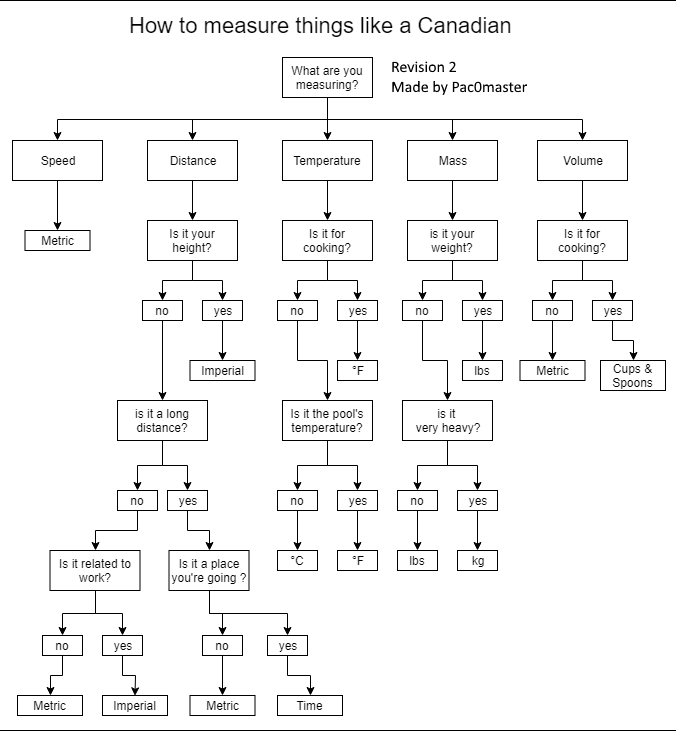
Most of the world switched over to the metric system, but some, like Britain and Canada still use both in a confusing-to-an-outsider idiosyncratic way:
February 26, 2026
The Hidden Engineering of Niagara Falls
Practical Engineering
Published 21 Oct 2025All the things I love about Niagara Falls
The same thing that makes Niagara Falls impressive for tourists (the big drop) makes it valuable for power and a major challenge for shipping. And out of that comes all kinds of fascinating infrastructure.
Practical Engineering is a YouTube channel about infrastructure and the human-made world around us. It is hosted, written, and produced by Grady Hillhouse. We have new videos posted regularly, so please subscribe for updates. If you enjoyed the video, hit that “like” button, give us a comment, or watch another of our videos!
(more…)
February 10, 2026
QotD: The (historical) walls of Jericho
The problem standing between that attacking army and access was, of course, walls (though as we will see, walls rarely stand alone as part of a defensive system). Even very early Neolithic settlements often show concerns for defense and signs of fortification. The oldest set of city walls belong to one of the oldest excavated cities (which should tell us how short the interval between the development of large population centers and the need to fortify those population centers was), Jericho in the West Bank. The site was inhabited beginning around 10,000 BC and the initial phase of construction on what appears to be a city wall reinforced with a defensive tower was c. 8000 BC. It is striking just how substantial the fortifications are, given how early they were constructed: initially the wall was a 3.6m stone perimeter wall, supported by a 8.5m tall tower, all in stone. That setup was eventually reinforced with a defensive ditch dug 2.7m deep and 8.2m wide cutting through the bedrock (that is a ditch even Roel Konijnendijk could be proud of!), by which point the main wall was enhanced to be some 1.5-2m thick and anywhere from 3.7-5.2m high. That is a serious wall and unlikely the first defensive system protecting the site; chances are there were older fortifications, perhaps in perishable materials, which do not survive. Simply put, no one starts by building a 4m by 2m stone wall reinforced by a massive stone tower and a huge ditch through the bedrock; clearly city walls [were] something people had already been thinking about for some time.
I want to stress just how deep into the past a site like Jericho is. At 8000 BC, Jericho’s wall and tower pre-date the earliest writing anywhere (the Kish tablet, c. 3200 BC) by c. 4,800 years. The tower of Jericho was more ancient to the Great Pyramid of Giza (c. 2600 BC), than the Great Pyramid is to us. In short, the problem of walled cities – and taking walled cities – was a very old problem, one which predated writing by thousands of years. By the time the arrival of writing allows us to see even a little more clearly, Egypt, Mesopotamia and the Levant are already filled with walled cities, often with stunningly impressive stone or brick walls. Gilgamesh (r. 2900-2700 BC) brags about the walls of Uruk in the Epic of Gilgamesh (composed c. 2100) as enclosing more than three square miles and being made of superior baked bricks (rather than inferior mudbrick); there is evidence to suggest, by the by, that the historical Gilgamesh (or Bilgames) did build Uruk’s walls and that they would have lived up to the poem’s billing. Meanwhile, in Egypt, we have artwork like the Towns Palette, which appears to commemorate the successful sieges of a number of walled towns
So a would-be agrarian conqueror in Egypt, Mesopotamia or the Levant, from well before the Bronze Age would have already had to contest with the problem of how to seize fortified towns. Of course depictions like these make it difficult to reconstruct siege tactics (the animals on the Towns Palette likely represent armies, rather than a strategy of “use a giant bird as a siege weapon”), so we’re going to jump ahead to the (Neo)Assyrian Empire (911-609 BC; note that we are jumping ahead thousands of years).
Bret Devereaux, “Collections: Fortification, Part I: The Besieger’s Playbook”, A Collection of Unmitigated Pedantry, 2021-10-29.
January 2, 2026
How did Ancient Romans build their roads?
Metatron
Published 2 Sept 2025Roman road construction was a marvel of ancient engineering that began in earnest around 312 BC with the famous Appian Way. The Romans developed a systematic approach that would serve their empire for centuries, creating over 250,000 miles of roads by 200 AD.
Their construction process started with careful surveying using tools called groma and chorobates to ensure straight lines and proper gradients. Roman engineers would then excavate a roadbed typically 14 to 16 feet wide, digging down 3 to 5 feet deep depending on local conditions and expected traffic. The foundation layer, called the statumen, consisted of large flat stones carefully fitted together. Above this came the rudus, a layer of crushed stone and mortar about 9 inches thick, followed by the nucleus, a finer mixture of gravel and mortar. The top surface, known as the summum dorsum, was made of large polygonal stone blocks called silex, fitted so precisely that no mortar was needed between them. These roads were built with a slight crown in the center to promote drainage, and ditches were dug alongside to carry away rainwater.
Roman construction crews, often composed of soldiers, would work in organized teams with specialized roles for quarrying stone, mixing mortar, laying foundations, and fitting the surface blocks. The entire process could take months or even years for major routes, but the result was a road surface so durable that many Roman roads remained in use well into the medieval period and beyond. Quality control was maintained through strict military discipline and the personal responsibility of engineers who literally put their names on milestone markers. By 117 AD, at the height of the empire, this road network connected Britain to the Middle East and North Africa to the Rhine frontier, facilitating trade, communication, and military movement across the known world.
#romanempire #ancientrome #romanroads
March 20, 2025
Everyday Life in the Roman Empire – Demography, Income, Life Expectancy
seangabb
Published 12 Sept 2024Part seven in a series on Everyday Life in the Roman Empire, this lecture discusses demography and life chances during the Imperial period. Here is what it covers:
Introduction – 00:00:00
Our Statistical Civilisation – 00:00:24
Ancient “Statistics” – 00:08:05
How Many Roman Citizens? – 00:18:04
Population of the Empire – 00:21:36
City Populations – 00:27:45
Average Incomes – 00:36:27
Life Expectancy – 00:35:37
Country Life – 00:52:06
Population of Rome – 00:54:39
Feeding Rome – 00:57:40
Roman Water Supply – 01:00:44
Bathing and Sanitation – 01:04:16
Hygienic Value – 01:04:16
Bibliography – 01:06:17
(more…)
January 18, 2025
Is the World Really Running Out of Sand?
Practical Engineering
Published 1 Oct 2024Sand: a treatise …
There’s a lot changing in the construction industry, and a lot of growth in the need for materials like sand and gravel. But I don’t think it’s fair to say the world is running out of those materials. We’re just more aware of all the costs involved in procuring them, and hopefully taking more account for how they affect our future and the environment.
(more…)
December 9, 2024
QotD: The downfall of Boeing
There’s a lot to love about an engineer-dominated corporate culture. For starters, it has a tendency to overengineer things, and when those things are metal coffins with hundreds of thousands of interacting components, filled with people and screaming through the air at hundreds of miles an hour, maybe overengineering isn’t so bad. These cultures also tend to be pretty innovative, and sure enough Boeing invented the modern jet airliner and then revolutionized it several times.
But there are also downsides. As any Googler will tell you, these companies usually have a lot of fat to trim. Some of what looks like economic inefficiency is actually vital seed corn for the innovations of the future, but some of it is also just inefficiency, because nobody looks at the books, because it isn’t that kind of company. Likewise, being highly deliberative about everything can lead to some really smart decision making and avoidance of group think, but it can also be a cover for laziness or for an odium theologicum that ensures nothing ever gets done. Smart managers steeped in this sort of culture can usually do a decent job of sorting the good from the bad, but only if they can last, because you see there’s a third problem, which is that almost everybody involved is a quokka.
Engineers, being a subspecies of nerds, are bad at politics. In 1996, Boeing did something very stupid and acquired a company that was good at politics. McDonnell Douglas, another airplane maker, wasn’t the best at making airplanes, but was very good at lobbying congress and at impressing Wall Street analysts. Boeing took over the company, but pretty much everybody agrees that when the dust had settled it was actually McDonnell Douglas that had taken over Boeing. One senior Boeing leader lamented that the McDonnell Douglas executives were like “hunter killer assassins”. No, sorry bro, I don’t think they were actually that scary, you were just a quokka.
Anyway, the hunter killer assassins ran amok: purging rivals, selling off assets, pushing through stock buybacks, and outsourcing or subcontracting everything that wasn’t nailed down. They had a fanaticism for capital efficiency that rose to the level of a monomania,1 which maybe wasn’t the best fit for an airplane manufacturer. And slowly but surely, everything went off the rails. Innovation stopped, the culture withered, and eventually planes started falling out of the sky. And now the big question, the question Robison just can’t figure out. Why?
John Psmith, “REVIEW: Flying Blind by Peter Robison”, Mr. and Mrs. Psmith’s Bookshelf, 2023-02-06.
1. This is how you know this story took place in an era of high interest rates!
November 17, 2024
Three (more) Forgotten Roman Megaprojects
toldinstone
Published Jul 19, 2024This video explores another three forgotten Roman megaprojects: the colossal gold mines at Las Médulas, Spain; the Anastasian Wall, Constantinople’s outer defense; and Rome’s artificial harbor at Portus.
Chapters:
0:00 Las Médulas
3:13 The Anastasian Wall
5:24 Portus
(more…)
November 14, 2024
Following the Longest Roman Aqueduct
Scenic Routes to the Past
Published Jul 19, 2024Tunisia’s Zaghouan Aqueduct, built to serve Carthage in the second century, is among the longest and most impressive of all Roman aqueducts. This video follows the aqueduct from the monumental fountain at its source to the grandiose baths at its terminus.
Historic tours with toldinstone: https://toldinstone.com/trips/
Check out my other channels, @toldinstone and @toldinstonefootnotes
September 29, 2024
This Bridge Should Have Been Closed Years Before It Collapsed
Practical Engineering
Published Jun 18, 2024Why Fern Hollow Bridge collapsed.
This is a crazy case study of how common sense can fall through the cracks of strained budgets and rigid oversight from federal, state, and city staff. And the lessons that came out of it aren’t just relevant to people who work on bridges. It’s a story of how numerous small mistakes by individuals can collectively lead to a tragedy.
(more…)
May 31, 2024
How To Install a Pipeline Under a Railroad
Practical Engineering
Published Feb 20, 2024I’m on location to document the installation of a water transmission line below two railroad tracks.
Huge thanks to our project partners!
Owner: Crystal Clear Special Utility District
General Contractor: ACP
(more…)
May 26, 2024
Evolution of The Churchill Tank | “No Damn Good”?
The Tank Museum
Published Feb 17, 2024Designed by a company that had never built a tank before with the Prime Minister, Winston Churchill, looking over their shoulders and plagued by mechanical teething troubles, the Churchill tank had unpromising beginnings. Despite this, it became one of the most successful British tanks of WW II: heavily armoured, not fast but with superb climbing ability, the Churchill served not only as a gun tank but the basis many of the specialised vehicles that helped the British and Canadian Armies ashore on D-Day.
00:00 | Intro
01:20 | History – What was needed?
03:38 | Design, Weaponry and Armour
08:44 | Up-gunned and Upgraded
13:59 | A Look Inside
17:51 | Combat Performance
20:23 | Multi-use Platform
23:10 | ConclusionThis video features archive footage courtesy of British Pathé.
#tankmuseum


