
Battle Guide
Published 2 May 2025On 19th August 1942, as dawn was breaking along the coast of occupied France, a force of just over 6,000 men stormed the beaches around the port town of Dieppe in the first major allied strike against Hitler’s Atlantic Wall. Within a matter of minutes hundreds lay dead or wounded, washed up against seawalls, hung on wire entanglements or incinerated in the burning landing craft. Over 60% of the mainly Canadian assault force were killed, wounded or captured by the end of the day, and the Dieppe Raid has, for the allies, gone down as one of the most infamous days of the Second World War.
(more…)
August 19, 2025
Dieppe 1942: The Failed Raid That Shaped D-Day
Comments Off on Dieppe 1942: The Failed Raid That Shaped D-Day
Operation Jubilee: Canada’s Devastating WWII Loss
WarsofTheWorld
Published 17 Jun 2023By 1942, the war was no longer another great European conflict. It was now a firmly global affair enveloping all of the world’s great powers as the Allies squared off against the tyranny and aggression of the Axis nations. Against such colossal forces, no one country could stand alone and events that affected one combatant would ultimately have consequences for the other further down the road.
To that end, while the western Allies and the Soviet Union were effectively fighting separate wars against the same enemy, there needed to be cooperation between the two fronts in order to squeeze the life out of Nazi Germany and insure victory against Fascism. However, the relationship was often a strained one as both Allied power blocks were suspicious of the other’s intentions once the war was over.
Thus, we come to the subject of today’s episode and a story of the war that is still the subject of much debate today. It was an operation with no specific military objective other than to experiment with conducting division-sized amphibious landings against a fortified beach and as a gesture to the Soviet Union who were starting to feel abandoned by their Allies. It is an operation that has become seared into the hearts and minds of the Canadian people for the sacrifice they were asked to make for it.
0:00 Introduction
3:26 A Red Request
7:50 Planning and Preparation
13:32 Operation Rutter – A False Start
18:10 Reviving Rutter
24:02 Operation Jubilee
35:52 A Necessary Lesson?
(more…)
Comments Off on Operation Jubilee: Canada’s Devastating WWII Loss
September 19, 2024
D-Day Tanks: Operation Overlord’s Strangest Tanks
The Tank Museum
Published Jun 7, 2024An opposed beach landing is the most difficult and dangerous military operation it is possible to undertake. Anticipating massive casualties in the Normandy Landings, the British Army devised a series of highly specialized tanks to solve some of the problems – Hobart’s Funnies.
Named after General Sir Percy Hobart, commander of their parent unit, 79th Armoured Division, the Funnies included a mine clearing tank – the Sherman Crab, a flamethrower – the Churchill Crocodile and the AVRE – Assault Vehicle Royal Engineers which could lay bridges and trackways, blow up fortifications and much else besides.
In this video, Chris Copson looks at surviving examples of the Funnies and assesses their effectiveness on D Day and after.
00:00 | Introduction
01:24 | Operation Overlord
03:02 | Lessons from the Dieppe Raid
05:31 | The Sherman DD
07:21 | Exercise Smash
14:38 | Sherman Crab
17:38 | The AVRE
19:47 | Churchill Crocodile
23:15 | Did the Funnies Work?
28:49 | ConclusionThis video features archive footage courtesy of British Pathé.
#tankmuseum #d-day #operationoverlord
Comments Off on D-Day Tanks: Operation Overlord’s Strangest Tanks
May 26, 2024
Evolution of The Churchill Tank | “No Damn Good”?
The Tank Museum
Published Feb 17, 2024Designed by a company that had never built a tank before with the Prime Minister, Winston Churchill, looking over their shoulders and plagued by mechanical teething troubles, the Churchill tank had unpromising beginnings. Despite this, it became one of the most successful British tanks of WW II: heavily armoured, not fast but with superb climbing ability, the Churchill served not only as a gun tank but the basis many of the specialised vehicles that helped the British and Canadian Armies ashore on D-Day.
00:00 | Intro
01:20 | History – What was needed?
03:38 | Design, Weaponry and Armour
08:44 | Up-gunned and Upgraded
13:59 | A Look Inside
17:51 | Combat Performance
20:23 | Multi-use Platform
23:10 | ConclusionThis video features archive footage courtesy of British Pathé.
#tankmuseum
Comments Off on Evolution of The Churchill Tank | “No Damn Good”?
August 19, 2023
One Day in August – Dieppe Anniversary Battlefield Event (Operation Jubilee)
WW2TV
Published 19 Aug 2021One Day in August — Dieppe Anniversary Battlefield Event (Operation Jubilee) With David O’Keefe, Part 3 — Anniversary Battlefield Event.
David O’Keefe joins us for a third and final show about Operation Jubilee to explain how the plan unravelled and how the nearly 1,000 British, Canadian and American commandos died. We will use aerial footage, HD footage taken in Dieppe last week and maps, photos, and graphics.
In Part 1 David O’Keefe talked about the real reason for the raid on Dieppe in August 1942. In Part 2 David talked about the plan for Operation Jubilee. The intentions of the raid and how it was supposed to unfold.
(more…)
Comments Off on One Day in August – Dieppe Anniversary Battlefield Event (Operation Jubilee)
Dieppe Raid – 19 August, 1942
The History Chap
Published 15 Aug 2021The Dieppe Raid (codename Operation Jubilee) was a disastrous amphibious landing by the allies in France during World War 2. Nearly 4,000 allied soldiers (mainly Canadians) were killed, wounded or captured during the Battle of Dieppe.
1942 was turning out to be a bad year for the allies. The Nazis were sweeping forwards in Russia, the Japanese were sweeping though South East Asia. The British commonwealth troops were being pushed back by the Germans & Italians in North Africa and the Americans were still reeling from the attack on Pearl Harbour.
The British wanted to show that they were still willing to take the offensive in the war and were were being urged by Stalin to take some pressure off the Soviet Union. A plan was hatched to conduct a “smash & grab” raid on the port of Dieppe in northern France. The aim was to seize Dieppe and hold it for a limited time before evacuation, during which time the allied troops would collect intelligence and destroy German military infrastructure.
The Canadian government were keen to have their own troops play a role in the war and so the majority of the raiding force was made up of their troops. Initially planned for early July, Operation Jubilee was delayed for over a month due to bad weather and the need for a high tide at dawn. Eventually the Dieppe Raid took place just before 0400 on the 19th August 1942. 5,000 Canadians, 1,000 British and 50 US Rangers were to land at five different points along a 16km (10 mile front) either side of the port of Dieppe itself.
The result was a complete disaster. No major objectives were achieved, poor intelligence had not identified the strength of the German defences and the Germans were on high alert for a possible attack after the firefight at sea and the fact that there was high tide. Within less than 6 hours of the landing starting the order had been given to evacuate and by 1400 hours what remained of the allied force had been successfully removed.
The Dieppe Raid lasted 10 hours. They left behind 4,000 killed, wounded or prisoners of war — over 80% of whom were Canadians. The Royal Navy lost a destroyer and 33 landing craft whilst the RAF lost 106 planes.
The raid had sent a signal to the Germans that the Atlantic shoreline was not secure. That eventually they would have to fight the war on two fronts. It also raised morale within the population of occupied France. They were not alone. The best that can be said for the raid was that it taught the allies valuable lessons which were successfully implemented in the D-Day landings in Normandy in 1944. Maybe the sacrifice of the young men at Dieppe saved many more young men on D-Day.
(more…)
Comments Off on Dieppe Raid – 19 August, 1942
August 18, 2023
One Day in August – Dieppe – Part 2 – The Plan
WW2TV
Published 17 Jan 2021Part 2 – The Plan With David O’Keefe
David O’Keefe joins us again. In Part 1 he talked about the real reason for the raid on Dieppe in August 1942. In Part 2 we talk about the plan for Operation Jubilee and David will share his presentation about the intentions of the raid and how it was supposed to unfold.
A final show sometime in the summer will come live from Dieppe to explain how the plan unravelled and how the nearly 1,000 British, Canadian and American commandos died.
(more…)
Comments Off on One Day in August – Dieppe – Part 2 – The Plan
August 17, 2023
Dieppe – One Day in August – Ian Fleming, Enigma and the Deadly Raid – Part 1
WW2TV
Published 29 Nov 2020In less than six hours in August 1942, nearly 1,000 British, Canadian and American commandos died in the French port of Dieppe in an operation that for decades seemed to have no real purpose. Was it a dry-run for D-Day, or perhaps a gesture by the Allies to placate Stalin’s impatience for a second front in the west?
Canadian historian David O’Keefe uses hitherto classified intelligence archives to prove that this catastrophic and apparently futile raid was in fact a mission, set up by Ian Fleming of British Naval Intelligence as part of a “pinch” policy designed to capture material relating to the four-rotor Enigma machine that would permit codebreakers like Alan Turing at Bletchley Park to turn the tide of the Second World War.
In this first show we will look at how the raid has been written about in previous books and the research David undertook and as importantly why he did it. In a future show, we will look at filming in Dieppe itself and explain the sequence of events.
(more…)
Comments Off on Dieppe – One Day in August – Ian Fleming, Enigma and the Deadly Raid – Part 1
June 3, 2023
Why Was Normandy Selected For D-Day?
Real Engineering
Published 28 Mar 2020In the debut episode of the Logistics of D-Day we explore the logic and planning that resulted in Normandy being chosen as the location for the largest amphibious invasion in the history of human kind.
(more…)
Comments Off on Why Was Normandy Selected For D-Day?
October 15, 2021
Nazis “Restore” Law and Order – WAH 044 – October 1942, Pt. 1
World War Two
Published 14 Oct 2021Resistance against occupation starts rising in the Autumn of 1942. It faces opposition not only from the occupiers, but also from collaborators killing their own countrymen.
(more…)
Comments Off on Nazis “Restore” Law and Order – WAH 044 – October 1942, Pt. 1
August 23, 2021
Swastika Raised on Highest Point in Europe – WW2 – 156 – August 21, 1942
World War Two
Published 21 Aug 2021The Axis advance in the Caucasus takes Mt. Elbrus, and the one on Stalingrad continues, and there are several raids of note this week- a Japanese one on Guadalcanal is destroyed, an Allied one on Dieppe is badly savaged, and an American one at Makin Atoll is successful in the short term, but with bad long term ramifications.
(more…)
Comments Off on Swastika Raised on Highest Point in Europe – WW2 – 156 – August 21, 1942
August 19, 2020
Dieppe 1942 – Slaughter on the Shingle
Mark Felton Productions
Published 14 Mar 2020Find out how and why the Dieppe Raid was launched in 1942 and why is went so disastrously wrong.
Visit my new audio book channel ‘War Stories with Mark Felton’: https://youtu.be/xszsAzbHcPE
Help support my channel:
https://www.paypal.me/markfeltonprodu…
https://www.patreon.com/markfeltonpro…Disclaimer: All opinions and comments expressed in the ‘Comments’ section do not reflect the opinions of Mark Felton Productions. All opinions and comments should contribute to the dialogue. Mark Felton Productions does not condone written attacks, insults, racism, sexism, extremism, violence or otherwise questionable comments or material in the ‘Comments’ section, and reserves the right to delete any comment violating this rule or to block any poster from the channel.
Credits: YouTube Creative Commons; WikiCommons; Google Commons; Mark Felton Productions
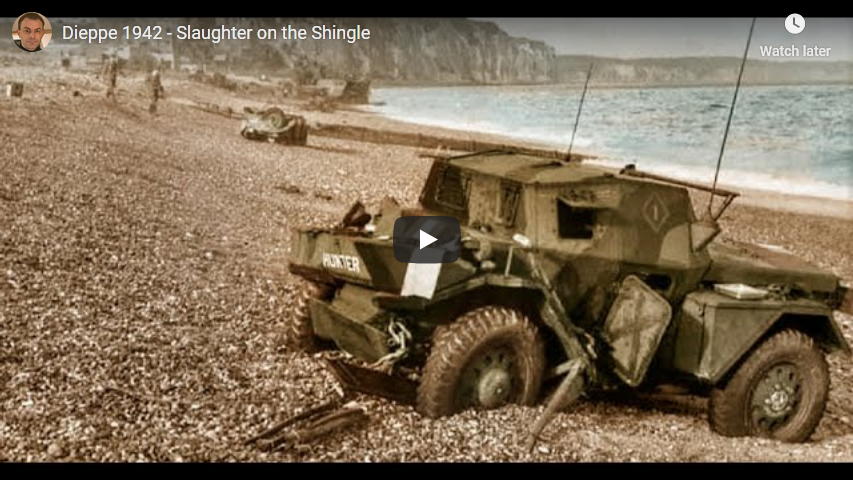
Comments Off on Dieppe 1942 – Slaughter on the Shingle
August 19, 2018
The Dieppe Raid, from Canada at War, 1962
piddflicks
Published on 19 Aug 2012An excerpt from the brilliant 1962 series Canada At War by the National Film Board of Canada focusing on the disastrous raid on Dieppe, 19 August 1942, where more than two-thirds of the 6,000 soldiers were killed, wounded or taken prisoner.
Comments Off on The Dieppe Raid, from Canada at War, 1962
June 7, 2018
D-Day – II: The Secret War – Extra History
Extra Credits
Published on 13 Jun 2017The Germans expected the Allies to invade France to re-open the Western Front, but they did not know when or where the invasion would start – thanks largely to the operations of MI5, British intelligence services, who staged an elaborate deception called Operation Bodyguard designed to make the Germans think they would be invading Pas de Calais instead of their real target: Normandy.
Comments Off on D-Day – II: The Secret War – Extra History
August 31, 2017
The Dieppe raid and the failure of the Churchill tank
Published on 15 Oct 2010
The Dieppe Raid, also known as the Battle of Dieppe, Operation Rutter and, later, Operation Jubilee, was a Second World War Allied attack on the German-occupied port of Dieppe. The raid took place on the northern coast of France on 19 August 1942. The assault began at 5:00 a.m. and by 10:50 a.m. the Allied commanders were forced to call a retreat. Over 6,000 infantrymen, predominantly Canadian, were supported by a Canadian Armoured regiment and a strong force of Royal Navy and smaller Royal Air Force landing contingents. It involved 5,000 Canadians, 1,000 British troops, and 50 United States Rangers.
Objectives included seizing and holding a major port for a short period, both to prove that it was possible and to gather intelligence. Upon retreat, the Allies also wanted to destroy coastal defences, port structures and all strategic buildings. The raid had the added objectives of boosting morale and demonstrating the firm commitment of the United Kingdom to open a western front in Europe.
Virtually none of these objectives were met.
Comments Off on The Dieppe raid and the failure of the Churchill tank


