Timing is everything in war — well, if not everything, it’s extremely important. An example was the development delays for the German V-1 and V-2 systems that kept them from being a potentially devastating weapon against the Anglo-American invasion forces on D-Day. Secretary of Defense Rock explains why allied air attacks to suppress the German launch sites were an almost unmitigated failure:
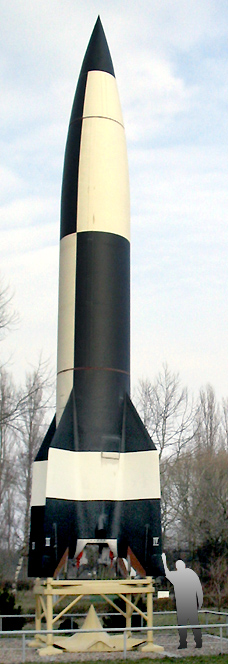
German A4 or V-2 replica at Peenemünde
Photo from Wikimedia Commons.
Two campaigns separated by 50 years — the Anglo-American CROSSBOW campaign against German V-weapons in 1943–1945 and the “Great Scud Chase” of Desert Storm in 1991 — suggest that what is happening over Iran today is not a deviation from the norm but simply a repeat of it. As Colonel Mark Kipphut argued in his 1996 study comparing the two campaigns, the failure to internalize CROSSBOW’s lessons was itself one of the reasons those same failures were repeated in 1991; the present campaign against Iran suggests we might still not have learned them.1
The first lesson of CROSSBOW is that fixed infrastructure is easy to destroy and that adversaries do not stay fixed for long. British intelligence had received “reliable and relatively full information” on German long-range weapons as early as November 1939 two months into the war.2 It wasn’t till four years later, in 1943, that Allied photo-reconnaissance first identified the German “ski-sites” in northwestern France, named for the curious shape of one of the buildings on each launcher complex.3 Within weeks, the U.S. Strategic Bombing Survey would later report, ninety-six sites had been cataloged, and a sustained bombing offensive against them had begun. Of these ninety-six sites, no more than two were ever used operationally.4 On its face, this was a complete victory. Allied airpower had, by direct attack, denied the Luftwaffe permanent launching infrastructure before the V-1 campaign could begin.5
The Germans drew the obvious conclusion. The Survey noted that during the period of the Allied counterattack, the Germans developed methods for launching V-1s and V-2s from small, inconspicuous sites that required minimal engineering work and freed firing operations from the elaborate sites originally planned.6 These were the “modified sites”, first photographed on April 26, 1944, which were well camouflaged, dependent largely on prefabricated buildings, of which more than sixty had been identified before the first V-1 was launched in England in mid-June.7 The “modified sites”, the Survey concluded plainly, were “heavily bombed without marked effect on the scale of effort”.8
Kipphut, working from the same primary documents, formalizes the consequence as a two-phase division of the campaign. CROSSBOW I, running from April 1943 to early June 1944, was a qualified success: it delayed the start of V-weapon attacks by an estimated three to six months and so allowed OVERLORD to proceed before the full weight of Hitler’s missile arsenal could be brought to bear.9 Eisenhower himself wrote that had the Germans perfected the weapons six months earlier, the invasion of Europe would have been “exceedingly difficult, perhaps impossible”, and that a sustained V-weapons attack on the Portsmouth-Southampton embarkation area could have caused OVERLORD to be written off entirely.10 CROSSBOW II, however, the campaign to suppress launches once they had begun, was in Kipphut’s assessment a “dismal failure”; despite thousands of sorties against more than 250 targets in the critical summer of 1944, the Germans averaged just over 80 launches per day, and German sources contend they never failed to launch on account of either Allied air attack or weapons shortages.11
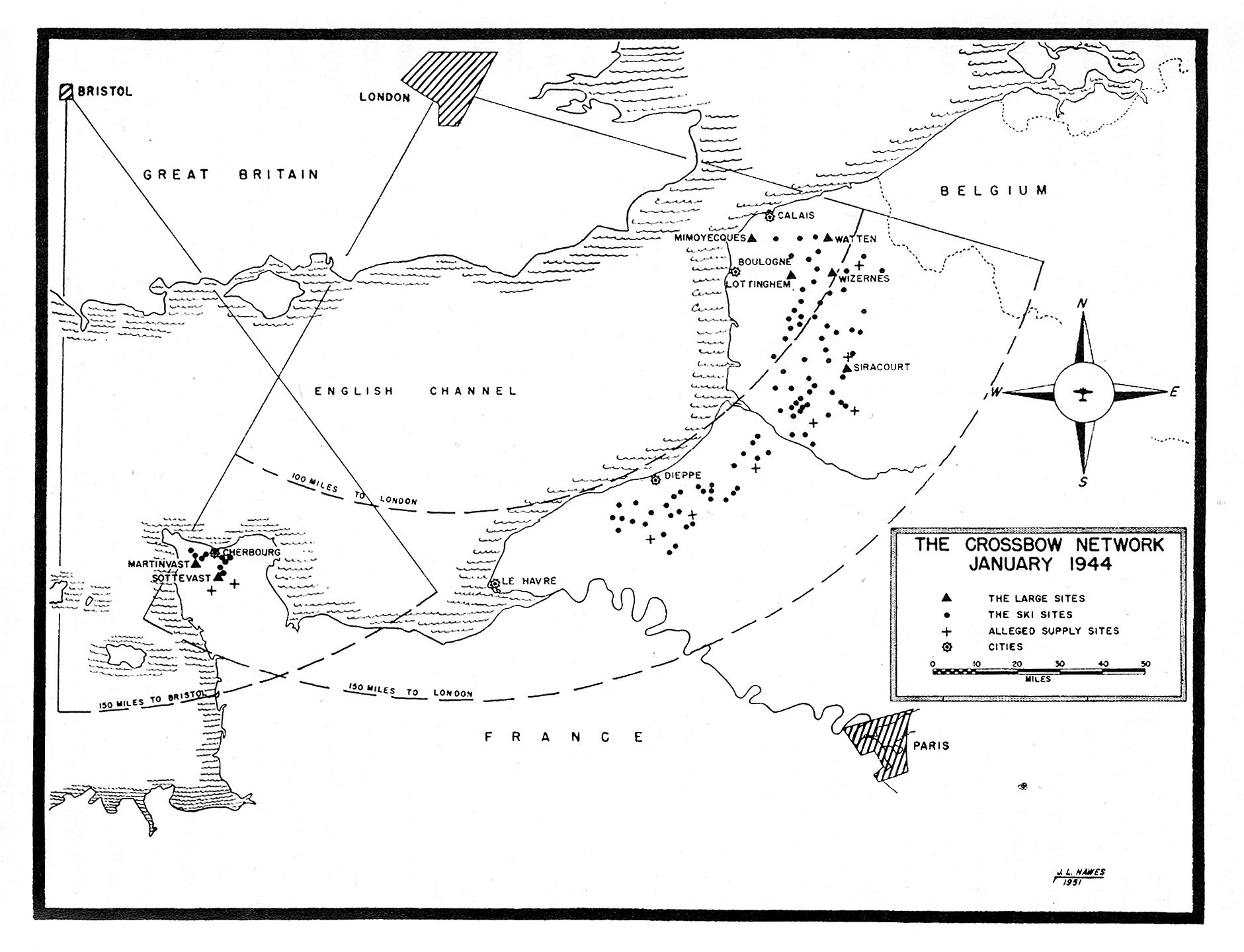
A World War II map shows the two areas where the Germans were setting up their secret “V” weapons to bombard England (right, center). These are the areas in which the Royal Air Force and 8th Air Force heavy bombers concentrated their bombs in order to knock out the weapons — part of the pre-invasion plan. This event was given the operational code name Crossbow during World War II. The grouping (left, center) is the site of the Invasion of Normandy.
The implications for Allied resource allocation were severe. Between the beginning of May 1943 and the end of March 1944, nearly 40% of Allied reconnaissance sorties over Europe were devoted to supporting CROSSBOW, with those planes taking more than 1.25 million photographs and service members preparing more than 4 million prints for study and analysis.12 Over the course of the campaign, U.S. and British air forces flew approximately 68,913 sorties against CROSSBOW targets and dropped roughly 136,789 tons of munitions.13 During the thirteen-month peak period from August 1943 to August 1944, the joint strategic-bomber effort absorbed 13.7% of its sorties and 15.5% of its tonnage on V-weapon targets.14 By the autumn of 1944 and into the winter, RAF Fighter Command devoted 79% of its offensive sorties to CROSSBOW.15 Eisenhower, faced with the apparent failure of CROSSBOW II to suppress the launches that began on D-Day plus seven, directed that V-weapon suppression take priority over all other Allied air operations, including direct support to the Normandy lodgment and the Combined Bomber Offensive.16
That bombing, which failed against the dispersed V-2 launch sites, was almost overdetermined. The Survey concluded bluntly that after the initial Allied success, the firing sites for V-2s were small, well camouflaged, and made poor targets for bombers.17 No comparable problem arises with a factory complex. The V-2 launcher, like the modified V-1 ramp, was small, mobile, and concealable, and the strategic-bomber instrument was designed and procured to flatten large, stationary targets. In the end, Kipphut notes, silencing the V-weapons required ground forces to overrun the launch sites.18
- Mark E. Kipphut, “Crossbow and Gulf War Counter-Scud Efforts: Lessons from History”, Counterproliferation Paper No. 15 (Maxwell AFB, AL: USAF Counterproliferation Center, February 2003), 1–3. Originally published in Airpower Journal, Winter 1996.
- Wesley Frank Craven and James Lea Cate, eds., The Army Air Forces in World War II, vol. 3, Europe: Argument to V-E Day: January 1944 to May 1945 (Chicago: University of Chicago Press, 1951), 89.
- United States Strategic Bombing Survey, V-Weapons (Crossbow) Campaign, Military Analysis Division, 2nd ed. (Washington, D.C., January 1947), 5–6.
- Ibid, 6.
- Craven and Cate, eds., have a full chapter on the operational history of CROSSBOW, 84-106.
- Ibid, 2.
- Ibid, 6.
- Ibid, 6.
- Kipphut, 7–8.
- Dwight Eisenhower, Crusade in Europe (New York: Doubleday, 1948), 260, quoted in Kipphut, 5.
- Kipphut, “Crossbow and Gulf War Counter-Scud Efforts”, 8, citing Phillip Henshall, Hitler’s Rocket Sites (New York: St. Martin’s Press, 1985), 187.
- Craven and Cate, eds., 89.
- Kipphut, “Crossbow and Gulf War Counter-Scud Efforts”, 8
- USSBS, “V-Weapons (Crossbow) Campaign”, 28.
- USSBS, “V-Weapons (Crossbow) Campaign, 28”; Kipphut, 8–9.
- Kipphut, 5.
- USSBS, “V-Weapons (Crossbow) Campaign”, 7
- Kipphut, 10.