As part of their mindless fanboyism for anything remotely related to “Net Zero”, the federal government and the Ontario provincial government have been serving up subsidies for electric vehicles and hastening the “inevitable transition” away from internal combustion vehicles. Through legislation and regulation, they’ve been doing everything they can to close down the traditional car and truck manufacturing sector and replace them with zero emission vehicles. The various governments have handed out subsidies amounting to billions, and yet one after another after another the much ballyhoo’d EV factories, battery plants, and other futuristic projects fall by the wayside, leaving very little in exchange for those billions:
There was a time, not very long ago, when Liberal politicians treated EV battery announcements like moon landings.
Hard hats. Safety glasses. Giant ceremonial cheques. Breathless speeches about “the future”. Every battery plant was “historic”. Every subsidy package was “transformational”. Every corporate press conference looked like a motivational seminar for people who think buzzwords are infrastructure.
All we were missing was a fog machine and Bono.
Meanwhile ordinary Canadians were standing in grocery aisles doing mental math over bacon prices, delaying dental work, and wondering whether they could survive another winter utility bill without sacrificing whatever scraps remained of their savings.
But while Canadians were trying to keep their heads above water, Ottawa was busy launching one of the most expensive industrial subsidy experiments in modern Canadian history.
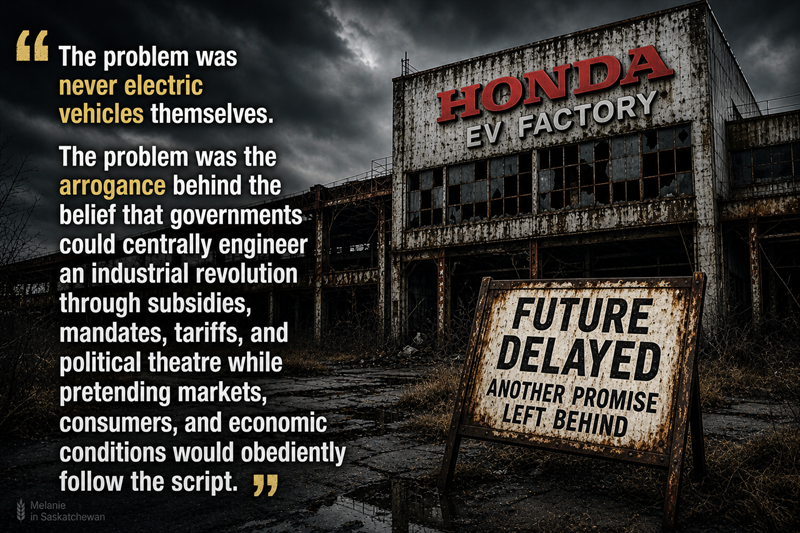
AI-generated image from Melanie in Saskatchewan
The Honda EV project in Ontario was supposed to be one of the crown jewels of this brave new green economy. Politicians lined up in hard hats and safety glasses like a traveling theatre troupe performing The Future Is Here. Canadians were assured this was proof the country was becoming an EV superpower.
Turns out it may have been more of a very expensive PowerPoint presentation with taxpayer financing attached.
[…]
In March 2020, Prime Minister Justin Trudeau appointed Mark Carney as an informal economic adviser during the COVID recovery period. Over the following years, Carney increasingly promoted “green transition” investment frameworks, climate-linked financial systems, ESG-focused economic planning, and massive public-private investment partnerships tied to decarbonization strategies.
Which is important context now, because the EV subsidy era did not emerge out of thin air. It grew out of a broader worldview that treated government-directed green investment as both economic policy and moral mission. The assumption underneath all of this was breathtakingly simple:
“If government wants it badly enough, reality will cooperate.”
That is usually where things begin going sideways.
Canadians were told the EV transition was inevitable. Questions about affordability, charging infrastructure, winter range, electrical grid capacity, or consumer demand were often brushed aside like annoying little details raised by peasants who simply lacked sufficient enlightenment.
Then came the subsidy gold rush.
[…]
Corporations are not charities. They are not loyal patriots. They are not emotionally attached to government slogans.
They follow incentives. They chase profitability. They change direction when conditions change.
That is exactly what Honda did.
Meanwhile Canadians are left holding the bill for another “historic transformation” that produced:
- endless announcements
- glossy photo ops
- consultant buzzwords
- government self-congratulation
- escalating subsidy exposure
- and corporate renegotiations every time market conditions shifted
- while producing no completed Honda EV manufacturing hub and no fleet of Canadian-built EVs rolling proudly off Ontario assembly lines.
What remains instead is a stalled megaproject, a confused tariff policy, a government spinning contradictory narratives depending on the week, and taxpayers once again discovering they were voluntold into becoming venture capitalists for political vanity projects.
Apparently this is what “economic leadership” looks like now.
Hard hats. Press releases. Fifty-plus billion dollars in EV-related exposure. And a factory plan slowly evaporating into the mist while Chinese EVs roll through the front gate anyway.