Quotulatiousness

November 27, 2025

Lack of talent is no obstacle to music success … even before Auto-Tune

Filed under: History, Media, Technology, USA — Tags: , , , , , — Nicholas @ 05:00

One of the reasons I like Ted Gioia’s Substack is that even when I’m not overly interested in the topic of any particular post, I usually learn something:

I’ve tried to identify the turning point — the moment when the rules changed. By my measure it happened one night in 1958.

Let’s revisit that fateful day …

One Friday evening in 1958, record producer George Avakian sat down in front of his TV set, and watched an episode of the popular detective show 77 Sunset Strip. This chance incident would have surprising ramifications in the music business for decades to come.

A few minutes into the episode, the record producer decided that one of the actors on the show looked and talked like a rock star. His name was Edd Byrnes and he played a hipster character named Kookie.

Kookie parked cars at a Hollywood nightclub in the show, and acted very cool. He had the right look and said witty hipster-ish things. The TV audience loved him, especially younger viewers.
Check Kookie out and decide for yourself.

There was just one tiny problem. Byrnes wasn’t a musician.

But Avakian didn’t worry about this. “I was sure that kids would like his talk and his looks, especially a way he had of looking out of the corner of his eye,” he later recalled. “And — the real clincher for his popularity with kids — parents would loathe him.”

They didn’t have Auto-Tune back then, but studio engineers had a few tricks to fix vocal imperfections. They knew how to splice together different takes, or make slight alterations in tape speed.

But when Byrnes did an audition for the label, it was bad. It was scary bad. This promising rock star had no sense of pitch. He had no range. He couldn’t even stay in rhythm with his accompanist.

No technology could fix this mess.

Record producer Avakian was no fool. During an illustrious career, he worked with Louis Armstrong, Duke Ellington, Miles Davis, Dave Brubeck, Sonny Rollins, and Keith Jarrett, among others. He had collaborated with genius, and now he had someone on the opposite end of the spectrum.

Maybe this situation is commonplace nowadays, but back in 1958 the record business believed in something called musical talent. Avakian’s bold decision to ignore that variable marks a historic moment in our culture.

Anybody else would have walked away from this looming disaster. They would have feared not just commercial failure but a tainted reputation. You don’t want to be the exec to greenlight a recording by somebody with zero musical ability.

But in a moment of brilliant insight, Avakian decided that Kookie didn’t need to sing, he could just rap. Of course, rapping wasn’t even a concept back in those days. But it sorta existed without a name. Deejays at radio stations often introduced a song by speaking in a hip tone of voice over the intro to a song.

Kookie would do the same. He would speak or rap his part, while somebody else did the actual singing. Connie Stevens, another Hollywood talent with the right look — and a slightly better voice — could handle the actual vocals.

October 16, 2025

RIFfing the US federal workforce

Filed under: Government, Media, Politics, USA — Tags: , , , , — Nicholas @ 03:00

In Reason, J.D. Tuccille considers the impact of the US government shutdown on the federal civil service:

“Lincoln Memorial During Government Shutdown 2013” by Flickr user reivax is licensed under CC BY-SA 2.0 .

As promised — or threatened, if you wandered over to Reason by accident — the Trump administration has started using the government sort-of-shutdown as an opportunity to engage in mass layoffs of federal employees. In the game of chicken between Republicans and Democrats over just how much the government should overspend and on what, the losers so far appear to be some of the almost 3 million Americans who thought federal employment would be a comfortable way to collect a paycheck.

Setting thousands of former government workers loose to seek jobs elsewhere — preferably not involving money forcibly extracted from taxpayers — is a step in the right direction.

Shutdowns Are (Mostly) Political Theater

As we all should know by now, government shutdowns are largely political theater. National parks and museums are closed to inconvenience the public into believing something big is happening even as taxes keep getting collected and government enforcers continue twisting arms to make sure people comply with laws and rules that never should have been imposed.

The Brookings Institution’s David Wessel pointed out last week, “the Justice Department said 90% of its employees would be exempted from the furlough” and “the Department of Homeland Security said in its 76-page contingency plan that roughly 95% of its nearly 272,000 employees would remain on the job if a shutdown occurred”. Agencies accomplish this by defining “essential” employees who remain on the job in the broadest way possible.

Paychecks may be delayed during the shutdown. But after it ends, “employees who were required to perform excepted work during the lapse will receive retroactive pay” and “employees who were furloughed as the result of the lapse will receive retroactive pay for those furlough periods” according to the Office of Personnel Management. Basically, all federal employees eventually get paid whether they continue to work or are sent home for the duration of the “shutdown”.

An Opportunity To Reduce the Federal Workforce

At least, that’s how it usually works. This time is a little different because the Trump administration came into office promising to downsize the federal government. The Department of Government Efficiency (DOGE) was supposed to accomplish that goal, but the shutdown offers another opportunity. Even before furloughs began, the Office of Management and Budget (OMB) sent out a memo noting:

    With respect to those Federal programs whose funding would lapse and which are otherwise unfunded, such programs are no longer statutorily required to be carried out. Therefore, consistent with applicable law, including the requirements of 5 C.F.R. part 351, agencies are directed to use this opportunity to consider Reduction in Force (RIF) notices for all employees in programs, projects, or activities (PPAs) that satisfy all three of the following conditions: (1) discretionary funding lapses on October 1, 2025; (2) another source of funding, such as H.R. 1 (Public Law 119-21) is not currently available; and (3) the PPA is not consistent with the President’s priorities.

The White House is apparently taking this opportunity seriously. “Around 4,200 employees were laid off in total on Friday,” reports Eric Katz of Government Executive. The biggest cuts were at the Department of the Treasury (1,446 employees) and the Department of Health and Human Services (between 1,100 and 1,200 employees). The Department of Education, which President Trump proposes to totally eliminate, also experienced layoffs (466 or nearly 20 percent of its remaining workforce), as did the Environmental Protection Agency, Homeland Security, and Housing and Urban Development.

Everything this administration does seems to involve a bit of chaos, and the latest rounds of reductions in force are no different. While hundreds of employees of the Centers for Disease Control and Prevention (CDC) were included in the layoffs, some were fired by accident and immediately rehired.

Chris Bray notes that — stop me if you’ve heard this before — a district court judge has ruled that the President doesn’t have the power to do, well, pretty much anything to do with the federal workforce (what is it with the executive branch thinking they have powers that haven’t been explicitly approved by the judiciary?):

After a just absolutely bizarre hearing in a Northern California federal court, a judge has forbidden the Trump administration from laying off government employees. The hearing may have been held in the Court of the Red Queen: After Counsel to the Assistant Attorney General Elizabeth Hedges argued that she wasn’t going to get into the legal merits of the Trump administration’s layoffs because the court lacked jurisdiction and the plaintiffs hadn’t met the legal standards for filing a lawsuit, Judge Susan Illston warned that, actual quote, “This hatchet is falling on the heads of employees all across the nation and you’re not even prepared to address whether that’s legal?” Getting laid off is a hatchet attack, so we skip the arguments about ripeness and standing. It’s emotionally dire, a thing that feels very bad. Judges talk like this, now. OH GOD COUNSEL THIS IS LIKE A THING WITH A KNIFE THAT WOUNDS ME. Objection, your honor, inadequate trigger warning. […]

Illston declared the existence of a temporary restraining order from the bench, and I’ve been waiting for her written order to land on PACER. It’s here, and it’s … very … Well, okay: It has a lot of feelings. […]

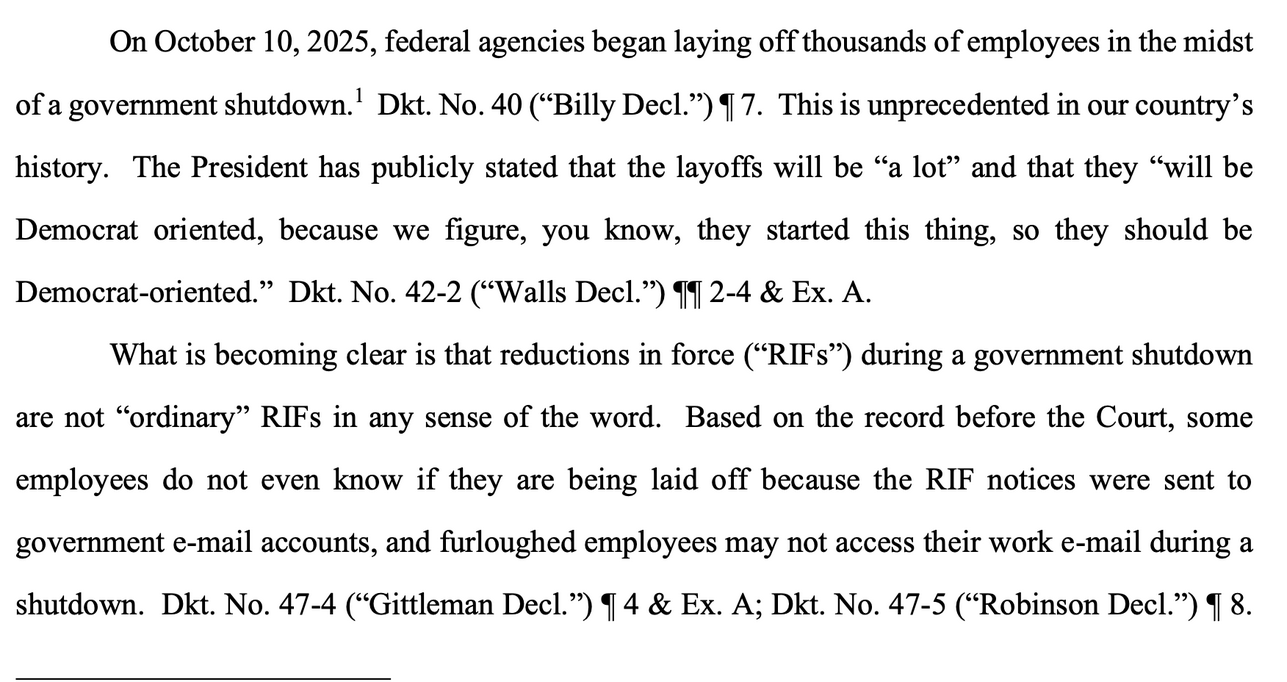
Opening paragraphs, first page:

Note that the first paragraph frames federal RIFs as historically unprecedented, while the second paragraph frames the current federal RIFS as not ordinary: different than the way RIFs are usually conducted. So this is unprecedented, but it has happened before, and the problem with the unprecedented thing is that it’s not being done the way the thing that has never been done before is usually done.

But anyway, a reduction in force of federal personnel during a shutdown is “unprecedented in our country’s history”. Of course, a reduction of force alone is not at all unprecedented, and the Clinton administration reduced the size of the federal bureaucracy by about 400,000 people. Illston doesn’t articulate a reason why reducing the bureaucracy during a shutdown is worse, or a reason why Clinton RIFs were good but Trump RIFs are a violent hatchet attack, but she clearly feels it. Of course, during a shutdown, the agencies being shrunk have no approved funding, so it would seem to make more sense to be careful about personnel costs, but this argument means that I just hurt people with a hatchet.

Above all, note that the argument out of the gate is a normative argument, not a legal argument. This is unprecedented! This is not ordinary! If a judge feels that something is a little off, she can order it stopped.

The Mexican-American War 1846-48

Filed under: Americas, Government, History, Military, USA, Weapons — Tags: , , , , , , — Nicholas @ 02:00

Real Time History
Published 16 May 2025

In the early 19th century, the United States and Mexico share a massive cross-continental border, but US settlement in Mexico, expansionist ideals and religious differences put the young republics on a collision course. As tensions boil over into bloodshed, the tiny, inexperienced US army marches to a war which will forge the modern United States.

Chapters:
00:00 Texas Republic
05:06 Declaration of War
07:03 The US Army
09:26 British Muskets in the Mexican Army
16:19 The Mexican Army
18:24 The Battles of Palo Alto and Resaca de la Palma
21:38 California and New Mexico
25:11 US Volunteers
28:40 Battle of Monterrey
33:03 Expanding the War
36:59 The Pedregal Battles
40:18 Battles for Mexico City
43:42 Treaty of Guadalupe Hidalgo
45:14 Legacy
(more…)

September 30, 2025

“San Francisco [is] a sort of market-segmented scheme [extracting] the basic comforts of civilization and licensing them back as upgrades”

Filed under: Health, Politics, Quotations, USA — Tags: , , , , , , — Nicholas @ 03:00

On the social media site formerly known as Twitter, Devon Eriksen describes the very comfortable lives of the very wealthy, who can support any kind of luxury beliefs because they never have to face the consequences that “the poors” who ape them do:

Dear sir,

I am not a filthy poor, and therefore conditions on the street level in Portland do not matter to me.

I drive my Jaguar to nice restaurants, give it to the valet to park, then go inside and order a fancy treat. So long as the valet parks my car, and the waiter brings my fancy treat for me to consoome in peace, I am utterly unaffected by conditions ten blocks away.

While I am technically forced to acknowledge that other humans exist — otherwise who would park my car or prepare my fancy treat? — I am not actually forced to consider what their lives are like.

And if you try to force me to confront this, I will simply point out that you are a filthy poor, who is unable to live a lifestyle that insulates you from this sort of unpleasantness.

At which point I don’t have to pay attention to you, loser.

Okay, here’s what’s really going on.

At a recent gathering in San Francisco, I listened to the tech bros I was dining with and their complaints about spending a million dollars a year on security teams, and a thought occurred to me, which I shared with the congregation.

I observed that San Fransisco, and perhaps other cities as well, seemed to be a sort of market-segmented money extraction scheme whereby the basic comforts of civilization are systematically removed from the environment, and then licensed back as upgrades to those who can afford them.

In Tennessee, it doesn’t cost me a thing to not be murdered for what I write online. Sure, I have a metric fuckton of extremely high-powered weapons and the skills to use them, but let’s be honest … I own them on principle, not because I would be murdered without them.

In SF, saying right-of-center things online while not being murdered costs a million dollars a year.

It probably costs slightly less than that to have zero drugged-out and/or schizophrenic bums urinating on your porch, but again, in Tennessee, this is a free service that comes with the “Western Civilization” package.

Also, it doesn’t cost anything go to a drugstore where nothing is locked behind glass, and be told “have a nice day” by someone at the register who actually means it.

And I’m told there is some sort of mythical beast called “graffiti”, but I have to go online to find out what it looks like.

In short, the argument that “civilization is just fine because I can still buy my way out of trouble” doesn’t hold any water, because it ignores the fact that you have to buy your way out of trouble, because civilization is shrinking.

You can’t have civilization without ass-kickings.

And if you forget that, you start having to buy your way into ever more and more exclusive clubs where the uncivilized can’t afford to go.

Until they figure out that they don’t have to pay, they can just push their way past the doorman. At which point you must be prepared to kick ass again.

All civilization rests on pillars made of violence. You are in danger until the moment you understand this.

Chris Bray also responded to the Nicholas Kristof take:

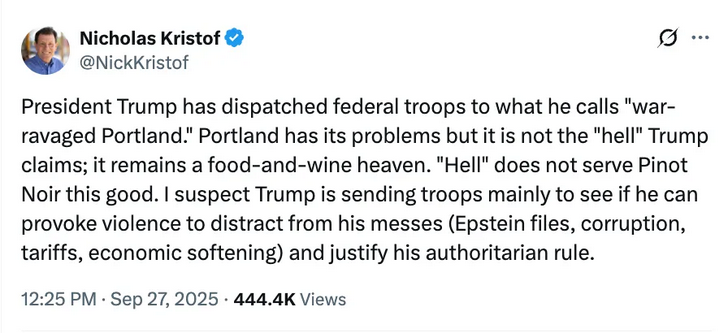
Now, here’s the hugely respectable New York Times columnist Nicholas Kristof, a very important Pulitzer Prize recipient, explaining from the heights of his journalistic perch what’s really happening in Portland:

This is as flawless a summary of the progressive cathedral classes as you could possibly manage: “‘Hell’ does not serve Pinot Noir this good”.

  1. Portland street journalist: Portland is a public graveyard
  2. Progressive New York Times columnist: Akshully, the Pinot Noir is exquisite

It’s time to shove these people onto a barge and tow them out to sea.

Like Karen Bass describing the open-air drug market of MacArthur Park as a sylvan paradise full of happy children and wonderful families having picnics, Oregon Governor Tina Kotek explained this week that Donald Trump is bizarrely intervening in a utopia, and for crying out loud look at this facial expression:

No one has ever been more lost than this. Your average good urban liberal is more insane than a psych ward full of psychotics. Akshully, the Pinot Noir is delightful. We are burdened with the existence of high-status people who have departed from earthly reality, and we can’t afford them.

Update, 1 October: Welcome, Instapundit readers! Please do have a look around at some of my other posts you may find of interest. I send out a daily summary of posts here through my Substack – https://substack.com/@nicholasrusson that you can subscribe to if you’d like to be informed of new posts in the future.

August 20, 2025

California’s ever-receding High Speed Rail dream

Chris Bray provides an on-the-ground update of California’s ultra-expensive high speed rail project which still has yet to deliver a single passenger from one station to another after nearly 20 years of funding:

Start with a description: “In 2008, California voters approved $9.95 billion of state bond funding as seed money to build an 800-mile high-speed rail (HSR) network connecting Los Angeles and San Francisco, and the Central Valley to coastal cities, at speeds of up to 220 miles per hour, with an expected completion date of 2020.”

Construction started in 2015. Pause for a moment and really notice the date.

Ten years later, the project has consumed $18 billion, and an effort to connect Los Angeles and San Francisco has turned into a much more modest “Phase One” plan to connect the cities of the Central Valley, well east of the coast. The modest declared cost of the proposed LA-to-SF bullet train now looks like this for the much shorter line: “a cost range of $89 billion to $128 billion.” The Trump administration has declined to provide more federal funding for the project, but California is suing to try to keep the federal spigot open.

[…]

Famously, the California High-Speed Rail Authority has been posting pictures of its huge construction successes on social media:

See, that’s … almost a whole rail line for a bullet train. Obviously!

So!

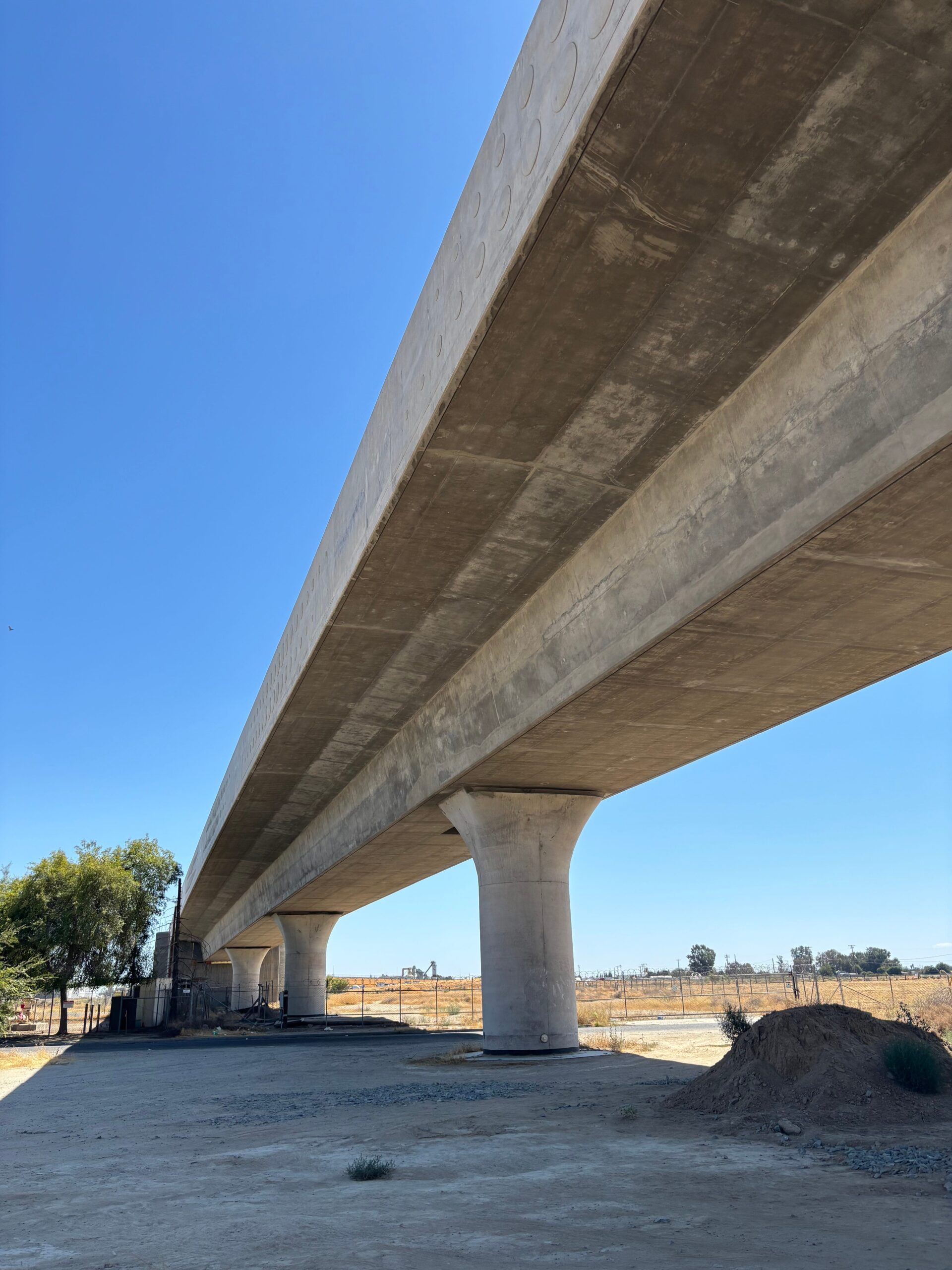
If you ever find yourself in Fresno, and I sincerely hope you don’t, the structures that have been built for “high-speed rail” are surprisingly easy to access. There are several places where those structures aren’t fenced in or guarded. At all. […] So when you see this:

…it’s not that hard to just head up onto the thing. It’s also very dangerous, legally dubious, and something you definitely shouldn’t do. Since it’s an elevated construction site, there are a lot of places without guardrails where you can just fall off the thing, and it’s a long way down.

Everyone see this part: Don’t go up there. It’s dangerous. You can fall and die. […] But if you were to climb up onto the thing, which you absolutely should never do, you would see a whole bunch of this:

That’s a section at the northern end of Fresno, looking south.

Of course, California isn’t the only jurisdiction struggling to complete big infrastructure projects: Toronto’s long-awaited Crosstown LRT project got started in 2007 and still has no confirmed completion date, although a faint possibility exists that a portion of the line may open later in 2025.

August 11, 2025

The problem with the theory that local government is more responsive is … people

Filed under: Government, Liberty, Politics, USA — Tags: , , — Nicholas @ 03:00

Poor Chris Bray is having a moment of deep cognitive dissonance over the vast chasm between his prior belief that local government is more sensible, more grounded, more responsive to the electorate than huge, distant, impersonal big government:

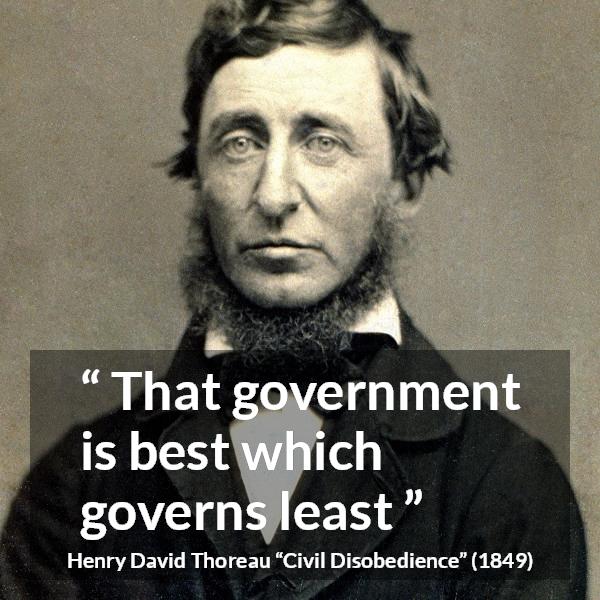
The more you deal with government, the more you are likely to agree with Thoreau

The problem of underlying principles and structural assumptions in a moment of profound cultural decay.

Like my old friend James Madison, the core of my understanding of political power is that authority becomes more rational and balanced as it gets closer to the people who are governed. Starting from home in my list of ideological priors, centralized power is usually going to be a steamroller, managed on top-down premises by people you’ve never met; local government, government by neighbors, is usually going to be more adept at listening and adapting. Your mayor is down the block, mowing his lawn. You can wave to him. When I worked at small town newspapers, I’d have breakfast with the city manager and the police chief — mostly so they could threaten to call my editor and have me fired, but still. They were here, right in front of me. I could talk to them. In the town where I’ve lived for a few years, now, I’ve waited at Trader Joe’s for a city councilman in cargo shorts and an old t-shirt to move over so I could get to the ground beef. They aren’t distant autocrats.

Sadly, though, a good few of them turn out to be proximate autocrats, and almost miraculously stupid. The problem with the theory of relatively well-balanced local authority is that some of the biggest goobers I’ve ever met have served on small town city councils and school boards, and your HOA board of literal neighbors makes Mussolini look like a hippie.

[Deleted a video here of an HOA officer being arrested, because it was staged.]

I wrote a quite carefully reported newspaper story about wasted money at a suburban school district, decades ago, that was critical but fair and elaborately sourced. The subsequent conversations I had with the members of the school board made me wonder if they had actual brain damage. No one on earth is more susceptible to psychotic conspiracy theories than small town elected officials, who respond to mild criticism by demanding to know WHO PUT YOU UP TO THIS, WHO ARE YOU REALLY WORKING FOR!?!?!?! WHAT’S YOUR TRUE AGENDA!?!?!?! WHO SENT YOU!?!?!?!? If you ask me for a list of the top ten people I’ve known personally and can’t stand at all, roughly eight of them were elected to local government positions in towns with low-five-figure populations, and I start grinding my teeth at the sound of their names. Wait, no: nine.

This topic is back on my mind this week because of Lina Hidalgo, though a county of five million people may be a bad example of real localism and neighborhood authority. Hidalgo is the county judge — in Texas, the chief executive officer — of Harris County. And she’s mad as a hatter. Click on the link to watch the video, but a tax increase is “not about politics, it’s about kids.” Never heard that one before.

[…]

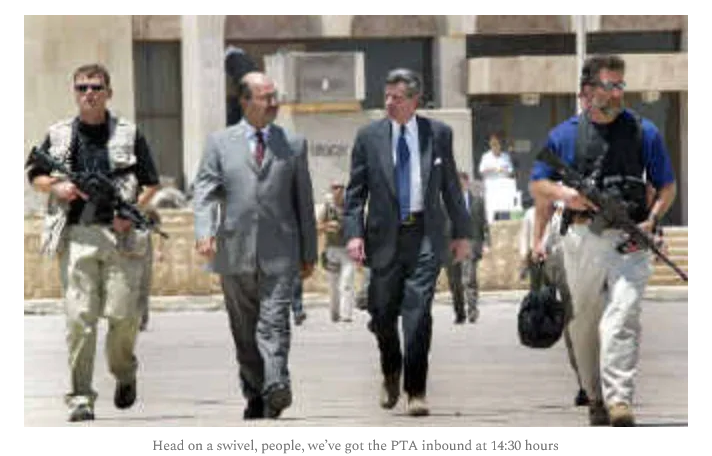
Making appalling decisions at the head of broken institutions, they respond to criticism by hiring men with guns as a shield against ordinary human contact. Like I said, the mayor is down the block, mowing his lawn, so you can wave to hi—STOP RIGHT THERE, GET ON THE GROUND.

The spirit of the NSBA letter lives on in a thousand local offices, where the problem with running schools is that parents exist, and the problem with running cities is that they have people in them.

July 8, 2025

The dangers of whiplash when “the narrative” suddenly changes

Filed under: Government, Law, Media, Politics, USA — Tags: , , , , , — Nicholas @ 04:00

I’ve never been to Los Angeles, although I did spend a couple of weeks working in the San Francisco area a few decades back, so I’m inclined to think Chris Bray is reporting closer to the objective reality than most of the mainstream media are doing:

Federal agents raided MacArthur Park in Los Angeles today, and that’s shocking! It’s HORRIBLE! Why on earth would they do that?!?!?!? (MY GOD, THEY WERE EVEN ARMED!)

Also, here’s local NPR station KCRW, a very few months ago:

Opening paragraphs:

    For more than a century, MacArthur Park, just west of Downtown Los Angeles, has been an urban oasis for residents of the surrounding Westlake District and the wider city. But in recent years, MacArthur Park has also become synonymous with fentanyl, the synthetic opioid that can be 50 times more powerful than heroin. Open fentanyl abuse is now so common, the drug might as well be an unofficial symbol of the park.

    Scenes of fentanyl abuse, and what it does to the body and mind, are everywhere, with people passed out or staring dead-eyed as they clutch drug pipes and small containers of fentanyl residue.

More recently, the Los Angeles County DA’s office announced a bunch of felony indictments for an aggressive retail theft ring that used MacArthur Park to recruit and organize its army of professional thieves:

    LOS ANGELES — Los Angeles County District Attorney Nathan J. Hochman announced today that Blanca Escobar has been charged with receiving over $350,000 in stolen merchandise from retailers including Target, Macy’s, TJ Maxx, CVS, and Walgreens at her business near MacArthur Park.

    “This case is an important step toward cleaning up MacArthur Park, a community that has long struggled with crime and safety concerns,” District Attorney Hochman said. “Combating organized retail theft in close partnership with LAPD and other law enforcement is a priority for my administration. My office will vigorously prosecute this case and send an unmistakable message to criminals: Retail theft will not be tolerated under my watch.”

Note that the DA called the indictments “an important step toward cleaning up MacArthur Park”. Why? Why did prosecutors think MacArthur Park needs cleaning up?

April 20, 2025

The essence of (most) modern western governments

Chris Bray on the paradox of how many western governments manage the alchemy of being both omnipresent and yet absent simultaneously:

Adding to my last post about covering language that masks the massive expansion of government behind performative language about limiting government: The most Los Angeles thing I have ever seen happened behind the Yoshinoya Beef Bowl.

See the alley between the Yoshinoya and the pharmacy? As I drove by on Wilshire, two extremely alert LAPD officers on motorcycles were sitting at the edge of that parking lot, postures tight and poised for action, urgently scanning the street. It was like watching a gunfighter movie, in the scene when the camera closes in on the gunfighter’s eyes, watching his opponent for the draw. These dudes were ready. If you did 38 in the 30 MPH zone, then brother, you were dead-ass done, nailed up in the trophy case.

Also, no more than thirty feet away from them, a little gaggle of filthy human zombies was passing a glass pipe around the circle, throwing up clouds of smoke, at the top end of an alley wall-to-wall full of open drug use and not terribly subtle drug dealing (and probably the prostitution that pays for the drugs, but I didn’t wander into the alley to look). But California made the possession and use of heroin, meth, and cocaine a misdemeanor, and the DA at the time was very proud that he wouldn’t allow his office to file most misdemeanor cases, because misdemeanors are lifestyle crimes that punish people for being poor, or for being “individuals experiencing homelessness”. So that alley full of people Hunter Bidening all day out in the open weren’t doing anything that could lead to prosecution, but your expired registration tags would bring down an immediate police response in you happened to roll by them.

Grand Guignol human depravity and ruin: no big deal. Minor traffic offenses: front and center.

This is Blue Zone governance, full stop, the thing people describe as anarcho-tyranny. Common San Francisco business owner experience: Police don’t intervene in the constant vandalism and tagging that degrades business property, but the highly alert army of code enforcement officers fine business owners for failing to clean up the damage that the city hasn’t prevented.

I forget who recently suggested this on I-still-call-it-Twitter, but go to Yelp and read some reviews for gas stations in Oakland:

January 30, 2025

Proposed California legislation to allow “Big Oil” to be sued for “climate change damage … regardless of cause”

Filed under: Business, Environment, Government, Law, USA — Tags: , — Nicholas @ 05:00

California is a lovely place. I’ve only ever been there once, back in January 1991 but it was a wonderful (business) trip. California’s political “leaders” on the other hand are clearly in need of immediate re-institutionalization:

First, the madness of the California state legislature is richly displayed in Senator Scott Wiener’s remarkable new bill that would allow people to sue the oil industry because climate change damaged their property, via “natural catastrophe, including a hurricane, tornado, storm, high water, wind-driven water, tidal wave, tsunami, earthquake, volcanic eruption, landslide, mudslide, snowstorm, or drought, or, regardless of cause, a fire, flood, or explosion”.

I hope you caught that “regardless of cause” thing, there at the end. If this bill passes — it won’t, being mostly a theatrical performance, but let’s pretend — Californians will supposedly be able to sue Chevron or ExxonMobil (and so on) because a flood or fire damages their property, which implicates fossil fuel-induced climate change, regardless of the cause of the flood or fire.

  1. I threw matches on your couch
  2. Climate change
  3. Big Oil burned your couch

On the hook: anyone who sold “fossil fuels” in California “since the year 1965”, although a lawsuit has to be brought within three years of the discovery of the damage caused by the fossil fuel’s effect on the climate.

Favorite part, and look at item #2 (click to enlarge):

I’m not a lawyer, but I have doubts about declaring in a law that you can’t question the constitutionality of the law. We had similar legal doctrines on the playground in elementary school, despite which some members of the first-grade community controversially persisted in utilizing the disallowed tag-back.

Wiener’s press release on the bill is … very special. California government knows why the recent fires were so harmful, and none of it involves California government. Sample quote from, please help me, the state senator who represents my district:

    “The Eaton Fire destroyed over 9,000 structures in my District, wiping out almost the entire town of Altadena, leaving thousands of my residents calling for justice and accountability,” said Sen. Sasha Renée Pérez (D-Pasadena). “Our communities have never seen anything like this in urban Los Angeles. The reality is that climate change is here and will continue impacting communities everywhere. What makes this worse is decades ago, Big Oil knew this would be our future, but prioritized lining their own pockets at the expense of our environment and the health of our communities. The Affordable Insurance and Climate Recovery Act will hold the oil industry responsible for the damage it has inflicted, and provide relief for future communities impacted by climate disasters.”

Decades ago, Big Oil knew Altadena would burn, but they did it anyway. Case closed.

I’m also quite fond of the senator’s use of “my residents”, which sounds like she’s buying up dead souls to expand her vassalage. I pay her in grain, of course.

January 19, 2025

California’s wildfire plight

Theophilus Chilton on the end of California dreamin’:

Southern California has had a REALLY rough week. Wildfires, started by arsonists and driven by the Santa Ana winds, have burned thousands of acres in the city and county of Los Angeles and destroyed over $150 billion worth of property (and counting). As I write this, the fires still burn and largely remain uncontained, even as new blazes break out. It is a disaster of epic proportions, striking one of the richest and most economically and culturally relevant portions of the country.

Never ones to let a crisis go to waste, the Left responded to this disaster by … focusing on climate change. Not empty fire hydrants, not drained reservoirs, not incompetent leadership, but climate change. These fires, we have been breathlessly assured, are the result of ever-worsening climatic conditions in the region, drying it out and making it susceptible to this kind of affliction. Never mind that observers since Spanish times consistently noted the same kind of weather conditions and hazards that we see today, which suggests that maybe things aren’t actually changing all that much. Of course, those who are blaming climate change fail to recognise the fundamentally chaotic, nonlinear nature of the Earth’s biosphere and the interactions of its constituent parts, something governed by complexity (in the chaos/complexity theory sense of the term). As a result, it’s somewhat foolish to try to draw a direct, causal link between two variables (such as atmospheric CO2 content and temperature) which depend upon nonlinear interactions with hundreds of other factors. Thankfully, they don’t seem to be getting much traction with this.

So what did create the conditions that burned down Los Angeles?

First of all, there was the implementation of a number of policies driven by the state’s radical environmentalist lobby. Thanks to the fanatics, common sense policies that would help to mitigate the region’s inherent fire hazard went undone. Regular controlled burns of underbrush are a standard conservation technique in dry areas that help to thin out brush and prevent wildfires from getting out of control. Building a sufficient number of desalination plants is a good way for coastal desert areas to provide themselves with abundant fresh water for things like drinking, watering crops, filling reservoirs, and fighting fires. In fact, filling reservoirs for future needs would make a lot of sense. But all of these things are “unnatural” and might have “negative impacts” on local wildlife and whatnot.

Another contributory issue is the state’s policies towards the chronically homeless and its de facto sanctuary status for illegal aliens. The Reagan-era deinstitutionalisation of the homeless has been a nationwide disaster for years and California’s particular policies have made the situation in their state even worse. For decades, California has regularly seen wildfires caused by untended campfires started by homeless junkies getting out of control, which the state’s liberal approach to its indigent population has only made more prevalent. Likewise, California’s harbouring of illegal aliens has created a situation in which the state is flooded with masses of hostile foreign elements, some of whom have been caught starting fires all around the LA basin and creating the current catastrophe.

Then there is the fact that California has systematically implemented a set of DEI policies for its governmental workers, including its firefighters. As a result, the state’s leadership in the relevant departments is very good at “promoting inclusion,” but not so good at dealing competently with emergencies when they take place. Indeed, Los Angeles’ mayor Karen Bass and LAFD Chief Kristen Crowley presided over budget cuts for the city’s firefighting capabilities while adding layers of “diversity and inclusion” bureaucracy aimed at systematically de-white-maleing the department and depriving it of the demographic most prone to self-sacrifice and overall technical competence. That reflects trends across the board in which the state and the city have regularly spent more on gay choirs and social justice artwork than they have on necessary functions of government.

(more…)

January 16, 2025

For some unknowable reason, high-tax states keep losing population to low-tax states

Filed under: Business, Economics, Government, USA — Tags: , , , , , , — Nicholas @ 03:00

It sure is a mystery:

“U-Haul Rental Truck (44601958941)” by HireAHelper is licensed under CC BY 2.0 .

This probably won’t come as a surprise to many readers, but when people move, they tend to prefer migrating to places where, among other considerations, the taxes are lower than in their old digs. Data from the U.S. government as well as from moving companies reveals that — as we’ve seen in the past — high-tax states are losing residents to states that take a smaller bite out of people’s wallets.

“Americans are continuing to leave high-tax, high-cost-of-living states in favor of lower-tax, lower-cost alternatives. Of the 26 states whose overall state and local tax burdens per capita were below the national average in 2022 (the most recent year of data available), 18 experienced net inbound interstate migration in FY 2024,” Katherine Loughead wrote last week for the Tax Foundation. “Meanwhile, of the 25 states and DC with tax burdens per capita at or above the national average, 17 of those jurisdictions experienced net outbound domestic migration.”

Loughead crunched numbers from both the U.S. Census Bureau as well as U-Haul and United Van Lines. The government data tracks population gains and losses across the country while numbers from the private companies is helpful for comparing flows in and out of various states. The results are revelatory, though not unexpected.

“For the second year in a row, South Carolina saw the greatest population growth attributable to net inbound domestic migration” according to Census Bureau figures. The Tax Foundation separately ranks South Carolina at number 9 for tax burden, with 1 being the lowest tax burden among states and 50 the highest. Rounding out the top-10 population-gainers were Idaho (ranked 29), Delaware (42), North Carolina (23), Tennessee (3), Nevada (18), Alabama (20), Montana (27), Arizona (15), and Arkansas (26).

According to census data, Hawaii lost the biggest share of its population to other states; it’s ranked at 48 for the third-highest tax burden in the country. The rest of the top 10 states for population outflow were New York (50), California (46), Alaska (1), Illinois (44), Massachusetts (37), Louisiana (12), New Jersey (45), Maryland (35), and Mississippi (21).

Numbers released this month by U-Haul and United Van Lines showed migration patterns closely, but not precisely, tracking the Census Bureau’s information. Loughead attributes the disparities, at least in part, to the companies’ varying geographic coverage and market share.

QotD: “At promise” youth

Filed under: Bureaucracy, Education, Quotations, USA — Tags: , , , — Nicholas @ 01:00

A new law in California bans the use, in official documents, of the term “at risk” to describe youth identified by social workers, teachers, or the courts as likely to drop out of school, join a gang, or go to jail. Los Angeles assemblyman Reginald B. Jones-Sawyer, who sponsored the legislation, explained that “words matter”. By designating children as “at risk”, he says, “we automatically put them in the school-to-prison pipeline. Many of them, when labeled that, are not able to exceed above that.”

The idea that the term “at risk” assigns outcomes, rather than describes unfortunate possibilities, grants social workers deterministic authority most would be surprised to learn they possess. Contrary to Jones-Sawyer’s characterization of “at risk” as consigning kids to roles as outcasts or losers, the term originated in the 1980s as a less harsh and stigmatizing substitute for “juvenile delinquent”, to describe vulnerable children who seemed to be on the wrong path. The idea of young people at “risk” of social failure buttressed the idea that government services and support could ameliorate or hedge these risks.

Instead of calling vulnerable kids “at risk”, says Jones-Sawyer, “we’re going to call them ‘at-promise’ because they’re the promise of the future”. The replacement term — the only expression now legally permitted in California education and penal codes — has no independent meaning in English. Usually we call people about whom we’re hopeful “promising”. The language of the statute is contradictory and garbled, too. “For purposes of this article, ‘at-promise pupil’ means a pupil enrolled in high school who is at risk of dropping out of school, as indicated by at least three of the following criteria: Past record of irregular attendance … Past record of underachievement … Past record of low motivation or a disinterest in the regular school program.” In other words, “at-promise” kids are underachievers with little interest in school, who are “at risk of dropping out”. Without casting these kids as lost causes, in what sense are they “at promise”, and to what extent does designating them as “at risk” make them so?

This abuse of language is Orwellian in the truest sense, in that it seeks to alter words in order to bring about change that lies beyond the scope of nomenclature. Jones-Sawyer says that the term “at risk” is what places youth in the “school-to-prison pipeline”, as if deviance from norms and failure to thrive in school are contingent on social-service terminology. The logic is backward and obviously naive: if all it took to reform society were new names for things, then we would all be living in utopia.

Seth Barron, “Orwellian Word Games”, City Journal, 2020-02-19.

January 15, 2025

Is there anything climate change can’t do?

Filed under: Government, Media, Politics, USA — Tags: , , , , , — Nicholas @ 05:00

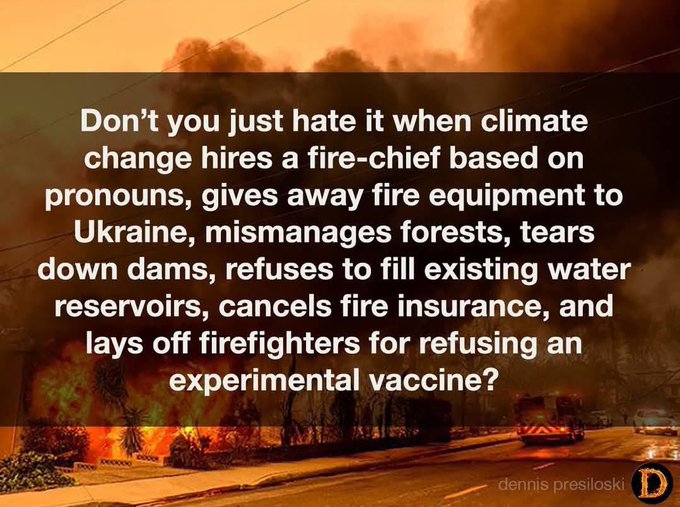
Seen on social media earlier this week:

Confirming this, Chris Bray talks about current reporting on the wildfires in and around Los Angeles:

In his much-discussed piece on the Los Angeles fires at the Free Press, Leighton Woodhouse looks to Mike Davis for a narrative foundation. In his book Ecology of Fear, Woodhouse notes, Davis “argued that the area between the beach and the Santa Monica Mountains simply never should have been developed. No matter what measures we take to prevent it, those hills are going to burn, and the houses we erect upon them are only so much kindling.” Malibu and the Palisades, the land of hard living. That’s why so many rich and famous people lived there: because it was so inherently miserable and dangerous.

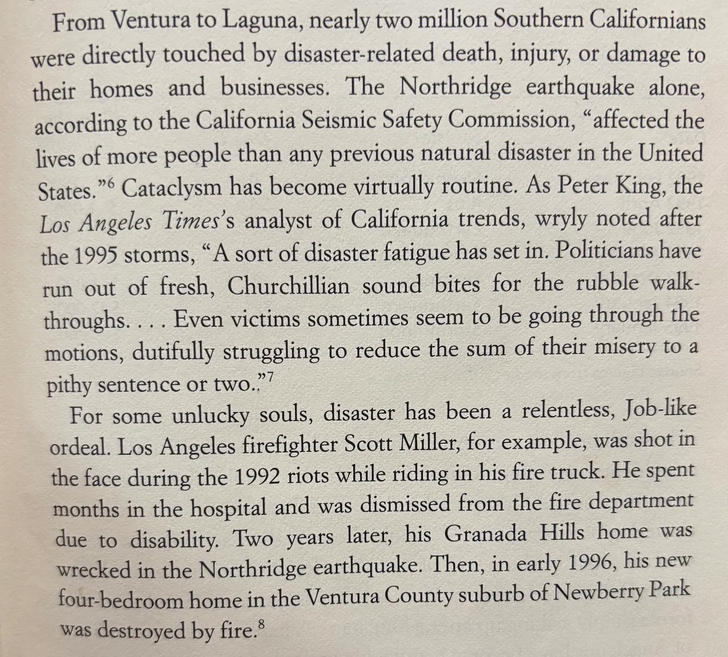
Mike Davis was full of shit for thirty years — he died in 2022 — and I’ve been rolling my eyes at him throughout. He described Los Angeles as an “apocalypse theme park”, a place of ruin and pain, populated by hardened survivors who, “dutifully struggling”, stagger on through the “Job-like ordeal” of clinging to a brutal landscape.

Also, Sierra Madre has bears. The Los Angeles suburbs are a place of horror and agony, because they back into the mountains, where blood-clawed wild animals prowl and stalk and slaughter. Places where life is especially grim and sanguinary, pgs. 240-41: Bradbury, La Crescenta, Glendora, the areas around the hellscape of Santa Barbara. A poodle was eaten by a mountain lion in Bradbury once, as neighbors gaped in open-jawed terror, YET STILL DO FOOLS ENDURE THE HORROR OF LIVING IN SUCH A PLACE.

Current real estate listings in Bradbury, a gated hillside community incorporated as an independent city in the San Gabriel Valley with a population of about 900 people:

How then would ye endure such horror, oh pilgrim, to live thus amid such blood and death? How bearest thou brutal existence upon this land?

Famously, in 1999, the Los Angeles Times, which used to be a newspaper, ran a long story examining Mike Davis and his vision of Southern California. It’s full of sentences like this:

  • Los Angeles’ most provocative social critic has stretched, bent and broken more than a few facts in “Ecology of Fear,” his latest, darkly themed work on the urban area he claims to love.
  • … more than a third of the time there were factual problems with his work.
  • Davis concedes the error.
  • Davis does not say where he got this piece of information.
  • “I honestly don’t know what I’m referring to,” Davis said.
  • Some of Davis’ mistakes involve mergers of fact and fiction, including making up a quote.
  • Davis attributes the false quote to a mix-up.
  • Then he takes readers on a partial flight of fantasy …
  • An examination of the Malibu Times article shows that Davis made up the parts about the jewels, the hair color, the kayakers’ occupations, the evidence of their callous classism and the ethnicity of their maids.
  • Davis is mischievously unrepentant.
  • Davis also merges fact and literary fiction, without acknowledgment, while arguing that Pomona, like other older, outer suburbs, is dying.

And so on.

The Times concluded that Davis could be read as “a polemicist, who makes cogent, incisive arguments on big themes”, but not as “a historian who is expected to be reliable, even on details”.

October 18, 2024

QotD: Californian wine

Filed under: Business, Quotations, Science, USA, Wine — Tags: — Nicholas @ 01:00

Of course, there is another reason why Californians so eagerly turned to science and machinery when they finally decided to make serious wine: American wineries were in horrific condition. Andrew Barr, in his social history Drink, tells us that even in the late 1930s there were rats swimming happily in the vats of Sauvignon Blanc at Beaulieu and vinegar flies in the other wines. “The wine is so excellent,” the resident wine maker cooed, “that all the flies go to it. It doesn’t do any damage.” Open fermentation tanks let off clouds of carbon dioxide which got birds flying overhead drunk; stunned, they would fall into the vats and stay there.

Lawrence Osborne, The Accidental Connoisseur: An Irreverent Journey Through the Wine World, 2004.

October 2, 2024

How Gold Rush Miners Ate in the Wild West

Filed under: Food, History, USA — Tags: , , , , — Nicholas @ 02:00

Tasting History with Max Miller
Published Jun 18, 2024

Biscuits topped with salt pork milk gravy

City/Region: United States of America
Time Period: 1881

Food prices skyrocketed during the Gold Rush. A single egg could cost $1 (in the mid-1800s!), and a barrel of flour went from $3 to a whopping $400, which equals about $16,000 today. Once you had some flour and a few other staples, including the newly invented canned evaporated milk, you could make these biscuits and gravy.

I love biscuits and gravy, and while the best biscuits and gravy I’ve ever had will always be my grandpa’s, this is pretty good. My biscuits turned out a little flat, but that’s just because I forgot the baking soda.

    Cream of Tartar Biscuits
    Mrs. Milliken
    One quart of flour, three heaping teaspoonfuls of pure cream of tartar, a piece of butter two-thirds the size of an egg, well worked in flour, one heaping teaspoonful of Babbit’s salaratus, dissolved in sweet milk. Make the dough as soft as can be kneaded conveniently; roll a half inch thick, cut in biscuits, and bake in a quick oven.
    — Los Angeles Cookery, 1881

(more…)

« Newer Posts — Older Posts »

Powered by WordPress