Quotulatiousness

May 14, 2026

“Trust is the most scarce thing in the media landscape right now”

Filed under: Media, USA — Tags: , , , — Nicholas @ 05:00

As with a lot of cultural upheavals, I’m a bit behind the curve on this one, so let Ted Gioia give you the state of play in “Rick Beato Versus the NY Times“:

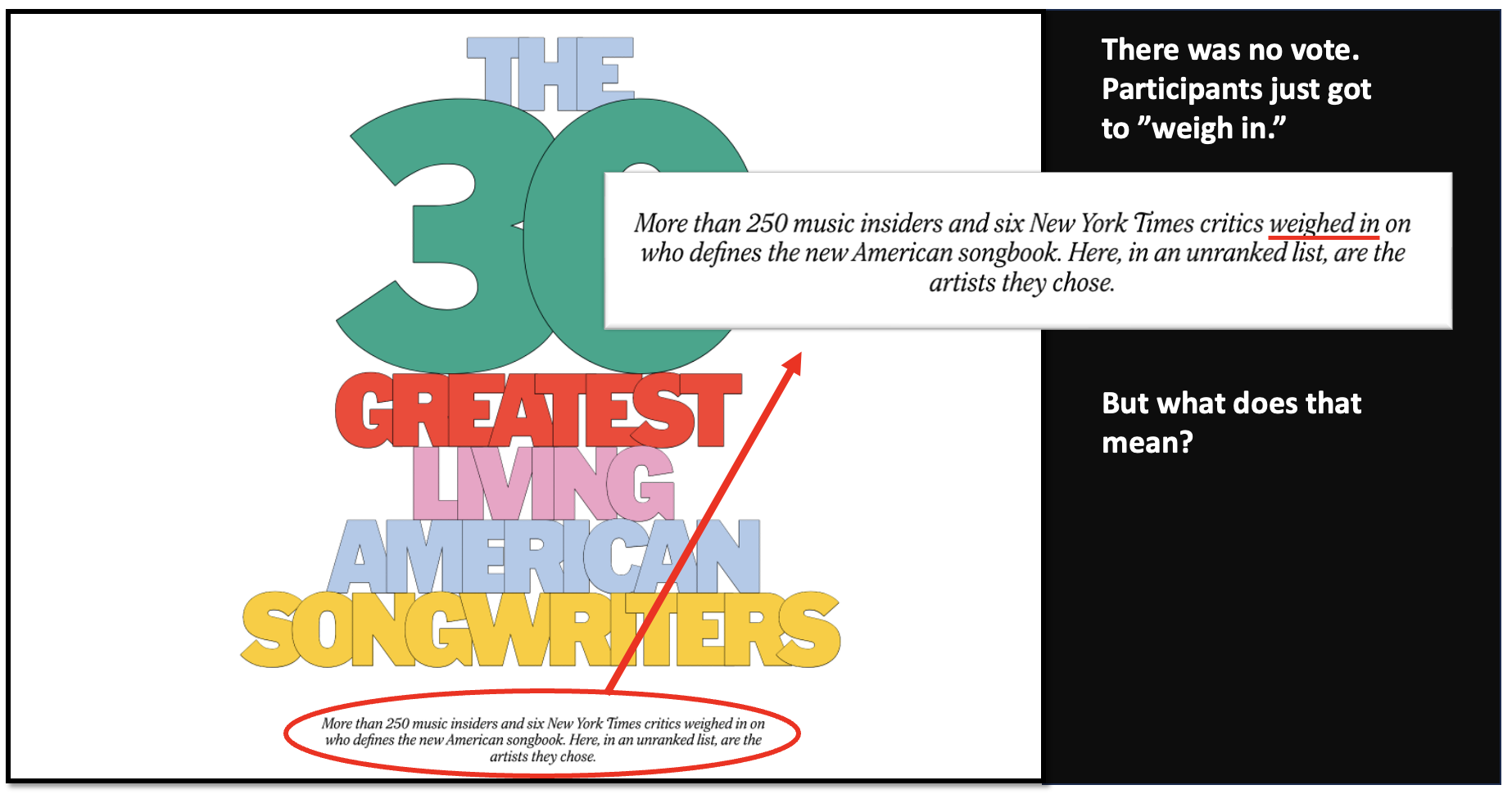
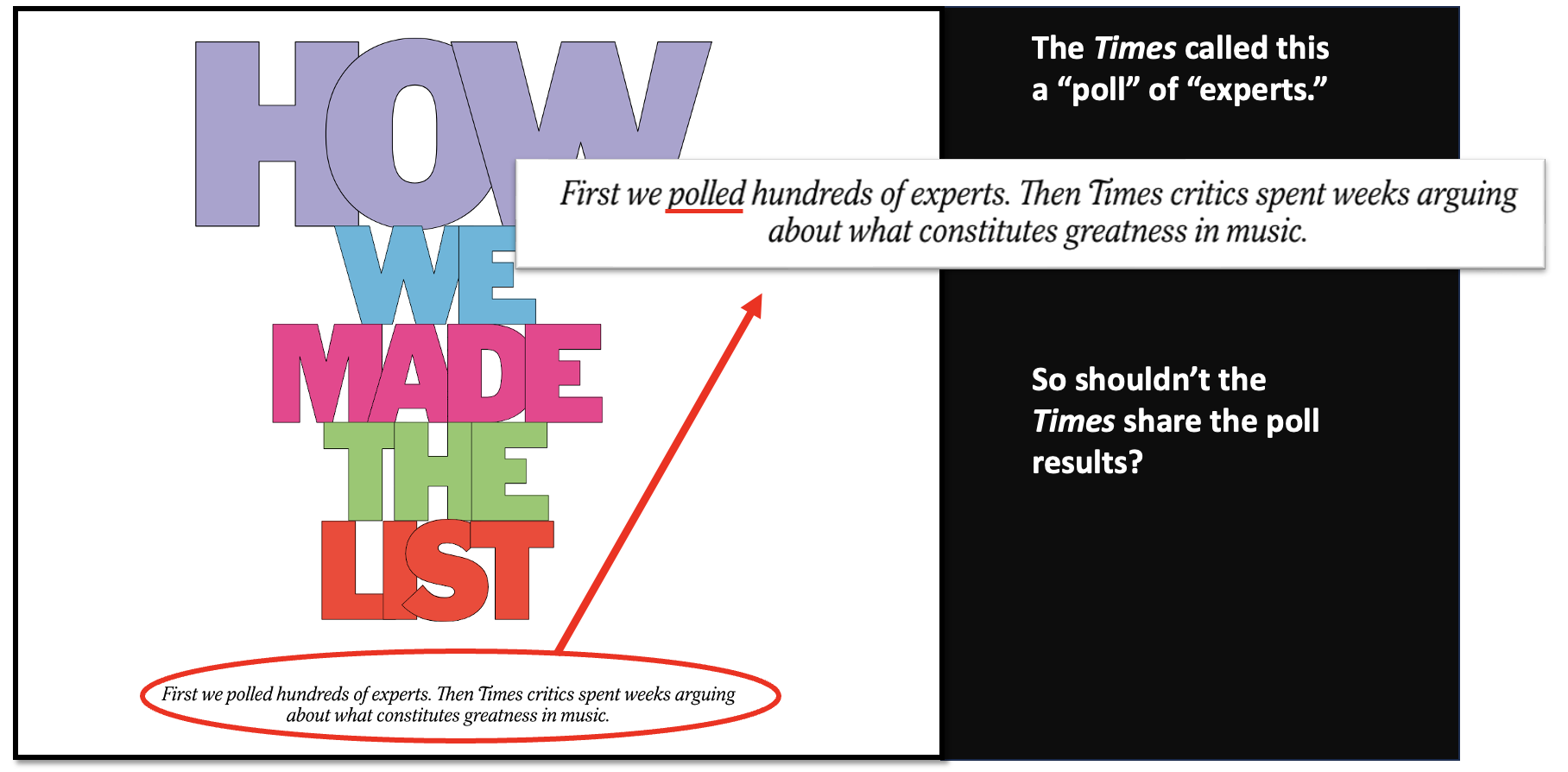
Fifteen days ago, the New York Times published its list of the 30 greatest living American songwriters. Since then, all hell has broken loose in the music world. And in the last 48 hours, that Hades just got a lot hotter.

I’d been one of the 250 “music insiders” surveyed by the Times for the article — so the day after the list was published I shared my ballot here.

I was unhappy with the results, as were many other music fans. But that might have been the end of the story. Surveys are always a bit dodgy — but what can you do about it?

Then I took time to learn about the Times methodology and was even more dismayed. In fact, I was miffed.

I assumed that I was voting for the songwriters who would be included in the list. But I now see that the experts consulted by the Times only got to make nominations. The final 30 names were chosen by six New York Times music critics.

There never was a real vote. The Times got the results it wanted internally — the insiders made the final call. But the way they explained it to their readers was intentionally vague.

In small print, readers were told that industry experts “weighed in” — whatever that means.

Readers were invited to click on a link to learn “how we made the list”. But even here, the Times served up fuzzy language.

If you kept on reading, you eventually learned the truth. The Times took the verdict of the “experts” and then “ran it through a filter”. The survey was just a “starting point”. The actual top thirty was decided via a “conversation” among its internal team.

Huh?

The Times did share a few ballots, and even this small sample made clear how different the final list was from the survey of experts. That would be embarrassing for the Times under the best of circumstances, but especially so in the current environment — when that same newspaper has repeatedly expressed outrage about voter suppression and attempts to subvert democracy.

If the Times really believes in the importance of voting and standing by results, why doesn’t it just share the actual ballot count?

Even so, this all might have been forgotten. But last Friday, the Times made the mistake of releasing a video entitled “In Defense of the NYT ‘Greatest Songwriters’ List“.

Here members of the inside team came across as smug, maybe even contemptuous, in responding to music fans who reached out to them. At one juncture, a Times critic laughs at a comment from a reader — simply for saying that he went to the Berklee College of Music. Then he continues to chuckle and smirk as he reads the rest of the reader’s comment, before finally throwing it on the floor.

This music lover had made the mistake of defending Billy Joel. For a serious critic at the Times, that is apparently very funny.

May 11, 2026

The History of SPI: Part 1 / Simulations Publications Inc. / Wargaming History

Filed under: Business, Gaming, History, Military, USA — Tags: , , , , , — Nicholas @ 02:00

Legendary Tactics
Published 18 Dec 2025

Remember the golden age of wargaming? This is THE definitive history of SPI (Simulations Publications, Inc.), one of the most influential publishers in tabletop gaming. From its groundbreaking magazine Strategy & Tactics to iconic titles like War in the East, StarForce, and Terrible Swift Sword, SPI reshaped what board wargames could be — and built a passionate community along the way.

This is Part 1, where we delve into the origins of SPI and Strategy & Tactics Magazine, and the people and games that were part of it.
(more…)

April 30, 2026

QotD: The terrible economics of (most) recycling efforts

Filed under: Economics, Environment, Quotations, USA — Tags: , — Nicholas @ 01:00

New York City confidently predicted that it would save money by starting a mandatory recycling program in 1992, but it took so much extra labor to collect and process the recyclables that the city couldn’t recoup the costs from selling the materials. In fact, the recyclables often had so little value that the city had to pay still more money to get rid of them. The recycling program cost the city more than $500 million during its first seven years, and the losses have continued to mount. A new study by Howard Husock of the Manhattan Institute shows that eliminating the city’s recycling program and sending all its municipal trash to landfills could now save taxpayers hundreds of millions of dollars annually — enough money to increase the parks department’s budget by at least half.

Even those calculations underestimate the cost of recycling because they include only the direct outlays, chiefly the $686 per ton that the city spends to collect recyclables. But what about all the valuable time that New Yorkers spend sorting and rinsing their trash and delivering it to the recycling bin? For a New York Times Magazine article in 1996, I hired a Columbia University student to keep track of how much time he spent recycling cans and bottles and how much material he gathered in a week. Using those figures (eight minutes to gather four pounds), I calculated that if the city paid New Yorkers a typical janitor’s wage for their recycling labors, their labor would cost $792 per ton of recyclables — over $100 per ton more than what the city pays its sanitation workers to collect it.

As the economics of recycling worsened, cities in America and Europe found that the only viable markets for their recyclables were in poor countries, chiefly in China and other Asian nations, where processing recyclables was still profitable, thanks to lower wages and lower standards for worker safety and environmental quality. But as those countries have gotten wealthier, they’ve become reluctant to accept foreign trash. As bales of unwanted recyclables pile up in warehouses, towns have had to start sending them to landfills, and dozens of American municipalities have finally had the sense to cancel their recycling programs.

John Tierney, “Let’s Hold On to the Throwaway Society”, City Journal, 2020-09-13.

Update, 1 May: Welcome, Instapundit readers! Have a look around at some of my other posts you may find of interest. I send out a daily summary of posts here through my Substackhttps://substack.com/@nicholasrusson that you can subscribe to if you’d like to be informed of new posts in the future.

February 13, 2026

QotD: The Democrats re-focus on the youth vote

Filed under: History, Media, Politics, Quotations, USA — Tags: , , , , , , , — Nicholas @ 01:00

That’s why it might work. Young people’s lives are simpler; it’s one of the great things about being young. That’s not me, the old guy, knocking the kids; it’s just the way it is. If that’s the way they decide to go — Jungvolk uber Alles — then that’s how they’re going to have to do it. Mamdani, the young, vigorous, exotic, foreign-born socialist weirdo — you know, a Barack Obama for The New Generation.

Which is why I’m tempted to write it off. After all, Obama was just a Bill Clinton for The New Generation. Who was just a JFK for The New Generation. Who — we forget this — was just FDR for The New Generation. Most of the idiot Boomers who voted for Bill Clinton as “the New JFK” barely remembered JFK. Nor did JFK himself win “the youth vote” by all that much — or at all — because “the youth vote” wasn’t a thing back then. For one thing, the voting age was still 21. I’m in History, not math, but even I can do Historian math, and 1960 – 21 = 1939. Most of JFK’s voters had clear memories of The Depression; even his youngest voters remembered the tail end of WWII. JFK sounded like an East Coast patrician, just like FDR did, and as opposed to that young parvenu from California, Richard Nixon.

That’s just a wee bit different from “the Youth Vote” Bill Clinton appealed to. To say nothing of the later freaks.

I’m tempted to write it off, but I’m not going to. For one thing, Obama, Clinton … they all won, and look at the incalculable damage they did. More importantly, I want to return to an issue we tabled earlier: The fact that there’s no “middle age” cohort in the Donk Party. They really are the Volkssturm — kids and oldsters. Or, if you prefer, they’re the Bolsheviks — having shot all their “technical intelligentsia” during The Revolution, they have to go out there and reinvent everything. All their accumulated experience is gone, so their rookies don’t just make rookie mistakes, they make the kind of mistakes that anyone with the tiniest shred of experience could see coming.

You know, those “hmmmm, I wonder what this big red button does?” types of mistakes.

You see it in the business world. Z Man, may he rest in peace, used to talk about this all the time. The Boomers were retiring, the kids were just so epically clueless, and all the thousands of workarounds and jimmy-rigged stuff that makes any operation go were seizing up, for lack of maintenance. And even the smart, ambitious kids were having a hell of a time getting up to speed, because they were looking for a Policies and Procedures manual that simply doesn’t exist. There’s no Official Manual for jimmy-rigged workarounds.

Say what you will about the Boomers, they’re competent. They might well be the last competent generation …

… maybe the older, smarter half of Gen X, but a) there were never that many of us, and b) in politics, as in so much else, the Groovy Fossils just would. NOT. leave, and so the competent among Gen X had to go do their own thing, if they ever wanted a chance to move up. This leaves your big Legacy Systems — you know, like the Apparat — in one hell of a bind. The Groovy Fossils don’t want to leave, but eventually they have to — 90 may be the new 30, but dead is dead. And they’re the only ones who know how to operate the Legacy Systems, because there are two, three “generations” of people who, if they had anything on the ball, had to go their own way.

Those who stayed had no choice, and all they know how to do is push buttons and fill in blanks. Look at Alexandria Ocasio-Cortez. Anyone 50 or older looks at her with horror, because we’ve all had to deal with that kind of kid. That’s the kind of person who has filled up every layer of the Apparat below Top Management. If they had anything at all on the ball, they’d be somewhere else … but they don’t, so now they’re all in Senior Management, because somebody’s got to do it, and they were better at pushing buttons and filling in blanks than anyone else who was available at the time.

But note that I’ve just been talking about candidates, politicians. The VOTERS are like that, too. See what I mean? That’s why it’s so dangerous … and very likely to succeed.

Severian, “Groovy, Baby!!”, Founding Questions, 2025-11-10.

February 11, 2026

The “True” History of Key Lime Pie: Florida or New York?

Filed under: Food, History, USA — Tags: , , , , — Nicholas @ 02:00

Tasting History with Max Miller
Published 12 Aug 2025

Key lime pie in a graham cracker crust with meringue, garnished with lime zest and lime peel

City/Region: Key West, Florida
Time Period: April 14, 1933

Yet another example of a dish with multiple origin stories, the key lime pie was perhaps invented in Key West in 1875 by Aunt Sally, the possible cook or family member of William Joseph Curry, Florida’s first millionaire, when she observed Cuban sponge collectors making a cream of lime juice, condensed milk, and egg yolk. Or maybe it was a spin on Borden’s (the makers of Eagle brand condensed milk) Magic Lemon Pie, created in New York City in 1931.

Either way, this recipe from 1933, one of the first using a graham cracker crust, is delicious. The filling is smooth, but firms up well, and the lime flavor really stands out without being too tart.

    Tropical Lime Pie

    Mix thoroughly:
    1 can condensed milk,
    1/4 cup evaporated milk,
    3 egg yellows,
    1-3 lime juice, strained.
    Butter 9-inch pie tin heavily. Sprinkle graham cracker crumbs about one-fourth inch thick for crust, pressing crumbs well up on sides of pan. Pour in uncooked custard and cover with meringue, using three egg whites and three scant tablespoons of sugar. Brown in moderate oven and allow to set for one hour before serving. Serves six.

    — Mrs. Mabel McClanahan, Key West Florida, in The Miami Herald, April 14, 1933

(more…)

January 17, 2026

Everything you need to know about art deco

Filed under: Europe, History, Media, USA — Tags: , , , , — Nicholas @ 02:00

Dezeen
Published 29 Apr 2025

To mark the centenary of art deco’s debut, Dezeen features editor Nat Barker rounds up everything you need to know about art deco.

In this video produced by Dezeen Studio, Dezeen explores the history and context of the movement, and the most notable characteristics of the style.

Art deco was a design movement that rose to prominence in the 1920s and 30s. Its origins are often disputed, but most agree that art deco’s entrance on to the world stage took place 100 years ago, at the Exposition Internationale des Arts Décoratifs et Industriels Modernes in Paris.

#artdeco #designhistory

January 16, 2026

“During the 1990s, the midlist disappeared at major publishing houses”

Filed under: Books, Business, Economics — Tags: , , , — Nicholas @ 03:00

It’s no secret that the publishing industry has changed substantially — and from most readers’ point of view, for the worse — but when did it happen, and why? Ted Gioia points to the mid-1990s in New York City:

Everybody can see there’s a crisis in New York publishing. Even the hot new books feel lukewarm. Writers win the Pulitzer Prize and sell just few hundred copies. The big publishers rely on 50 or 100 proven authors — everything else is just window dressing or the back catalog.

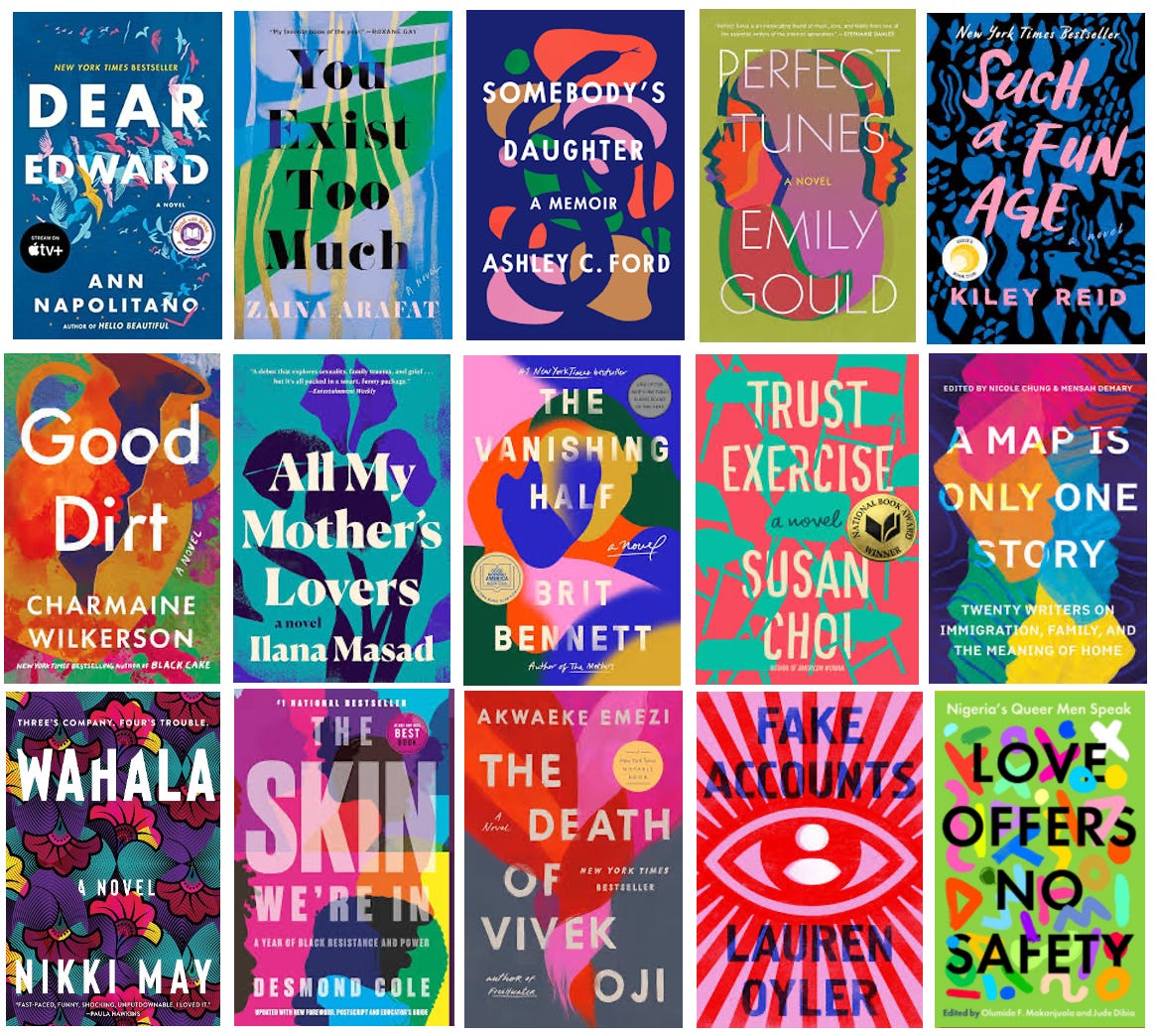
You can tell how stagnant things have become from the lookalike covers. I walk into a bookstore and every title I see is like this.

They must have fired the design team and replaced it with a lazy bot. You get big fonts, random shapes, and garish colors — again and again and again. Every cover looks like it was made with a circus clown’s makeup kit.

My wife is in a book club. If I didn’t know better, I’d think they read the same book every month. It’s those same goofy colors and shapes on every one.

Of course, you can’t judge a book by its cover. But if you read enough new releases, you get the same sense of familiarity from the stories. The publishers keep returning to proven formulas — which they keep flogging long after they’ve stopped working.

And that was a long time ago.

It’s not just publishing. A similar stagnancy has settled in at the big movie studios and record labels. Nobody wants to take a risk — but (as I’ve learned through painful personal experience) that’s often the riskiest move of them all. Live by the formula, and you die by the formula.

How did we end up here?

It’s hard to pick a day when the publishing industry made its deal with the devil. But an anecdote recently shared by Steve Wasserman is as good a place to begin as any.

He’s describing a lunch with his boss at Random House in the fall of 1995. Wasserman is one of the smartest editors I’ve ever met, and possesses both shrewd judgment and impeccable tastes. So he showed up at that lunch with a solid track record.

But it wasn’t good enough. The publishing industry was now learning a new kind of math. Steve’s boss explained the numbers:

    Osnos waited until dessert to deliver the bad news … First printings of ten thousand copies were killing us. It was our obligation to find books that could command first printings of forty, fifty, even sixty thousand copies. Only then could profits be had that were large enough to feed the behemoth — or more precisely, the more refined and compelling tastes — that modern mainstream publishing demanded.

Wasserman countered with infallible logic:

    I pointed out, if such a principle were raised to the level of dogma, none of the several books that were then keeping Random House fiscally afloat — Paul Kennedy’s The Rise and Fall of the Great Powers, John Berendt’s Midnight in the Garden of Good and Evil (eventually spending a record two hundred and sixteen weeks on the bestseller list, and adapted into a film by Clint Eastwood), and Joe Klein’s Primary Colors (published anonymously and made into a movie by Mike Nichols in 1998) — would ever have been acquired. None had been expected to be a bestseller, and each had started out with a ten-thousand copy first printing.

But it was a hopeless cause. And I know because I’ve had similar conversations with editors. And my experience matches Wasserman’s — something changed in the late 1990s.

The old system offered more variety. It took greater risks. It didn’t rely so much on formulas. So it could surprise you.

In a post about the jinned-up anger about CEO pay versus average worker pay, Tim Worstall briefly touches on the plight of writers:

Or even more fun perhaps.

    In 2006, median author earnings were £12,330. In 2022, the median has fallen to £7,000, a drop of 33.2% based on reported figures, or 60.2% when adjusted for inflation.

That’s median earnings so 50% of all authors earn less than £7,000. And note this is only among those taking it seriously enough to join the Society of Authors (a number which does not include me). Even at my level of scribbling 5x to 10x, depends upon the year, of those median earnings can be gained.

But top level authors, well, they do earn rather more. No, not thinking of the JK Rowling level of global superstardom. But it would astonish me if Owen Jones is earning less than 50x those median earnings (yes, Guardian column, books, Patreon, YouTube and whatever, £350k would be my lower guess).

Writers display that similar sort of income disparity and range, no? Because we’re not about to suggest that Owen is top rank earning now, are we, even if it is a damn good income there.

Which shows us what is wrong with the Cardiganista’s1 initial calculation. They’re pointing only to the incomes of the very tippy toppy of the income distribution for that job. If we apply the same sort of reasoning to writers or footie players (and it’ll be the same for actors and all sorts of other peeps) we find very similar distributions.


  1. They all seem to be Guardian retirees and their byline pictures have them wearing cardigans — or did — therefore …

January 6, 2026

Typhoid Mary’s Deadly Ice Cream

Filed under: Food, Health, History, USA — Tags: , , , , , — Nicholas @ 02:00

Tasting History with Max Miller
Published 15 Jul 2025

Fresh peach ice cream frozen in a mold garnished with sliced peaches and peach puree

City/Region: United States of America
Time Period: 1877

Mary Mallon, born in 1869, was a cook for wealthy families, but she’s better known for being the first person found to be an asymptomatic carrier of typhoid fever. While most food was cooked to a temperature that kills the typhoid-causing bacteria, the families that employed Mary loved her peach ice cream.

While ice cream that has eggs in it is cooked, and there’s no way to know what kind Mary made, I opted for a recipe from the time for American style ice cream that has no eggs and isn’t cooked. Whichever ice cream base Mary used, she put cut up fresh peaches into it, which certainly could have carried the bacteria.

Gruesome inspiration for this recipe aside, the ice cream is really good. There’s a ton of fresh peach flavor, and you can make it as sweet or not as you like. The slices of peach inside the ice cream were very cold and kind of froze my mouth, so you could try cutting them up into smaller pieces to avoid the brain freeze I got.

    Peach Ice-Cream
    Mix a quart of cream with a cupful of sugar and four tablespoons of sherry. Add four cupfuls of peaches mashed fine and sweetened to taste, and freeze.
    Everyday Desserts by Olive Green (Myrtle Reed), 1911

(more…)

December 25, 2025

Repost – “Fairytale of New York”

Filed under: Europe, Media, USA — Tags: , , , — Nicholas @ 02:00

Time:

“Fairytale of New York” by The Pogues featuring Kirsty MacColl

This song came into being after Elvis Costello bet The Pogues’ lead singer Shane MacGowan that he couldn’t write a decent Christmas duet. The outcome: a call-and-response between a bickering couple that’s just as sweet as it is salty.

December 1, 2025

Feeding the Robber Barons of the Gilded Age

Filed under: Food, History, USA — Tags: , , , , , , — Nicholas @ 02:00

Tasting History with Max Miller
Published 24 Jun 2025

Two majestic tiers of grapes, mandarin oranges, and raspberries suspended in pink champagne gelatin topped with whipped cream

City/Region: United States of America
Time Period: 1877

The Gilded Age, a period of late 19th century United States history when a handful of people got mind-bogglingly wealthy off of industrialization, conjures up images of the social elite in New York. High society families had more money than most of us could imagine, and they spent it in the most ostentatious ways. One of those ways was by throwing parties that could cost up to the equivalent of millions of dollars in today’s money. These parties would host lavish feasts with dozens of dishes, like this gelée macédoine, which would have been served in a sweet course alongside plum puddings, mince pies, and fruit cakes.

I’m not normally a fan of gelatin, but this was really nice. It wasn’t rubbery at all and the champagne flavor really comes through. It takes a while to make, but feels fancy and is delicious. You could also use the recipe as a base and swap out other types of wine or use other flavorings like liqueurs or spices. If you do add spices (cinnamon was popular at the time), put them into the syrup, and be sure to use a cloth jelly bag or nut milk bag to strain the gelatin mixture. This will ensure a clear jelly.

If you don’t have a gelatin mold, you can use a bundt cake pan, or really any bowl of pan that you have.

    Gelée Macédoine. This is made with any kind of jelly; however, jelly made with Champagne or sherry is preferable. Any of the delicate fruits of the season, such as grapes, cherries, peaches, strawberries, raspberries, mulberries, currants (on their stems), plums, and orange sections, or preserved fruits, such as brandied cherries, peaches, etc., are tastefully imbedded in the jelly, so as to show their forms and colors to best advantage.br/>
    Practical Cooking, and Dinner Giving by Mrs. Mary F. Henderson, New York City, 1877

(more…)

November 6, 2025

Mamdanimentum – NYC gets its very own Justin Trudeau clone

Filed under: Media, Politics, USA — Tags: , , , , — Nicholas @ 05:00

It’s been decades since I last visited New York City, so I don’t know if they really deserve what they’ve just voted for, but I guess we’ll all get to find out over the next few years. On the City Journal substack, Reihan Salam weighs in on the newly elected mayor and what to watch for:

New York State Assemblymember Zohran Mamdani photographed in Assembly District 36, 10 February 2024.
Photo by Kara McCurdy via Wikimedia Commons.

A year ago, not even the most perfervid Astoria leftist would have thought that Zohran Mamdani would soon be elected mayor of New York City. Back then, it was easier to imagine Eric Adams coasting to reelection on the strength of declining crime, or state attorney general Tish James, who came close to running for mayor in 2021, swooping in to unite a fractious Democratic coalition. With Adams badly damaged by a federal indictment and James anxious about what a mayoral bid would mean for her ongoing battle with President Donald Trump, however, the path was seemingly clear for Andrew Cuomo to make a dramatic comeback.

Though it was no secret that Cuomo had real weaknesses, thanks to his polarizing tenure as governor, his name recognition and formidable fundraising machine were enough to freeze out other serious contenders. As a result, the Democratic mayoral field was so bereft of talent that Mamdani — an obscure, hard-left state assemblymember with no legislative or professional accomplishments to speak of — was able to cut through, buoyed by surging anti-Israel sentiment and a series of half-baked pseudo-solutions to the city’s very real affordability crisis.

From one vantage point, then, Mamdani is best understood as an accidental mayor. If federal prosecutors had declined to prosecute Adams, if James had jumped in and Cuomo had stayed out, if Hamas had surrendered its hostages a few months sooner, if moderates and conservatives had consolidated behind a single candidate in the general election, or if any of a number of other possibilities had obtained — the outcome of New York City’s 2025 mayoral race would have been quite different.

In another sense, however, Mamdani’s victory represents the culmination of New York’s larger leftward turn. The shift started in 2018 with the dissolution, at Cuomo’s behest, of the state’s Independent Democratic Conference, an eight-member coalition of centrist Democratic senators who caucused with the Republicans. Their subsequent replacement heralded a broader takeover of Albany by progressives who — again, with Cuomo’s assent — passed a series of ideologically inflected bills: bail reform, the “most aggressive climate change legislation in the nation“, and a major overhaul of tenant protection statutes, to name only a few.

The Mamdani revolution was led by downwardly mobile elites — children of the professional class struggling to make ends meet and entranced by the promises of frozen rent and fare-free buses. They were fired by the same ideas that animated those Albany progressives: that some New Yorkers have been handed the short straw, that soak-the-rich policies can correct these imbalances, and that New York’s private sector was resilient enough to sustain a further ratcheting up of punitive taxation and regulation.

The voters of NYC are not the same demographic distribution as of old … among other things, the Jewish population has shrunk while the Muslim population has grown to nearly the same over the last 25 years, although Jewish women probably voted more similarly to women generally in this election:

October 26, 2025

The financial gap between Zohran Mamdani’s promises and what NYC can afford

Short of a couple of political earthquakes, Zohran Mamdani is going to be the next mayor of New York City. He has, as Andrew Sullivan admits, a lot going for him with Democratic voters, but he’ll have to get some special magic formula working to fund all the things he’s promising:

New York State Assemblymember Zohran Mamdani photographed in Assembly District 36, 10 February 2024.
Photo by Kara McCurdy via Wikimedia Commons.

It is not hard to see the appeal of Zohran Mamdani. He is, after all, not Andrew Cuomo — another corrupt, old, Democratic sexual harasser who’s already spent years in power and thinks he’s entitled to be mayor because of his last name. He doesn’t appear steeped in petty corruption like Mayor Adams. He’s not as obviously nutty as Sliwa seems to be. And he has done politics, pace Ezra, the right way: listening to the other side, earning people’s votes one by one, talking to people on the street, and, of course, mastering our new collective replacement for civil discourse: 30-second videos on TikTok.

Those videos are fantastic. Check out this one in favor of freezing rents in NYC, with the man, in full suit and tie, jumping into a freezing bay and out again. Or this one about “Halalflation” — on how licensing food carts has become a grift for middlemen. Or this one, when he sits down with two old white men — one for Adams and one for Cuomo — and tries to talk them into an alternative. If I were a Democrat, I’d be thrilled to see someone this fresh, this approachable, and this likable as a new face of the party. He’s young and charming and upbeat in a party lacking in all three.

He’s also right to focus his campaign on the question of affordability. New York City is ridiculously expensive in every way; the toll that high taxes and inflation have taken on working-class residents has been huge. Capitalism isn’t working the way it should, and we need to reboot our economic policies to address that as a priority. Trump has promised this but is delivering the opposite. Just this morning, we see an accelerating inflation rate. An opening beckons.

So I get why Mamdani is popular. And I have little doubt he will be the next mayor, as well as a major national figurehead for the Democrats — a nice dose of youth to a party debilitated by seniorityitis. He will define the Democrats nationally — certainly if the GOP has any say in it. And in many ways, he is the perfect candidate for today’s Dem elites: wealthy, woke, with a degree in “Africana studies.” His only problem is not being female — but since he denies that the category of female exists, no big deal I suppose. He will give the MSNBC/Bulwark crowd a new lease on self-righteousness.

But to be honest, when I read his proposals, at first I thought I was reading a high-schooler’s essay. Free everything! I mean: why not? Free universal childcare for kids as young as six weeks old. Free buses for everyone. Rent control for everyone already privileged by it. Subsidized collective supermarkets. $30-an-hour minimum wage by 2030 — up from $16.50. Woohoo! And arresting Bibi as an added bonus. (I have to say the last plank might even tempt me to vote for him.)

The problem, of course, is how to pay for it. And a NYC mayor, quite simply, cannot. Mamdani simply won’t have the power. None of the tax hikes he proposes — a new 2 percent tax on everyone earning over $1 million a year, and jacking up the corporate tax to 11.5 percent — can be passed by his council. Albany has the final say, will almost certainly say no, and the Democratic governor, Hochul, opposes the hikes.

So a lot of this is purely performative, no? He has a good chance to create his Soviet bodegas and, in all likelihood, freeze rents if he replaces members of the board. (That will, of course, make housing availability and expense even worse.) He may be able to wangle some increase in NYC’s minimum wage — by trying to bypass Albany. But doubling it in five years? Meh. All of the economic stuff is iffy because of the very probable lack of funding. Maybe a big victory will change the dynamics and allow a big tax hike in one of the most highly taxed cities on earth. But it’s hard to believe it.

So what’s left? What’s left is cultural leftism on hormones. You may get daycare — but it will come with full woke indoctrination of kids from the earliest years on. No more “boys” or “girls” allowed! Mamdani, as we all know, regards the police as the enforcers of “white supremacy“, supports the end of Israel as a Jewish state, will subsidize the transing of children with no safeguards, and has erased gays and lesbians from our own history, re-marginalizing us as “queers”. There’s no one the woke left hates more than an empowered and integrated person who just happens to be gay or lesbian.

Like all good critical-theory racists, Mamdani believes in a racial hierarchy with whites, Jews, and Asians as oppressors, and blacks and Hispanics and “queers” as victims; he wants to make NYC “the strongest sanctuary city in the country” — i.e. go to war with ICE — and kill the educational programs that help gifted poor kids in kindergarten — because most turn out to be of the oppressor races. A racist, in other words — to his fingertips.

And he is a near-perfect foil for Trump. “Queer liberation means defund the police,” he once tweeted — though he says he no longer wants to defund the cops. It’s the kind of 2020 slogan almost designed to ensure MAGA control of the national discourse forever. And if I were a show-runner on the Trump show, Mamdani would be central to provoking the kind of real fascist putsch that Trump and Miller are itching for, if they can find a suitable provocation. Mamdani is that provocation. He will go to war with ICE in NYC, and Trump will go to war with him. And broadcast it every day.

September 21, 2025

From Eat Pray Love to plotting a murder

Filed under: Books, Health, Media, Religion — Tags: , , , , — Nicholas @ 05:00

On Substack, Elizabeth Nickson charts the career of Elizabeth Gilbert who wrote Eat Pray Love and more recently a memoir of her life up to the point where she planned to murder her “once in a million year” partner:

Gilbert, you certainly know, wrote Eat Pray Love which was a massive international bestseller made into a film with Julia Roberts, which was also very successful. During the Pray portion, Gilbert retreated to an ashram in India to worship a living sub-deity called The Mother. At the time I was still tangentially aware of life in the world of moderately successful upscale arty women from the mega-cities and I’d heard of the Mother and her clinging clanging worship sessions — Siddha Yoga — going round the Pilates and yoga studios and the upscale self-help programs. The Mother’s satsangs were guaranteed to put you into an ecstatic state where you fused with the divine. And then you’d heal. From the abuse of the Patriarchy.

During the Pray section, Gilbert had a series of intense moments, which &mddash; coupled with an earlier session on the bathroom floor where God told her to wash her face and go to bed — meant, to her, a great deal. Her “God” gave her direction and purpose, where before she was caught in an unhappy marriage, being apparently the breadwinner in that marriage with a husband who a) didn’t work, b) wanted her to buy more and more stuff and c) have a child.

This seems a poor choice for a husband, but never mind. Gilbert was successful in the New York world of publishing and magazines and much occupied with that pursuit, a business which I now suspect is financed by the drug trade and used to launder money. In that world where success is one in ten thousand, one hundred thousand, and where Gilbert experienced perhaps the biggest literary success of her generation. She became universally, ridiculously, excessively loved.

And embrace it she did. For the past 15 years, Gilbert has traveled the world, usually with a woman companion to keep her on the rails, dishing out nostrums and platitudes with relish meant to show you how to “find yourself” and “live your truth” to women searching for purpose. “Creativity” or “art” is now substituted for what women in the before times used to call service to their communities and families, which is now called slavery to the patriarchy.

The following is the progression of “evolving” for modern left-of-center women, for whom finding a meaningful work is the number one priority, children being the last, as the below illustrates.

When the recognition of slim to no talent or at least un-sellable talent, is made and a future of grinding for multinationals is revealed, and spiritual enlightenment or Kundalini awakening seems out of reach, the desperation moves onto Democrat politics, and ends in middle-aged and elderly woman on the streets, face contorted in rage. Those women, a full 40% of whom are childless and family-less, spend their lives slogging away in some corporate or health or educational structure, becoming semi-insane. As an aside note, in my years-long investigation of voter fraud, many of the operators are women just like these below: middle-aged, put together, well dressed, polite, fully criminal.

In searching for your creativity — the highest good — you have to become fully aligned with your child self, your spiritual self, and that self becomes the most cherished part of you. Your intelligence, your executive function is demoted. Your creativity, your spirituality, then becomes fused to others whom you perceive being as weak as that child self you have elevated as spiritually superior. Women, it seems hardwired, must have people to care about. In the absence of family, it is the helpless to whom you assign your life.

Gilbert’s once-in-a-million-years love was a gay Syrian immigrant hairdresser with a history of heroin addiction and incarceration. No more victimish victim can be found.

For Gilbert’s millions of acolytes, spiritual worth, meaning,creative power is found in allyship with the weak, with whom they fully identify. And meaning is also found in hysterical advocacy and fury on behalf of the weak. There is no thinking attached to any of this, no analysis, no study. Just intense emotionality.

September 18, 2025

NYC smokers get most of their cigarettes from the black market

Filed under: Bureaucracy, Business, Government, Health, USA — Tags: , , , , — Nicholas @ 03:00

Smokers in New York City pay very high taxes for their nicotine delivery systems, so it shouldn’t have surprised public health officials that many would turn to the black market … but the state and local taxes add so much to the price of a pack of cigarettes that most of the supply now comes from the black market:

“Enjoyin’ a cigarette at busy Time Square, NYC” by Mel Schmidt is licensed under CC BY 2.0 .

In 2023, New York raised its cigarette excise tax by $1.00 to $5.35 per pack. New York City imposes its own tax of $1.50 per pack, and that’s before you include federal and sales taxes, making for the most expensive smokes in the country. That is, cigarettes are expensive in New York for those who pay those taxes. But state officials were warned that such a high rate would drive consumers to the black market, and that’s exactly what happened. According to recent research, more New Yorkers than ever are turning to tax-evading illicit sources for their nicotine needs.

Taxes Into Good Health — or Not

When the New York excise tax was hiked, the Albany Times-Union noted, “it’s the nation’s highest and brings a pack of cigarettes at many retailers to about $12 … Health advocates hailed the increase, saying it will lead to fewer smokers and cancer deaths. Anti-tax groups, though, predicted it will increase trafficking in illicit untaxed cigarettes in the state.”

Health advocates like taxing vices on the theory that raising taxes simultaneously generates government revenue while escalating prices for allegedly bad things — like cigarettes — out of reach of many consumers. What they rarely consider is that there are other options, such as buying cigarettes smuggled from jurisdictions with lower levies.

“New York has created a cigarette-smuggling empire, and the worst is yet to come,” Todd Nesbit, an economics professor at Ball State University, and Michael LaFaive, of the Mackinac Center for Public Policy, warned even before the 2023 tax increase. “It’s the unavoidable consequence of the state’s decades long history of raising the cigarette tax.”

“If enacted, consumers will go across borders to do their shopping or rely on black-market suppliers,” agreed the Tax Foundation’s Adam Hoffer. “Tax revenues will fall, illicit activities will thrive, and law enforcement spending will need to increase.”

In fact, as Nesbit, LaFaive, and Hoffer emphasized, even before the dollar-per-pack tax hike, more than half of cigarettes sold in the state of New York lacked local tax stamps and were smuggled from elsewhere. Since 2023, illicit dealers appear to have claimed even more market share.

July 5, 2025

NYC selects its own Justin Trudeau clone

Filed under: Media, Politics, USA — Tags: , , , , , — Nicholas @ 03:00

The winner of the Democratic primary is almost always subsequently elected as the mayor of New York City, so it’s fair to assume that Zohran Mamdani is going to be NYC’s next mayor. And he’s an American version of ultra-progressive former Prime Minister Justin Trudeau:

New York State Assemblymember Zohran Mamdani photographed in Assembly District 36, 10 February 2024.
Photo by Kara McCurdy via Wikimedia Commons.

American politics often seem to balance themselves out in the worst possible way. Even as the GOP sheds its last vestiges of affection for limited government and free markets, the opposition Democrats openly embrace bigotry and crazy economic nostrums. Case in point: the rise in New York City of Zohran Mamdani, an avowed socialist who flirts with antisemitism, to represent the Democratic Party in this year’s mayoral election.

The primary race in New York was a snapshot of the Democratic Party’s woes. Despite the presence of other candidates seeking the mayoral nomination, the race ultimately came down to two candidates: Mamdani and Andrew Cuomo, the disgraced former governor of New York.

Before resigning over allegations of sexual harassment, Cuomo, the 67-year-old son of another former governor, was best known for a “controversial directive that told nursing homes they couldn’t deny patients coming from hospitals admission based on a COVID-19 diagnosis”, according to StatNews. He then covered up the large number of ensuing deaths. He was the favoured candidate of the Democratic establishment and the early front-runner for the nomination.

Standing out from the pack of political hopefuls facing Cuomo was Zohran Mamdani, the 34-year-old son of an Oscar-nominated filmmaker and a Columbia University political science professor. Before being elected to the state legislature as a Democrat and a socialist, Mamdani tried his hand as a government employee and a rapper. His musical output included the song “Salaam”, which, as The Independent put it, “praised the ‘Holy Land Five’ — five men convicted in 2008 of donating over $12 million to Hamas”.

To say that New Yorkers are tired of Cuomo is a wild understatement. Like most Americans, New Yorkers are deeply sick of the old party establishment that rallied around Cuomo as well as the man himself. Yet, he was expected to walk away with the nomination and then cruise to victory in a largely one-party city.

But Mamdani sweetened the pot in the expensive metropolis with promises to freeze rent, make buses free, offer no-cost childcare, lower grocery prices with city-owned grocery stores, and use “public dollars” to build 200,000 apartments. He swears that he “knows exactly how to pay for it, too” with higher taxes on those making more than $1 million per year. Not explicitly part of his campaign, but on the record as his intention, is “the end goal of seizing the means of production”.

In the 2021 recording in which he advocated seizing the means of production, Mamdani endorsed BDS as an issue “that we firmly believe in”. The BDS movement — shorthand for “Boycott, Divestment, and Sanctions” — aims to economically pressure Israel into withdrawing from so-called “occupied territories” and allowing Palestinians to settle throughout Israel. At its extremes, BDS seeks to eliminate the world’s only Jewish-majority state. It’s inspired by the movement against South Africa’s old apartheid regime.

Older Posts »

Powered by WordPress