
… this morning I was thinking about monasteries. Specifically, monasteries as the one place in the Middle Ages where you might could test my theories about Information Velocity and Caloric Surplus.
I don’t know whether you need much in the way of background, but since some of you seem to enjoy the “inside baseball” stuff … History, as an academic discipline, has always suffered from a “source base” problem. We deal with artifacts; more specifically with documents. If it ain’t written down … see what I mean? This is why whoever-it-was wasn’t wrong when he said that History is just the biographies of Great Men. It’s the biographies of the best-documented men, anyway. I’m exaggerating for effect, obviously, but you see what I mean.
So when, in the Seventies, we had the “cultural turn“, a whole new series of techniques had to be developed to expand the source base. Some of those were good and necessary. Others … well, Wiki quotes Frederic Jameson, one of the most prominent early-90s obfuscators (Indie band name?):
The very sphere of culture itself has expanded, becoming coterminous with market society in such a way that the cultural is no longer limited to its earlier, traditional or experimental forms, but it is consumed throughout daily life itself, in shopping, in professional activities, in the various often televisual forms of leisure, in production for the market and in the consumption of those market products, indeed in the most secret folds and corners of the quotidian. Social space is now completely saturated with the image of culture.
Translated from the PoMo, it’s your standard, tiresome stuff about “critique”. Culture just IS Capitalism, which IS Consumerism, blah blah blah, you know the drill. It’s tedious, but it’s not entirely wrong — what people “consume” (in the egghead sense, not the biomechanical sense) can give us important clues about their world. So long as you avoid the teleological temptation (didn’t they tour with EVC?) of attributing everything to “Capitalism”, you can do good work.
The “problem” with recent history is that the “centers of cultural production” do seem to be identifiable, and so are their motives. They are “Madison Avenue” and “to make money”, respectively, and so it’s easy — and profitable!! — to do the tiresome PoMo CultMarx thing. The further back into The Past you go, though … well, consider this:
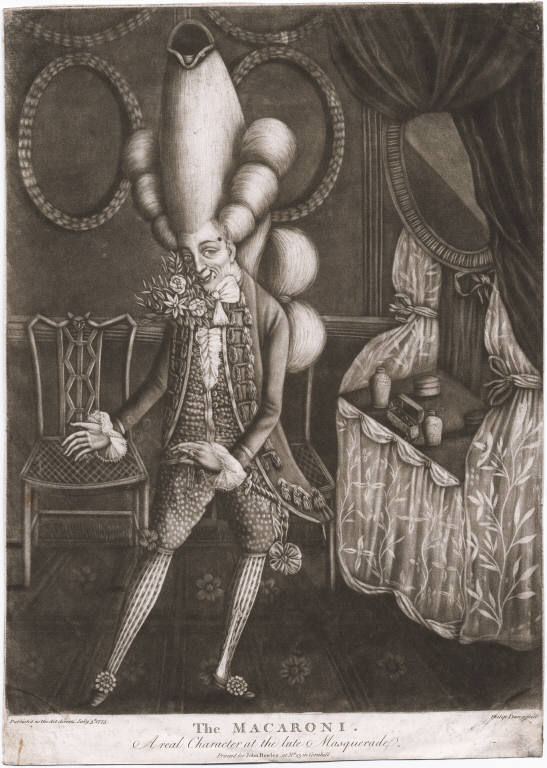
As you can see from the caption, that style is called “macaroni” — like from the old song “Yankee Doodle,” which the Colonials appropriated in an early example of “owning the insult.” Wiki sez:
Stereotypically, men in the macaroni subculture dressed, spoke, and behaved in an unusually epicene and androgynous manner. The term “macaroni” pejoratively referred to a man who “exceeded the ordinary bounds of fashion” in terms of high-end clothing, fastidious eating, and gambling. He mixed Continental affectations with his British nature …
… The macaronis became seen in stereotyped terms in Britain, being seen as a symbol of inappropriate bourgeois excess, effeminacy, and possible homosexuality – which was then legally viewed as sodomy. At the time, homosexuality was frowned upon, and was even punishable by death. Many modern critics view the macaroni as representing a general change in 18th-century British society such as political change, class consciousness, new nationalisms, commodification, and consumer capitalism.
You see the typical “critical” blah blah blah there at the end, and it’s not wrong, just tedious, predictable, and tediously predictable. It’s also much harder to find a “purpose” for this behavior. It’s easy to do for the modern analogue of the macaroni, the hipster […] which Wiki documents extensively, because of course they do, it’s right there underneath “macaroni”. But the whole “culture industry” thing wasn’t there yet in the 18th century, so it might actually be down to an individual person. It’d be theoretically possible to find “the first macaroni” — it was the Marquis de Whatever, and he decided to dress like that because reasons, and all the best people decided to copy him, also because reasons, and that’s pretty much all your “cultural turn” can do, because that’s the only documentation we have.
Since we here are not bound by the canons of scholarship, however, we can speculate. I want to focus on this bit about macaronis:
In the 18th century, wealthy young British men traditionally took a trip around Europe upon their coming of age, known as the Grand Tour. Italy was a key destination of these tours. During their trip, many developed a taste for maccaroni, a type of pasta little known in Britain then, and so they were said to belong to the Macaroni Club, founded in 1764 by those returning from the Grand Tour. They would refer to anything that was fashionable or à la mode as “very maccaroni”.
That’s Information Velocity, preindustrial-style. They had to go there personally — or, at the very least, have access to the in-house journals of those who did:
The song “Yankee Doodle” from the time of the American Revolutionary War mentions a man who “stuck a feather in his hat and called it macaroni”. Dr. Richard Shuckburgh was a British surgeon and also the author of the song’s lyrics; the joke which he was making was that the Yankees were naive and unsophisticated enough to believe that a feather in the hat was a sufficient mark of a macaroni.
In America, only a select few persons would have access to that kind of thing, because only a few would move in those circles.
Go back a bit further, and cultural trends are far less traceable, but “centers of cultural production” are much easier to find, in one specific sense: They’re monasteries. And there you have a group which speaks a common language — extremely rare in the Middle Ages — is literate (ditto), and has something close to, if not caloric surplus, then at least “chronic caloric sufficiency”, I guess we’ll have to call it. Monks worked hard in the Middle Ages, by our standards, but not as hard as the peasantry. They were well-fed, or at least consistently fed, in a way the peasantry weren’t.
In other words, whatever Information Velocity existed in the Middle Ages, they had it. They made a virtue out of circulating books, and all those books were in a common tongue. Since they also produced books — indeed, were pretty much the only ones who did — they were also, by definition, au courant with whatever the high fashions were, because they illustrated the books that were such a crucial part of the aristocracy’s gift-giving culture.
Severian, “Monastic Vices”, Founding Questions, 2026-01-13.
August 25, 2026
QotD: “… and called it macaroni”
July 4, 2026
QotD: “Yankee Doodle”
[…]
Which is how we ended up with a patriotic standard that is also a death threat, a sodomy joke, a farm boy’s account of watching grown men handle their enormous guns with mounting enthusiasm, and the song we teach five year olds at Fourth of July parades. All of this has been inside the song the whole time. I want to walk through what is actually in there, because once you can see it you cannot stop seeing it, and I think we owe the song more than we have been giving it.
Start with the title, because the title is already doing two things at once. “Yankee” is almost certainly from the Dutch Janke, a diminutive Dutch settlers in New York used to mock their English neighbors. The British army picked it up as convenient shorthand for a provincial American. A rube. A man of no consequence. “Doodle” meant fool, from the German dudel, and this is the part that makes it into the elementary school music program. The part that does not is that “doodle” was also eighteenth-century British slang for a penis. Both meanings were in active circulation. Neither was obscure. When the British handed this song to their regulars as a marching tune intended to demoralize the enemy, they were calling the colonists provincial idiots and, on a second pass, Yankee dicks. The American troops heard the title and, in the great tradition of men who have already stopped caring what anyone thinks of them, said yes, that one, put it on the flag.
The first thing the song was is a threat.
Yankee Doodle’s come to town / For to buy a firelock / We will tar and feather him / And so will we John Hancock.
British soldiers were singing verses like this one in the run-up to Lexington. Tar and feathering was not a prank. It was a ritual. Men were stripped, had boiling pine tar poured directly onto bare skin, rolled in feathers while the tar was still cooling, and paraded through town as public spectacle. The skin came off with the tar. Some victims died in the days that followed from shock and from infections in the raw flesh. The British soldiers are singing about doing this to a specifically named man. John Hancock. The wealthiest man in Boston, already on London’s list for arrest. “So will we John Hancock” uses his name as a verb. We will do this to him. We will use his body to make a point.
The soldiers singing this were on their way to arrest him. They missed. Hancock got through Lexington, made it to Philadelphia, and in the summer of the following year signed the Declaration of Independence in letters so large that his name became, in English, the common noun for a signature. The verb became the noun. We will destroy you publicly became I was here, I did this, come and get me. The song that had been a mob-violence threat against a living dissident was now, a year later, being sung by the men who had saved him as they mustered for the same war. The target of the verse became the architect of the country that kept the verse. This is the first transformation the song undergoes and it is not subtle. It is also not the last.
The second thing the song is is a sodomy panic. He stuck a feather in his cap and called it macaroni. Every American schoolchild has been told this means the colonist was too stupid to know what fashion was. That is the sanitized reading. The full reading requires understanding what the Macaroni Club was. Young English aristocrats came back from the Grand Tour in Italy wearing wigs so tall they required structural adjustment to pass under a doorframe, corseted coats, embroidered slippers, and Continental affectations so pronounced the London press began printing caricatures of them within the year. “Macaroni” meant dandy, in the same dictionary-accurate way “doodle” meant fool. Technically correct. Missing the entire point.
The point is that the Macaroni Club had become, by the 1770s, a convenient public container for British anxieties about male effeminacy, foreign moral contamination, and sodomy. The caricatures drew them in pinched silhouettes and muffs, in poses the London audience was supposed to read as unmistakably queer. The courts were not caricaturing. They were prosecuting. Men were pilloried. Others were executed. The word “macaroni” was carrying the weight of active criminal cases at the exact moment “Yankee Doodle” was being composed. A British army surgeon named Richard Shuckburgh is the likely author of the most famous macaroni verse, and what he wrote was a joke with a second floor. On the ground floor: the colonial rube does not know what high fashion is and mistakes a single feather for an entire wardrobe. On the second floor: the colonial rube has just put on the signifier of a group of men the British state is currently prosecuting for sodomy, and he does not realize what he has announced himself as. He is a joke to the troops singing the song, and the joke is that he is queer and does not know it.
The colonists heard all of this and kept the song anyway. The British were banking on a shame that had already dissolved. You cannot humiliate a people that has stopped needing your approval. The song arrived as an instrument of British contempt, and the colonists adopted it anyway, and from that moment on it stopped being a British song and started being something else. A vessel. Whatever the singer needed it to carry, the song carried. That is the reclamation, and it is also the engine of everything that happens to the song from here.
Emma, “Yankee Doodle, Undressed”, Past Life, Present Cleavage, 2026-04-22.
December 24, 2025
Welcome to Bland World
Ted Gioia yearns for the return of the weirdo, the eccentric, and the non-conformist to spice up our bland, smooth, grey world:
“People are less weird than they used to be,” claims psychologist Adam Mastroianni. He describes this as “an epidemic of the mundane”.
The strangest thing, he believes, is absence of strangeness. Nobody wants to make waves — or even trickles. Conformity is the flavor of the month, and it tastes the same every month.
We live in a “smoothness society”, explains philosopher Byung-Chul Han. He points to the smooth, rounded contours of the iPhone as a symbol of society’s desire to remove friction. Our phone apps demonstrate the exact same thing. We scroll and swipe with such ease, and anything with complexity, nuance, or resistance is eliminated from consideration.
“The smooth is the signature of the present time”, he claims. Everything from the Brazilian wax job applied to human bodies to the wax coating put on fruits and vegetables aims at the same ideal.
Resistance is futile. Everything must be smooth. Paradise now really is that paved parking lot.
In a world without complexity or resistance, nothing ever changes. Most movies, music, books feel like stagnant rehashes of the same formulas. And that’s intentional.
For the first time in history, fashions don’t change. We don’t change.
Others have noticed this avoidance of anything new or different. Things are designed to blend in, not stand out. Jessica Stillman, writing in Inc., complains about a “blandness epidemic“. Brian Klaas calls it the “surefire mediocre“.
Everywhere you look, the system is serving up more of the same.
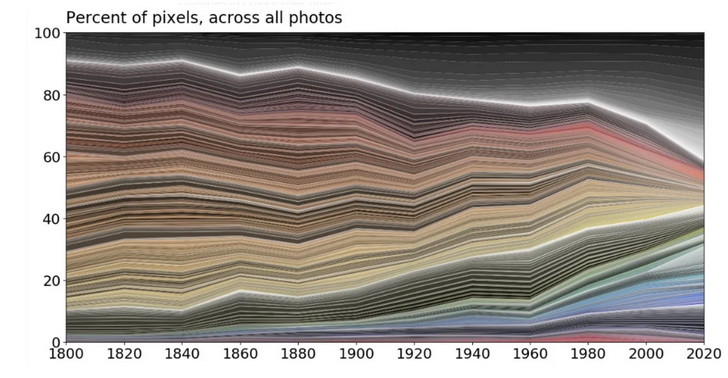
It’s not just in our imagination — the “world really is getting grayer“. A researcher recently studied photos of household items going back two centuries. An analysis of the pixels showed a scary collapse in color.
Even the Victorians — often considered as conformists — lived a more color-filled life. We have almost completely abandoned red and yellow and other bright hues in favor a boring black-and-white spectrum.
But what’s most striking is how this descent into grayness has accelerated during the last few years. The most popular color is now charcoal — and at the current rate it will soon account for half of the marketplace.


September 9, 2025
QotD: The horrible 1970s
Colby Cosh, “Cinema: recently seen”, ColbyCosh.com, 2005-08-19.
June 27, 2025
QotD: The dangers of “doing too much principal component analysis”
[…]
By the way, the fact that models are beautiful in a highly specific way, and that there exist women who are similarly beautiful but condemned to be “civilians”, is a good reminder of the dangers of doing too much principal component analysis.2 In so many areas of life, we are obsessed with collapsing intrinsically high-dimensional phenomena onto a single uni-dimensional axis. You see this a lot with the status games that leftists play around privilege and oppression — I feel like a rational leftist would say that a disabled white lesbian and a wealthy scion of Haitian oligarchs are just incomparable, each more privileged than the other in some senses and less in other senses. But no, instead there’s an insistence that we find an absolute total ordering of oppression across all identity categories, a single hierarchy that allows us to compare any two individuals and produce a mathematical answer as to which one is more deserving of DEI grants. My hunch is a lot of the internal tensions and bickering within American leftism are actually produced by this insistence, which makes sense because it’s totally zero sum.
But the disease of trying to pin everything to a single number is hardly confined to the left. You see it on the right in the obsession with IQ, as if a single number could capture the breathtaking range of variation of cognitive capabilities across all humanity. I mean for goodness sake, Intel learned the hard way that this doesn’t even work for computers, and human brains are much weirder and more complicated than microprocessors. But the even dumber version of this is the 1-10 scale of female beauty. There’s something so sublime about seeing a beautiful human being, because so much of it is either bound up in subtle interrelationships between different features (this is why plastic surgery often makes people uglier — there’s no such thing as a “perfect nose”, and if you pick one out of a catalog you’ll probably end up with one that doesn’t fit your face), or it’s irretrievably evanescent — a fleeting glance, or the way her hair falls across her face just so, gone the moment after it happens. Taking something so ineffable and putting it on a 1-10 scale only makes sense as a form of psychological warfare. And I get it, amongst the young people relations between the sexes have degenerated to the point of more or less open warfare, but come on, this is pornbrained nonsense.
Speaking of both the DEI olympics and the classification of female beauty, some parts of this book are really charmingly naive, and I snickered a bit at Mears’s mystification at why all of the models are white and blonde. The really funny part is that she says something like: “I expected this legacy of white supremacy to be in retreat given that so many of the big spenders in clubs these days are from Asia and the Middle East”. Is she really not aware that men of other races have an even stronger aesthetic preference for white women than white men do?3
John Psmith and Gabriel Rossman, “GUEST JOINT REVIEW: Very Important People, by Ashley Mears”, Mr. and Mrs. Psmith’s Bookshelf, 2024-03-04.
1. In fact, an unusually high proportion of models are intersex individuals with a Y-chromosome and androgen insensitivity syndrome.
2. Not the only danger of too much principal component analysis!
3. Gabriel: Kimberly Hoang did an ethnography as a bar girl in several Vietnam bars. At the bar that catered to Vietnamese elites, the other bar girls made her lighten her skin with cosmetics and wear a black minidress, with the target look being tall, pale, and slender K-pop idol. When she moved to another bar catering to white sex tourists, the other bar girls told her to wear bronzer and a slutty version of traditional Asian dress with the target look being exoticized sexiness. See: Hoang, Kimberly Kay. 2015. Dealing in Desire: Asian Ascendancy, Western Decline, and the Hidden Currencies of Global Sex Work. University of California Press.
March 21, 2025
The Shocking Dress That Sparked Global Outrage! – W2W 13 – 1947 Q3
TimeGhost History
Published 19 Mar 2025In 1947, Christian Dior stunned the world by introducing his controversial “New Look”. With luxurious dresses and ultra-feminine silhouettes, Dior’s designs ignited fierce debates about gender roles, societal values, and post-war extravagance. While some saw his collection as a welcome return to elegance, others viewed it as an insult during times of austerity. Was Dior celebrating beauty or setting women’s progress back decades?
(more…)
February 7, 2025
Justice for WW2?! – W2W News 1945
TimeGhost History
Published 6 Feb 2025Join SPARTACUS and INDY on the War2War 1945 Newscast as we explore a world tumbling from war to war. European colonies face fresh conflicts and groundbreaking polymer innovations spark industrial revolutions. All the while Nazi war criminals are brought to justice at the Nuremberg Trials.
(more…)
October 22, 2024
A Conquering Hat: a History of the Bicorn
HatHistorian
Published Jul 1, 2022Emblematic of Napoleon Bonaparte and his age of conquest, the bicorn is a distinctive military hat that became part of the most formal of dress uniforms and remains to this day in certain ceremonial outfits
The bicorn I wear in this video comes from Theatr’Hall in Paris https://www.theatrhall.com. The uniform comes from thejacketshop.co.uk
Title sequence designed by Alexandre Mahler
am.design@live.comThis video was done for entertainment and educational purposes. No copyright infringement of any sort was intended.
August 3, 2024
The Rise, Fall, And Revival Of Art Deco | A Style Is Born W/ @KazRowe
Wayfair
Published Jun 15, 2023Welcome to A Style is Born, hosted by YouTuber, cartoonist, and champion of under-represented history, Kaz Rowe!
Join us as we go down the rabbit hole and uncover the unique histories and origin stories behind your favorite design styles. In this first episode of Season 2, we delve into the history-rich Art Deco movement.
Chapters
Intro – 00:00
History – 00:45
Influences, Elements, & Materials – 04:58
1980s Art Deco Revival Via Memphis Group – 07:46
Conclusion – 09:13
(more…)
June 23, 2024
QotD: Shoes
Grant McCracken, “Cotton, Converse and co-creation”, This Blog Sits at the, 2005-07-27.
December 30, 2023
In defence of … cufflinks?
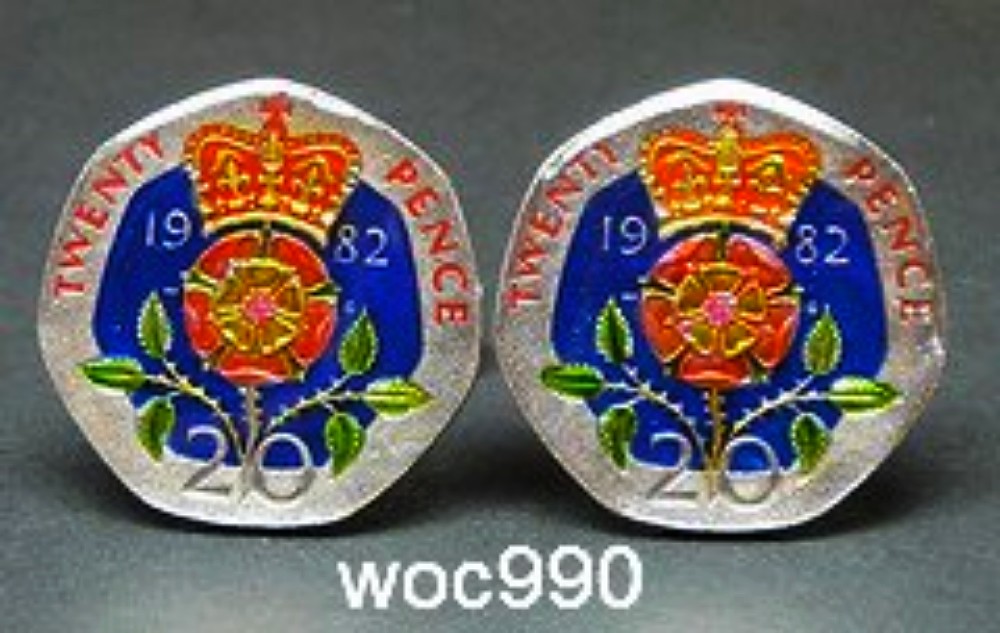
In The Critic, Peter Caddick-Adams makes the case for sartorial splendour over modern-day slovenly dress, and particularly for the cufflink:
“Great British coin cufflinks” by wowcoin is licensed under CC BY-SA 2.0 

 .
.
… these traditional baubles are fast becoming the clothing language of the old guard. Although fashion is always on the move, we are less stylish than we once were. Perhaps propelled by Mrs Thatcher’s homely handbags, refinement in dress is receding from everyday life. The fact that our current Prime Minister, like his predecessor-but-one, rarely sports cufflinks is a symptom of a greater sartorial malaise.
Links evolved in the 19th century as a means of displaying wealth and class, following the ruffled nonsense of the Elizabethan and Baroque eras and floppy sleeves sported by Beau Brummell and his Regency dandies. After Prince Albert had popularised the watch chain named after him, masculine fashion was bowled over by his son, the frock-coated Prince of Wales, later Edward VII. “Gentlemen, you may smoke,” he proclaimed on ascending the throne in 1901, instantly removing Queen Victoria’s ban on puffing away on the royal estates.
Apart from making a profession out of cigar-smoking, the new king influenced many clothing innovations, including trouser turn-ups (a last-minute tailor’s resort), those monstrous “Windsor” tie-knots, and leaving the bottom button of a waistcoat undone (due to the imperial stomach). The most colourful were His Majesty’s shirt embellishments designed by Fabergé. They immediately prompted Europe’s middle classes to weigh-in with gold, enamelled or monogrammed cuff jewellery, without which the aspiring Edwardian-era male was, frankly, naked.
Not compatible with the rigours of combatting the Bosche in the trenches of the Great War (when the affectation of tucking a muddied or bloodied handkerchief into one’s coat sleeve re-emerged), cuff-links returned with vigour during the Jazz Age. Their reappearance, along with spats (worn around the ankle) was due to the lack of central heating in His Majesty’s realm. All those draughty corridors in smart houses (and lack of instant remedies for colds and flu) necessitated warm ankles, with silk-wrapped necks and wrists protected by elaborate studs and links.
Resurgence was brief, for the aforesaid gentleman’s accessories almost vanished in 1939–45 with the advent of austerity imposed by adversity. Skullduggery by German submarine captains created shortages of fine shirting. The resultant famine of silk and cotton in turn destroyed the double cuff, which hitherto had been bound together so effectively by links. As it was deemed unpatriotic in the many countries at war to advertise luxury, these flourishes fell out of fashion completely.
Winston Churchill compounded this utilitarian mood with his man-of-the-people “siren suits” (predecessor of today’s onesies). They reflected the epoch of clothing short-cuts, such as collar-attached shirts, zip fasteners and trouser belts, replacing collar studs, fly buttons and braces — all, you will note, gifts from our Transatlantic cousins. Although men’s hats were retained for warmth, mainly disappearing in the 1960s because of our extended lives in automobiles, these moves to simpler clothing (even if, in Churchill’s case, adorned with a spotted bow tie) also threatened the permanent demise of the cuff-link. More correctly, they threatened cufflinks, for these are only of value in the plural.
Indeed, “what is the point of cufflinks?”, I hear you ponder. Anthropologists will tell you that man is a curious creature. From the dawn of time, he has had a weakness for asserting individuality, to signify class or leadership, or oft-times as part of a mating ritual. Archaeologists will reference troves of treasured jewellery in excavated graves. Historians cite portraits, engravings, photographs and uniforms, monocles and cravats as proof of this down to modern times. Staying with a barrister friend recently, I was shown his collection of about fifty pairs of cufflinks. Their designs reflected his three lives as a reserve officer, lawyer and freemason.
October 11, 2023
Art Deco in 9 Minutes: Why Is It The Most Popular Architectural Style? 🗽
Curious Muse
Published 3 Sept 2021What comes to your mind when you think of the 1920s? For most people, the 1920s conjures up images of jazz, flappers, Old Hollywood, the Great Gatsby, and the Chrysler Building in New York City. It was a time of prosperity, exorbitant spending, and entertainment that gave rise to one of the most popular decorative arts and architecture movements — known as Art Deco.
Characterized by exquisite craftsmanship, lavish decoration, and rich materials, the style has become synonymous with the Roaring Twenties. So, what was the Art Deco movement all about and what differentiates it from other major movements? Finally, despite its popularity today, what makes Art Deco so closely associated with the 1920s?
In this week’s video, we’ll dive into the history of the era and learn about Art Déco, the style that continues to inspire designers and architects around the world!
(more…)
August 30, 2023
QotD: Hairstyles of the late Ancien Régime
As the industrial revolution and various other shifts (including truly disastrous harvests) robbed those whose income came from hereditary landholding of their ancient riches and prominence, even while the court demanded a complex set of “dancing attendance” for royal favor (A policy started and encouraged by Louis XIV in part to rob the nobility of wealth and prominence, not to mention keeping their minds off rebellion) the nobility felt insecure. The fact that its ranks were being penetrated by people from the bourgeoisie, who married their children or “simply” franked the nobility’s lavish lifestyles, made the nobles feel they were losing control. Even though rank remained a thing of birth, they were in fact, in the real world, losing rank.
The response were fashions so extravagant that they make us go “Wait, what?” and must have given people headaches.
You can see where wigs came from and were fashionable, in a society without running water and/or decent shampoos. It was easier to keep your hair ridiculously short and wear wigs, which is why they’ve been part of human fashion since ever.
But it took the French revolution to come up with wigs on armatures (or hair extensions, ditto) and hairstyles that incorporated ships and, at one point, bird cages with live, singing birds.
To look at drawings or read descriptions is to go “uh, what? who ever thought that was attractive?” and also “Boy their heads must have hurt”.
Yet the competition for the most elaborate and showy hairstyle, no matter how insane, did not stop until those heads fell to Madame Guillotine thereby stilling forever their status anxiety.
Sarah Hoyt, “Is That A Ship On Your Head?”, Libertarian Enterprise, 2019-09-01.
August 25, 2023
QotD: Passive-aggressive “fashion”
This is why the doctrine of multiculturalism, far from making people behave better and more sensitively to the feelings of others, allows them to behave worse and less sensitively to the feelings of others. It is almost normal or instinctive human behaviour when in unfamiliar social surroundings to look around and see how other people are behaving, estimate what might offend them, and adjust one’s own conduct accordingly. Of course, one sometimes gets it wrong, but at least one tries. However, if multiculturalism is the demand that we accept the conduct of others, it is at least as much the demand that they accept our conduct, whatever it might be. And therefore there is no need for us to adjust it merely for their comfort.
Theodore Dalrymple, “Suit Yourselfie”, Taki’s Magazine, 2017-09-16.
June 7, 2022
QotD: Mens’ fashion in Europe versus the USA
The Z Man, “Travelogue: Talinn”, The Z Blog, 2019-04-03.


