Quotulatiousness

May 4, 2026

Our genetic heritage and our culture

On Substack, Helen Dale and Lorenzo Warby look at our genetic inheritance and how it continues to shape our culture:

From Wikipedia:

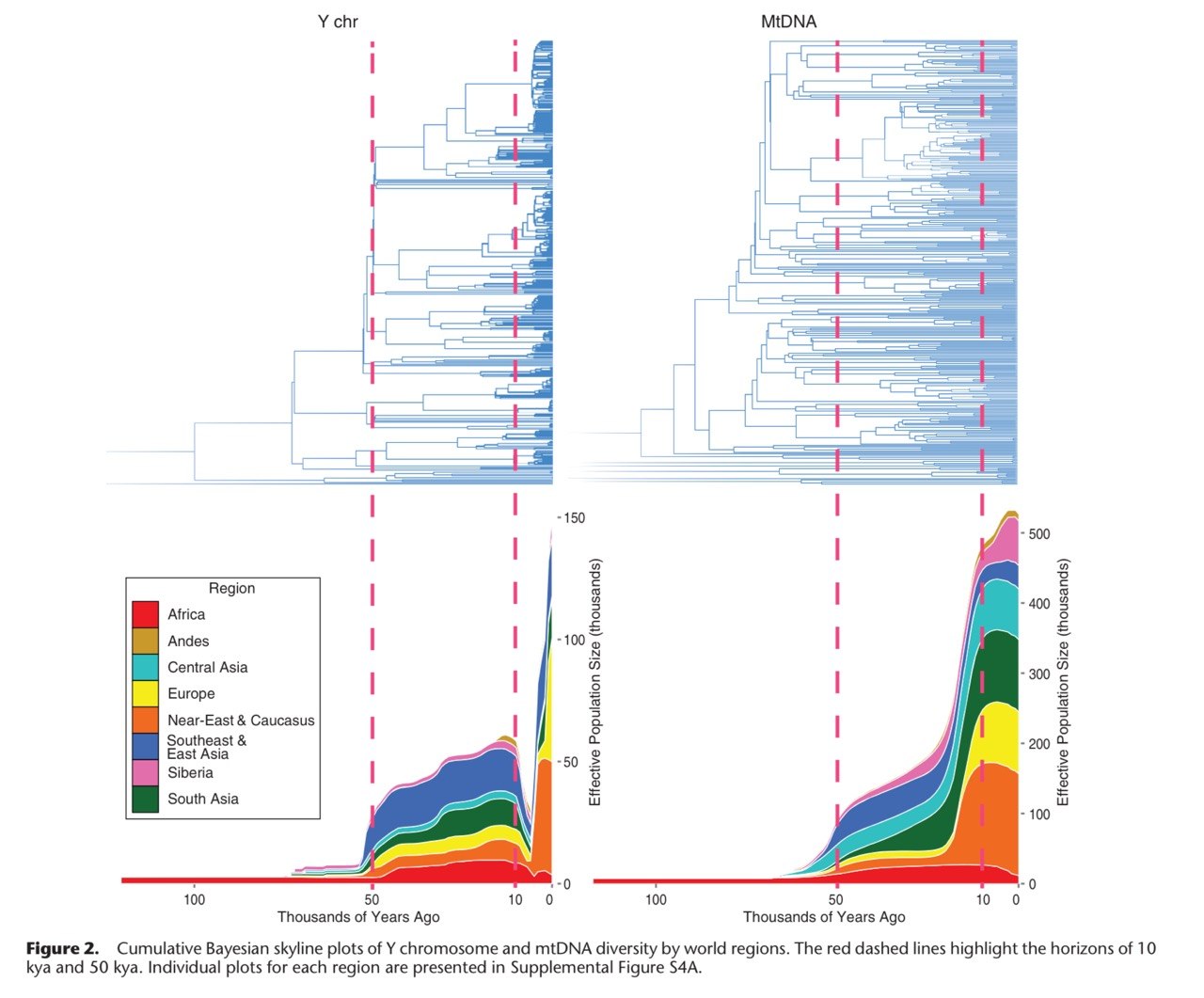
    The Neolithic Y-chromosome bottleneck refers to a period around 5000 BC where the diversity in the male y-chromosome dropped precipitously across Africa, Europe and Asia, to a level equivalent to reproduction occurring with a ratio between men and women of 1:17. Discovered in 2015, the research suggests that the reason for the bottleneck may not be a reduction in the number of males, but a drastic decrease in the percentage of males with reproductive success in Neolithic agropastoralist cultures, compared to the previous hunter gatherers.

The development of farming and then animal herding greatly increased the number of humans — which continued to have evolutionary consequences for our species — and created productive assets (farms and animal herds) worth fighting over. Successful male teams (typically organised as clans) wiped out unsuccessful male teams and took their women as spoils.

Hence, there is a dramatic bottleneck in male lineages but not in female lineages. This pattern stopped with the development of chiefdoms and especially states, though not so much on the Steppes, whose states were more like super-chiefdoms and where intense competition over resources (and women) continued.1

This had consequences. A major one is that the male expression of human genes became dramatically better at forming and maintaining teams — as there was drastic selection pressure for that — but the female expression of human genes did not.

This is why young schoolboy sporting teams regularly crush adult women’s national teams in team sports such as soccer. It is not that schoolboys have the strength advantage over women associated with adult men (they are often not particularly advantaged around age 14-15). It’s simply that human males are much more likely to “get” teamwork at a visceral level.

At least some of the differences in the statistical distribution of cognitive traits between men and women comes from this genetic bottleneck’s intense selection pressure differences. This is particularly clear in social patterns. For instance, men readily form hierarchies — often using physical cues such as height to do so.

Men focus on roles, suppressing or otherwise managing their emotions to do so. They regularly test each other — hence ragging each other, making appalling jokes, etc. Such mechanisms generate trust, as they test whether you will fold under pressure, whether one can say outrageous things and still get support. Hence the popular quip:

    Men insult each other but they don’t mean it. Women compliment each other but they also don’t mean it.

Men roast each other as tests because so much male interaction is about teamwork, and the roles and reliability that requires, while women typically look to emotional connection. Given that the latter requires a lot of interaction to build up trust, yes, female friendships can be quite intense, but relations between human females can also be viciously unstable and fissile.

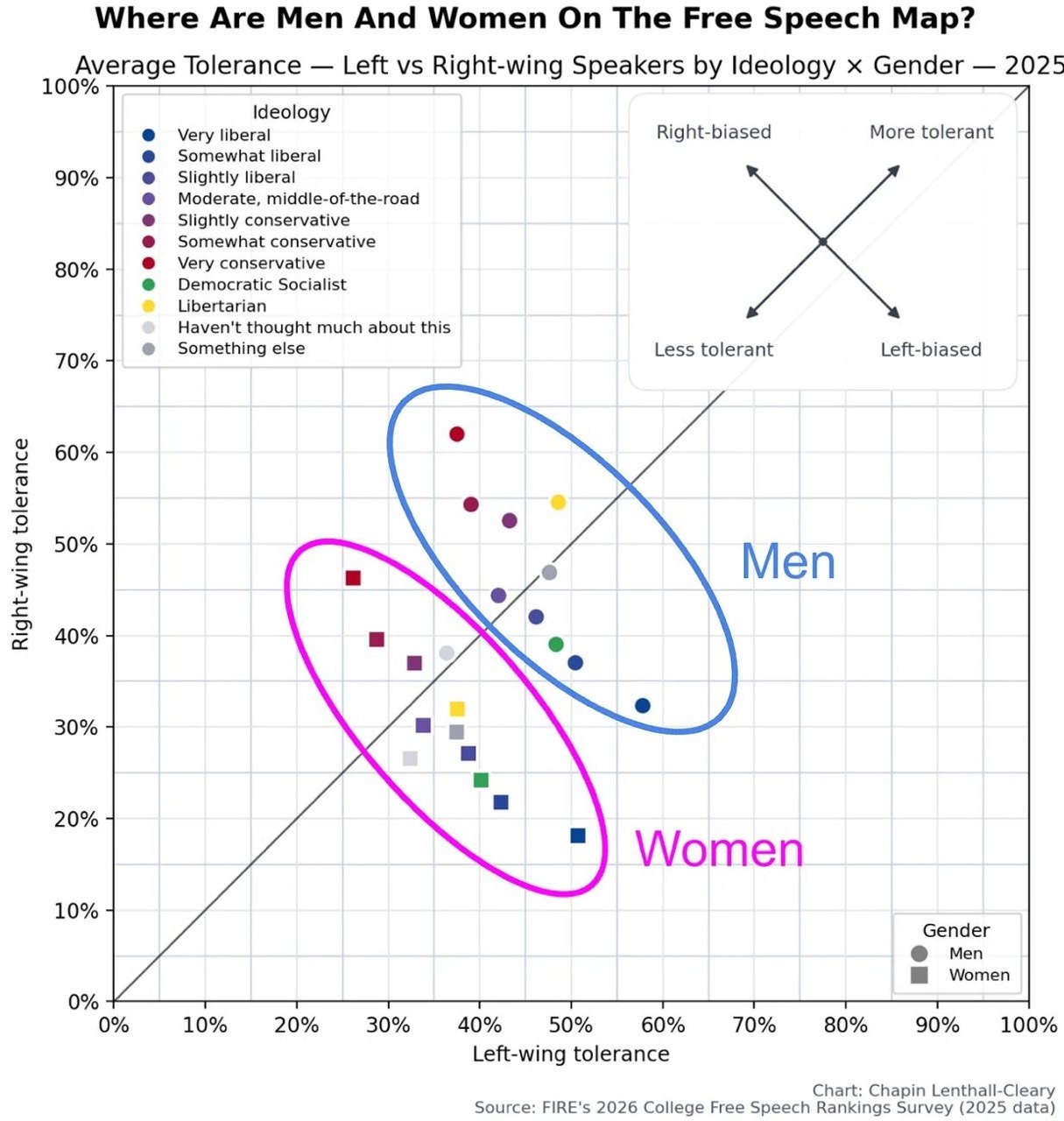
These differences have other social consequences. Men are notably more positive about free speech than women, because men often see speech as a test while women are more likely to see it as a threat. As universities have feminised, the male-female differences on free speech among students have become more pronounced. Men are systematically more tolerant of alternative points of view than are women.

Orwell’s famous comment in his novel 1984:

    It was always the women, and above all the young ones, who were the most bigoted adherents of the Party, the swallowers of slogans, the amateur spies and nosers-out of unorthodoxy.

Was a great novelist doing what great novelists do: noticing.

As part of the teamwork focus, men tend to be the social solidarity sex while women are not. Women are much less likely to have friends of lower socio-economic status than are men. For women, such friends are much less likely to be worth the emotional investment. For men, they may be useful members of a future team.

As institutions, occupations and public discourse become more feminised, there has been a shift in patterns of language. A massive study of patterns of language use found a dramatic shift since the 1980s, such that:

    our results suggest that over the past decades, there has been a marked shift in public interest from the collective to the individual, and from rationality toward emotion.

All this means that male-dominated institutions and spaces will be generally better, often much better, at generating and managing feedback than female-dominated spaces. When people note that feminising institutions and occupations have a strong tendency to become less functional, it is precisely because they are worse at generating and managing feedback, and at generating and maintaining trust.


  1. This paper attempts to explain the extreme narrowing of surviving male lineages by the adoption of patrilineal systems and polygyny. While the shift to patrilineal systems in itself does increase unequal lineage success—as does polygyny—much of the point of the shift to patrilineality was precisely that warriors who grow up together are better warrior teams.
  2. Moreover, there is considerable evidence of violence after the shrinkage of male lineages dramatically slowed — and then reversed — with the development of chiefdoms, and especially states. These suppressed violence, but not patrilineality or polygyny. In many societies, polygyny actually intensified with the rise of states.

    The bottleneck effects continued to echo down populations. The extraordinary reproductive success of particular male lineages is associated either with pastoralist violence and conquest and/or early state creation. Further, the notion that the majority of male lineages just passively accepted their reproductive exclusion flies in the face of a huge amount of evidence — especially as the examples of very successful pastoral lineages occurred in societies with notoriously high levels of violence, including as raiders, such as across the Steppes and in Ireland.

    Moreover, polygyny is associated with higher rates of violence, single-spouse marriage with higher social cohesion. Nor was the creation and maintenance of states typically a peaceful process: periodic violent peaks in Chinese history, for example, were extraordinary. It was precisely the creation of a reproductively-excluded underclass that provided so much of the impetus for the banditry and mass peasant revolts that are such a feature of Chinese history. So, while patrilineality and polygyny were definitely factors in the wildly differentiated success rates of male lineages, considerable levels of violence and contestation over resources and women — that selected in favour of male teamwork — were clearly also very much in play.

April 12, 2026

The two kinds of enshittification

Filed under: Business, Media, Technology — Tags: , , , — Nicholas @ 03:00

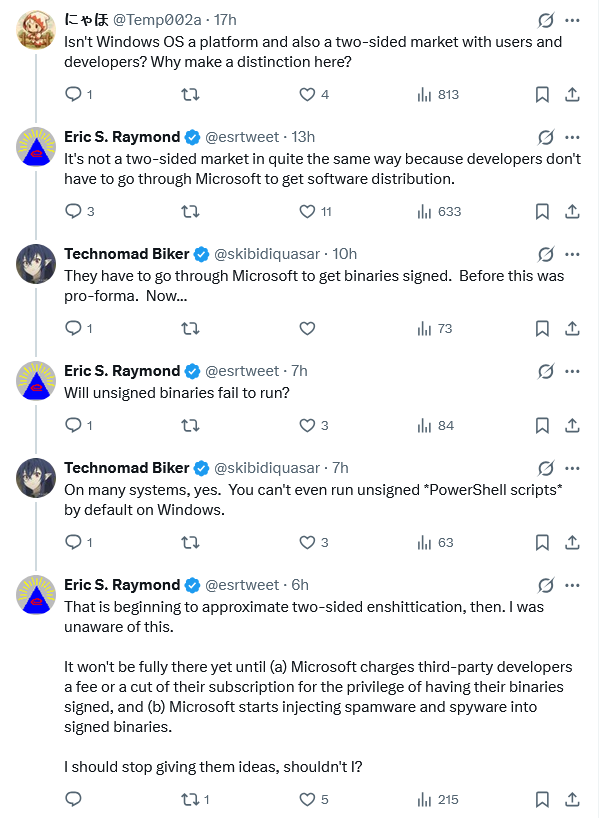
On the social media site formerly known as Twitter, ESR explains the differences between the two kinds of enshittification we’re seeing these days:

It may be time to start distinguishing between classic two-sided enshittification and a more general single-sided variety.

When Corey Doctorow originally defined the term “enshittification” he was describing a very specific thing that can and does happen when a platform like Amazon or Google acts as a two-sided market-maker. They start by reducing friction for both buyers and sellers, get everybody locked in by the higher cost of doing volume business anywhere else, then start charging tolls on both sides and injecting spamware that nobody wants. Eventually even their search function becomes completely shitty.

The increasingly horrifying “agentic” train wreck that Windows 11 has become isn’t a two-sided platform in the same way, but the feel of its late stages is depressingly familiar. It’s so stuffed with bloatware, spamware, and spyware that its nominal function as an operating system to run programs for its users feels almost like an afterthought.

I’m going to call this “single-sided enshittification”, and point out that both kinds stem from the same fundamental disconnect. They’re both things that happen when the dominant revenue stream from a product is disconnected from the needs of its original users.

In both cases, an important factor, though not the only one, is the attack of the adtech vampires. So very much of the ugliness in enshittified platforms is downstream of the easy money that they offer product owners for allowing them to sink their fangs into the information stream.

I don’t have a solution to this problem. But if there is one, it starts with identifying the problem correctly. Enshittification — it’s not just for two-sided platforms anymore.

From the comments on the original post:

March 27, 2026

The reason you feel detached from most modern art, movies, and music

Filed under: Economics, Media, USA — Tags: , , , , — Nicholas @ 05:00

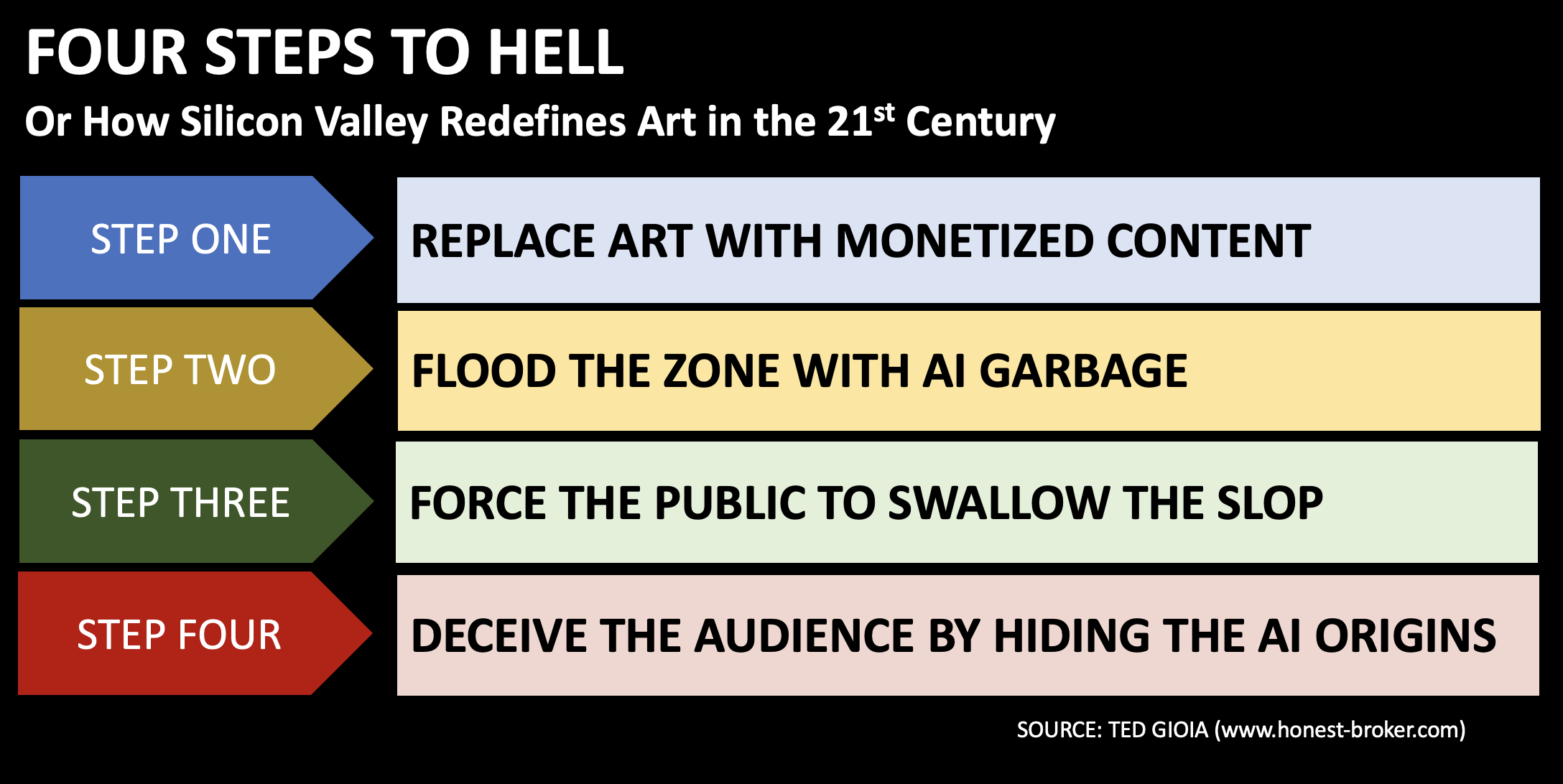
Ted Gioia explains what he calls the “Four steps to Hell” that have replaced the aesthetic values of the past and shows why everything in entertainment is being actively enshittified:

MGM’s lion and the Ars Gratia Artis motto (Art for Art’s Sake). But the lion is screaming in pain today.

Smart people have recently asked: What is the aesthetic vision of the 21st century? What are the stylistic markers of our time? What are the core values driving the creative process? What is our zeitgeist?

At first glance, that’s a hard question to answer. We are more than a quarter of the way through the century, and very little has changed since the 1990s.

  • Music genres have barely shifted in that time. The songs on the radio sound like the hits of yesteryear — in many instances they are the hits of yesteryear, played over and over ad nauseam.
  • Movies are in even worse shape. Hollywood keeps extending the same tired brand franchises you knew as a child. SoCal culture feels like an antiquated merry-go-round where the same tired nags keep coming around in an endless circle.
  • Publishers still put out new novels, but when was the last time you read something really fresh and new? Even more to the point, when was the last time you went to a social gathering and heard people discussing contemporary fiction with enthusiasm?
  • The same obsession with the past is evident in video games, comic books, architecture, graphic design, and almost every other creative sphere. Everything is a reboot or retread or repeat.

It’s not aesthetics, it’s just arteriosclerosis.

Even so, I see a new dominant theory of art — and it’s sweeping away almost everything in its wake. It already accounts for most of the creative work of our time, and is still growing. Nothing else on the scene comes close to matching its influence.

So if you’re seeking the most influential aesthetic vision on the 21st century, this is it. It’s simple to describe — but it’s ugly as sin.

I call it Flood the Zone. It happens in four steps. […]

Do read the whole thing, but in case it’s a case of tl;dr, he also summarizes it for you:

March 2, 2026

A Day in the Life of an Ensh*ttificator

Filed under: Business, Humour, Media, Technology — Tags: , , , , — Nicholas @ 04:00

Forbrukerrådet – Norwegian Consumer Council
Published 27 Feb 2026

Digital products and services keep getting worse. In the new report Breaking Free: Pathways to a fair technological future, the Norwegian Consumer Council has delved into enshittification and how to resist it. The report shows how this phenomenon affects both consumers and society at large, but that it is possible to turn the tide.

Read more on: https://www.forbrukerradet.no/breakin…
(more…)

January 25, 2026

Why does Microsoft treat its users so badly? Because it can

Filed under: Business, Media, Technology — Tags: , , , — Nicholas @ 03:00

On the social media site formerly known as Twitter, ESR considers the situation most Microsoft users find themselves in these days:

Between the forced updates, the spyware, the adware, OneDrive constantly attempting to suck up all your data, and infinite dark-pattern subscription traps, I’m gathering that many Windows users are now nostalgic for the days when the shit only seemed to be up to their ankles rather than lapping at their nostrils.

The information asymmetry of closed-source software inevitably fucks the user over. I know, I know, I sound like a broken record. I’ve been banging on about this for going on 30 years now and even I get tired of my own rant sometimes.

That’s not why I’m posting today. Instead I want to publicly contemplate an unobvious question: just why is Microsoft treating its users so badly?

“Because it can” is not really a responsive answer. Corporations don’t do evil things because they like being evil, they only do evil things because they think they’re profit-maximizing.

So I understand about the dark-pattern subscription stuff and the adware. That’s slimy, but it’s revenue capture. There’s at least a cold-blooded trade-off you can imagine some product planner making between revenue line-go-up now and pissing off people who won’t be customers later.

But what is Microsoft maximizing by doing things that drive users away from it without any revenue capture? What model of reality, or failure of decision making, do you have to have to think it’s a good idea to push forced updates with work-interrupting reboots that can’t be blocked or delayed by the user?

It would have been trivial to have a pop-up that says: An update is available. Do it now, or defer it until ? The fact that that didn’t happen can’t be ascribed to revenue-line-go-up fever. These are two different kinds of ugly.

And that second kind makes me think that there’s nobody left in product management at Microsoft with the ability and authority to veto bad ideas because they will anger the users.

It looks to me like nobody over there is thinking strategically about customer retention anymore. By the time you get to the point where nobody squashes forced-update reboots, nobody can seriously raise the question of whether adware is going to drive away so many users that Windows market share will tank and take all that lovely subscription revenue with it.

This is where I point out, with weary inevitability, that it’s going to get worse before it gets even worse. With nobody keeping an eye on the long game and user retention, the petty money grabs will only accelerate. Microsoft will keep flogging that donkey until it dies.

The irony here is that if Microsoft were an efficient maximizer of long-term profit they would be doing less of the shitty enraging crap that they are now.

How much less depends on how good their judgment is. You can be actively trying to keep a critical mass of your user base happy enough not to bail out and still fail. But at least Microsoft would be trying. Right now, there’s damn little evidence that they are.

January 12, 2026

The rise of slop – “you get a clanker, and you get a clanker, everyone gets a clanker!”

Filed under: Business, Media, Technology — Tags: , , , — Nicholas @ 03:00

The artificial intelligence wave continues, despite widespread resistance to AI being inserted into everything. It was bad when your toaster and refrigerator started needing access to the internet, but it’s bound to be so much worse when everything has to have an AI component bolted on to it as well. At The Libertarian Alliance, Neil Lock decries the rising tide of AI slop:

In recent days, there has been an eruption in the tech world. It is unlike anything I have seen in my more than half a century as a software developer, consultant and project manager. Microsoft, its Windows 11 operating system in particular, and artificial intelligence (AI), are in trouble. Big trouble.

The pressures leading to this eruption have been building for a year or so. Right now, the effects are confined mostly to tech blogs and tech people in the USA. But they are spreading. And fast.

Slop

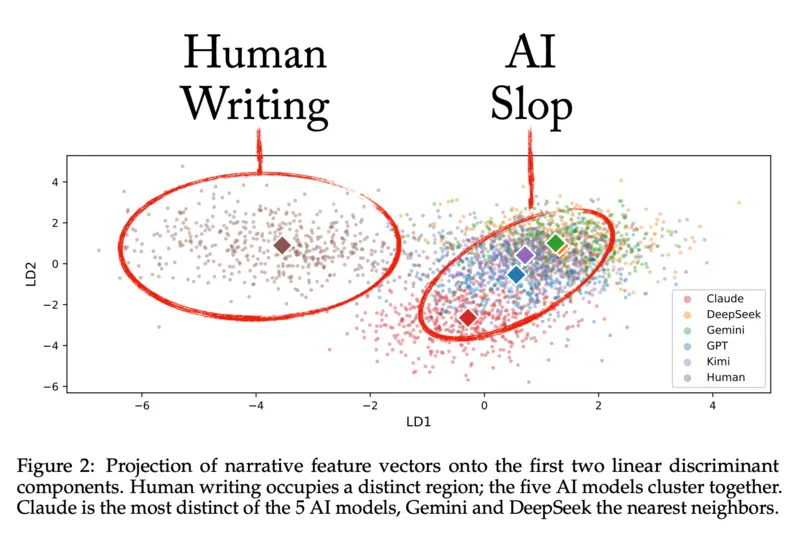
In the last couple of years, AI-generated content has become ubiquitous on the Internet. It may consist of text, images or videos. Some of it is dangerous – for example, erroneous medical information. Most of it is of low to very low quality. And some of it is just bizarre. Such as the infamous “shrimp Jesus” I used as the featured image for this post.

In tech circles, the stuff has become known as “slop”. When you do a Google search, you may see more links to slop than to human-produced material. It looks as if “sloppers” have been using AI to generate large amounts of clickbait, not to mention content that may be misleading or downright dangerous.

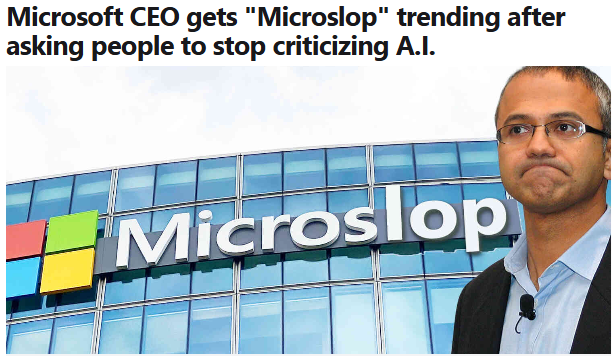
In February 2025, Microsoft’s CEO, Satya Nadella, pleaded in an interview for people to stop using the term “slop”. Saying “people are getting too precious about this”. The response could not have been further from what he asked for. The word “slop” went viral.

So much so, that last month Merriam-Webster, the dictionary publishers, declared “slop” to be their “word of the year”. Nadella responded huffily to this, saying: “we need to get beyond the arguments of slop versus sophistication”. The Internet tech community disagreed. And they took their revenge1 by re-naming the phenomenon “Microslop”.

Windows 10 and Windows 11

All tied up with this is Microsoft’s botched transition from Windows 10 to Windows 11.

Windows 11 was launched in October 2021. Due to higher hardware requirements, it would not run on around 60% of the PCs then running Windows 10. Including mine. That was already a time-bomb.

Support for Windows 10 was withdrawn for general customers on October 14th, 2025. Although Extended Security Updates (ESUs) remained available for corporate customers who wanted to keep Windows 10 running.

At no point has Windows 11 been popular with users. It had only about half the take-up Microsoft had expected. And by February 2025, many companies who had “upgraded” their staff’s PCs to Windows 11 had started returning them to Windows 10. It’s estimated that 400 million computers world-wide are still running Windows 10 without any Microsoft software support, simply because the users cannot, or do not wish to, “upgrade” to Windows 11.

Worse, some of Microsoft’s biggest corporate clients, with hundreds of thousands of users each, are switching to Apple Mac. And tech-savvy customers, including gamers and many smaller professional firms, are moving towards platforms like Linux.


  1. https://cybernews.com/ai-news/microsoft-ai-microslop-copilot/

If — when — Microsoft tries to force me to switch to a version of Windows with a built-in clanker, then I’ll be forced to switch to Linux. I do have a functional Linux laptop (a 14-year-old HP laptop that could barely boot under Windows by the end, but is now almost peppy running Linux). There’s only one piece of software I still run that doesn’t have a Linux version or competitor but if I accept the reduced functionality of running it in a web browser rather than natively, I could get by.

November 23, 2025

John Cage’s 4’33” meets the anti-clanker protest song

Ted Gioia on Paul McCartney’s latest single — his first in several years — and what he’s protesting against … clankers in music and the arts:

Paul McCartney is releasing a new track. It’s his first new song in five years — so that’s a big deal. But there’s something even more significant about this 2 minute 45 second release.

The song is silent. It’s a totally blank track — except for a bit of hiss and background noise.

What’s going on? Has Paul McCartney run out of melodies at age 83? Is he nurturing his inner John Cage. Did he simply forget to turn on the mic?

No, none of the above.

Macca is releasing this track as a protest against AI.

His new “music” is part of an album entitled Is This What We Want? It’s already available on digital platforms, and is now coming out on vinyl. All proceeds will go to the non-profit organization Help Musicians.

“The album consists of recordings of empty studios and performance spaces,” according to the website. In addition to McCartney, more than a thousand musicians are participating, including:

    Kate Bush, Annie Lennox, Damon Albarn, Billy Ocean, Ed O’Brien, Dan Smith, The Clash, Mystery Jets, Jamiroquai, Imogen Heap, Yusuf / Cat Stevens, Riz Ahmed, Tori Amos, Hans Zimmer, James MacMillan, Max Richter, John Rutter, The Kanneh-Masons, The King’s Singers, The Sixteen, Roderick Williams, Sarah Connolly, Nicky Spence, Ian Bostridge, and many more.

I keep hearing that protest music is dead — and has been losing momentum since the Vietnam War. But there’s now a new war, and it’s stirring up creators in every artistic idiom.

They are fighting for their livelihoods and IP rights. And, so far, it’s been a losing battle.

You can see the new battle lines across the entire creative landscape.

Vince Gilligan, one of the most brilliant minds in TV, admits that he “hates AI”. He calls it the “world’s most expensive plagiarism machine”. For his new show Pluribus, he has added this disclaimer to the credits:

    This show was made by humans.

AI represents the exact opposite of creativity, Gilligan warns. It steals the work of others. So any attempt to legitimize it as a creative tool is built on lies. A bank robber might just as well pretend to be a financier. Or an art forger claim to be Picasso.

[…]

This is the new culture war.

And it’s very different from the old culture war — which was a dim reflection of politics. This new battle is happening inside the culture world itself, and threatens to cut off artists from their own longstanding partners and support systems.

This new culture war will only escalate. The stakes are too high, and artists can’t afford to stay on the sidelines. But they face heavy odds, with the richest people on the planet opposed to their efforts.

How will this battle get decided? It really comes down to the audience. If they prefer AI slop, we will witness the total degradation of arts and entertainment.

I’d like to think that people are too smart to fall for this crude simulation of human creative expression. Who wants to hear a bot sing of love it has never experienced? Who wants a nature poem from a digital construct that exists outside of nature? Who wants a painting made by something with no eyes to see?

Will the public find this charming. Or even plausible? Maybe a few twelve year olds and fools, but not serious people. That’s my hunch.

In any event, we will soon find out.

November 10, 2025

Enshittification, the book

Filed under: Books, Media, Technology — Tags: , , , , — Nicholas @ 04:00

Cory Doctorow originally coined the all-too-useful name for the steady deterioration of pretty much everything in the online world and now it’s the title of his latest book:

Author and activist Cory Doctorow wants you to understand why online digital platforms are failing users, and he’s fighting for a better internet. “Enshittification” — a word he coined to describe the degradation of online platforms and services — is the slightly profane albeit funny title of his latest book.

[…]

First question from me: “What does enshittification look like in Canada?” (Try saying that word without chuckling). The country had several opportunities to lead as a global digital force to be reckoned with, Cory agrees, and in his view, “we dropped the ball on market concentration”.

“The Competition Bureau has, through almost all of its history, until last year when we got a new bill out of Parliament, been, I think, the weakest competition bureau in the world,” Cory declares, emphatically. It’s hard to refute his assessment: The merger of Shaw and Rogers, two very large telecoms in Canada, was made official in 2023, the year before Canada’s competition law was modernized.

“Wouldn’t you think, at the very least, Canada would have a robust domestic network platform available by now?” I ask. Gander Social, a made-in-Canada social media platform, designed as an alternative to large U.S.-based companies, is only now being beta tested.

“There are any number of people who would like very, very much to host a few thousand of their friends on a little Mastodon or Blue Sky server that can talk to all the other ones, and everyone can be in a conversation,” Cory counters.

“We don’t all have to be on the same server,” Cory continues. “If there’s one thing we learned from the Amazon outage, it’s that putting everyone on the same server is an incredibly bad idea, right? So we can all be on different servers in the same way we’re all on different email servers, drive on different roads. We have to live in different cities; we don’t all have to be in the same place to all talk to each other and be part of a single digital network. That’s what networks are, right?

“You know, what we don’t have, the lacuna in this plan, the thing that we need public investment in, is not the bicycles on the road, it’s the bike lanes, it’s the infrastructure, and it’s the kind of thing the private sector can’t do well,” he asserts. The pain points for small businesses, communities, large businesses, cooperatives or any entity wanting to host a social media platform, Cory suggests, include things like security audits and content moderation tools.

He also recommends “some mechanism to ease people’s passage off (existing) social media and onto a new platform”. Right now, Cory explains, “you have people building these new platforms and wondering how the people on the old platforms are going to get there. This is like West Germans building housing for East Germans in West Germany, without thinking about how they’re going to get over the wall. Except that, we built the wall. We are the ones maintaining the wall. The wall is made entirely of law. The wall could be torn down with an act of Parliament at the stroke of a pen.”

And on the related topic of artificial intelligence being crowbarred into everything we use online:

Cory’s also saying very provocative things about AI. His most-memorable quip: “AI is the asbestos we are shovelling into the walls of our society and our descendants will be digging it out for generations”. While he sees the merits of AI to support the work of radiologists or lawyers or software engineers — or nearly anyone — he doesn’t believe AI can do the job. “But,” he warns, “an AI salesman can 100 per cent convince your boss to fire you and replace you with AI”.

October 31, 2025

The “internet of shit” is somehow managing to get even shittier

Filed under: Business, Media, Technology — Tags: , , — Nicholas @ 05:00

At The Honest Broker, Ted Gioia enumerates just a few of the ways that advertisers have abandoned attempts to persuade you and instead now run online extortion rackets to get you to pay to avoid having to see their ads:

Advertising is no longer about creativity and storytelling. Ads are now a matter of annoyance, plain and simple (as I recently described in this article).

It’s a simple concept. Web platforms force people to pay money to avoid the ads — so the more annoying they are, the more money they make.

They used to call it extortion — pay now to avoid pain later. And it always works like a charm. Needless to say you don’t need an English major to run an extortion business. (However, they do make good victims.)

This business strategy started out in media — where it made some sense. People are familiar with the idea of advertising during screen entertainment.

And here is how it played out:

  • YouTube started this with the launch of an ad-free tier in 2014.
  • Paramount announced an ad-supported subscription plan in June 2021.
  • Disney + launched a low-price subscription option with advertising in March 2024.
  • Netflix introduced a similar program in October 2022.
  • Amazon Prime did the same thing in early 2024.
    But in the last few months, it’s gone crazy. The ads are spreading beyond movies and videos — and into almost anything with a digital interface. So we’ve seen the following in recent days:
  • Jeep drivers started complaining about ads on their vehicle touchscreen in early 2025. An ad for an extended warranty allegedly appears every time they stop their car (at a red light, etc.).
  • Meta announced an ad-free subscription option for Facebook and Instagram in September 2025. (initially in the UK).
  • Microsoft announced an ad-supported subscription plan for Xbox cloud gaming in October 2025.
  • A rumor about Apple inserting ads into its map app started spreading in October 2025. This will allegedly launch in 2026.

This is more than annoying — it’s also abusive. A new Jeep can cost $50,000 or more. When you hand over that much cash, you should get an exemption from spam ads on your screen.

But the most annoying move of all is coming from Samsung. They are putting ads on $3,499 smart fridges. They’re rolling out this “software upgrade” right now.

According to Samsung, your smart (or maybe smart-ass) refrigerator will soon share “useful day-to-day information such as news, calendar and weather forecasts, along with curated advertisements”. The display will change every ten seconds.

I definitely rely on my fridge for some things — milk, eggs, orange juice, and an occasional cold beer. But you don’t see curated advertisements on that list.

Ads will never be on the list.

October 2, 2025

UNshittifying the internet

Filed under: Business, Media, Technology — Tags: , , — Nicholas @ 04:00

In The Line, Matt Gurney asks if we can go back to when the internet (and by extension, all the other tech toys and gadgets we see everywhere) was … good?

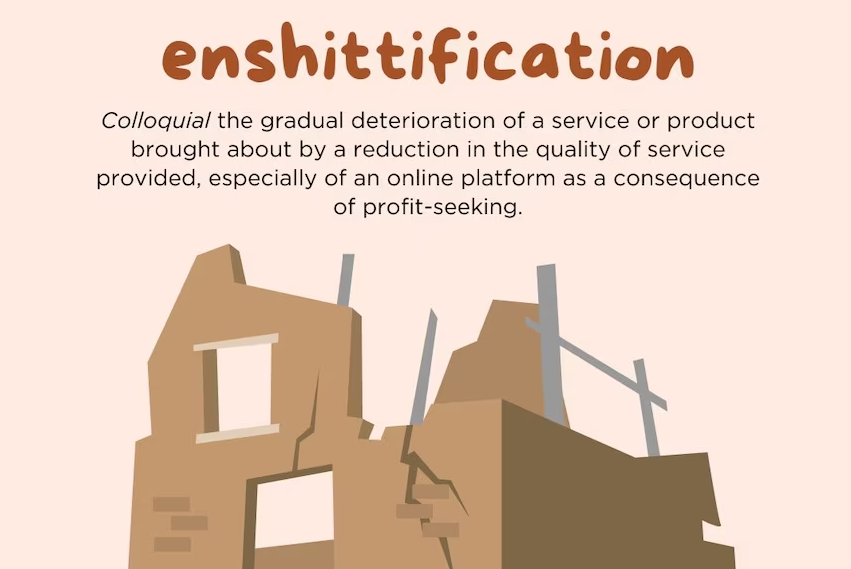
Have you heard about enshittification? It’s not just a potty word. It’s actually a pretty fascinating concept, and you read about it mostly in tech circles. Enshittification is the process by which something becomes worse over time, instead of better, normally as people try to squeeze more efficiency and revenue value out of it. Through that process of squeezing, the thing becomes enshittified.

If you want a proper definition

    Enshittification: The gradual deterioration of a service or product brought about by a reduction in the quality of service provided, especially of an online platform, and as a consequence of profit-seeking.

There are lots of examples. My favourite example? My video doorbell has an annual service fee. Another great example? Cars that now require payments to access certain features, like heated seats. You own the device. But you need to pay a recurring fee to use it. That’s enshittification.

It’s everywhere. And it’s getting worse, especially online. And, perversely, maybe this is a good thing. Maybe it’s going to force us to stop, rethink how we use the digital realm, and, basically, try again. Start over. And get it right this time.

Noah Smith is an American economics writer whose work I enjoy. Smith noted on Twitter recently that we are rapidly getting to the point where we should declare social media a failure. It’s passé to criticize social media on social media, but Smith wasn’t making the usual warmed-over moral argument. He wasn’t saying that it was bad because people are mean there or that they fall down dark rabbit holes and end up believing insane things. Those are problems! But Smith’s concern was the extent to which AI-generated content and bots have simply flooded all the social media channels. Even a responsible user trying to use these platforms for the good is going to find it increasingly difficult to derive any value from them. They’re being rapidly enshittified.

I share his view of the trajectory. I don’t really know anyone who doesn’t. But Smith’s comment led me to ponder what value I actually derive from them — what I would miss if they were gone. I came up with four broad use cases.

September 20, 2025

QotD: Why modern dishwashers suck

    The current standards for dishwashers took effect in 2013. The standards, which were based on a consensus agreement between manufacturers and efficiency advocates, specify minimum energy and water efficiency levels. The standards require that standard-size dishwashers use no more than 307 kWh per year and 5.0 gallons of water per cycle.

    In 2024, DOE finalized amended standards for dishwashers based on a joint recommendation from manufacturers and efficiency advocates. The new standards for dishwashers will cost-effectively reduce energy consumption by 15% relative to the current standards while also cutting water waste. Dishwashers

It is a general problem, but what started me thinking about it was being told by my dishwasher that it would take three and a half hours to wash the dishes. That seems, judging by a quick search online, to be longer than average but still within the normal range. I have not been able to find figures online for how long dishwashers took twenty or thirty years ago but, by what I remember, it was substantially less — and the dishes ended up dry, which ours don’t.

The explanation is in the final word of the quote above, “waste”. The owners of dishwashers pay for water and power, so if making them more efficient in those dimensions was costless, did not require giving up something else, there would be no need for the Department of Energy to make the manufacturers do it. I conclude that it was not costless, that it either made dishwashers cost more or do their job less well — take longer, not dry the dishes as well, not clean them as well. Using more power or water to do a better job is not waste.

David Friedman, “Optimizing On A Single Variable”, David Friedman’s Substack, 2025-06-02.

August 30, 2025

QotD: SaaS – software as an “intolerable swarm of blood-sucking leeches”

Filed under: Business, Quotations, Technology — Tags: , , , , — Nicholas @ 01:00

Commercial desktop software is getting worse, not better. I’ve been generally aware of this for a while — the relentless pull away from “you pay for it once and own it” to monthly subscription models that extract money from you forever has been a leading indicator.

But my friend @DrInsensitive reports that the enshittification is accelerating. He says that in addition to a lot of tediously stupid UI changes, his most recent upgrade of CorelDraw now spams ads at him even when CorelDraw itself is not running! Furthermore the plague of microtransactions that has afflicted AA games for years is spreading — the set of free fill patterns for rectangles that his old version had is gone, instead when he tries to fill a rectangle he gets a pop-up invitation to buy an extra-cost feature pack of them.

When one asshole vendor thinks they’ve successfully numbed their user base into accepting this kind of crap, others immediately follow. We’ve seen this movie before, we know how it ends — with applications, like games, designed to be deliberately frustrating and low-level awful, intended to give you itches that you can only scratch by buying their endless parade of “enhancements”.

I’m sure a surcharge to suppress the spammy CorelDraw ads won’t be long in coming. And soon after that it will be everywhere.

If this goes on, open-source software will finally win the desktop not because it’s gotten enough better but because closed-source desktop applications have reached final form as an intolerable swarm of blood-sucking leeches.

This is not the way I was looking forward to winning.

ESR, Twitter, 2025-03-22.

July 22, 2025

The internet keeps getting worse. Let’s talk about why.

Jared Henderson
Published 16 Jul 2025

Why do major online platforms keep getting worse? Cory Doctorow’s work helps us understand the pattern of growth, decline, and eventual demise.

→ Timestamps
00:00 Beginning
00:51 How Platforms Die
08:29 The Death of a Platform (From the Inside)
12:14 Ads, Everywhere
14:47 Yes, I Make Money from Ads
16:32 Bots
22:04 The Internet We Need
(more…)

July 21, 2025

AI slop seems to have finally triggered significant pushback

Filed under: Business, Media, Technology — Tags: , , , , , — Nicholas @ 03:00

Ted Gioia says that he’s seeing strong indicators that the AI slop superabundance has helped create a widespread rejection of it and all its works:

2025 has been the year of garbage culture.

Creators watch in horror as dismal AI slop threatens their livelihoods — and the integrity of their fields. It’s everywhere, spreading faster than a pharaoh’s plague.

In recent months, we’ve been bombarded with millions of lousy AI songs, idiotic AI videos, and clumsy AI images. Error-filled AI texts are everywhere — from your workplace memos to the books sold on Amazon.com.

Even my lowly vocation, music journalism, gets turned into a joke when it’s accompanied by slop images of fake events.

No, these things did not really happen.

But something has changed in the last few days.

The garbage hasn’t disappeared. It’s still everywhere, stinking up the joint.

But people are disgusted, and finally pushing back. And they are doing so with such fervor that even the biggest AI companies are now getting nervous and pulling back.

Just consider this surprising headline:

This was stunning news. YouTube is part of the biggest AI slop promoter of them all — namely the Google/Alphabet empire. How can they possibly abandon AI garbage? Their bosses are the biggest slopmasters of them all.

After this shocking news reverberated through the creative economy, YouTube started to backtrack. They said that they would not punish every AI video — some can still be monetized.

But even the revised guidelines are still a major blow to AI slop purveyors. YouTube made clear that “creators are required to disclose when their realistic content is altered or synthetic”. That’s a huge win—we finally have a requirement for disclosure, and it came straight from the dark planet Alphabet.

YouTube also stressed that it opposes “content that is mass-produced or repetitive, which is content viewers often consider spam”. This is just a step away from blocking slop.

Update, 22 July: Ted posted a follow-up with a bit more evidence that the pushback is working:

In my latest article I criticized Spotify for allowing uploads of unauthorized AI tracks to the profiles of dead musicians.

But the company may finally be listening to criticisms of its AI policies. In this case, Spotify has now taken steps to stop the abuses, and a spokesperson reached out to me today with an update and expressing a clear and proper policy on AI fraud.

I share it below (and have also updated my article):

    We’ve flagged the issue to SoundOn, the distributor of the content in question, and it has been removed. This violates Spotify’s deceptive content policies, which prohibit impersonation intended to mislead, such as replicating another creator’s name, image, or description, or posing as a person, brand, or organization in a deceptive manner. This is not allowed. We take action against licensors and distributors who fail to police for this kind of fraud and those who commit repeated or egregious violations can and have been permanently removed from Spotify.

They acted quickly, and I give them credit for that.

Update the second, 23 July: Ah, Spotify giveth and Spotify taketh away:

“Spotify is publishing new, AI-generated songs on the official pages of artists who died years ago without the permission of their estates or record labels,” reports 404 Media.

This scandal came to light because of an AI song attributed to Blaze Foley, who died in 1989. The bogus track is accompanied by an AI-generated image of a man who bears no resemblance to the singer.

What’s going on here? Is this just ignorance or carelessness at Spotify? Or does it represent something more sinister — another example of the company’s willingness to deceive users in the pursuit of profits?

These scams must stop. If Spotify doesn’t fix this mess immediately, courts should intervene.

But the dead musician scandal is just a start — because other bizarre things are happening at Spotify.

The whole situation is positively surreal.

July 7, 2025

Consumers don’t want AI in everything, but you’ll be forced to take your AI, peasants!

Filed under: Business, Media, Technology — Tags: , , , — Nicholas @ 05:00

Ted Gioia — like about 92% of consumers at last count — doesn’t want to have artificial intelligence “enhancing” the software he uses every day, but software companies don’t want him — or you — to have that choice:

A few months ago, I needed to send an email. But when I opened Microsoft Outlook, something had changed.

Microsoft asked me to use Copilot to write my email. Copilot is my AI companion. (That’s the cute word they use.)

Hey I don’t want a companion — especially not a fake AI buddy. I never asked for this.

And what about the people receiving my emails? They don’t want this either. They want to hear from me, not a bot.

How do I turn my companion off?

After some trial-and-error, I found a way to disable Copilot. Phew!

But a few days later, Microsoft surprised me again. It wouldn’t let me save an Excel file until I had agreed to new terms for my software account.

Guess what? AI is now bundled into all of my Microsoft software.

Even worse, Microsoft recently raised the price of its subscriptions by $3 per month to cover the additional AI benefits. I get to use my AI companion 60 times per month as part of the deal.

But I don’t want to use it. I want to kill it.

As you can see, I’ve never used this service. I still have all 60 credits unused. But I’m paying for it — because it’s now embedded into Microsoft Word, Excel, etc.

This is how AI gets introduced to the marketplace — by force-feeding the public. And they’re doing this for a very good reason.

Most people won’t pay for AI voluntarily — just 8% according to a recent survey. So they need to bundle it with some other essential product.

You never get to decide.

Before proceeding let me ask a simple question: Has there ever been a major innovation that helped society, but only 8% of the public would pay for it?

That’s never happened before in human history. Everybody wanted electricity in their homes. Everybody wanted a radio. Everybody wanted a phone. Everybody wanted a refrigerator. Everybody wanted a TV set. Everybody wanted the Internet.

They wanted it. They paid for it. They enjoyed it.

AI isn’t like that. People distrust it or even hate it — and more so with each passing month. So the purveyors must bundle it into current offerings, and force usage that way.

Older Posts »

Powered by WordPress