Jared Henderson
Published 16 Jul 2025Why do major online platforms keep getting worse? Cory Doctorow’s work helps us understand the pattern of growth, decline, and eventual demise.
→ Timestamps
00:00 Beginning
00:51 How Platforms Die
08:29 The Death of a Platform (From the Inside)
12:14 Ads, Everywhere
14:47 Yes, I Make Money from Ads
16:32 Bots
22:04 The Internet We Need
(more…)
July 22, 2025
The internet keeps getting worse. Let’s talk about why.
July 21, 2025
AI slop seems to have finally triggered significant pushback
Ted Gioia says that he’s seeing strong indicators that the AI slop superabundance has helped create a widespread rejection of it and all its works:
2025 has been the year of garbage culture.
Creators watch in horror as dismal AI slop threatens their livelihoods — and the integrity of their fields. It’s everywhere, spreading faster than a pharaoh’s plague.
In recent months, we’ve been bombarded with millions of lousy AI songs, idiotic AI videos, and clumsy AI images. Error-filled AI texts are everywhere — from your workplace memos to the books sold on Amazon.com.
Even my lowly vocation, music journalism, gets turned into a joke when it’s accompanied by slop images of fake events.
But something has changed in the last few days.
The garbage hasn’t disappeared. It’s still everywhere, stinking up the joint.
But people are disgusted, and finally pushing back. And they are doing so with such fervor that even the biggest AI companies are now getting nervous and pulling back.
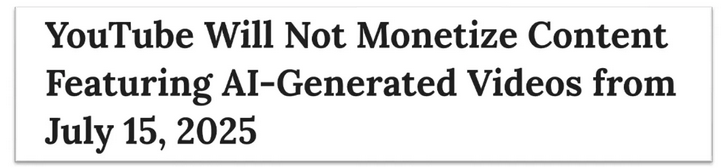
Just consider this surprising headline:
This was stunning news. YouTube is part of the biggest AI slop promoter of them all — namely the Google/Alphabet empire. How can they possibly abandon AI garbage? Their bosses are the biggest slopmasters of them all.
After this shocking news reverberated through the creative economy, YouTube started to backtrack. They said that they would not punish every AI video — some can still be monetized.
But even the revised guidelines are still a major blow to AI slop purveyors. YouTube made clear that “creators are required to disclose when their realistic content is altered or synthetic”. That’s a huge win—we finally have a requirement for disclosure, and it came straight from the dark planet Alphabet.
YouTube also stressed that it opposes “content that is mass-produced or repetitive, which is content viewers often consider spam”. This is just a step away from blocking slop.
Update, 22 July: Ted posted a follow-up with a bit more evidence that the pushback is working:
In my latest article I criticized Spotify for allowing uploads of unauthorized AI tracks to the profiles of dead musicians.
But the company may finally be listening to criticisms of its AI policies. In this case, Spotify has now taken steps to stop the abuses, and a spokesperson reached out to me today with an update and expressing a clear and proper policy on AI fraud.
I share it below (and have also updated my article):
We’ve flagged the issue to SoundOn, the distributor of the content in question, and it has been removed. This violates Spotify’s deceptive content policies, which prohibit impersonation intended to mislead, such as replicating another creator’s name, image, or description, or posing as a person, brand, or organization in a deceptive manner. This is not allowed. We take action against licensors and distributors who fail to police for this kind of fraud and those who commit repeated or egregious violations can and have been permanently removed from Spotify.
They acted quickly, and I give them credit for that.
Update the second, 23 July: Ah, Spotify giveth and Spotify taketh away:
“Spotify is publishing new, AI-generated songs on the official pages of artists who died years ago without the permission of their estates or record labels,” reports 404 Media.
This scandal came to light because of an AI song attributed to Blaze Foley, who died in 1989. The bogus track is accompanied by an AI-generated image of a man who bears no resemblance to the singer.
What’s going on here? Is this just ignorance or carelessness at Spotify? Or does it represent something more sinister — another example of the company’s willingness to deceive users in the pursuit of profits?
These scams must stop. If Spotify doesn’t fix this mess immediately, courts should intervene.
But the dead musician scandal is just a start — because other bizarre things are happening at Spotify.
The whole situation is positively surreal.
July 7, 2025
Consumers don’t want AI in everything, but you’ll be forced to take your AI, peasants!
Ted Gioia — like about 92% of consumers at last count — doesn’t want to have artificial intelligence “enhancing” the software he uses every day, but software companies don’t want him — or you — to have that choice:
A few months ago, I needed to send an email. But when I opened Microsoft Outlook, something had changed.
Microsoft asked me to use Copilot to write my email. Copilot is my AI companion. (That’s the cute word they use.)
Hey I don’t want a companion — especially not a fake AI buddy. I never asked for this.
And what about the people receiving my emails? They don’t want this either. They want to hear from me, not a bot.
How do I turn my companion off?
After some trial-and-error, I found a way to disable Copilot. Phew!
But a few days later, Microsoft surprised me again. It wouldn’t let me save an Excel file until I had agreed to new terms for my software account.
Guess what? AI is now bundled into all of my Microsoft software.
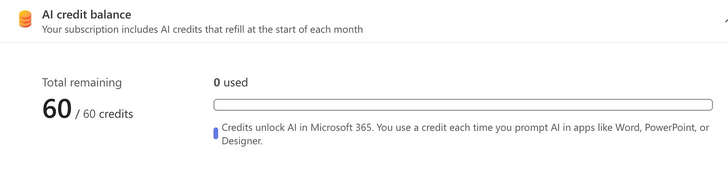
Even worse, Microsoft recently raised the price of its subscriptions by $3 per month to cover the additional AI benefits. I get to use my AI companion 60 times per month as part of the deal.
But I don’t want to use it. I want to kill it.
As you can see, I’ve never used this service. I still have all 60 credits unused. But I’m paying for it — because it’s now embedded into Microsoft Word, Excel, etc.
This is how AI gets introduced to the marketplace — by force-feeding the public. And they’re doing this for a very good reason.
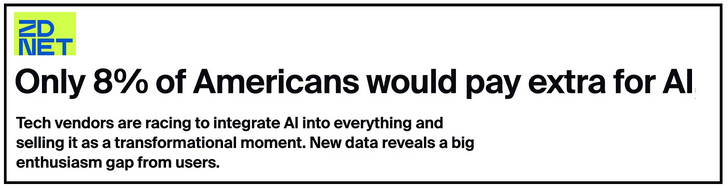
Most people won’t pay for AI voluntarily — just 8% according to a recent survey. So they need to bundle it with some other essential product.
You never get to decide.
Before proceeding let me ask a simple question: Has there ever been a major innovation that helped society, but only 8% of the public would pay for it?
That’s never happened before in human history. Everybody wanted electricity in their homes. Everybody wanted a radio. Everybody wanted a phone. Everybody wanted a refrigerator. Everybody wanted a TV set. Everybody wanted the Internet.
They wanted it. They paid for it. They enjoyed it.
AI isn’t like that. People distrust it or even hate it — and more so with each passing month. So the purveyors must bundle it into current offerings, and force usage that way.
February 21, 2025
January 14, 2025
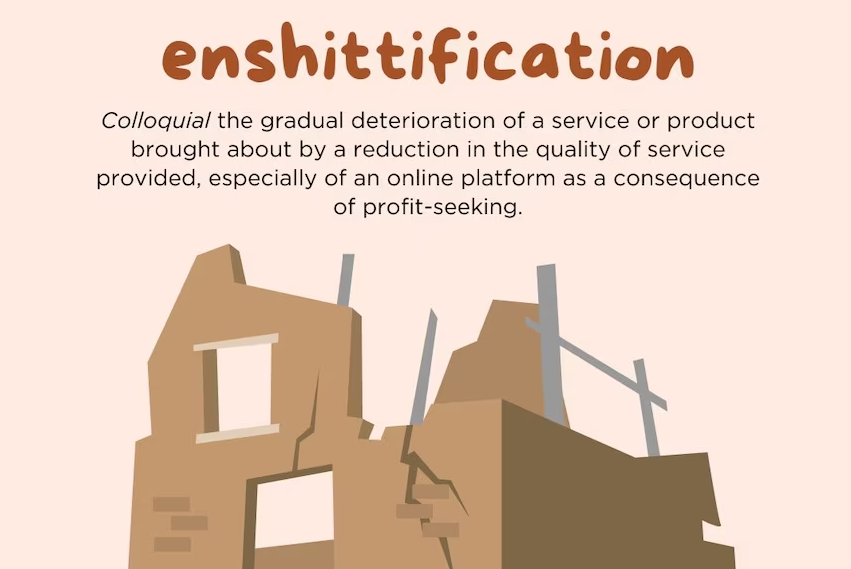
The deliberate enshittification business plan of every “tech” company
It may be hard to believe, but once upon a time we actually used to look forward to new technology releases and updated software. I know, I know, that’s asking you to believe fairy tales in our current “enshittification-as-a-service” technology dystopia. The Bone Writer — who worked in the same tech field that I once did — clearly understands why the promise of new technology has turned so negative:

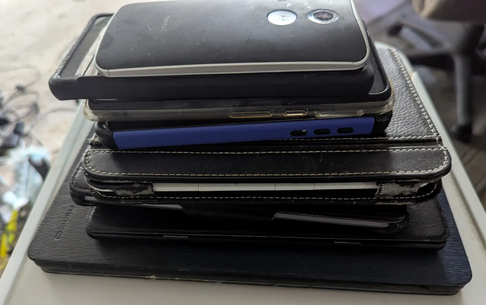
Dead technology. Not because they’re broken, but because they’re no longer supported and THEREFORE no longer work.
I was straightening some stuff/junk up and came upon a pile of my e-Waste. It’s a damn shame that electronics devices are a planned obsolesce when they shouldn’t be. Especially the tablets and e-readers that would still work if the mothership, the corpo HQ, the evil Tech Bros, actually cared about their customers at all.
Do we need legislation that offers up some sort of tax write off incentive to get companies to support their shit for at least 10 years? I know what you’re saying … “That’s not a free market economy.” Yeah … well … The tech sector broke the free market economy a long time ago and now they actively hurt everyone with their greed and drive to force people into what comes next, every month to 3 months to 1 year.
That’s another reason prices never come down on tech stuff. They put out something new monthly to yearly, with just a small addition to the software or the design. Then they push it on people as if it is the BEST thing there ever was, creating FOMO. Then, some people will upgrade with every new device or software version sold.
[…]
Agile is the Devil’s Tool for Creating More Waste
Agile is the method that is used to push new software and updates out continuously. Get those updates out there and keep that device or software looking shiny but hold back the good stuff for the next big release. Even though the current iteration can likely support the next big release, we’re not going to do that. This way we can sell more shit to people and they will have FOMO so they will buy it up. Even though, the next big release isn’t all that great anyway… They consumer will eat it up.
Recycle It
The activist techies will just say, “Go ahead and recycle the old stuff.” As if it really gets recycled. More often than not (only 10% of recycled stuff actually gets recycled), it gets buried or sent to other countries to be disassembled and buried there, out of site. Both the tech sector and fashion industry are guilty of this. Meanwhile, YOU are told that if you recycle, you are doing your part to clean up the world, when you’re really just sending stuff elsewhere to pollute a third world country. Sleep easy though, it isn’t in YOUR backyard.
November 26, 2024
September 10, 2024
“The world has gone mad. But nothing is as crazy as the AI news”
Ted Gioia is covering the AI beat like nobody else. In this post he shares several near-term predictions involving AI development and deployment:
The world has gone mad. But nothing is as crazy as the AI news.
Every day those AI bots and their human posse of true believers get wilder and bolder — and recently they’ve been flexing like body builders on Muscle Beach.
The results are sometimes hard to believe. But all this is true:
- The movie trailer for Francis Ford Coppola’s new film got pulled from theaters because “the studio had been duped by an AI bot“.
- Just one person in North Carolina was able to steal $10 million in royalties from human musicians with AI-generated songs. They got billions of streams.
- The promoters of National Novel Writing Month angrily declared that opposition to AI books is classist and ableist.
- Children are now routinely using AI to make nude photos of other youngsters.
- Nearly half of the safety team at OpenAI left their jobs — and almost nobody seems to care or notice.
- AI tech titan Nvidia lost a half trillion in market capitalization over the course of just a few days — including the largest daily decline in the history of capitalism.
- By pure coincidence, Nvidia’s CEO sold $633 million worth of stock in the weeks leading up to the current decline.
We truly live in interesting times — which is one of the three apocryphal Chinese curses.
(The other two, according to Terry Pratchett, are: “May you come to the attention of those in authority” and “May the gods give you everything you ask for”. By tradition, the last is the most dangerous of all.)
I get some credit for anticipating this. On August 4, I made the following prediction:
But it’s going to get even more interesting, and very soon. That’s because the next step in AI has arrived — the unleashing of AI agents.
And like the gods, these AI agents will give us everything we ask for.
Up until now, AI was all talk and no action. These charming bots answered your questions, and spewed out text, but were easy to ignore.
That’s now changing. AI agents will go out in the world and do things. That’s their new mission.
It’s like giving unreliable teens the keys to the family car. Up until now we’ve just had to deal with these resident deadbeats talking back, but now they are going to smash up everything in their path.
But AI agents will be even worse than the most foolhardy teen. That’s because there will be millions of these unruly bots on our digital highways.
September 2, 2024
There’s no limit to how progressive politicians want to control your life
In the National Post a couple of days ago, Carson Jerema provided many examples of how the Canadian federal government — despite failing and fumbling so many of its existing responsibilities — still wants to increase control over the daily lives of Canadians:
After a decade or so, progressives are on the defensive in Canada and elsewhere because regular people, as in those who are not activist weirdos, are tired of the agenda to control every aspect of our lives. Point this out to a progressive, and they will deny that anyone’s life is being interfered with and claim only some far-right monster would think otherwise. They can’t believe there are people out there who share a different view. They don’t understand how this could be.
But progressive governments are trying to control our lives in ways big and small, and in ways that range from subtle to a punch in the face.
In Canada, the federal government’s environmental policies are the most obvious example of this interference. The Liberals have banned plastic straws and plastic bags; even compostable bags are banned in grocery stores because they resemble plastic. Such bans are pointless irritants that make shopping more expensive, and life slightly less enjoyable as paper straws dissolve in one’s drink. People might dismiss these concerns as simply minor inconveniences, but this is how most people experience government policy, by being forced to replace their bag of plastic bags that they were already reusing, with more expensive, less useful options.
Next up, the Liberals are exploring options to bring in environmental regulations for clothing. The cost of clothes has actually gone down in recent years, so leave it to Ottawa to look for ways to bring the cost back up and to limit options.
There is also the plan to essentially force Canadians to purchase electric vehicles, that nobody would otherwise want, through government mandates to phase out the sale of gas-powered cars and trucks.
On a larger scale, the government is attempting to restrict the kind of work people do, specifically work in the oil and gas industry, through steep emissions targets, which will close off lucrative job opportunities in western oilfields. It will also limit the kinds of fuels people will be able to use to heat their homes.
There are also policies that the Canadian government hasn’t implemented, but which green activists have endorsed, such as the banning of gas stoves and the ludicrous suggestion from some academics that “climate lockdowns” be implemented to help cut emissions.
It is possible to be supportive of all these policies, despite their paternalistic and job-killing nature, but pretending that no one is trying to, or that no one wants to, interfere with our liberty is not a credible position to take.
August 21, 2024
The Great Enshittification – technological progress is now actually regressing
Ted Gioia provides ten reasons why all our lovely shiny technological improvements have turned into a steady stream of enshittified “updates” that reduce functionality, add unwanted “improvements” and make things significantly less reliable:
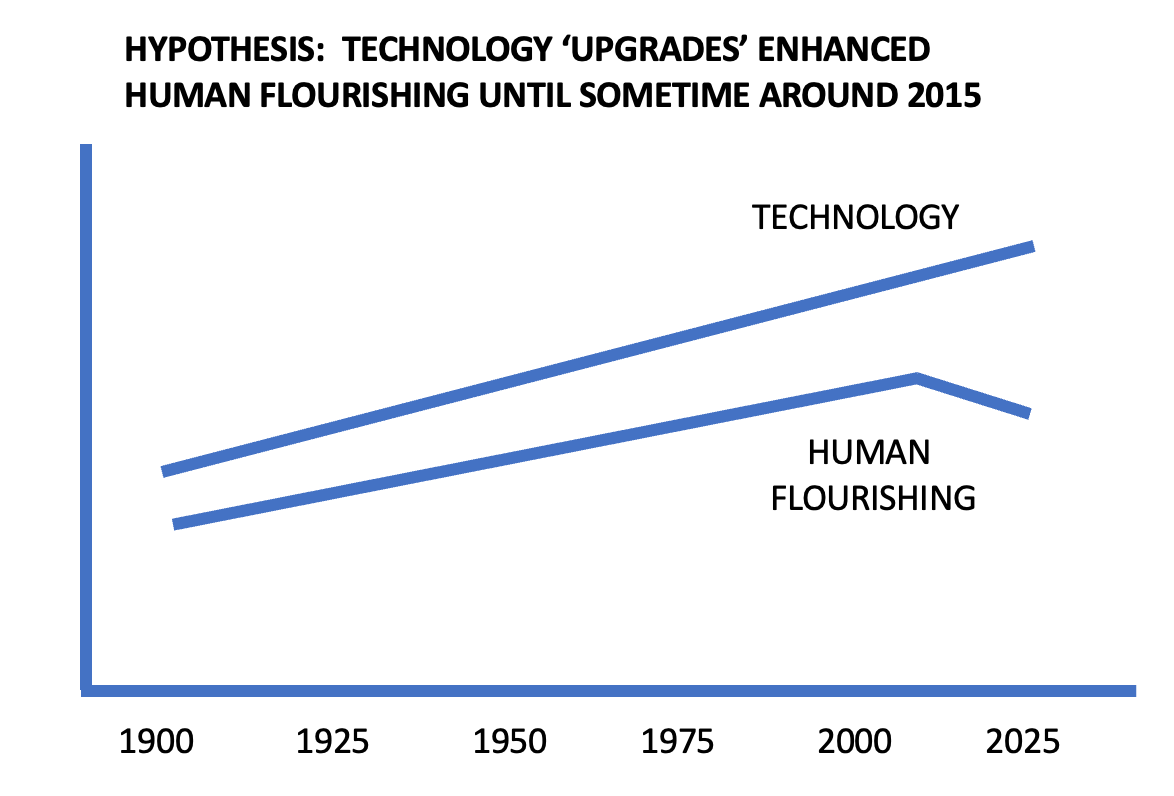
By my measure, this reversal started happening around a decade ago. If I had to sum things up in a conceptual chart, it would look like this:
The divergence was easy to ignore at first. We’re so familiar with useful tech that many of us were slow to notice when upgrades turned into downgrades.
But the evidence from the last couple years is impossible to dismiss. And we can’t blame COVID (or other extraneous factors) any longer. Technology is increasingly making matters worse, not better — and at an alarming pace.
[…]
But I have avoided answering, up until now, the biggest question — which is why is this happening?
Or, to be more specific, why is this happening now?
Until recently, most of us welcomed innovation, but something changed. And now a huge number of people are anxious and fearful about the same tech companies they once trusted.
What caused this shift?
That’s a big issue. Unless we understand how things went wrong, we can’t begin to fix them. Otherwise we’re just griping — about bad software or greedy CEOs or whatever.
It’s now time to address the causes, not just complain about symptoms.
Once we do that, we can move to the next steps, namely outlining a regimen for recovery and an eventual cure.
So let me try to lay out my diagnosis as clearly as I can. Below are the ten reasons why tech is now breaking bad.
I apologize in advance for speaking so bluntly. Many will be upset by my frankness. But the circumstances — and the risks involved — demand it.
August 5, 2024
Short-term technological forecast – “If I were a commercial pilot, I’d tell you to return to your seats and buckle up”
Most of this Ted Gioia post is behind the paywall (and if you can afford it, I’m sure you’d get your money’s worth for a subscription):
I anticipate extreme turbulence on every front for the remaining five months in 2024. You will see it in politics, business, economics, culture, world affairs, the stock market, and maybe even your own neighborhood.
That’s one of the themes of my latest arts and culture update below.
What happened to the AI business model last week?
After almost two years of hype, the media changed its opinion on AI last week.
All of a sudden, news articles about AI went sour like reheated 7-Eleven coffee. The next generation AI chips are delayed, and 70% of companies are behind in their AI plans. There are good reasons for this — most workers now say AI makes them less productive.
People are also noticing that AI businesses want to use the entire electricity grid to run their money-losing bots. Meanwhile AI companies are burning through cash at historic levels. Even under the best case scenario, this all feels unsustainable.
But the worst disclosure, in my opinion, came on July 24 — just eleven days ago.
A study published in Nature showed that when AI inputs are used to train AI, the results collapse into gibberish.
This is a huge issue. AI garbage is now everywhere in the culture, and most of it undisclosed. So there’s no way that AI companies can remove it from future training inputs.
They are caught in the doom loop I described last week.
That same day, the Chief Investment Officer at Morgan Stanley warned investors that AI “hasn’t really driven revenues and earnings anywhere”. One day later, Goldman Sachs quietly released a report admitting that the AI business model was in serious trouble.
Even consulting firms, who make a bundle hyping this tech, are backtracking. Bain recently shared the following chart (hidden away at the end of a report) which explains why AI projects have failed.
These findings are revealing. They show that management is absolutely committed to AI, but the tools just don’t deliver.
And, finally, last week the media noticed all this.
They published dozens of panic-stricken articles. Investors got spooked too — shifting from greed to fear in a New York minute. Over the course of just two days, Nvidia’s stock lost around $400 billion in market capitalization.
In this environment, true believers quickly turn into skeptics. The whole AI business model gets scrutinized — and if it doesn’t hold up, investment cash flow dries up very quickly.
This is exactly what I predicted 6 months ago. Or even a year ago.
I expect that the next few weeks — or maybe even the next few days — will be extremely turbulent in the AI world.
Buckle up!
The dominant AI music company just admitted that it trained its bot on “essentially all music files on the Internet”.
Suno is a huge player in AI music — it tells investors it will generate $120 billion per year. Microsoft is already using its technology.
But there’s a tiny catch.
The company now admits in a court filing:
Suno’s training data includes essentially all music files of reasonable quality that are accessible on the open internet, abiding by paywalls, password protections, and the like, combined with similarly available text descriptions
Hey, this is totally illegal — it’s like Napster all over again.
Suno will need to prove that all these copyrighted songs are “fair use” in AI training. I doubt that any court will take that claim seriously.
If the music industry is smart, they will use this violation to shut down AI regurgitation of copyrighted songs.
If the music industry is stupid — run according to my “idiot nephew theory” — they will drop charges in exchange for some quick cash.
July 4, 2024
“In other words, God is a deliverable for the R&D team”
Ted Gioia isn’t impressed with the changes we’ve seen over the years among the Silicon Valley leadership:
Yes, I should have been alarmed when this cult-ish ideology took off in Silicon Valley — where the goal had previously been incremental progress (Moore’s law and all that) and not being evil.
When I first came to Silicon Valley at age 17, the two leading technologists in the region were named William Hewlett and David Packard. They used their extra cash to fund schools, museums, and hospitals — both my children were born at the Lucile Packard Children’s Hospital — not immortality machines, or rockets to Mars, or a dystopian Internet of brains, or worshipping at the Church of the Singularity.
Tech leaders were built differently back then. When famous historian Arnold Toynbee visited Stanford in 1963, he had a chance encounter with William Hewlett. Afterwards Toynbee marveled over his new acquaintance, declaring: “What an amazing fellow. He has more knowledge of history than many historians.”
In other words, Bill Hewlett had more wisdom than ego. He invested in the community where he lived — not the Red Planet. Instead of promulgating social engineering schemes, Hewlett and Packard built a new engineering school at their alma mater, and named it after their favorite teacher.
They wouldn’t recognize Silicon Valley today. The FM-2030s are now in charge.
Another warning sign came when Google hired cult-ish tech guru Ray Kurzweil — a man who had once created a reasonable music keyboard that even Stevie Wonder used.
But Kurzweil went on to write starry-eyed books of utopian tech worship which come straight out of the weird religion playbook (The Age of Spiritual Machines, The Singularity is Near, etc.)
What does tech look like when it gets turned into a religion? Kurzweil summed it up when asked if there is a God. His response: “Not yet.”
In other words, God is a deliverable for the R&D team.
I note that, when Forbes revisited Ray Kurzweil’s predictions, they found that almost every one went wrong.
So what does he do?
Kurzweil follows up his book The Singularity is Near with a new book entitled The Singularity is Nearer. Give the man credit for hubris. This is exactly what religious cults do when their predicted Rapture doesn’t occur.
They just change the date on the calendar — Utopia has been delayed for another 12 months.
But, of course, Utopia is always delayed another 12 months. Meanwhile the cult leaders can do a lot of damage while preparing for the Rapture.
And despite the techno-elite’s apparent endless quest for perfection in their own lives, the enshittification of the technology they deliver to us proles continues relentlessly:
Here’s a curious fact. The more they brag about their utopias, the worse their products and services get.
Even the word upgrade is now a joke — whenever a tech company promises it, you can bet it will be a downgrade in your experience. That’s not just my view, but overwhelmingly supported by survey respondents.
For the first time since the dawn of the Renaissance, innovation is now feared by the vast majority of people. And the tech leaders, once admired and emulated, now rank among the least trustworthy people in the world.
It was different when Linus Pauling was peddling his horse pills — he eventually set up shop in Big Sur, far south of the tech industry, in order to find a hospitable home for his wackiest ideas.
Nowadays, Big Sur thinking has come to the Valley.
And when you set up cults inside the largest corporations in the history of the world, we are all endangered.
Just imagine if Linus Pauling had enjoyed the power to force everybody to take his huge vitamin doses. Just imagine if Bill Shockley had possessed the authority to impose his racist eugenics theories on the populace.
It’s scary to think of. But they couldn’t do it, because they didn’t have billions of dollars, and run trillion-dollar companies with politicians at their beck and call.
But the current cultists include the wealthiest people in the world, and they are absolutely using their immense power to set rules for the rest of us. If you rely on Apple or Google or some other huge web behemoth — and who doesn’t? — you can’t avoid this constant, bullying manipulation.
The cult is in charge. And it’s like we’re all locked into an EST training sessions — nobody gets to leave even for bathroom breaks.
There’s now overwhelming evidence of how destructive the new tech can be. Just look at the metrics. The more people are plugged in, the higher are their rates of depression, suicidal tendencies, self-harm, mental illness, and other alarming indicators.
If this is what the tech cults have already delivered, do we really want to give them another 12 months? Do you really want to wait until they deliver the Rapture?
May 11, 2024
Apple crushes it
You might not believe me, but I haven’t seen the Apple ad that everyone is hating on. I actively avoid ads of all kinds and refuse to open websites that are little more than shills for whoever is paying for the advertising. That aside, the description of the current ad — that Apple has already apologized for, I’m told — would certainly make me less likely to deal with the company that produced it:
Not since Kendall Jenner slipped away from a modeling shoot to defuse the tensions around a Black Lives Matter protest by handing a can of Pepsi to a riot cop has a mainstream ad campaign generated as much hostility as the just-released spot from Apple pitching the arrival of the thinnest iPad ever.
The ad was shared on Twitter by Apple CEO Tim Cook, who implored potential customers to “Just imagine all the things it’ll be used to create.” The clip shows a huge hydraulic press slowly crushing a bunch of old analog-era creative tools and treats, including a trumpet, an acoustic guitar and a piano, a record player, a camera, an old stand up arcade game, some rubber squeeze toys, and a bunch of paint cans. Then it pulls up to reveal the new, ultra thin iPad Pro, which has assimilated all of these things like some flatland Borg.
You can see what Apple was going for here – all these old, bulky, single purpose tools and playthings are now available at your fingertips, in a package no bigger than a magazine. It’s an upgraded version of that old meme that used to go around about everything that used to be literally on your desktop – phone, typewriter, file folders, fax machine, and so on – is now digitally sitting there on your computer desktop.
People got it all right. The response to the spot was immediate, visceral, and vicious. They hate it.
How did Apple go so wrong?
The most salient feature of the western mind’s relationship with technology is the ambivalence we have felt ever since Prometheus stole fire from the gods. On the one hand, we can now cook our food and keep ourselves warm. On the other hand, who knows where this will lead? Have we unleashed forces that will lead us to our destruction, or at least, lead us away from our true, authentic, selves? We love technology but we fear it, and the pendulum tends to swing from one extreme to the other depending on a host of factors, the most important of which is probably the rate of change and innovation. The faster things move, the less time we have to adapt, and we fear what is being lost more than we appreciate what is being gained.
We are living through a period of what is for most of us unprecedented technological change, where the threats – to both humanity, and to our humanity – seem more urgent than they have in decades, certainly since the advent of the nuclear bomb. Whether it is the sudden fears over AI or the rising moral panic over smartphones or the leery way we look at self-driving cars, there is a firm sense that things are just happening too fast, that the old is being replaced by the new in ways we are barely able to process, let alone control.
Update, 17 May: Samsung picks up something from the wreckage:
The publicity error was compounded by a frenzy of critical mainstream media coverage accompanied by celebrities expressing their outrage at the ad. But Samsung was not ready to let it lie.
The South Korean consumer technology mega-corp posted a short video on Twitter — which now calls itself X — accompanied by the hashtag “UnCrush”.
It shows a young woman walking into what appears to be the wreckage left behind by the Apple ad. Picking up a badly damaged guitar, with strings missing and holes in the body’s soundboard, she nonetheless sits down to play, reading music from a Samsung tablet.
“We would never crush creativity,” Samsung says in the social media post.
It might be a cheap shot, but it is one that is bound to sting for Apple.
March 31, 2024
March 20, 2024
March 16, 2023
Once it was possible to be a fully fledged techno-optimist … but things have changed for the worse
Glenn Reynolds on how he “lost his religion” about the bright, shiny techno-future so many of us looked forward to:
Listening to that song reminded me of how much more overtly optimistic I was about technology and the future at the turn of the millennium. I realized that I’m somewhat less so now. But why? In truth, I think my more negative attitude has to do with people more than with the machines that Embrace the Machine characterizes as “children of our minds”. (I stole that line from Hans Moravec. Er, I mean it’s a “homage”.) But maybe there’s a connection there, between creators and creations.
It was easy to be optimistic in the 90s and at the turn of the millennium. The Soviet Union lost the Cold War, the Berlin Wall fell, and freedom and democracy and prosperity were on the march almost everywhere. Personal technology was booming, and its dark sides were not yet very apparent. (And the darker sides, like social media and smartphones, basically didn’t exist.)
And the tech companies, then, were run by people who looked very different from the people who run them now – even when, as in the case of Bill Gates, they were the same people. It’s easy to forget that Gates was once a rather libertarian figure, who boasted that Microsoft didn’t even have an office in Washington, DC. The Justice Department, via its Antitrust Division, punished him for that, and he has long since lost any libertarian inclinations, to put it mildly.
It’s a different world now. In the 1990s it seemed plausible that the work force of tech companies would rise up in revolt if their products were used for repression. In the 2020s, they rise up in revolt if they aren’t. Commercial tech products spy on you, censor you, and even stop you from doing things they disapprove of. Apple nowadays looks more like Big Brother than like a tool to smash Big Brother as presented in its famous 1984 commercial.
Silicon Valley itself is now a bastion of privilege, full of second- and third-generation tech people, rich Stanford alumni, and VC scions. It’s not a place that strives to open up society, but a place that wants to lock in the hierarchy, with itself on top. They’re pulling up the ladders just as fast as they can.