
Feral Historian
Published 5 Jun 2026Michael Flynn’s In The Country of the Blind gives us a mystery wrapped around an examination of the idea of predictive history. Sort of Foundation with more laughs and cynicism.
I’ve been sitting on this one for some time now, hoping to think of some good b-roll to cut in. But I got nothing, so here it is. For those that listen to these while driving, this one’s for you.
I haven’t found the study I mentioned that isn’t paywalled, but here’s a link so you know which one I’m talking about. https://muse.jhu.edu/pub/1/article/92…
00:00 Intro
04:50 Results, Not Intentions
10:43 Technopeasants
13:21 Scientific Management
16:33 Back to Now
18:43 Power Structures🔹 Patreon | patreon.com/FeralHistorian
🔹 Ko-Fi | ko-fi.com/feralhistorian
🔹 and Merch! | feral-shop.fourthwall.com
October 11, 2026
In The Country of the Blind: A Tale of Applied Cliology and Incompetence
October 6, 2026
QotD: The decline of academic standards over the years
… while I was on the road, I went to visit a buddy who’s still deep cover in academia. He teaches at a really SPLAC-y SPLAC, the kind that bills itself as “Minnesota’s answer to Princeton”. He’s part of a team running this course that, back in my undergrad days thirty years ago, would’ve been called “Paideia” or something similarly pretentious, taught to the “honors college” (or equivalent). Twenty years before that, it would’ve been called “Western Civ I” and required of all incoming freshmen, regardless of major.
Twenty years before that, and it would’ve been called “basic cultural literacy”; the kind of thing any college man — indeed, any graduate of a remotely decent high school — would know cold. I’ve written many times that the not-elite-but-certainly-very-respectable school which awarded my PhD wouldn’t have admitted me as an undergrad as late as 1960; they would’ve been sticking me in some serious remedial classes as late as 1980. Watching my buddy struggling mightily — and failing miserably — to get even the ridiculously watered-down, extremely fake and utterly gay version of this stuff across to the brown-nosing test-acers of the Current Year sent me sobbing into the arms of Jack Daniel.
Not because I would’ve done better, mind you, but because I would’ve done so much worse. The only way I got through my last few semesters in academia was to regard it as acting. The University is paying me to stand on stage and say my lines, so I’ll stand there and say them. Aside from that, all they want to do is check the appropriate box: Students have attended thus-and-such class, taught by someone with a PhD (crucial for those “best college” rankings!), and … there it is.
What actual knowledge am I supposed to be conveying? What skill set? What world view?
Category error. If it doesn’t fit on the standardized test, which is the only thing that matters to the bottom line, then it’s useless.
Severian, “On the Absurdity of Life”, Founding Questions, 2022-09-12.
August 15, 2026
“Forestalling collapse is simple: all we need do is reinstate meritocracy within institutions”
John Carter discusses the ever-more-concerning collapse in basic competence in western societies, which left unchecked will absolutely lead to civilizational collapse due to the vastly complex interconnection of so many systems that we all depend on day and night:
Helen Andrews recently wrote an essay for Compact Magazine, titled The Racial Crossroads, which has been making waves for daring to use the verboten descriptor “race communism” for the acrimonious racial spoils system that has replaced meritocracy throughout the dying West. It’s very good. You should read it.
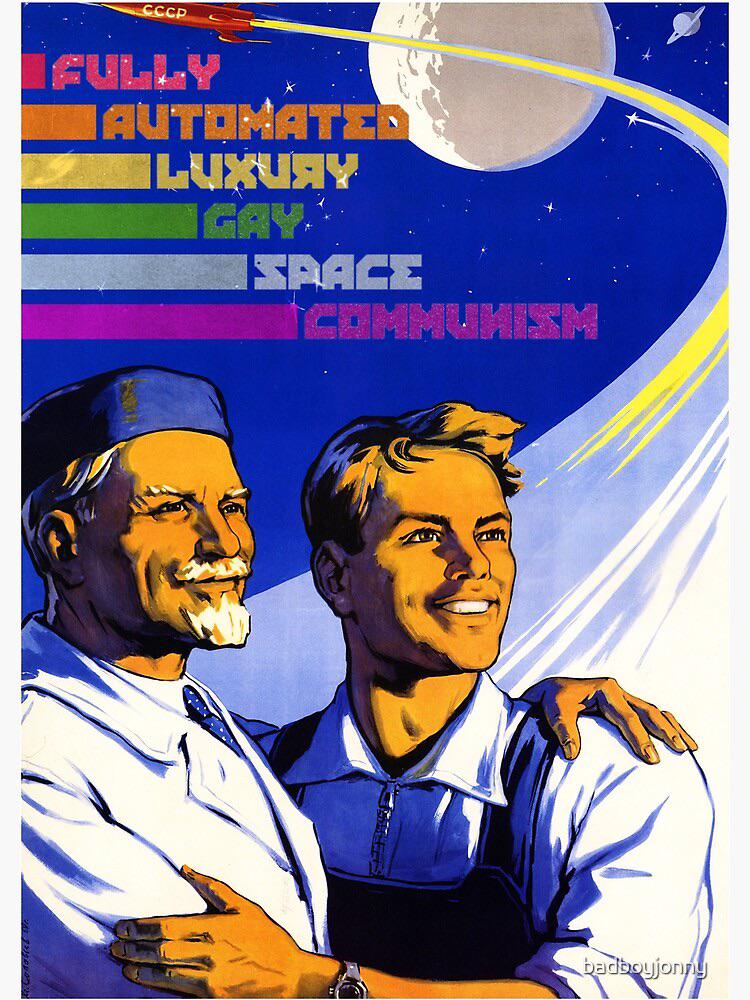
Personally, I prefer the more descriptive “gay race communism”. The progress pride flag is inseparable from the clenched Marxist fist of Black Lives Matter in regime iconography. Moreover, gay race communism is a deliberate subversion of the left’s own “fully automated luxury gay space communism” meme.
There are zero communists who actually look like this, gay or otherwise.
To be fair, Andrews introduces the concept as “gay race communism”, and even directly acknowledges its coinage by Twitter anon Drukpa Kunley. It wasn’t that long ago that conservative popularizers laundered ideas emerging from the anonosphere without attribution, as a means of hiding their origin and making themselves look more original, and Helen deserves credit for not doing this. Also to be fair, given the focus of Andrews’ piece, adding the “gay” to “race communism” could be seen as an unnecessarily inflammatory complication. It isn’t, but we’ll get to that in due time.
Andrews spends the first half of her essay detailing how the regulatory framework built by the Civil Rights Act created the cultural conditions for the rise of wokeness, affirmative action, and DEI initiatives. The official explanation given for anti-discrimination laws was that they were well-intended correctives to the legacy of slavery and Jim Crow. Affirmative action was to be an explicitly temporary measure to give American blacks a helping hand, with the understanding that – after a decade or at most a generation of assistance – they would no longer need a thumb on the scale. Once racism was defeated, we could all live in utopian colour-blind race-neutral Star Trek liberalism, judging one another by the content of our individual characters and no more concerned by the phenotypic differences of ancestral population groups than we are by sartorial quirks. Kumbayah and such. This isn’t an original argument: the same points have been made by Christopher Caldwell in his 2021 book The Age of Entitlement, and of course most directly by Richard Hanania in his 2023 book The Origins of Woke (whom Andrews doesn’t mention, possibly because everyone hates Hanania now).
The central point of Andrews’ essay is the following:
The old racial bargain is breaking down, due to a combination of changing demographics and a dawning realization that racial outcomes are not going to converge any time soon. One possible path forward is to throw out the old racial bargain and establish a new one based on equality under the law. The other possible path is to accept permanent racial favoritism at every level of society.
As Andrews sees it, the first problem with the Civil Rights regime is that it reifies the abstraction of equality into a legal presumption that there are no salient biological differences between human population groups. This simply isn’t true, but the assumption that it is true leads to the necessary conclusion that all differences in outcome between groups must be a consequence of discrimination based on irrational prejudice, rather than a natural result of inborn distinctions of cognitive capacity or behavioural profile. Biological differences are real and significant, but the make-believe that they are socially constructed and unimportant incentivizes a perpetual inquisition that dismantles society as it persecutes innocent people for ever more tenuous spectres of racism implicitly haunting the privileged depths of their incorrigbly white ids. This places institutions in an impossible quandary, since the only way to avoid being dragged into court in discrimination lawsuits is to preemptively discriminate in favour of protected groups, which is to say, against unprotected groups. Human resources departments have formed as a direct response to the legal sword of Damocles poised over every institution’s neck: their function isn’t actually to hire the best people, or to hire anyone at all, but rather to ensure that the employer won’t get sued for hiring people from the wrong groups, or not hiring the people from the right groups, or for allowing people from the right groups to get offended by things said by people from the wrong groups. A doctrine predicated on denial of reality must go to war with reality to preserve itself, and as the war on noticing grinds on the battlefront presses into ever more intimate corners of people’s lives, their public speech, their private speech, their silent thoughts, their very emotions.
Your emotions are illegal, chud.
The second problem Andrews identifies is demographic mission creep. When race communism first got rolling in the 50s and 60s, the focus was quite specifically on African-Americans, who had an arguable claim to restitution on the basis of their long period of bondage on the cotton plantations.1 White Americans largely agreed with that, and were trying to do the decent thing, to make up for the abuses and indignities suffered by the disadvantaged blacks.
The mass migration of the third world into the first upsets that balance. America is no longer a 90% white country with a small rump of Africans, but more like a 50% white country, with large and growing minorities from every benighted slum in the Global South … and every single one of those groups gets to classify itself as an oppressed racial minority from the Global Majority, and therefore help itself to the largess spilling forth from the cornucopia of white guilt. In the 70s and 80s affirmative action was largely no more than an annoyance for white Americans, but in the 2020s young American whites find themselves shoved aside in university admissions, in corporate hiring, in the availability of loans and grants for education, in the availability of venture capital, in promotions, and so on, with these opportunities being bestowed instead upon supposedly oppressed minorities who arrived five minutes ago and were never actually oppressed by white Americans.
[…]
Institutional collapse is a near certainty on this track. Our civilization is a staggeringly complex system of systems. Operating and maintaining those systems requires a high degree of competence. Competence has to be learned, but it can’t be learned by anyone. DEI pushes incapable people into key positions, while denying even the opportunity for training to the potentially capable. Eventually, the systems themselves begin to malfunction. Repair becomes impossible, because there’s no one who actually knows how to repair the systems: the ones working in the system are too stupid to understand it, while those who could have learned were locked out and therefore didn’t learn what they needed to know. One system breaks, causing a problem in another system, which leads to a problem in a third system, and soon cascading failures junk the entire machine. DEI – and by extension, Civil Rights – has precipitated a competence crisis, and Complex Systems Won’t Survive the Competence Crisis.
This complex systems collapse is already happening. Andrews uses the example of failures in airplane manufacturing, pilot training, and air traffic control that have made air travel that much more hazardous, and which seem to trace directly to DEI-motivated recruitment policies, although naturally it is difficult to verify this as the regime does everything it can to obscure such a connection. The general enshittification of the Internet is probably at least partly a result of less talented and less scrupulous Indians replacing white software engineers. Entertainment media has become ludicrously bad in direct proportion to the replacement of white male directors, showrunners, screenwriters, animators, artists, and programmers by women of pronouns. Academia is in the midst of a credibility collapse for exactly the same reason.
It is not hard to extrapolate this degenerative process out a generation or two. Instead of building cities on Mars, we will be bouncing over potholes on dirt roads. Tap water will have to be boiled, assuming water even comes from taps. Electricity will only be available a few days a week, and that in the good neighbourhoods. What did South Africans use for light before they had candles? Light bulbs. There are still liberals in South Africa, by the way.
Forestalling collapse is simple. All we need do is reinstate meritocracy within institutions.
Simple does not mean easy. Reinstating meritocracy is in fact ideologically impossible for the regime.
- The merits of that case can certainly be debated: white Americans have spilled rivers of their blood and mountains of treasure to end and make up for slavery, and when is enough enough?; the crime and dysfunction blacks have brought to American cities must surely be included against them in the accounting; the standard of living of the most low-down American hood rat is orders of magnitude better than that of his distant cousins in the shantytowns of Lagos, suggesting that if anything blacks should be grateful for free transport to the New World. Putting all of that aside, the fact remains that American blacks have a long history in America, and therefore have some claim to consideration.

August 11, 2026
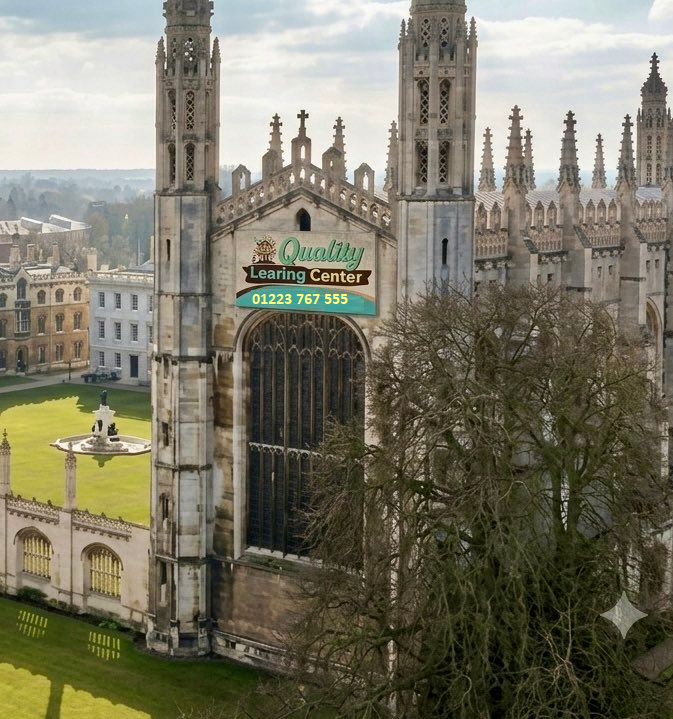
Cambridge has turned into a “Quality Learing Centre”
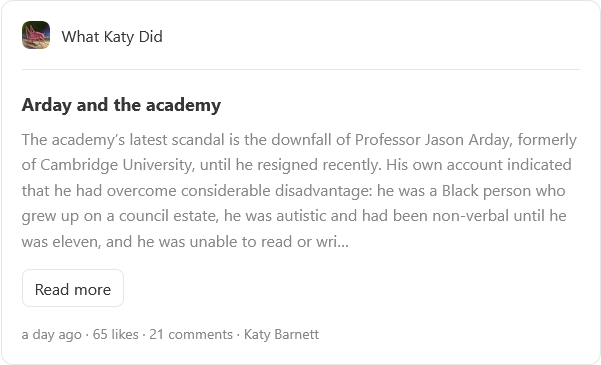
Even as I typed Sunday’s headline, I knew the fallout from the Jason Arday affair wasn’t going to be over quickly: it’s too high profile and gores far too many sacred cows to just fade out of the headlines. On his Substack, Francis Turner remembers what a Cambridge education used to mean and what progressive racists have turned it into now:
Once upon a time I was an undergraduate at Cambridge. Back in the day when men were real men, women were real women and Cambridge’s contribution to the national sense of humour were people like John Cleese, Tom Sharpe and Douglas Adams. Cambridge students were well aware that we were at the top of the intellectual tree and generally proud of the fact. In fact for many of us (e.g. your humble correspondent) coming to Cambridge was where we discovered that there were people far far smarter than we were for pretty much the first time in our lives. It was humbling. And once we got over that, exhilarating. You could have discussions about quantum mechanics or code optimizations or whatever with people who understood the concepts at least as well as you did. You could be lectured by professors who had Fields Medals or Nobel Prizes; often they had literally written the standard text book in the field. Sometimes they would drop digs about colleagues or rivals and you had to know that “Tony” was Tony Hoare who was in charge of Computer Science at the slightly inferior other place. And so on. Yes it was elitist. I’d say it was proudly so. Yes there were concerns about there being too many Old Etonians and other “public school”1 students compared to those from state schools but the solution was seen as going out to state schools and ruthlessly headhunting the top students rather than putting a cap on the number of privately educated students.
Some forty years later it seems that Cambridge no longer aspires to such intellectual heights — at least not for some areas of study. It is true that back then we generally held the Education Department and the associated students of Homerton College to be at a slightly lower level of intellect — and since they were mostly of the female persuasion many male chauvinist jokes were made at their expense. Also those of us reading for the more challenging degrees also disparaged some of the less challenging ones (sociology, land economy …) but even the most elitist MCPs agreed that even the ladies of Homerton had some intellectual assets to go along with what John Cleese might have called their attractive large tracts of land. However I doubt that even the ladies studying education back then would have put up with the quality of tuition offered today by professors such as J Arday, PhD.
However it isn’t just that the quality has gone down, what has also happened is that the racism, sexism and disableism has gone up at the same time as a deliberate part of the process. What do I mean by the racism etc. has risen?
Start with this excellent substack by Katy Barnett
You should read the whole thing because it is truly excellent, but the most relevant bit is this:
Arday’s appointment might make Arday’s enablers feel a righteous glow in the short term — “Look at how wonderful we are, we appointed a Black, disabled scholar!” — but when the web of falsehood disintegrates, it leads people to doubt the worth of all Black or disabled scholars more generally. It also does a disservice to all scholars and students at an institution. From what I have seen on social media, several former Cambridge graduates who had come from less advantaged backgrounds, and had worked exceptionally hard to be admitted, felt particularly betrayed.
I can understand this: they must feel that their hard work has been mocked. Instead of working so hard, why did they not embroider a story of sadness and use that instead? I, too, have felt this bitterness. Am I fool for not using my disadvantage?
If you want to know my “lived experience” before you think I’m worth listening to, you can have it. I have suffered from cerebral palsy since birth, because I was born at 29 weeks — and yes, I have proof of this! — but I do not think that this is relevant to my academic work. […]
I do not think my disability is a reason to promote me, nor do I think it is a reason why I am better than other people. It is certainly not a reason why I am more worth listening to on questions of private law. […]
Just presuming that someone is worthwhile simply because he is Black and disabled and from a disadvantaged background is patronising. But so, too, is dismissing someone simply because he is Black and disabled and from a disadvantaged background. These two positions are two sides of the one coin: using a simple, superficial heuristic to decide worth, without looking at the reality.
The sole relevant consideration is does this person produce good work, and can they do what is needed? I worry that the coin may flip in society, and we’ll go to a position where women and those from minority or disadvantaged backgrounds are presumed to be worthless. If the academy continues on this path, they will produce the very thing they fear: a backlash against minorities.
This is bit at the end is exactly the problem. If you promote incompetents to positions they are not suited for because of their gender, race etc. then you inspire everyone to look at other people with the same gender, race etc. and wonder if they too are incompetent. This is not a philosophical point, it is a real practical issue. I know people, some of whom read this substack, who make a conscious choice of choosing the older, white, male doctor if they can because they can be sure that this doctor was not given a helping hand due to his gender, race etc. and that therefore he will be more likely to give correct medical treatment.
Medicine is far from the only field where this is the case. You may recall the DC crash in early 2025 where a female helicopter pilot collided with a jet. There was a lot of commentary wondering whether (or outright saying that) she was unqualified and only got the job because she was a woman of the right (i.e. left) political leaning. I don’t know whether that is true or not — from what I recall at least some of the so-called evidence against her turned out to be rubbish — but the fact that such commentary sounds plausible and the responses are mostly of the form “Sexist!!!” with no evidence provided makes my point. Likewise the Florida university bridge collapse where the primary engineering firm was all female and (IIRC) Hispanic.
The fact that the phrase “DEI hire” exists and that everyone knows that a DEI hire is known to be less capable is the result of this racist behavior. And I do in fact mean racist. To quote Katy again:
In fact, their attitude strikes me as profoundly racist and not in the least “progressive”. The subtext is, “Black and disabled people can’t manage it, let’s turn a blind eye to any flaws and let this guy in anyway, so we can look good.”
This is the soft bigotry of low expectations.
- i.e. private, boarding school
June 16, 2026
Universal suffrage has its drawbacks
Democracy is a better system than many others that have been tried over the centuries, but it’s far from perfect. Giving everyone the vote sounds like a good idea: you have some small theoretical degree of influence over the people who run the country (note the “theoretical” here). Devon Eriksen points out one of the problems with universal suffrage today:
The problem with universal suffrage is that the more technologically advanced a civilization becomes, the smaller the fraction of people there are in it with the native intelligence to understand how it works.
When the majority of humanity was employed in whacking at the dirt with a pointed stick, and the height of technology was a slightly better pointed stick, anyone with a triple digit IQ could understand what was going on.
Now, we have things like stock markets, the internet, transportation infrastructure, and the Linux kernel, but most people who vote are unable to conceive of these as anything but large piles of chocolate coins, or something else they can put their mouths.
Because that’s how the average monkey interacts with money. They stack the blocks, the research assistant gives them a token, they exchange the token for a banana.
It’s no good trying to explain to the monkeys what supply chain is, or how a trillion dollars worth of rockets can’t magically be converted into a trillion dollars worth of bananas just because they’re both measured in dollars, as if a six-foot man and a six-foot plank of wood were interchangeable.
Finding a slightly different explanation, or getting the monkeys to sit still and really listen, doesn’t really help.
Because the problem isn’t just that the monkeys aren’t paying attention. The problem is that the monkeys are monkeys.
Their brains simply don’t have the developmental capacity to grow the neural connections they would need in order to grasp and manipulate the concept.
In the long term, this is why universal democracy is doomed. Because societies that let retards vote will fail, and be replaced by those that don’t.
You may think that we, as a society, face a great variety of problems. We do not. We have only one. Retards. Every other problem we have is downstream from their inability to understand the consequences of their political opinions.
But to fully grasp the implications of this, you have to understand that the definition of “retard” changes over time, as technology advances, because the IQ level required to grasp what’s really going on gets steadily higher and higher.
Eventually, the category “retard” grows until it includes the average person.
This has already happened.
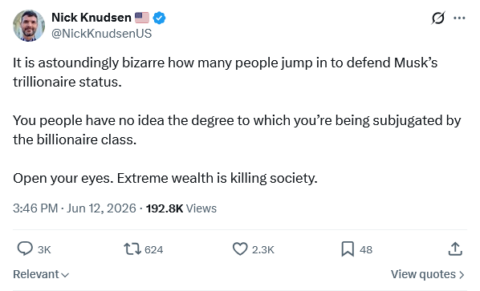
Nick Knudsen isn’t dumber than the average guy. But the average guy, the 100 IQ salt of the earth guy that’s sitting on the next bar stool over, can no longer understand the modern economy. And this isn’t correctable, because the problem isn’t ignorance, it’s complexity.
You can’t make Nick Knudsen smarter by telling him things. You can’t even make him less ignorant, because the bare facts aren’t believable to someone who doesn’t have the framework to understand how they fit together.
The people who understand what’s going on are so much smarter than him that he doesn’t even think they sound smart.
He thinks they sound crazy.
March 11, 2026
Britain’s reputation in the Near East just cratered
On Substack Notes, Earl explains why the inexplicable delay in getting a Royal Navy warship out to protect Gulf allies from Iranian missiles is having serious negative impact on Britain’s longstanding relations with the targeted nations:
A MASTERCLASS IN MILITARY INCOMPETENCE
The Starmer administration’s handling of the Iranian crisis is being whispered about in the corridors of Whitehall as a historic “cock up” of the highest order. Despite receiving a formal request from the Americans on 11 February — a full 17 days before the offensive actually commenced — the British government appears to have spent that critical window in a state of paralyzed indecision. The U.S. request was not an invitation for Britain to join the initial “decapitation strikes”, but rather a plea for the Royal Navy to help shield vulnerable Gulf allies from the inevitable Iranian retaliation. Instead of stepping up to protect the 240,000 British citizens living in Dubai and Abu Dhabi, the Ministry of Defence oversaw a period of baffling inaction that has left regional partners feeling utterly betrayed.
The diplomatic fallout has been described by insiders as nothing short of catastrophic, with Middle Eastern allies expressing “undiluted fury” at the lack of British support. A former minister with deep ties to Amman reports that Jordan is “fking furious”, while leaders in Kuwait and the Emirates are openly questioning whose side Britain is actually on. The Cypriots are reportedly “incandescent” after learning that military assets were actually withdrawn from their vicinity just as the threat level spiked. Only this week did it emerge that HMS Dragon would finally deploy — nearly three weeks after the initial American SOS — a timeline that military experts say is far too little and far too late to restore trust.
Strategic failures have been compounded by what veteran commanders call a total lack of foresight regarding naval positioning. The only available Astute-class submarine was permitted to continue its journey toward Australia, despite having passed through the Gulf just weeks ago when it could have been held as a vital contingency. Security officials now warn that the Trump administration is viewing the UK’s “free riding” with growing contempt. There is a palpable fear in the MOD that the Americans, tired of London’s dithering, will simply cut Britain out of the loop entirely and strike a direct deal with Mauritius to secure the long-term use of Diego Garcia for future operations.
Inside the government, the situation is being described as “incoherent” and “unconscionable”. By allowing the United States to utilize British bases like RAF Fairford for strikes while simultaneously refusing to participate in the missions themselves, Starmer has managed to achieve the worst of both worlds. Critics say they have invited the risk of being targeted by Tehran without the benefit of having any say in the coalition’s strategic direction. One former defence chief has branded this policy “reprehensible”, arguing that Britain has effectively surrendered its seat at the table in exchange for a front-row seat to its own strategic irrelevance.
The sobering reality in Whitehall is a growing sense that the UK no longer has the capacity to shape events in the Middle East. A former Downing Street adviser noted that the “intensity of Labour’s feelings” on the conflict is now matched only by their lack of influence. Allies have stopped listening because they no longer believe Britain can — or will — deliver on its security promises. As the Trump administration continues its high-tempo campaign to dismantle the IRGC, the United Kingdom finds itself sidelined, watched with suspicion by its friends and emboldened by its enemies, all due to a fortnight of inexcusable hesitation.

On March 9th, The Guardian reported that HMS Dragon will sail “in the next couple of days”, heading to Cyprus to take over duties from French, Greek and Spanish ships in providing missile defence to the British air base at Akrotiri. YouTube channel Navy Lookout posted footage of HMS Dragon leaving Portsmouth here.
CDR Salamander looks back at the naval “special relationship” that appears more and more to be just a fading memory:
We need to stop pretending we have a Royal Navy we knew in our youth or even that of two decades ago. No, we have something altogether different. Something shrunken. Something weaker. Something that is, in the end, really sad. A symptom of a nation who has lost an enthusiasm for herself or even an understanding of her national interest and led by a ruling class that seems uninterested in stewardship.
The state of the Royal Navy — a condition that took decades of neglect to manifest into its form today and will take decades to repair if there is ever the will to do so — has become, as navies can often do, a symbol of the state of the nation it serves.
There is a lesson here, not just for the United States, but all nations who consider themselves a naval power.
If you fail over and over to properly fund, develop, train, and support your navy, you can coast for quite awhile on the inertia of the hard work and investment of prior generations, but eventually that exhausts itself, and you are left with the husk of your own creation.
Yes, I’m looking at you, DC.
January 7, 2026
“All of that operational brilliance was always there; it persisted through the Stupid Era”
I missed this Chris Bray piece when it was published a few days ago, but it’s still fully relevant. In it, he discusses the contrast between the faltering and visibly failing military operations like Operation Craven Bugout, sorry, I mean “Operation Allies Refuge”, in 2021 as the US and allied forces abandoned the Afghanistan mission leaving behind billions in military equipment and untold numbers of pro-western Afghans to the “mercy” of the Taliban and the recent brilliant military success in Venezuela:
For years, I’ve been shouting two related messages. First, “we’re in a contest of persistence between elite cosplayers and low-status producers”. Institutions that advance leaders on the basis of their ability to engage in au courant symbol-chanting are crushing the people in those institutions who do the work, and therefore hollowing out the institutions. Second, and so closely related you could just call it the same point in different words, “We’re healthy from the bottom up, and sick from the top down”. The “making stuff” people are mostly just fine; the “running stuff” people are mostly insane.
After years of dismal military failures, like the bafflingly inept withdrawal from Afghanistan after twenty years of ineffective warfare against the Taliban, the raid that captured Nicolás Maduro was operationally brilliant. It required perfection from everyone in a giant list of moving parts, executing a detailed plan with absolute precision. If you haven’t watched the briefing from Chairman of the Joint Chiefs of Staff Dan Caine, who was ritually denounced by the idiot media and the Democratic Party as an unqualified choice for the job, take some time to watch at least some of it. You aren’t used to seeing competence and clarity from an American institutional leader, so it’ll bring back some parts of your consciousness that may have gone to sleep for a while.
With 150 aircraft in the air, launching from something close to two dozen points of origin, every asset arrived in place and on time, while the lights went out below them. From the transcript:
The “pathway overhead” was that the US military switched off the Venezuelan military. They pressed the off switch on another nation’s command, control, and communications systems. Venezuela spent 2025 posturing at the US Navy, displaying their power as a warning against American aggression:
Similarly, “Experts had warned that Venezuela’s layered air-defence network could complicate US air operations”. Apparently not. At the designated moment, it all just went away.
I’ve talked for years about “recipe knowledge”, about the ability to know the steps that will produce a desired outcome. If I want to produce X result, I have to perform steps A, B, C, D, E, and F, in that order. If I skip Step C, Result X doesn’t occur, even though I’ve performed all the other steps.
We’ve just watched a military that apparently lacked the recipe knowledge to destroy the Taliban, or even to withdraw from a failed war in an orderly fashion and without leaving a bunch of weapons behind, demonstrate a shockingly high level of recipe knowledge. A failing institution isn’t a failing institution. Brilliant planning, flawless execution, ruthless competence.
There’s no way in hell that a single year of top-down intervention reversed years of hard decline. All of that operational brilliance was always there. It persisted through the Stupid Era.



On Substack Notes, John Carter commented on the article:
This, right here, is the meta-message of the Venezuelan raid. Competence collapse isn’t a purely military pathology, nor is it solely an American affliction. It applies to every institution in every Western country. We’ve been living with the frustrations and humiliations of this imposed decline for decades now.
With one decisive act, Trump has demonstrated that decline is a choice made by a small, false elite – and that if that elite is removed, decline can be reversed.
Removing the elite is the fix-everything switch in the presidency, the US military, and the Venezuelan government.
And now the whole world sees it.
A related post from ESR on the social media site formerly known as Twitter explores one of the more geographically distant ramifications of the US operation in Venezuela:
The Watcher On The Web @WatcherontheWeb
“ThIs Is GoInG tO cAuSe ChInA tO aTtAcK tAiWaN”
Yes retard, the country that just got shown all it’s calculations based on weapons systems which depended on being able to use RADARS to engage US aircraft/ships are essentially worthless and billions of dollars in investment and research have been wasted is going to feel VERY brave in launching an assault against a fortified island nation armed with US weapons, US fighters, backed up by the US navy and Japanese defense force …
I’m sure they are just giddy with excitement to try and pull that off. Practically chomping at the bit
This is an extremely important point that I’ve been thinking about ever since we got an unexpected audit of Venezuela’s air defenses. Russian SAM-300s and BUKs, Chinese anti-air radar, all proved completely worthless against U.S. gear and operators.
I guarantee you that if you are a Chinese military planner contemplating how to get an invasion army across 100 miles of the Straits of Taiwan, you are shitting your pants right about now. Because you have just learned that if you had tried to bust that move yesterday, your nice shiny new invasion fleet would have gotten absolutely gacked by U.S. airpower and missiles that you wouldn’t see coming BECAUSE YOUR FUCKING RADARS DON’T FUCKING WORK.
Also, the Soviet anti-air missile designs you cloned turn out to be about as useful as so many busted shopping carts.
Some of your guys are going to be saying “That’s impossible. The fix must have been in. Air defense must have had orders not to engage.” Which is an extremely cheering thought, but …
… isn’t that what the Americans would want you to believe? The only thing better than having complete technological dominance of an adversary is having complete technological dominance of an adversary who’s been conned into believing it isn’t true and walks blithely into getting utterly wrecked by it.
Yep. Before this went down I was figuring a very high probability that the Chinese make their move on Taiwan in 2027. Now? I guarantee you that their confidence in their previous risk assessments has evaporated. They no longer know what they’ll be facing, and there’s a significant possibility that mainland China’s domestic air defenses are worthless too.
Now I’m going to suggest that you juxtapose two phrases: “thermobaric bombs” and “Three Gorges Dam”. A China that’s naked from the air has the biggest glass jaw in human history.
Now I think there’s pretty good odds that the invasion of Taiwan will never happen at all.
Update, 8 January: Welcome, Instapundit readers! Please do have a look around at some of my other posts you may find of interest. I send out a daily summary of posts here through my Substack – https://substack.com/@nicholasrusson that you can subscribe to if you’d like to be informed of new posts in the future.
December 14, 2025
Where does all the money go for so many First Nations bands?
Earlier this month, I shared a long thread highlighting some incredible findings from the audit of a single First Nations group in Saskatchewan (here). On the social media site formerly known as Twitter, @Martyupnorth discusses how the federal government has gone out of its way not to ensure that First Nations funding is transparent:
Cory Morgan @CoryBMorgan
The Siksika reserve got $1.3 billion a few years ago and the housing is still predominantly shit.It’s not lack of government funding folks.
It’s a broken system of racial apartheid.
This ruling won’t help a bit.
Let’s talk about transparency in First Nations reserve finances in Canada. It’s topic that’s sparked a lot of debate.
Back in 2013, the Harper government passed the First Nations Financial Transparency Act (FNFTA), which required chiefs and councils to publicly disclose their salaries, expenses, and audited financial statements. The goal? To ensure accountability for the billions in federal funding going to reserves, empowering community members to hold leaders responsible and curb potential corruption.
But the Act was controversial from the start. Critics, including many First Nations leaders (no surprise there), called it paternalistic, imposed without proper consultation, and an infringement on Indigenous sovereignty. Some argued it violated privacy by forcing the public release of sensitive financial details, like personal remuneration schedules.
Enter Justin Trudeau. During his 2015 campaign, he promised to repeal the FNFTA, saying it wasn’t “respectful” to First Nations and needed replacement with a co-developed approach. Once in power, his government didn’t formally repeal the Act, but effectively reversed it by suspending enforcement. They stopped withholding funds from non-compliant bands, halted court actions, and reinstated frozen money. Compliance rates plummeted afterward, with fewer bands disclosing info publicly.
See the screen shot below. The Siksika Nation, to whom Cory refers to, hasn’t dislosed financial data since 2013.
The Liberals’ rationale? Building “mutual accountability” through partnership rather than top-down rules, addressing privacy concerns and respecting self-governance. But a decade later, as of 2025, the Act remains on the books unenforced, while polls show most Canadians still want transparency in how reserve funds are mis-managed.
What do you think? Does ditching enforcement help or hinder real accountability?

Update: At some point, the audits have to start and the government and the courts will then have their hands full:
December 9, 2025
Auditing where the money goes, First Nations edition
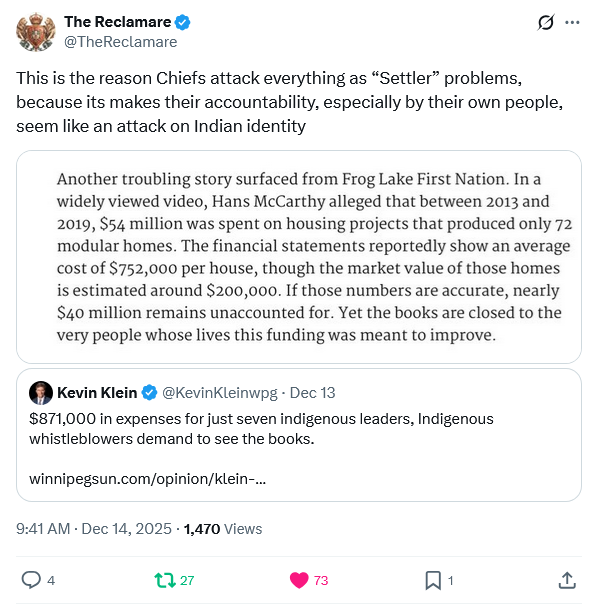
I don’t think many Canadians would argue with the government providing funding to First Nations groups in remote areas so they have access to services and amenities that most of us take for granted. But the government has been giving so much money for so long with very little evidence that the money is actually making a difference. Surely, a regular system of audits would show what happens to the money after the feds cut a cheque and why conditions in First Nations communities aren’t improving? Well, on the social media site formerly known as Twitter, @The Reclamare shares a thread detailing some of the findings of a recent audit of a First Nations NGO and it’s kind of disturbing:
Where our taxes go, First Nations Edition
KPMG audited the Federation of Sovereign Indigenous Nations (FSIN) representing 74 First Nations in Saskatchewan
They analyzed spending between April 2019 and March 2024
Hang on🧵
#1 – COVID Funding
$26 million was audited
KPMG found $23.5 million was questionable
** an 89% failure rate**– no records
– missing contracts
– missing invoices
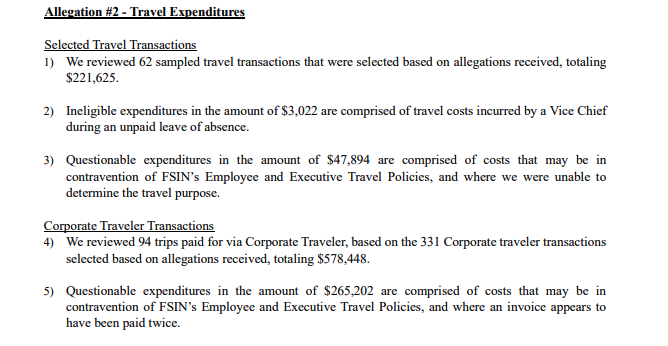
# 2 – Travel expenditures
$800K of travel spending was audited
$316K was flagged by auditors, a 39% failure rateHalf the travel bookings couldn’t be justified, either policy violations or they couldn’t explain the purpose. And one Vice Chief was billing personal trips
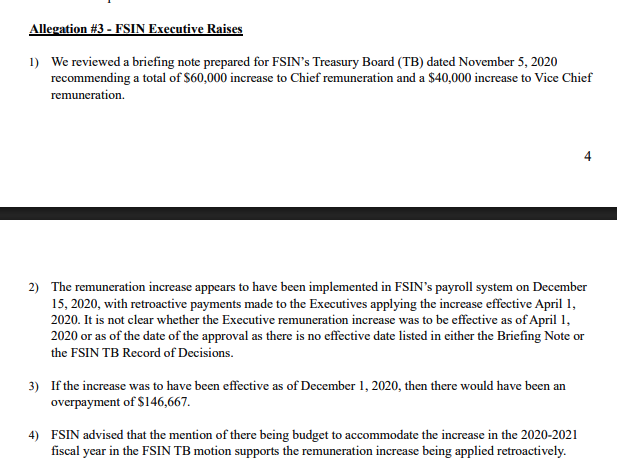
# 3 – Executive Pay Raises during Covid
On November 5, 2020, a briefing note went to FSIN’s Treasury Board recommending:
$60,000 pay raise for the Chief
$40,000 pay raise for each Vice ChiefRetroactive 8 months prior


November 29, 2025
“There comes a point where government waste stops looking like incompetence and starts looking like treason”
Canadians must be literally the most passive and forgiving people on Earth. It’s the only thing that can account for how we are governed by incompetents or idiots, yet keep re-electing them despite all the clear signs of failure and opportunistic crony looting of the public purse:
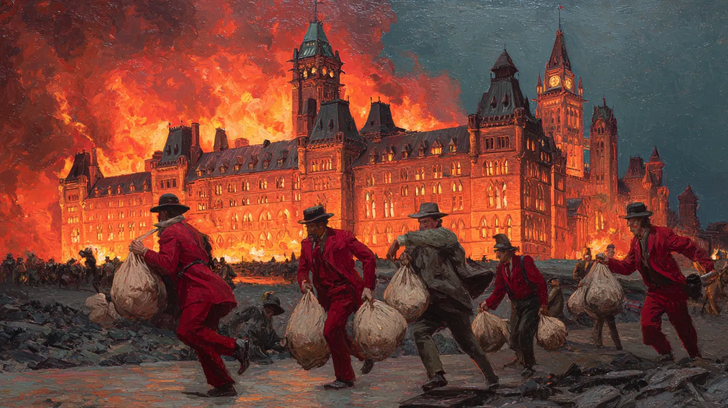
Image from Blendr News
There comes a point where government waste stops looking like incompetence and starts looking like treason. Canada has long passed that point. What we are witnessing now is not mere mismanagement or bureaucratic drift — it is the systemic looting of a nation by the people meant to serve it. Billions vanish with no oversight, no accountability, and no shame. The numbers have grown so grotesque that one struggles not to call this what it is: organized theft.
Take Stellantis. Ottawa handed the automaker $15 billion — the largest corporate subsidy in Canadian history — and the industry minister didn’t even read the contract before approving it. This, despite Stellantis shifting Jeep production to the U.S., delaying its employment targets at the Windsor battery plant, and refusing to appear before Parliamentary Committee hearings. Honda received a major subsidy without full Treasury Board review. Volkswagen hid its cost estimates. Northvolt was showered with subsidies and then slipped into insolvency. Each scandal blurs into the next until you realize the pattern is not incompetence but a business model.
Then there’s the LNG project in British Columbia. The main industrial partner is an American firm. The terminal will be built overseas, floated to Nisga’a land, and subsidised by Canadian taxpayers. In other words: Canadians take the risk while the profits flow abroad and the jobs go to Korea or Japan.
Or consider Telesat. They received $2.14 billion to connect rural Canadians to high-speed internet — with no obligation to connect a single home, no penalties for failure, no clawbacks if the project collapses, and no enforced timelines. Three years later, the network still does not exist. Meanwhile, Starlink already worked, already served rural communities, could have done it for half the cost, and offered immediate deployment — but was rejected because Elon Musk is “polarizing”.
ArriveCAN? $54 million spent on an app worth $80,000, much of it funnelled to GC Strategies, a boutique firm that admitted it didn’t actually build anything. Then the Sustainable Development Fund — the so-called green slush fund — where $400 million flowed into Liberal-friendly firms.
The State tells us its creed is “responsible governance”. Yet almost every act defies that claim. What we have instead is a system run by well-dressed operators who treat the public purse as their own. Canada is now a nation run by criminals, for criminals.
October 10, 2025
A POSWID analysis of the contention that “Canada is broken”
It’s my strong opinion that Canada is indeed “broken”, and much but not all the blame for that goes to former Prime Minister Justin Trudeau and increasingly to current PM Mark Carney. It hasn’t all been the direct action or deliberate inaction of the Liberal party and their bureaucratic minions in the civil service, but their fingerprints are on a lot of the damage. Eberhard Englebrecht analyzes Canada using POSWID framing and concludes that “the Purpose Of Canada is What It Does”:
Now, one of the core criticisms made of POSWID by its opponents is that it leans heavily on a consequentialist interpretation of events, completely discarding the roles human intention, error, and agency play in how things transpire.
However, these critiques only hold validity if you take POSWID and make it your singular mode of analysis — something that I don’t encourage, nor intend on doing myself. Rather, POSWID should be understood and used as a specific tool with a specific purpose — that is, to peel back the noxious platitudes, gaslighting, and wishful thinking that envelop our politics, and hinder our ability to view our present situation with clarity and honesty.
And, unfortunately for the citizenry of Canada, Canadian politics is — and has been for some time — a domain chock full of the misguided idealism and obfuscation that POSWID seeks to erase.
It is why many Canadians — despite their country having experienced a precipitous decline in both general prosperity and the integrity of the common social fabric — remain willfully blind to such an absurd degree.
POSWID, as I will be applying it, can tackle many of the polite pleasantries and mindless incantations that have become embedded in Canada’s “consensus” of acceptable political discourse, exposing them as misaligned with reality. This will take one of two forms: the first is to demonstrate that a common belief in the trope in question has led to results contrary to the intentions of those who originally pushed the trope; the second is that the trope was always purely abstract and aspirational, never described reality, and any attempts to align reality with said trope have failed miserably.
Many of these tropes are sacred cows of Canada’s political establishment — ideas that they would insist define “what it means to be Canadian” or are things that “we all believe”. Going against them, or merely questioning their validity or suitability, would be considered “UnCanadian”. These tropes have, in many cases, dictated the direction of Canadian society since the 1960s and created the foundations for the paradigms that currently define Canadian politics. Therefore, the deconstruction of these tropes constitutes the deconstruction of these paradigms — something that would have cascading ramifications for our country.
It is worth noting, however, that my intention in writing this piece is not to make granular policy prescriptions. My job is merely to provide a clear-eyed account of how three of the values and policy programmes of Canada’s chattering class (you could substitute “chattering class” with “professional-managerial class” or “Laurentian Elite”) are out of step with how this country actually exists — a reality felt and experienced at an intuitive level by many, but rarely articulated in public.
The federal government’s gun “buyback” program pilot in Nova Scotia
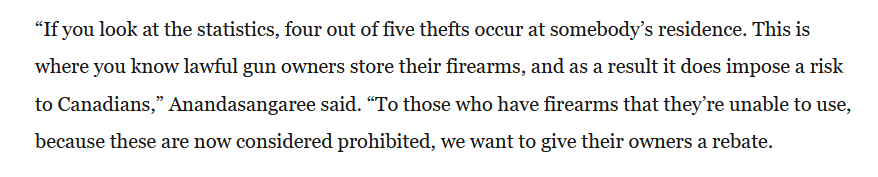
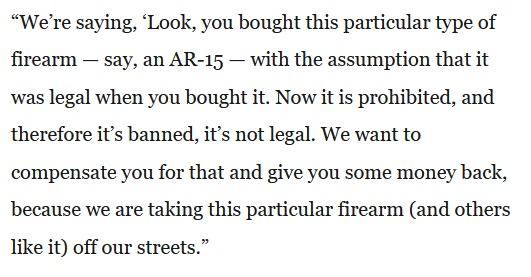
On the social media site formerly known as Twitter, Tim Thurley responds to a report about the gun “buyback” pilot program:
This reads like a government flailing for a message. We know this is incorrect, the Minister knows it is incorrect, and we know the Minister knows it is incorrect, and yet.
(The “Ensure…” section is also painful to read, but that’s another matter.)
He’s suggesting the risk is posed by stolen firearms. Not only do we know this is a small portion of risk — and easily substituted by other sources — but to say we must confiscate your property because someone else might misuse it sounds an awful lot like victim blaming.
Nobody bought an AR-15 under the assumption it was legal when they bought it (unless FRT banned, then it gets complex).
If a licensed user bought and registered it pre-OIC (or just bought if non-restricted) then it was legal when they bought it, period. No assumptions needed.
A rebate is also incorrect. A rebate is something a customer gets back after purchase.
They get to keep both the rebate and the product.
The part about only getting some money back is at least accurate.
The government is not offering full compensation for many users based on the list prices, and has reiterated that it does not plan to offer further compensation once the initial pot runs out.
September 23, 2025
Voters didn’t have to pay attention, but now they really, really should
On the social media site formerly known as Twitter, Tristin Hopper posted the best explanations I’ve seen for why Canada is in the state it’s in:
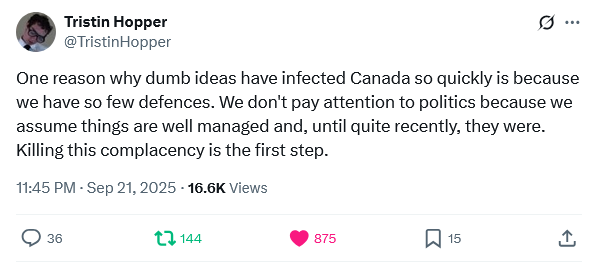
Canadians took it for granted that, no matter which party was in government, the country would continue to be stable, predictable, and competent. That’s clearly wrong today, yet the voters haven’t really accepted the new situation yet. Until they start paying attention, things may not improve.
It’s not just Canada, of course, but Canada is further down the road to ruin and thanks to the governments’ conscious actions, it will probably take longer to recover (and I don’t see a Canadian Javier Milei on the horizon, more’s the pity).
At The Freeman, Will Ogilvie Vega de Seoane discusses a related issue with most forms of representative government:
We are stupid. There, I said it. I feel much better now — like I’ve finally opened up in group therapy. PhDs won’t fix it, nor will subscriptions to all the best outlets. As individuals, we simply do not have the capacity to decide what is best in public life. As voters, we don’t usually care what our representatives are up to, nor do we have the faintest idea what the best policy on agriculture, artificial intelligence, or healthcare should look like — and that’s on a good day. But we do think we know. Deep down we think we are sovereign, that democracy is “all of us”, as though the government were some noble embodiment of “the people” rather than just another collection of organized persons with private agendas.
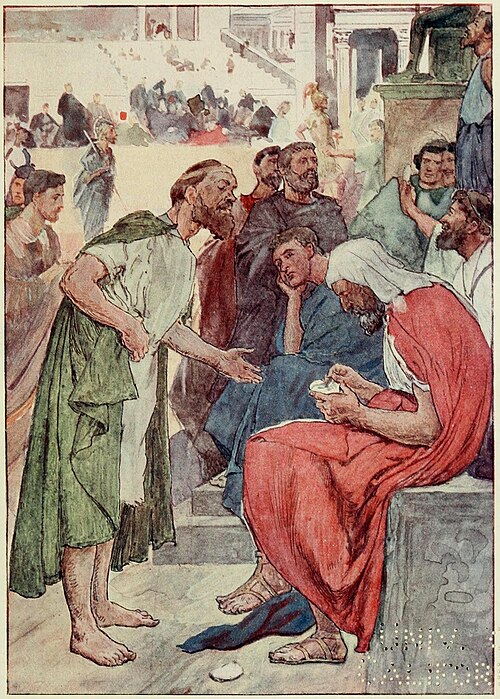
“Aristeides and the citizens” from Plutarch’s lives for boys and girls (1900).
Plutarch tells a story that I have always found marvelous. It’s about Aristeides “the Just”, one of Athens’s heroes in the Persian Wars. The Athenians, weary of kings and tyrants, invented ostracism — a mechanism to expel for ten years any citizen who got too powerful. Each voter would scratch a name onto a shard of pottery, and if more than 6,000 shards had the same name on them, the man was politely asked to take a decade-long sabbatical. Today we’d probably call it “a career break for the common good”.
Anyway, one day a farmer approached Aristeides himself — without realizing who he was — and asked him to write the name “Aristeides” on his shard. Surprised, Aristeides asked if he had ever harmed him. “No,” said the farmer, “nor do I know him by sight. But I am tired of always hearing him called ‘the Just’.” Aristeides, being annoyingly noble, wrote down his own name and handed the shard back. Later, as he left the city in exile, he prayed the opposite prayer of Achilles: that no crisis should come which would force the Athenians to remember him. On LinkedIn, Aristeides might have written: “Currently on a ten-year sabbatical generously sponsored by the people of Athens. Seeking new challenges outside the Attic peninsula #OpenToWork.”
This, in miniature, is how people vote. Not with knowledge, or vision, or even vague coherence — but out of envy, spite, boredom, or some other glorious irrationality. The Athenians had shards; we have hashtags. Instead of ostracism by pottery, we have ostracism by X: one bad joke, one leaked email, and the digital mob sends you packing. Today in Britain, people can even be jailed for their comments on social media. So much for parrhêsia, that old Athenian virtue of speaking frankly to power. We’ve managed to turn it into a crime — and worse, the canceling mob thinks it’s “speaking truth to power” when in fact it is obedience dressed as rebellion.
Modern voters aren’t any better. Some vote because the candidate owns a cute dog. Others because the candidate is endorsed by Taylor Swift. Entire campaigns have been won on promises of free cable, or by a politician smiling the right way on TikTok. In Spain, we even coined a term for it: the Charo. A Charo is usually an old lady with pink hair who parrots whatever our president says. Charos cannot resist the presidential smile. Even when the president contradicts himself, as he normally does, doing the exact opposite of what he promised, they just blush and blink as if to say: “Oh, Pedro, always misbehaving — we love you all the more for it.” They pamper their charming president and dismiss any criticism as fascist slander. Welcome to the Charocracy.
That’s a pitch-perfect description of the typical Liberal voter in Canada. Mark Carney’s Canada is clearly a maple-flavoured Charocracy.
September 13, 2025
QotD: The Peter Principle in football, the military, and life in general
Is that true in other jobs where you need a combo of a certain physique, a certain IQ, and a certain attitude? The military, say, or the police? Would the average platoon sergeant be a better lieutenant than the average lieutenant? (I’m seriously asking, even though I know that the average corporal’s opinion of the average butterbar lieutenant and vice versa makes the town-gown split in college look like a friendly rivalry). What about the best NCO — would he make a good general? How about the best patrolman vs. the best detective?
And of course this is complicated by the outliers. SWAT guys generally don’t become police chiefs, Special Forces guys don’t become generals (that McChrystal bastard being an unfortunate exception), and so on, but those are extreme outliers, like quarterbacks — physical freaks with fast-firing heads; they don’t want desk jobs, I imagine.
The reason I’m rambling on about this (other than “I’m jet lagged and I have the flu”) is that our whole society seems to have fucked up its competence sorting mechanism, and that flaw seems to be structural. You don’t want a coach who never played, or a general who never fought, but at the same time there’s fuck-all relationship between “being good at playing / fighting” and “being good at coaching / strategizing” that I can see. The same applies in all bureaucracies, of course, we call it the “Peter Principle” — the guy who was good at answering phones in the call center might or might not be any good at supervising the call center, but there’s only one way to find out …
… or is there? Football is interesting in that there’s only one metric for success, and it’s easy for everyone to see. There’s absolutely zero question that So-and-So was a good player, in the same way that there’s zero question So-and-So was a good coach. You can always find nerds and lawyers to niggle around the edges — oh, So-and-So is overrated, and here’s my charts and graphs to prove it — but we all know what that’s worth. Figuring out a better way to sort talent in a binary system like football would go a long way to help us figure out how to fix our society’s fucked-up competence sorting mechanism.
Severian, “Friday Etc.”, Founding Questions, 2022-02-04.
July 16, 2025
Matt Gurney’s “Hollywood Thesis”
I almost skipped reading this one, as Matt and Jen usually keep their own columns behind the paywall, but this one is free to non-paying cheapskates like me:

… I actually think there is one way that Hollywood — and probably mass entertainment writ large — has kind of warped our society. It’s not that it has promoted degeneracy or loose morals or shameless enjoyment of vice. It’s more insidious. And probably more dangerous.
I think Hollywood has tricked us into thinking that, in an emergency, our governments will prove to be a lot more competent than they will be. And usually are.
This is something I’ve been thinking about for a while. I’ve mentioned it to my Line colleagues before, and I call it my Hollywood Thesis. As I see it, the broader public has fairly accurate expectations about the level of service they can expect from their government. Sometimes it’s good, sometimes it’s bad, but it’s mostly realistic. We basically know what we’re getting into when we, for example, drag the trash bin to the curb, or turn on a tap in the morning, or go to an emergency room because you need to get stitched up after a minor mishap.
But I’ve observed over the years an interesting exception. When the public is confronted with any kind of new or unexpected threat, people, for some reason, believe their government will have some secret ability or unexpected expertise in dealing with it. Maybe it’s a quirky scientist working in the bowels of some ministry or department. Maybe it’s an elite team of experts. Or some hidden base loaded with commandos and advanced weaponry.
Wrong. And I’ve been thinking about this. Why do we assume the same government that is, for instance, struggling to fill potholes in my city, or hire enough nurses in my province, or fix a federal payroll system, is going to be more competent when presented with something totally out of the blue? This flies in the face of all of our lived experiences with government. It’s a generous assumption of state capacity that is, to put it charitably, unearned.
So why? What explains this?
It’s Hollywood. It has to be.
Lots of smart, competent people have government jobs. One of the great joys of my career has been the opportunity to speak with many. There are shining lights of unusual competency in every department, and at every order of government, really — my colleague Jen Gerson recently told our podcast listeners about how one of these hidden gems helped her cut through a confusing and dysfunctional process so she could get a permit. And I will never get tired of saying good things about the men and women of the Canadian Armed Forces — true miracle workers we do not support enough.
But there aren’t hidden capabilities. There aren’t secret teams. The same people trying to prevent Canada Post from going on strike will be the same people handling the next pandemic — or who would be responsible for opening a dialogue if aliens decided to land their mothership in the middle of a Saskatchewan farm.
It’s within the range of possibilities that, presented with a unique challenge, government leaders could rise to meet it … as long as it’s a completely unexpected situation with no pre-existing rules or regulations or bureaucratic processes in place. I admit it’s not the way the smart money would bet, but it’s technically a possibility.


