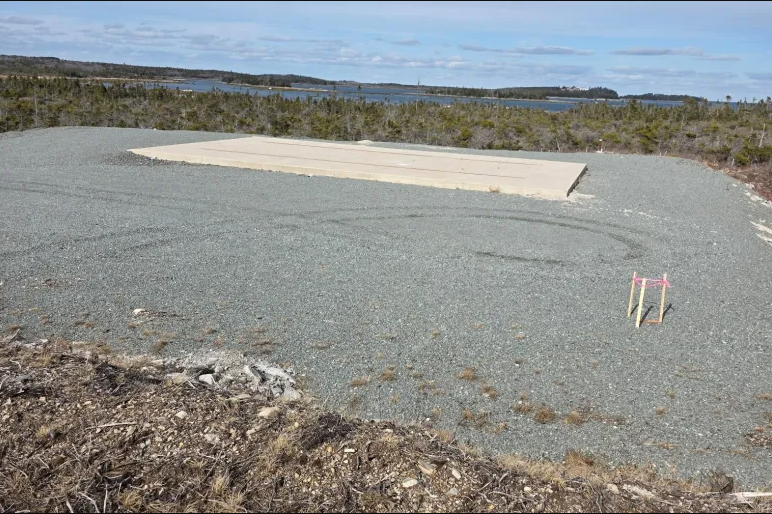
Along with many others, I was boggled to hear this week that the Canadian government was spending $20 million per year to lease a “launch facility” — photos show a pretty rudimentary concrete pad surrounded by gravel and not much else — which the Ukraine-connected lessor itself is leasing from the Nova Scotia for $13,500 per year. John Carter is somewhat more optimistic than I am that there’s a path from the dubious patch of land to a real maple-flavoured space program:
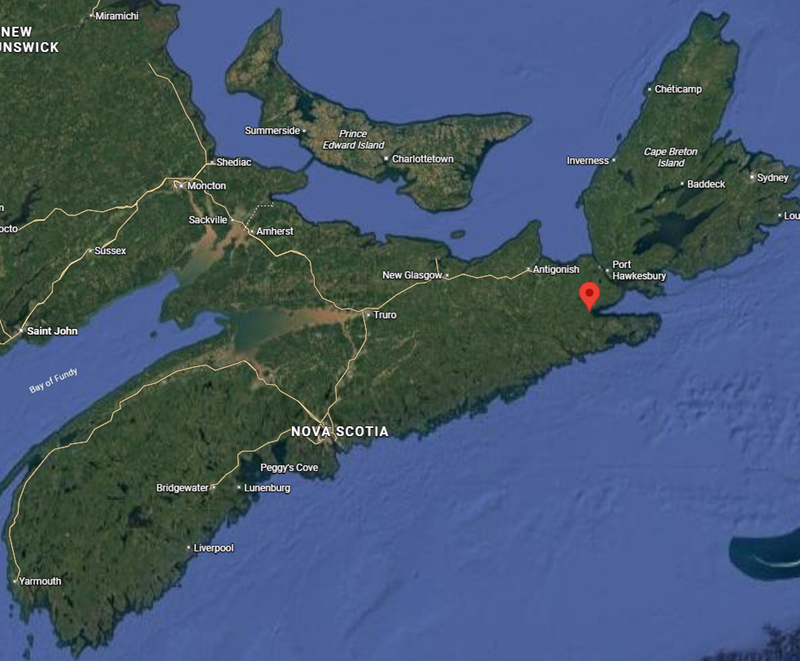
Guysborough, Nova Scotia, site of the MLS “spaceport”
Image from Google Maps.
It would be a gross exaggeration to say that Canada doesn’t have a space program. The launch of the Alouette 1 satellite in 1962 made Canada the fourth country to place an object into orbit around the Earth. Astronaut Marc Garneau nearly became the leader of Canada’s Liberal Party in 2012 (yes, we could have had an astronaut prime minister … Canadians voted for a nepo baby instead); astronaut Chris Hadfield is a minor celebrity in Canada; Jeremy Hansen became the first Canadian to visit the Moon a few weeks ago. Various iterations of the Canadarm have been fixtures of Space Shuttle missions and the International Space Station for decades. However, Canada does not yet have its own, native launch capability. The Canadian Space Agency acts as an appendage of NASA, with Canadian astronauts and satellites hitching rides on American rockets.
The announcement that the Canadian government is taking steps to develop a Canadian launch capacity has roused me from my uneasy slumber of the last several weeks, and I have awakened in a cranky mood. Several aspects of this story have annoyed me, both those relating to the government’s execution, and those emerging from the reaction from influencers whose justified skepticism of Ottawa’s intentions is intersecting with their poor understanding of space in a fashion that is leading them to beclown themselves.
The story that got everyone’s attention was a two hundred million dollar lease Ottawa signed with Maritime Launch Services for a spaceport in Nova Scotia, Canada’s largest Atlantic province, covering ten years of operations at twenty million dollars per year. The spaceport is, at the moment, essentially just a concrete pad at the end a gravel road, with no other apparent infrastructure.
The “spaceport”
Image from Postcards from BarsoomThere are several genuine reasons for serious concern with this, which have been detailed by a Nova Scotian NIMBY who’s been annoyed by MLS for several years now. MLS is a Ukrainian-American company whose original business model was to design, manufacture, and launch the Ukrainian-built Cyclone 4M, which it has never successfully done. To be fair, this effort was interrupted by the Ukrainian war, which for obvious reasons redirected Ukrainian rocketry to military production. However, it’s also worth emphasizing that MLS is an offshoot of the Ukrainian Space Agency, which is every bit as corrupt as you’d expect. The Ukrainian Space Agency has been mired in several expensive scandals over the years; one of them resulted in the theft of $10 million from Export Development Canada.
A former Liberal Party premier, Stephen McNeil, sits on MLS’s advisory board, which could be quite natural and could also be an indication of bog-standard conflict of interest.
The company’s finances are rather suspicious. It has posted operating losses of several million dollars a year, with the exception of 2025 when it lost $47 million1; revenue in 2025 was less than $15,000, and in 2024 it was zero. The incredible 2025 cash burn was apparently due to MLS acquiring Spaceport Canada. The company’s normal losses seem to be mostly due to executive compensation for its small roster of employees: the CEO and CFO between them rake in about a million dollars. This is despite the company not apparently actually have done anything yet. Other expenses include paying the Ukrainians for technical documentation for a launch vehicle MLS had already abandoned, and debt service on funding advanced by investors.
In 2024, MLS abandoned the scheme to launch Ukrainian rockets and pivoted to an “airport model”, the idea being that they would make money by charging launch service providers for the use of their spaceport. In 2025 there were precisely two launches from MLS’s concrete pad. Both of them were suborbital. One of them was a student-designed rocket from Toronto’s York University.
Even more absurdly, MLS’s concrete pad is on Crown land, which the company rents from Nova Scotia for $13,500 a year. This then looks like Ottawa renting its own land for $20 million a year.
In yet another suspicious-looking move, one of MLS’s chief financiers, Sasha Jacob, sold millions of shares immediately after the deal was announced and the stock price 10x’d; he then exercised stock options to replenish his position at below-market rates, thereby maintaining interest in the company while pocketing a couple million dollars.
All of this looks a whole lot like one more public-private partnership grift in which press releases and public relations materials project a hologram of visionary development, while the funds disappear into a complex web of regulatory compliance, stock buybacks, environmental impact studies, and executive salaries, without anything ever actually being built. This is a scam in which Canada’s Laurentian elites have learned to excel. It turns out that it is much easier, and far more profitable, to get paid for something you’re pretending to do instead of actually doing it; when the inevitable questions get asked, you simply throw up your hands and complain of unexpected engineering difficulties, tortuous regulatory pathways, or other factors beyond your control. None of the people involved – not government ministers, not government bureaucrats, not their private-sector partners – care one bit whether any given project succeeds, because they get paid by the taxpayer and the debt taken out in the taxpayer’s name regardless of outcomes. It is my working assumption that there is nothing more to this supposed space program than this. We are governed by theatre kids dancing to the tune of the Music Man, and none of them know anything about doing anything real.