Quotulatiousness

May 11, 2026

“We’ve entered the pre-violence rhetorical phase of the classic communist cycle”

Filed under: China, History, Politics, Russia, USA — Tags: , , , , , — Nicholas @ 04:00

You have to have noticed that progressives all seem to have recently decide en masse that we need to liquidate eliminate expropriate the billionaire class. It’s been done in the past, and modern progressives seem to be unable to spot the pattern, even as they work hard to bring it back to life by constantly scapegoating the wealthy (machine translated from Brivael Le Pogam’s original French post):

Lydia is putting her finger on something that no one wants to name clearly: we’ve entered the pre-violence rhetorical phase of the classic communist cycle.

The script is documented, archived, and it repeats itself identically for a century. Before every mass massacre carried out in the name of Marxism, there are always 5 to 15 years of public designation of a category of people as “the enemy to be taken down”. Not a debate on public policies. Not a critique of inequalities. A methodical dehumanization of an entire class.

In the USSR in the 1920s, it was the kulaks. Lenin wrote as early as 1918 that it was necessary to “exterminate the kulaks as a class”, an expression repeated word for word by Stalin ten years later. Result: 4 million peasants deported, several million dead in the Holodomor.

In Maoist China, it was the landlords and “class enemies”. Mao orchestrates public “struggle sessions” where neighbors, children, former employees are forced to denounce, humiliate, and beat. Tally from the land reform alone: 1 to 2 million executions, not counting what follows.

In Cambodia, it was the “new people”: city dwellers, intellectuals, people wearing glasses. Khmer Rouge propaganda designated them for years as parasites before massacring them. 1.7 million dead in 4 years.

Now look at what’s happening in the United States in 2026.

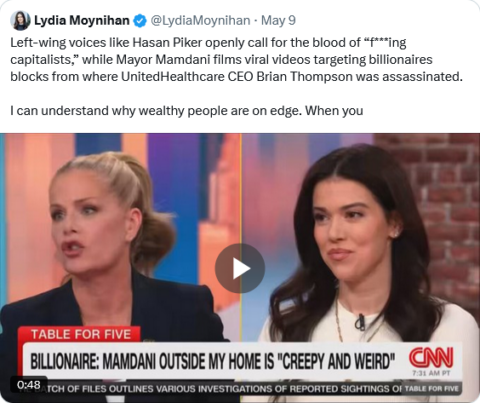
Hasan Piker, who reaches millions of young men on Twitch, speaks openly of the “blood of f***ing capitalists”. Not in 1968 in a Trotskyist cell, in 2026 on the platform most watched by 18-25 year olds.

Zohran Mamdani, elected mayor of New York, films viral videos in front of billionaires’ buildings, exactly where Brian Thompson, CEO of UnitedHealthcare, was assassinated last year by Luigi Mangione. The latter was turned into a pop icon by a part of the American left in less than 48 hours. T-shirts, fan art, romanticization of the murderer.

This isn’t “political passion”. It’s phase 1 of the protocol. The public designation of a category of humans as legitimately hateable, followed by the valorization of those who take action.

The “normal” reaction of a healthy democracy should be the immediate social and professional isolation of these voices. What’s happening: they top podcast charts, they’re elected officials, and they get favorable media coverage.

History doesn’t stutter. It copy-pastes. And the first victims are always surprised to discover, too late, that the speech they found “a bit excessive but oh well” was actually the clear warning that a pit was being dug for them.

Lydia is right to say it. And she’ll be even more right in five years when we reread these tweets.

And more:

And if you’re reading this thinking, “This doesn’t concern me, I’m not a billionaire”, stop for two seconds and really think about it.

Because that’s exactly what the Russian peasants told themselves in 1918 when people started talking about the “bourgeois”. They applauded, or they looked the other way. It wasn’t their problem. They weren’t rich.

Ten years later, they were called kulaks. And “kulak“, in Stalinist practice, meant any peasant who owned one more cow than his neighbor, who had dared to hire a seasonal worker, who had a slightly better-kept barn. 4 million deported. Several million dead.

That’s exactly what the small Chinese shopkeepers told themselves in 1949, when Mao went after the “great landowners”. Not their problem. They just ran a little store. Five years later, they too were classified as “class enemies”, stripped of everything, publicly humiliated, sometimes beaten to death by their own neighbors.

That’s exactly what the Cambodian schoolteachers told themselves in 1970, when the Khmer Rouge talked about “urban exploiters”. Not their problem. They barely earned enough to live on. In 1975, knowing how to read was enough to sign your death warrant.

The communist mechanism NEVER stops at the ultra-rich. Never. It’s a historical law as solid as gravity.

Why? Because fundamentally, the communist doesn’t hate wealth. He hates individual emancipation. He hates the very idea that a man can build something that belongs to him, decide his own life, refuse the collective. Private property isn’t an economic detail to him — it’s the metaphysical enemy. Because someone who owns something is someone who can say no.

So if you have an apartment you spent 15 years paying off, you’re concerned. If you have a small business, a shop, a sole proprietorship, you’re concerned. If you have a savings plan, a bank book, stocks, you’re concerned. If you have a family home in the provinces, you’re concerned. If you work hard to pass something on to your kids, you’re at the top of the next lists.

Billionaires are just the first course. Always. Because there are few of them and they’re easy to point out. They’re the appetizers for the machine. The main course, historically, is you.

And meanwhile, a lot of people read threads like this, nod their heads, and don’t share. Don’t comment. Don’t take a stand. Out of fear of being labeled “right-wing”, “reactionary”, “too political on LinkedIn”. Out of comfort. Out of social cowardice.

Know that this silence has a precise historical cost. Every time a society has tipped into this madness, it did so because the reasonable majority stayed silent too long, thinking it would all blow over on its own.

It never blows over on its own.

May 6, 2026

Carney panders to the Euro elites and his TDS-afflicted base

Filed under: Cancon, Europe, Media, Military, Politics, Russia, USA — Tags: , , , , — Nicholas @ 03:00

On the social media site formerly known as Twitter, Ben Woodfinden explains Prime Minister Mark Carney’s constant pandering on the international stage:

The average voter won’t care, but the more Carney lays out his worldview the more the contradictions and incongruences in his thinking (or lack of sincerity) become apparent.

In his famous Davos speech he said “we actively take on the world as it is, not wait around for a world we wish to be”. But the way he talks about and sees Europe does not fit this, and this statement is bizarre.

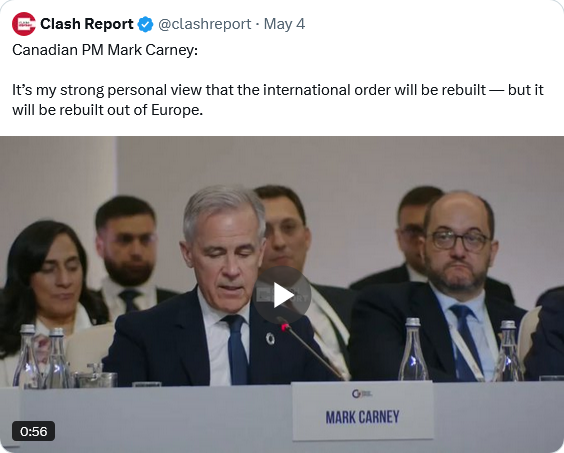
We should absolutely be pursuing closer ties to Europe, but it is delusional if he actually believes the new international order will be “rebuilt out of Europe”.

Europe for all its grand aspirations cannot even defend Ukraine by itself and without American help. Europe would need something like 300,000 additional troops and €250 billion a year in extra defence spending just to deter Russia without the Americans.

NATO’s own Secretary General told the European Parliament in January that Europe “cannot at the moment provide nearly enough of what Ukraine needs to defend itself today, and to deter tomorrow”, and that without American weapons “we cannot keep Ukraine in the fight. Literally not.” Rutte told European lawmakers that anyone who thinks Europe can defend itself without the US should “keep on dreaming”. Four years into the most serious land war on the continent since 1945 and this is where we are. That is not a continent about to anchor a new international order.

The world order is quickly is reorganising, yes. But around a US-China axis, not Brussels. The eurozone is forecast to grow 0.9% this year. China at 4.5%. China accounts for roughly 30% of global growth, Europe’s share of global GDP keeps shrinking. Europe is just one of many players. Again if you take Carney seriously here, it’s silly. Build closer ties with Europe yes but do not believe this is the next superpower.

But I suspect this is actually just another sign that Carney is good at politics — he knows exactly what the Davos crowd, his boomer base and media admirers want to hear and he is very good at giving it to them. Flattery has done him enormous favours in European capitals. But telling European elites the future runs through them is not realism, it is the opposite of realism. It is telling people what they want to hear, not the truth.

L. Wayne Mathison also comments on Carney’s profound europhiliac positions:

Europe is not the model. It is the warning label.

High regulation. Weak growth. Expensive energy. Soft defence. Endless bureaucracy.

America built. Europe managed. America innovated. Europe regulated.

And Carney wants Canada rebuilt “out of Europe”?

No thanks. Canada needs strength, productivity, energy, defence, and sovereignty, not Brussels-style decline with better catering.

April 25, 2026

Can a genuine Canadian launch capability grow from a sketchy concrete pad in Nova Scotia?

Filed under: Cancon, Government, Space — Tags: , , — Nicholas @ 05:00

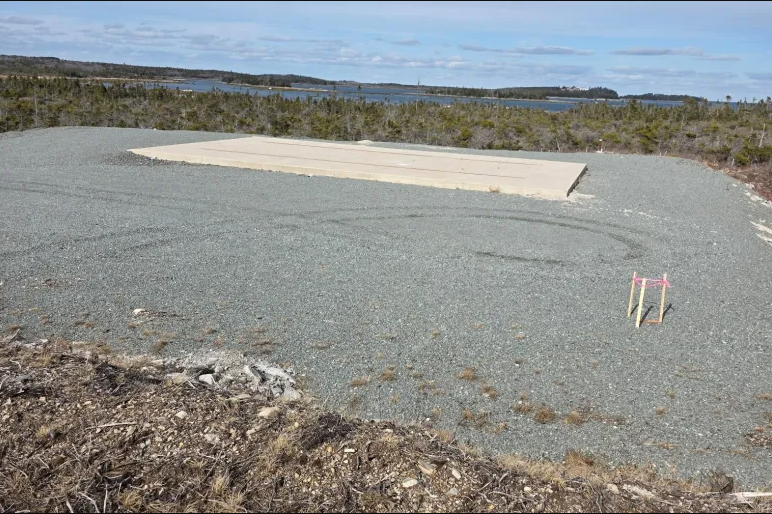
Along with many others, I was boggled to hear this week that the Canadian government was spending $20 million per year to lease a “launch facility” — photos show a pretty rudimentary concrete pad surrounded by gravel and not much else — which the Ukraine-connected lessor itself is leasing from the Nova Scotia for $13,500 per year. John Carter is somewhat more optimistic than I am that there’s a path from the dubious patch of land to a real maple-flavoured space program:

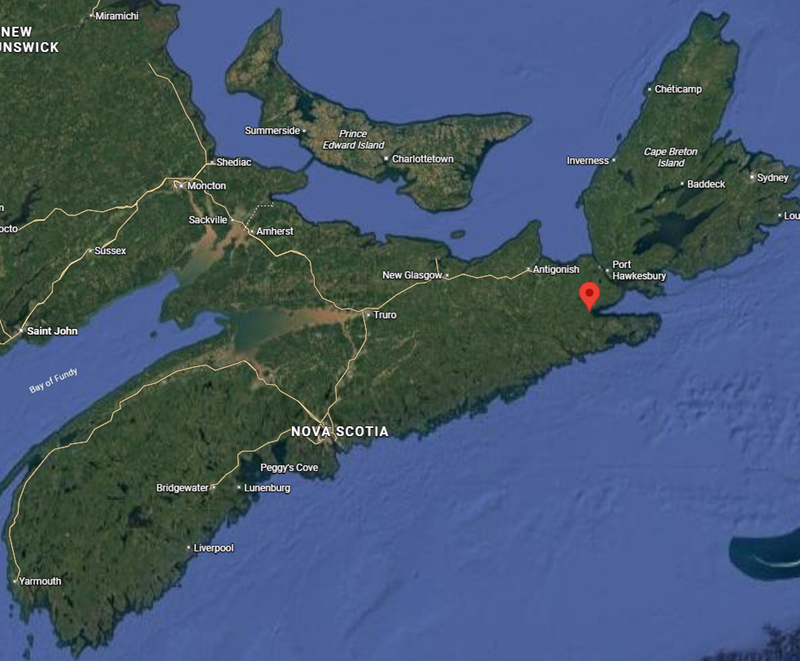
Guysborough, Nova Scotia, site of the MLS “spaceport”
Image from Google Maps.

It would be a gross exaggeration to say that Canada doesn’t have a space program. The launch of the Alouette 1 satellite in 1962 made Canada the fourth country to place an object into orbit around the Earth. Astronaut Marc Garneau nearly became the leader of Canada’s Liberal Party in 2012 (yes, we could have had an astronaut prime minister … Canadians voted for a nepo baby instead); astronaut Chris Hadfield is a minor celebrity in Canada; Jeremy Hansen became the first Canadian to visit the Moon a few weeks ago. Various iterations of the Canadarm have been fixtures of Space Shuttle missions and the International Space Station for decades. However, Canada does not yet have its own, native launch capability. The Canadian Space Agency acts as an appendage of NASA, with Canadian astronauts and satellites hitching rides on American rockets.

The announcement that the Canadian government is taking steps to develop a Canadian launch capacity has roused me from my uneasy slumber of the last several weeks, and I have awakened in a cranky mood. Several aspects of this story have annoyed me, both those relating to the government’s execution, and those emerging from the reaction from influencers whose justified skepticism of Ottawa’s intentions is intersecting with their poor understanding of space in a fashion that is leading them to beclown themselves.

The story that got everyone’s attention was a two hundred million dollar lease Ottawa signed with Maritime Launch Services for a spaceport in Nova Scotia, Canada’s largest Atlantic province, covering ten years of operations at twenty million dollars per year. The spaceport is, at the moment, essentially just a concrete pad at the end a gravel road, with no other apparent infrastructure.

The “spaceport”
Image from Postcards from Barsoom

There are several genuine reasons for serious concern with this, which have been detailed by a Nova Scotian NIMBY who’s been annoyed by MLS for several years now. MLS is a Ukrainian-American company whose original business model was to design, manufacture, and launch the Ukrainian-built Cyclone 4M, which it has never successfully done. To be fair, this effort was interrupted by the Ukrainian war, which for obvious reasons redirected Ukrainian rocketry to military production. However, it’s also worth emphasizing that MLS is an offshoot of the Ukrainian Space Agency, which is every bit as corrupt as you’d expect. The Ukrainian Space Agency has been mired in several expensive scandals over the years; one of them resulted in the theft of $10 million from Export Development Canada.

A former Liberal Party premier, Stephen McNeil, sits on MLS’s advisory board, which could be quite natural and could also be an indication of bog-standard conflict of interest.

The company’s finances are rather suspicious. It has posted operating losses of several million dollars a year, with the exception of 2025 when it lost $47 million1; revenue in 2025 was less than $15,000, and in 2024 it was zero. The incredible 2025 cash burn was apparently due to MLS acquiring Spaceport Canada. The company’s normal losses seem to be mostly due to executive compensation for its small roster of employees: the CEO and CFO between them rake in about a million dollars. This is despite the company not apparently actually have done anything yet. Other expenses include paying the Ukrainians for technical documentation for a launch vehicle MLS had already abandoned, and debt service on funding advanced by investors.

In 2024, MLS abandoned the scheme to launch Ukrainian rockets and pivoted to an “airport model”, the idea being that they would make money by charging launch service providers for the use of their spaceport. In 2025 there were precisely two launches from MLS’s concrete pad. Both of them were suborbital. One of them was a student-designed rocket from Toronto’s York University.

Even more absurdly, MLS’s concrete pad is on Crown land, which the company rents from Nova Scotia for $13,500 a year. This then looks like Ottawa renting its own land for $20 million a year.

In yet another suspicious-looking move, one of MLS’s chief financiers, Sasha Jacob, sold millions of shares immediately after the deal was announced and the stock price 10x’d; he then exercised stock options to replenish his position at below-market rates, thereby maintaining interest in the company while pocketing a couple million dollars.

All of this looks a whole lot like one more public-private partnership grift in which press releases and public relations materials project a hologram of visionary development, while the funds disappear into a complex web of regulatory compliance, stock buybacks, environmental impact studies, and executive salaries, without anything ever actually being built. This is a scam in which Canada’s Laurentian elites have learned to excel. It turns out that it is much easier, and far more profitable, to get paid for something you’re pretending to do instead of actually doing it; when the inevitable questions get asked, you simply throw up your hands and complain of unexpected engineering difficulties, tortuous regulatory pathways, or other factors beyond your control. None of the people involved – not government ministers, not government bureaucrats, not their private-sector partners – care one bit whether any given project succeeds, because they get paid by the taxpayer and the debt taken out in the taxpayer’s name regardless of outcomes. It is my working assumption that there is nothing more to this supposed space program than this. We are governed by theatre kids dancing to the tune of the Music Man, and none of them know anything about doing anything real.

February 27, 2026

Brookfield, Carney, Freeland, and Ukraine – cui bono?

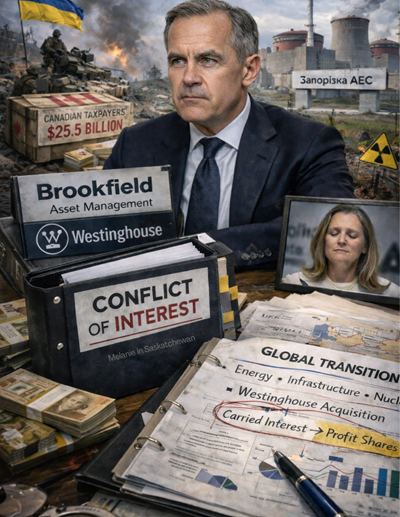
Melanie in Saskatchewan goes digging in the less-publicly-visible parts of Canada’s massive support of Ukraine to see who is gaining the benefit from all that money and all those political and economic manoeuvres … and you probably won’t be surprised to hear that it’s not ordinary Ukrainians or their soldiers fighting on the front line against Russia:

Image from Melanie in Saskatchewan

I need you to stop for a moment and really sit with this. Ask yourself a question that should make your stomach drop. What if the billions of your tax dollars being sent to Ukraine are not just about solidarity, democracy, or defending freedom? What if they also intersect with private financial interests connected to the very people making those decisions?

Because that is the bombshell.

And once you see the connections, you cannot unsee them.

Canada has now committed more than $25.5 billion to Ukraine. Just days ago, Prime Minister Mark Carney announced another $2 billion in military aid. Armoured vehicles. Equipment. Sanctions. More money flowing outward while Canadians juggle mortgage renewals, grocery bills, and heating costs that feel like ransom demands.

[…]

And to the Ethics Commissioner, Canadians deserve clarity. The Conflict of Interest Act is widely described as a disclosure regime. It relies heavily on what office holders report and on screening mechanisms that operate within defined boundaries. Committee testimony has acknowledged that screen administrators do not know the specific underlying assets within the Brookfield Global Transition Fund and that a significant portion of Brookfield’s broader portfolio is outside those screens. Mark Carney is the architect of Brookfield’s Global Transition Fund. He KNOWS what the assets in that fund are. He also has carried interest structures in that fund. If Konrad von Finckenstein does not take note and act, then I cannot validate the need for his position. We might as well install a potted Boston Fern in his chair, we’d still get the same results.

So the question becomes simple. If an issue of this magnitude does not justify proactive scrutiny and clear public documentation, then what does? Canadians are not asking for drama. They are asking for written determinations, documented recusals, and visible oversight that goes beyond procedural minimums.

Were Canadian Ukraine policy decisions structured, timed, or insulated in a way that ensures there is absolutely no benefit, direct or indirect, to any financial exposure connected to Brookfield-related structures? Have recusals been documented? Has the Ethics Commissioner issued written determinations? Has conflict screening been publicly disclosed?

Where is the paperwork?

If everything is clean, then showing the documentation should be effortless. If everything is arms-length, then release the recusal letters. If there is nothing to hide, then open the books.

Canadians are not children. We understand complexity. What we resent is opacity.

To Moose on the Loose, credit where it is due. Independent researchers willing to comb through filings, contracts, and timelines are the reason these overlaps are being discussed at all. Without that digging, most Canadians would never see the full picture.

Now it is on us.

Share this. Ask your MP. Demand written answers. Demand documentation. Demand transparency from Mark Carney.

January 5, 2026

International law is more like International “law”

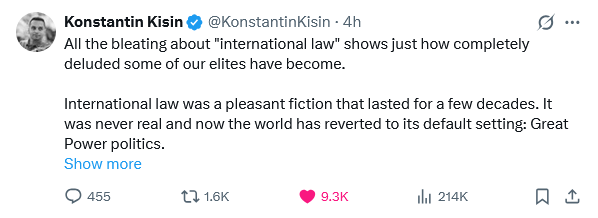
On the social media site formerly known as Twitter, Konstantin Kisin points out that calling it “International Law” gives it a semi-mythic quality that it absolutely does not deserve:

All the bleating about “international law” shows just how completely deluded some of our elites have become.

International law was a pleasant fiction that lasted for a few decades. It was never real and now the world has reverted to its default setting: Great Power politics.

This is why, as a strong Ukraine supporter, I have never talked about international law or called Putin’s attack an “illegal invasion”.

Laws are based on submission to an overarching authority backed by force. There is no such international authority and even if you view the UN as one, it does not have the ability to use force against those who violate “international law” other than against small countries with weak militaries.

When the US attacked Iraq, the UN did nothing.
When Russia invaded Ukraine, the UN did nothing.
If China invades Taiwan tomorrow, the UN will do nothing.

If you cannot enforce a law, it’s not a law.

I do not support Ukraine because naughty Vlad broke the rules. I support Ukraine because it’s not in OUR interest in the West to have Russia marauding its way through friendly countries on the borders of Europe. It’s in our interest for us to be as strong as possible and for our adversaries to be as weak as possible.

President Trump is a realist and a pragmatist. He sees through the fictions other “leaders” cling to.

A good leader advances the national interests of his country. If more Western leaders did this, our civilisation would be in a much better place.

I commented on another post that,

For a lot of people (Canadian Liberals and American Democrats in particular), the invocation “international law” has a mesmerizing effect on their ability to reason [insert usual disclaimer that if they could foresee the results of their enlightened beliefs, they wouldn’t be progressives]. They seem to have a quasi-religious belief in the UN as if it were some kind of God-given supergovernment that is always right and must always be obeyed. “World opinion” might as well be the hand of God to them, so any time the legacy media can portray the US (and Trump in particular) as going against “world opinion” they want to get out the sackcloth and ashes … or sack a city and turn it into ashes, whichever comes first.

vittorio analyzes the default position of most progressives on the social media site formerly known as Twitter:

most political issues nowadays can be explained by understanding that american leftists dont have positions, they have oppositions.

their entire belief system is defined by negation of whatever the right supports. this is why portland chants “free maduro” while actual venezuelans celebrate in the streets. they’re not pro-venezuelan or pro democracies, or pro tyrant, or pro maduro, they’re simply anti-american-right.

they’ve outsourced their worldview to institutional narratives for so long that genuine self-reflection would require questioning everything. for them it’s much easier to just oppose. the beliefs arent coherent because they were never meant to be coherent. they only need to signal tribal membership, and leftist membership is gained by opposing the right.

trump does X? the left screams and cries because they wanted Y

trump does Y? the left screams and cries and riots because even if they said they wanted Y, what they meant is that X was the way to go

trump cures cancer? they’ll argue that the cancer cells are alive have a right of free determination

trump saves lives? they’ll protest because somehow those lives didn’t matter and should have been ended

no coherent word model. no logic. pure opposition

at some point you just have to stop engaging with it as if it’s a real political position. it’s not. it’s aesthetic opposition wearing the costume of ideology

As Severian at Founding Questions often remarks, progressives’ core belief is The Great Inversion: “whatever is, is wrong”.

Bingo Bobbins makes the case that “International law is fake and gay”:

Was this operation necessary? Was Maduro really a “narcoterrorist”? I admit that I haven’t really been following all the drama with Venezuela recently, but my intuition is that Maduro was probably accepting bribes to look the other way with regards to drug trafficking, rather than being directly involved. And sure, he was a socialist dictator but there’s plenty of those around. The US doesn’t go and topple dictators unless there is a perceived US interest in doing so.

What Maduro was actually doing was cozying up to China. In fact, he had just finished a meeting with some Chinese ambassadors hours before Delta Force snatched him up by the scruff. This was actually a warning to China not to mess around in our hemisphere. The Trump administration is re-establishing the Monroe Doctrine, or, as he recently called in a press conference, “The Donroe Doctrine“. As far as I can see, this is completely in keeping with my preferred Vitalist Foreign Policy.

You can agree or disagree with this show of force, but please don’t whine to me about “International Law”. International Law is fake and gay. I certainly don’t care that the Trump administration “targeted a political leader”. This is the complaint being leveled by many leftists in regard to the operation. Really, this is just because leftists are anti-American third-worldists, and they are filled with butthurt because “their guy” lost. But, let’s examine this “rule” of not being allowed to target a countries rulers, because it’s particularly ridiculous.

If you have a problem with a specific country, who do you really have a problem with? You have a problem with that country’s leaders, since they are the ones making the decisions. Why wouldn’t you target the leaders? The only reason is that all the leaders from all the countries got together and agreed that they wouldn’t target each other. They would rather resolve their differences by throwing cannon fodder at each other, while keeping themselves off the table. And sure, I understand why that is great for them, but not why it would be great for me (or you).

Of course, the CIA has been ignoring this “international law” for decades, but they’ve been doing it in a very effeminate way, skulking about the world, funding Color Revolutions and clandestinely arming insurgent groups in order to subvert existing regimes. The Donroe Doctrine is much better. Imagine if the Trump administration had tried to handle Maduro the way the Obama administration tried to handle Assad. Fund a decades long civil war, accidentally establish a caliphate, fight a war against said caliphate, facilitate the deaths of tens of thousands of Christians, all to have an even worse dictator eventually rise to power.

Update, 6 January: Welcome, Instapundit readers! Please do have a look around at some of my other posts you may find of interest. I send out a daily summary of posts here through my Substackhttps://substack.com/@nicholasrusson that you can subscribe to if you’d like to be informed of new posts in the future.

December 16, 2025

If your military embraces “Net Zero”, you’ve actually got a civil service in uniform, not a military

Filed under: Britain, Environment, Government, Military, Russia — Tags: , , , , , — Nicholas @ 05:00

In The Critic, Maurice Cousins points out the painful truth (painful that is to policians and career bureaucrats) that no serious military can prepare and carry out their prime duties if they also tout their allegiance to “Net Zero” bullshit:

Two developments explain the shift in tone. The first is the protracted US–Russia peace talks conducted largely over Europe’s head. The second is the publication of Donald Trump’s National Security Strategy, which makes explicit that Europeans must now assume far greater responsibility for their own defence. None of this should surprise anyone who has been paying attention. The Trump administration has been saying the same thing, bluntly and repeatedly, since its inauguration.

Speaking at the NATO Defence Ministers’ meeting in February 2025, the US War Secretary, Pete Hegseth, put it plainly: “To endure for the future, our partners must do far more for Europe’s defence. We must make NATO great again. It begins with defence spending, but must also include reviving the transatlantic defence industrial base, prioritising readiness and lethality, and establishing real deterrence.”

After nearly eighty years of relying on American power to underwrite their security, European leaders are being forced to relearn the fundamentals of hard power and grand strategy. It is difficult to overstate how profound a challenge this represents for both Europe and the UK. It demands a rethink across policy areas that, for decades, have been treated as marginal to national security.

Since the 1990s, Britain’s political and intellectual elite has operated within a fundamentally different paradigm. The “end of history” has become a cliché, but it is worth recalling just how deeply it shaped elite thinking. In the aftermath of the Soviet Union’s collapse, Anthony Giddens — one of the intellectual architects of New Labour — argued in The Third Way that the West no longer faced “clear-cut enemies”. Cosmopolitanism, he claimed, would be both the “cause and condition” of the disappearance of large-scale war between nation-states. The “strong state”, once defined by preparedness for war, “must mean something different today”. They believed that post-material and post-traditional values, including ecological modernisation, human rights and sexual freedom, would come to dominate politics.

For realists, this utopian worldview was always naïve. In her final book, Statecraft (2003), Margaret Thatcher warned that the post-Cold War world was far more likely to vindicate Samuel Huntington’s “clash of civilisations” than Francis Fukuyama’s progressive vision of an “end of history”, in which liberal democracy emerged as the inevitable global victor.

Clearly, the liberal internationalist illusion should finally have been shattered by Russia’s annexation of Crimea in 2014. Alas, it was not. Instead of prompting a fundamental strategic reset, Britain’s governing class doubled down on the same post-material, cosmopolitan assumptions that had shaped the 1990s and 2000s. In 2015, Europe and the UK embraced the Paris Climate Agreement. In 2019 — a year after the attempted murder of Sergei Skripal on British soil with a chemical weapon — ministers enshrined Net Zero in law and banned fracking. Each decision reflected the same belief: that geopolitics could remain subordinate to “climate leadership”, and that the material foundations of security could continue to be dismantled.

That worldview is now colliding with reality.

The US National Security Strategy contains a series of blunt truths about Europe’s condition. British commentary has focused on its remarks about culture, migration and defence spending. But one critical area has been largely overlooked: energy and industry.

The document begins from a hard material premise: that dominance in dense and reliable sources of energy — oil, gas, coal and nuclear — is essential to the ability of the United States, and its allies, to project power. From that foundation it draws a sharper conclusion, rejecting what it describes as the “disastrous ‘climate change’ and ‘Net Zero’ ideologies” that have hollowed out Europe’s industrial base while subsidising its adversaries. The result, it argues, is a defence problem that runs far deeper than military budgets. Alongside cultural weaknesses, myopic energy policy and de-industrialisation — exemplified by Germany’s recent offshoring of its chemical industry to China — are identified as anti-civilisational forces that directly erode Western hard power.

This makes Carns’s most important observation all the more sobering. While armies, navies and air forces respond to crises, he said, it is “societies, industries and economies [that] win wars”. He is unequivocally right.

On his Substack, Niccolo Soldo discusses the contents of the Trump administration’s new National Security Strategy:

Egyptian President Gamel Nassar had some choice lines to describe US foreign policy too:

    The genius of you Americans is that you never make clear-cut stupid moves, only complicated stupid moves which make the rest of us wonder at the possibility that we might be missing something.

    With the Soviet Union, you know where you stand today and where you will stand tomorrow. With the United States, you never know where you will stand tomorrow—and sometimes not even today.

    America is like a beautiful woman who changes her mind every night. You can love her, you can fear her, but you can never be sure what she will do in the morning.

And then there is this recent classic from Russia’s chief diplomat, Sergey Lavrov:

    The USA is agreement non-capable.

The point of sharing these quotes is to highlight the obvious fact that US foreign policy has long been unpredictable. This wouldn’t be too much of an issue if it were a middling power. When a superpower routinely upends the table, it makes life very, very difficult for those countries that have become “states of interest” for the Americans. Creating and pursuing foreign policy strategies require a lot of time and effort, meaning that they are very rarely predicated on short-term trends. When the predictability of foreign actors is removed from the strategic equation, the foundation of any plan becomes very weak.

Earlier this month, the White House issued its 2025 National Security Strategy vision in a 33 page .pdf document available for all to see and read here. This is an action that the US Executive Branch is mandated to do, ever since the Goldwater-Nichols Act of 1986. The point of this exercise is to articulate the vision of the President of the United States of America regarding foreign policy, so as to effectively communicate said vision to Congress and the American people. It does not mean that it is an official foreign policy strategy, since this area of governance is the responsibility of both the executive and legislative branches of the US Government.

Because this is the Trump Administration, and because of the fever pitch that has coloured both of his terms in office, a lot of attention is being given to this iteration of this mandatory document. This document is intentionally high-level (meaning that it purposely doesn’t drill down into specifics), keeping within the tradition of previous administrations. However, attention is warranted this time, because the vision outlined by President Trump per this document indicates a significant break in both the USA’s approach to and philosophical arguments regarding how and why it conducts its foreign policy. Despite the obvious Trumpist (think: transactional) touches interspersed throughout this document, what it does represent is a stated desire to break with certain idealist practices of recent administrations in favour of a more realist approach and worldview, one that stresses respect (if we accept the document at face value) for national sovereignty, and an admission that US global hegemony is simply not possible.

So what we are left with is a document that outlines a new vision for US foreign policy, one that has determined that taking on both Russia and China simultaneously is the wrong approach to securing American national interests. This makes it very worthy of closer inspection and analysis (something that I have been thinking about deeply since it was first made available to the public a fortnight ago). Before we begin to dive into it, I am asking you all to temporarily suspend your cynicism and take the strategy outline at face value for the sake of this analysis. I will once again repeat that this is not official policy, and there is a very strong chance that it will never be adopted as that.

December 1, 2025

The United States is not – and should not be – the arbiter of all the world’s conflicts

Filed under: Military, Russia, USA — Tags: — Nicholas @ 03:00

On the social media site formerly known as Twitter, Devon Eriksen responds to a demand that the United States intervene directly in the Russia-Ukraine war:

America is not special. It’s just a country.

Yes, it’s the best country, but it is not the god of all other nations.

A lot of people like to point this out when saying that America doesn’t have special rights, but those same people very rapidly and conveniently forget that phrase when they want something from America.

Because no special rights means no special obligations.

We don’t have to rob our own citizens to keep African AIDS patients alive, or feed nations that overbreed while they are unable to feed themselves.

We don’t have to stop the genocide in East Ethnicklashistan.

We don’t have to accept refugees from anywhere, much less from the worst failed states on the planet.

We don’t have to cooperate with, fund, host, or even participate in the United Nations.

And we don’t have to take sides in ethnic conflicts on the other side of the planet.

The assumption that any conflict is between the good guys and the bad guys, and that the US must help the good guys is the assumption that America is god, responsible for bringing peace, justice, and prosperity to the planet.

Are you ready to be ruled by us as if we were gods?

No?

Then don’t demand justice from us as if we were gods.

The responsibility of America, as just another nation, is to look after the interests of Americans.

Look, we all know that Russia is dogshit at warfare, because wars are not won by being tough. They are won by being organized, coordinated, trained, and equipped.

And Russia is an extraction economy, not a high-trust, high-tech first world state.

So, yes, we could easily beat Russia in a war. That does not mean it is in our best interests to do so. Lots of costs, no benefits.

And while we are wealthiest nation in the history of … everything … we still have a severe overspending problem, mostly because we’ve been the wealthiest nation for a long time, and have developed some bad problem with political corruption, and throwing money at ever grifter with a sob story and an outstretched hand.

I know you think your cause is just. I’m not trying to tell you it isn’t, because I don’t need to decide if it is or not.

It doesn’t matter.

America’s responsibility is to Americans, and if that responsibility is not being discharged, taken care of, thoroughly handled, then support of any other side quest, regardless of its merits, is dereliction of duty.

Update, 2 December: Welcome, Instapundit readers! Please do have a look around at some of my other posts you may find of interest. I send out a daily summary of posts here through my Substackhttps://substack.com/@nicholasrusson that you can subscribe to if you’d like to be informed of new posts in the future.

August 23, 2025

T-55: 70 Years Old. Still in Service

Filed under: History, Military, Russia, Weapons — Tags: , , , , , , — Nicholas @ 04:00

The Tank Museum
Published 22 Aug 2025

No tank in history has been produced in the quantities that the T-55 and its relatives have. Some sources suggest as many as 100,000 have been built since 1946, this tank is still seeing service across the globe. So how come this 80-year-old tank is still in service in 2025?

When looking at its predecessor, the T-34, the move to the T-55 looks like a massive leap in design. But there is a clear evolutionary progression – there is just a missing link. The T-44 laid the groundwork for future Soviet tank design – pioneering torsion bar suspension and a transverse engine.
It was soon decided that the T-44 would require a new 100mm gun to replace the 85mm. This new model would be called the T-54. While NATO classes both the T-54 and 55 as the same vehicle, the T-55 is a substantially better tank. A comprehensive series of upgrades made this an effective force on the battlefield.

The T-55 would prove popular with forces around the world. It would even go head-to-head against itself in the Iran-Iraq War of the 1980s. Eventually the T-55 would become outdated as NATO technology became more and more advanced. But it is still in service in the conflict in Ukraine – why?

The Russian army, despite the stereotype of having unending stockpiles of weaponry, have been struggling to keep up with the astounding loss rate the Ukrainians have been able to inflict on them. This has resulted in older and older vehicles being dragged out of those large storage depots across Russia, mainly being used as mobile, protected artillery.

The T-55 has endured partly due to its sheer numbers, availability and upgradability. Its performance on the battlefield has varied, but its basic but effective design has proven itself again and again throughout the decades. It is worth reiterating how remarkable it that a vehicle conceived at the end of the Second World War is still even a consideration for armies 80 years on.

In this video, historian James Donaldson explores the history of the most-produced tank in history – the T-55. This Soviet design has its roots in the iconic T-34, evolving through the years to become an effective fighting machine that was sold around the world. Despite manufacturing ending in the 1980s, this tank is still a feature on the battlefield, with both sides making use of T-55s in the current conflict in Ukraine. It may not be engaging in tank-on-tank combat as initially intended, but the T-55 is still providing a useful, effective and relatively cheap addition to the arsenal of many armies in the 21st Century.

00:00 | Introduction
00:43 | The Missing Link
02:31 | Making the T-55
05:24 | Upgrades
08:34 | A Numbers Game
12:51 | In Action
16:41 | T-55 Today
(more…)

June 29, 2025

Does Russia Always Win Its Wars?

Real Time History
Published 17 Jan 2025

The Russian Federation is at war with Ukraine, and some of its supporters insist it will win because Russia doesn’t lose wars. They point to its vast territory, its cold climate, its manpower reserves, or its peoples’ ability to endure hardship and accept death – and they point to great Russian victories of the past. So let’s put this claim to the test and see what history has to say about Russia’s record on the battlefield.

Chapters:
00:00 Intro
02:03 Mongol Invasion of Kyivan Rus’
03:29 Livonian War
04:52 Time of Troubles
06:13 3rd and 4th Coalition Wars
08:12 Crimean War
09:31 Russo-Japanese War
11:44 First World War & Russian Civil War
14:07 Polish-Soviet War
15:25 Winter War
16:48 Soviet-Afghan War
18:34 First Chechen War
19:33 Conclusion
(more…)

June 26, 2025

NATO members “commit” to a new 5% defence spending target

Filed under: Cancon, Europe, Military, USA — Tags: , , , , , , — Nicholas @ 03:00

As many predicted, just as Canada finally gets around to at least pretending to meet the 2% defence spending target we agreed to over a decade ago, those goalposts get moved:

So today the leaders of Nato convene for a landmark summit:

NATO countries agree to increase defence spending to 5%

That headline isn’t strictly accurate. Member states have apparently agreed to commit to a target of 5% by 2035, to mark the start of the fourteenth anniversary of the Ukraine war. Which means that, as always with Nato, they’ll all look butch at the photo-op, and then they’ll do bugger all. Even the “commitment” to a “target” is too much for Spain, which has secured an opt-out.

But hang on a minute: Nato has been at war — or at proxy-war — with Russia for three-and-a-half years now. So it’s been on a war-footing, supposedly, for seven-eighths of the length of the First World War. How’s that war-footing going? Per Nato’s head honcho, Mark Rutte (the woeful former Dutch PM — ask our pal Eva Vlaardingerbroek), earlier this month:

    The Russian army is developing its war capabilities by multiple times more than that of NATO despite having an economy 25 times smaller, NATO’s secretary general has warned …

    “The Russians, as we speak are reconstituting themselves at a rapid pace and producing four times more ammunition in three months than the whole of NATO in a year,” said Rutte.

That’s a rather confusing way of putting it; what he means is: the Russians (who, as Mark Levin assures us, “scare nobody”) produce more ammunition in three weeks than the whole of Nato does in a year. Can even Nato be that worthless?

Taking the Secretary-General at his word, if you’re wondering why the Pentagon has to divert ammo marked for Israel to Ukraine and then divert it back from Ukraine to Israel … well, let’s do what everybody else does and dredge up the only historical analogy anybody knows — not the First World War, but the Second (see Levin’s “Iranian Nazi regime”): We’re asked to believe that Nato needs longer than the US was in the Second World War for to move to a war-production footing.

To be sure, supply chains are always difficult: Iran’s threat to close the Strait of Hormuz could have seriously impacted McDonald’s need to recall the hash browns it sent to Montenegro and divert them to Kiribati.

Trump gets something very basic: Flying the highest of high-tech weaponry seven thousand miles to drop down a ventilation shaft opening the size of a dishwasher is the kind of brilliant, dazzling one-off only the United States can do. But what next? Almost all geopolitical conflicts start with a bit of shock-&-awe (Pearl Harbor, even the assassination of the Archduke) and then dwindle down to old-school wars of attrition – as the United States should certainly know after taking twenty years to lose to goatherds with fertiliser, and three years to lose to “a gas station masquerading as a country” (thank you, John McCain). In wars of attrition, old-fashioned unglamorous things become important, like the ability to manufacture bullets in a timely manner. The basic arithmetical calculations are not complex: Don’t get into a long war with an enemy whose stock of long-range ballistic missiles outnumbers your surface-to-air missiles.

So Trump had the narrowest window of opportunity, and used it.

On the other side, the last week-and-a-half mostly revealed the shallowness of the War Party. You’ll recall, for example, that Ted Cruz got into a spat with Tucker over the actual population of Iran. Last week, a UK podcast had a brief discussion on The US Army-Marine Corps Counter-Insurgency Field Manual, which notes the following (foot of page xxvi):

    The troop demands are significant. The manual’s recommendation is a minimum of twenty counterinsurgents per 1,000 residents.

That’s roughly what the British had in Malaya. Which they won, by the way. Twenty-two years ago, a couple of weeks after the fall of Saddam, I stopped on the shoulder of the main western highway from Jordan to Baghdad to fill up from an enterprising Iraqi who’d retrieved some supplies from a looted petrol station and was anxious to sell them to any passing Canadian tourists. As he was topping off, I asked him how agreeable he found the western soldiery. He grinned a big toothless grin and pointed to a chopper that had just come up over the horizon to hover above our heads. Then he said: “Americans only in the sky.”

We did not win that one, you’ll recall. Instead, we created an Iranian client-state.

That’s why Ted Cruz’s breezy indifference when Tucker asked him the population of Iran was so revealing. The senator told Tucker that it doesn’t matter whether the population of Iran is eighty million or a hundred million. Really?

Because, per the Pentagon’s own field manual, the latter figure would require finding an extra 400,000 troops. Oh, wait. If it’s a Nato mission, the other members could muster 127 guys between them, so it would only require 399,873 extra Americans.

Even if the public were minded to put one-and-a-half million pairs of boots on the ground, it couldn’t do it. “Americans only in the sky” equals what an Australian prime minister told me, after a flying visit to the troops in Afghanistan, was “the Crusader fort mentality”.

It doesn’t work. The political divide in America is between, crudely, Trumpians and neocons. The former are anti-war; the latter are pro-war … but a way of war that doesn’t work.

June 6, 2025

Former Putin advisor claims nuclear strike is an appropriate reaction to Ukraine attacks

Filed under: Europe, Military, Russia, Weapons — Tags: , , , , — Nicholas @ 03:00

Mark Steyn surveys the media reaction to Sergey Markov’s foaming-at-the-mouth threats of nuclear escalation in the Russo-Ukraine conflict:

Here’s a cheery headline from the Russian press:

    Markov: an attack on Russia’s strategic aviation is grounds for the use of nuclear weapons.

That would be Sergey Markov, former advisor to Tsar Vlad, who admittedly is somewhat partial to nuke-rattling: in the early stages of the Ukraine war, he threatened to nuke the UK, for what reason I forget — the exciting new Islamic blasphemy laws? the paedo rape gangs?

This time, however, Mr Markov was responding to the weekend’s Ukrainian drone strike deep inside Russia. By “deep”, I mean Siberia. Which supposedly took out forty of Putin’s 120 strategic bombers using drones smuggled into the country via trucks which then fanned out and parked within range of various air bases.

Which is brilliant and innovative, in the sense that Castro blowing up a third of the USAF during the Cuban missile-crisis negotiations would have been. Right now, the only thing standing between the planet and the Third World War is Vladimir Putin’s forbearance. And, as all the smart people assured us in the spring of 2022, the Russian not-so-strongman was “dying” (Christopher Steele, sole proprietor of Dossiers R Us) or dead, either of which condition can make one’s nuclear-war judgment a little erratic. Headline from the UK Daily Mirror, almost exactly three years ago:

    Vladimir Putin may already be dead with body double taking his place, MI6 chiefs claim

That headline is 100 per cent accurate if you remove the words “Vladimir” and “Putin” and replace them with “Joe” and “Biden” respectively. Incidentally, analyse each nation’s advances in body-double technology by comparing “Biden”‘s ability to host a G7 with “Putin”‘s ability to host a BRICS summit. That’s the way to bet if it comes to World War Three. Sen. Lindsey Graham (R – Zakarpattia), was in Kiev to meet with Zelenskyyyy the day before Operation Bring It On. He had the affect of a chap who knew what was coming — although one notes he has yet to make good on his comparatively less ambitious pledge to sink Greta Thunberg’s Gaza boat.

Forty years ago, everybody claimed to be super-worried about imminent mushroom clouds. A bestselling poster of the day:

Anyone care to remake the above with Senator Graham and Victoria Nuland, She-Wolf of the Donbass? Ah, but maybe it doesn’t work as well with Deep State non-household-names in the leads. It’s not so long since Lindsey was telling Zelenskyyyy to resign, but he’s apparently back on board. And, more generally, most western media were happy to report the drone strike as more of a poke in the eye to Trump than to Putin. Headline from National Review:

    Country That Allegedly Had No Cards to Play Keeps Finding New Cards to Play

This is in reference to Trump’s jibe from February that Ukraine had “no cards to play”. The question then arises: Where did Z find these “new cards”? When Pete Hegseth took over as US Defence Secretary, he quickly confirmed what every sentient creature had long suspected — that the Pentagon had been micro-managing Ukraine’s end of the war for the previous three years. Are they still doing so? In defiance of their nominal commander-in-chief?

June 3, 2025

Ukraine’s strategic strikes against Russian airbases

Filed under: Military, Russia — Tags: , , , , — Nicholas @ 04:00

CDR Salamander on the lessons to be learned from the latest dramatic turn in the Russo-Ukrainian war with Ukraine carefully avoiding letting their American supporters know about the attack before it went in:

[This] picture from 2012 of Norfolk is what I want you to think about.

We talked about the superbly executed Ukrainian attack on Russian bomber bases for most of yesterday’s Midrats, and what keeps coming to mind for me is not the details of that attack, but the stark warning it is giving us.

The threat of drone strikes isn’t a new warning, but in my mind it intersect almost perfectly with the self-inflicted vulnerability of the US Navy’s fleet — its concentration.

The growing utility of attack drones isn’t an insight that is unique to the Russo-Ukrainian War. The topic has come up here and on Midrats for almost two decades. We’re not alone. Heck, broad thinking people like our friend Matt Hipple was pondering it over at CIMSEC thirteen years ago a few months before the picture at the top of the post was made.

I’ll tie in the picture a bit, but let’s take a moment to give the Ukrainians credit where credit is due. They executed precision strikes against the RUS bomber fleet across the entire two-thirds of the Euro-Asian landmass.

We will find out more details, a dozen or 40+ high-demand/low-density strategic bombers were taken off the battle line. RUS is not building any more of them. As missile carriers, they have been a cornerstone of the city terrors for most of the last four years. You would be hard-pressed to find a more honorable, or legitimate target.

Streiff over at Red State has a good summary with what we think we know as of Sunday afternoon:

    The airbases are the home to Russia’s fleet of Tu-22, Tu-95M, and Tu-160 nuclear-capable strategic bombers as well as AS-50 battle management aircraft. They were located from the Siberian Far East to the Arctic Circle. The furthest target, Belaya Airbase in Irkutsk, is over 2700 miles from Ukraine.

    Reports indicate that at least 41 aircraft were hit. The unofficial tally indicates 24 Tu-22, 8 Tu-95MS, and 5 Tu-16 were hit. MiG-31 fighters and Il-76 transports were also hit. To put this in context, open-source data says Russia’s bomber inventory is about 58 Tu-22, 47 Tu-95MS, and 15 Tu-160. These planes are the ones used to launch most of the missiles fired at Ukrainian cities.

    By any standard, this was a devastating attack. Nearly half of the Tu-22, a quarter of the Tu-95MS, and a third of the Tu-160 fleet, representing just over 30 percent of Russia’s strategic bomber force, were damaged or destroyed in one attack. When you consider the operational readiness rate, Russia probably has less than 50 aircraft capable of flying … on the bright side, they have plenty of aircraft to cannibalize for parts. The Tu-22 and Tu-95MS production lines are closed, and the Tu-160 production is one, yes, one per year. For all intents and purposes, this represents a permanent decrease in the size of the Russian strategic bomber fleet.

Before we discuss what the USA needs to take away, let’s look at the top-4 primary and second-order effects this will have on the Russian Federation.

First Order Effects

  • Fewer raiding assets to use against UKR.
  • The weakest leg of their nuclear triad (bombers are dual use) is even weaker.
  • PSYOP defeat as RUS now know even their most valuable weapons, stationed deep into RUS rear, are vulnerable.
  • Paranoia elevated into an already paranoid national psyche under duress of year four of a grinding war.

Second Order Effects

  • Inefficiencies in both civilian logistics and manpower are the natural response to every tractor-trailer being a weapons delivery vehicle at range … and the need to defend important bases as a result, sinks into an already stressed nation.
  • Loss of face. RUS launched a war of choice against nation 1/4th its size and much weaker than it from any measure, and four years on, still has only made marginal progress. Now that nation proved it can operate with impunity anywhere inside RUS. The “R” in BRICS is not impressing its friends.
  • It shouldn’t, but this is going to get the nuclear autists the jitters. All theory, but yes, UKR took out one-third or more of the fully mission capable nuclear capable bombers that form one leg — but as mentioned above the weakest leg — of RUS’s nuclear deterrence. Those who work in the theory-dominated nuclear world will have all their gauges twitching, yes, but in the end analysis, it won’t matter.
  • UKR morale just got a big boost. Wars of attrition usually last until one side or the other loses either the material ability or the will to fight. At least from the “will” line of operation, that decisive point just shifted to the right.

Simply a superb operation. How do you defend against weapons like this disguised in a trailer’s false roof?

May 25, 2025

When NATO “stopped being an effective military alliance” and instead “became a kind of social club”

Filed under: Europe, History, Military, Russia, USA — Tags: , , , , — Nicholas @ 05:00

In UnHerd, Edward Luttwak says that Europe (however you might prefer to define it) needs a new Great Power:

All through European history, the intervals of peace, during which reconstruction and progress overcame the ravages of war, were secured by a temporary equilibrium between the Great Powers of the day.

It is obvious that there was no such equilibrium on 23 February 2022, when Russian columns started rolling towards Kyiv, and Russian President Vladimir Putin had just described Ukraine not merely as Russian, but as the homeland of the very first Russian state: Kievan Rus’.

[…]

But when the moment came, and Russian tanks rolled into Ukraine, there was no cohesive and determined power ready to respond quickly and effectively. Nato had done just that several times during the Cold War, by promptly reinforcing threatened allies with thousands of air-lifted troops from the so-called “Allied Command Europe Mobile Force”.

That, however, was the old, pre-enlargement Nato, which was still a veritable military alliance of countries capable of defending themselves, and help weaker allies in trouble, and whose chronically weak Mediterranean member states, with the most resplendent uniforms and least combat strength, had no Russian troops on their borders.

But once very deserving yet utterly indefensible countries such as Estonia were included in Nato — along with Poland, which mustered just 42,000 combat soldiers out of its population of 33 million a mere three months before Putin’s full-scale invasion began — it stopped being an effective military alliance.

Instead, it became a kind of social club. The Nato calendar is full of meetings at the “Supreme Allied Headquarters” in Mons in Belgium, where all manner of military and related issues are addressed often very professionally and quite freely — except that nobody is allowed to mention, however politely, even the most glaring military shortcomings of fellow allies, which undermine important war plans.

The highpoint of the Nato calendar is the splendid summits with all flags flying, in which the arrival of new countries is greatly celebrated, regardless of their ability to actually defend themselves. Both heads of state and heads of government are invited to those gatherings on the premise that there is strength in numbers, with no concerns about the inherent difficulty of reaching any agreements in such a vast crowd.

In the last summit, held in Washington DC in July 2024, Biden’s confusion of President Zelensky with Putin added a touch of humour to otherwise gloomy proceedings: nobody in attendance offered any suggestions on how to end the war in Ukraine.

What proves that Nato is no longer a genuine military alliance was that nothing was done in the last pre-war days before Putin’s invasion finally began. The satellite intelligence that revealed Russian forces on the move also showed that they were already in assault formations. But even then, five days remained to fly fighter-bomber squadrons to forward bases.

Yet even inaction would have been better than what actually happened. Instead of ordering the rapid deployment of tactical airpower to bases in Germany, Italy and the United Kingdom, the Biden administration instead evacuated US diplomats from Kyiv, starting a panic that induced the evacuation of some 20 other diplomatic missions.

March 15, 2025

Trump’s actual goal in Ukraine

Filed under: Europe, Military, Russia, USA — Tags: , , , — Nicholas @ 05:00

David Friedman posted this a couple of days ago, considering what President Trump’s real goals may be in the Russo-Ukraine conflict:

There are two possible interpretations of Trump’s policy. The pessimistic one is that he plans to give Putin what he wants, force Zelensky to accept peace terms that give Russia substantial amounts of Ukrainian territory and leave Ukraine disarmed and defenseless against future Russian demands. On that theory the clash with Zelensky was a pre-planned drama intended to provide an excuse for the US withdrawing support, make it less obvious that Trump now supports Putin. As of Monday that looked like a plausible reading of the situation.

The optimistic reading was that Trump wanted to force an end to the war on compromise terms, use the withdrawal of support to force Zelensky to agree. Tuesday’s news, Zelensky agreeing to a proposed cease fire and Trump responding by resuming US support for Ukraine, is evidence for that reading. The ball is now in Putin’s court. If he rejects the proposal Trump will be under pressure to continue, perhaps even increase, US support. That is a reason for him not to reject the proposal. My guess is that Putin will agree to a temporary cease fire, at least in principle, although he may haggle over details, try to push for a version more favorable to him.

What Trump wants, on the optimistic interpretation, which I now find likely, is to end the war. To do that he needs to find terms that both sides will accept. Zelensky will not accept terms that amount to surrender — even if the US abandons him, he has the option of continuing the war with increased support from the European powers, now moving to rearm. If they are sufficiently committed to Ukraine or sufficiently annoyed at the US they should be able to replace most, although not all, of what the US has been providing, if necessary with munitions purchased from the US; it is hard to imagine even Trump forbidding US arms manufacturers from selling to allies. Ukraine would be worse off than continuing the war with US support but, if Russia is willing to agree to terms Trump approves of and Ukraine is not, that will not be an option.

Putin was, despite American support for Ukraine under the previous administration, winning, although very slowly and at considerable cost. Unless Trump is willing to respond to Russian rejection of his peace plan by greatly increasing US support, which I think unlikely — no boots on the ground nor wings in the air — Putin has the option of returning to that, so will not accept anything much less. That suggests that the most likely terms amount to an extended cease fire. Ukraine does not disarm, Russia does not withdraw from territory it is occupying. Both sides stop blowing things up on territory controlled by the other, stop shooting at each other.

Judged by territorial control that is a win for Russia, since it ends up controlling most of what it wanted, the parts of Ukraine occupied by Russian speakers plus the areas that can block the water supply into Crimea, with Ukraine even further from recovering Crimea than before. That might be enough to let Putin present it to his population has a victory sufficient to justify the decision to invade Ukraine.

Seen from the outside, it would be an expensive victory, which might be enough to deter future adventurism or a renewal of the war. To get it, Russia has consumed a large part of the store of military equipment inherited from the Soviet Union, making it less formidable in any future conflict with Ukraine or anyone else. Worse still, the war has driven two neutral powers, both militarily substantial and one of them on the Russian border, into joining NATO. And between Putin and Trump they may have pushed the European powers into finally rearming. The population of the European NATO members is several times that of Russia, their economies as well:

    “It’s striking but it’s true. Right now, 500 million Europeans are begging 300 million Americans for protection from 140 million Russians who have been unable to overcome 50 million Ukrainians for three years.” (Donald Tusk, prime minister of Poland)

What would be the effect of an extended pause in the war on the balance of power between Russia and Ukraine, the prospects for a renewed conflict? Both Russia and Ukraine will be able to rebuild what the war has destroyed; that will be a bigger benefit for Ukraine, since it has lost much more. One of Russia’s advantages in the war was that it not only had more munitions, it could build more, could fire far more shells at Ukrainian forces than Ukraine could fire back. An extended pause will give Ukraine and its allies time to build the factories they need. It will give states not involved in the war, such as South Korea and India, time to build up supplies of armaments and ammunition some of which can be sold to Ukraine when and if the pause ends. It will give US arms firms time to expand for a world where there is increased demand for what they produce.

If the European powers go through with their current talk of greatly increased military expenditure and continue to back Ukraine, there will be much more money bidding for arms on behalf of Ukraine than on behalf of Russia. That could shift the balance when and if the war resumes.

March 9, 2025

Europe’s leaders start talking about rearmament

Filed under: Europe, Government, Military, Russia — Tags: , , , , , — Nicholas @ 05:00

Yet another side-effect of the Trumpening has been a shift in attitude among European leaders on the issue of self-defence and military spending. eugyppius points out that the flashy new media campaign to drum up support for the new position has “borrowed” its design from an unfortunate donor:

For three years we have had war in Ukraine, masterminded on the NATO side by senile warmonger-in-chief Joe Biden. This war included bizarre moments, like direct attacks on German energy infrastructure, and also escalatory brinksmanship, as when Biden authorised long-range missile strikes within Russian territory, and the Russians responded with a not-so-subtle threat of nuclear retaliation. Throughout all of this madness, the Europeans slept, sparing hardly a single thought for their defence. Now that Donald Trump hopes to end the war in Ukraine, however, Continental political leaders are losing their minds. War: not scary at all. Peace: an existential threat.

The first way our leaders hope to dispel the disturbing spectre of peace, is via Ursula von der Leyen’s “ReArm Europe” initiative, which will permit member states to take on billions in debt to fund their rearmament. In this way, the clueless histrionic Brussels juggernaut hopes (in the words of Polish Prime Minister Donald Tusk) to “join and win the arms race” with Russia, even if (in the words of the Neue Zürcher Zeitung – h/t the incomparable Roger Köppel) we must “avoid for the moment a confrontation with the new Washington”. Becoming a global superpower with a view towards confronting the hated Americans is all about spending and time, you don’t need strategy or a plan or anything like that.

Those of you wondering whether it might be a better idea to rearm first and then set about alienating our powerful geopolitical partners simply lack the Eurotardian vision. These are such serious people, that in the space of a few days they spun up this remarkable logo for their spending programme …

… which obviously portrays the EU member states smearing yellow warpaint on themselves and in no way evokes the most notorious obscene internet image of all time. Nations just do stuff, but the Eurotards cannot even take a shit without bizarre hamfisted branding campaigns.

As I said, these are deeply serious people, and they also speak very seriously, in declarative sentences that don’t mean anything. In a publicity statement, von der Leyen said that these are “extraordinary times” which are a “watershed moment” for Europe and also a “watershed moment for the Ukraine”. Such extraordinary watersheds require “special measures,” such as “peace through strength” and “defence” through “investment”. Top EU diplomat and leading Estonian crazy person Kaja Kallas for her part noted that “We have initiative on the table” and that she’s “looking forward to seeing Europe show unity and resolve”. Perhaps there will also be money in the ReArm Europe programme to outfit Brussels with an arsenal of thesauruses so we do not have to hear the same words all the time.

At Roots & Wings, Frank Furedi says that “Europe Has Just Become A More Dangerous Place” thanks to the shift to “military Keynsianism” where future economic growth is mortgaged to current military spending:

Net Zero image from Jo Nova

Of course, it is still early days, and wise counsel may well prevail over Europe’s jingoistic shift towards a war economy. The justification for opting for military Keynesianism is the supposed threat posed by Russia to European security and the necessity for defending the integrity of Ukraine. However, it is evident to all that even if all the billions earmarked for the defense of Europe are invested wisely it will have little bearing on developments on the battlefields of Ukraine. Converting Germany’s ailing automobile industry to produce military hardware will take years as will the process of transforming Western Europe’s existing security resources into a credible military force.

Just remember that Germany’s railway infrastructure is currently in too poor a state to transfer tanks and other military hardware across the country. Years of obsessing with Net Zero Green ideology have taken their toll on Germany’s once formidable economy.

It is an open secret that Europe has seriously neglected its defence infrastructure. It is also the case that initiatives led by the EU and other European institutions are implemented at a painfully slow pace. The failure of the EU to offer an effective Europe wide response to the Covid pandemic crisis exposed the sorry state of this institutions capacity to deal with an emergency. The EU is good at regulating but not at getting things done. The EU’s regulatory institutions are more interested in regulating than in implementing a complex plan designed to rearm the continent.

Nor is the problem of transforming European defense into a credible force simply an matter to do with military hardware. European armies – Britain and France included – are poorly prepared for a war. The nations of the EU have become estranged from the kind of patriotic values necessary to support a real military engagement with Russia. Keir Starmer’s “coalition of the willing” raises the question of “willing to do what?”. At a time when neither France nor Britain can secure their borders to prevent mass illegal migration their willingness to be willing will be truly tested.

Macron and his colleagues may well be good at acting the role of would-be Napoleon Bonapartes. But these windbags are not in a position seriously affect the outcome of the war in Ukraine. As matters stand only the United States has the resources and the military-technological capacity to significantly influence the outcome of this war.

While all the tough talk emanating from the Brussels Bubble has a distinct performative dimension it is important to take seriously the dangers of unleashing an explosive dynamic that has the potential of quickly escalating and getting out of control. As we head towards a world of increased protectionism and economic conflict there is a danger that European rearmament could inadvertently lead to an arms race. History shows that such a development inevitably has unpredictable consequences.

What’s really concerning about the decision taken by the European Council is not simply its “spend, spend” strategy or its wager on the economic benefits of the arms industry. What is really worrying is that Europe’s leading military hawks lack clarity about the continent’s future direction of travel. Afflicted by the disease of geopolitical illiteracy the leaders of Europe have failed to address the issue of how they can navigate a world where the three dominant powers – America, China, Russia – have a disproportionately strong influence on geopolitical matters.

Older Posts »

Powered by WordPress