Real Time History
Published 17 Jan 2025The Russian Federation is at war with Ukraine, and some of its supporters insist it will win because Russia doesn’t lose wars. They point to its vast territory, its cold climate, its manpower reserves, or its peoples’ ability to endure hardship and accept death – and they point to great Russian victories of the past. So let’s put this claim to the test and see what history has to say about Russia’s record on the battlefield.
Chapters:
00:00 Intro
02:03 Mongol Invasion of Kyivan Rus’
03:29 Livonian War
04:52 Time of Troubles
06:13 3rd and 4th Coalition Wars
08:12 Crimean War
09:31 Russo-Japanese War
11:44 First World War & Russian Civil War
14:07 Polish-Soviet War
15:25 Winter War
16:48 Soviet-Afghan War
18:34 First Chechen War
19:33 Conclusion
(more…)
June 29, 2025
June 26, 2025
NATO members “commit” to a new 5% defence spending target
As many predicted, just as Canada finally gets around to at least pretending to meet the 2% defence spending target we agreed to over a decade ago, those goalposts get moved:
So today the leaders of Nato convene for a landmark summit:
NATO countries agree to increase defence spending to 5%
That headline isn’t strictly accurate. Member states have apparently agreed to commit to a target of 5% by 2035, to mark the start of the fourteenth anniversary of the Ukraine war. Which means that, as always with Nato, they’ll all look butch at the photo-op, and then they’ll do bugger all. Even the “commitment” to a “target” is too much for Spain, which has secured an opt-out.
But hang on a minute: Nato has been at war — or at proxy-war — with Russia for three-and-a-half years now. So it’s been on a war-footing, supposedly, for seven-eighths of the length of the First World War. How’s that war-footing going? Per Nato’s head honcho, Mark Rutte (the woeful former Dutch PM — ask our pal Eva Vlaardingerbroek), earlier this month:
The Russian army is developing its war capabilities by multiple times more than that of NATO despite having an economy 25 times smaller, NATO’s secretary general has warned …
“The Russians, as we speak are reconstituting themselves at a rapid pace and producing four times more ammunition in three months than the whole of NATO in a year,” said Rutte.
That’s a rather confusing way of putting it; what he means is: the Russians (who, as Mark Levin assures us, “scare nobody”) produce more ammunition in three weeks than the whole of Nato does in a year. Can even Nato be that worthless?
Taking the Secretary-General at his word, if you’re wondering why the Pentagon has to divert ammo marked for Israel to Ukraine and then divert it back from Ukraine to Israel … well, let’s do what everybody else does and dredge up the only historical analogy anybody knows — not the First World War, but the Second (see Levin’s “Iranian Nazi regime”): We’re asked to believe that Nato needs longer than the US was in the Second World War for to move to a war-production footing.
To be sure, supply chains are always difficult: Iran’s threat to close the Strait of Hormuz could have seriously impacted McDonald’s need to recall the hash browns it sent to Montenegro and divert them to Kiribati.
Trump gets something very basic: Flying the highest of high-tech weaponry seven thousand miles to drop down a ventilation shaft opening the size of a dishwasher is the kind of brilliant, dazzling one-off only the United States can do. But what next? Almost all geopolitical conflicts start with a bit of shock-&-awe (Pearl Harbor, even the assassination of the Archduke) and then dwindle down to old-school wars of attrition – as the United States should certainly know after taking twenty years to lose to goatherds with fertiliser, and three years to lose to “a gas station masquerading as a country” (thank you, John McCain). In wars of attrition, old-fashioned unglamorous things become important, like the ability to manufacture bullets in a timely manner. The basic arithmetical calculations are not complex: Don’t get into a long war with an enemy whose stock of long-range ballistic missiles outnumbers your surface-to-air missiles.
So Trump had the narrowest window of opportunity, and used it.
On the other side, the last week-and-a-half mostly revealed the shallowness of the War Party. You’ll recall, for example, that Ted Cruz got into a spat with Tucker over the actual population of Iran. Last week, a UK podcast had a brief discussion on The US Army-Marine Corps Counter-Insurgency Field Manual, which notes the following (foot of page xxvi):
The troop demands are significant. The manual’s recommendation is a minimum of twenty counterinsurgents per 1,000 residents.
That’s roughly what the British had in Malaya. Which they won, by the way. Twenty-two years ago, a couple of weeks after the fall of Saddam, I stopped on the shoulder of the main western highway from Jordan to Baghdad to fill up from an enterprising Iraqi who’d retrieved some supplies from a looted petrol station and was anxious to sell them to any passing Canadian tourists. As he was topping off, I asked him how agreeable he found the western soldiery. He grinned a big toothless grin and pointed to a chopper that had just come up over the horizon to hover above our heads. Then he said: “Americans only in the sky.”
We did not win that one, you’ll recall. Instead, we created an Iranian client-state.
That’s why Ted Cruz’s breezy indifference when Tucker asked him the population of Iran was so revealing. The senator told Tucker that it doesn’t matter whether the population of Iran is eighty million or a hundred million. Really?
Because, per the Pentagon’s own field manual, the latter figure would require finding an extra 400,000 troops. Oh, wait. If it’s a Nato mission, the other members could muster 127 guys between them, so it would only require 399,873 extra Americans.
Even if the public were minded to put one-and-a-half million pairs of boots on the ground, it couldn’t do it. “Americans only in the sky” equals what an Australian prime minister told me, after a flying visit to the troops in Afghanistan, was “the Crusader fort mentality”.
It doesn’t work. The political divide in America is between, crudely, Trumpians and neocons. The former are anti-war; the latter are pro-war … but a way of war that doesn’t work.
June 6, 2025
Former Putin advisor claims nuclear strike is an appropriate reaction to Ukraine attacks
Mark Steyn surveys the media reaction to Sergey Markov’s foaming-at-the-mouth threats of nuclear escalation in the Russo-Ukraine conflict:
Here’s a cheery headline from the Russian press:
Markov: an attack on Russia’s strategic aviation is grounds for the use of nuclear weapons.
That would be Sergey Markov, former advisor to Tsar Vlad, who admittedly is somewhat partial to nuke-rattling: in the early stages of the Ukraine war, he threatened to nuke the UK, for what reason I forget — the exciting new Islamic blasphemy laws? the paedo rape gangs?
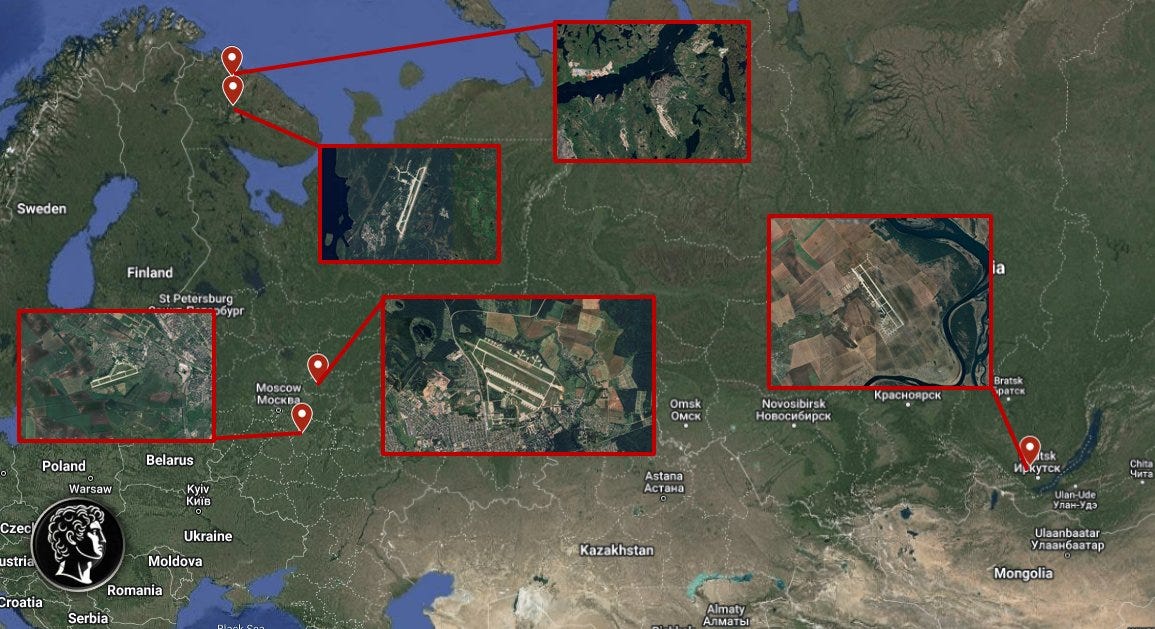
This time, however, Mr Markov was responding to the weekend’s Ukrainian drone strike deep inside Russia. By “deep”, I mean Siberia. Which supposedly took out forty of Putin’s 120 strategic bombers using drones smuggled into the country via trucks which then fanned out and parked within range of various air bases.
Which is brilliant and innovative, in the sense that Castro blowing up a third of the USAF during the Cuban missile-crisis negotiations would have been. Right now, the only thing standing between the planet and the Third World War is Vladimir Putin’s forbearance. And, as all the smart people assured us in the spring of 2022, the Russian not-so-strongman was “dying” (Christopher Steele, sole proprietor of Dossiers R Us) or dead, either of which condition can make one’s nuclear-war judgment a little erratic. Headline from the UK Daily Mirror, almost exactly three years ago:
Vladimir Putin may already be dead with body double taking his place, MI6 chiefs claim
That headline is 100 per cent accurate if you remove the words “Vladimir” and “Putin” and replace them with “Joe” and “Biden” respectively. Incidentally, analyse each nation’s advances in body-double technology by comparing “Biden”‘s ability to host a G7 with “Putin”‘s ability to host a BRICS summit. That’s the way to bet if it comes to World War Three. Sen. Lindsey Graham (R – Zakarpattia), was in Kiev to meet with Zelenskyyyy the day before Operation Bring It On. He had the affect of a chap who knew what was coming — although one notes he has yet to make good on his comparatively less ambitious pledge to sink Greta Thunberg’s Gaza boat.
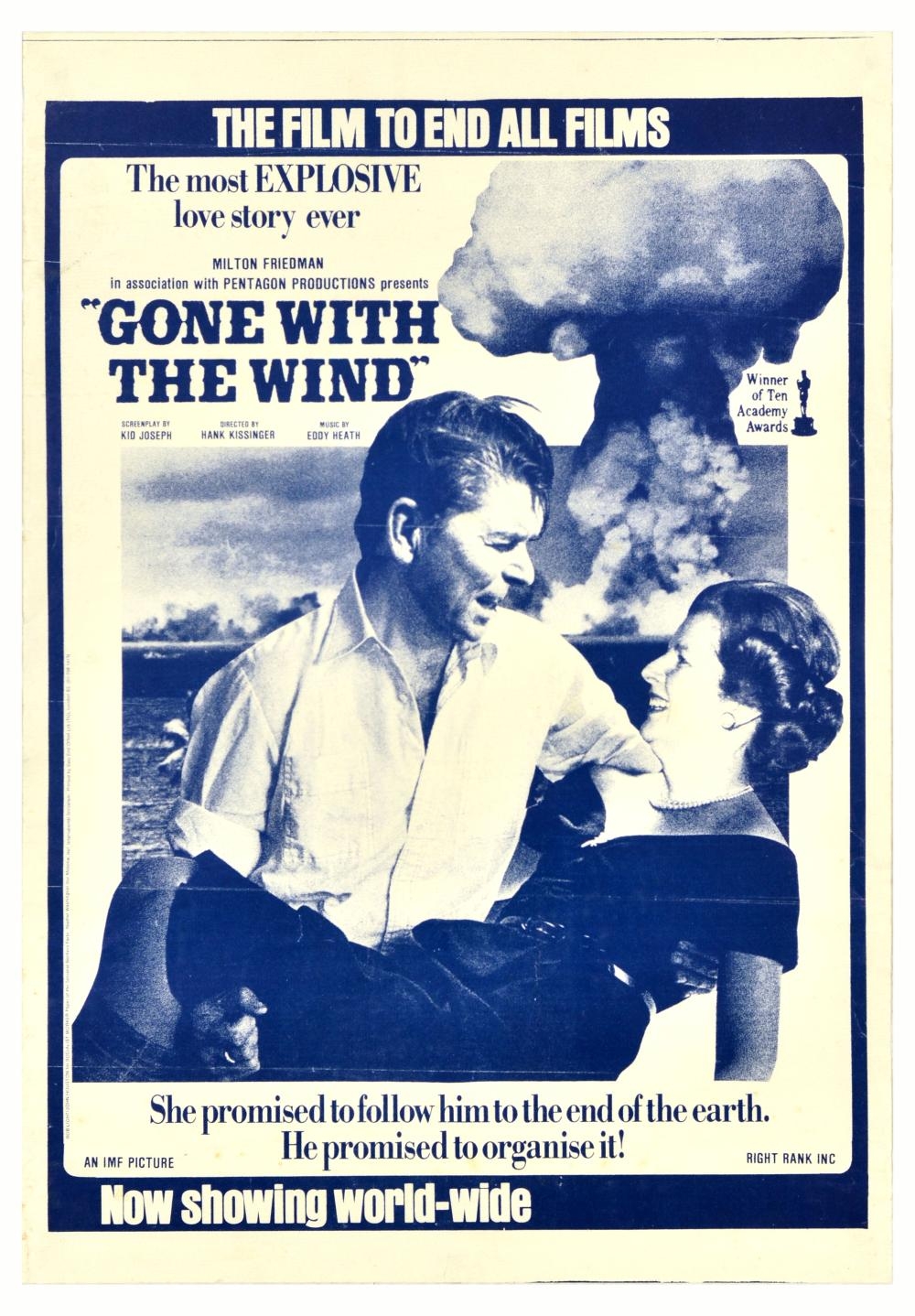
Forty years ago, everybody claimed to be super-worried about imminent mushroom clouds. A bestselling poster of the day:
Anyone care to remake the above with Senator Graham and Victoria Nuland, She-Wolf of the Donbass? Ah, but maybe it doesn’t work as well with Deep State non-household-names in the leads. It’s not so long since Lindsey was telling Zelenskyyyy to resign, but he’s apparently back on board. And, more generally, most western media were happy to report the drone strike as more of a poke in the eye to Trump than to Putin. Headline from National Review:
Country That Allegedly Had No Cards to Play Keeps Finding New Cards to Play
This is in reference to Trump’s jibe from February that Ukraine had “no cards to play”. The question then arises: Where did Z find these “new cards”? When Pete Hegseth took over as US Defence Secretary, he quickly confirmed what every sentient creature had long suspected — that the Pentagon had been micro-managing Ukraine’s end of the war for the previous three years. Are they still doing so? In defiance of their nominal commander-in-chief?
June 3, 2025
Ukraine’s strategic strikes against Russian airbases
CDR Salamander on the lessons to be learned from the latest dramatic turn in the Russo-Ukrainian war with Ukraine carefully avoiding letting their American supporters know about the attack before it went in:
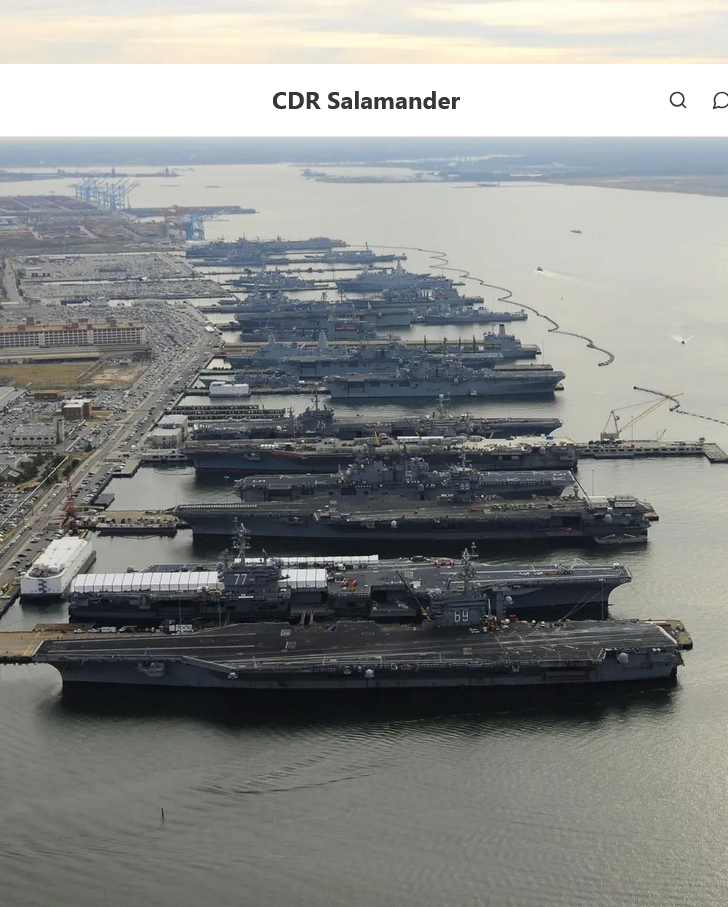
[This] picture from 2012 of Norfolk is what I want you to think about.
We talked about the superbly executed Ukrainian attack on Russian bomber bases for most of yesterday’s Midrats, and what keeps coming to mind for me is not the details of that attack, but the stark warning it is giving us.
The threat of drone strikes isn’t a new warning, but in my mind it intersect almost perfectly with the self-inflicted vulnerability of the US Navy’s fleet — its concentration.
The growing utility of attack drones isn’t an insight that is unique to the Russo-Ukrainian War. The topic has come up here and on Midrats for almost two decades. We’re not alone. Heck, broad thinking people like our friend Matt Hipple was pondering it over at CIMSEC thirteen years ago a few months before the picture at the top of the post was made.
I’ll tie in the picture a bit, but let’s take a moment to give the Ukrainians credit where credit is due. They executed precision strikes against the RUS bomber fleet across the entire two-thirds of the Euro-Asian landmass.
We will find out more details, a dozen or 40+ high-demand/low-density strategic bombers were taken off the battle line. RUS is not building any more of them. As missile carriers, they have been a cornerstone of the city terrors for most of the last four years. You would be hard-pressed to find a more honorable, or legitimate target.
Streiff over at Red State has a good summary with what we think we know as of Sunday afternoon:
The airbases are the home to Russia’s fleet of Tu-22, Tu-95M, and Tu-160 nuclear-capable strategic bombers as well as AS-50 battle management aircraft. They were located from the Siberian Far East to the Arctic Circle. The furthest target, Belaya Airbase in Irkutsk, is over 2700 miles from Ukraine.
Reports indicate that at least 41 aircraft were hit. The unofficial tally indicates 24 Tu-22, 8 Tu-95MS, and 5 Tu-16 were hit. MiG-31 fighters and Il-76 transports were also hit. To put this in context, open-source data says Russia’s bomber inventory is about 58 Tu-22, 47 Tu-95MS, and 15 Tu-160. These planes are the ones used to launch most of the missiles fired at Ukrainian cities.
By any standard, this was a devastating attack. Nearly half of the Tu-22, a quarter of the Tu-95MS, and a third of the Tu-160 fleet, representing just over 30 percent of Russia’s strategic bomber force, were damaged or destroyed in one attack. When you consider the operational readiness rate, Russia probably has less than 50 aircraft capable of flying … on the bright side, they have plenty of aircraft to cannibalize for parts. The Tu-22 and Tu-95MS production lines are closed, and the Tu-160 production is one, yes, one per year. For all intents and purposes, this represents a permanent decrease in the size of the Russian strategic bomber fleet.
Before we discuss what the USA needs to take away, let’s look at the top-4 primary and second-order effects this will have on the Russian Federation.
First Order Effects
- Fewer raiding assets to use against UKR.
- The weakest leg of their nuclear triad (bombers are dual use) is even weaker.
- PSYOP defeat as RUS now know even their most valuable weapons, stationed deep into RUS rear, are vulnerable.
- Paranoia elevated into an already paranoid national psyche under duress of year four of a grinding war.
Second Order Effects
- Inefficiencies in both civilian logistics and manpower are the natural response to every tractor-trailer being a weapons delivery vehicle at range … and the need to defend important bases as a result, sinks into an already stressed nation.
- Loss of face. RUS launched a war of choice against nation 1/4th its size and much weaker than it from any measure, and four years on, still has only made marginal progress. Now that nation proved it can operate with impunity anywhere inside RUS. The “R” in BRICS is not impressing its friends.
- It shouldn’t, but this is going to get the nuclear autists the jitters. All theory, but yes, UKR took out one-third or more of the fully mission capable nuclear capable bombers that form one leg — but as mentioned above the weakest leg — of RUS’s nuclear deterrence. Those who work in the theory-dominated nuclear world will have all their gauges twitching, yes, but in the end analysis, it won’t matter.
- UKR morale just got a big boost. Wars of attrition usually last until one side or the other loses either the material ability or the will to fight. At least from the “will” line of operation, that decisive point just shifted to the right.
Simply a superb operation. How do you defend against weapons like this disguised in a trailer’s false roof?

May 25, 2025
When NATO “stopped being an effective military alliance” and instead “became a kind of social club”
In UnHerd, Edward Luttwak says that Europe (however you might prefer to define it) needs a new Great Power:
All through European history, the intervals of peace, during which reconstruction and progress overcame the ravages of war, were secured by a temporary equilibrium between the Great Powers of the day.
It is obvious that there was no such equilibrium on 23 February 2022, when Russian columns started rolling towards Kyiv, and Russian President Vladimir Putin had just described Ukraine not merely as Russian, but as the homeland of the very first Russian state: Kievan Rus’.
[…]
But when the moment came, and Russian tanks rolled into Ukraine, there was no cohesive and determined power ready to respond quickly and effectively. Nato had done just that several times during the Cold War, by promptly reinforcing threatened allies with thousands of air-lifted troops from the so-called “Allied Command Europe Mobile Force”.
That, however, was the old, pre-enlargement Nato, which was still a veritable military alliance of countries capable of defending themselves, and help weaker allies in trouble, and whose chronically weak Mediterranean member states, with the most resplendent uniforms and least combat strength, had no Russian troops on their borders.
But once very deserving yet utterly indefensible countries such as Estonia were included in Nato — along with Poland, which mustered just 42,000 combat soldiers out of its population of 33 million a mere three months before Putin’s full-scale invasion began — it stopped being an effective military alliance.
Instead, it became a kind of social club. The Nato calendar is full of meetings at the “Supreme Allied Headquarters” in Mons in Belgium, where all manner of military and related issues are addressed often very professionally and quite freely — except that nobody is allowed to mention, however politely, even the most glaring military shortcomings of fellow allies, which undermine important war plans.
The highpoint of the Nato calendar is the splendid summits with all flags flying, in which the arrival of new countries is greatly celebrated, regardless of their ability to actually defend themselves. Both heads of state and heads of government are invited to those gatherings on the premise that there is strength in numbers, with no concerns about the inherent difficulty of reaching any agreements in such a vast crowd.
In the last summit, held in Washington DC in July 2024, Biden’s confusion of President Zelensky with Putin added a touch of humour to otherwise gloomy proceedings: nobody in attendance offered any suggestions on how to end the war in Ukraine.
What proves that Nato is no longer a genuine military alliance was that nothing was done in the last pre-war days before Putin’s invasion finally began. The satellite intelligence that revealed Russian forces on the move also showed that they were already in assault formations. But even then, five days remained to fly fighter-bomber squadrons to forward bases.
Yet even inaction would have been better than what actually happened. Instead of ordering the rapid deployment of tactical airpower to bases in Germany, Italy and the United Kingdom, the Biden administration instead evacuated US diplomats from Kyiv, starting a panic that induced the evacuation of some 20 other diplomatic missions.
March 15, 2025
Trump’s actual goal in Ukraine
David Friedman posted this a couple of days ago, considering what President Trump’s real goals may be in the Russo-Ukraine conflict:

There are two possible interpretations of Trump’s policy. The pessimistic one is that he plans to give Putin what he wants, force Zelensky to accept peace terms that give Russia substantial amounts of Ukrainian territory and leave Ukraine disarmed and defenseless against future Russian demands. On that theory the clash with Zelensky was a pre-planned drama intended to provide an excuse for the US withdrawing support, make it less obvious that Trump now supports Putin. As of Monday that looked like a plausible reading of the situation.
The optimistic reading was that Trump wanted to force an end to the war on compromise terms, use the withdrawal of support to force Zelensky to agree. Tuesday’s news, Zelensky agreeing to a proposed cease fire and Trump responding by resuming US support for Ukraine, is evidence for that reading. The ball is now in Putin’s court. If he rejects the proposal Trump will be under pressure to continue, perhaps even increase, US support. That is a reason for him not to reject the proposal. My guess is that Putin will agree to a temporary cease fire, at least in principle, although he may haggle over details, try to push for a version more favorable to him.
What Trump wants, on the optimistic interpretation, which I now find likely, is to end the war. To do that he needs to find terms that both sides will accept. Zelensky will not accept terms that amount to surrender — even if the US abandons him, he has the option of continuing the war with increased support from the European powers, now moving to rearm. If they are sufficiently committed to Ukraine or sufficiently annoyed at the US they should be able to replace most, although not all, of what the US has been providing, if necessary with munitions purchased from the US; it is hard to imagine even Trump forbidding US arms manufacturers from selling to allies. Ukraine would be worse off than continuing the war with US support but, if Russia is willing to agree to terms Trump approves of and Ukraine is not, that will not be an option.
Putin was, despite American support for Ukraine under the previous administration, winning, although very slowly and at considerable cost. Unless Trump is willing to respond to Russian rejection of his peace plan by greatly increasing US support, which I think unlikely — no boots on the ground nor wings in the air — Putin has the option of returning to that, so will not accept anything much less. That suggests that the most likely terms amount to an extended cease fire. Ukraine does not disarm, Russia does not withdraw from territory it is occupying. Both sides stop blowing things up on territory controlled by the other, stop shooting at each other.
Judged by territorial control that is a win for Russia, since it ends up controlling most of what it wanted, the parts of Ukraine occupied by Russian speakers plus the areas that can block the water supply into Crimea, with Ukraine even further from recovering Crimea than before. That might be enough to let Putin present it to his population has a victory sufficient to justify the decision to invade Ukraine.
Seen from the outside, it would be an expensive victory, which might be enough to deter future adventurism or a renewal of the war. To get it, Russia has consumed a large part of the store of military equipment inherited from the Soviet Union, making it less formidable in any future conflict with Ukraine or anyone else. Worse still, the war has driven two neutral powers, both militarily substantial and one of them on the Russian border, into joining NATO. And between Putin and Trump they may have pushed the European powers into finally rearming. The population of the European NATO members is several times that of Russia, their economies as well:
“It’s striking but it’s true. Right now, 500 million Europeans are begging 300 million Americans for protection from 140 million Russians who have been unable to overcome 50 million Ukrainians for three years.” (Donald Tusk, prime minister of Poland)
What would be the effect of an extended pause in the war on the balance of power between Russia and Ukraine, the prospects for a renewed conflict? Both Russia and Ukraine will be able to rebuild what the war has destroyed; that will be a bigger benefit for Ukraine, since it has lost much more. One of Russia’s advantages in the war was that it not only had more munitions, it could build more, could fire far more shells at Ukrainian forces than Ukraine could fire back. An extended pause will give Ukraine and its allies time to build the factories they need. It will give states not involved in the war, such as South Korea and India, time to build up supplies of armaments and ammunition some of which can be sold to Ukraine when and if the pause ends. It will give US arms firms time to expand for a world where there is increased demand for what they produce.
If the European powers go through with their current talk of greatly increased military expenditure and continue to back Ukraine, there will be much more money bidding for arms on behalf of Ukraine than on behalf of Russia. That could shift the balance when and if the war resumes.
March 9, 2025
Europe’s leaders start talking about rearmament
Yet another side-effect of the Trumpening has been a shift in attitude among European leaders on the issue of self-defence and military spending. eugyppius points out that the flashy new media campaign to drum up support for the new position has “borrowed” its design from an unfortunate donor:
For three years we have had war in Ukraine, masterminded on the NATO side by senile warmonger-in-chief Joe Biden. This war included bizarre moments, like direct attacks on German energy infrastructure, and also escalatory brinksmanship, as when Biden authorised long-range missile strikes within Russian territory, and the Russians responded with a not-so-subtle threat of nuclear retaliation. Throughout all of this madness, the Europeans slept, sparing hardly a single thought for their defence. Now that Donald Trump hopes to end the war in Ukraine, however, Continental political leaders are losing their minds. War: not scary at all. Peace: an existential threat.
The first way our leaders hope to dispel the disturbing spectre of peace, is via Ursula von der Leyen’s “ReArm Europe” initiative, which will permit member states to take on billions in debt to fund their rearmament. In this way, the clueless histrionic Brussels juggernaut hopes (in the words of Polish Prime Minister Donald Tusk) to “join and win the arms race” with Russia, even if (in the words of the Neue Zürcher Zeitung – h/t the incomparable Roger Köppel) we must “avoid for the moment a confrontation with the new Washington”. Becoming a global superpower with a view towards confronting the hated Americans is all about spending and time, you don’t need strategy or a plan or anything like that.
Those of you wondering whether it might be a better idea to rearm first and then set about alienating our powerful geopolitical partners simply lack the Eurotardian vision. These are such serious people, that in the space of a few days they spun up this remarkable logo for their spending programme …
… which obviously portrays the EU member states smearing yellow warpaint on themselves and in no way evokes the most notorious obscene internet image of all time. Nations just do stuff, but the Eurotards cannot even take a shit without bizarre hamfisted branding campaigns.
As I said, these are deeply serious people, and they also speak very seriously, in declarative sentences that don’t mean anything. In a publicity statement, von der Leyen said that these are “extraordinary times” which are a “watershed moment” for Europe and also a “watershed moment for the Ukraine”. Such extraordinary watersheds require “special measures,” such as “peace through strength” and “defence” through “investment”. Top EU diplomat and leading Estonian crazy person Kaja Kallas for her part noted that “We have initiative on the table” and that she’s “looking forward to seeing Europe show unity and resolve”. Perhaps there will also be money in the ReArm Europe programme to outfit Brussels with an arsenal of thesauruses so we do not have to hear the same words all the time.

At Roots & Wings, Frank Furedi says that “Europe Has Just Become A More Dangerous Place” thanks to the shift to “military Keynsianism” where future economic growth is mortgaged to current military spending:

Net Zero image from Jo Nova
Of course, it is still early days, and wise counsel may well prevail over Europe’s jingoistic shift towards a war economy. The justification for opting for military Keynesianism is the supposed threat posed by Russia to European security and the necessity for defending the integrity of Ukraine. However, it is evident to all that even if all the billions earmarked for the defense of Europe are invested wisely it will have little bearing on developments on the battlefields of Ukraine. Converting Germany’s ailing automobile industry to produce military hardware will take years as will the process of transforming Western Europe’s existing security resources into a credible military force.
Just remember that Germany’s railway infrastructure is currently in too poor a state to transfer tanks and other military hardware across the country. Years of obsessing with Net Zero Green ideology have taken their toll on Germany’s once formidable economy.
It is an open secret that Europe has seriously neglected its defence infrastructure. It is also the case that initiatives led by the EU and other European institutions are implemented at a painfully slow pace. The failure of the EU to offer an effective Europe wide response to the Covid pandemic crisis exposed the sorry state of this institutions capacity to deal with an emergency. The EU is good at regulating but not at getting things done. The EU’s regulatory institutions are more interested in regulating than in implementing a complex plan designed to rearm the continent.
Nor is the problem of transforming European defense into a credible force simply an matter to do with military hardware. European armies – Britain and France included – are poorly prepared for a war. The nations of the EU have become estranged from the kind of patriotic values necessary to support a real military engagement with Russia. Keir Starmer’s “coalition of the willing” raises the question of “willing to do what?”. At a time when neither France nor Britain can secure their borders to prevent mass illegal migration their willingness to be willing will be truly tested.
Macron and his colleagues may well be good at acting the role of would-be Napoleon Bonapartes. But these windbags are not in a position seriously affect the outcome of the war in Ukraine. As matters stand only the United States has the resources and the military-technological capacity to significantly influence the outcome of this war.
While all the tough talk emanating from the Brussels Bubble has a distinct performative dimension it is important to take seriously the dangers of unleashing an explosive dynamic that has the potential of quickly escalating and getting out of control. As we head towards a world of increased protectionism and economic conflict there is a danger that European rearmament could inadvertently lead to an arms race. History shows that such a development inevitably has unpredictable consequences.
What’s really concerning about the decision taken by the European Council is not simply its “spend, spend” strategy or its wager on the economic benefits of the arms industry. What is really worrying is that Europe’s leading military hawks lack clarity about the continent’s future direction of travel. Afflicted by the disease of geopolitical illiteracy the leaders of Europe have failed to address the issue of how they can navigate a world where the three dominant powers – America, China, Russia – have a disproportionately strong influence on geopolitical matters.
March 3, 2025
Trump and Zelensky in “the most amazing bilateral meeting and press conference of all time”
In the free-to-cheapskates portion of his latest post, eugyppius considers the most newsworthy press conference in living memory between US President Donald Trump and Ukrainian President Vladimir Zelensky that went theatrically wrong:
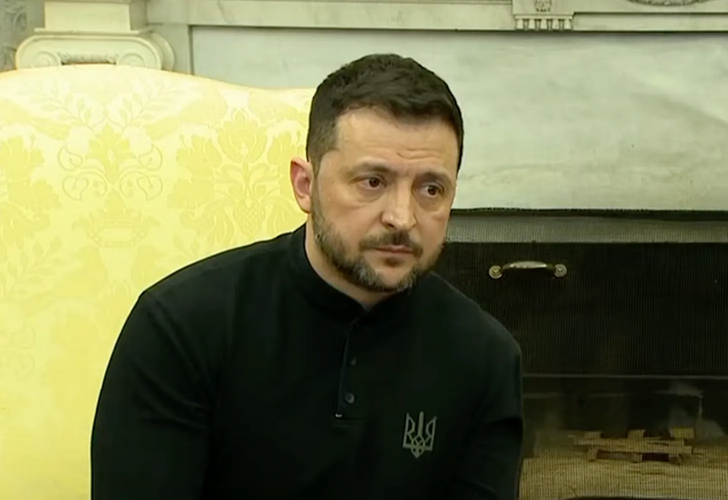
tfw you have no cards.
Since 2022, the Ukrainian President Vladimir Zelensky has been running about the globe in his weird focus-grouped jumpers and combat boots, lecturing all of our parliaments on the unity and mutual interests of Europe, the goodness of democracy, the genocidal evils of Vladimir Putin and the importance of ever more weapons deliveries to his country’s armed forces. In the process, he has become one of the more obnoxious political phenomena in recent memory, and I hope I would be able to see this even if I were firmly convinced that German interests aligned perfectly with Ukrainian interests and that we should do nothing but give the AFU all of our tanks and all of our Taurus missiles and possibly even all of our soldiers to defend our shiny wonderful and deeply liberal European democracy, where we are so free that riot police will bash your head in for protesting Covid restrictions and if you call the wrong cabinet minister a moron the speech crimes battalion will raid your house.
Here in Europe, our political leaders have treated the shouting, remonstrating Zelensky with nothing but egregious reverence, and the man has grown accustomed to his noxious political celebrity. Nothing else can explain the amazing press conference Zelensky and Trump held yesterday, ahead of afternoon plans to sign an agreement concerning Ukraine’s rare-earth minerals. We got to witness nothing less than the near-total meltdown of American and Ukrainian relations, live and in colour. Historians of the Ukraine war will be writing about this press conference for years and decades to come.
The meeting almost didn’t happen at all. Zelensky has been publicly irritated that Trump reversed the American policy of isolating Russia, after the American president opened talks with Vladimir Putin to end the war. Two weeks ago, Trump suggested that Ukraine was at fault for the hostilities, Zelensky said Trump was “living in a [Russian] disinformation space“, and Trump said Zelensky was “a dictator without elections“. Trump’s administration initially planned to cancel Zelensky’s visit to Washington this week, but French President Emmanuel Macron persuaded the Americans to go ahead with it. Imagine how much the man regrets that now. After receiving his verbal beat-down in the Oval Office, Zelensky and the rest of the Ukrainian delegation decamped to the Roosevelt Room, while Trump and his advisers decided that the President of Ukraine “was in no position to negotiate“. White House officials told them to leave before they could even eat lunch.
Foreign relations are typically pounded out in back rooms, out of sight, and that was also the intent here. Somewhere in the midst of the journalists’ questions and Trump’s banter, however, yesterday’s event ceased being a press conference and became at first a subtle unacknowledged negotiation and then a hostile disagreement – one which Zelensky got the worst of.
Mark Steyn examines what was said both before and during the Zelensky-Trump slap fight:
The Beltway rumour is that, on his flight to DC, Zelenskyyyy was telephoned by Victoria Nuland, She-Wolf of the Donbass, plus Susan Rice and Anthony Blinken and advised to get tough with Trump. If true, that’s gotta be the worst episode of “Phone-a-Friend” since the plucky little Ukrainian started playing Who Wants to Be a Billionaire (in Euros)? For all you nuanced diplomatists out there, there is now a rather arcane dispute as to whether Z called the Vice President of the United States a “bitch” or merely interjected “f**king hell”:
He literally didn’t. He said “suka blyat“, which, like “kurwa mać” in Polish, is an expression of annoyance equivalent to “fucking hell”. Not ideal politics, granted, but not the same.https://t.co/mOgGZN9iwh
— Ben Sixsmith (@BDSixsmith) March 1, 2025
UPDATE! From Leonid in our comments section:
If the audio is not altered, it does sound like ‘suka, blyad‘ which is akin to ‘f**king piece of sh*t’. It is not necessarily directed at Vance personally, but I specifically translated this as ‘f**king piece of sh*t’, not ‘f**king hell’ because it can indeed be taken as directed at Vance, too. Obviously, even the milder reading doesn’t absolve Z of being an a**hole.
The Ukrainian ambassador seemed to be the only member of Z’s delegation who grasped how badly things were degenerating: the cameras captured her at one point with her head in her hands. The President booted the guy from the White House and gave the Ukrainian’s lunch to the Oval Office interns. I have always found the American vernacular “oh, the guy totally ate my lunch” incredibly lame, but, if Trump is now proposing to make it literal, I wish he’d started with Keir Starmer. Fortunately, America’s wanker media could be relied upon to agree that, when it comes to Z vs T, “the world” sides with Ukraine.
World opinion has been swift, loud and mostly unanimous against the childish behavior today of Trump and Vance. The only question now is if other countries realize that the USA they’ve long known, loved and respected is no longer a reliable ally.
— Aaron Astor (@AstorAaron) February 28, 2025
By “world opinion”, Mr Astor means not China, India, South Africa, Brazil or Saudi Arabia, but the Prime Minister of Luxembourg:
Luxembourg stands with Ukraine. You are fighting for your freedom and a rules based international order. 🇱🇺🇺🇦
— Luc Frieden (@LucFrieden) February 28, 2025
From the blissful ignorance of a California congressman:
My grandfather and the Greatest Generation didn’t fight in World War II to see our country side with murderous thugs like Putin. This is a disgrace. https://t.co/3ZrB8ur2Au
— Mike Levin (@MikeLevin) February 28, 2025
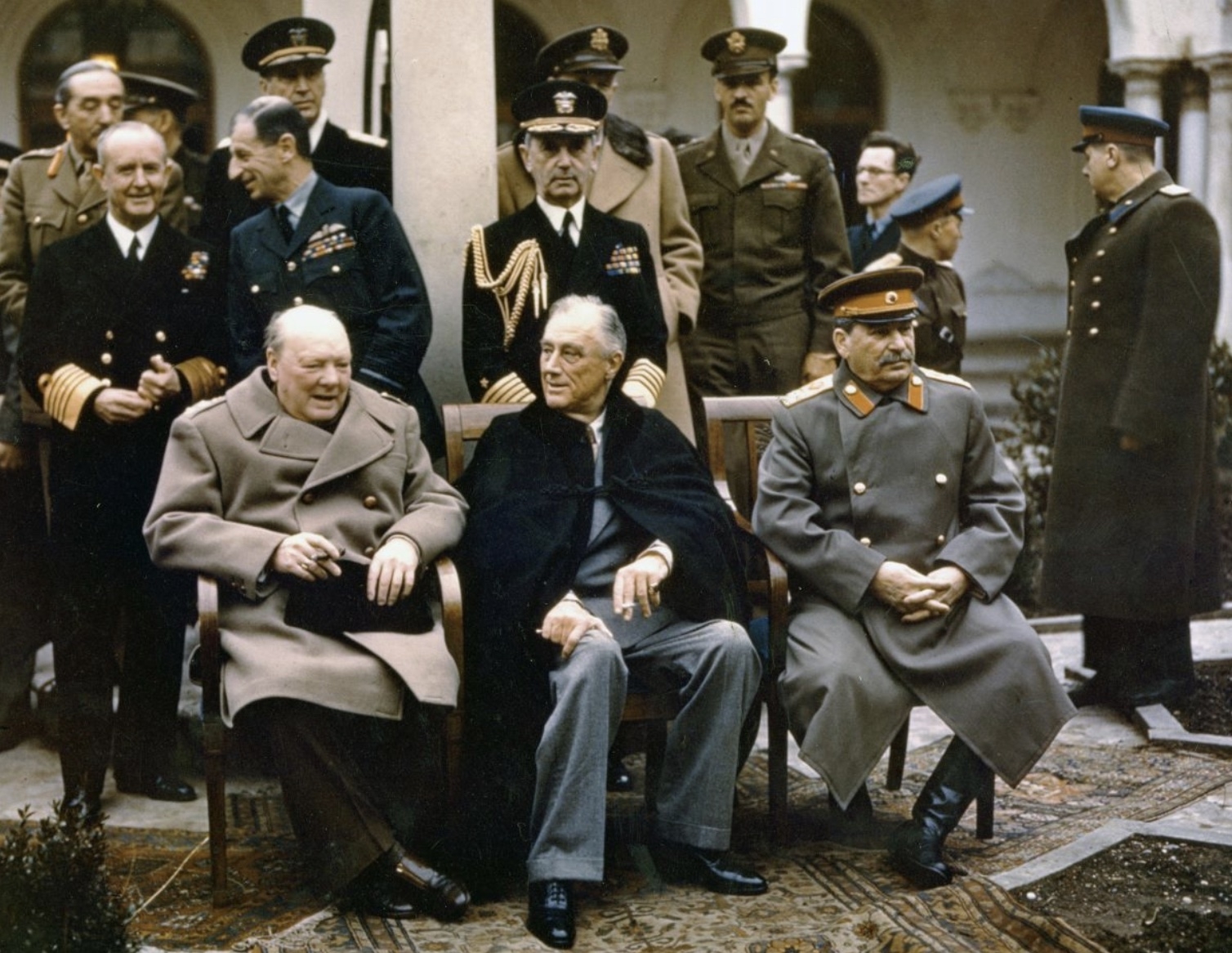
Er, in your extensive researches into World War Two, did you ever happen to come across a photograph of, say, the Yalta summit?
Churchill, FDR, and Stalin at Yalta
Still, if Luxembourgish prime ministers are going through one of their periodic butch phases, I prefer the words of Mr Frieden’s predecessor, Jacques Poos, who a third-of-a-century back, as Yugoslavia was disintegrating, told the Yanks to butt out and declared “The hour of Europe has come!” He was right, kind of: shortly thereafter, Bosnian Serbs began tying Continental peacekeepers to trees.
Mr Frieden, like many other politicians and geopolitical experts, has failed to grasp the essential dynamic of yesterday’s meeting – which is very simple:
Zelenskyyyy needs Trump far more than Trump needs Zelenskyyyy.
March 2, 2025
The end of the Ukraine narrative
On the social media platform formerly known as Twitter, “Captain Benjamin” outlines the last several years of progressive narrative that may have been totally derailed in the Oval Office the other day:

Zelenskyy walked into the Oval Office wearing an outfit that was reminiscent of the uniforms from Star Trek, he was escorted out a few hours later and the entire liberal consensus that has been the guiding narrative of the West for the last three years was a smoking hot mess, as if struck by several Photon Torpedoes from the Starship Enterprise itself.
It’s forgotten now but the Ukraine War was how the Liberal consensus moved on at breakneck pace from the Covid hysteria without ever having to explain why we had hidden from a cold for the previous two years and spent untold billions doing so.
I still remember being in a newsagent and the woman behind the desk told me that Covid was over and Ukraine was the new thing now, that was how quickly it happened, one mass consensus narrative seamlessly replaced another and the show went on.
Until today when show came off the tracks crashed into the buffers and a million Liberal talking heads exploded in unison as the entire narrative which had served as this strange outlet for their repressed jingoistic and nationalist desires was destroyed.
To me there was always something about the Ukraine War that didn’t pass the sniff test, whether it was Hunter Biden’s links to energy companies there, the way in which valid criticisms of the NATO expansion were shouted down, the mysterious blowing up of the Nordstream pipeline that was never explained.
Or the feverish want to protect Ukraine’s borders while European elites operated an unpopular open borders policy themselves, the billions being funnelled in, the tales of Ukrainians buying up yachts and sports cars.
But most clearly fact that the entire Uniparty Party and the chattering classes were in absolute lockstep about what needed to be down and any disagreement or attempt to question the narrative had you dismissed as a traitor or Putinist.
It was all very reminiscent of the groupthink that had swept the world two years previous during Covid, another unquestionable narrative, with the Uniparty in lockstep and anyone who dared to question it smeared as an anti-vaxxer.
I didn’t support Covid as the narrative had more holes than Swiss cheese and the Ukraine narrative has similarly porous texture, but to see the narrative explode so spectacularly was as much as a shock to me as it was to Zelenskyy who found himself in a hole and just kept digging.
At one-point he shocking seeming to delivered a veiled threat to Trump himself: “During war, everybody has problems, even you, but you have a nice ocean and don’t feel now, but you will feel it in the future.”
A comment that really sent the meeting side-ways, as Trump swiftly told Zelenskyy not to tell him what he should feel, leading to the arguments that scuppered the signing of a deal.
And the essence is that Trump wanted to make a deal, he’d been bragging about it to Starmer the day before, he was going to get a great deal, recoup American loses with rare-earth minerals and the EU could save-face by guarding the American mines as a peace keeping force.
It also meant that America wasn’t getting sucked into a Vietnam in the snow.
Trump doesn’t want to be a war-time President, especially a war he doesn’t think is necessary or good for business, Trump wants to usher in an AI Golden Age, send rockets to Mars, and American living standards to the moon; a 21st Century tycoon economy.
He wants peace for Ukraine and Russia as he knows that thousands are senselessly dying every week, and knows his presidency and the country cannot cope with hundreds of Americans coming home in body bags every month.
And so he wanted to make a deal with Zelenskyy, make a deal with Russia, and America gets paid, it’s a crude outcome but its aligned with reality.
But Zelenskyy doesn’t want that, he wants America men and weapons to win the war and make Russia to pay, while the EU have gassed him up to believe this possible because the EU are clinging to this war as a chance to project the veneer of power that they cannot possibly muster domestically due [to] Populist parties eroding their authority at home.
However, as Trump asked Keir to much nervous laughter, can you take on Russia alone?
America knows without them the EU cannot continue this charade, but more than that the Americans are disgusted with the EU, they view them as a drunk Uncle that has run out of goodwill.
How they are suppressing the free-speech of their citizens, failing to protect their own borders, yet grandstanding off the back of the US defence budget?
These are the questions being asked Stateside about the since Trump took office.
While the America people are questioning why are billions of tax dollars being poured into Ukraine as America goes deeper into debt.
Trump wanted to close the chapter with a deal, Zelenskyy wanted to continue a war he cannot win, and as Zelenskyy realised he wasn’t going to drag America deeper into this war he lost control, and in doing so forgot he wasn’t dealing with the Bidens and petulantly disrespected his new would-be patrons, triggering the mother of all blowbacks in the process.
Trump made it clear that what Zelenskyy was asking for was for America to risk World War 3, and Vance made it clear that everyone knew that Zelenskyy was a creature of the old regime, even highlighting how Zelenskyy campaigned against Trump in Ohio, while Trump reiterated that without the America Zelenskyy holds no cards for future negotiations with Russia.
This dose of reality was too much for Zelenskyy and also for the EU who tweeted up a storm in the aftermath pledging to ‘stand’ with Ukraine, only Starmer staying conspicuously silent.
This wasn’t simply a change of policy direction this was the public evisceration of the sacred cow of the waning Liberal Order by the ascendant Populist Insurgency.
Ukraine has functioned as the binding narrative, and in the Oval Office it faced Total Liberal Death, the fragile myth of the rules based international order being violated by Russia Man Bad and being saved by the Liberal Democratic Alliance Good, no further thinking necessary, had functioned as a very effective distraction from the utter failure that Liberalism had turned into domestically while allowing our elites to cos-play as war heroes on the world stage.
This narrative has now been utterly destroyed.
What comes next is still unknown but what we can clearly see is that the Populist Pax Americana will be a very different beast from the Liberal Pax Americana.
As always my friends, thank you for reading I know this is a very polarising issue, so if resonates please like, share and follow, if not please feel free to point out the flaws in my thinking in the comments.
February 18, 2025
Trump is a lot of things, but he’s no Neville Chamberlain
Tom at The Last Ditch reacts to his European friends’ facile association of Trump’s overtures to Putin with Chamberlain’s ill-fated attempts to appease Hitler:
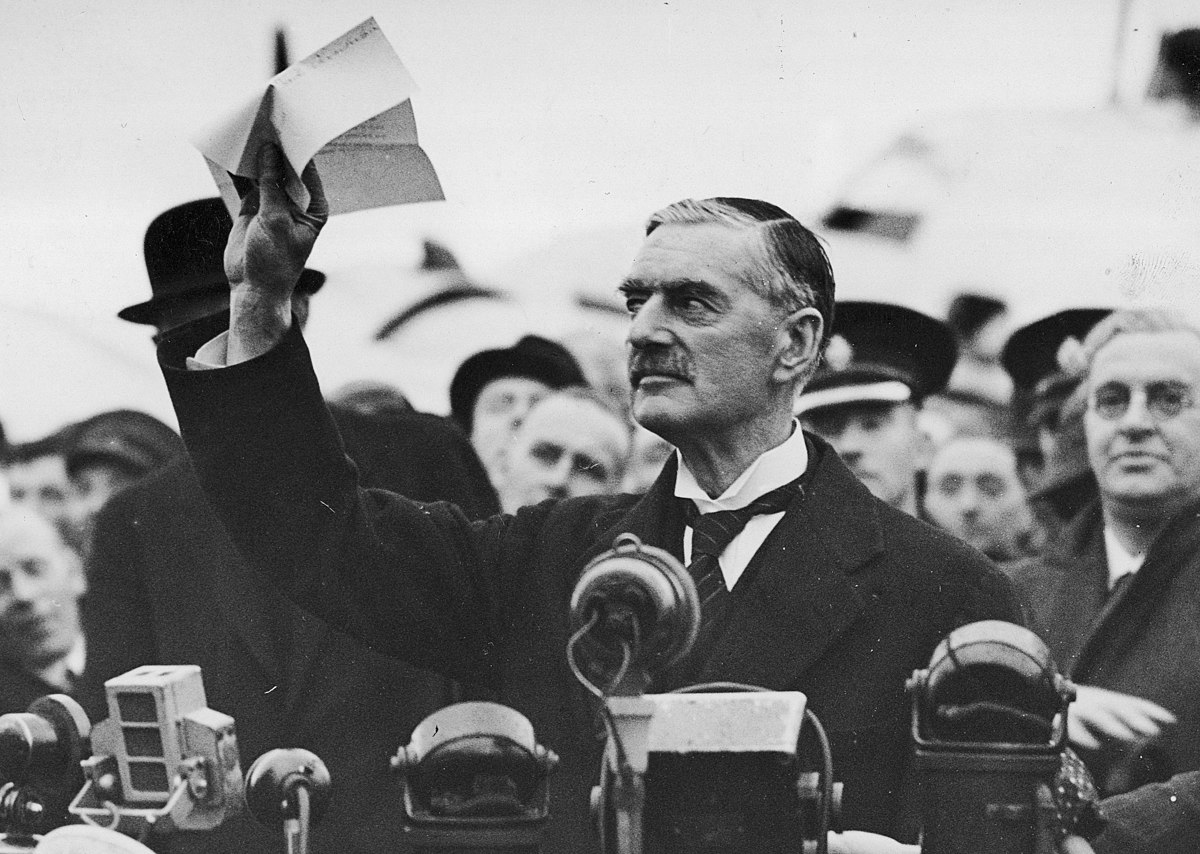
Prime Minister Neville Chamberlain at Heston Aerodrome, waving a copy of the Anglo-German Declaration he had negotiated with Adolf Hitler, 30 September, 1938.
Narodowe Archiwum Cyfrowe via Wikimedia Commons.
It’s interesting to watch my Continental friends react on their socials to President Trump’s overtures to that monster Putin — the greatest modern example of a real life Bond villain. Their sympathies, like mine, are with plucky Ukraine. Its soldiers, outgunned and outmanned, have fought like lions and their place in history is assured. Toasts will be drunk and songs will be sung, for sure. But they’re losing and not one European power is ready to send in troops. Under Biden the policy of the West was to fight to the last Ukrainian. Trump sees it in more practical terms.
[…]
Trump’s drama, trolling and exaggeration is in the same category. Most people just don’t get it and react to his bluster like that naive articled clerk I once was. Everything he says and does is calculated to find a path to the best achievable outcome. There’s not a virtue-signalling molecule in his body and yet there’s more actual virtue than in his hypocritical critics.
My European friends are comparing Trump to Chamberlain and Putin to Hitler. Europe seems unable to move on from World War II. Every issue is analysed through the historical lens of how they mishandled the rise of the Nazis. As someone once said, all we really learn from history is that we never learn from history.
The hypocrisy here is breathtaking. If his critics were any more ready than him to send in their troops, they’d have the moral high ground over him. They aren’t and (Poland perhaps excepted) they never will be. So whether it’s just or not, Ukraine can’t win. The only people the Germans and French are ready to see die in this war are Ukrainians, Americans and their loyal English-speaking sidekicks — as usual. So they have no moral basis for their maiden auntery
The post-war settlement has expired. Continental Europeans have to meet their long-neglected NATO obligations and stop expecting Uncle Sam (already carrying more debt than the world has assets) to pay for everything.
Putin is evil, yes, but Ukraine is every bit as corrupt as Russia and would add nothing to NATO’s strength. It’s in the right here as a matter of international law and (for what it’s worth in war) morality. But international law is a myth unless the rich nations enforce it by (plausible threat of) military action. Europe is just standing by signalling virtue while breaching sanctions and sending half the military matériels it promises. Meanwhile Ukraine loses men and wealth with no hope of victory. When the last Ukrainian soldier has died or surrendered, what do Europeans think the outcome will be? Ukrainian flags on your socials won’t win it mes amis.
My advice to my Continental chums? They should let the President try to make peace and hold their comments until they see the result. Based on all my years working in Continental Europe, I expect them all to decry the result and pretend their leaders (prepared to sacrifice nothing) would have done better. It’s bullshit. War is hell and has to end eventually. This is not a Hollywood movie. There are no guarantees that the (relatively) good guys will win. If you won’t end it with arms, then jaw jaw is all you have. This man is much better at jaw jaw than you are so shut up and stop assisting the enemy by showing him how divided the West is.
January 31, 2025
“… and 10% for the Big Guy”
In the New English Review, Bruce Bawer reviews Miranda Devine’s new book, The Big Guy: How a President and His Son Sold Out America:

Even now, roughly half of Americans seem to believe that all the attention that’s been paid to Hunter Biden and his laptop has to do with his love of prostitutes and drugs rather than with high crimes and misdemeanors committed by him on behalf of his dad and other members of the clan. Even now, many Americans seem to be blithely unaware of the mountains of evidence showing that Hunter has long been fleecing foreign firms on Daddy’s behalf. For some reason those clueless Americans, even if capable of accepting that Hunter was up to no good, simply can’t believe that his pop – good old Lunchpail Joe – has ever been guilty of anything. (These same people, of course, are convinced that Donald Trump is the most corrupt politician ever to come down the pike.)
This blindness to facts – or stubborn refusal to pay attention to them – is immensely frustrating. And it must be especially frustrating for Miranda Devine, the Australian-American New York Post journalist who, in Laptop from Hell: Hunter Biden, Big Tech, and the Dirty Secrets the President Tried to Hide (2021), detailed the contents (by turns sordid and criminal) of Hunter’s celebrated computer, the story of which her newspaper broke 20 days before the 2020 presidential election, and who in her new book, The Big Guy: How a President and His Son Sold Out America, focuses on the cover-up.
To say that Devine tells her story in impressive detail would be an understatement. Like War and Peace, The Big Guy opens with a long list of the main players, just in case you lose track of who’s who. And you will. Reading this book isn’t just like reading War and Peace – it’s like reading War and Peace at the same time as One Hundred Years of Solitude. You have to remember a slew of foreign-sounding names, many of which sound very much alike, all the while following an exceedingly labyrinthine narrative.
To be sure, this tale also involves plenty of Americans, some of them public officials who, when they scented the heady whiff of corruption in the Biden circle, actually did their jobs by digging into the facts and gathering evidence. Others, alas, are people who also held positions of authority but who did their damnedest to put up “roadblocks” or “obstructions” or “delays” or “logjams” – to use some of the many synonyms that Devine uses to describe efforts to keep the public in the dark.
And boy, was there a lot to cover up. Among the expenses that Hunter tried to write off on his taxes – not that he was quick to pay them, mind you – were disbursements to prostitutes and drug dealers and memberships in sex clubs. During one “crack and hooker bender” in 2018, he spent $8,000 on a single sex worker, $140,000 on a stay in Las Vegas, and $34,000 on a sojourn at the Chateau Marmont in L.A. The Chateau Marmont is legendary for playing host to celebrities on drug binges, but Hunter caused so much damage to his room that he was banned from the place thereafter, which even he suspected was a first.
Part of the reason why Hunter was able to go through a small fortune so quickly was that he had a “sugar daddy” by the name of Kevin Morris, who for reasons that still remain a mystery chose to give him millions of dollars over the years to save him from financial crises (such as the ones posed by the relatively modest monetary demands of Hunter’s baby mama in Arkansas). A 2019 book contract with Simon & Schuster also netted Hunter a $750,000 advance, even though the book (surprise!) ended up selling so few copies that it made back only a tiny fraction of that sum. Then there were his paintings, which brought in at least $1.5 million. People laughed when Hunter first revealed his artworks to the world in 2020, but I didn’t: they’re no worse than a hell of a lot of contemporary art – and, after all, the art market these days is as much about laundering money than it is about aesthetics.
But Hunter’s main sources of mazuma were foreign companies. One of them was Barisma in Ukraine. Another, in Russia, was run by a man named Zlochevsky who said that Hunter, whom Joe Biden had called the smartest man he knew, was in fact stupider than Zlochevsky’s dog. A third was the Chinese energy company CEFC, a leading promoter of China’s Belt and Road Initiative. CEFC put Hunter on its board – and paid him millions – in exchange for his promise to use his father’s name to “open … doors around the world” for the firm.
Collecting loot from all these sources and funneling some of it to family members involved a complex network of bank accounts and shell companies that was designed to make the moolah tough to trace. To illustrate the process, Devine follows the path of a single $5 million payment by a CEFC affiliate to one of Hunter’s firms, HWIII. Over time, Hunter transferred most of that $5 million to another firm of his, Owasco; in addition, he wired some of it to his uncle Jim’s company, after which Jim’s wife, Sara, withdrew a fraction of that sum and deposited it in the couple’s personal account and dispatched a $40,000 check to Joe Biden.
January 18, 2025
The Battle of the Bulge, LGBTQ+ Victims & Atomic Secrets – WW2 – OOTF 038
World War Two
Published 17 Jan 2025This episode of Out of the Foxholes dives deep into your WWII questions. From LGBTQ+ persecution during and after the war, to the potential impact of diverting Battle of the Bulge troops to the Eastern Front, and Ukrainian collaboration with the Germans, we unravel the complexities of war. Join us as we tackle the secrets, strategies, and untold stories of WWII.
(more…)
December 14, 2024
Matt Gurney’s final thoughts from the Halifax International Security Forum
One of the things I regret about being totally broke is that I can’t pay for a full subscription to The Line, which is one of Canada’s best sources of (relatively) unbiased commentary on current events both in Canada and around the world. This is the third instalment of Matt Gurney’s report from the recent Halifax International Security Forum (earlier parts linked here and here):

This next one is going to be very brief, since it’s really just an observation. There was very little discussion of Israel. As I noted at the top, there was discussion of the situation in the Middle East. But it was mostly in the context of “The world is currently a mess”. Parts of the Forum involve breaking into smaller groups for more focused discussion on specific issues, and some of those might have focused on Israel or the Middle East more broadly. I can’t speak to what I didn’t see. But I was surprised by a relative lack of focus on the ongoing fighting around Israel in the main events.
A notable exception was the presence of Dr. Cochav Elkayam-Levy on one of the on-record panels. An international law expert, she has spent the months since the October 7th attacks documenting the mass sexual violence that was such an awful feature of Hamas’s attack. Her comments were brief but powerful and can be seen here starting at around the nine-minute mark. I’d like to zoom in on one comment in particular. Dr. Elkayam-Levy told the audience how the invaders were able to capture the personal devices of many of their victims, and use those devices to broadcast the abuse and sometimes murder of these victims via the victims’ own social media apps. This was something that was discussed shortly after the October 7 attacks but not much after: by seizing the victims’ phones, the invaders were able to spread terror and traumatize the loved ones of the victims by showing their friends and family, via photos and videos and live streams, exactly what the victims were being made to suffer.
“I thought I had seen the worst,” the doctor told the assembled audience. “But really, if there is hell, this is what it looks like. Someone abusing your kin. Someone killing your loved ones in front of your eyes.”
Though it was only a small part of the official agenda, Dr. Elkayam-Levy’s comments left an outsized impression on me, and I suspect on many others.
He also discussed his own professional path which he regrets didn’t include a lot of traditional on-the-spot reporting on tragedies and interviewing survivors, as he feels he doesn’t have a good “game face” for those times when he now finds himself doing that kind of work:
I am 100 per cent on side with Ukraine in its war with Russia. I’m not blind to flaws in Ukraine today or in Ukraine’s history, but I have absolutely no doubt who’s the good guy and the bad guy in that ongoing war. I’ve had wonderful opportunities to speak with many Ukrainians since their country was invaded. I have heard their stories and tried to share them on my platforms. I’ve also had opportunities to meet and talk to many Ukrainians who are living now in my own hometown, mostly women with young children, who fled the fighting or once lived in parts of the country that are now occupied by Russia.
I feel so profoundly that these people have been wronged, and tremendously wronged. I believe so sincerely that they should have our full backing as they try and drive back the invaders and liberate their country. That their cause is not just in the West’s strategic interests, and I very much think that it is, but also that it is morally just.
But I have concluded that they’re screwed. We’ve lost interest, and Ukrainians are about to get the Kurd treatment, if I can be so crass. And I just didn’t have the heart to tell them that. I don’t even know how I’d begin to say that to them. I write and speak for a living. And words still failed me.
During a meal in Halifax, a woman who’d flown in to give a presentation on the work her organization does in Ukraine assisting displaced people told me a story of her own experience with the war. The original Russian invasion in 2014 hadn’t been anywhere near where she lived. She was somewhat shocked, she told me, when in 2022, her hometown came under attack. She described the first time she heard air raid sirens. The first time she heard a bomb blast. The first time she could hear the gunfire of advancing ground troops. She told me about the first person from her small community to die, a paramedic who was on her way to collect wounded when their ambulance was hit. And then she told me how, months later, she realized she couldn’t remember any of those things anymore, except for the first time, because they’d happened so much. Constant sirens. Constant bombings. Constant gunfire. The deaths of more people she personally knew than she could even remember.
And as she told me this story, I found myself near tears. I was able to cover it up, I think. I wish I had better game face, but I have some. But my tears weren’t even of sympathy. I wasn’t overwhelmed by her sad story, though it was awfully goddamned sad. No, the tears I felt were tears of shame. I knew that at the end of the conference, I’d get to go home. Toronto is a bit rougher than it was when I was growing up, but it ain’t a war zone.
This woman doesn’t get to go home, assuming her home is even still standing. She knew it, I think. I knew it. I think we both knew that the other knew. But we talked around it.
History is going to judge us harshly for our failure to do more, faster, to help Ukrainians defend themselves.
And alas, we’ll deserve it.
December 5, 2024
Mélanie Joly in Halifax, demonstrated her belief that “communication” is much more important than “action”
In The Line, Matt Gurney continues his report from the recent Halifax International Security Forum, where the Trudeau government’s representatives were Foreign Affairs Minister Mélanie Joly and Bill Blair, the Minister of National Defence:
Whoo boy. Mélanie Joly has got to go. Now. Today, if possible. Because we’ve got problems enough without, uh, well … maybe I should just explain what happened.
Joly is, of course, our foreign affairs minister. She and Bill Blair, the national defence minister, constituted the “star power” the Trudeau government sent to the Halifax International Security Forum, which I attended late last month. Joly would have, no doubt, taken part in many direct meetings with allied counterparts and various stakeholders behind closed doors during the three-day event. I can’t tell you what happened there. I can tell you, though, what happened during her public, on the record appearances. One of them in particular. And I can tell you what happened after it.
It wasn’t good.
I covered a bit of the basics about the Forum itself — what it is, who funds it, who shows up — in my last column about this year’s event, so I’ll skip the recap this time. Except for this: the event schedule is divided up into on-the-record panel discussions, off-the-record sessions (generally, those are the more interesting ones), and just lots of slack time for networking and gabbing over coffee and routinely excellent food. Joly took part in two of the on-the-record sessions. In one, she gave introductory remarks. They were about what you’d expect. The other time, she was a panelist. And that’s the one where things went wrong for Joly.
Joly was on a panel titled “Era of Unity: Victory for Ukraine”, moderated by Russian political dissident and chess grandmaster (uh oh) Garry Kasparov. Kasparov can be an aggressive moderator, and he and Joly sparred about the value of the United Nations. (I’m more of Kasparov’s view on the value of the UN, to put it mildly, but Joly more or less held her own under his questioning.) Kasparov followed up with a question about tangible support by Canada for Ukraine. He set it up as a hypothetical — he alluded to the recent re-election of Donald Trump, and noted that there are many who’d be happy to sell out Ukraine to secure some kind of peace with Russia. “Will Canada step in … will Canada play a bigger role? Canada is an important country, as you said,” Kasparov put to Joly. “When you have free time from diplomatic victories at the United Nations,” he asked, a bit mockingly, “can you help Ukraine win?”
Oh dear, I thought. This could be bad.
And it was. And then it got worse.
To Kasparov’s specific question — would Canada help Ukraine win? Would Canada step up and do more? — Joly replied at length about how much she believes in defence. And collaboration. And working together with allies. And why we need an Arctic strategy. And the value of deterrence. And the need for a stronger security architecture in the Indo-Pacific. And then some stuff about North Korean missiles. And then a nice bit about Canada’s long friendship with Ukraine. And how Canada, even though we’re smaller than the U.S., will always advocate for Ukraine at the NATO table.
I haven’t quoted directly from what the minister said. I am conscious about not wanting this entire column to become long quotes. You can see the entire exchange between Kasparov and Joly here, starting at around the 37 minute mark. What I can tell you as someone who watched it in person was that there was a real vibe shift — see, I can talk about vibes, too! — in the room as Joly spoke. Kasparov had asked a straightforward question and he’d gotten an answer that seemed as if Joly was envisioning a globe in her head, and spinning it, and just commenting on everything that came to mind as a different region came into view. Oh! There’s the Indian Ocean! Say something about the Indo-Pacific!
It was bad. Everyone in the room knew it was bad, with the possible exception of Joly.
But Joly hadn’t hit bottom yet.
November 25, 2024
Looking toward the first order effects of 47
At Postcards From Barsoom, John Carter is delighted that his pessimistic election forecast turned out to be wrong and considers what the incoming Trump administration will be doing in the short-term:
There are obvious parallels between the 2024 election, the 2016 election, and the Brexit vote, all of which are a bit awkward for elite theory maximalists. Their position, taken to its extreme, seems to be that only the elite can actually do things, that all political phenomena are ultimately a consequence of elite machinations. Which makes elite theory in many ways the highbrow version of conspiracy theory, the main difference being that they talk about the Cathedral’s systems of power instead of the Illuminati, the Freemasons, and smoky backrooms. And yet, the elite clearly don’t always get their way. In the case of Brexit, the elite were absolutely unanimous in their support for Remain … and the elite lost. Similarly in the case of the 2016 US election. Elite preferences carry an enormous amount of weight; it’s generally much better for a cause to have elite support than suffer elite opposition. But elites are not actually decisive. They can be beaten.
It’s obviously much too early to judge the 47th US presidency, which hasn’t started yet. Cynics expect a repeat of 2016: just as Trump’s promises to drain the swamp and build the wall came to, if not nothing, then very little, so will his promises to deport them all, replace the income tax with tariffs, reign in the universities by going after their accreditation and endowments, drain the swamp for real this time, and so on prove to be so much hot air. So far all we know are Trump’s cabinet picks and other appointments, which suggest that this cynicism might be premature. […]
The new Trump admin shows every sign of gearing up for a Dark MAGA rampage through the Beltway.
If you’re curious about where Dark MAGA came from, why yes it was memed into reality. Aristophanes
tells the wild saga: from in-joke to shitcoin to the hat on Elon Musk’s head.They aren’t going to just drain the swamp. They’re going to drain it, dry it, soak it in gasoline, and set it on fire. They are going to purge the US government of the useless, the incompetent, the subversive, and the criminal. At least, that seems to be the intention … and given the way the rats are scrambling to escape the ship before it sinks, the regime’s minions, at least, seem to think that plan has a good chance of succeeding. […]
Of course, a lot could happen between now and January. The Democrats might find some convoluted legal pathway to deprive The Insurrectionist of the Oval Office, as Tree of Woe suggested, which of course would initiate a constitutional crisis and probably a civil war. They could assassinate him, which would also probably start a civil war, and which is probably why Trump has been holed up in Mar-a-Lago since the election. Either of these outcomes would probably place JD Vance in the presidency, which is probably much worse for the regime than Trump: Vance is marine corps combat vet who reads Curtis Yarvin and is fluent enough in meme that he probably has a frog alt on Twitter.
[…]
News that suicides spiked after the election is apparently fake, though crisis call centres catering to the Pronoun Jugend did experience a massive increase, and one guy apparently unalived his entire family. They’re still in a state of shock: shaving their heads, vowing to start a sex strike, fleeing to Canada (I do not recommend).
The left are religious fanatics, and religious fanatics don’t give up just because it looks hopeless. It’s also worth recalling that the last time Trump won, the riots didn’t start until inauguration. There’s plenty of time yet, and there are a lot of very wealthy and very influential people who probably feel they have nothing to lose as their precious oxen are in danger of being lethally gored by Dark MAGA on the Washington Mall as a sacrifice to America’s Founding gods, after which they themselves will be hanged from Wotan’s Tree of Liberty. Note that it doesn’t matter if Trump will really follow through with all of this; what matters is if the other side thinks that he will. Ruling out a dramatic escalation in civil violence in the US is almost certainly hasty.
[…]
Another play the regime could make is to just start World War III before Trump takes office, either in order to justify a military coup d’etat, or just to dump a catastrophe in Trump’s lap so that he’ll be too busy dealing with that to drain the swamp. They definitely seem to be ramping things up in Ukraine, with the new strategy of long-distance missile strikes deep into Russian territory. The idea is probably to provoke the bear so badly that it starts mauling NATO countries directly, rather than just chewing through their exhausted national arsenals in the mud of the Donbass. That might work; then again, Putin knows full well that all he has to do is wait a couple months and he’ll be dealing with Trump directly, and Trump is on record as wanting to wind down hostilities as a top priority as soon as he’s in office. Vlad may be a bad man, but he is a very patient bad man.
Assuming that the regime is unsuccessful in baiting Russia into a direct attack on Europe, Trump’s victory probably has very big, tumultuous, and positive implications for European politics. Positive, at least, for anyone who doesn’t hate Europe … and therefore very bad implications for the people currently running the civilizational centre of the human species into the dirt.
The Germans, at least, seem to think so.
Yes, it’s real.
Chancellor Scholz’ unstable “traffic light” coalition disintegrated almost immediately after Trump was elected, sending Germany into its own election … in which the AfD is poised to do very well for itself, much to the consternation of Germany’s political class. eugyppius has been doing invaluable work covering Germany’s politics for the anglosphere audience; he provides an excellent overview of the reasons for the coalition’s collapse in this recent interview on the J Burden show.