
Quotulatiousness

April 15, 2026

Do “combat-trained Islamists in Britain … now outnumber the British Army”?

Filed under: Britain, Government, Middle East, Military, Politics — Tags: , , , — Nicholas @ 05:00

In The Conservative Woman, Julian Mann asks Conservative party leader Kemi Badenoch if Britain’s immigration policies have imported enough “combat-trained Islamist” to outnumber the ever-decreasing number of soldiers in the British army:

You won’t find anyone less military-minded than me but Conservative leader Kemi Badenoch’s speech to the London Defence Conference last week prompted me to put these questions to her on X:

“How many combat-trained Islamists do you estimate there to be in Britain? Would they now outnumber the British Army and, if so, by how many?”

I very much doubt that I will get an answer. She is a busy woman and she might be reluctant to comment for fear of being drawn into an anti-Muslim conspiracy theory. She should note that the question is about Islamists, not about integrated and peaceable British Muslims.

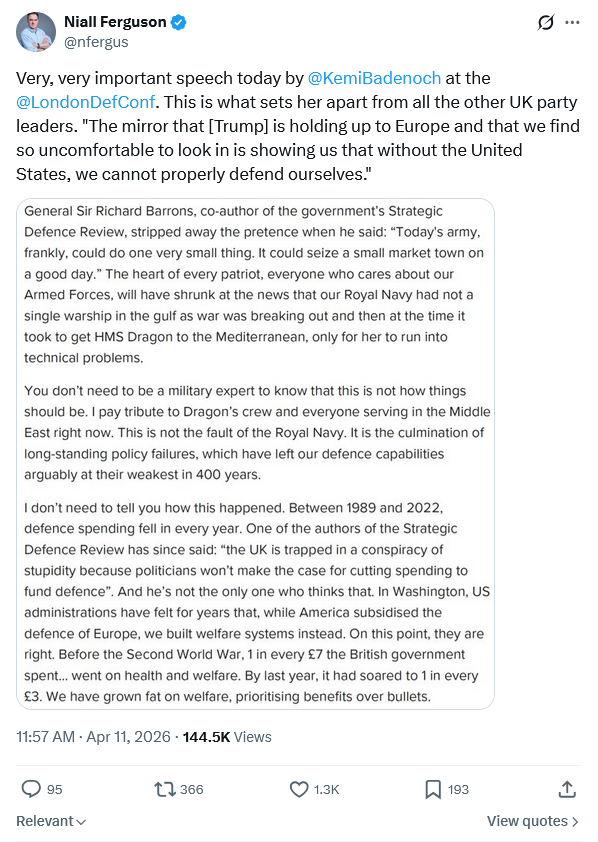
It was this part of her speech, highlighted by historian Niall Ferguson on X, that provoked the questions:

    General Sir Richard Barrons, co-author of the Government’s Strategic Defence Review, stripped away the pretence when he said: “Today’s army, frankly, could do one very small thing. It could seize a small market town on a good day”.

Ms Badenoch also said: “Between 1989 and 2022, defence spending fell in every year. One of the authors of the Strategic Defence Review has since said: ‘The UK is trapped in a conspiracy of stupidity because politicians won’t make the case for cutting spending to fund defence’. And he’s not the only one who thinks that. In Washington, US administrations have felt for years that, while America subsidised the defence of Europe, we built welfare systems instead. On this point, they are right. Before the Second World War, one in every £7 the British government spent went on health and welfare. By last year, it had soared to one in every £3. We have grown fat on welfare, prioritising benefits over bullets.”

According to the House of Lords Library: “As at 1 April 2025, there were 181,890 people in the UK armed forces, a 1 per cent decrease compared with the previous year. This total includes:

  • all full-time service personnel (known as the UK regular forces) and Gurkhas, who comprise 77.7 per cent of the total number of personnel
  • volunteer reserves (17.5 per cent of the total personnel)
  • other personnel, including the serving regular reserve, sponsored reserve and military provost guard service (4.8 per cent of the total personnel)

“The total size of the full-time UK armed forces, comprising the UK regular forces, Gurkhas and full-time reserve service, was around 147,000. Of these, 82,000 were Army personnel, 33,000 were members of the Royal Navy or Royal Marines, and 32,000 belonged to the Royal Air Force.”

So if there were 100,000 combat-trained Islamists in Britain, they would outnumber the British Army by about 20,000. I realise that there are various levels of combat training. It is possible that British Army personnel are better trained than any Islamist forces they might face on British soil. But would they be better motivated, given the way they are being treated by the Government? Why has the Government apparently failed to reckon with the appalling impact on morale and recruitment from the lawfare it is allowing against special forces and Northern Ireland veterans?
Update, 16 April: Welcome, Instapundit readers! Have a look around at some of my other posts you may find of interest. I send out a daily summary of posts here through my Substackhttps://substack.com/@nicholasrusson that you can subscribe to if you’d like to be informed of new posts in the future.
The Korean War Week 95: TWO THIRDS of POWs Refuse Repatriation – April 14, 1952

Filed under: China, History, Military, USA — Tags: , , , , , , , — Nicholas @ 04:00

The Korean War by Indy Neidell
Published 14 Apr 2026

US Marines begin to make contact with their Communist Chinese adversaries in their new position in the west of Korea, but a more insidious issue is beginning to threaten the UN war effort: dwindling stockpiles of ammunition. In fact, two-thirds of the US army’s procurement budget is going exclusively to ammunition, but production lag — the time between paying for something and actually getting it — is putting Eighth Army operations at risk. Elsewhere, POW screening begins, with results that might throw a wrench into the painstakingly negotiated armistice terms back at Panmunjom.

00:00 Hook
00:59 Recap
01:51 POW Screening
05:49 Ammunition
10:46 Marine Operations
14:07 Summary
14:57 Conclusion
(more…)

MMIWG2SLGBTQQIA+ is “a case study in progressive linguistic self-sabotage”

Filed under: Cancon, Media, Politics — Tags: , , , , — Nicholas @ 03:00

In Quillette, Jonathan Kay highlights how NDP politician Leah Gazan’s freshly coined replacement for our already over-long initialism for other-than-cis-gendered individuals has been a boon to online commentators and comedians across the internet:

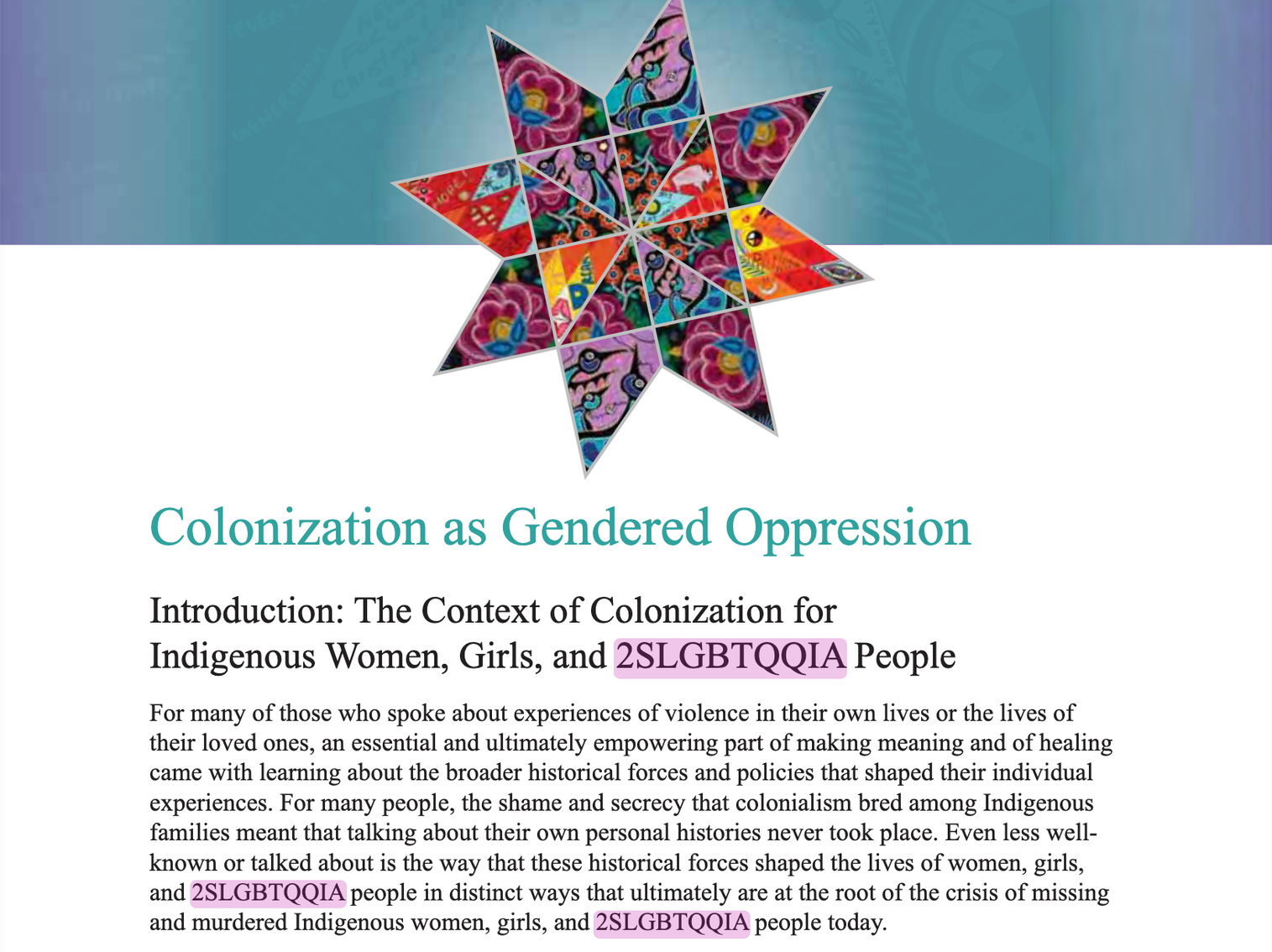
While the National Inquiry into Missing and Murdered Indigenous Women and Girls was announced in 2015, its final report wasn’t published until mid-2019. The three-and-a-half year period in between overlapped with Justin Trudeau’s manic campaign to replace the idea of biological “women” in public discourse with faddish gender-inclusive terms that describe female-identified men. The initialism he eventually came up with is “2SLGBTQI+” (whose “2S” component signifies a special — albeit ill-defined — “two-spirited” LGBT category that Indigenous people can opt into).

And so, channelling the state-of-the-art in Canadian gender jargon, the Inquiry’s commissioners duly expanded references to Indigenous “women” by addition of the words “… and 2SLGBTQQIA people” — i.e. Two-Spirit, Lesbian, Gay, Bisexual, Transgender, Queer/Questioning, Intersex, and Asexual.

The term “2SLGBTQQIA” appears in the final report 1,197 times. Agglomerating that with the original “MMIWG” mandate yields “MMIWG2SLGBTQQIA”.

Detail from page 229 of The Final Report Of The National Inquiry Into Missing And Murdered Indigenous Women And Girls.

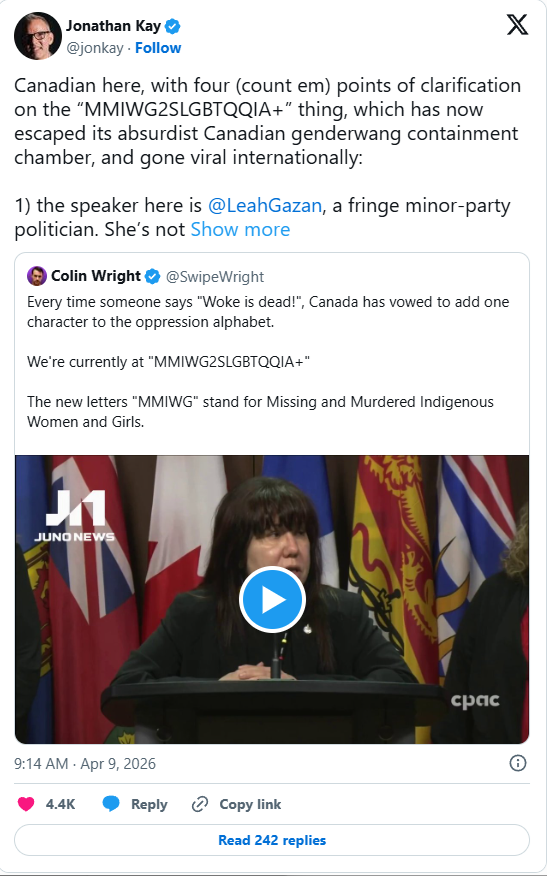
If this unbreakable wi-fi code sounds familiar, it’s because a Canadian MP named Leah Gazan just became an international laughingstock for using it at a televised 8 April news conference. (Indeed, she lengthened it even further by adding a plus sign to the end — suggesting that yet more letters, numbers, and/or symbols are on their way.) This unintentional comedy routine was made all the more meme-worthy by the casual, deadpan, en passant way the sixteen-character term rolled off Gazan’s tongue, as if it were a set of ASCII characters that ordinary Canadians ran together all the time in normal day-to-day discussions.

As some Canadians (including me) tried to explain on social media, “MMIWG2SLGBTQQIA+” is not a commonly used term outside of activist circles. I also let people know that Gazan is not a Canadian government representative (as was being claimed), but rather a member of a small and increasingly radicalised hard-left federal party known as the New Democrats.

But by then, no one was in the mood for such nuances. Elon Musk‘s three-word tweet on the subject — “Canada is cooked” — has, as of this writing, garnered more than half a million likes and 77 million views. Thanks to Gazan, millions of people around the world now believe that ordinary Canadians talk in this ridiculous fashion. We don’t.

Gazan told CBC News that the whole episode only goes to show that “bigots are offended by my positions around equality”. A more useful lesson she might take away from this experience is that the use of cultish ideological jargon can turn discussion of even the most serious issue into a farce. This is especially true when terms such as “MMIWG2SLGBTQQIA+” (or “menstruators”, or “uterus-havers”, or “people with a vagina”) are used to soothe the sensitivities of men who demand the right to be called women.

Origins of the Legendary CZ-75: Short Rail and Pre-B Models

Filed under: Europe, History, Weapons — Tags: , , , , , , , — Nicholas @ 02:00

Forgotten Weapons
Published 28 Nov 2025

The CZ-75 began development in the late 1960s as a commercial project. It was not intended for Czechoslovak military use, but instead for export sales to bring foreign currency into Czechoslovakia. It was designed by František Koucký with some elements from other pistols (like frame rails and camming lug from the SIG P210 and a magazine based on the Browning High Power) and a healthy dose of original creativity (including the trigger mechanism). The design was finalized in 1973, approved for production in 1976, and the first production models were ready in June 1977.

The first model of the pistol is quite distinctive, with frame rails much shorter than what we see on examples today. This is called the Short Rail or Slab Side model, and it comprised just the first 16,000 guns produced, with the last ones made very early in 1980. This frame design proved prone to cracking, and in 1980 a longer frame replaced it. A half-cock notch was also added to the hammer in 1980. A few additional points in the production timeline include:

1984: Heavy black enamel paint replaces bluing as the standard finish
1986: Slightly enlarged trigger guard, grip panel design changes
1987: Magazines cease being marked with serial numbers
1988: Serial numbering changes to from 6 digits to 1 letter and 4 digits
1989: Ring hammer replaces spot
1993: CZ-75B introduced with a firing pin block in the slide

In 1992 the communist government in Czechoslovakia fell, and the country split into Slovakia and the Czech Republic. CZ became a privately owned company, and a slew of new options on the CZ-75 were rapidly introduced — so we will leave those for a separate video.
(more…)

QotD: Archaeological evidence of human achievement misses a lot

Filed under: History, Quotations, Science — Tags: , , , — Nicholas @ 01:00

We associate human achievement, striving, and greatness with the archaeological remains that testify to them — things like written works and monumental architecture — because often that’s our only evidence that it ever happened. But sometimes, a little clever digging (literal or figurative) can uncover glories of a barbarian past. The most obvious example, of course, is that of the Iliad and the Odyssey, products of a non-state people’s oral culture in the Greek Dark Ages and only recorded with the reintroduction of writing centuries later. How many other texts would be considered classics of world literature if only they had ever become, you know, actual texts? But let’s go beyond art: if you want to talk world-bestriding greatness more broadly, look no further than the ferociously expansive Proto-Indo-Europeans, whose obsession with “imperishable fame” left their DNA all over Eurasia and their culture and even mythology so deeply embedded in their daughter cultures that it can be convincingly reconstructed today.1 Or the Polynesians, whose expansion is arguably even more impressive given how much harder it is to travel across ocean than steppe. Sure, it’s not the Lion Gate or the Mona Lisa — or even the cuckoo clock — but the remains we do have should remind us of the other cultural achievements that have doubtless been lost like tears in the rain.

“What cultural achievements?” you may ask, eyeing the world’s few remaining hunter-gatherers, and it’s true: we judge barbarians of the past by analogy to barbarians of today.2 But that’s not entirely reasonable; there’s no reason to assume that a lack of cultural elaboration among, say, the highlanders of Papua New Guinea reflects anything about the Lapita culture, let alone about the Middle Stone Age or Neolithic Europe.3 It reminds me of the friend who once explained to me, quite seriously, that he would never work for a startup because they’re all culturally dysfunctional and have stupid products. And, you know, statistically he’s probably right: most startups suck, because if they’re any good at what they do they don’t stay startups for long.4 But we all know that different cultures are different: some groups of people see a horizon and burn with the desire to know what’s beyond it, and others don’t. Well, guess who those horizons are going to end up belonging to?

Of course there’s something nice about things that last: the written works and monumental architecture give succeeding generations something to point to and discuss, a jumping-off point for their own striving. Reading Latin is great, partly because you can read what the Romans had to say but more because you can read the same things that every educated person since the Romans has read. But that’s talking about their utility for us, not anything intrinsic to them; if the Huns or the Mongols or the Turks had come a little farther west and despoiled a little more thoroughly, it wouldn’t have retroactively detracted from the grandeur that was Rome. It would simply have turned it into a dark age because it would have left us blind.

Jane Psmith, “REVIEW: Against the Grain, by James C. Scott”, Mr. and Mrs. Psmith’s Bookshelf, 2023-08-21.


  1. Calvert Watkins argues for a Proto-Indo-European Ur-myth in the charmingly-titled How to Kill a Dragon: Aspects of Indo-European Poetics, which really ought to contain more stat blocks than it does.
  2. Or, more often, a hundred years ago, since there are vanishingly few non-state peoples left.
  3. I can’t get over how annoying it is that there’s an entirely different set of terms for periods of human history depending on what continent you’re discussing.
  4. I’m sorry if it’s uncool, but by the time you employ someone with a certification from the Society of Human Resource Managers you’re not really a startup anymore even if your office fridge is full of energy drinks.

Powered by WordPress



