Quotulatiousness

April 15, 2026

MMIWG2SLGBTQQIA+ is “a case study in progressive linguistic self-sabotage”

Filed under: Cancon, Media, Politics — Tags: , , , , — Nicholas @ 03:00

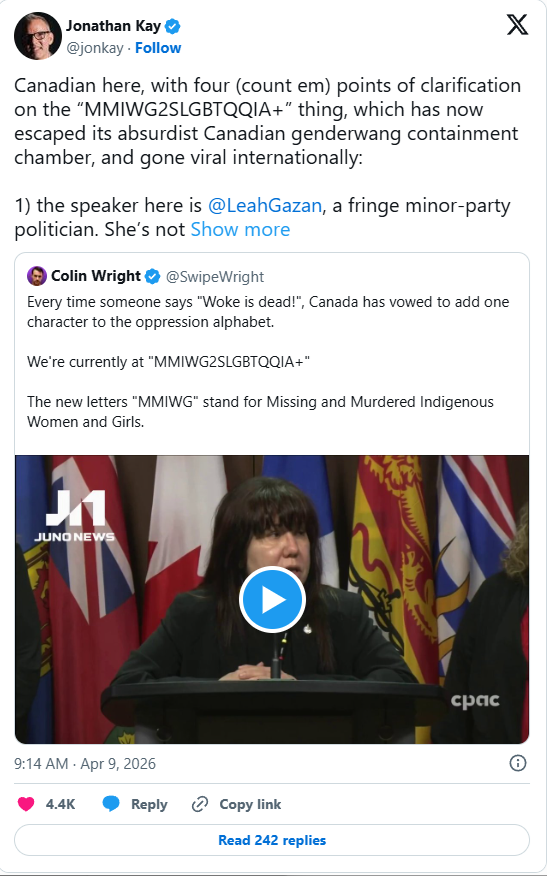
In Quillette, Jonathan Kay highlights how NDP politician Leah Gazan’s freshly coined replacement for our already over-long initialism for other-than-cis-gendered individuals has been a boon to online commentators and comedians across the internet:

While the National Inquiry into Missing and Murdered Indigenous Women and Girls was announced in 2015, its final report wasn’t published until mid-2019. The three-and-a-half year period in between overlapped with Justin Trudeau’s manic campaign to replace the idea of biological “women” in public discourse with faddish gender-inclusive terms that describe female-identified men. The initialism he eventually came up with is “2SLGBTQI+” (whose “2S” component signifies a special — albeit ill-defined — “two-spirited” LGBT category that Indigenous people can opt into).

And so, channelling the state-of-the-art in Canadian gender jargon, the Inquiry’s commissioners duly expanded references to Indigenous “women” by addition of the words “… and 2SLGBTQQIA people” — i.e. Two-Spirit, Lesbian, Gay, Bisexual, Transgender, Queer/Questioning, Intersex, and Asexual.

The term “2SLGBTQQIA” appears in the final report 1,197 times. Agglomerating that with the original “MMIWG” mandate yields “MMIWG2SLGBTQQIA”.

Detail from page 229 of The Final Report Of The National Inquiry Into Missing And Murdered Indigenous Women And Girls.

If this unbreakable wi-fi code sounds familiar, it’s because a Canadian MP named Leah Gazan just became an international laughingstock for using it at a televised 8 April news conference. (Indeed, she lengthened it even further by adding a plus sign to the end — suggesting that yet more letters, numbers, and/or symbols are on their way.) This unintentional comedy routine was made all the more meme-worthy by the casual, deadpan, en passant way the sixteen-character term rolled off Gazan’s tongue, as if it were a set of ASCII characters that ordinary Canadians ran together all the time in normal day-to-day discussions.

As some Canadians (including me) tried to explain on social media, “MMIWG2SLGBTQQIA+” is not a commonly used term outside of activist circles. I also let people know that Gazan is not a Canadian government representative (as was being claimed), but rather a member of a small and increasingly radicalised hard-left federal party known as the New Democrats.

But by then, no one was in the mood for such nuances. Elon Musk‘s three-word tweet on the subject — “Canada is cooked” — has, as of this writing, garnered more than half a million likes and 77 million views. Thanks to Gazan, millions of people around the world now believe that ordinary Canadians talk in this ridiculous fashion. We don’t.

Gazan told CBC News that the whole episode only goes to show that “bigots are offended by my positions around equality”. A more useful lesson she might take away from this experience is that the use of cultish ideological jargon can turn discussion of even the most serious issue into a farce. This is especially true when terms such as “MMIWG2SLGBTQQIA+” (or “menstruators”, or “uterus-havers”, or “people with a vagina”) are used to soothe the sensitivities of men who demand the right to be called women.

March 31, 2026

Reaction to Avi Lewis being elected federal NDP leader

Filed under: Cancon, Economics, Media, Politics — Tags: , , , , — Nicholas @ 03:00

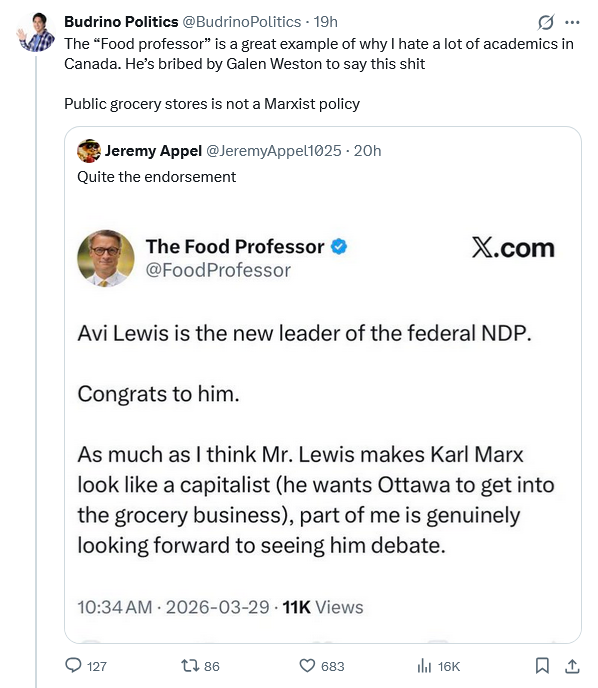
On the social media site formerly known as Twitter, L. Wayne Mathison responds to an ill-informed snipe at @TheFoodProfessor for a post about Avi Lewis:

This take reads like someone who’s never had to meet a payroll or balance a ledger under real pressure.

Accusing the “Food Professor” of being bribed is just noise. No evidence, no numbers, just a conspiracy to avoid the actual argument. Classic move when the facts aren’t cooperating.

I ran a grocery business. Not a theory. Not a model. A real one. Thin margins, constant spoilage risk, price swings, labour costs, supplier pressure, and customers who notice every 10-cent increase. Grocery isn’t some gold mine. It’s a logistics grind with razor-thin profit.

Here’s the part people like this never mention:
Canada’s total grocery profits are roughly $6 billion. Spread that across 40 million people and you’re looking at maybe $12 a month per person if you wiped out every dollar of profit.

So what’s the fantasy here?

Government steps in, runs stores “for the people”, eliminates profit… and somehow prices magically drop while efficiency improves?

Let’s test behaviour, not intentions.

What happens when you remove profit?

No incentive to optimize operations
No accountability for waste
Political hiring instead of performance hiring
Pricing driven by optics, not supply reality
Losses covered by taxpayers … meaning you, again

You don’t eliminate costs. You just hide them and move them.

I lived through high interest rates north of 20%, carried customer debt, and still had to make the numbers work. Government doesn’t operate under that discipline. It can fail indefinitely and call it policy.

Public grocery isn’t “not Marxist”. It’s not even that sophisticated. It’s just naive.

The real issue isn’t ideology. It’s a complete lack of understanding of how incentives drive outcomes.

You don’t fix affordability by replacing people who have to be efficient with a system that doesn’t.

You fix it by increasing competition, reducing regulatory drag, and letting supply actually respond.

Everything else is theatre.

In the National Post, Kelly McParland outlines the scale of challenge Lewis is facing to make the NDP electorally viable again:

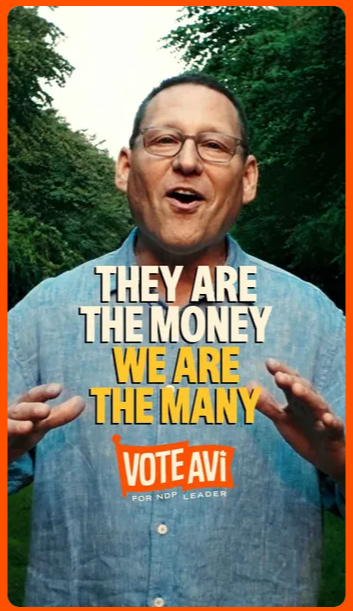
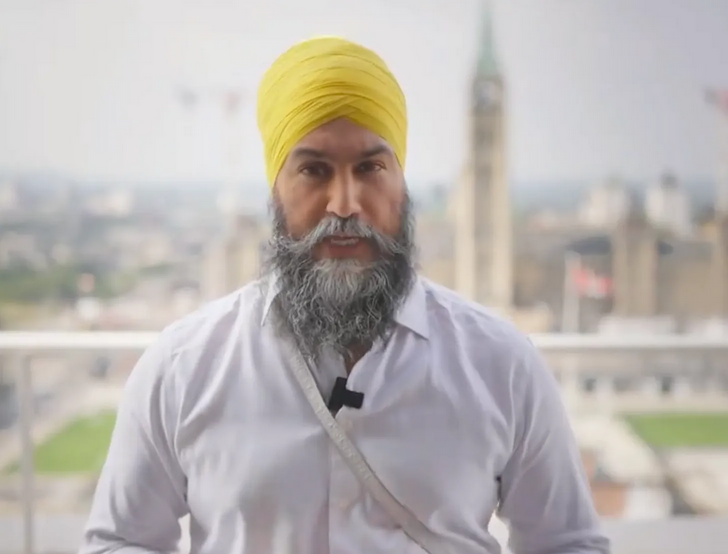
Thumbnail of one of Avi Lewis’s campaign shorts

After two weeks on the road [Jagmeet Singh] finally conceded to reality, allowing that while “I would be honoured to serve as prime minister … I don’t want to presuppose the outcome of the election”.

Maybe Lewis should start straight off with that line, since choosing him as leader saves the party from pretending it expects to find itself in power. “The return of the NDP starts today!” Lewis declared in his victory speech, but as the most out-there ideologue of the candidates he defeated he’ll have a harder time convincing ordinary Canadians than he did winning over his fourth-place party. A film-maker and activist, he’s not just left-wing, but way off in a universe of his own.

His ambitions are dazzling: a Canada powered entirely by renewable energy in which everyone gets a guaranteed income, vast infrastructure projects are built to sustain the environment, farmers produce healthier, affordable, cleaner food while homebuilders concentrate on energy-efficient homes for lower income groups. All this paid for by an economy that somehow remains vibrant while its vital energy industry is crippled, jobs are lost, taxes are raised, royalties are increased, government spending balloons, the carbon tax is re-introduced and “the rich” are somehow found to have plenty of excess revenue to cover the costs.

Voters who continue to back the NDP will now know exactly what they’re casting their ballots for. That wasn’t always clear under previous leaders. Thomas Mulcair didn’t hate trade deals or pipelines enough to satisfy party stalwarts deeply hostile to both. To the unyielding, Singh did a deal with the devil when he agreed to prop up Justin Trudeau’s Liberals, even if the decision succeeded in squeezing out some policy victories.

Small victories aren’t in Lewis’s lexicon. He wants a revolution. “This is more than a rigged economy, it is a war on working people”, he declared on Sunday. “It is immoral, it is unCanadian and we cannot let it stand.”

March 28, 2026

“Avi Lewis isn’t just left-wing … He’s the Leap Manifesto come to life”

Filed under: Cancon, Media, Politics — Tags: , , , , — Nicholas @ 03:00

The federal New Democratic Party is having a leadership contest with the voting to be tallied this weekend. Avi Lewis is apparently the overwhelmingly odds-on candidate to take it on the first ballot, and as Fred DeLorey explains, it’s likely to be very bad news indeed … for the NDP’s provincial counterparts:

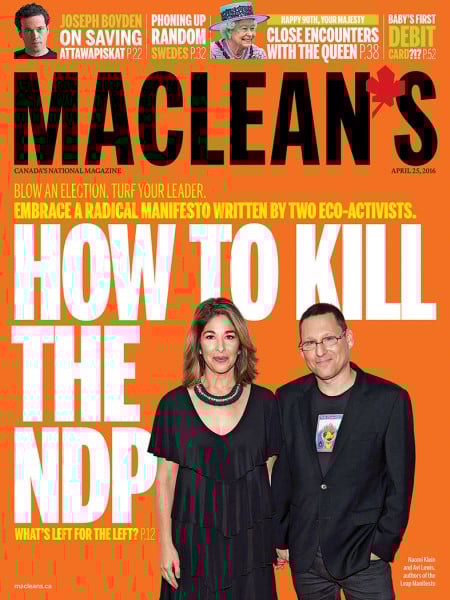
Maclean’s called it a decade ago. (Cover image: Maclean’s, April 25, 2016)

Pundits love to overcomplicate politics, but the math for this Sunday’s NDP leadership vote is painfully simple. For Avi Lewis to be denied a first-ballot victory, the other four candidates on the ballot need to somehow scrape together 50% plus one of the vote.

Let’s be brutally honest: that ain’t happening.

[…]

So, what does this imminent coronation mean for the NDP?

My gut tells me it’s an unmitigated disaster. Avi Lewis isn’t just left-wing; he’s arguably the most radical, far-left extremist to ever take the helm of a major Canadian political party. We’re talking about a guy who literally wants to nationalize our grocery stores, completely defund the Canadian military, and aggressively shut down our entire energy sector by next Tuesday. He’s the Leap Manifesto [Wiki] come to life.

And here is why this is a catastrophic problem for the broader NDP movement. Unlike the federal Liberals or Conservatives, the NDP is one highly integrated entity. There is no structural separation between their federal and provincial wings. Right now, the federal party is a broke, 6-seat laughingstock without official party status in the House of Commons. But provincially? The NDP is a powerhouse, currently sitting as the government or the Official Opposition in 6 of Canada’s 7 largest provinces.

Those provincial machines weren’t built on Leap Manifesto radicalism. Leaders like John Horgan, Wab Kinew, and Rachel Notley found massive success by dragging their parties to the pragmatic, business-friendly middle. Back in my home province of Nova Scotia, Darrell Dexter famously secured his historic majority by literally branding himself a “conservative progressive”.

Avi Lewis wouldn’t be caught dead anywhere near that kind of pragmatism. As federal leader, his extreme views will instantly infect the brand of the entire integrated party. Every time he attacks the resource sector or champions a fringe socialist policy in Ottawa, Conservative and Liberal premiers are going to gleefully hang those quotes around the necks of every provincial NDP leader in the country. He isn’t just going to sink the federal party; he is going to drag the successful provincial wings down with him.

But then again, the world is changing rapidly, and usually in crazy ways. Maybe Canadians can be convinced that they desperately want Canada Post managing their produce aisles. Maybe the electorate is finally ready for a platform where your weekly ration of locally sourced lentils is delivered by a government-appointed bicycle courier.

I remain deeply unconvinced. But these days? Who knows.

March 25, 2026

UNDRIP’s malign power in Canada

Filed under: Cancon, Government, Law — Tags: , , , , , — Nicholas @ 03:00

The United Nations Declaration on the Rights of Indigenous Peoples (UNDRIP) has been adopted into law by the provincial government in British Columbia and the federal government. In BC, voters were assured that this was a purely symbolic act to advance reconciliation with First Nations groups in the province. But that was deliberate misdirection and lies:

During the debate on DRIPA [BC’s Declaration on the Rights of Indigenous Peoples Act] in the legislature in late 2019, government ministers of the day waxed lyrical that DRIPA and UNDRIP created no new rights, had no legal force, did not apply to private land, and did not provide a veto. Those assurances were used to justify passing DRIPA, which resulted in the B.C. Opposition unanimously supporting the legislation. It turns out that the government’s assessment and promises were neither correct in substance nor valid legally.

Much has been written lately about DRIPA, some of it wrong. Prior to the B.C. Court of Appeal decision in Gitxaala, some DRIPA defenders insisted it was merely a “process” piece of legislation that bound the government to an arguably undemocratic joint government and Indigenous leadership arrangement, set out in section 3, to evaluate every B.C. statute for conformity with the 46 Articles of UNDRIP and then amend statutes as deemed necessary to create that conformity.

DRIPA itself, though arguably highly undemocratic and perhaps unconstitutional, is not the real problem in this province. The real problem is that DRIPA has been effectively employed as a “smokescreen” by the B.C. NDP and certain of its allies, while the government, secretly and with no explicit public mandate, imposes the Articles of UNDRIP throughout B.C. as a fundamental matter of policy, as though they have the force of law.

Let’s be clear, this is a devious political manoeuvre, much of which is not underpinned in law by DRIPA or, more importantly, by Supreme Court of Canada jurisprudence at all.

Notwithstanding statements made to the legislature in 2019 to get DRIPA passed, the NDP government immediately chose to implement a policy approach to UNDRIP throughout B.C. under which UNDRIP Articles would be applied by the government and the public service as though they were, in fact, the law in this province, notwithstanding the fact that they are inconsistent in many respects with Canadian constitutional law.

In the wake of recent court decisions, there is no indication that the government’s policy approach has changed or that the Premier is thinking about backing away from it, even though there is now much greater public scrutiny of what the government has really been up to since 2019.

The Eby government claims to be upset that UNDRIP is now being applied by the courts as the law in B.C., which it knows will create utter chaos. What has upset it more, however, is that the courts have usurped the NDP government’s desire to quietly and secretly implement UNDRIP everywhere in the province as a matter of policy, a policy that they would like to be viewed as law but without being legally enforceable by judges.

This amounts to a policy of subterfuge by a government that has shown an inclination towards deception on matters concerning First Nations. It appears that a law is not a law unless the B.C. government says it is a law, but some laws, like DRIPA, can be used as a false “front” to allow the covert implementation of a complex UN-based policy that is clearly unfit for the Canadian context, with no one being the wiser.

In the National Post, Warren Mirko explains the murky theory that allows “indigenous ways of knowing” to be taken more seriously than science, history, and legal procedure:

Canada is rapidly abandoning a principle that has shaped western democracies since the Enlightenment: the idea that no person or group has privileged access to sacred or divine knowledge unavailable to everyone else.

Now, this principle is being threatened by Canada’s increasing embrace of “Indigenous Knowledge” — whereby knowledge is treated as collectively owned and restricted by ancestry rather than something open to examination and shared across society.

The governments of British Columbia and Canada — both of which have formally adopted the United Nations Declaration on the Rights of Indigenous Peoples (UNDRIP) — endorse “Indigenous Knowledge” as inherited, rooted in ancestral relationships to the land, and encompassing spiritual, cultural and metaphysical dimensions passed down through generations.

Remarkably, the defining quality to possess this knowledge is not study, training, time spent on the land, or lived experience by any individual alive today. Instead, it’s lineage itself.

That’s a paradigm shift. When knowledge is said to be possessed by birth rather than learned, its universality is replaced with mysticism and its value diminished.

This comes with real-world consequences: ancestry-based considerations are reshaping how public land and resources are managed on Canadians’ behalf.

In British Columbia, newly proposed changes to hunting and wildlife regulations are described as being informed by “the best available science and Indigenous Knowledge“. In practice, this means “Indigenous Knowledge” is being used to design a regulatory regime that falls almost entirely on non-Indigenous users. That’s because Indigenous harvesting rights are recognized under Section 35 of the Constitution, not bound by the same hunting seasons, bag limits, gear restrictions, or limited-entry systems that apply to the broader public.

The growing influence of this genetically transmitted, ancestry-qualified knowledge extends to matters of public safety and economic security, like nuclear regulation: “Indigenous ways of knowing and the Indigenous cultural context enhance the Canadian Nuclear Safety Commission’s understanding of the potential impacts of nuclear projects and strengthen the rigour of project reviews and regulatory oversight”, says the government of Canada website.

Governments championing the principles of UNDRIP insist that “Indigenous Knowledge” can be combined with “Western” science to produce better public policy. But this is a contradiction. Knowledge cannot at once be exclusive and universal.

December 30, 2025

“This is where Canada is now”

Filed under: Cancon, Economics, Government, Media, Politics — Tags: , , , , — Nicholas @ 03:00

On the social media site formerly known as Twitter, L. Wayne Mathison handily sums up the state of the nation:

I’ve reached the point most people hit right before systems fail.

The point where facts stop working.

Charts don’t matter. Reports don’t matter. Evidence doesn’t matter. You can post receipts until your fingers cramp and political partisans will still clap, chant, and rationalize while the house fills with smoke. They are not misinformed. They are committed. And commitment beats reality every time.

That’s where Canada is now.

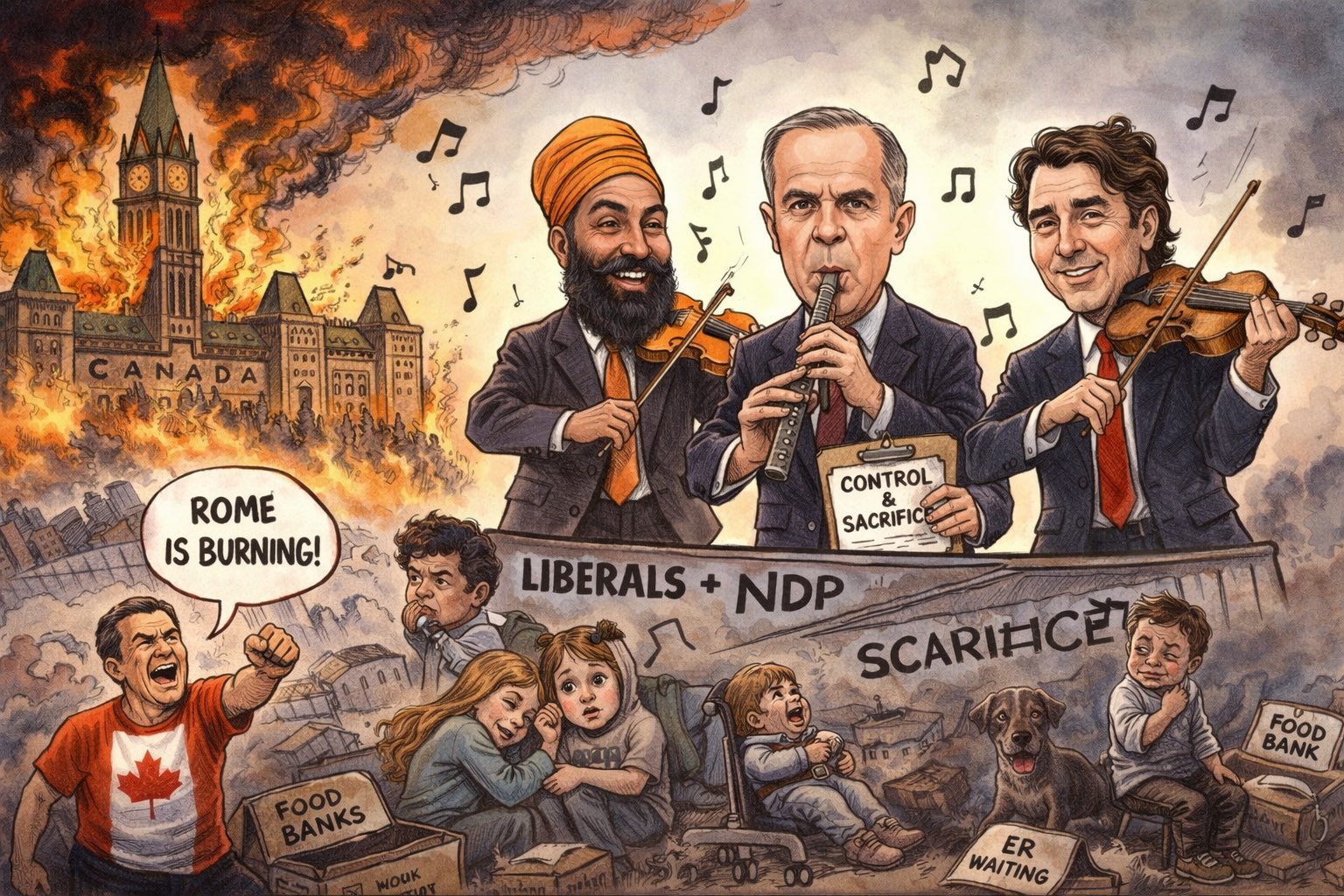
The Liberals and the NDP no longer govern with outcomes in mind. They govern with narratives. If the story sounds compassionate, the damage underneath is waved away as acceptable collateral. Housing explodes. Healthcare buckles. Food banks flood. Productivity sinks. And if you point to any of it, you’re told to be kinder, quieter, or more patient.

Patience is a luxury people without power can’t afford.

What scares me isn’t just the policies. It’s the psychology. We are watching a ruling class that confuses control with competence and optics with success. Every failure is met with more management, more spending, more moral language, and less accountability. When reality resists, they don’t change course. They tighten.

That’s where Mark Carney enters the picture, and why he should worry anyone paying attention.

Carney doesn’t speak like a democratic leader. He speaks like a risk officer explaining why losses are necessary. “Sacrifice.” “Stability.” “Confidence.” These are not solutions. They are words used when the model is failing but the managers refuse to admit it. In his world, the problem is never the plan. It’s public resistance to the plan.

That mindset is poison in a democracy.

The Liberals broke affordability and papered it over with subsidies. The NDP cheered and demanded more of the same. Now Carney offers to professionalize the decline. Smoother language. Tighter controls. Bigger levers. Less dissent. He doesn’t promise prosperity. He promises management.

Here’s the part people don’t want to hear.

You can’t fix a country by overruling its citizens.
You can’t tax, regulate, borrow, and moralize your way out of shortages.
You can’t feed kids, house families, or staff hospitals with press releases.

And when governments start treating criticism as a threat rather than a warning, history tells us what comes next. Not reform. Hardening. Surveillance language. Emergency logic. Ever broader definitions of “harm”. Ever fewer off ramps.

This is how civilizations don’t collapse in a bang. They collapse in meetings.

I don’t expect to convince partisans anymore. That window is gone. This is a warning, not an argument.

If you are still cheering while food banks replace paycheques, while hospitals ration care, while housing becomes a privilege, while leaders talk about sacrifice without ever naming their own, understand this: they are not fiddling while Rome burns. They are insisting the fire is necessary.

And once that belief sets in, facts won’t save us. Only consequences will.

By then, our children are already in the smoke.

December 12, 2025

British Columbia’s embrace of UNDRIP entails vast unintended consequences

Filed under: Cancon, Government, History, Law, Media, Politics — Tags: , , , , , — Nicholas @ 05:00

The government of British Columbia may have downplayed or even deliberately lied about the impact of incorporating the United Nations Declaration on the Rights of Indigenous People (UNDRIP) into BC’s legal system, but I suspect even they are suddenly realizing just what a legal disaster they have unleashed on their province (and indirectly, on the rest of Canada):

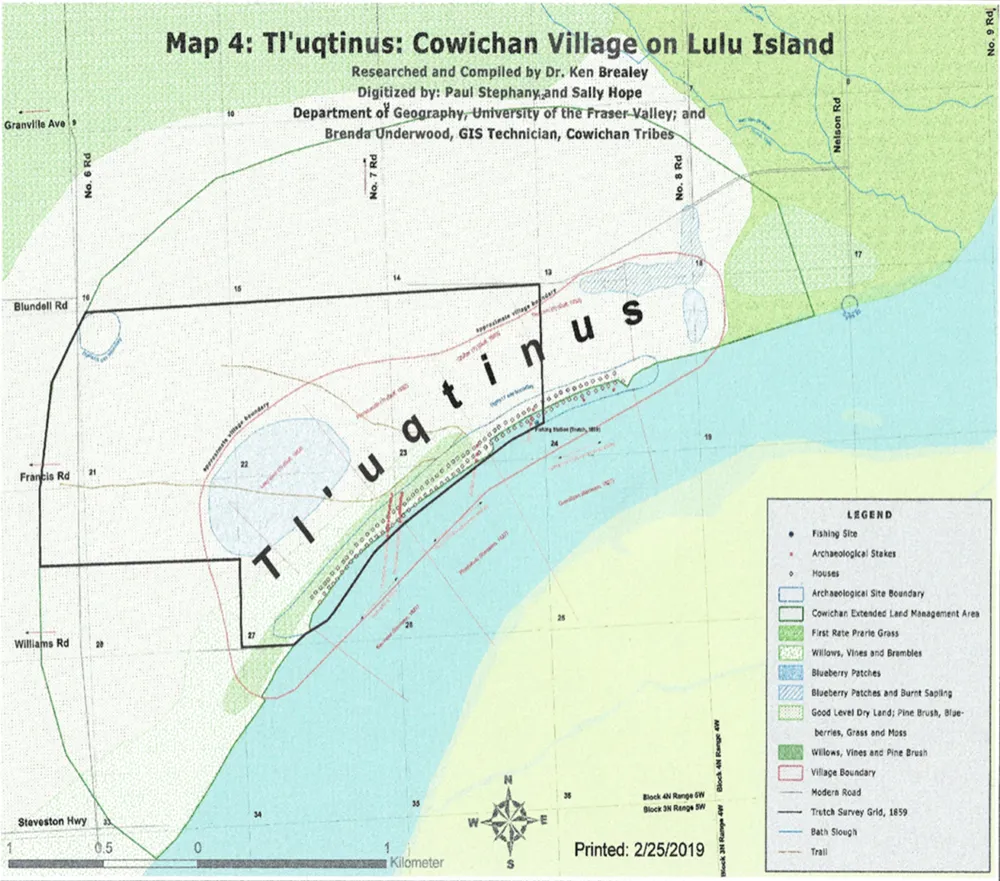
A map showing the Cowichan title lands outlined in black. These lands were declared subject to Aboriginal title by the BC Supreme Court earlier this year, in accordance with the UNDRIP provisions added to BC law in 2019.

When the B.C. NDP introduced a 2019 act committing the province to the United Nations Declaration on the Rights of Indigenous People (UNDRIP), they very specifically assured critics that it would not be a “veto” over existing laws.

“The UN declaration does not contain the word veto, nor does the legislation contemplate or create a veto”, Scott Fraser, the province’s then Indigenous relations minister, told the B.C. Legislative Assembly.

Fraser explained that it was not “bestowing any new laws”, it would not “create any new rights” and it certainly wouldn’t make B.C. subservient to a UN declaration.

Fraser would even explicitly assure British Columbians that there was no conceivable future in which, say, a private landowner could suddenly see their property declared Aboriginal land.

“We are not creating a bill here that is designed to have our laws struck down,” he said.

That it only took six years for all of these scenarios to take place may explain why there is so much panic in B.C. right now.

The newly appointed head of the B.C. Conservative Party is calling for an emergency Christmas session of the legislature to excise UNDRIP from provincial law, saying it has become an anti-democratic tool.

Even B.C. Premier David Eby — a onetime champion of the legislation — has said that “clearly, amendments are needed”.

And British Columbians, whose support for the UN law was already not great, are growing restless. According to an Angus Reid Institute poll released on Wednesday, Eby ranks as one of the least popular provincial leaders in the country.

What changed was a Dec. 5 B.C. Appeals Court ruling that not only struck down a B.C. law (the Mineral Tenure Act) on the grounds that it violated UNDRIP, but effectively ruled that any law or government action could similarly be overturned if it wasn’t in line with the 32-page UN declaration.

By writing UNDRIP into B.C. law, the province had adopted the Declaration as “the interpretive lens through which B.C. laws must be viewed and the minimum standards against which they should be measured”, read the majority decision.

Although UNDRIP is mostly filled with uncontroversial declarations about languages and traditional medicine, its clauses are pretty uncompromising when it comes to issues of land use or resource development.

“Indigenous peoples have the right to the lands, territories and resources which they have traditionally owned, occupied or otherwise used or acquired”, reads a subsection of Article 26. It also states that Indigenous peoples “own, use, develop and control” any land that they’ve held traditionally.

Eby is saying that the courts took it too far, and that writing UNDRIP into B.C. law was only ever meant as a holistic decision-making guide, rather than a law superceding all others.

As Eby told reporters this week, by signing onto UNDRIP, B.C. wasn’t intending to put courts “in the driver’s seat”.

November 3, 2025

The BC government “has been doing everything in its power to have Aboriginal title triumph across B.C.”

Filed under: Cancon, Government, Law, Liberty, Media, Politics — Tags: , , — Nicholas @ 03:00

A Fraser Institute commentary by Bruce Pardy addresses the role of the NDP government of British Columbia in undermining the established laws on land title in the province among other actions to the advantage of First Nations bands and to the definite disadvantage of ordinary British Columbians:

Recently, British Columbia Attorney General Niki Sharma said that fee simple title in private property is superior to Aboriginal title. She’s a day late and a dollar short. In fact, her NDP government, led by Premier David Eby, has been doing everything in its power to have Aboriginal title triumph across B.C.

A B.C. Supreme Court judge has granted several First Nations a portion of a 1,846-acre land claim on Lulu Island. B.C. Supreme Court

A few days earlier, the City of Richmond sent out a letter to more than 125 property owners warning them that the security of their land is in doubt. “For those whose property is in the area outlined in black,” the letter reads, “the Court has declared aboriginal title to your property which may compromise the status and validity of your ownership … The entire area outlined in green has been claimed on appeal by the Cowichan First Nations.”

The Richmond letter is a consequence of a recent decision of the B.C. Supreme Court, which awarded Aboriginal title over 800 acres of land in Richmond to the Cowichan First Nation. Wherever Aboriginal title is found to exist, said the court, it is a “prior and senior right” to other property interests, whether the land is public or private.

It is finally dawning on British Columbians that obsequious devotion to reconciliation is putting their land at risk. Sharma claimed that B.C. was pursuing multiple grounds of appeal, but that makes her a hypocrite. Her government did not robustly defend in court against the Cowichan claim. And in a dozen other ways, the Eby government has sought to put title and control of B.C. into Aboriginal hands.

In early 2024, it proposed to amend the province’s Land Act, which governs the use of Crown land in B.C. It planned to give B.C.’s hundreds of First Nations a veto over mining, hydro projects, farming, forestry, docks and communication towers. The government tried to consult quietly, but the backlash was immediate. It withdrew the proposals, promising to be more transparent. But it did not shelve its objectives or its plans. And did not deliver on its promise. Instead, it sought to make agreements over specific territories with specific Aboriginal groups, often negotiated covertly and announced after the fact.

In April 2024, the Eby government recognized Aboriginal title to Haida Gwaii, the archipelago on Canada’s West Coast. Around 5,000 people live on Haida Gwaii. About half are Haida, who voted overwhelmingly in favour of the deal. But non-Haida residents had no say. The Haida agreement says private property will be honoured, but private property is incompatible with Aboriginal title, which is communal. If Haida Gwaii really is subject to Aboriginal title, then no one can own parts of it privately.

Update: I forgot to include the URL to Mr. Pardy’s article … fixed now.

April 30, 2025

After the votes were counted

Filed under: Cancon, Government, Media, Politics — Tags: , , , , , — Nicholas @ 05:00

John Carter suggests that votes should be allocated to reflect the costs imposed on the voters by taxation, that is to ensure that those with the most “skin in the game” at least have their votes weighted more than those who pay little or no taxes but can still vote themselves more benefits:

Have you ever noticed how election results are regularly broken down geographically, as well by the demographic categories of age, sex, and – depending on the country – race, yet we almost never see the results separated into taxpayer vs taxeater status?

So anyhow.

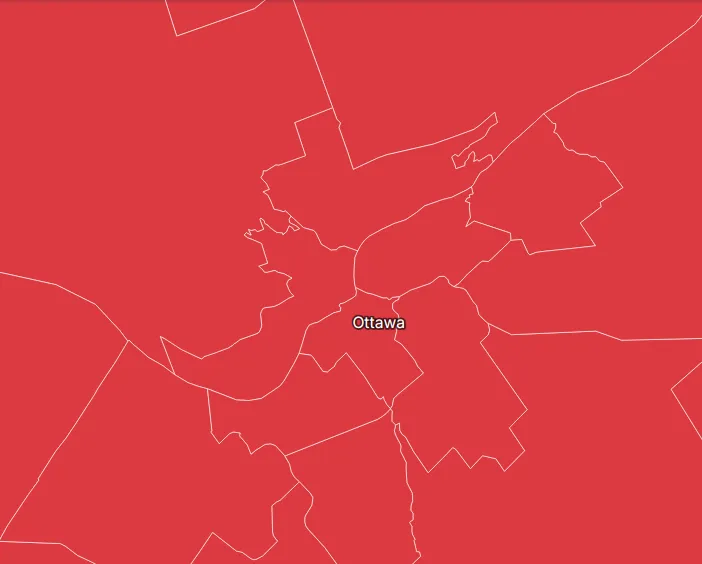
For my American readers, in Canadian elections the Liberal Party is denoted by red, as the Devil and Karl Marx intended.

It is absolutely no surprise that Ottawa voted solidly for the Liberal Party of Canada, whose base consists of three primary groups: migrants, public sector workers, and baby boomers, all of whom are regime client groups, and all of whom are tightly packed into the nation’s capital.

Perhaps it’s that it’s tax season and I’m in a grumpy mood because I just got the bad news, but I can’t help but wonder about how electoral politics would change if only taxpayers were allowed to vote. It’s common for “taxpayers” to be used as a synonym for “the voting public”, but this is a bit of linguistic legerdemain which obscures a core dynamic rotting the heart out of every liberal democracy: most of the population are not, in fact, taxpayers. First there are those who don’t earn enough to pay taxes, such as university students; then there are those receiving direct welfare payments of one form or another; then there are public employees, who although they pay tax on paper, are clearly net recipients of government largess since their paychecks come from taxes in the first place.

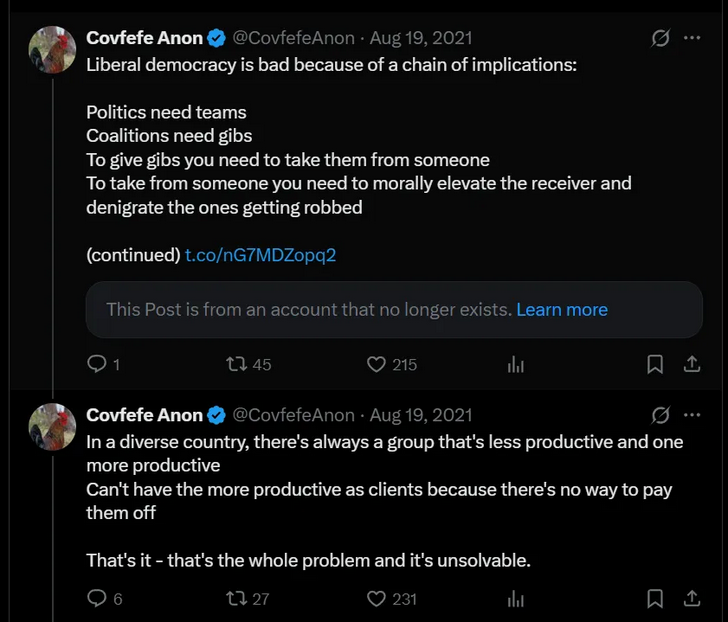
The most successful parties in country after country are the parties that mobilize client groups by promising to steal money from productive citizens and transfer that wealth to their non-productive clients. This dynamic is baked into the cake of any universal suffrage democracy, which is why Universal Suffrage is a Suicide Pact. Parties need client groups for electoral support; wealth can only be plundered from the productive; therefore the only available relationship is to cultivate non-productive clients.

The problem, of course, is that over time this destroys the economic productivity of the liberal democracy, because the productive groups will become less productive because what’s the point, or they’ll just look for the exits, while the client groups will swell, becoming simultaneously too expensive to maintain and to electorally heavy to dislodge.

I suspect you could fix all of this by simply tying votes to tax receipts, with only those who are net taxpayers being given the franchise in any given election. At a stroke this would disenfranchise the welfare underclass, government bureaucrats, and university students, all of whom should be prohibited from voting as a matter of principle. If you wanted to be really fancy, you could implement a tax-weighted vote: the more taxes you pay, the more your vote counts.

In addition to the salutary effects of reducing the electoral weight of female voters (since men tend to pay more in taxes), weighting votes by tax receipts would lead to a very interesting incentive structure. On the one hand, everyone hates paying taxes, and wants to minimize the taxes they pay; if only taxpayers were voting, this would place a strong downward pressure on taxes and, hence, on the size of government (thus forcing states to find other ways of funding themselves, via e.g. tariffs or service fees). On the other hand, people like to vote, so there would be a strong incentive not to evade taxes. On the gripping hand, since paying more tax means your vote counts for more, there would be a countervailing incentive to pay as much tax as you can afford. One might imagine a state functioning as a sort of de facto oligarchy, with the billionaires happily paying obscene levels of tax in order to gather as much political power to their class as possible, and enforcing their tyranny by voting to keep taxes on everyone else to the absolute bare minimum. This would be a truly dystopian brier patch to be thrown into.

Alas, we do not inhabit such a political experiment. Returning to the ostensible topic of yesterday’s Canadian election, however, it would probably not be an exaggeration to posit that if we did inhabit such a system, Canada’s Conservative Party would have rolled the Liberals in this and, in all likelihood, almost every other election.

That is not, however, what happened.

The high-level outcome is that, after running the country into the ground for the last decade, the Liberal Party has been elected for the fourth consecutive time, with a mandate to complete the project of crashing the plane of Dominion with no survivors. It brings me absolutely no pleasure to report that I predicted the Liberals would win before the election was even called. The Liberals are four seats short of forming a majority in parliament, meaning they cannot quite form a stable government on their own. This is not a problem for the Liberals, however. Despite the glorious collapse of the New Democratic Party – which plummeted from 25 seats in the last federal election to 7 in the current election, by far their lowest in 30 years – the NDP retains just enough seats for them to form a stable coalition government with the Liberals. In other words, the outcome of this election is that Canada will be in essentially the same situation it was in before the election, with the only meaningful difference being that the Liberals have a few more seats than they did before.

April 29, 2025

Canadian federal election result

April 26, 2025

The week-before-the-vote Bullshit Bulletin

Filed under: Cancon, Media, Politics — Tags: , , , — Nicholas @ 04:00

The Line‘s invaluable bullshit tracker includes some steaming bullshit from Mark Carney, the Conservative campaign, and, perhaps the most acrid bullshit from the NDP’s Jagmeet Singh:

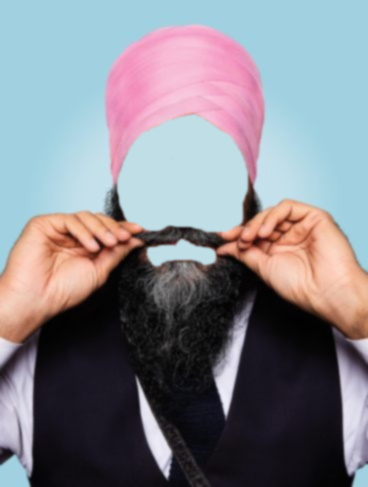
Jagmeet Singh, the empty turban. He is the current (and possibly last) leader of the federal New Democratic Party, and it’s his conscious actions that may have doomed his party to parliamentary oblivion.

This article, about a recent meeting between Singh and the Toronto Star editorial board, is just absolutely bonkers. Jagmeet. Our dude. We like you. We do. But this is some epic bullshit.

This passage, in particular:

    The NDP leader stood by his decision not to plunge the country into an early election last fall while support for Justin Trudeau’s Liberals plummeted, telling the Star‘s editorial board he “couldn’t stomach” the idea of causing Pierre Poilievre’s seizure of power, and that he made the choice to put Canada’s interests ahead of those of the New Democratic Party.

    “While we could have won lots of seats, it would have meant a Pierre Poilievre majority Conservative government, and I could not stomach that,” Singh said, making the argument that an election would have jeopardized progress on pharmacare deals and dental care expansion. “I love my party. I care deeply about it. I want us to win. I want us to up our seats. I know we’re good for people. But in that moment, I made a decision for the interest of the country ahead of my party. And that was a decision I made wide-eyed, and I stand by that decision.”

Hmmm. Okay. So. Let’s take that at face value. If only for the sake of argument.

Singh realizes what the logical endpoint of that argument is, right? … right?! The story of this election, to the extent there is a single one, is that the NDP collapse made it impossible for the Conservatives to win. We have lots of criticisms of the CPC campaign; we’ve made some already and we’ll have more to say when it’s over. But we recognize the truth that without a strong NDP, even a perfect and flawless Conservative campaign was always going to be an uphill battle. It’s just a really difficult situation for the Conservatives to overcome.

And you know what Singh could do to make that a permanent state of affairs? Give up! Tank the NDP completely. Do a national tour asking everyone to vote Liberal. Defect and become a Liberal. Spend his post-politics career, which seems set to start sometime early next week, campaigning for a two-party system, under which the Liberals defeat the Conservatives over and over.

End the vote splitting by ending the NDP. That’s a case that many Liberals have made before. And fair enough. But it’s some kind of bullshit to see Singh himself making it, and we can’t imagine his NDP colleagues are particularly pleased to see their leader taking a position that the Liberals took years ago: that the best way for left-leaning voters to stop the Conservatives is to put the country first, and vote for them.

September 7, 2024

What is Jagmeet Singh’s actual plan here?

Filed under: Cancon, Government, Media, Politics — Tags: , , , , — Nicholas @ 05:00

In The Line, Jen Gerson outlines the NDP leader’s options now that the Confidence and Supply Agreement has been “ripped up”:

Federal NDP leader Jagmeet Singh announces the end of the Confidence and Supply Agreement.
Screencap from the NDP official video via The Line,

… I’m starting to consider the possibility that Jagmeet Singh is bad at politics.

I mean, think about this.

We at The Line have long pointed out that CASA was a bad deal for the NDP. It earned the party only a few piecemeal spending concessions like two-treatment Pharmacare and a half-baked dental program. It’s the Liberals who will, and have, taken full credit for both.

Meanwhile, Singh has lost all credibility as a government critic. What blows he can level at the Liberals are fatally undermined by the fact that he’s supported them for years. If the Liberals are complacent in enabling corporate greed, then Singh is demonstrably an enabler of a government that is “too weak, too selfish and too beholden to corporate interest to fight for people”?

I realize that nobody in Liberal-land is going to take this advice seriously, but I’m going to offer it anyway. On its current trajectory, Canada is heading toward a two-party system. Either the Liberals are going to eat the NDP, or the NDP is going to eat the Liberals. Until Wednesday, I put my money on the latter. Now, I’m not so sure.

If the Liberals maintain any existential instinct at all, they’d call Singh’s bluff. Drop the writ on a party that’s demonstrably unprepared to fight the battle it’s proclaimed. Eat the left, and survive to fight on another day. The meal is right there for the taking.

Singh’s big announcement about “ripping up” CASA — meep meep — gains him absolutely nothing. What additional leverage can he expect to acquire in a post-CASA parliament that he didn’t already possess?

Perhaps Wednesday’s announcement was merely a gambit to soothe internal problems, or distance himself from the Liberals. Okay, fine. This might be a viable strategy if it buys Singh a few months to trash Trudeau and raise funds off the effort while frantically trying to wash off the stinky stain of hypocrisy.

But what’s going to happen when the Liberals face their next confidence motion, presumably as soon as the Conservatives can arrange one? What happens at the next one, and the next one after that?

What credibility can Singh possibly hope to maintain if he votes for the Liberals, again? How in the world is the NDP seriously going to claim to have ripped up CASA while effectively acting as if it is in a CASA? The NDP cannot credibly distance itself from the sitting government while spending the next year propping up said government again and again and again in successive confidence motions. Especially after such a brazen display of pulling out of the deal.

No. They’re going to have to pull the trigger, and soon. Obviously. Clearly.

Singh sees this.

Right?

September 6, 2024

“I support Jagmeet Singh’s right to terminate his half pregnancy”

Filed under: Cancon, Media, Politics — Tags: , , , , — Nicholas @ 03:00

Matt Gurney on NDP Leader Jagmeet Singh’s decision to pull the plug on the Confidence and Supply Agreement that had propped up Justin Trudeau’s government, long after it became clear that the Liberals were garnering all the benefits and the NDP were losing core supporters over the arrangement:

Let us start with words of affirmation and support: I support Jagmeet Singh’s right to terminate his half pregnancy. How could anyone not? His constant daily humiliation was getting uncomfortable to observe.

I know you might be expecting some kind of political analysis here. What will the end of the Confidence and Supply Agreement — or Supply and Confidence Agreement (we probably should’ve settled on one before the thing collapsed)—mean for Canadian politics, the upcoming elections, and the next general federal election? But the truth is, I don’t know. No one does. All we can say with any particular certainty is that our minority government situation has become more complicated. The Conservatives will keep trying to bring the government down. Don’t be surprised if they try to make everything a confidence motion, if only to further embarrass Singh. The NDP, for their part, will face some brutal decisions. Most polls show them heading for a wipeout, with half of their seats looking likely to flip to someone else. They’d need a huge spike in the polls just to break even. So, that’s going to be fun for them to navigate. Then, of course, there’s Justin Trudeau and the Liberals. Their prospects look awfully bleak, too. But it’s entirely possible they might decide to rip the Band-Aid off and call an election at some point in the reasonably near future.

Am I predicting any of these things? No. Like I said, I have no idea what’s going to happen. If I had to guess, I’d say the NDP will continue to support the government unofficially for the foreseeable future while all the parties reassess the new reality on the ground. But that guess is entirely subject to revision as events unfold. Time will tell. What more can I offer you?

So, in terms of political commentary on yesterday’s news, that’s about it. I don’t expect any immediate changes, and we’ll see where things shake out. Thanks for reading.

But there is a related point I’d like to make. And though it may sound snarky, I mean it with total sincerity. I am so, so happy for Jagmeet Singh. Since the deal was announced, he’s had to keep Trudeau in office while also acting like he was as disgusted with the PM as the typical Canadian voter seems to be. It was, truly, cringe-inducing, a real-life manifestation of the first half of the Hot Dog Car sketch (the back half gets weird).

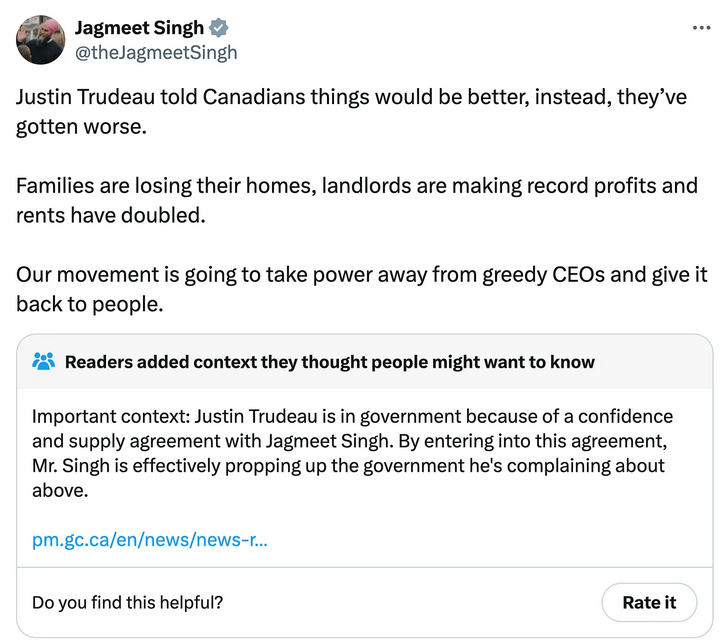
I wasn’t kidding when I said it was painful to watch. And it wasn’t just me who noticed — a few podcasts ago, Jen and I had a laugh at Singh getting hit by Twitter’s Community Notes fact-checking service. After one of his regular tweets attacking Trudeau, a note was added to it, reminding readers that Singh was officially, as per a signed agreement, responsible for keeping Trudeau in power. It was laugh out loud funny, and, alas for the NDP leader, we were very much laughing at him, not with him.

That’s finished now. His nightmare is over. He can stop looking so goddamn ridiculous every day now. The deal is dead.

And now that it is, we can finally take a long look back at it and wonder how the hell Singh ever decided that the deal, or at least how he behaved during the deal, was a good idea.

In the National Post, Chris Selley seems a bit less charitable toward Singh, for largely the same reason … the pain and humiliation was almost entirely self-inflicted:

So, the deal is off. NDP leader Jagmeet Singh apparently located a few scraps of dignity in some long-forgotten kitchen drawer or closet. Just minutes before Prime Minister Justin Trudeau was set for a press conference to give himself yet more credit for the NDP’s national school-lunch program, Singh announced he was calling off the NDP’s two-and-a-half-year-old confidence-and-supply agreement with the governing Liberals.

“Canadians are fighting a battle … for the future of the middle class,” Singh pronounced. “Justin Trudeau has proven again and again he will always cave to corporate greed.” Reports suggest it was the Liberals last month ordering the railway unions back to work and into binding arbitration with their employers that finally soured the milk in Dipperland.

“In the next federal election, Canadians will choose between Pierre Poilievre’s callous cuts or hope” Singh continued, casting himself as the Barack Obama figure in the forthcoming contest — “hope,” he specified, “that when we stand united, we win; that Canada’s middle class will once again thrive together.”

Because a Canadian political announcement must come with some impenetrable bafflegab, Singh added the following: “It’s always impossible until it isn’t. It can’t be done until someone does it.”

Up is left. Forward is up. United we dance. The future.

All the reasons for the NDP to cut the Liberals loose on Wednesday were so myriad and obvious that it’s difficult to remember what on earth the point of this agreement was supposed to be. Singh got no cabinet seats out of it, maybe just a few “thanks for your contribution” pats on the back from Trudeau and his ministers along the way. But the NDP essentially gave away any policy wins to the Liberals.

New Democrats understand better than anyone else the fundamentally amoral nature of the Liberal Party of Canada. They understand the Liberals’ all but total conflation of the party’s best interests with the country’s, and therefore its utter lack of shame. Anything the Liberal party does, anything it says, even if it’s completely the opposite of it did and said yesterday, is precisely the medicine Canada needs. And the NDP understands as well as the Conservatives do how mainstream Canadian media privileges the Liberals in that regard.

September 5, 2024

CASA doloroso, or Jagmeet finally locates a pair

Filed under: Cancon, Media, Politics — Tags: , , , , , — Nicholas @ 04:00

Ding, dong! The long-running deal between the New Democrats and Justin Trudeau’s Liberals has finally been terminated. It was Jagmeet Singh’s support that kept Trudeau in power and had been intended to run until next summer, but Singh announced he was no longer going to provide confidence and supply votes in Parliament. The editors at The Line warn us that this doesn’t automatically mean we can start heating up the tar and ripping open the feather pillows quite yet:

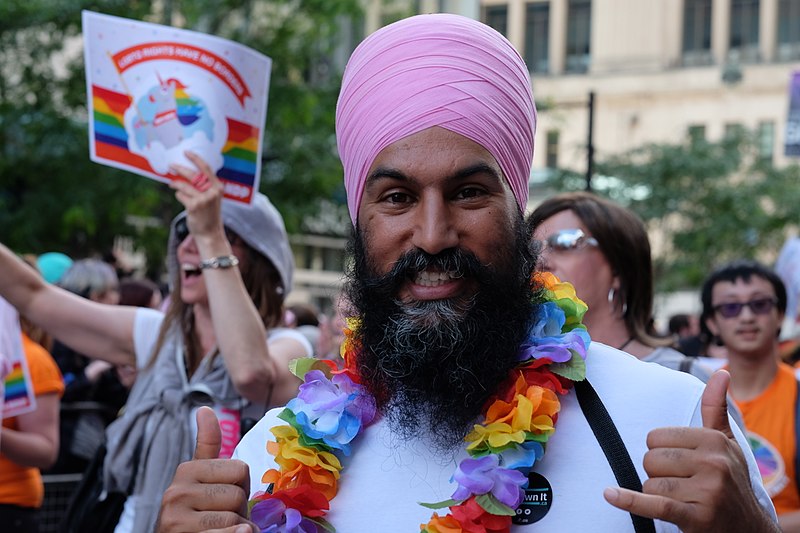
Federal NDP leader Jagmeet Singh in happier days at a 2017 Pride parade.
Photo via Wikimedia.

On Wednesday, Jagmeet Singh finally took longstanding criticism to heart, and announced he would be tearing up the Confidence and Supply Agreement, the deal that allows the Liberals to hold the confidence of the house.

That said, don’t expect an election just yet.

CASA has been an unmitigated disaster for the little sister of the non-alliance alliance between the two parties. As we’ve previously noted here at The Line, Singh proved to be a weak negotiator, agreeing to support Justin Trudeau with nary a cabinet seat nor a concrete spending promise. To date, the only real concessions the NDP have landed amount to, essentially, half-baked Pharmacare and dental programs that are little more than targeted subsidies to the poor. The merits of these programs in and of themselves is a debate for another day; however, what benefits they do bring have not benefited the NDP one whit.

That’s because the Liberals will — and have — taken full credit for these programs, while Singh has been left in the unenviable position of having to criticize a sitting government that he continues to buttress through the CASA. In other words, for virtually no spending concessions, the NDP has fatally undermined its position as a credible critic of the government.

Meanwhile, the Conservative Party — still strong in the polls — can lean on the NDP’s hypocrisy in order to gather up traditional blue collar and even union workers into the bosom of its culturally cozy embrace.

Obviously, this position is untenable. However, we at The Line admit to being surprised that Singh is actually ripping it up ahead of the deal’s natural expiry in June of 2025. Rather, we expected the Liberals to rag the puck on this government for as long as constitutionally possible — and, to be honest, we thought the NDP would stay in step because the party is, at its heart, weak.

Lo! We were surprised.

By ending CASA, the party has time to restore some of its spent credibility, bashing Trudeau hard to drum up fundraising ahead of the next election. Without the NDP’s support, the Liberals can carry on only until they are required to pass a confidence motion — likely the Spring budget. This gives the NDP a few months to generate support. Of course Singh won’t win that election, but he can now leave his party in a stronger position to live to fight another day.

That is … unless Trudeau decides to respond to the collapse of CASA by simply dropping the writ now, catching his opponents on the left off guard and unprepared to run a full election campaign.

September 4, 2024

There’s always been “BC weird”, but today’s BC politics is weirder than ever

Filed under: Cancon, Media, Politics — Tags: , , , , — Nicholas @ 05:00

Although I can technically say I’ve been to British Columbia, a couple of hours driving around just west of the BC/Alberta border in 1988 doesn’t give me any real understanding of Lotusland’s, uh, unique political landscape. Fortunately, here’s Rob Shaw in The Line to give a somewhat better-informed view of BC politics today:

British Columbia politics has always been weird.

This is a province in which an obese Taiwanese billionaire once bought a premier’s personal amusement park using envelopes stuffed with cash in his underwear; where the clerk of the legislature was convicted of fraud; where the Speaker claimed the legislature’s ceremonial mace was bugged by spies; and an MLA stole from a children’s charity for the disabled.

In short, the province has a bit of a reputation. So it might be tempting to view the most recent headlines about the implosion of the former dominant B.C. Liberal party — and the meteoric rise of the B.C. Conservatives — as keeping with British Columbia’s unique brand of zaniness.

Except, it isn’t.

B.C.’s political realignment mirrors one that’s already occurred in several other provinces and is playing out federally, as well, as a tired, middle-road centrist party is squeezed out by a harder-right, hungrier, more-energetic conservative movement.

At the leading edge of it all is an unlikely figure — a 61-year-old former Liberal cabinet minister with a low profile, who was booted from the B.C. Liberal caucus in 2022 by leader Kevin Falcon for sharing a social media post questioning the role of CO2 in climate change. Rather than retire quietly, John Rustad took the ejection, pivoted and joined the moribund B.C. Conservative party, which had clocked only 1.9 per cent of the popular vote in 2020. He gave the party a seat in the legislature, and a profile to grow. Since then, it has skyrocketed.

“Of course nobody thought you could do this in a year, take a political party from two to three per cent to challenge to form government,” Rustad told me. “Lots of people ask me about it and I put it down simply to people are really desperate and looking for change.” Last week — two years and 10 days after he was fired — Rustad stood in a Vancouver hotel ballroom to accept Falcon’s political surrender. The leader of the B.C. Liberal dynasty, a party that ruled the province from 2001 to 2017 under premiers Gordon Campbell and Christy Clark, announced that he was disbanding B.C. United ahead of the next election. Supporters were encouraged to flock to the Conservatives.

“This is the right thing to do for the province,” Falcon said at the Aug. 28 press conference. “I said to John: I may only agree with about 75 per cent of what you might believe in, but I do know this, that on his very worst day John Rustad would be a far better premier than (B.C. NDP premier) David Eby on his very best day. And I’ve never lost sight of that bigger picture.” The Conservatives have been within striking distance of the governing NDP for months, according to polling done by almost every firm in the country.

March 21, 2024

“That is a catastrophic miscalculation for the NDP, and it’s the single best thing that happened to Poilievre”

In The Line, Matt Gurney reflects on what he got wrong about Pierre Poilievre and why he misread the situation leading up to Poilievre becoming Conservative leader:

Pierre and Ana Poilievre at a Conservative leadership rally, 21 April, 2022.
Photo by Wikipageedittor099 via Wikimedia Commons.

“Think of Trudeau in late 2019,” he told me from the bar. “India trip. SNC-Lavalin. ‘Thank you for your donation.’ Black and brown face. Canadians were souring on him. They were starting to think he was a fake, and maybe a bit of an asshole. His disapproval ratings were soaring. Then COVID hits, and he’s doing his smiling, reassuring press conferences every day outside his house. His disapprovals tank. Canadians are reminded of 2015 Trudeau. But then pandemic ends, and we’ve got some Trudeau missteps. ‘Unacceptable people’, COVID-era wedges. He’s going back to his 2019 position: people don’t like him.”

“And then,” he told me, “just as Canadians are starting to think the PM is an asshole again, the NDP decides to sign an agreement with him. [NDP leader] Jagmeet [Singh] could not have screwed up more. This is a historical, books-to-be-written-about-it screw up. Because just as Canadians are remembering that they don’t like the PM, Singh is giving those voters no reason to go to the NDP.”

Normally when the Liberal vote collapses, he continued, those voters disperse across all the parties. But CASA, my source told me, was like a funnel, forcing all the voters the Liberals were losing to go to the Conservatives instead of going everywhere. “If you’re angry at Trudeau, if you don’t like him, if you’re sick of him, you can only go Conservative this time. Singh did that. That is a catastrophic miscalculation for the NDP, and it’s the single best thing that happened to Poilievre. None of us saw that coming.”

He had other thoughts, as did others I spoke to. The People’s Party having been neutered as a threat was something I heard repeatedly, which matters, but not in the way that you think. “The PPC wasn’t a huge draw on our voters,” a senior Tory told me. “People still think the PPC was just our most-right-wing fringe. Wrong. It was drawing voters from everywhere, including typical non-voters. So the problem wasn’t that we were losing votes. The problem was that the fear of the PPC gave too many of our western MPs licence to get away with anything or oppose anything. ‘If we do/don’t do this, Maxime Bernier is going to kill us!’ Guess what? Portage-Lisgar was Bernier’s best possible shot and we annihilated him. No one is afraid of the PPC anymore. No one can use the PPC as leverage against the leader.”

I asked about that — Poilievre’s hold over his own party. In my 2021 column, I had noted that O’Toole never really had full control. Every Conservative I spoke to agreed: Poilievre has the most control over his caucus of any CPC leader they can remember. Better than O’Toole, better than Andrew Scheer, and as good, at least, as Stephen Harper. Not all the MPs were thrilled when O’Toole was replaced, but the smell of impending victory has a way of winning over new friends.

I talked with the source at the bar for a long time, and we covered a lot of ground. A lot has gone right for Poilievre, he said. Some of it is luck, some of it is timing, but some of it is entirely to Poilievre’s credit. My source isn’t one of Poilievre’s guys, so to speak. He’s just long-time CPCer, who served all four leaders of the modern era. He has never hesitated to critique the current leader in our chats, but he gave credit where he felt it due. “Poilievre was talking cost of living and inflation back when the PM was taking time at press conferences to tell everyone he doesn’t care about monetary policy, and when the finance minister and the governor of the Bank of Canada were telling everyone there was nothing to worry about, and when all the economists on Twitter were saying that deflation was the worry. Poilievre was right. In public, loudly, right. About the issue that was about to completely take over Canadian political conversation. He called it. Trudeau, Macklem and Freeland were wrong. People may not remember the details, but they remember that.”

Older Posts »

Powered by WordPress