
The way the mainstream media reacted to the recent Hungarian election results, you’d think it was the 2020s equivalent to the fall of the Iron Curtain. Outgoing leader Viktor Orbán has been portrayed as Hungary’s Trump when he hasn’t been discussed as Hungary’s Mussolini. His successor, Péter Magyar is largely unknown outside Hungary where he had been a member of Orbán’s Fidesz party before leaving to join his current party, Tisza. In The Critic, Ben Sixsmith provides some useful background on the state of politics in Hungary today:
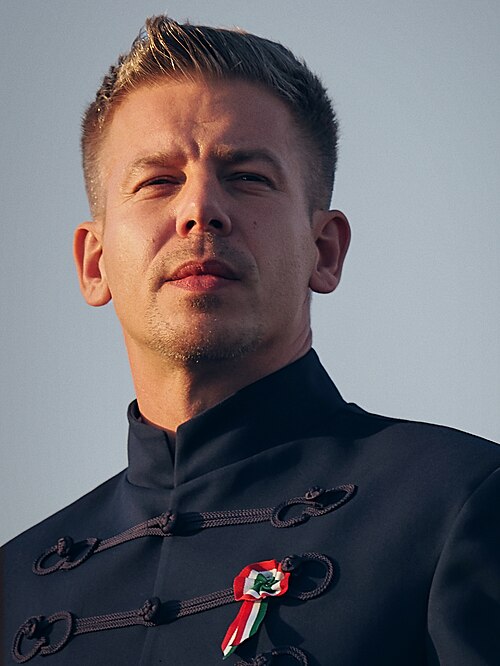
Hungarian Prime Minister-elect Péter Magyar, on 15 March 2026 during a national day demonstration at Heroes’ Square in Budapest. Magyar is wearing a traditional bocskai jacket and a national cockade.
Photo by Norbert Banhalmi and released under CC BY-SA 4.0 via Wikimedia Commons.
Tisza — the name being a portmanteau of the Hungarian words tisztelet (respect) and szabadság (freedom), and a reference to the nation’s second largest river — was founded in 2020 and registered in 2022. It was a very marginal conservative party with policies like “raise the minimum pension” and “stop migration”.
In the 2022 parliamentary elections, the party fielded no candidates at all.
Tisza became a major force in Hungarian elections when Péter Magyar joined the party. Magyar, who has a legal background, had been a member of Viktor Orbán’s party Fidesz. More significantly, he had been married to the Hungarian Minister of Justice, Judit Varga, from 2006 to 2023.
In 2024, Varga resigned, along with Hungarian president Katalin Novák, after both were exposed as having signed a pardon for a convicted paedophile who had been a director of a state-run children’s home. Magyar resigned from Fidesz, accusing Orbán of “hiding behind women’s skirts”.
“For a long time I believed in an idea, a national, sovereign, civic Hungary,” wrote Magyar in a much-quoted statement, “But in recent years, I have slowly and finally realized that all of this is really just a political product.”
Magyar became a ferocious critic of alleged government corruption. His ex-wife responded to his anti-Orbán activities by accusing him of domestic abuse. Magyar denied this. Undaunted, he led various anti-government demonstrations, which attracted tens of thousands of Hungarians. He was also chosen to lead Tisza.
Magyar has profited from good timing. He is also a photogenic man who has performed well on social media. His politics are more mysterious. He has called himself a “critical pro-European and a conservative liberal”.
He is not the sort of liberal that anti-Orbán Westerners might want him to be. While he has said that he will “move away from the current, uncritically friendly approach towards Russia”, he has also said that it will take time to stop buying Russian fuel, and he has criticised the Ukrainian approach to Hungarian minorities. He has sometimes tried to outflank Orbán on sovereignty, saying that Fidesz have brought in too many guest workers, and even questionably saying that migrants have been stealing ducks from Hungarian ponds. Still, it remains to be seen if the pro-EU Magyar will maintain his more right-wing opinions or be swept along by European orthodoxy — not least when he has emphasised the importance of unlocking EU funds.
At The Sceptic, James Alexander says that the situation is more complicated than a split between Orbán and what he terms “the Roral Response”:
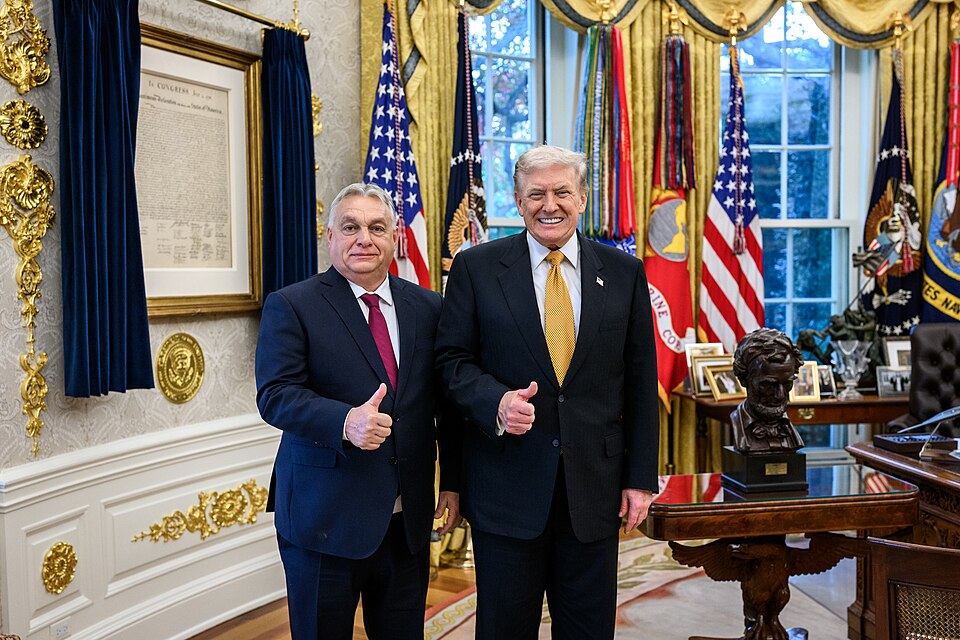
President Donald Trump and Hungarian Prime Minister Viktor Orban pose for a photo in the Oval Office, Friday, November 7, 2025.
Official White House photo by Daniel Torok via Wikimedia Commons.
What is the Orbán-Roral Divide? It is the Manichaean yin-yang binary of the simplistic political imagination, which supposes that, on one side, we have Orbán, Putin, Trump etc., and that, on the other side, we have von der Leyen, Merz, Starmer, Carney, Zelensky and of course the man after whom I name the category: Rory Stewart.
It has some truth in it, but it is bewildering when we see the binary exalted as if it is the only truth of politics. The downfall of Orbán illustrates this almost perfectly.
The subject today is Orbán Developments. And the Roral Response.
News.
As you all know, Orbán, after 16 years of power, fell in the recent election.
- Viktor Orbán = Fidezs = 37.8% = 55 seats
- Peter Magyar = Tisza = 53.6% = 138 seats
“Who loses and who wins, who’s in, who’s out,” quoth King Lear.
Orbán lost.
Now, I like Orbán, symbolically. I don’t know about actually: never studied him. I read one of his speeches once, and it read as more intelligent than any equivalent political speech. I have one thing in common with him, which is that he was present at the funeral of Norman Stone. Anyhow, like him or loathe him, we have to be philosophical. And we have to respect him, even if he is an Oxford man.
- Oxford: Obsessed with power. Corrupt. Cecil Rhodes, Lord Milner, Tony Blair, David Cameron, Boris Johnson, Dominic Cummings, Viktor Orbán etc.
- Cambridge: Lord Acton: “Power corrupts and absolute power corrupts absolutely.”
So let us look at what people say. The amusing thing is that people immediately editorialise. Twitter, X, Whatyouwill.com, turns everyone into William Rees-Mogg. Look at all these Editors.
Here is Ferenc Horcher, a very important Hungarian scholar:
Time to face reality: the Hungarian electorate ousted the ruling power. The electoral system Fidesz introduced gave its opponent a two-thirds majority. Orbán established a one-man rule, tailored the campaign to himself, he is responsible for the defeat, he has to resign.
That’s grim talk from a conservative. So here on the jolly side is Sam Moyn, a very important Yale Law School professor:
Yay for Hungary. What if the answer to illiberalism is democracy?
Ho hum. I sigh a bit over the innocence of making a contrast between illiberalism and democracy, as if liberalism = democracy.
Aleks Eror warns that even though Orbán has been defeated at the polls, the forces that kept him in power for 16 years are still strong:
Every party has to come to an end eventually – it’s just unfortunate when it ends in a bloodbath. That’s ultimately what happened in Hungary at the weekend as Viktor Orbán’s 16 years in power came to a brutal end after a landslide defeat to Péter Magyar — a former member of his own party who no one had even heard of two years ago. Armed with a supermajority, Magyar’s Tisza party will have huge scope to remodel the Hungarian state as they see fit. What this means for the global populist right for whom Orbán served as a lodestar is anybody’s guess.
Little is known about the incoming prime minister. He claims to be a conservative and there’s good reason to believe him. A former mid-ranking civil servant in Orbán’s once-dominant Fidesz party, he was reportedly passed up for promotion by the party hierarchy multiple times until he eventually lost patience and quit in February 2024 while going public with allegations of corruption against a number of Fidesz insiders. He launched his political campaign the following month, promising to clean up Hungarian politics and also mend relations with the EU. Since then, he’s served as a perfect blank canvas onto which all of Orbán’s critics could project their hopes and dreams.
This has led to a weird situation where he has been portrayed as some sort of democratic freedom fighter by both the liberal media and Brussels elites alike, even though he promised to keep Orbán’s big beautiful border fence, refused to comment on Fidesz’s attempted cancellation [of] gay parades last year, and expressed only lukewarm support for Ukraine — all while wearing traditional folkloric shirts that would probably be described as “white nationalist” coded by the #FBPE crowd. The only reasonable assessment of Magyar at this moment is that he’s an unknown quantity and that we can only speculate about his true convictions and how they will affect Hungarian politics.
For now, the only thing that is likely to change is a shift in tone from confrontational illiberalism to a more restrained patriotic conservatism because Magyar’s focus will be on purging state institutions of Fidesz appointees so he can rule with a free hand and unlock some €18 billion in frozen EU recovery and cohesion funds that Brussels withheld from Orbán. His response to Budapest Pride this summer will be a possible indicator of just how far he intends to dismantle the Orbánist state. State officials with Fidesz loyalties are almost certainly doomed, but the Hungarian capital could yet remain a bastion for rightwing think tanks and networks that will help sustain Fidesz-style populism as a political force in the long run.


