Quotulatiousness

July 29, 2026

The changing nature of Canadian patriotism

Filed under: Cancon, History, Media, Politics, USA — Tags: , , , , — Nicholas @ 03:00

On the social media site formerly known as Twitter, Jay Currie contrasts the kind of patriotism most Canadians grew up with against the politicized version hijacked by the Liberals as a tool in their never-ending quest to re-shape Canadians in their preferred image:

Sitting out here on the southern tip of Vancouver Island overlooking the Olympic mountains across the Strait of Juan de Fuca, I am bemused by the Eastern Canadian debate on Canadian patriotism. @BenWoodfinden weighs in as does Auntie Andy @acoyne

The current version of the debate is focused on whether the Conservative Party is “patriotic enough”. In less fraught times that would translate to “love of Canada” but now it comes down to anti-American and, more importantly, anti-Trump enough.

Probably because, after twelve years of Trudeau/Carney there is very little “Canada” left to love. We’re a post-national, genocidal, nearly European entity ruled from an embattled Ottawa beset by Americans, Chinese and our own separatists.

From the Ottawa/Toronto point of view Canada’s singular attribute is our willingness to punch Trump right in the nose. And woe betide the traitors like Smith, Moe and Frechette who are not willing to get behind Captain Canada as he takes his roundhouse swings.

And the Conservative Party is failing on the patriotism front precisely because a significant part of it thinks punching the Yanks in the nose is possibly the dumbest thing they have ever heard. Why the Hell would we do that?

On the Auntie Andy/Woodfinden scale of patriotism this disqualifies the CPC from ever winning a federal election because only Canadian Patriots should be allowed to command the Ottawa ramparts eyes firmly fixed on the perfidious Yanks.

As a thought experiment try to define Canadian patriotism without reference to the US or Donald Trump. I assure you it can be done. The way you do it is begin with the ground you are on. Where is it? What is it? What can you see?

Now, think about your neighbours, the stores you go to, the pub you like, the golf course or soccer field or swimming pool you prefer, the schools you went to, the teams you played on, yes, your favourite NHL team, vacation spot, drive.

Essentially these and hundreds of other details are the ground truths of your Canada and it is that Canada where your patriotism begins. The Canadian flag, the Peace tower, your favourite version of “Oh, Canada” are all abstractions of this ground truth.

People don’t fight for “King and Country”, they fight for their children, their spouse, their parents, their neighbours. That is where the real loyalty lies. It’s acutely local and it accretes across time, across generations.

The Liberal Party project of the last half century has been to replace this hyper-localized patriotism with an synthetic, denatured, atomized Patriotism which defines itself by what it is against, not what it is for. It is a deeply unsatisfying project.

The fact the CPC is wary of this synthetic patriotism is to its credit. Looking at its messaging in the last election at least a part of the CPC understands that Canada is the ground you stand on, not an invention of Ottawa. It’s the right message.
At Without Diminishment, Carl Vallée identifies one of the structural strengths of the left that allow them to concentrate on achieving and maintaining power: unity of vision across all progressive parties.
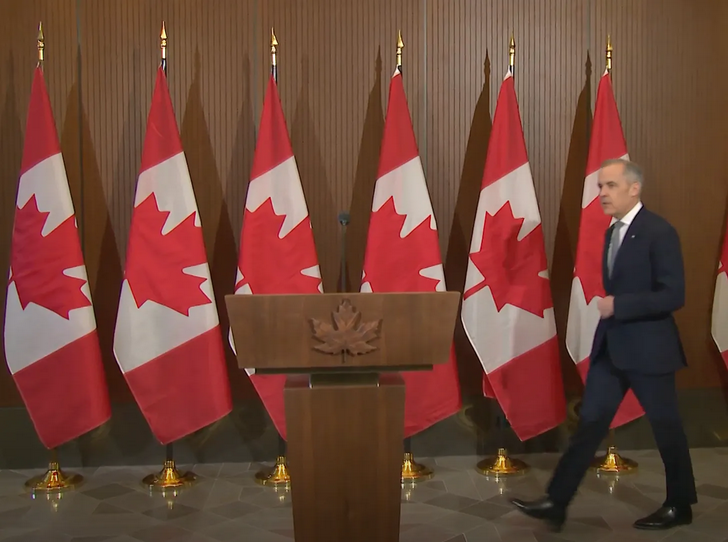
Exit Trudeau, enter Carney.

It must be admitted that the Liberals have dominated the political landscape for much of the past century, enabling them to weave their own partisan symbols and values into the fabric of Canadian institutions.

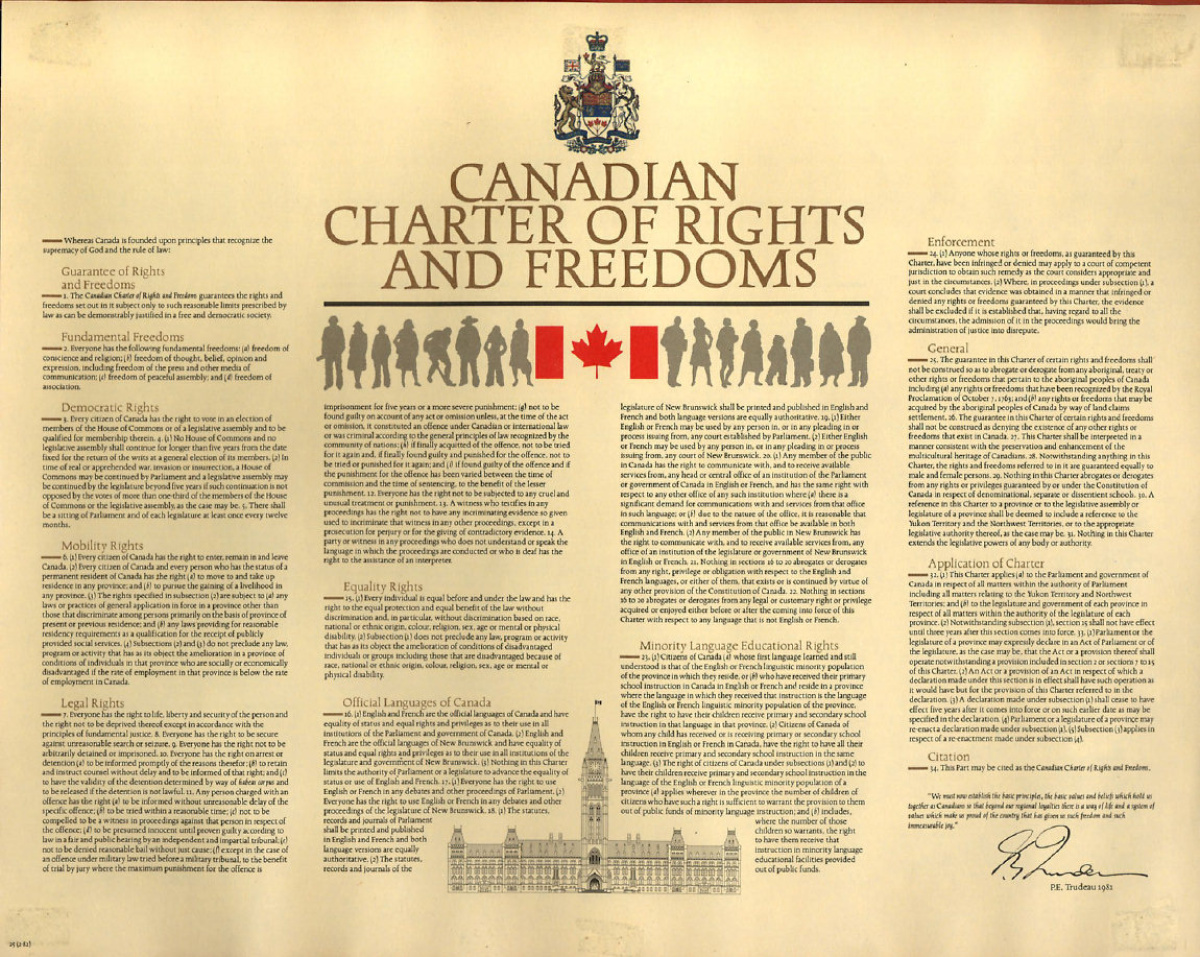
The federal state as it exists today is a legacy of Liberal Party rule. Pierre Trudeau’s Charter of Rights and Freedoms fundamentally changed the trajectory of this country, but the ideology underpinning it had begun to take shape even before his time. Whether one considers multiculturalism, mass immigration or the red maple leaf flag, Canada is a country whose institutions naturally lean, if not lurch, to the left.

Therefore, conservatives must swim against the current, almost perpetually. Why is this? I submit that it stems from the fact that Liberals in both English Canada and Quebec are ideologically closely aligned and share a common vision of Canada. The left often looks much the same everywhere. Certainly, its values, methods and codes of communication are identical across the Western world.

In Canada, Liberals will not hesitate to weaponise the state to ensure their values endure. The alignment between Liberals in Quebec and English Canada has been critical to their electoral success.

Conversely, the right are more locally rooted and provincial, and are therefore less inclined to share a broad common vision with their compatriots across the country. This poses a challenge to both the coherence of Canadian conservatism and its electoral arithmetic.

Conservatism in Quebec is not libertarian, and here we envisage using the state to advance nationalist and conservative ends. What we conserve in Quebec is not what our friends in Western Canada or Ontario seek to conserve.

Arrayed against our alliance of local political traditions are the Liberals, who share and promote a single, pan-Canadian narrative. The inability of the right to offer a catch-all vision capable of rallying the anti-Liberal vote partially explains the electoral success of the Liberal Party over the past few decades.

Structurally, the 1982 rupture over the imposition of the Charter has made this phenomenon almost permanent, despite the efforts of prime ministers Brian Mulroney and Stephen Harper to rally coalitions against the Liberals. Neither was able to prevent the Charter from entrenching itself as Canada’s new national narrative, despite the explicit opposition of Francophones, one of the country’s founding peoples.

If there is a fault, it does not lie solely with the pan-Canadian conservative movement, but also with Quebec’s bleus, who failed to invest in the Conservative Party of Canada, the only political party capable of rivalling the Liberals. As a result, the Quebec vote is split between the Conservatives and the Bloc Québécois, whose voters are much less left-wing than the party’s current leadership. In the 2025 federal election, the combined Conservative and Bloc vote in Quebec actually exceeded the Liberal vote.
July 20, 2026

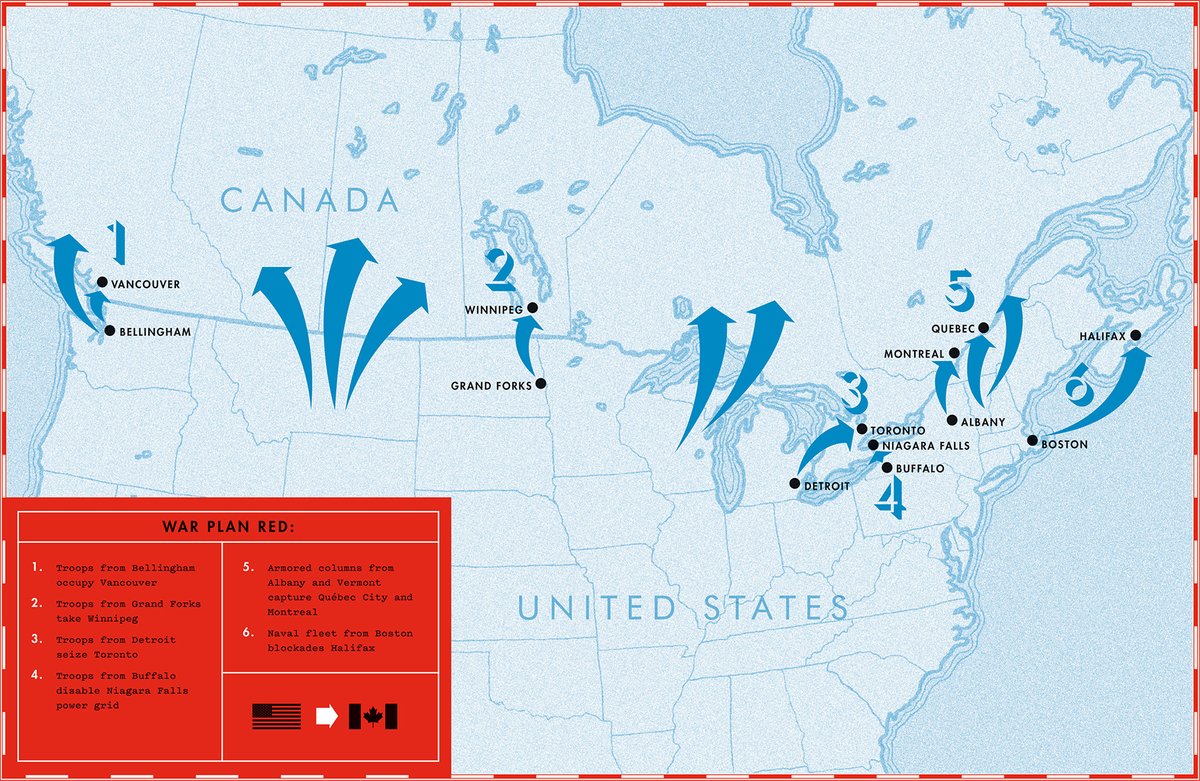
“Blame Canada”: evergreen. “Invade Canada”? It’s been done before

Filed under: Cancon, History, Military, USA — Tags: , , , — Nicholas @ 06:00

Upper Canadian Cavalier points out the obvious … that the United States absolutely could invade Canada and there’s not a lot the Canadian Armed Forces could do to stop them. But that would be the easy part:

“A mere matter of marching …”

The question of “could America ever invade Canada?” is wrong before it is even asked. Picture the MAGA politicos huddled in D.C. and the anon poasters spamming maps of how America could take Canada, as if it were even a question, as if the border were a wall and the wall the point. The whole conversation is midwits who never grasped what America already occupies.

Occupation is the crude instrument of the conqueror who arrives too late, who finds the ground already held by another and must break it by force, and that has never once been the American position in the north. The American position is that of the covert shareholder rather than the invader, and a shareholder does not knock down the door of a house whose deed already sits in his desk.

Empire in its highest form neither occupies nor marches, because it has learned to administer instead, and it does not plant a flag on the palace, since the flag is a confession that the palace was not yet yours. The genius of the modern Global American imperium has been to take without ever confessing, to hold Canada so completely that Canadians experience the holding as their own free choice. To reach for the army now would throw all of that away, trading a profitable and invisible dominion for a visible and bloody one, and teaching the empire at ruinous cost the difference between owning a country and holding it.

The republic was born reaching north with a bayonet, and it should remember how that went. In the winter of 1775 it sent Brigadier General Richard Montgomery and Colonel Benedict Arnold (yes, that Benedict Arnold) up through the snow to seize Quebec. The spirit of the country rose up in the snow to meet them, and Quebec killed Montgomery in a blizzard at the walls, the land itself passing sentence on the invasion before a single treaty could be signed.

That was first offensive act of the American project, it was a failed invasion of Canada that froze to death in the cold for its own arrogance. There is a symmetry waiting at the end of this essay that the reader should carry from the beginning, because a republic that opened its history reaching north may yet close its history the same way. America could invade Canada, but then it would not be able to conquer it, and in that attempt it would destroy the very thing that made its northern dominion worth having, because the soft empire cannot survive being seen and that invasion is nothing other than the act of trading quiet profits for overt pain and suffering.

June 3, 2026

“… basically it’s a plan to make power more expensive while campaigning on affordability”

John Robson examines a few of the ways the Ontario government (and other provincial and state governments) frames what they call “affordability”, yet somehow it always seems to cost more afterwards and nobody is ever held responsible:

In many areas of life, the devil is famously in the details. And it presents both an opportunity and a frustration because there is so much out there deserving readers’ attention that you can’t even follow it all let alone cram it into a newsletter. Including former banking executive Parker Gallant‘s vigilance about the absurdities of the power system in the Canadian province of Ontario that the aspiring Conservative premier Doug Ford promised to fix in the 2018 campaign and then has smugly done nothing about. These things might seem uninteresting if you do not live in Ontario … until you realize it’s just as bad wherever you live. And when we say bad we mean both the cost and the deviousness with which it is presented to, or hidden from, the public. On this very point we like to quote the late great P.J. O’Rourke that “Beyond a certain point complexity is fraud … when someone creates a system in which you can’t tell whether or not you’re being fooled, you’re being fooled.” Which brings us to the shiny new buzzword “affordability” which refers to policies that make everything more expensive and the beneficiaries hide the fraud in tangles of complex bureaucracy.

If you want to get a headache, stay with us while we explain what it is that Gallant tracks. Ontario has what they call the “Independent Electricity System Operator” so politicians can claim whatever disaster is unfolding isn’t their fault. Sure, they make the laws and oversee the creation of the regulations. But heck, these things are “arms’ length” and “impartial” and independent and expert and wise and wonderful so shut up.

Including this nutty system where the province buys power we don’t need at grossly inflated rates from wind and solar virtue-signallers and then sells the surplus at deep losses to the neighbouring province of Quebec and some American states including New York and Michigan. So he looked in depth (we promised a headache) at just half a day, May 19, 2026, because a post by another of the people who keeps an eye on this stuff for the benefit of an indifferent or baffled populace alerted him to something fishy in the IESO forecast of generation by Industrial Wind Turbine operators. But it seems to be hard to find out exactly how much the taxpayers, via this wonderful “Independent” system with its hand in their pockets via the arm of the state, actually paid these IWTs not to produce power.

Paid them what? Yup. It’s how it works. And the idea is that if they didn’t produce the original forecast rather than the revised one we’d have had to pay them even more for what they didn’t do. Weird even by the standards of government. And expensive. As Gallant sums it up:

    The net result is that those IWT cost us Ontario ratepayers almost $2.6 million for NOTHING over just the first 12 hours but we should rest assured the IWT owners loved it!

You read that right. The citizens of Ontario paid $2.6 million to the energy producers of the future not to produce energy in the present in just half of one day. If it were typical, it would be over $5 million a day times 365 days in the year so yes indeedy folks nearly $2 billion a year.

[…]

He then looks at various efforts to try to figure out the cost to consumers, including one by “my friend Roger Caiazza (the Pragmatic Environmentalist of New York)” based on the auction price of “allowances” in March 2025:

    Roger’s conclusion at that time was that the RGGI auctions were adding about $8-11/MWh to the wholesale cost of electricity, for electricity produced by natural gas. That would mean an addition of about 1 cent/kWh on a consumer’s bill. A penny may not seem like much, except when you realize that the average price in the country is less than 18 cents/kWh, so the penny is about 6%.

Imagine if people knew. As he concludes:

    remember that the structure of the program is that the amount of allowances goes down every year and the price is intentionally driven up. And data centers are going in all over the place. And the Northeastern states have refused to build new power plants for a couple of decades now in the midst of the climate hysteria. So the 10-15% extra cost being experienced now is only the beginning of much worse to come. The worst part of the RGGI ‘cap and invest’ scheme is that the consumers get absolutely nothing for the increased cost. It is just a gratuitously inflicted injury brought about by completely artificial scarcity. Keep this in mid when you hear a politician from an RGGI state talking about how they care about energy ‘affordability’.

Or, we add, transparency. Or accountability.

April 23, 2026

They put out propaganda because it works

Filed under: Britain, Cancon, Government, History, WW1, WW2 — Tags: , , — Nicholas @ 04:00

I often find myself commenting on social media posts that the Canadian government’s direct subsidies to most of the mainstream media in Canada has created one of the most effective propaganda machines since 1930s Germany. “eLbOwS uP!” They keep doing it because it clearly is working fantastically well on a large enough share of Canadian voters that the polls (which may or may not be biased) keep touting that Dear Leader Carney and the Natural Governing Party are ever more popular. And most of the people consuming the propaganda message have their preferences re-inforced and the cycle starts again.

At Cracking Defence, Matthew Palmer discusses wartime propaganda during the 20th century, emphasizing that it’s the use to which it is put rather than the mechanism itself that has a moral value:

Propaganda is an absolute favourite subject of mine — probably not surprising considering that one of my roles in the military was psychological operations.1 Despite its very negative connotations thanks to the work of interwar writers like Frederick Ponsonby,2 propaganda really should be seen as a neutral term, perhaps best defined as “the deliberate attempt to persuade people to think and behave in a desired way”.3 Nor does it need to be state-driven; propaganda can come be generated from below as much as being driven top-down from the state or elites.

Some of the best propaganda comes out of wartime, and the First and Second World Wars were absolute goldmines. I also have a particular weakness for propaganda drawn up in early modernist and art deco styles, for which the first half of the 20th century was the high watermark. As such, here are a few of my all-time favourites for your delectation.4


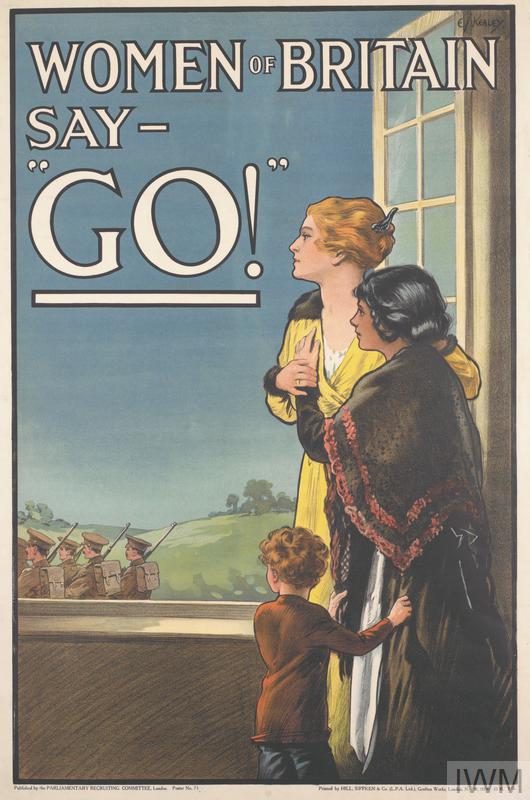
Women of Britain Say — Go!

Women of Britain Say ‘Go!’
Copyright: © IWM. Original Source: http://www.iwm.org.uk/collections/item/object/14592

A true classic that has reverbrated through the ages. Despite First World War propaganda having the reputation of being crudely jingoistic, much of it was in fact consciously aware of the pain and sacrifice being endured by the warring population, and did not try to hide it. This one acknowledges the sacrifice undertaken by the women and children left behind, while the background reminds the viewer of the green and pleasant land of ‘old England’ that they are fighting for.

[…]


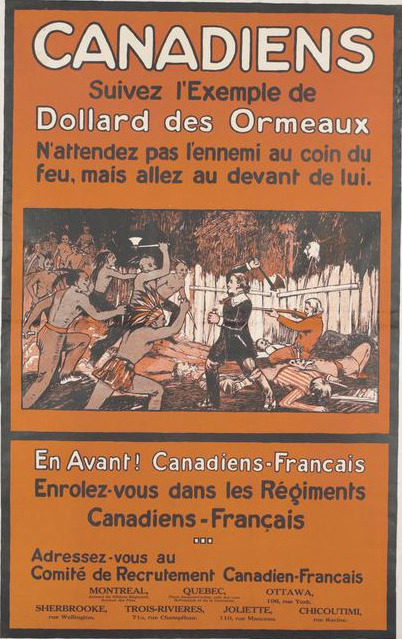
Canadiens, Suivez l’Exemple de Dollard des Ormeaux

Canadiens, Suivez l’Exemple de Dollard des Ormeaux [Canadians, Follow the Example of Dollard des Ormeaux] a depiction of Adam Dollard resisting an attack by Iroquois tribesmen. Dollard’s dead comrades lie at his feet.
Copyright: © IWM. Original Source: http://www.iwm.org.uk/collections/item/object/31027

I find this one intriguing, not because I think it is actually a brilliant poster but for what it tells you about historical context and how propaganda was often tailored explicitly for local sensibilities. While Canadian support for the Allies in the First World War was generally fierce, the major exception was Quebec, which saw relatively poor levels of recruitment for overseas service. As such, propaganda aimed at Quebecois often tapped deeply into local traditions, in this case the (extremely dodgy!) myth of Adam Dollard, venerated in the period as a Catholic martyr who died defending Quebec from native Iroquois.5

[…]


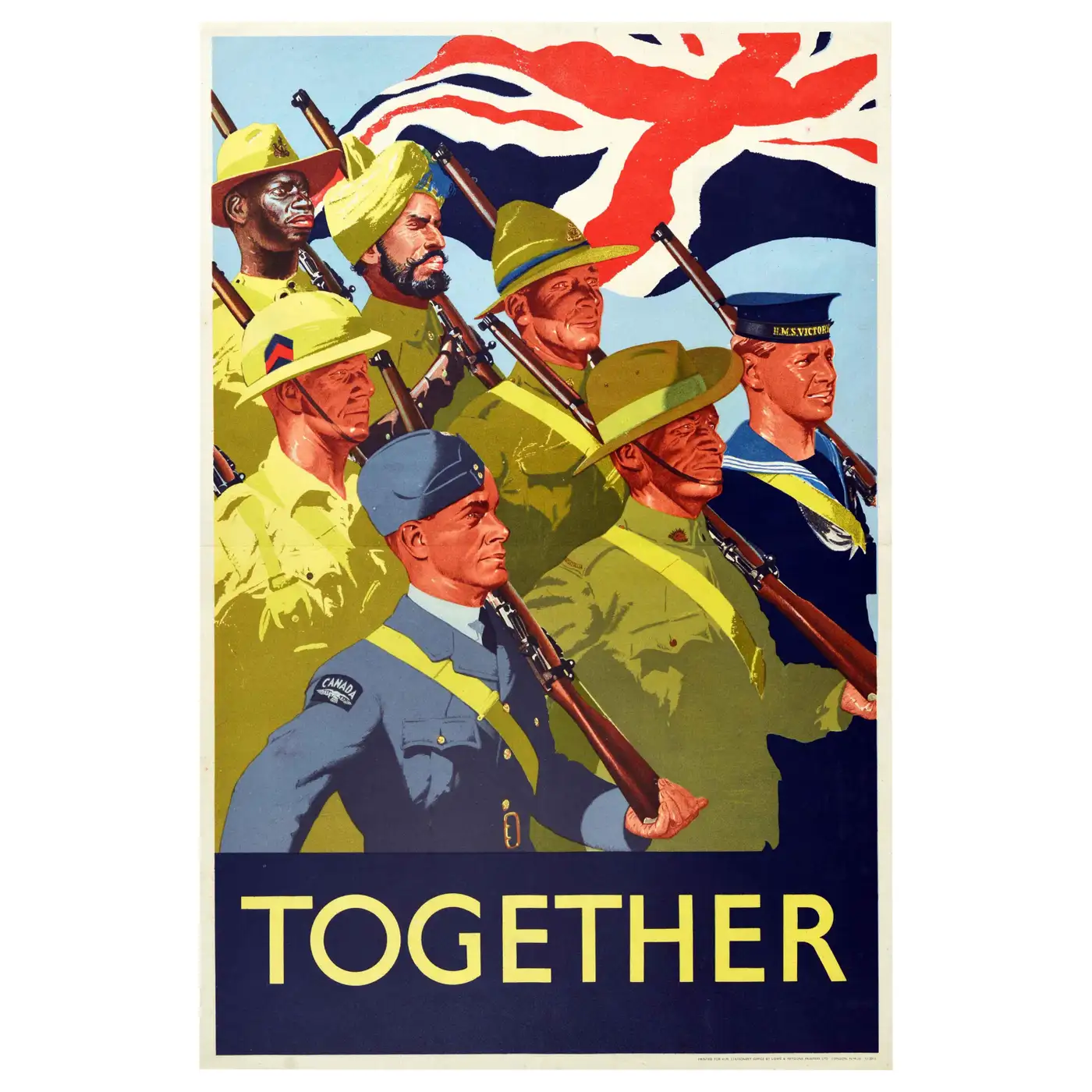
Together

Image courtesy of the IWM.

One can of course criticise the imperialism inherent in this poster, but I think it still works exceptionally well as a bold call for unity between the different nations of the British Empire. It shows how British propagandists took pains to highlight the Second World War as a global conflict against fascism.


  1. A job which, if I do say so myself, I was pretty bloody good at.
  2. Ponsonby wrote Falsehood in Wartime in which ironically he basically made up stories about British propagandists in a book supposedly about manufactured atrocity propaganda!
  3. Phillip Taylor, Munitions of the mind: A history of propaganda (Manchester University Press, 2013).
  4. I’m only going to present Allied propaganda. Because, frankly, fuck fascism.
  5. The story of Dollard is mostly myth, and he was more likely an idiot fur-trapper who got himself killed through stupidity.

April 16, 2026

UOTCAF – EP 002 – Royal 22e Régiment (R22R)

Filed under: Cancon, History, Military, WW1, WW2 — Tags: , , , , , , — Nicholas @ 02:00

Stormwalker Group
Published 11 Nov 2025

Units of the CAF: Episode 2 – R22R

Join your host, Mario Gaudet, as he confuses his brain by talking about French stuff in English, and dive into the epic saga of the Royal 22e Régiment, Quebec’s legendary “Van Doos”, in Episode 2 of “Units of the CAF”.

From their 1914 founding as the first French-speaking battalion in WWI and their heroic stand at Vimy Ridge, and at Ortona in WWII, to Korea’s Hill 355 raids and Afghanistan’s dusty patrols, we spotlight decorated heroes like Joseph Kaeble (VC, WWI), Paul Triquet (VC, WWII), Léo Major (DCM, Korea), and modern heroes aswell. Explore their iconic cap badge featuring the motto “Je me souviens” adopted in 1925.

Whether you’re a veteran, history buff, or just a fan of military trivia, this one’s for you.

#Royal22eRegiment #VanDoos #CanadianArmy #MilitaryHistory #CAF #QuebecPride #WWI #WWII #KoreaWar #AfghanistanWar

March 30, 2026

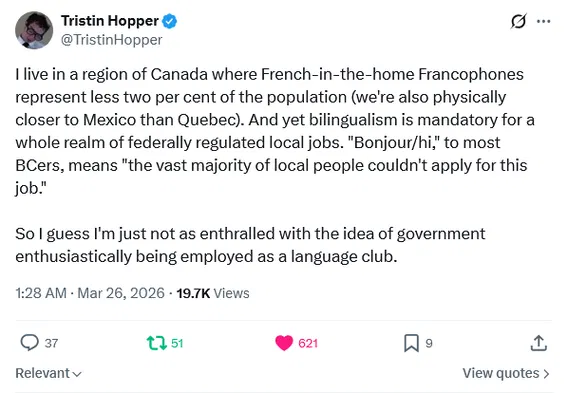
Canada’s official bilingualism benefits only one of the two “founding” peoples

Filed under: Cancon, Government, Politics — Tags: , , , — Nicholas @ 05:00

Canada has been officially a bilingual country for decades, but it hasn’t made most Canadians capable of effective use of both official languages, especially in the western half of the country. Instead, with the imposition of mandatory bilingualism for most federal civil service roles, it’s functioned as a strong bias in favour of bilingual Quebeckers and against Canadians from majority anglophone provinces. Given that government jobs have been growing at a far faster rate than private-sector jobs, this injustice is fuelling anger and support for separatism in the west:

This is why French Immersion schools function as “private schools for the middle class” … it provides access to lucrative and secure government jobs for the children of the bourgeoisie, excluding most working class kids.

It’s a uniquely ridiculous Canadian story.

Two Canadian pilots were killed in a freak accident at LaGuardia airport and yet Canadian news coverage has been dominated by outrage over the fact that the CEO of the pilots’ airline, Michael Rousseau of Air Canada, released a condolence video that had French captions but no spoken French!

Though one of the two dead pilots was French Canadian, near as I can tell, none of the anger at Rousseau’s video is coming from anyone associated with the victims themselves, but rather the Canadian political class and punditocracy. Prime Minister Carney denounced the video for lacking “judgment” and “compassion,” and a bunch of other politicians have said similar things, particularly in Quebec, where the legislature passed a unanimous motion demanding Rousseau’s resignation. There have been a ton of angry anti-Rousseau editorials in all the leading Canadian papers.

It is obviously a highly performative, almost ritualistic, almost religious outrage occurring mostly so members of the Canadian establishment can collectively affirm one of their shibboleths: the country’s elite should be bilingual.

On social media, however, the reaction has been quite different, with ordinary Canadians expressing frustration and annoyance at the distasteful nature of it all. Two men are dead and this is what our betters are yapping about? An old debate — long stigmatized, but never successfully suppressed — has resurfaced: why are we doing this bilingualism thing at all?

I’ve been arguing against the Canadian elite’s cult of official bilingualism for a very long time. To the extent I have a controversial reputation in Canada and don’t get invited on things very much, it’s in large part because I’m very outspoken on this issue, which is often treated as the one line you’re not allowed to cross. Hating trans people or saying October 7 wasn’t so bad … those are edgy opinions that can be forgiven. Questioning bilingualism is a much more unforgivably toxic take, because it’s seen as offending Quebeckers, and a lot of elite Canada wants to be on Quebec’s good side.

But I also feel this is one issue where I’m very, very obviously in the right, and where I have the least self-doubt. There aren’t many issues where I feel I could hold my own in some Jubilee-style “Surrounded” debate bro type thing, but this is one.

So, with that being said, let me attempt to engage with some of the arguments you see made in favor of not just official bilingualism, but the idea of Canada requiring a bilingual ruling class in particular.

Canada is a bilingual country, so it makes sense for the Canadian government, and other Canadian national institutions, to provide nationwide services in both French and English.

Canada is a bilingual country by law, but not by fact. Canada is in fact an overwhelmingly English-speaking country. According to the 2021 census, 87% of Canadians can speak English while 11% can speak only French and about 2% can speak neither. Of this four million Canadians who can only speak French, 96% are located in the province of Quebec. Excluding Quebec, the rate of Canadians who can speak English rises to 97.8%.

It’s sensible for things in Quebec to function mostly in the French language, given about 94% of people in the province can speak it. It’s sensible for things outside of Quebec to operate mostly in English for the same reason. In both Quebec and the rest of Canada there is a very small minority of people, mostly in urban centers, who cannot speak the dominant language of where they live, so it’s reasonable for accommodations to be made for their needs on a case-by-case, community-by-community basis.

What is decidedly not reasonable, however, is to blindly organize all public (and in some cases, private) operations in this country as if there exists some substantial unilingual French-speaking minority everywhere from Newfoundland to Nunavut that is helpless without services specifically tailored to them — a minority in need of French-speaking receptionists and clerks and cops and teachers and librarians and journalists and guides and managers and lawyers and judges and HR departments and all the rest, all accessible at all times, anywhere in Canada.

For Canada’s service sector to go above and beyond in seeking to accommodate the needs of a unilingual French population in provinces and territories outside of Quebec that either barely exists or is substantially overshadowed by other linguistic minorities is to engage in a preposterous misallocation of resources simply to pay tribute to a bilingual fantasy version of Canada that’s never actually existed.

March 11, 2026

The Supreme Court of Canada in Santa Claus mode (even if they no longer use those robes)

Filed under: Cancon, Government, Politics — Tags: , , , , , , , — Nicholas @ 05:00

In a pretty conclusive 8-1 decision, the Supreme Court of Canada seems to have overturned not only the Quebec childcare entitlement at issue in this case, but the notion of citizenship in a much wider sense:

The SCC recently abandoned their traditional red robes for black robes more similar to those of the US Supreme Court. This is a case where the older robes would be more appropriate for other reasons.

On Friday, the Supreme Court of Canada delivered its latest stupefying ruling. According to an 8–1 majority in the case of Quebec (Attorney General) v. Kanyinda, the Charter requires the Quebec government to extend subsidized daycare benefits to refugee claimants — asylum seekers who have not yet proven the legitimacy of their claim to refugee status. Founded on a prevalent but contentious reading of constitutional equality rights, the court’s reasoning has far-reaching potential to destabilize parts of the nation’s immigration and social welfare systems.

Until last week, Quebec law granted daycare subsidies to certain categories of parents, including Canadian citizens, permanent residents, and those with approved refugee status. When Bijou Cibuabua Kanyinda, the plaintiff in this case, arrived in the province and sought asylum in 2018, she fell into none of those categories. Aided by cause lawyers, and a coterie of social justice interveners (third party interest groups who submit arguments to the court), Kanyinda argued that the exclusion of refugee claimants from this welfare scheme amounted to unconstitutional discrimination.

Remarkably, the majority of the Supreme Court not only agreed with Kanyinda that the Quebec daycare scheme violated Section 15(1) of the Charter — which provides for “the right to the equal protection and benefit of the law without discrimination” — but bypassed the Quebec legislature by “reading in” a remedy directly into the law. In other words, the court rewrote the statute to immediately grant subsidies to “all parents residing in Quebec who are refugee claimants”.

More troubling than the outcome itself, however, will be the judicial reasoning that rationalized it. Writing for the majority, Justice Andromache Karakatsanis held that the Quebec scheme created a distinction “on the basis of sex”, a proscribed ground of discrimination under Section 15. But rather than fostering a distinction between men and women, Justice Karakatsanis asserted that the scheme discriminated between “men and women refugee claimants” — even though neither group was eligible for benefits at all. Because Quebec’s exclusion of refugee claimants worsened the economic disadvantage of the female claimants, she concluded, it constituted discrimination that violated Section 15.

The court’s reasoning is convoluted, to be sure. Readers may be forgiven for struggling to understand how a ruling that extends benefits to “refugee claimants” can follow from a supposed distinction on the basis of “sex”. In fact, the judgment exposes the incoherence into which the Supreme Court’s equality rights jurisprudence has fallen.

February 16, 2026

“Multiculturalism” should really be called “anti-cultural slop” for it destroys real culture in favour of bland genericism

Filed under: Cancon, Government, Media, Politics — Tags: , , , , , , — Nicholas @ 05:00

At Without Diminishment, Geoff Russ traces the rise of the “global hub” among western cultures and identifies why we shouldn’t strive to drown distinct local cultures under a tide of “could be anywhere” multicultural slop:

London’s vibrantly diverse bus riders … or is it Toronto … or Sydney … or Montreal?

Multiculturalism is the false prophet of celebrating difference, presented as the ultimate engine for “diversity”.

In practice, it is a factory of global homogenisation, and a solvent that erases local cultures. Cities like Sydney, Toronto, and London now compete to be the top “global hub”, which is no unique identity at all.

There is no preservation of character under the hegemony of the global hub, only its erasure. The officially multicultural city is uniform across continents, like clones of each other in all but the most superficial ways. It sounds contradictory on the surface, but makes perfect sense once it is understood that multiculturalism as a policy and identity is inherently anti-cultural.

The multicultural city has nearly identical urban design, and its bureaucrats and professionals weaponise the same moral vocabulary, deploying terms like “inclusivity” and “openness“. It has all the charm of an airport lounge, justified with the same slogans, decorated with the same grey glass-and-steel architecture, and guided by the same self-reinforcing sensibilities.

It makes people docile, and rewards them with sensory appeasement, like supposedly exotic cuisine. A fusion rice bowl is the consolation for the disappearance of the environment you grew up in.

In Canada, it first came to the Anglo cities like Toronto and Vancouver. Now it has broken linguistic and cultural containment into Quebec. For decades, Montreal was the metropolis of the Québécois. Now, as Kevin Paquette outlined last month, the city has changed. It mirrors the anti-culture that took over Toronto, and has no use for the legacy of those who built it.

Paquette described how Montreal has become a “filter” that promotes an internationalist identity that renders it alien to Quebec’s exurban regions. Bloc Québécois (BQ) leader Yves-François Blanchet has warned that “two Quebecs” have emerged, which are disconnected and alienated from each other.

Jean-François Lisée has gone further, and written of the emergence of an “anti-Québécois identity” in an increasingly diverse Montreal. In public schools, students openly mock the Québécois, and English is more commonly spoken than French in the hallways.

Lisée writes that an alternate, anti-Quebec dynamic now exists among some newcomers. In this dynamic, attachment and assimilation into the Québécois identity become contemptible.

This is the essence of multiculturalism when treated as an end in itself. “Inclusion” is the hollowing out of the obligation to belong, and the transformation of identity into a lifestyle choice.

Not even Quebec City is immune. It was long a living, breathing exception to Canadian multiculturalism, with a dominant Québécois culture and ethos. However, the mayor, Bruno Marchand, has embarked on a mission to destroy what makes it distinct.

The following sentence is from a glowing feature in the Globe and Mail last week: “Mr. Marchand says his hometown’s traditional pure laine image is changing, and it’s a good thing”.

Quebec City’s inherited way of life is being targeted so that it can become just one more global hub. The city’s established symbols, traditions, and habits stand in the way. It takes remarkable ideological and moral heavy lifting to dismiss provincial identities as unworthy, and as something that must inevitably be replaced.

The city still carries deep meaning for francophones across the country.

“I’ve never lived there, or in the province of Quebec, and yet it speaks to me profoundly,” said one resident of Ontario I spoke to. “This is where my ancestors landed 400 years ago and it still bears witness to them.”

What was the point of Quebec’s 400-year effort to survive if it becomes a mirror image of what has happened to the rest of Canada?

Ontario, and the rest of Anglo-Canada, have long been conditioned to regard its own inheritance as unworthy of loyalty or respect.

Anglo-Canada is bound up in the history of the British Empire, the most fashionable whipping boy of leftist academics and activists. Due to the institutional power of these malcontents, it naturally follows that Canada’s historic and cultural self is treated as an embarrassment, whose memory is a problem that must be solved, or rather dissolved.

Update, 17 February: Welcome, Instapundit readers! Have a look around at some of my other posts you may find of interest. I send out a daily summary of posts here through my Substackhttps://substack.com/@nicholasrusson that you can subscribe to if you’d like to be informed of new posts in the future.

December 10, 2025

Murmurs of dissent from within Canada’s supply management cartel

At Juno News, Sylvain Charlebois shares a sign of internal dissent inside the supply management system that prioritizes protecting producers at the cost of significantly higher prices and reduced choice for Canadian consumers — not to mention getting Trump’s attention (and anger) for shutting out American competitors:

Every once in a while, someone inside a tightly protected system decides to say the quiet part out loud. That is what Joel Fox, a dairy farmer from the Trenton, Ontario area, did recently in the Ontario Farmer newspaper. In a candid open letter, Fox questioned why established dairy farmers like himself continue to receive increasingly large government payouts — even though the sector is not shrinking, but expanding. His piece, titled “We continue to privatize gains, socialize losses“, did not come from an economist or a critic of supply management. It came from someone who benefits from it. And yet his message was unmistakable: the numbers no longer add up.

Fox’s letter marks something we have not seen in years — a rare moment of internal dissent from a system that usually speaks with one voice. It is the first meaningful crack since the viral milk-dumping video by Ontario dairy farmer Jerry Huigen, who filmed himself being forced to dump thousands of litres of perfectly good milk because of quota rules. Huigen’s video exposed contradictions inside supply management, but the system quickly closed ranks. Until now. Fox has reopened a conversation that has been dormant for far too long.

In his letter, Fox admitted he would cash his latest $14,000 Dairy Direct Payment Program (DDPP) cheque, despite believing the program wastes taxpayer money. The DDPP was created to offset supposed losses from trade agreements like CETA, CPTPP, and CUSMA. These deals were expected to reduce Canada’s dairy market. But those “losses” are theoretical — based on models and assumptions about future erosion in market share. Meanwhile, domestic dairy demand has strengthened.

Which raises the obvious question: why are we compensating dairy farmers for producing less when they are, in fact, producing more?

This month, dairy farmers received another 1% quota increase, on top of several increases totalling 4% to 5% in recent years. Quota — the right to produce milk — only increases when more supply is needed. If trade deals had truly devastated the sector, quota would be falling, not rising. Instead, Canada’s population has grown by nearly six million since 2015, processors have expanded, and consumption remains stable. The market is expanding.

Understanding what quota is makes the contradiction clearer. Quota is a government-created financial asset worth $24,000 to $27,000 per kilogram of butterfat. A mid-sized dairy farm may hold $2.5 million in quota. Over the past few years, cumulative quota increases of 5% or more have automatically added $120,000 to $135,000 to the value of a typical farm’s quota — entirely free. Larger farms see even greater windfalls. Across the entire dairy system, these increases represent hundreds of millions of dollars in newly created quota value, likely exceeding $500 million in added wealth — generated not through innovation or productivity, but by regulatory decision.

December 7, 2025

History Summarized: Quebec’s Architectural Memory

Overly Sarcastic Productions
Published 1 Aug 2025

Congratulations, you just got Chateau’d.

Ten years ago I visited Quebec City with my dad, this summer the two of us went back, and today I bring you the analytical fruits of a visit well spent. (Let it be known I did my best attempt at Quebecois, recalling pronunciation differences like Frontenac condensing to “Frotnak”, but otherwise defaulting to Metropolitan French when I wasn’t sure of local pronunciations. Alas, any attempt to “split the difference” between Quebecois and Metropolitan French will invariably result in utter disaster. For this, je suis désolé.)
(more…)

October 1, 2025

“Sean Fraser, the current minister of justice and attorney general, has made two major mistakes of late”

If you’re at all interested in Canadian affairs, you should subscribe to The Line … even a free subscription will definitely provide you with some excellent non-propagandistic coverage of what is happening in the dysfunctional dominion. For instance, last weekend’s weekly post from the editors included this segment about Sean Fraser, who is perhaps the worst of Mark Carney’s cabinet (and that takes some doing):

Sean Fraser, as Minister of Immigration, Refugees & Citizenship, during day one of Collision 2023 at Enercare Centre in Toronto, Canada.
Photo by Vaughn Ridley via Wikimedia Commons

We at The Line contend that Sean Fraser, the current minister of justice and attorney general, has made two major mistakes of late.

The first was in deciding not to rescind his decision to spend more time with his friends and family when it became clear that Justin Trudeau was no longer an anchor on his electoral chances. After failing to fix Canada’s housing problem and proving himself integral to blowing apart a pan-partisan consensus on immigration that was once the envy of the world, the man had a real opportunity to leave office on a high note. But, no.

Instead, after hitching his bloated baggage to Mark Carney’s trunk, Fraser decided that Canada needed more of him.

And so, as justice minister, instead of addressing petty stuff like, oh, bail reform, or fixing prisons, or getting crime under control, he turned his attention to … Section 33 of the Charter of Rights and Freedoms. The notwithstanding clause.

You may recall that Quebec’s contentious Bill 21 — which prohibits public-service employees in positions of authority, and teachers, from wearing religious symbols while on the job — is currently before the Supreme Court of Canada. Despite numerous mixed rulings on the law, Quebec moved forward with its stance on secularism by invoking Section 33, which allows parliaments to temporarily override judicial rulings.

Section 33 was placed in the Charter for precisely this kind of situation; one in which the courts and parliament disagree about governance. As we still live in a democracy, and are still nominally governed by representatives we elect, the clause was always a bit of a compromise gesture intended to preserve parliamentary supremacy after granting the courts broad powers to basically reinterpret law according to an expansive and ever-expanding understanding of both their jurisdiction, and of the concept of “rights” writ large.

Section 33, nonetheless, has maintained a heavy odour about it, which has generally limited its application, especially outside Quebec. Among the Sean Fraser set, and the largely Liberal collection of lawyers who will insist that the Supreme Court isn’t remotely political, and how dare we entertain the thought, Section 33 was only ever intended as a symbolic right.

But as the definitely-not-political Supreme Court has edged ever deeper into the territory of override and governance, so too have provincial parliaments responded with a very not-symbolic application of the clause.

We do think there’s some blame to be placed at everyone’s door, here. But we also never really took much issue with Section 33. That’s because, at heart, we at The Line believe in, well, democracy. We believe that the people we elect should be able to decide our laws; and we believe that while the Supreme Court of Canada serves as an important check on Parliamentary power, that power doesn’t and should never override the will of the people.

And that’s basically where we part ways with Fraser and many of his — dare we say it? — Laurentian Consensus ilk. Because the unstated critique of the use of Section 33 is basically always the same: these people dislike the application of the clause because they think politics is icky, and that politicians fundamentally cannot be trusted.

In other words, these people don’t actually want a democracy.

They want a technocracy. One in which the smartest and ablest individuals (as defined by them, of course) are the ones who actually get to set the rules and guardrails for society writ large. One in which parliament really is as theatrical, symbolic and pointless as it often regards itself.

There’s an obvious illogical inconsistency here — Fraser and his colleagues are politicians. We aren’t sure if this desire to go out and limit the ability of he and his fellow parliamentarians to do the best jobs they can for the citizens reflects mere self-loathing, or a particular brand of Liberal blindspot, one that leads them to believe that they alone among politicians are exempt from anything as crass political considerations and/or motivations. Those moral failures are apparently for the other guys. But in any case, we have an elected official making the case that unelected courts should have the ability to override legislators, and that the legislators should have no recourse. However Fraser rationalizes this to himself, it’s where we are.

We think the people who have issues with Section 33 are generally not being honest with themselves in that regard; we also think that their instinctual aversion to politics (or their exemption of themselves from it) tends to make them naive. If you vest all the real power of governance in a “non-partisan” Supreme Court, what you’ll get is not a dispassionate government, but rather a heavily politicized Supreme Court. We need only look at what has happened in the U.S. over the past 30 years to see how that pans out in the long run.

Look, we at The Line don’t like Bill 21. It’s a bad law. It needlessly tramples on minority rights. But there’s a very obvious way to get that law repealed that doesn’t involve flirting with a full-blown constitutional crisis in the midst of, you know, all of the other crises going on right now.

Elect a government that will repeal that law.

That’s what democracies do.

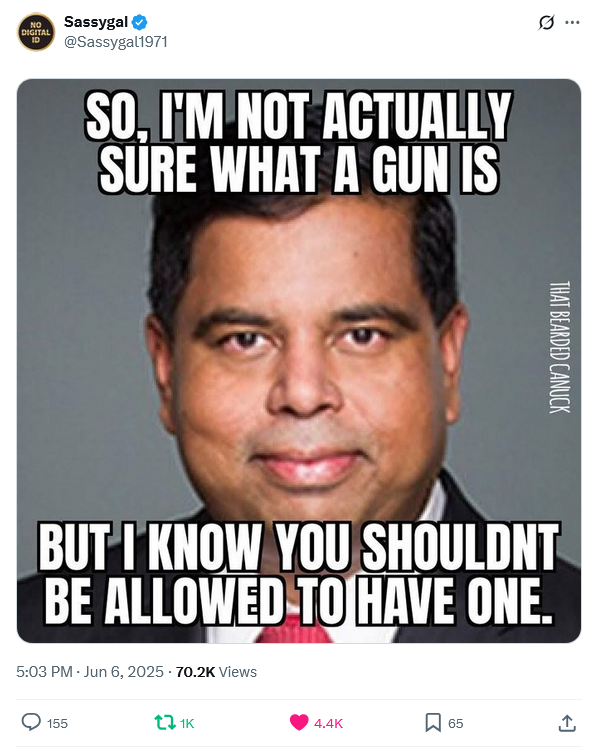
To me, one of the most puzzling things about the Carney government’s recent actions is the overall incoherence of them. They are going ahead with one of the worst policies inherited from the Trudeau years with the “gun buyback” program that the minister responsible has openly admitted is almost completely a sop to voters in Quebec. Okay, that makes cynical sense as the Liberal vote is about as “efficient” as it possibly can be so losing just a few seats in Quebec would make it impossible for the Liberals to get re-elected. Fine. Scummy as hell, but fine. Yet the challenge to Section 33 is guaranteed to piss off far more Quebec voters — and stir up controversy across the country to boot — and you’re going to stage a pitched battle against pretty much all the provinces before the Supreme Court? Are you sure about that?

September 24, 2025

It won’t work – the minister responsible knows it, but they’re going ahead with it anyway

The “it” in the headline is the federal government’s gun confiscation program, which they claim will reduce crime but they already know it won’t do any such thing. What it will do is take away from literally the most law-abiding, responsible citizens their legally purchased property and leave illegal guns in the hands of criminals … at an ever-increasing estimated cost to the taxpayer. In The Line, Matt Gurney covers the details:

The federal gun confiscation program […] is illogical. It won’t save lives or make the public safer. The federal government doesn’t really even expect it to work, and is only going ahead with it because they’ve been stuck with a dumb proposal the Trudeau government made almost five years ago. If they could do it all over again, they wouldn’t, but they feel like they’ve blocked themselves in and have no choice but to proceed so that they don’t anger part of their electoral coalition, mainly voters in Quebec.

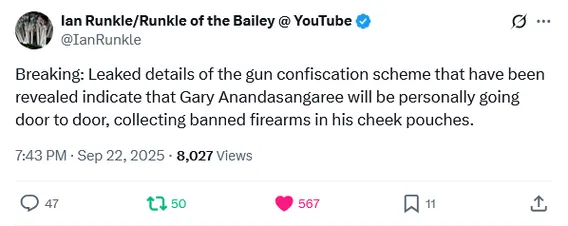
That might sound like a blistering criticism of the program, the kind of thing you’ve read in any number of my columns before. It’s actually what the public safety minister thinks about it. He just didn’t know he was being tape recorded when he said so. In a 20-minute conversation Gary Anandasangaree had with a firearms owner he rents a home to, which was recorded and then leaked, the minister says all of the above things. (He has also confirmed the recording is legitimate.)

Awkward for the minister, clearly, but I actually give him credit. The minister’s comments on tape are a confession, and an admission of defeat. They’re also, hands down, the most honest thing a Liberal government official has said on the gun control file in five years. Given that the minister responsible is freely telling people the program is a bad idea he’s stuck with and that won’t work, a sensible government would probably take this opportunity to walk away from the program.

Unfortunately, that’s not what this PM has chosen. It’s full speed ahead with an idea so bad Anandasangaree wishes he’d never been saddled with it.

Let’s talk about what this program is for a second. And forgive me, there’s quite a bit of history here. During Justin Trudeau’s first term, his only majority, his government had proposed a series of fairly moderate changes to the gun control laws they had inherited from Stephen Harper. As I’ve written often since, the proposals were a mixed bag. Some were okay. Some were bad. But they more or less left the well-functioning Canadian gun control system intact. They nibbled around the edges enough so that they could tell their voters that they had gotten tougher. But they generally didn’t try to fix what wasn’t broken.

But then politics got in the way, as it always does. Trudeau lost his majority in 2019 and became ever-more dependent on voter efficiency and wedge issues. And then in 2020, there was a horrible massacre in Nova Scotia. That catastrophe had nothing to do with our gun control laws; the weapons used were brought in illegally from the United States, as is typical of guns used in gun crime. But the Trudeau government seized on the opportunity — never waste a crisis, right? — to announce that they were “banning” “assault rifles”.

A lot of quotes above. So let me explain. First of all, there really wasn’t much of a ban. Anyone who owned one of the newly banned rifles was allowed to keep them. And as for assault rifles, actual assault rifles — rifle-calibre weapons that use high-capacity detachable magazines and can fire in fully automatic mode — have been banned in Canada for decades. This isn’t a problem that we actually had. And the government tacitly admitted as much when they began fudging the words they used to describe them. In acknowledgement that there were no actual assault weapons to ban, they started talking about assault-style weapons.

“Style” is a tell. You wouldn’t take medicine-style pills, or munch on a food-style snack. Because you’d know better. Trudeau et al knew better. It didn’t stop them. They needed something to announce, and by God, they were going to announce it!

And as we’ve noted several times, the Trudeau government got addicted to the media high of making big showy announcements. So they started doing repeat announcements over a period of time, and thanks to the spinelessness of Canadian legacy media even before Trudeau started directly subsidizing them, the media sugar high got repeated as well. It didn’t take long for the lesson to be learned that making an announcement was cheaper than doing the thing that was announced, and we quickly transitioned to a world where it was the announcement that mattered, not the thing.

At Junk Economics, Bryan Moir sums up the stupidity:

You want blunt? Fine. Here it is:

Listen: politics is kabuki theater and promises are props. Here we have a government rolling out a nationwide confiscation-style buyback and calling it “voluntary” — which is like calling income tax “optional” if you want to be arrested. The minister tells citizens, in public, “it’s voluntary”, then admits in private he’ll criminalize non-compliance, will “bail you out” if it goes that far, and says the whole exercise exists because the party must keep the promise and because the Quebec caucus wants to show muscle. That’s not statesmanship. That’s PR with a warrant.

They lecture you about being “tough on guns” while refusing to be tough on the people who actually bring violence into our streets. The minister himself says if he could do it over he’d target illegal guns and put criminals in jail — not law-abiding owners. Translation: the policy is ideologically driven and politically performative, not strategically intelligent. You don’t cure gang violence — which the cops tell you comes from illegal trafficking and cross-border smuggling — by borrowing billions to buy back legally purchased rifles. That’s like throwing sandbags into a burning house and patting yourself on the back for “doing something”.

And then there’s the logistics and the cost — the ugly part they don’t want on camera. The federal pot is capped at about $742 million and the program is rolled out in fits and starts. Major police forces are already saying “no thanks”, which means the feds must either stand down, contract a patchwork of municipal services, or try to outsource enforcement. Any of those choices blows up the promise in different ways: it becomes toothless, it becomes wildly more expensive, or it becomes a federal-provincial fight that will make the Notwithstanding clause dust-ups look like backyard squabbles. Pick your disaster.

Remember the math: a capped pool of cash plus a growing list of banned models (hundreds, then thousands) equals many owners getting nothing while the bureaucracy eats up the rest on administration, contracts, security, staffing, and political “bribes” (a nicer word for handouts to get agencies to play ball). If the fund runs out — and the minister openly says “it’s capped; when it’s gone, it’s gone” — you’ll have a bunch of people stripped of legal property, out of pocket, and the state triumphant only in optics. That’s confiscation without fair market compensation; it reads like policy designed by accountants and sold by televangelists.

Worst of all: while Ottawa gamely auctions off the idea of virtue, or was that “Canadian values”, real problems pile up. Fire seasons rage, hospitals are full, kids wait for surgeries, food banks are overwhelmed and the cost of living keeps rising— and Mark and Gary are borrowing money to offer coupons for now-illegal guns. If you wanted a textbook case of political misallocation, this is it: symbolic policy delivered with symbolic money so the party can say it kept a promise, while the public pays the bill and crime networks keep smuggling.

On the gun confiscation program in particular, thank goodness you can always depend on social media to find the funny side of any issue:

September 20, 2025

Feds move to neuter the “notwithstanding clause” to frustrate Alberta

To be honest, I wasn’t a fan of the Charter of Rights and Freedoms when it was forced down our throats in 1982, on the basis that if Pierre Trudeau thought it was a good idea then it must be the opposite. All these years later, although I’m still not a huge fan, I support the provinces who now need to combat Mark Carney’s minority Liberal government’s attempt to use the Supreme Court to limit or eliminate the provinces’ use of the notwithstanding clause:

You might be hearing a lot about the notwithstanding clause these days and wondering what is going on. The fact is, the Carney government is trying to change the constitution via a Supreme Court case on Bill 21 – a heinous bill in my opinion – but not an excuse to scrap or weaken the notwithstanding clause.

We’ve been here before with this debate before and I’m still of the same position, leave the clause alone.

It was in 2018 that Ontario Premier Doug Ford was looking to use the notwithstanding clause to shrink the size of Toronto city council. He should never have had to do this, but a lower court ruled that Ford’s actions were unconstitutional.

Which is really weird because the constitution is clear, municipalities are creations of the province. A provincial government can merge municipal governments, they can even abolish them if they wish.

Eventually, a higher court overturned the very politically driven decision against Ford, but for a time, he seemed to need the notwithstanding clause, otherwise known as section 33 of the Charter of Rights and Freedoms.

I’ll never understand why some claim the notwithstanding clause is against the Charter when it is part of the Charter.

On the social media site formerly known as Twitter, Sean Speer notes the Liberals seem to be taken by surprise at the negative reactions to their plans:

I suspect that non-conservatives are a bit surprised by the magnitude of the reaction to the Carney government’s factum on the notwithstanding clause. That’s mainly because I think liberals and progressives don’t quite understand how much the past decade or two of judicial activism has come to animate Canadian conservatism. Even as a somewhat moderate conservatism, I admit to being radicalized on these issues.

The Carter decision on MAID was a key moment in this evolution. Not necessarily because of the issue per se — though a lot of us oppose it. But mainly because it was such a naked example of judicial lawmaking. The clearest case that it’s just power and politics all the way down.

After having ruled that there was no right to physician-assisted death in the Charter, just over twenty years later the Supreme Court unanimously decided there was indeed such a right.

There had been no constitutional amendment in the meantime. Parliament had considered the issue and carefully and consistently voted against it. And yet nine judges decided that the right should exist and so they created one.

If the judiciary isn’t merely protecting constitutionally-prescribed rights but manufacturing them based on the political preferences of judges themselves—if it’s in effect just politics from the bench — then we might as well have the politicians who we’ve duly elected to be making these decisions for us.

Before Carter I would have said that I was broadly supportive of S.33 as part of our constitutional order but today it’s much bigger part of my core political identity as the only check we have on judicial politicking.

The Carney government’s factum then isn’t just objectionable because it threatens to constrain the notwithstanding clause but precisely because it invites the Supreme Court to once again alter the constitution in its own image.

Brian Peckford, the last surviving signatory to the patriation of the Constitution in 1982:

Tragically, it is not surprising that we see this further emasculation of our 1982 Constitution.

It has been ongoing almost since its inception. Witness the 1985 Court Opinion twisting the meaning of the opening words: “the Supremacy of God”.

And the constant distortions ever since, accelerated during the false covid crisis.

This is The Tyranny of The Judiciary —The Destruction Of Parliamentary Democracy!

How important is Section 32 — the notwithstanding clause?

There would be no Constitution Act 1982 — no Charter of Rights and Freedoms without Section 32.

When PM Trudeau Sr. tried to unilaterally Patriate the Constitution and failed miserably because of the Provinces’ opposition before the Courts, he validated the suspicion most Premiers had about the Federal Government and its intentions during that time. The ability of the Provinces to continue democratically to initiate specific exemptions was crucial to solidify the federal nature of this country.

The Supreme Court was right in Sept 1981 in denying the Federal Government such sweeping powers.

None of the 10 First Ministers who signed the Patriation Agreement intended for this Section to be amended in any other way except by the Amending Formula that was achieved for the first time in our history in that Agreement.

The Federal Justice Minister’s action to ask the court is wrong — totally against the intent of those who authored the Patriation Agreement and defies and denigrates one of major accomplishments of 1982, The Amending Formula, a crucial part of the earlier 1981 Agreement, the foundation document, “The Patriation Agreement”.

The Canadian Press carries this:

    OTTAWA — The federal government’s request to Canada’s top court for limits on the notwithstanding clause isn’t only about Quebec’s secularism law, Justice Minister Sean Fraser said on Thursday.

    In a media statement, Fraser said he hopes the Supreme Court’s eventual decision “will shape how both federal and provincial governments may use the notwithstanding clause for years to come”.

Excuse me, Mr Fraser, this is the job, the solemn responsibility, for Canada’s Elected First Ministers and Their elected Parliaments not the Judiciary. Making law is the job of the elected, interpreting law the role of the Judiciary.

This brazen action of the Federal Government would enlarge the Judiciary power to make law — it deciding the powers of The Governments of this Nation.

Ironic in the extreme it is to ponder that Canada sought for decades to find an amending formula — self criticizing itself for not having a legitimate avenue for Constitutional Change.

Now that it has such an avenue instead of using it, it cowardly asks The Court?

Should not a majority of the Provinces have to agree — that’s what the Supreme Court said in 1981?

Hence, the Supreme Court, consistent with it predecessor views of 1981 should refrain from hearing the matter, and inform the Governments that it is they who have the power through the legitimate constitutional process present in the Constitution to make such significant change ie the powers of the Governments, adhering to Section 38, the Amending Formula.

July 4, 2025

QotD: US-Canadian conflict before Confederation

Filed under: Cancon, History, Military, Quotations, USA — Tags: , , , , , — Nicholas @ 01:00

Canada has never fought a direct war against the United States. However, before confederation (1867) when Canada became a self-governing dominion, the territories that would later form that dominion, which had been under the control of the British, engaged in a small number of military conflicts with the United States (or as they were known previously, the Thirteen American Colonies). The total is four, if we only count significant engagements which involved organized forces. Economic wars, or trade disputes, are another story. We’ll get there.

The Aroostook War (1838–1839) drew no blood. The conflict concerned the Maine-New Brunswick border and was resolved amicably by the Webster-Ashburton Treaty of 1842. A quarter of a century later the Fenian Raids (1866–1871) saw the Irish-American Fenian Brotherhood make multiple non-state sanctioned attacks in British North America in an effort to sway Britain to withdraw forces from Ireland.

The other far more consequential military struggles between the two North American friends and neighbours occurred first in the late eighteenth century, and second in the early nineteenth century. During the American Revolutionary War (1775-1783), which saw limited involvement of areas north of the 49th parallel, British North America thwarted a particularly serious invasion by the Americans in 1775 known as The Battle of Quebec.

It was fought during a snowstorm on December 31, 1775 (one of few battles fought in such miserable conditions during the revolutionary war). The American intention was to conscript the British colony, which today forms the province of Quebec (and also included parts of Ontario) into their struggle against the British. The Patriots of the Thirteen Colonies had earlier that year begun rebelling against British taxation and governance. They surmised that the French-speaking Quebec settlers, disaffected with the imposition of British rule as it was laid out in the 1763 Treaty of Paris (which ended the Seven Years War), would join the American cause. A significant miscalculation, to say the least.

The battle was fought on two fronts against a British garrison of 1800 soldiers led by British commander, Governor Guy Carleton. The combined total of American troops was only 1200. The first front was commanded by Brigadier General Richard Montgomery, who led his troops in an attack of the Lower Town from the south. The second assault occurred from the north and was led by Colonel Benedict Arnold (who would later become an infamous American traitor).

Montgomery and several officers were killed instantly on their initial advance. This sparked a retreat amongst his remaining soldiers. Arnold had slightly more luck. His army penetrated northern defences but were stymied in the narrow streets of Quebec. During fighting Arnold was wounded, after which he handed the command to Daniel Morgan. After hours of fighting, Morgan and his men were forced to surrender. The Americans lost the battle decisively ensuring Quebec would remain a loyalist stronghold.

The second of the two significant conflicts involving British North America and the Thirteen American Colonies was the infamous War of 1812 – a more well-known period of antagonism between proto-Canada and her American neighbours.

Here is a topline summary with some extra history concerning the U.S.-Canada border (the world’s longest undefended border), from Terry Glavin:

    The War of 1812 — which the Americans still pretend they won — was officially concluded with the Treaty of Ghent in 1814. Then came the Rush-Bagot Pact of 1817 and the Convention of 1818, which set the border at the 49th parallel.1

The War of 1812 took place during Britain’s struggle against Napoleonic France. The two most famous Canadian battles from this tragic conflict were the Battle of Queenston Heights and the burning of York (now Toronto) – British troops would even the score of the latter by burning Washington D.C.

The war was unpopular. Like today, there were too many bonds between the Americans and proto-Canadians. But also like today, with Canada and the United States once again bickering over trade and various political interests, the disagreements were accompanied by a reluctance to engage in hostilities.

From Pierre Burton’s War of 1812:

    At the outset, it was a gentleman’s war. Officers on opposing sides met for parlays under flags of truce, offered hospitality, exchanged cordialities, murmured the hopes that hostilities would quickly end.2

No matter what time period we are examining, we can never forget that Britons, Canadians and Americans are all first cousins. Yes we disagree from time to time, sometimes we even fight. But always over some unfortunate political dispute, and never for each other’s annihilation.

In 1812, for a variety of reasons, the Americans, especially a minority of hawkish elites in Washington, felt they had no other choice but to invade the north. Some of them felt it would be easy. An aggravating factor concerned Britain’s support of Indian tribes in the north west, at a time when the Americans were aggressively expanding into that region. But also, during their imperial contest with France, the British were impressing sailors in the American navy (forcing them to join British forces), because they considered them traitors of the British crown. Further, they blocked key trade ports under Napoleon’s control, disrupting trade between America and France.

Isn’t it curious how trade so often appears as the rift in Canadian-American relations? Further examples include: the Reciprocity Treaty of 1854 which allowed for free trade of natural resources between the American and British colonies. However, the Americans abrogated that treaty in 1866 partly out of frustration at perceived British support of the confederacy after the Civil War. A post-confederation trade war with the Americans ensued after Canada’s first Prime Minister John A. MacDonald adopted the National Policy in 1879, which imposed high tariffs to protect Canadian industry. Triggering the Americans to respond with tariffs of their own.

James Pew, “Canadians and our ties to Americans”, Woke Watch Canada, 2025-03-30.


April 19, 2025

Notes on the English debate

In the National Post, Chris Selley explains the apparent utility of having Bloc Québécois leader Yves-François Blanchet included in the English-language leaders’ debate:

Bloc Québécois leader Yves-François Blanchet, 8 November, 2023.
Screencapture from a TVA Nouvelles video via Wikimedia Commons.

Wednesday evening’s French-language leaders’ debate kicked off with a video montage that mentioned President Donald Trump roughly 175 times. (I exaggerate somewhat.) Thursday evening’s English-language leaders’ debate was much less focused specifically on Trump, to an almost bizarre extent. When moderator Steve Paikin offered each leader a chance to ask a question of an opponent, Liberal Leader Mark Carney chose to ask Conservative Leader Pierre Poilievre about the security-clearance drama.

Carney’s campaign clearly believes Poilievre’s Achilles’ heel is Trump. One has to wonder how many Canadians even know the basics of the security-clearance issue. It was a baffling decision.

Ultimately, though, leaving Trump aside was a benefit. One of Carney or Poilievre will be prime minister in a month, and they essentially agree that Trump is too unpredictable to strategize against with any confidence from our current position as a semi-deadbeat country. (Again, I paraphrase.)

The only thing we can really do is focus on our own affairs in ways that would make us more prosperous, safe, happy and independent in every sense. In the long term: diversify our trade partners in every sector, including natural resources; improve border security, not to satisfy Trump’s fentanyl obsession but to prevent the northbound flow of illegal firearms (and because borders are supposed to be secure by definition); rebuild the military, not because Trump demands it but out of respect to our existing commitment to NATO and our self-styled reputation as An Important Country; fix health care; make housing affordable; get a handle on our own opioid crisis; fix our broken justice system. All that jazz.

You might think in a debate on those big national issues Bloc Québécois Leader Yves-François Blanchet would be extraneous on the stage. I saw plenty of people reacting in real time in that vein: Why is this man here? But in fact Blanchet served a very useful purpose: He was the voice of comfy Canadian inertia; the voice of Quebec continuing to plod along in its own way under Canada’s protective umbrella (ludicrous sovereignty-referendum threats notwithstanding).

Blanchet embodied how Canada might very plausibly abandon the opportunity that Trump’s kick in our rear end, however unjustified, offered us to live up to the greatness Canadian politicians always ascribe — often dubiously — to this country.

“The building of (new) pipelines will take at least 10 to 14 years. Mr. Trump will be 90 years old, not president … and somebody of course less terrible will be there before you can even dream of having oil through (a new) pipeline,” Blanchet said, kiboshing (as ever) the notion of any new pipeline running through Quebec.

At Rigid Thinking, Damian Penny tries to explain Jagmeet Singh’s performance as the designated interrupter:

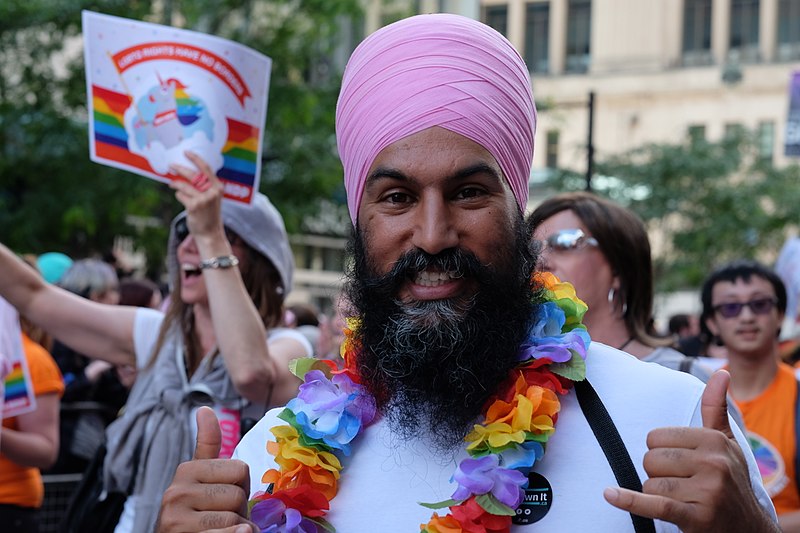
Federal NDP leader Jagmeet Singh taking part in a Pride Parade in June 2017 (during the leadership campaign).
Photo via Wikimedia.

I didn’t see the entire English-language, federal leaders debate on Thursday night, but from what I did see each of the leaders accomplished exactly what they set out to do:

  • Pierre Poilievre went on offence against the liberals and tried to show that, despite their new leader, it’s the same bunch that have been running the country for the past decade.
  • Mark Carney portrayed himself as much more measured and serious than either his main opponent or his predecessor.
  • The Bloc guy showed that his only concern is Quebec and by the way everything comes down to immigration.
  • And the NDP’s Jagmeet Singh did everything he had to do to lock down that cushy patronage appointment he’ll receive should Carney be elected Prime Minister on April 28.

    There was far more cross talk and interruptions during Thursday’s English debate compared to the French parlay the night before. Singh in particular seemed prone to interrupt his opponents.

    Poilievre was the main target of Singh’s interjections — so much so that at one point Carney told the NDP leader to let his Conservative rival finish his point.

    When Poilievre criticized the industrial carbon tax, Singh jumped in and accused the Conservatives of wanting to let everyone pollute. Poilievre spoke about border issues and Singh accused the former Conservative government of cutting border officers.

    Poilievre at one point tried to make an appeal to voters: “The question that Canadians have to ask…”

    “Why vote for Conservatives?” Singh jumped in before Poilievre could finish.

As of this writing, the venerable NDP is polling about as well in Canada as Marjorie Taylor Greene, and their only real shot at even maintaining major party status is to peel off voters from the Liberals, since no one even considering voting Conservative will vote for Singh’s party.

The Line‘s election Bullshit Bulletin overflowed with bullshit from the debates, including some Mark Carney blarney about pipelines:

Mark Carney had quite a few howlers during Thursday’s debate, one of which was aptly called out by Blanchet (hey, we like the guy, we just don’t think he should be in the debate). Carney wants to portray himself as strongly pro-pipeline, while still respecting Quebec’s ability to effectively veto national projects. That’s bullshit — and Carney should stop pretending otherwise.

Carney has been out of the country in recent years, so he may be unaware of how things are actually working. To sum up the last 10 years of internecine battles on this point: Pipelines absolutely fall under federal jurisdiction to approve or disapprove. However, provinces can hold up or significantly delay certain aspects of the process, either through legal challenges, or through sandbagging local permitting processes. The big lesson of the last 10 years is that absolute jackshit can actually get built when provincial governments try to encroach on federal authority to stall projects that fall under the national interest. Duties for First Nations consultation add another complicating step. Lastly, this country couldn’t build a goddamn supermarket (and Singh might try to stop it, even if we could) if conditions veer into the quasi-spiritual realm of “social license” — because nobody really knows what that means, or how the bar for “social license” can be cleared when any project at all is even remotely contested or controversial.

Add Bill C-69 to the mix, and what we’re facing is a regulatory quagmire in which the Liberals have made the approvals process practically impossible, and pissed everybody off while doing it. It’s worse than that almost nothing is getting built; the situation is now such a disaster that major projects are no longer even being seriously proposed. Even CEOs of Canadian companies know that their best return on investment is energy projects outside of Canada (see The Line Podcast episode from a week ago and our dispatch last Sunday for discussion of this).

In short, Blanchet is correct, here. A pipeline filled with Alberta oil is not getting through Quebec if Quebec gets a veto. Either we’re in a Confederation in which a federal government has the final say over these things, or Quebec has already separated, and that’s the end of it.

There was also an excellent dissection of the Liberal Party’s endless games with Canadian firearm laws, but it was too long to sensibly excerpt, but if you have any interest or curiosity about why so many Canadian gun owners are pissed off with the feds, it’s worth reading in full.

Older Posts »

Powered by WordPress