Quotulatiousness

October 5, 2026

Communism and the DSA

Filed under: Books, China, History, Media, Politics, USA — Tags: , , , , , , — Nicholas @ 05:00

The fortunes of America’s self-described socialists are clearly on the rise, as DSA-backed candidates gain more media attention and come closer to being elected to office. The DSA really could rename itself the DCA without much pushback, as communism has lost a lot of its massive historical baggage in the minds of average American voters.

Photo via Rob Henderson’s Newsletter

Communism is on the rise in America. More than that: It is being celebrated.

With the midterm elections just over one month away, at least eight congressional candidates with avowedly socialist perspectives are poised to take office, polling well ahead of their opponents in states from New York to Colorado.

Think there’s no connection between socialism and communism? Think again. Nearly half of the members of the Democratic Socialists of America‘s (DSA) leadership body identify as communists. As Stu Smith reported earlier this summer, “Members with Communist political tendencies now significantly shape the DSA’s leadership”. In their December 2025 newsletter, members of the DSA’s Red Star Caucus celebrated Mao Zedong’s 132nd birthday.

All of which raises some natural questions: Where is this revolutionary romance coming from? And as it steadily seeps into our leadership class, where will it lead?

The best guide to understanding these questions is a book published more than 50 years ago under a pseudonym — because the author feared what pro-Maoist intellectuals would do to him if they discovered who wrote it.

Simon Leys, whose real name was Pierre Ryckmans, was a Belgian-Australian scholar of Chinese art and literature. In 1974, he published Chinese Shadows, a record of the cultural and political destruction he saw in China in the years just after the Cultural Revolution. The book is full of eerily relevant observations. One of them, which I will get to, is the most haunting thing I’ve read about what political terror does to the human soul. And nearly all of them describe habits of mind that didn’t die with Mao. In fact, they are now alive in America.

First, some background. In The Cultural Revolution: A People’s History, 1962-1976, the historian Frank Dikötter explains how it began. Mao Zedong wanted to purge rivals at the top of the Communist Party. So he turned to radical students, giving them permission to denounce every authority except his own. Party officials egged on these young militants as they raided the homes of “class enemies” and turned them into social outcasts. What followed was violence, looting, the legitimization of hatred, and the denunciation of family, friends, neighbors, and coworkers.

When the resulting catastrophe became impossible to deny, Mao and the regime’s officials disavowed their own shock troops, claiming that an “extreme left” had been responsible for the atrocities.

Sound familiar? Americans witnessed a milder version of this in the summer of 2020. Rioting and looting that year caused between $1 billion and $2 billion in damages. As this transpired, prominent voices in politics and media minimized the destruction. And some leading officials quickly insisted that the destruction was not the work of their own residents. Minnesota governor Tim Walz, later the 2024 Democratic nominee for vice president, estimated that 80 percent of those causing damage came from out of state, while Minneapolis mayor Jacob Frey declared that “the people that are doing this are not Minneapolis residents”. Jail records showed the opposite.

If the scale is different, the pattern is the same: indulgence first, followed by disingenuous disavowal after the damage is done.

There’s never any good news on the climate front

Filed under: Environment, Media, Politics — Tags: , , , — Nicholas @ 04:00

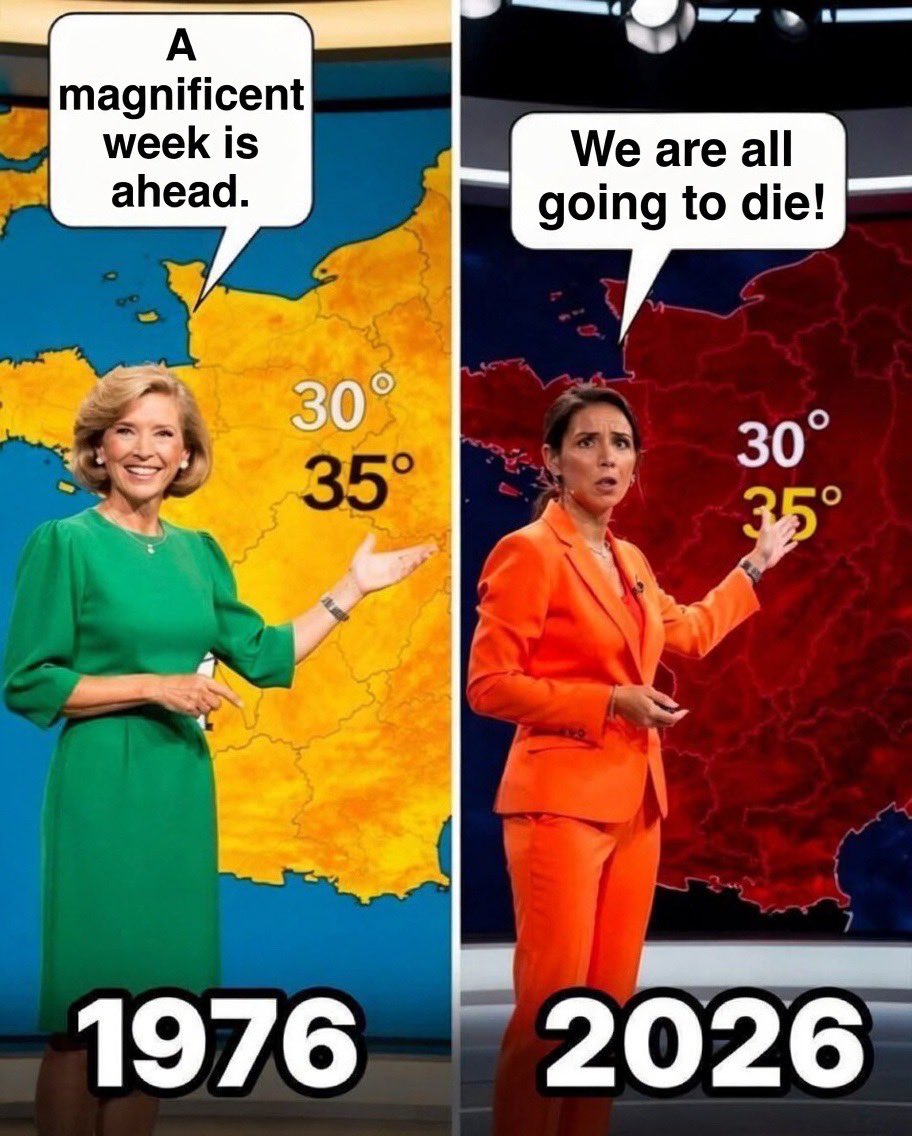
John Robson calls out the extreme rhetoric employed by environmentalists and their journalist flappers to try to keep climate anxieties as high as possible, especially if there haven’t been any new alarming climate-related events to build on:

The New York Times engages in some classic yellow journalism with “Climate: Disaster Survivors Sticking Together” teasing to a column by David Gelles that starts “Extreme weather is hitting more people with each passing year”. But it’s not, even though there are more people for it to hit with each passing year as the climate crisis coincides strangely with unprecedented human material flourishing and a 99 percent drop in climate-related fatalities. We accept that there is room for intelligent and well-meaning debate about facts as well as their meaning. But the drumbeat of assertions by climate fanatics that the weather is getting worse when it’s just not crosses the line into bad-faith bellowing ignorance.

Another Times story titillates with a “CALCULATOR” of:

    Is Your City Prepared for Climate Disaster? A new report ranks the world’s large cities on how well they have adapted to face climate risk.

What exactly “climate risk” is, unless they mean bad weather, is not explained. Why the Times thinks bad weather is new is also not explained. What the Times thinks of the fact that even as global population soars, the number of people killed every year by bad weather has plummeted, not the proportion but the absolute number, is apparently nothing. Instead they lead off:

    When it comes to the effects of hostile climates – flood, fire and more – what matters isn’t just inherent risk, but rather the ability of a place to withstand that risk.

Well, duh. And clearly wealthier societies are far better able to withstand that risk, so even if you believe that fossil fuels make the weather a bit worse, the tradeoff is well worth making. But so is the effort to see if the weather is getting worse.

Now we don’t deny that “fire” is a hostile climate. But if it’s an “effect” of hostile climate, then the climate has always been hostile since what evidence we have says there were a lot more wildfires two and three hundred years ago than there are now. Don’t wait for them to credit CO2 with the decrease though … since they didn’t bother looking it up.

That story also blathers about how things from “early warning systems” to “governance” can “significantly mitigate the effects of climate change” although climate change is not a causal force it’s a statistical description of how the weather has altered in some place over at least 30 years. And it says Chicago is the most resilient city with “low hurricane risk” due, we point out, not to them building a big windbreak or something but it not being in the path of the hurricanes that regularly sweep through other parts of the US and have for as long as there have been observers to flee them shouting “Whoa Nelly a twister!” Moreover:

    Many of the least resilient places were South Asian cities with extreme exposure to floods and monsoons to which they were poorly adapted.

And if the Times seriously thinks monsoons are a new and horrible consequence of the gasoline-powered automobile you should cancel your subscription before it puts some other nonsense in your head. Like that floods and mudslides in rural Nepal and Tibet are relevant to urban resilience.

Media outlets have always had a strong bias toward reporting bad news, “If it bleeds, it leads!” but on the climate beat, there’s never any good news to report because everything — warming, cooling, precipitation, seasonal change — has to be presented in a negative light.

“The fertility crisis is really the equality crisis”

Filed under: Health, USA — Tags: , , , , , — Nicholas @ 03:00

On the social media site formerly known as Twitter, Devon Eriksen responds to a post about the need for middle class couples to budget excessive amounts of money before starting a family:

It’s not about the money.

Money has an effect, yes, but it’s a part of something bigger.

Women are genetically programmed to mate up. Not down. And not even across. Up. If she doesn’t regard a man as superior to her, she generally doesn’t want to have his babies.

What this means is that there is an extremely simple control dial on fertility.

More male power and status = more babies.
More female power and status = less babies.

Yes, it really is that simple.

Why? Because every species has a mating ritual, and can only breed if they can carry it out. That’s why you can breed rats and chickens in cages, but not pandas. Different mating ritual.

And a critical element of the human mating ritual is “male impresses female”.

Not charms. Not bribes. Definitely not respects.

Impresses.

So, if you take power, wealth, and status away from men, and give it to women, you are just plain reaching for the controls and turning down the fertility dial.

If you let men keep power, wealth and status — you don’t have to give it to them because they’re the ones who create it — fertility goes up.

The fertility crisis is really the equality crisis.

This idea might horrify you. You might have been taught all your life that everyone is equal, or must be, and anything else is unfair.

Well, have you looked around you at universe? Unfairness is baked into the life cycle of every living organism, not mention the food chain. Evolutionary processes don’t care about fairness. They care what works.

Perhaps someday, we will be able to code DNA as easily as we code C++, and can decide what we want our instincts to be. But until that day, we are faced with a choice.

1. Stop using the political, legal, and mass media processes to force female equality, if not outright female supremacy, on the first world.

Or

2. Die out and be replaced by third world retards, who will stay on this planet fighting wars with increasingly rusty AK47s and then spears, until the next asteroid comes along.

Tom Holland Explains the Entire History of Wine in 72 Minutes

The Rest Is History
Published 5 May 2026

What does The Odyssey teach us about the history of wine in the ancient world? How did Julius Caesar use wine to conquer the world? And why was The Judgement of Paris – when America took on France – the most controversial incident in the history of wine?

Join Dominic and Tom as they discuss the long history of wine; from ancient Jordan, to Bronze Age Greece, to the Vikings, and beyond …

00:00 The complete history of wine in 8,000 years
00:41 Lloyds
02:14 Pliny the Elder and the first wine snob
06:02 Why wine is such a rich subject for history
09:27 Noah, Mount Ararat and the biblical origins of wine
11:31 Georgia, Armenia and the world’s first wineries
13:15 The Canaanites and the invention of the wine trade
16:19 The Phoenicians, Greeks and wine culture across the Mediterranean
18:32 How Rome created the first international wine culture
20:32 Wine, slavery and the Roman conquest of Gaul
23:12 Italy becomes the heartland of Roman wine
24:40 How Christianity preserved wine after Rome’s fall
27:22 Why Islam transformed the history of wine
30:09 Wine drinking, loopholes and the caliphs
33:41 Rumi, Sufism and wine as a metaphor for divine love
37:29 England and the invention of the modern wine bottle
40:08 Kenelm Digby and the rise of English bottles
43:22 Cork, port and the Methuen Treaty
45:12 The English invention of the corkscrew
47:10 How French became the language of wine
50:07 Samuel Pepys discovers Haut-Brion
52:33 First growths, Bordeaux and the hierarchy of wine
56:09 Why wine was once an elite English obsession
57:49 Terroir and the spiritual language of French wine
1:00:59 The Judgment of Paris
1:03:57 Prohibition and the collapse of Californian wine
1:06:19 The blind tasting that humiliated France
1:08:08 Stag’s Leap and California’s victory
1:09:11 How New World wine changed the industry
1:10:44 Wine, competition and partnership
1:11:46 Henry Jeff, the bonus episode and the Mona Lisa

Video Editor: Jack Meek, Adam Thornton & Harry Swan
Social Producer: Harry Balden
Producers: Aaliyah Akude & Tabby Syrett
Senior Producer: Callum Hill
Executive Producer: Dom Johnson
Head of Digital & Social: Sam Oakley

QotD: Socialism and the world wars

What gave socialism a shot was that the hypertrophic nationalism of the first half of the twentieth century plunged the world into not just one but two world wars. Without these catastrophes, it is inconceivable that so many devotees of Marx would have come to power in the seventy years after 1917. The world wars made the case for socialism in multiple ways. First, they seemed to confirm the destructive tendencies of “imperialism, the highest form of capitalism”, in Vladimir Lenin’s words. Second, they greatly expanded the role of the state, which became the principal purchaser of goods and services in most combatant countries, creating precisely the kind of state-controlled economy that socialist theory claimed would perform better than free markets. Third, the wars acted as a great leveler, imposing very high marginal rates of taxation, wage controls, and price controls in ways that tended to reduce wealth and income disparities. Fourth, in 1917 the German government financed the Bolshevik coup in Russia that brought Lenin to power.

The tragedy was that those who promised utopia generally delivered hell on earth. According to the estimates in the Black Book of Communism, the “grand total of victims of Communism was between 85 and 100 million” for the twentieth century as a whole. The lowest estimate for the total number of Soviet citizens who lost their lives as a direct result of Stalin’s policies was more than 20 million, a quarter of them in the years after World War II. Mao alone, as Frank Dikötter has shown, accounted for tens of millions: two million between 1949 and 1951, another three million by the end of the 1950s, a staggering 45 million in the man-made famine known as the Great Leap Forward, yet more in the mayhem of the Cultural Revolution. Even the less bloodthirsty regimes of Eastern Europe killed and imprisoned their citizens on a shocking scale. In the Soviet Union, 2.75 million people were in the Gulag at Stalin’s death. The numbers were greatly reduced thereafter, but until the very end of the Soviet system its inhabitants lived in the knowledge that there was nothing but their own guile to protect them from an arbitrary and corrupt state. Other communist regimes around the world, including the very durable dictatorships in North Korea and Cuba, were strikingly similar in the miseries they inflicted on their own citizens.

The various socialist regimes could not even justify their murderous behavior by providing those they spared with higher living standards than their counterparts living under capitalism. On the contrary, they were economically disastrous. The collectivization of agriculture invariably reduced farming productivity. A substantial proportion of the victims of communism lost their lives because of the famines that resulted from collectivization in the Soviet Union and China. North Korea had a similarly disastrous experience. Central planning was a miserable failure for reasons long ago identified by Ludwig von Mises, Friedrich Hayek, and Janos Kornai, amongst others. Indeed, the economic performance of strictly socialist countries got worse over time because of rigidities and perverse incentives institutionalized by planning.

Moreover, the evidence is clear that, as countries moved away from socialist policies of state ownership and toward a greater reliance on market forces, they did better economically. The most striking example — but one of many — is that of China, which achieved a true great leap forward in economic output after beginning to dismantle restrictions on private initiative in 1978. After the collapse of “real existing socialism” in Central and Eastern Europe in 1989 and the dissolution of the Soviet Union in 1991, there was widespread recognition (the “Washington consensus”) that all countries would benefit from reducing state ownership of the economy through privatization and from lowering marginal tax rates. […] the highest marginal personal income tax rate was reduced in nearly all Organisation for Economic Co-operation and Development (OECD) countries between the mid-1970s and mid-2000s.

Niall Ferguson, “Capitalism, Socialism and Nationalism: Lessons from History”, 2020-02.

Powered by WordPress