Quotulatiousness

October 7, 2026

Lessons from Patrick O’Brian’s Master and Commander

Filed under: Books, Britain, History, Media, Military — Tags: , , , — Nicholas @ 05:00

As a child, I was a very early fan of C.S. Forester’s series of novels on the career of Horatio Hornblower, so I was a bit wary about reading Patrick O’Brian’s new-to-me stories set in the same period. A friend from Halifax practically forced Master and Commander on me during my first visit to Nova Scotia and I quickly picked up Post Captain, HMS Surprise and a few more in the series. At Athena’s Bridge, Mike Hennelly makes the case that there are valuable leadership lessons that can be learned from O’Brian’s work:
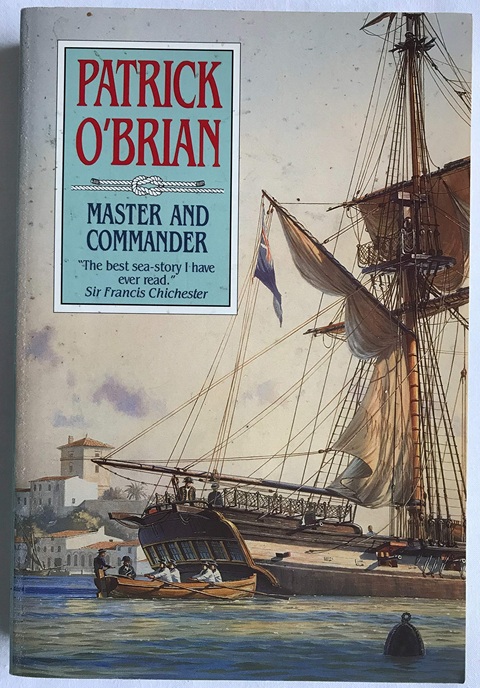
Cover from a later printing than the one I read in 1982.

In the study of leadership, there are many who say that there is nothing to be gained from novels or movies. Their argument is that only the study of reality (real CEOs, real generals, real political leaders) will yield insights of value for the study and practice of leadership. The purpose of this essay is to argue the opposite case. One of the most remarkable literary achievements of the 20th century was Patrick O’Brian’s multi-volume depiction of British naval life during the Napoleonic Wars. Eventually stretching to twenty books, O’Brian gives us the lives of Captain Jack Aubrey and his great friend, Doctor Stephen Maturin. A reviewer from the New York Times stated (rather categorically) that O’Brian’s books are “the best historical novels ever written”. O’Brian’s characters finally appeared in a movie entitled Master & Commander and the film faithfully captures much of the atmosphere and spirit of this maritime world.

O’Brian’s world, both in the books and the movie, is surprisingly faithful to the world of the Royal Navy during the Napoleonic Wars. He brings to life the nature of the great naval leaders of the time, the victories they achieved and the hardships they endured. As O’Brian himself notes, “I have gone straight to the source for the fighting in this book. I have log-books, official letters, contemporary accounts or the participants’ own memoirs“. What follows is not a review of the movie nor a synopsis of the plot. This is an essay that uses one particular movie to frame a discussion of leadership in realistic, uncertain and risky circumstances. Our focus is the character of Jack Aubrey – created by Patrick O’Brian, visualized by director Peter Weir and brought to life by actor Russell Crowe. An examination of Aubrey’s behavior and attitudes throughout the movie provides a wealth of insight into the mystery that is called leadership.

To begin at the beginning, a consideration of the term “master and commander” brings two curious facts to light. First of all, in the early days of the Royal Navy, this term applied to two people – not one. When English warships fought the Spanish Armada, for example, they had a “master” who was a life-long mariner with the nautical experience to sail the ship and a “commander” (frequently a noble) who was entrusted with the combat performance of the ship. Over time, this phrase was combined and came to describe the responsibilities of a warship’s captain. The second curious fact is that this term (as a job description) is incomplete. When Patrick O’Brian brought the character of Captain Jack Aubrey to life, he did so in a way that clearly shows that the term “master and commander” was an incomplete description of a captain’s responsibilities. HMS Surprise might be a ship (that needed a master to sail her) and she might be a weapon of war (that needed a commander to fight her) but she was also a collection of almost two hundred sailors of all sorts (who needed a leader to direct and influence their actions). To carry out all the responsibilities of a ship’s captain, Jack Aubrey needed to be a “master, commander and leader”. Without the ability to take a random set of landsmen and mold them into a cohesive, disciplined and skilled crew, he would not have been able to sail the ship safely nor would he have been able to exert any combat power.

“She’s a vastly heavier ship. She’s out of our class” (or, how leaders get others to face existential risk)

As the movie begins, it is the spring of 1805 and we are aboard HMS Surprise, a small Royal Navy frigate of 28 guns with a crew of 197 souls. The Surprise is under orders to find the French frigate Acheron and “sink, burn or take her as a prize”. The Surprise is off the coast of Brazil and approaching a fogbank when she is ambushed by the Acheron. Captain Aubrey is energized by the prospect of combat (“straight at ’em, Mr. Mowatt!“) but events soon take a turn for the worse as Surprise‘s rudder is shot away and the British barely escape safely into the fog.

We learn more about Aubrey as he faces a serious leadership challenge after this disastrous encounter with the French. The ship’s officers, somewhat in shock, are discussing the engagement and they observe that Acheron was “more like a ship of the line than a frigate” and “our shots couldn’t penetrate“. Their misgivings are understandable. HMS Surprise, with twenty-eight guns, is about as small as a ship can be and still be called a frigate. The forty-four guns of the Acheron make it far larger and more heavily armed than the Surprise and what this means in combat is that every broadside fired by the Acheron is almost four times the weight of a broadside from the Surprise. Aubrey’s command team assumes that the clear superiority of the French ship means the Surprise will have to abandon her mission and head home. But their misgivings are not in line with the attitudes of a) the British Admiralty, b) the British public and c) their captain. At this point in the war, most Britons and the Admiralty operate under the assumption that their navy should always project an aura of invincibility. This has been a British naval characteristic since the great British sea-victories at Camperdown (1797) and the Nile (1798). Furthermore, we find out that Jack Aubrey’s mental model of an ideal officer is Lord Nelson who was famous for his relentlessly aggressive behavior at sea. One of Nelson’s most famous sayings was “no captain can do very wrong if he places his ship alongside that of an enemy” and that is exactly what Aubrey intends to do to the Acheron. Aubrey quickly disabuses his officers of the idea of abandoning their mission. Positively radiating with decisiveness, he tells them there is not a moment to lose if they are to carry out repairs and catch up with the French.

Aubrey faces two challenges as he attempts to lead his ship into a situation of existential risk. First, he must gain the support of his officers and secondly, he must ensure the willingness of his crew. He addresses these concerns in turn. To gain the support of his officers and bolster their morale, he addresses their concerns with a discussion of battle tactics in a way that provides reassurance. Although the French ship has far more guns, Aubrey explains that the Surprise possesses intangible advantages that level the killing field. He is convinced that the Surprise is more maneuverable than the Acheron and he intends that his gun crews be better-trained and more effective than their French counterparts. Without any further dissent from his officers, the Surprise carries on with its pursuit of the bigger and more powerful enemy ship – which is a testament to the effectiveness of Aubrey’s leadership.

Aubrey’s approach to the crew about the threat of the Acheron is intensely practical in nature. The crew spend much of their time engaged in gunnery drill. Captain Aubrey has very high standards for the ship’s gunnery because he expects his gun crews to be both fast and accurate. Accuracy in naval gunfire is always a challenge because ships are inherently unstable firing platforms, but, in addition, the faster the rate of fire, the sooner a gun crew is exhausted with a corresponding reduction in accuracy. Aubrey’s standards, while achievable, are higher than the standard in naval fleets of the time. His standards require intensive, dangerous training which is the only way to produce highly disciplined and effective gun crews. To keep his crew motivated while they are training so hard, Aubrey gives them a rousing talk (Do you want to see a guillotine in Piccadilly? NO!, they roar back. Do you want your children to have to sing “La Marseillaise”? NO!). He also states his expectations in terms that every sailor can grasp – the gun crews of the Surprise must be able to fire two broadsides for every broadside fired by the Acheron. Over time, the crew of the Surprise is welded into a cohesive and effective fighting force; they take pride in their achievements and their confidence grows as they face the prospect of future combat.
The Korean War Week 120 – The Battle of White Horse Hill begins – October 6, 1952

Filed under: China, France, History, Military, USA — Tags: , , , , , , — Nicholas @ 04:00

The Korean War by Indy Neidell
Published 6 Oct 2026

The Chinese are busy this week; they open the floodgates of a reservoir and attack Arrowhead Hill, but it turns out these are diversions from their main attack, which begins the Battle of White Horse Hill. It does not at all begin well for the Chinese, although the ROK take pretty heavy casualties too. There are also plans afoot for a new UN offensive operation, and a naval exercise begins off the east coast.

00:00 Phone Call
00:50 Recap
01:21 Reinforcing ROK 9th Division
03:01 Diversions
07:02 Operation Showdown
08:47 Naval Exercise
10:38 Increasing the ROK
13:17 Commonwealth Division
15:43 Warsaw and Seattle
17:29 Summary
17:45 Conclusion

USAF re-evaluating the risks of stationing aircraft in Al Biriṭāniyā

Filed under: Britain, Military, USA, Weapons — Tags: , , , , , — Nicholas @ 03:00

The US military leadership got an unwelcome security wake-up call after a reported incident adjacent to a Royal Air Force base used by USAF B-1 bombers:

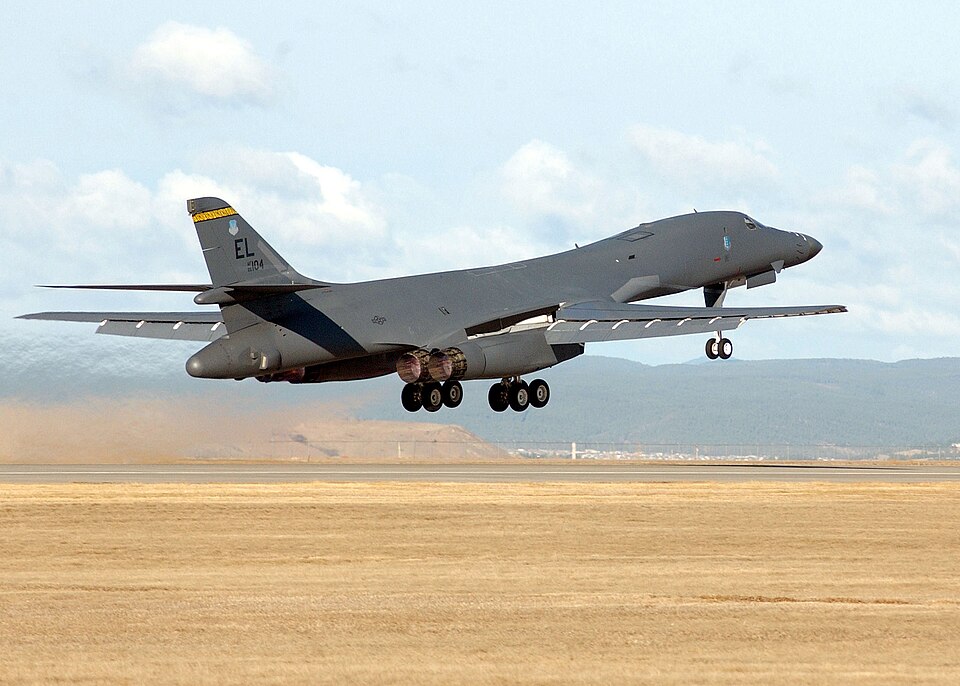
USAF B-1B Lancer takes off on a routine mission from Ellsworth AFB, South Dakota. Carrying the largest payload of both guided and unguided weapons in the Air Force inventory, the multi-mission Lancer is the backbone of America’s long-range bomber force.
USAF photo by Senior Airman Michael B. Keller via Wikimedia Commons.

To say that the reporting of the last few days about the sudden departure of our B-1B bombers from RAF Fairford has been frustrating — for me at least — is an understatement.

Airfield security has been a pebble in my shoe for a very long time. I assume everyone is familiar with my post from 11 months ago a bout the wake-up call at Whitman AFB? If not, give it a read, then come back.

Let’s all get our reference point first from last week.

    Five men who were arrested on suspicion of explosive and terrorism offences after a major incident was declared at an RAF airbase in the west of England have been released on police bail.

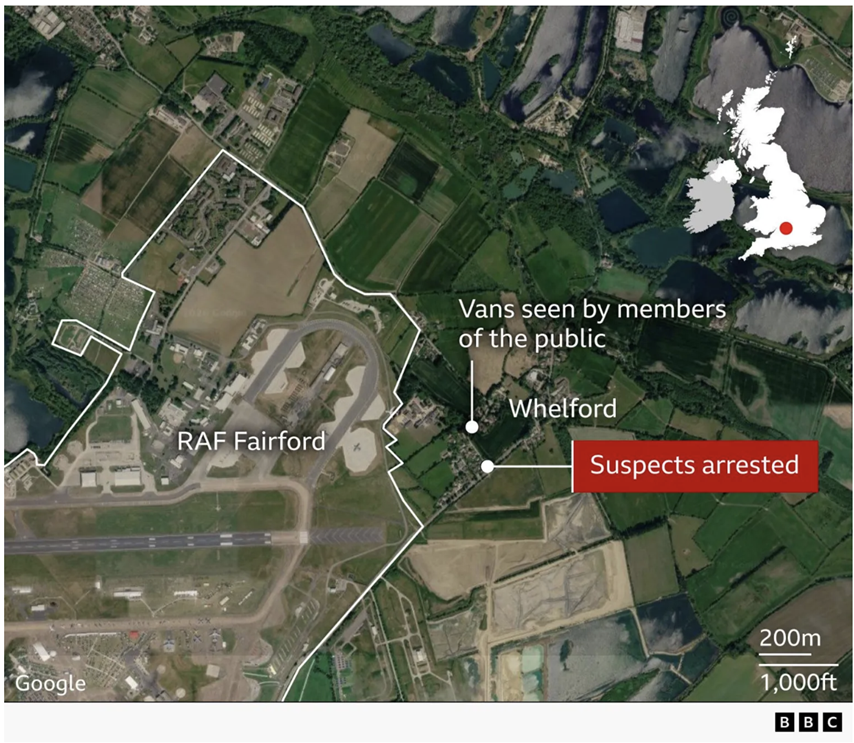
    Three vans were spotted near RAF Fairford in the early hours of Sunday morning and the police were called. A major incident was declared, and everyone in the small village of Whelford was evacuated.

    The head of Counter Terrorism Policing has stressed that the five men remain under investigation and must adhere to strict bail conditions. It has since come to light that the first of two 999 calls was made by one of the arrested men.

    A dual UK-Iranian national, aged 25, has also since been arrested on suspicion of preparing terrorist acts.

    Investigators are exploring “multiple lines of enquiry”, Assistant Commissioner Laurence Taylor said on Monday, including whether proxies or individuals were working on behalf of a foreign state — knowingly or not.

Like all professionals do, let’s go to the map room.

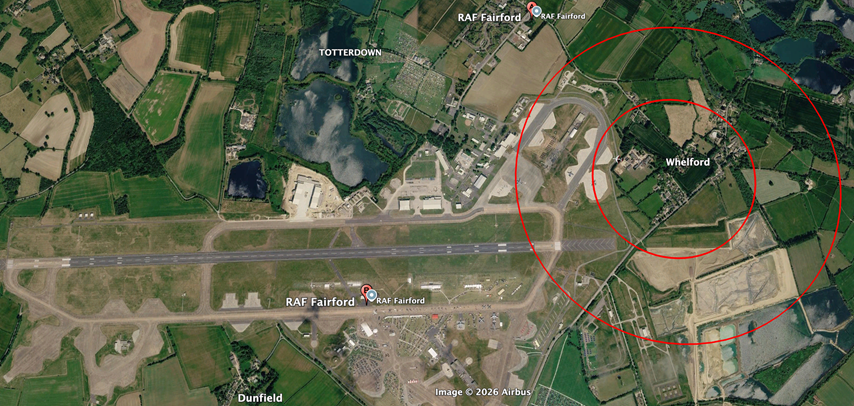
This is what the geometry looks like.

OK. Soak that in a bit. Whelford is one of the few little residential areas around this base where our literally irreplaceable heavy bombers were operating from. The parking apron they are using? There it is, right around where the “RAF Fairford” label is.

Now, let’s give you some scale. The smaller circle is 500 yards from where the vans and “fellas” were. The larger circle is 1,000 yards.

Put on your force protection hat. Remember Operation Spider Web from over a year ago and what it was warning us about?

I know for a fact that there has been a rather heated argument over whether we are simply taking too many risks with some of our “There’s nothing dangerous about this airfield! Why, four generations of my family have been flying out of here“. attitude. Habits, inertia, etc.

We Americans make some assumptions about distance that is simply not a reality overseas, especially in Europe.

Why do British trains still rely on century-old levers?

Filed under: Britain, History, Railways, Technology — Tags: — Nicholas @ 02:00

Tom Scott
Published 8 Jun 2026

At National Rail’s Manchester classroom, I learn why it’s very rare for trains to collide … and try out signalling for real.
(more…)

QotD: The cultural dominance of “Yankeedom”

People like to point out that the political Right in America, split as it is between redneck populists and classically-liberal free marketeers, lacks the European conservatives’ emphasis on order and tradition, place and class, throne and altar and blood and soil and so forth. And, pace various European immigrants over the years and a few weirdos on the Internet, that’s true. But it’s interesting to imagine what our politics might look like today if Tidewater had remained a force on the national stage and if any substantial strain in America could say, with John Randolph of Roanoke, “I am an aristocrat. I love liberty, I hate equality.”

So there’s Tidewater, lost and forgotten except for some guys in Virginia who still put on red jackets to hunt foxes from horseback — and maybe in slightly different voting patterns. What about the nation that won, the one that’s everywhere?

I refer, of course, to Yankeedom.

“But Jane,” you say, “Yankeedom isn’t everywhere! Scroll back up to your own map — it’s in New England, sure, and, uh, northeastern Ohio and, wow, okay, the entire Upper Midwest. But that’s not everywhere.” But ignore the map for a moment: that’s Woodard’s idea, based on settlement patterns and voting behavior. What is Yankeedom, really? What are its fundamental beliefs, its vision of how life ought to be, and where do they show up today?

Of course you know the story of Yankeedom’s founding: radical Calvinists from East Anglia, settled around the Massachusetts Bay in the 1620s and 30s, funny hats? Maybe you made one of those hats for your construction paper turkey in first grade — or, if you’re a little younger, maybe you learned a nice poem about welcoming new immigrants for a glowing future of multiculturalism and prosperity. In fact the emphasis on “the Pilgrims” in American civic mythology — never mind the traditional Thanksgiving menu, heavy on quintessentially New England dishes like pie1 — is itself a product of Yankeedom’s cultural dominance, as is the insistence in that familiar story that they left England for religious freedom. It’s true! They did! But there’s a very important final bit that we somehow leave out of the version we teach to elementary schoolers: religious freedom for themselves.

The earliest Yankees imagined their new society as a Protestant utopia, a new Zion, in which they would work out their collective salvation. Any deviation from the straight-and-narrow could doom everyone, so enforcing moral and religious conformity — through banishing heretics or, if necessary, even executing them — was of paramount importance. Yankeedom was meant to be a “city on a hill”, a model for mankind: if only they could be good enough, pure enough, and holy enough, God would bless them abundantly — and then everyone else, seeing their manifest blessings, would naturally emulate them and become holy themselves! The important thing, then, was not merely to do right but to be seen to do right, as an example to neighbors and foreigners alike. Yankeedom also put a tremendous emphasis on education (literacy was necessary to read the Word of God), encouraged subordinating the interests of the individual to the greater good of the community, and saw government as an extension of the citizenry. Government, then, since it was run by and for the people, was naturally called to propagate God’s will in a corrupt and sinful world by prohibiting or regulating immoral activities.

As Yankeedom moved west, out of the strict control of the Congregationalist ministers who dominated the New England colonies, they began to abandon their specific religious tenets. Sometimes this meant exciting new religious — the Yankee-settled western portions of New York State gave rise to such religious enthusiasms that people began to call it the “Burned-Over District“2 — but just as often it meant becoming a Methodist, Unitarian, or Baptist. Wherever they went, though, the Yankees clung to their belief that you could make earthly society resemble Heaven, or at least that there was no excuse for not trying as hard as you could. Yankees were at the heart of every push for social reform, from abolitionism and the temperance movement to Reconstruction, the minimum wage, women’s suffrage, and an end to child labor. For example, the members of New York City’s Committee of Fifteen, which militated against gambling and prostitution, were mostly Yankees or German-Jewish immigrants; none were culturally New Netherlanders.

By now this should all be sounding familiar. Heavy emphasis on education, embrace of the government regulation or prohibition of immoral behavior as the central bulwark of societal virtue, extremely visible adherence to highly specific rules and norms of behavior as proof of righteousness? Oh, look, it’s woke! It’s the ideology of the professional-managerial class, the meritocratic elite — it’s the same people with the same bumper stickers on the same Mercedes SUVs in the Whole Foods parking lot that you see in every major American city, regardless of which “nation” most of the other residents belong to.

There are two things going on here, I think: first, high-cultural capital Americans are far more mobile than they used to be. Plenty of people spend a few years in DC, then a few years in Austin, or maybe San Francisco or Boulder or Brooklyn, regardless of where they grew up. Second, and perhaps more important, is the role of education. Maintaining or improving your class position depends far more on a “good” college than it used to (witness the to-do when someone claims the distinction of Harvard on a night school degree!). The Yankee emphasis on education means that most of America’s prestigious colleges and universities are in Yankee-settled areas.3 Thus, membership in a higher stratum of society practically depends on four or eight years marinating in Yankeedom. What’s a kid from rural Nebraska to do?

Jane Psmith, “REVIEW: American Nations, by Colin Woodard”, Mr. and Mrs. Psmith’s Bookshelf, 2024-02-19.


  1. Harriet Beecher Stowe, in Oldtown Folks, as quoted in Albion’s Seed:
  2. “The pie is an English institution, which, planted in American soil, forthwith ran rampant and burst forth into an untold variety of genera and species. Not merely the old mince pie, but a thousand strictly American seedlings from that main stock, evinced the power of American housewives to adapt old institutions to new uses. Pumpkin pies, cranberry pies, huckleberry pies, green-currant pies, peach, pear, and plum plies, custard pies, apple pies, Marlborough-pudding pies, — pies with top crusts, and pies without, — pies adorned with all sorts of fanciful flutings and architectural strips laid across and around, and otherwise varied, attested the boundless fertility of the feminine mind, when let loose in a given direction.”

    For more on the history of distinctly American pies, including why they’re so different from the English pies you may have seen on The Great British Bake-Off, I highly recommend BraveTart: Iconic American Desserts, which is somehow both the best history of American sweets I’ve ever read and the best cookbook for them.

  3. Famous alumni of the Burned-Over District include the Seventh-Day Adventists, John Humphrey Noyes’s Oneida Community, and the Church of Jesus Christ of the Latter-Day Saints. (Yes, Mormons are Yankees. Obviously.) But my favorite wacky Yankee religious enthusiasm — actually in Massachusetts, where they weren’t branding people with H for heretic any more — was John Murray Spear‘s “New Motive Power”, an attempt to build an electric perpetual motion machine Jesus.
  4. The exceptions are generally the flagship school of a large non-Yankee region or in California, the culture of which I’ve entirely elided for reasons of brevity. Sorry. The tl;dr is that Woodard argues the “Left Coast” is a hybrid of Yankees settling the cities and Greater Appalachia in the countryside, which leads to culture fairly similar to that of Yankeedom.

Powered by WordPress