Quotulatiousness

October 21, 2026

The first modern wine critic: Philip the Bold of Burgundy

Filed under: Europe, France, History, USA, Wine — Tags: , , , , — Nicholas @ 05:00

In The Critic, Henry Jeffreys identifies the first post-Roman Empire wine critic in the noble person of Philip II, Duke of Burgundy, who, in 1395 …
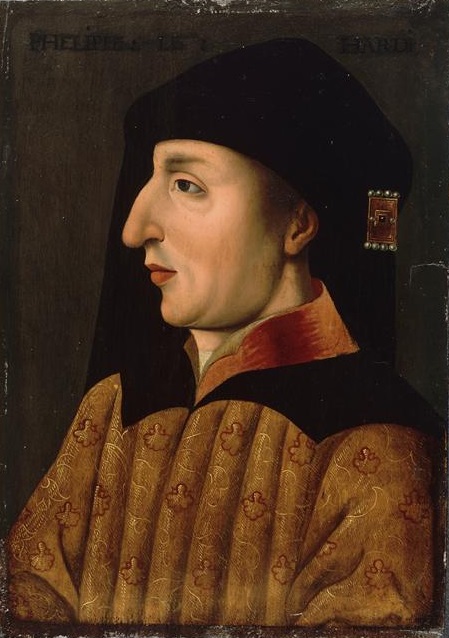
Philip the Bold (Philip II, Duke of Burgundy), 1342-1404.
Unknown painter of the Flemish School via Wikimedia Commons.

… banished the Gamay grape from his lands, describing it as an “evil and disloyal” plant. The only grape for Philip was Noiriens, known today as Pinot Noir.

Peasants loved Gamay because it ripened early and produced lots of grapes but Philip wanted small quantities of high quality wine which Pinot Noir is better suited for.

And that’s how it’s been ever since: Gamay has been shunned in Burgundy, going only into the cheapest wines, whereas Pinot Noir is lionised around the world.

Wine 101 says that some grapes are better than others. It’s common for wine-lovers to have a favourite and often a least favourite grape. Philip the Bold was way ahead of his time here. Most wine drinkers didn’t catch up with grape varieties until much later.

We have an American, Frank Schoonmaker, to thank for this. In the 1940s he came up with the idea of labelling California wines by variety rather than giving them fake French names like Hearty Burgundy or Mountain Chablis.

It took a while, but this is now the established way of classifying wines. For Schoonmaker there was a hierarchy of varieties with the great French ones, naturally, at the top. He wrote in his book American Wines: “There are only about 30 or 40 superior grape varieties in the world and only about a dozen are capable of producing great wine. No really distinguished wine has ever been made from an inferior grape.”

Some grapes were good and some were bad. In the 1980s and 1990s the French government encouraged growers in the Languedoc to pull up their Carignan and Cinsault vines and replace them with so-called cépages améliorateurs, improving varieties, like Syrah or Cabernet Sauvignon. You can understand the logic. Syrah sells, whereas the traditional grapes have a Gamay-like tendency to produce lots of grapes of mediocre quality if overfertilised and not pruned severely.

In Chile, Cinsault is known as “cargadora” meaning the loaded one. Home gardeners will know exactly this tendency. When growing tomatoes, some strains produce massive quantities of fruit with very little flavour. In contrast, we had a plant last year that produced only one piece of fruit the whole summer — but it was exceptionally tasty. I am sure Philip the Bold would have approved.

In the 1970s, Canadian winemakers were selling beverages labelled as “Burgundy” and “Claret”, but after the French government and then the EU started getting pushy about wines named for the great French wine traditions, they eventually got onto the same naming pattern pioneered by Schoonmaker and other Californian winemakers. If “truth in advertising” laws had applied to wine, those 1970s Canadian wines would have had consumer-deterring names like “oversweetened alcoholic grape juice” and “made from randomly selected grapes of unknown provenance”.

Can you tell I don’t miss any of the Canadian wines I sampled in the 1970s?

The Korean War Week 122 – One Showdown Ends, Another Begins- October 20, 1952

Filed under: China, History, Military, USA — Tags: , , , , — Nicholas @ 04:00

The Korean War by Indy Neidell
Published 20 Oct 2026

One fight comes to an end as another gets going- the ROK forces are victorious and drive the Chinese completely off of White Horse Hill, but Operation Showdown, a larger battle involving a whole hill complex, is indecisive as the week ends despite a lot of brutal fighting. Away from the battlefield the question still remains — will the peace talks resume or is diplomacy at a dead end?

00:00 Cold Call
00:58 Recap
01:13 White Horse Hill
04:47 Operation Showdown
08:46 1st Battalion
11:59 Pike’s Peak
14:24 Peace Talks End
16:25 Summary
16:36 Conclusion
17:50 A Call to Arms

Capital gains tax is legalized theft

Filed under: Bureaucracy, Business, Economics, Government, Politics, USA — Tags: — Nicholas @ 03:00

On the social media site formerly known as Twitter, Handre explains the iniquity of most “capital gains” tax schemes in the west:

Capital gains tax is theft, committed twice against the same dollar.

You earn income. The government takes its cut immediately, in the US it’s between 22% and 37% depending on your bracket. What remains is yours, after-tax money, already processed through Washington’s collection machine. You choose not to spend it. You save it, invest it, buy assets with it. The discipline required to delay consumption is precisely the behavior that funds capital formation across the economy.

Then the asset grows. You sell it. The government appears again, demanding 20% (plus the 3.8% Net Investment Income Tax for higher earners) on the nominal gain, which often includes pure inflation adjustments that represent no real increase in purchasing power whatsoever.

The IRS treats your patience as a second taxable event. The original dollar was already taxed. The “gain” frequently reflects nothing more than the dollar losing value while you held the asset. Murray Rothbard identified this pattern: the state punishes capital accumulation.

Consider a simple case. You invest $50,000 of after-tax earnings in 2016 into an S&P 500 index fund. By 2026, it’s worth $115,000. Inflation consumed a meaningful slice of that $65,000 gain. You pay capital gains tax on the full nominal figure regardless.

Capital gains taxation suppresses investment, shrinks the capital pool available for productive enterprise, and forces entrepreneurs to seek financing from a shallower pond. Fewer productive investments get made. Workers carry that cost through lower wages and fewer opportunities. The state expands, while you suffer.

Pachelbel Rant

Filed under: History, Humour, Media — Tags: — Nicholas @ 02:00

RobPRocks
Published 5 Nov 2019

The original Pachelbel Rant in full resolution! I found the transcode file from the original mini DV tape!

Thank you to everyone who liked, shared, translated, and commented on the Rant over the years. It’s been so exciting to hear about how people have found the video — some through music class in school, some found it through friends, some found it by googling Pachelbel to find Canon in D (Ha! Take that, Johann!)

If you’re curious I’m still performing comedy music, I put out a live concert album in early 2019, I regularly perform in New York, the occasional cruise ship, and I write and produce music for myself and other artists.

Turn on closed captioning for the official transcript, here are the songs referenced:

2:21 Graduation (Friends Forever), Vitamin C
2:32 Cryin’, Aerosmith
2:43 One Tin Soldier, Coven
3:35 Hook, Blues Traveler
3:45 Basket Case, Green Day
4:11 Push, Matchbox 20
4:15 Good, Better Than Ezra
4:17 Machine Head, Bush
4:21 With or Without You, U2
4:25 Torn, Natalie Imbruglia
4:28 Sk8r Boi, Avril Livigne
4:32 We’re Not Gonna Take It, Twisted Sister
4:36 Laverne & Shirley Theme Song
4:40 No Woman No Cry, Bob Marley
4:43 Let It Be, The Beatles

QotD: Religious institutions in the late western Roman Empire

… the decline of political and civic institutions did not mean the decline and destruction of every sort of institution and this is particularly obvious with the survival of the institutional Church. It is important here to stress at the beginning how Roman an institution the Church was by the start of the fifth century. After Constantine (with a brief hiatus under the emperor Julian) the “catholic” church (that is, the institutional Church which conformed to the “right” sort of Christianity) had been the continued recipient of imperial benefaction: emperors built churches and funded Church activity. This was itself very Roman, reflecting a continuation of the role that pagan emperors had played in previous centuries, demonstrating their piety by building temples and reviving old religious practices. The emperors had not “gotten religion” but merely changed religion and so changed their religious benefaction accordingly.

The emperors and the Roman state had also taken an active role beginning in the fourth century in defining exactly what the “right” sort of Christianity was. In response to a dispute over the ordination of bishops in North Africa (the “Donatist” schism), Constantine called a council of bishops to convene in Arles in 314 to resolve the matter (it didn’t work and Constantine began persecuting the remaining Donatists). But that council would hardly be the last – Constantine convoked the first ecumenical council (one that in theory reflected the entire Christian Church) in Nicaea in 325 in order to create a single universal Christian doctrine and resolve a number of internal disputes (having grown as a religion in secret and facing persecution, as you might imagine Christianity had a lot of significant local variations). The emperor Theodosius I (r. 379-395) convened the next major council at Constantinople in 381; after that it was the emperor Theodosius II (r. 402-450) who convened the next at Ephesus in 431 and then the emperor Marcian (r. 450-457) who convened the next at Chalcedon in 451. All of these councils served to define what the “right” Christianity was (“Chalcedonian” Christianity, named after the council), putting some belief systems outside of the doctrine of the Roman Church.

But whereas other Roman institutions didn’t survive the collapse of Roman political authority, the Church as an institution very much did. It was perhaps not obvious that it would – many of the “barbarians” had embraced a non-Chalcedonian Christianity, Arianism, and so might have been hostile to the Church as it existed in Rome. But in practice the need to consolidate the loyalty of their Roman Chalcedonian Christian subjects (on this, note Brown, op. cit. 2nd ed., 105-6, 133-8) and the prestige that the institutional Church held led the rulers of Rome’s successor states to convert to Chalcedonian Christianity; the last of the major Arian Christian kings was Garibald, King of the Lombards in 671.

Indeed, the institutional Church was in some ways a lifeboat in which other elements of the Late Roman world were carried through the storm of the fifth century into the Middle Ages. We’ve already talked about the Church’s role in preserving a fair chunk of the Latin literary tradition. Much of this was done through the spread and then perseverance of monasticism. The first communities of monks emerged in the Eastern Roman Empire in the fourth century and spread through the failing Roman Empire in the fourth and fifth centuries. The Western monastic tradition builds from this with the foundation of Monte Cassino in 529 by Benedict of Nursia and the promulgation of the Rule of Saint Benedict.

Meanwhile, the Church also emerged as one of the central institutions in the cities of the Roman world, with the bishop, the religious head of the Church in a given city, emerging as a key figure in civic governance. While the figure of the bishop rose to importance in both the east and the west, in the east, bishops largely did not move into becoming secular leaders alongside religious figures, in part presumably because the central Roman authority still existed to handle those functions. But in the west, the decline of both civic and centralized government left bishops in the breach. This in turn often preserved older Roman political geography as Liebeschuetz notes, with the civitas surviving as an administrative unit in the form of the diocese of a bishop, precisely because those bishoprics were originally established along Roman administrative lines and remained so even after Roman administration vanished. Bishops ended up taking up some of the tasks that in the past would have fallen to a Roman governor and since they had their seats in the embattled Roman cities, many of those cities survived the difficult fifth and sixth centuries precisely because they were the seat of a bishop.

And in order to run the institution of the Church, its bishoprics and their diocese, it needed both educated clergy who could read the Bible but also administrators who had learned the law – by which they meant Roman law. Secular learning had largely collapsed with the Roman Empire in the west – it had existed to provide training for wealthy men to become secular administrators for the central imperial government and so when the demand for that kind of training vanished, so too did the schools that trained the administrators and jurists. And so the Church had to train them itself, setting up episcopal and monastic schools which trained theology, but also law and administration (and of course provided the context for that survival of Latin literature as a teaching tool). As levels of education and literacy among the secular elite declined, it made sense for kings to employ bishops and other members of the clergy as members of their own administration, leading to this distinctly Roman religious institution having a key place within the secular “barbarian” kingdoms that followed.

Bret Devereaux, “Collections: Rome: Decline and Fall? Part II: Institutions”, A Collection of Unmitigated Pedantry, 2022-01-28.

Powered by WordPress