Quotulatiousness

October 19, 2026

“If alternative energy is a ‘lower-cost’ solution they shouldn’t need prodding from a wise and benevolent state”

Filed under: Cancon, Economics, Environment, Media, Politics, USA — Tags: , , — Nicholas @ 04:00

John Robson points out that words do have meanings and calling expensive things “cheap” and cheap things “expensive” doesn’t actually change their economic or environmental value in the real world:

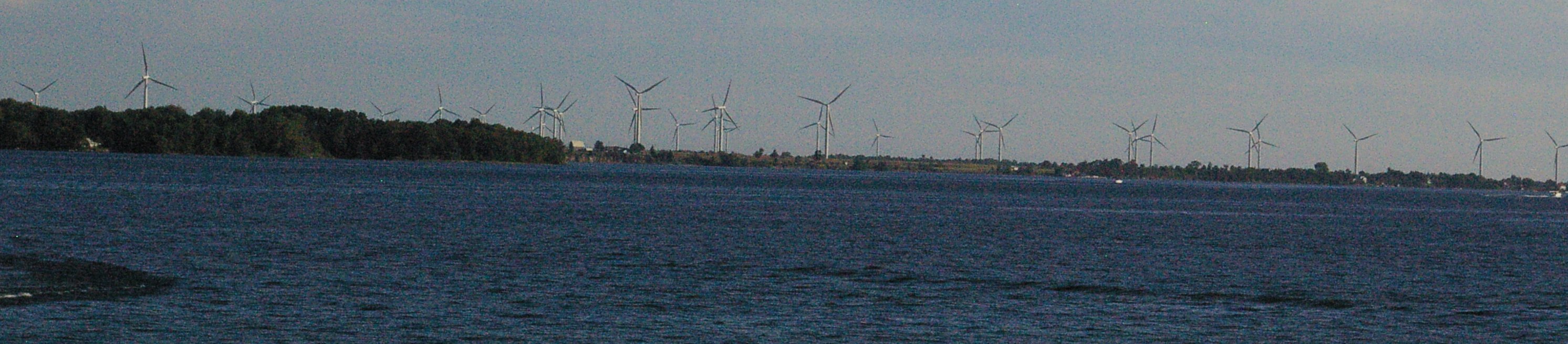
Martian fighting machines striding over Horsell Common … no, wait, these are actually wind turbines on Wolfe Island, near Kingston, Ontario.

When it comes to the alleged green energy transition and its flood of cheap power and paradisaically green, lucrative and fulfilling jobs, those with even fairly short historical memories will recall that the “Green New Deal” legislative package was meant to do for the US economy what Franklin Roosevelt’s “New Deal” had supposedly done in the 1930s. Those of us who think the main achievement of the “New Deal” was to extend a sharp recession into a decade-long depression through a massive set of taxes and regulations driven by inane economic theory, for instance plowing crops under to fight hunger under the AAA, didn’t even find that claim appealing. But others sure did, and with about as much to show for it.

As Wikipedia put it, after tracing uses of the term back to 2007:

    The 2019 United States congressional resolution Recognizing the duty of the Federal Government to create a Green New Deal introduced by Alexandria Ocasio-Cortez and Ed Markey advocated a ‘just transition’, counteracting previous systemic injustices that had disproportionally hurt vulnerable communities. A ‘just transition’ relies on increasing social and economic equity and access to opportunity which are crucial components of the Green New Deal and principles of environmental and social justice.

For these hyper adherents to Thomas Sowell’s “unconstrained vision”, just saving the planet isn’t enough. You also have to save the economy, eliminate injustice and after lunch world peace.

In Canada, where we pride ourselves so fiercely on our “elbows up” independence from the United States that we call our system of socialized medicine brought in back in 1966 “Medicare” after um uh the American program from 1964, there are calls for “A Green New Deal for Canadian Sovereignty” which appears to be the US version with maple syrup:

    This will allow us to quickly transition from an economy excessively reliant on serving the United States and based on exploitation and the burning of fossil fuels, to one that is more self-reliant, driven by dignified work, clean renewable energy, more equitable and with efficient public services for all.

Oh. Just that? Who knew giving up oil and gas in a cold northern country could fix government health care? Well, Greenpeace Canada, for one, with their 2019 infographic that includes “Create a plan for 1 million good green jobs” (shades of Mole from Pogo exclaiming “A plan! You’re right! I’ll need a plan!”). And with this one, wait, you also get “Indigenous rights” and “proportional representation” and “BETTER LIFE FOR ALL” and “Build clean industries”. Oh and “Grant personhood protections to forests and bodies of water”. And interfaith harmony and a guy in a wheelchair and all that there.

Mind you, the bit where you “Build clean industries” still appears to face a few minor hurdles, like building clean industries. And why just 1 million good green jobs? Why not 5 million, or 53 million, or 628 billion? Since climate transition enthusiasts don’t do practical well.

For instance Canary Media just launched a publication “California Wire” dedicated to telling you the transition that failed in California worked in California:

    I’m launching this newsletter at an intriguing moment in California politics. Democratic Gov. Gavin Newsom – who everyone knows is eyeing a run for the White House – has one last chance to show his true colors on energy and climate change. Rising electricity costs are a major issue in California, and Newsom must decide by the end of this month whether to sign a host of bills that could help cut utility rates while also advancing the state’s clean energy transition. What message does he want to send to Californians and the rest of the country?

Dude, he already “sent a message” that this GND is pie in the sky and energy gets more expensive not less. And not because he hid his “true colors on energy and climate change” but because he waved them in everyone’s face while shouting about the subject. So now all he needs to do is wave his pen? Yup:

    a few bills on his desk now could at least start the long slog of reforms that experts say will help make power more affordable.

Oh wait. Experts say. But long slog? Help make it more affordable? Why the Dickens isn’t it already more affordable since these kinds of people keep telling us wind and solar are now cheaper than oil and gas, and let’s not even mention coal, and Newsom’s true colours are wind and solar?

Indeed, he calls for:

    a precursor to setting up regulations that could steer them [utilities] toward prioritizing lower-cost solutions over expensive grid upgrades.

Talk about leaping into verbiage. And also error, since if alternative energy is a “lower-cost” solution they shouldn’t need prodding from a wise and benevolent state, and if they’re not, you’re just making things worse by persisting in your delusion.

British Columbia’s David Eby

Filed under: Cancon, Media, Politics — Tags: , , , — Nicholas @ 03:00

I barely pay attention to politics in my own province, so my knowledge of British Columbia politics is far less detailed. I do rather think of BC’s political class as maple-flavoured understudies to California politicians, which may not be fair … I’m not sure if it’s not fair to BC politicians or to the folks running California into the ground. At Without Diminishment, Geoff Russ looks at whether David Eby actually seems to love his adopted province or if he just values it for what it allows him to do:

David Eby, Premier of British Columbia
Photo from the Government of British Columbia via Without Diminishment

In the only televised debate of British Columbia’s provincial election, Premier David Eby tried to make it clear that he loves our province.

Are we sure about that?

We know there are people who come from afar to make a home here and go on to do incredible things for B.C. Names like Alberta-born Trevor Linden, W.A.C. Bennett from New Brunswick, and others are all enshrined in the pantheon of West Coast heroes.

If Eby’s record is any indication, he loves what B.C. can do for him. He uses provincial taxes to fund his political experiments and the premier’s office as a pulpit, while milking the treasury to save a buck in his personal life.

The best example of this was the way in which he took advantage of the $10-a-day subsidised daycare program, using it to save money despite the fact that he and his wife earn well over half a million dollars per year.

There was nothing illegal about Eby, a resident of B.C., putting his child in the daycare program. However, that scheme is clearly intended for struggling families and single parents, not a highly paid premier and his well-paid spouse. It was a gross, indecent decision, and there is no way around that.

All of Eby’s alleged affection runs in one direction.

Under his watch, the term “British Columbian” has been replaced in official guides with “people living in B.C.” because the former is allegedly harmful to Indigenous peoples, refugees and other newcomers, like the premier himself. As for British Columbians, the premier seems determined to give away every kilometre of public land in the name of “reconciliation”.

Who British Columbians are has been rendered a source of embarrassment that can only be handled with safety gloves, for they are “uninvited guests” in the government’s cosmology. More broadly, his party’s politics have converted that suspect sentiment into a permanent division between Indigenous peoples and, in the government’s view, apologetic interlopers. This is what constitutes “reconciliation”, according to the one indispensable figure.

That indispensable man arrived from Kitchener, Ontario, with a nose for creating trouble. At both the Pivot Legal Society and the B.C. Civil Liberties Association, Eby introduced himself to his new neighbours by disrupting the Olympics and trying to undermine the local police.

Like so many other Ontario-born transplants in the B.C. NDP, Eby decided that he, and he alone, knew what was best for British Columbians. Never mind that the Ontario NDP have only headed one disastrous government.

Aimpoint CS: Revolutionary Battery Life for the Swedish Home Guard

Filed under: Europe, History, Military, Technology, Weapons — Tags: , , , , , — Nicholas @ 02:00

Forgotten Weapons
Published 19 Jun 2026

The Aimpoint CS is an optic designed specifically for the Swedish Home Guard, which wanted a red dot that was extremely durable and also capable of being left on for 10 years on a single battery. This was a very challenging requirement, and Aimpoint considered two paths to meet it. One was a pulsed LED to reduce actual “on” time of the dot, but this did not prove successful. The other was a traditional red dot, with improved design and power circuitry to allow an extended battery life. The new system was integrated into Aimpoint’s other optics (including the US M68CCO contract).

Along with the improved electronics, the CS used a large (approximately AA size) 3.7V battery hard-wired into the case. Per Swedish request, the battery was not user serviceable, and the optics are returned to Aimpoint for battery replacement every 10 years (they are on their third such cycle now). It also includes a set of hard rubber backup sights on top and a small length of picatinny rail that was never really used (it was intended for accessories like laser modules).

The Aimpoint CS was developed in 2001, adopted in 2002, and deliveries of about 60,000 total began in 2003. It was used on Home Guard AK4 rifles, and also on AK5s. They were not sold on the commercial market, and are very scarce in the US.
(more…)

QotD: The “social norms” that enable society to exist

Filed under: Quotations, USA — Tags: , — Nicholas @ 01:00

The modern word “blockhead” […] was Lucy’s favorite label for the too-trusting Charlie Brown in the Peanuts comic strip. Lucy never tired of snatching away the football; Charlie fell for it every time. We all know the feeling: when you’re inching forward in the freeway exit lane, say, and another driver flies past and swerves onto the ramp at the last second; when your child has to complete her college-entrance exams within a designated time period, but your neighbor’s child gets twice as long because of a suddenly diagnosed “learning disability”; when you pay extra to have your pet travel in the airplane’s cargo hold but the yipping poodle across the aisle, an “emotional-support animal”, gets to ride on its owner’s lap for free. You didn’t know that you could get an emotional-support card just by claiming an anxiety disorder and paying a fee to an online agency? What are you — a chump?

What makes these indignities so infuriating isn’t just that a few people game the system. It’s that their selfish gambits work only because the rest of us follow the rules. If every driver mobbed the freeway exit from the passing lanes, traffic would come to a halt. The student who fraudulently obtains extra test time gets a leg up only if most other students stick to the original time limit. And if every pet were designated an emotional-support animal, airplanes and restaurants would become full-time menageries. (Some airlines have begun tightening rules on support animals for just this reason.)

Thousands of norms, rules, and traditions make civilized life possible. Some, like paying taxes or not littering, are enshrined in law. Others are informal. Most of us take pride in adhering to basic standards of etiquette and fairness, to say nothing of following the law. And we have a deep emotional investment in having the people around us follow these norms as well. There’s a reason that we call selfish, disruptive, or criminal behavior “antisocial”. We know that if everyone stopped paying their taxes, or started running red lights and shoplifting, our society would be on its way to collapse.

James B. Meigs, “The Chump Effect”, City Journal, 2020-11-15.

Powered by WordPress