Quotulatiousness

October 23, 2026

The Praetorian enforcer for Tiberius Caesar

Filed under: Books, Europe, Government, History — Tags: , , , , — Nicholas @ 05:00

In Quillette, an excerpt from Guy de la Bédoyère’s new book, Brief Lives of the Ancient World: Rulers, Rebels, and Robbers, on Sejanus, Praetorian Prefect for much of the reign of Tiberius Caesar:
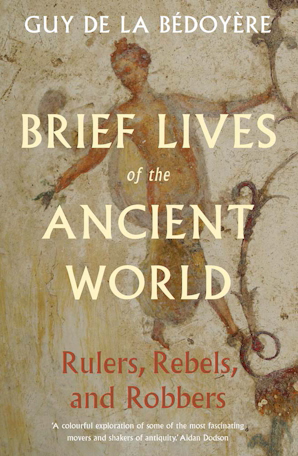
The story of Sejanus is dependent on the accounts of Roman historians, in particular Tacitus, who indulged himself with an unforgettable tale of treachery and dissimulation. His main purpose was to portray Tiberius as a sinister and manipulative tyrant, but he also succeeded in creating an allegory of cynicism at the heart of power.

Shortly after Tiberius’ accession in AD 14, the son of praetorian prefect Seius Strabo — Lucius Aelius Sejanus (born Lucius Seius) — was appointed co-prefect. Like his father, he was an equestrian, Rome’s second aristocratic tier, but had been adopted into the senatorial Aelii clan, hence his name change.

The adoption entitled Sejanus to a senatorial career, but he must have decided that the prefecture of the Praetorian Guard offered him more real power and personal access to the emperor. It also allowed him to avoid the suspicion that surrounded ambitious senators. Tiberius chose a few trusted equestrians to form part of his most intimate circle.

Within a year, Sejanus held the position on his own when his father was promoted to the prefecture of Egypt. Enjoying a trusted pedigree, he quickly inveigled himself into Tiberius’ favour. Sejanus was the first of the praetorian prefects to experiment with the power and influence the position enjoyed, and thereby also with the potential power of the guard as a political force.

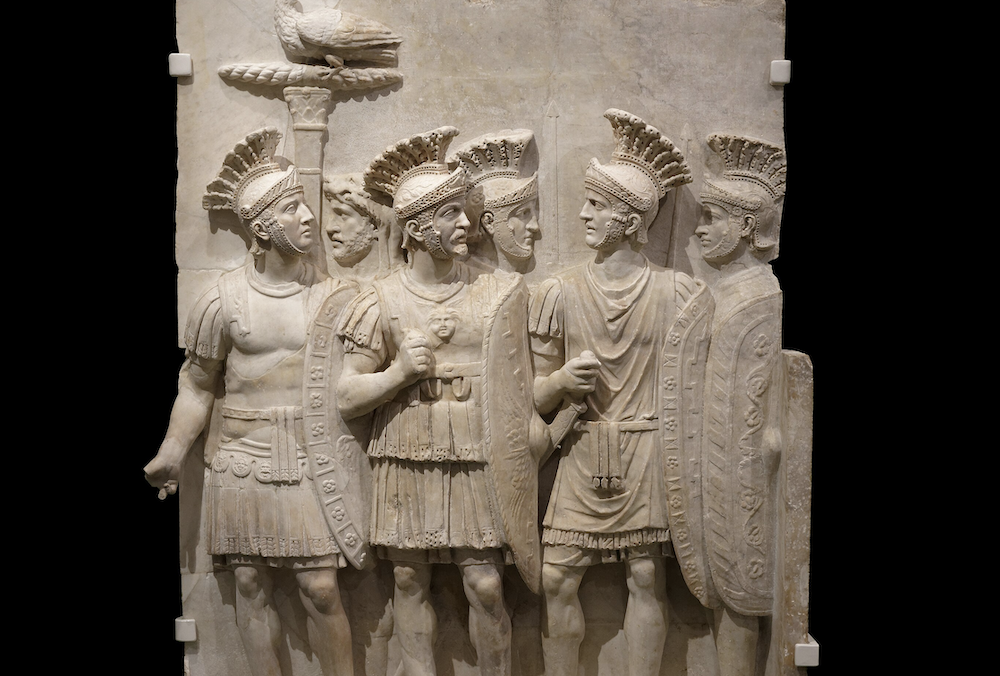
Detail from the Praetorian Relief, a Roman marble relief dated to c. 51–52 AD from the Arch of Claudius in Rome.

Sejanus was helped by chance, so often the principal agent in realising ambition. The huge theatre that had been built in Rome by Pompey Magnus in 55 BC burst into flames in the year AD 22. The fire was contained thanks to quick work by Sejanus, who used his position to tackle the emergency. Tiberius heaped praise on Sejanus for averting a catastrophe. The senate voted that a statue of Sejanus be erected on the grounds of the theatre.

In time, the career of Sejanus would expose how dangerous the commander of the guard could become. Tiberius ignored the signs, preferring to take as little interest as possible in the job of being emperor.

Sejanus made his first significant move in AD 23 when he installed all the praetorian cohorts in the Castra Praetoria, a fortified military camp in the northeastern part of the city. Under Augustus, they had been based at several locations in Italy, safely dispersed away from Rome, but may have already been brought into various barracks around the city under Tiberius. Their new dedicated fortress transformed the significance of the prefecture of the guard. The Castra Praetoria, which would remain a permanent feature until the guard’s disbandment under Constantine almost three centuries later, meant that the men were now directly and immediately under Sejanus’ control.

Faint signs of civilizational hope: “The Great Un-Karening”

Filed under: Health, Liberty, USA — Tags: , , , — Nicholas @ 04:00

It’s become old hat for Generation Jones and Generation X grizzled grognards to moan on about the almost-unsupervised “come back when the streetlights come on” childhood they remember in comparison to the over-scheduled, over-organized, over-computerized, hyper-supervised situation too many children now find themselves in. But there’s an occasional glimmer that things are changing:

The Great Un-Karening has begun, and decades of cultural engineering have finally run into something their architects cannot fucking control: human nature.

A seven-year-old conquers El Capitan, breaking his older brother’s record, and some sanctimonious busybody responds by reporting his father to Child Protective Services. Apparently, raising children capable of extraordinary achievements now qualifies as suspicious parenting.

And that tells you everything about the suffocating bullshit we’ve allowed to masquerade as progress.

For years, the helicopter-parenting crowd, DEI bureaucrats, ideological school administrators, and professional grievance merchants have worked to remake childhood in their own miserable image. Courage became recklessness. Masculinity became toxic. Independence became neglect. Every hurt feeling became an emergency, and every whining control freak acquired a fresh excuse to interfere.

They built entire systems around rewarding fragility, policing behavior, and teaching children to view the world through the narrow lens of identity, victimhood, and institutional permission.

And now the machinery is encountering resistance.

Kids are reportedly refusing school Pride Day activities. Parents are defending their children’s right to adventure. Twenty to forty neighborhood kids organized their own nighttime pursuit game, complete with strategies, head starts, and a mile-long course. Some neighborhood hall monitor called security.

The kids kept playing.

Fucking beautiful.

There’s the nightmare for the self-appointed guardians of acceptable behavior: children discovering they can organize their own lives without a diversity consultant, a school psychologist, or some miserable asshole clutching a rulebook.

And every independent decision chips away at the authority these people spent years accumulating.

The Karens can scream. The bureaucrats can threaten. The ideological busybodies can keep issuing commandments from their increasingly ridiculous little thrones.

The generation they expected to mold into obedient, perpetually offended dependents is discovering the exhilarating pleasure of telling them to piss off.

They tried to rewrite normalcy.

Now they’re watching the next generation reclaim it without asking their fucking permission.

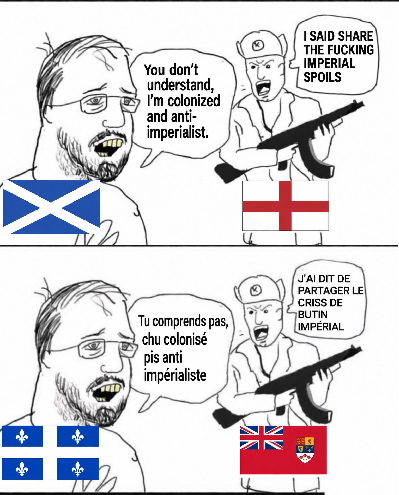
Quebec is to Canada as Scotland is to the United Kingdom

Filed under: Britain, Cancon, History, Politics, Religion — Tags: , , , , — Nicholas @ 03:00

On the social media site formerly known as Twitter, Fortissax explores the idea that Quebec’s relationship to the rest of the Demented Dominion closely resembles the sometimes awkward relationship between Scotland and the rest of the UK (but primarily England):

People have often compared the relationship between Anglo Canada and Quebec to that of England and Ireland, and while there are some similarities there particularly in the visceral emotions during the Cold War, I’d actually argue that Quebec is closer to Canada’s Scotland.

Scotland entered the British union in 1707 as an established kingdom with its own institutions and national consciousness. Québec entered Confederation in 1867 as the homeland of French Canadians, whose institutions and identity predated the Dominion.

Scotland and Quebec became elements of a larger political order while retaining separate identities. Both the English and Scottish can be British, both Anglo and French Canadians can be “Canadian”.

Scotland preserved its legal system and established church under the Union of 1707. Québec retained its civil law tradition, while the Quebec Act of 1774 protected Catholic religious practice and established important foundations for institutional continuity

Scottish identity has historically coexisted with British identity, just as French Canadian identity has coexisted with Canadian identity. In both cases, nationalists have disagreed over whether their distinctive peoplehood is best expressed through political independence or continued participation in a multinational union.

Scots were disproportionately involved in, and benefited enormously from, the British Empire, particularly through commerce, banking, industry, trade, colonial administration, and the military.

French Canadians likewise disproportionately participated in and benefited from the expansion of British North America and the Canadian economy, establishing banks, credit unions, grocery enterprises, factories, and steamship companies. They helped establish the Hudson’s Bay Company, the North West Company, explored vast swathes of the continent, contributed four Fathers of Confederation, and produced six prime ministers

Fast forward to 2026, certain Scottish and Québécois nationalists are suddenly smol wittle itty bitty decolonial Third World beans who dindu nuffin, possessed absolutely no historical agency, and were apparently dragged kicking and screaming into the imperial projects their ancestors helped build.

FN MAG Tactical with Long Rail Upgrade Kit

Filed under: Europe, History, Military — Tags: , , , , — Nicholas @ 02:00

Forgotten Weapons
Published 20 Jun 2026

The FN MAG is one of those guns that is so durable and well designed that it continues to be one of the best options in its field despite being nearly 70 years old. To meet the demand for mounting larger and heavier optics, particularly night-time clip on sorts, FN developed a long rail kit. This sounds like a pretty straight-forward thing, but adding lots of extra optics to the top cover has a number of second-order issues. To solve them all, the kit includes a strengthened hinge mechanism, overtravel stop, articulated barrel handle, and adjustable-length buttstock. The stock by itself is called the FN MAG Tactical, with the rest of the kit coming as a package. It is able to mount to any existing MAG, including all models of US M240 and British L7/GPMG.
(more…)

QotD: Peter Green on Epicureanism and Cynicism

Filed under: Europe, History, Quotations — Tags: , , , , — Nicholas @ 01:00

But if Stoicism was the shallow George W. Bush evangelicalism of its day, it at least fares better than Epicureanism, the other popular and enduring school of Hellenistic thought. The traditional Christian attack on Epicurus was that he was an atheist and hedonist. More modern scholars emphasize that Epicurus’s belief in pleasure as the highest good actually encourages moderation and avoiding pain or fear so as to achieve tranquility.

Green picks neither of these interpretations, instead arguing that Epicureanism was totally a cult. Epicureans joined communes after swearing oaths to obey “the Leader”, whom they “flattered like a god”. “Act always”, they were told, “as though Epicurus is watching”. The Leader “seems to have enjoyed droit de seigneur with several of his followers’ wives and mistresses”. In Epicurus’s famous Garden outside Athens, nobody actually worked, with the commune instead sustained in “endowed leisure” by donations extracted from supporters across the Mediterranean. “Send us, for the care of our holy body, first fruits on behalf of yourself and your children”, Epicurus writes to one of his disciples. In Green’s telling, “Epicureanism was, in the last resort, the brainchild of an antisocial and anti-intellectual dogmatist, with a bee in his bonnet about providential gods, and more than a passing urge … to replace the deity himself”.

Quite the cynical attitude … except that Green is just as harsh on the literal Cynics. Being an ascetic who lives on the street in ostentatious poverty while engaging in public defecation and masturbation doesn’t make you a rebel, it just makes you a loser:

    The lifestyle is strictly self-promoting; it has no real ulterior end in view. We adopt the lifestyle to be happy. Happiness is defined through the lifestyle, which becomes an end in itself. The manipulation of these social concepts, the “natural” and the “shameless”, simply gives the Cynic an excuse to thumb his nose at the society he is busy rejecting. … Worst of all, the so-called self-sufficiency is a patent sham. The Cynic, in the last resort, exists as a tolerated parasite on the society that he condemns. … The situation is not unfamiliar today.

Blake Neff, “GUEST REVIEW: Alexander to Actium, by Peter Green”, Mr. and Mrs. Psmith’s Bookshelf, 2025-10-20.

Powered by WordPress