Quotulatiousness

October 15, 2026

Nearly half of Cornell students report being “harassed”

Filed under: Education, Media, Politics, USA — Tags: , , , , — Nicholas @ 05:00

William M Briggs discusses the most recent sexual harassment survey results from Cornell, where — if you take the numbers at face value — the situation is dire:

You may have heard of the depressing contretemps at Cornell of late (written in the lady’s (a hotelie) own words here, but I cannot recommended reading it). It is not a coincidence that Cornell recently asked all students about how much sexual assault and harassment they enjoyed. It is that survey which interests us, because it so closely matches the breed and we need to understand their shortcomings.

Don’t put too much blame on Cornell. New York has a law that makes them give this survey every two years. This allows bureaucrats and rulers to think that they have done something good, which is the main reason for their existence, regardless how silly the results are.

Cornell gave the “instrument” — toot, toot — to 6,000 students, but only had “757 full completions”, which is a return rate of just over 12%.

How would the missing 88% have answered? This is a key question. The assumption sociologists make is: exactly the same. Yet, as we’ll see, it is far from impossible that those who blew off the survey would have responded differently than those who did answer, especially on the questions I’ll highlight.

Naturally, a lot more ladies than men answered, because women like to “play quiz” more than men. They also had a handful of students who, it seems, were unable to identify their sex; non-science majors, one supposes. All the extra ladies would have been fine if Cornell had broken the results out by sex, which they always didn’t. It will make a difference.

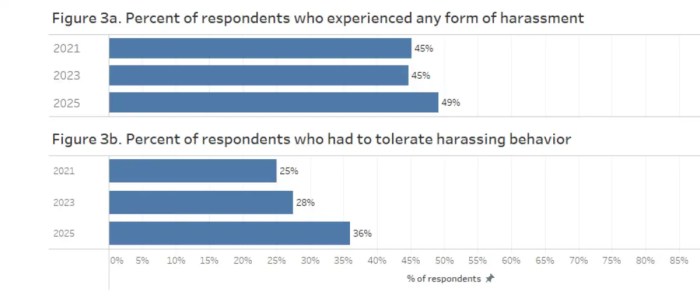
Cornell reported 49% of the students claimed that they “experienced any form of harassment”. My guess, since I am an arch sexist, is that the great bulk of that 49% were female reports. We never learn, but never mind. Let’s take the number as given.

If we extrapolate the survey results, as all good sociologists and rulers do, we would announce that half of all students were harassed. Half. Half, my dear readers, is an enormous number. Half would suggest that a small army of mouth-breathing harassers, likely from the Poetry Department, skulk around campus hiding behind bushes waiting for their chance to harass. Who could tolerate such an environment where half of all students are so abused?

I’ll tell you who: students. They can tolerate it. Because similar numbers of harassed were also reported in 2021 and 2023. Which can only mean one of two things. One: students come, they get harassed, then they come back for more of that rousing hands-on experience. They must be loving them some harassment to stick around when half get the business.

Or two: the survey and its results are, to use a technical word, bullshit.

I favor the second explanation, though I don’t entirely dismiss the first.
1980s gun myths from TV shows

Filed under: Media, Politics, USA, Weapons — Tags: , , , , , — Nicholas @ 04:00

On Substack, John Van Stry discusses one of the myths about guns that were commonplace in 1980s cop shows on TV:

Okay, so he’s talking handguns, but this is still kinda on-topic.

Decades ago, and I do mean decades, on one of the many police drama TV shows that existed in the 70’s, there was one about cops (of course there was!) where they followed a different set of officers (not detectives, street cops — kinda1) each week.

So in that particular episode we had these guys (I think it was two? It was more than one) going around and robbing banks and they were shooting (and of course killing) people at the banks. They were using “HIGH POWERED WEAPONS” (emphasis theirs) of some sort. I don’t remember if it was rifles (AR-15’s weren’t the boogie man back then) or pistols. I think it was pistols though, Magnums perhaps?

Anyway, cutting to the chase, we’ve got two officers “staking out” the bank that they believe is going to be next and all they’ve got are their wimpy-wimpy-wimpy (emphasis theirs) .38 revolvers. Because everyone knows being shot by a .38 is no more dangerous than being shot by a B-B gun!2

So, before the “big shootout” one officer comes up to the other and offers him a Special Bullet.3 He tells the other “I thought maybe we should have a little something to even the odds”.4

The other officer is of course duly horrified because this is NOT “regulation ammo”!

So what was this “special ammo”? Were they .357 magnum rounds? (which you might be able to shoot from some .38’s back then, if you could get them to fit, just once). Were they +P’s?5 Oh no no no no no! They were (Dun dun DAAAA!)

HOLLOW POINTS!!!!

Yup, their first bullet in their revolver was a .38 hollow point.

When the robbers attack, oh the things that happen! One officer blows one of the robber’s heads Clean OFF!! Yes, that’s right! The dreaded hollow point is so powerful it took off the guy’s head! Completely!!! I don’t recall exactly what the other robber had happen, but I think it was a hole blown throw him you could see through.6

But wait! There’s More!7


  1. I forget the details exactly, it was a long long time ago.
  2. In this episode at least — consistency from the anti-gun lefties who wrote this dreck in the 70’s was not to be expected.
  3. I ain’t making this part up.
  4. Or words that effect. Again, 50 years ago, I don’t remember the exact line.
  5. A lot of .38 ammo was ‘+P’ back then, because they hadn’t created the designation yet, look up the specs in the old reloading manuals if you don’t believe me.
  6. Props to these officers however for their first shots in each case being killing ones!
  7. Of course there is!

When your political establishment is controlled by globalists

Filed under: Britain, France, Government, Media, Politics — Tags: , , , , , , — Nicholas @ 03:00

On Substack Notes, Spiff responds to someone decrying the British media’s concerted efforts to ignore the political protests across the channel:

Britain’s traditional media have long since chosen their side on the culture wars. They have embraced the establishment and their disgust at patriotism and national loyalty. They are globalists.

That is why they are becoming more extreme over time. They have to. They are a crucial part of the establishment narrative machine along with nudge units, elaborately funded NGOs and charities, and the civil service.

A Nuremberg-style trial would likely convict them of treason given how anti-immigration the British public is. We may not know the details but all these institutions point in only one direction; more immigrants, more diversity, the managed decline of the country, the condemnation of its people.

We often have to step back and look at screenshots like the one below to remind ourselves the media class are making a series of conscious decisions to damage and diminish Britain and the British people. It is not an accident. They know what is happening in France and their choice has been to downplay the enormous social changes that were avoidable and are not working in favour of the French people. Mass immigration of North Africans is destroying France. These riots reflect the alliance between immigrant groups and the hard-left who hate the West.

A similar process is now destroying the UK. They have to keep that observation away from the public for as long as they can. But time is now running out.

Prime Minister Burnham will probably follow Mark Carney’s example and start subsidizing the non-state media to ensure that the propaganda is more closely co-ordinated to the establishment’s preferred narrative. After all, it’s working quite well to keep malinformed Canadian elbows up.

Why is it called Welsh Rabbit (Rarebit)?

Filed under: Britain, Food, History — Tags: , , , , — Nicholas @ 02:00

Tasting History with Max Miller
Published 21 Apr 2026

Buttered toast with a rich cheese sauce made with mustard and ale

City/Region: England
Time Period: 1861

Is it Welsh? Maybe. The Welsh certainly had a reputation for loving toasted cheese that precedes “Welsh rarebit” as a dish, so it’s possible, but we’ll likely never know if that’s where it originated. There were recipes for English rarebit and Scotch rarebit, the main difference between them and Welsh rarebit being the addition of mustard. It’s no wonder that the mustard-containing Welsh rarebit is the one that we see today, because it’s delicious.

This recipe is so simple, but so good. The combination of the crunchy toast and silky smooth cheese sauce is phenomenal, and the addition of the ale and mustard are just enough to bring out the flavor of the cheese. It’s one of the simplest and one of the best dishes I’ve made on the channel, and is one that I look forward to making again.

    Toasted Cheese, Or Welsh Rarebit
    Ingredients — 1/2 a lb. of Cheshire or Cheddar cheese, 1 oz. of butter, 2 tablespoonfuls of either milk or ale, 1 teaspoonful of made mustard, hot buttered toast.
    Method — Melt the butter in a stewpan, add the cheese cut into small pieces, stir until melted, then add the milk or ale gradually, mustard and season to taste. Have ready some hot-buttered toast, pour the cheese preparation on to it, and serve as hot as possible.
    — Mrs. Beeton’s Book of Household Management by Isabella Beeton, 1861

Ingredients:

A loaf of bread, like French or Italian, enough for 6 slices
1/2 lb (225 g) good quality cheddar cheese*, or something similar
2 tablespoons (30 g) butter, plus some more for the toast
2 tablespoons milk or ale
1 teaspoon mustard
Seasonings**, to taste, optional

*Don’t use pre-shredded cheese as they usually add starches to keep it from sticking that make it harder to melt.
**Seasonings they’d add to this dish at the time include salt, cayenne pepper, garlic, and horseradish. Feel free to use any that you like.

Instructions:

  1. Slice 6 slices of bread. How thick and what size you cut the bread is up to you, just keep in mind you want about 2 slices per serving.
  2. Toast the bread either in a toaster or under the broiler. If you use the broiler, a couple of minutes on each side should do the trick. Spread a little butter on each slice.
  3. Chop the cheese into small pieces or grate it.
  4. Melt the 2 tablespoons (30 g) of butter in a saucepan over medium heat. When it’s melted, add the cheese and stir constantly as it melts.
  5. Once the cheese has melted, stir in the milk or ale a little bit at a time. You want to make sure that the cheese doesn’t get so hot that it starts to bubble or burn. Lower the heat if necessary. Stir in the mustard and any of the seasonings you like to taste.
  6. Dish the hot cheese sauce over the prepared toast and serve it forth right away for the best texture.

QotD: The “political object” in war

Filed under: History, Military, Quotations — Tags: , , — Nicholas @ 01:00

Political Object is a key concept from Clausewitz, a term reflecting the state’s actual interest in a conflict which is one component of his “trinity” and indeed, the foremost of the three. The political object is what a state (or the leader or leaders of a state) want to get out of a war. This can, of course, change as the conflict continues. As Clausewitz notes (drink!) the role of political leadership in war is to tailor the methods and means employed to obtaining the political object they have set. Clausewitz supposes the political object to be rightly ruled by reason and calculation, rather than emotion or instinct. One way to compel an enemy to cease hostilities is by so altering the political calculus that the enemy leadership concludes that continuing the conflict is no longer in their interest.

Bret Devereaux, “Miscellanea: A Very Short Glossary of Military Terminology”, A Collection of Unmitigated Pedantry, 2022-03-25.

Powered by WordPress