Quotulatiousness

October 20, 2026

Cognitive dissonance made flesh – Homosexual Intifada: A Queer Palestinian Anthology

Filed under: Books, Media, Middle East, Politics — Tags: , , , , — Nicholas @ 06:00

They say that politics makes unlikely bedfellows, but the alliance-of-convenience between Palestinian extremists and LGBT activists is surely one of the least likely to have a long, happy life. A guest post by Fred Litwin at The Real Story reviews a book that I wouldn’t have believed to be real but apparently is:

As soon as I saw this book cover, I knew I had to write a review. And the dedication alone had me hooked: “For our Ghazzawi kin, surviving siege after impossible siege, teaching life under the most abject genocidal conditions …

    For the martyrs, from every river to every sea,

    especially those who died illegible deaths

    For those whose queerness was erased from the pages of

    history & the ancestors queered on their own terms

    For the queer living, despite the systems that

    attempt to annihilate Palestinians everywhere

George Abraham (he/they), one of the editors of the anthology, writes in his introduction about “writing from within the dying days of western empire and racial capital”. And so this is a hopeful book:

    Contextualized within this interconnected settler genocidal regime, it is unsurprising to witness a rise of queer and trans insurgence, both globally and domestically in the US, standing in solidarity with Palestinians against the very regimes that dispose of all of our bodies without hesitation or consequence.

This rising up is leading to something extremely worthwhile – the “genocidal moment is changing our community’s understanding of queerness”. A friend of Abraham’s says that her [their?] homophobic, transphobic parents are “starting to unlearn these harmful views because of this notable queer solidarity”.

It’s too bad it took a genocide to get people to change their minds but “pessoptimistically, it is a testament to the living power of organized people”. I don’t know about you, but I’m starting to think pessoptimistically: Are minds really being changed in Gaza? Is Hamas starting to “unlearn these harmful views” because of the queers marching in western streets?

Unfortunately, the “transphobic attacks” right here in the west are “the ruling class’s efforts to reconstitute the gender binary, which has always been at the heart of its colonial hegemony”. And so the community’s rage and despair leads to what Abraham calls the “Homosexual Intifada”.

    We come to think about the ways queer and Palestinian identities might co-resist, pushing each other to horizons of resistance, knowing that our entangled fight is one against an entire world order, and one that carries many universes of grief.

Thankfully, editing this anthology has connected Abraham “with queer Palestinians all over the world, across generations and transnational contexts”. The contributions of the various authors and poets “treat queer Palestinian life on our own terms, give you clarity and precision of language that feels dangerous to the imperial English of our daily lives”.

Clarity? There’s one word that appears only once in the entire anthology: Hamas.

Precision of language? Let’s have a look at the “precision of language” in Homosexual Intifada.

From the poem “Further Thoughts on Living” by Noor Hindi (she/they):

    I loved pinning her against the wall and fucking until her screams silenced her shame.

Noor Aldayeh (they/them), a self-described non-binary Syrian-Palestinian lesbian contributed “Arab Lesbianism is Not an Oxymoron”.

    Similarly, gender diversity (and what we might define as gender-queerness or transness, acknowledging such labeling as inherently colonial in nature) has an even wider and deeper standing within our history. From intersex ancient deities (see: Astarte) to gender-nonconforming djinn, to medieval androgyny to “cross-dressing” AFABs [assigned female at birth] in early 1900s Egypt, Palestine and Lebanon – beyond binary ideas and manifestations of identities – not only exist but are deeply integral to SWANA history as a whole.

Update: Of course, I didn’t spot the typo in the headline until after the post had gone live …
Singapore’s unique approach to multiculturalism

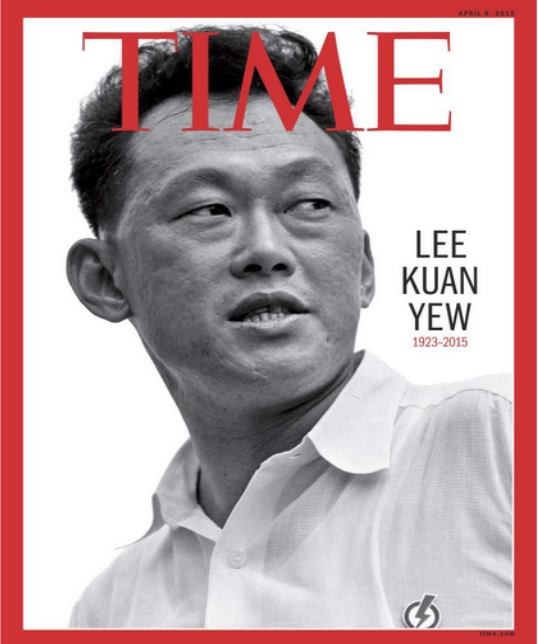
In the third and final (?) part of Ed West‘s review of Lee Kuan Yew’s memoirs, he describes the multicultural issue in Singapore and how it was addressed to reduce racial tensions in the city state:

Singapore led the way in becoming the first truly multicultural democracy, but this entailed sacrifices. Because segregation was a major driver of inter-communal tension, so the new Housing and Development Board, as well as providing much needed homes, brought with it the revolutionary idea of neighbourhood quotas. This meant the vast majority of Singaporeans being allocated a flat, on which they had a 99-year lease, in purposefully desegregated housing blocks. The city would never again suffer from race riots.

Parliamentary seats were also reorganised to ensure that every constituency had a representative from each group. “Without this arrangement, the Chinese majority in all constituencies would most likely return Chinese candidates”, he wrote. Voters “preferred one who empathised with them, spoke the same dialect or language and was of the same race. All candidates who have campaigned know this only too well. It was going to be difficult if not impossible for a Malay or Indian candidate to win against a Chinese candidate.”

Lee had a hard-headed approach to multiculturalism, as only someone who was truly multicultural could. As one of the Straits Chinese elite, English was his “master language”, but he spoke Malay well, more like a peranakan — a local-born Chinese — rather than a totok, a recent Chinese immigrant. For his annual speech, which could take up to two hours, Lee would address the audience first in Malay, then Hokkien, and finally in English. Hokkien would later be replaced by Mandarin, even though “for many Chinese Singaporeans, dialect is the real mother tongue and Mandarin a stepmother tongue”.

Lee’s view of multiculturalism also directed his approach to the law. An early experience of defending rioters in 1951 during the “Jungle Girl” disturbances had left him sceptical of the jury system, and he had it abolished in 1969, except for murder trials. Lee saw juries as incompatible with a multi-racial society, but he also believed that many people were too irrational to make such a decision.

He wrote how “a Straits Times court reporter who had watched many jury trials gave evidence … that superstitious beliefs and a general reluctance to take responsibility for severe punishment, especially the death sentence, made Asian jurors most reluctant to convict. They preferred acquittal or conviction on a lesser charge. The reporter said he could predict that whenever a pregnant woman was a member of the jury there would be no conviction on a murder charge, for otherwise her child would be born cursed. After the bill was passed and jury trials were abolished, there were fewer miscarriages of justice arising from the vagaries of jury sentiments.”

Singapore’s tough approach to crime became world famous, and curiously this was partly inspired by his experiences of the Japanese occupation, after which “I did not accept the theory that a criminal is a victim of society”.

He wrote how “punishment then was so severe that even in 1944-1945, when many did not have enough to eat, there were no burglaries and people could leave their front doors unlocked, day or night. The deterrent was effective. The British used to have whipping with a cat-o’-nine-tails or rattan in Singapore. After the war, they abolished whipping but retained caning (with rattan). We found caning more effective than long prison terms and imposed it for crimes related to drugs, arms trafficking, rape, illegal entry into Singapore, and vandalising of public property.”

Elon Musk’s evil plan to turn American youth into filthy capitalists

Filed under: Business, Economics, Space, USA — Tags: , , , , — Nicholas @ 04:00

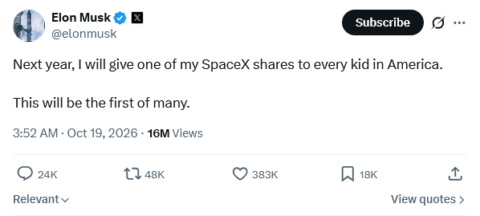
Did you hear the latest outrage? Arch-capitalist exploiter Elon Musk — reportedly the richest man in the world — intends to bribe American children by giving them each a share in one of his most important businesses. On X, Brivael Le Pogam has thoughts:

In 2021, the head of the UN World Food Programme said $6 billion from Elon Musk could solve world hunger.

Elon replied: publish the plan, right here, publicly, and I’ll sell Tesla stock on the spot.

The plan came out. And when you read it, it wasn’t a plan to solve hunger. It was one year of food for 42 million people. A twelve-month subscription. And the year after? Start over.

A few months later, Elon summed up his view: if you care about the reality of goodness rather than the perception of it, philanthropy is extremely difficult.

“Reality of goodness over perception of goodness.”

That line stuck with me for weeks. Does philanthropy actually work?

Gates-style philanthropy is first and foremost institutional capture. Foundations funding NGOs, funding governments, funding programs, producing reports, producing photos. Everyone’s happy, and the aid machine keeps itself alive. Sixty years and hundreds of billions later, much of Africa is still dependent on aid. Zambian economist Dambisa Moyo laid it out in Dead Aid: aid breeds dependency, feeds corruption, and short-circuits the only mechanism that has ever lifted a country out of poverty.

So what actually works?

It’s been tested. In Kenya, Berkeley researchers working with GiveDirectly randomly selected villages and gave every poor household about $1,000 in cash. No program. No training. No conditions. Just cash.

The result: people bought metal roofs, livestock, started small businesses. Barely any inflation. And every dollar injected generated around $2.50 of economic activity locally, including for neighbors who received nothing.

Why? Because you didn’t give them charity. You gave them capital. You primed the pump.

And that’s where everything hinges: ownership. Hernando de Soto showed that the world’s poor hold trillions of dollars in assets, but without recognized property titles, it’s dead capital. You can’t borrow against it, pass it on, or grow it. Where property rights are respected, the system starts running. Where they aren’t, no amount of aid will ever be enough.

Now reread Elon’s post.

“Next year, I will give one of my SpaceX shares to every kid in America. This will be the first of many.”

That’s not a meal. That’s not a handout. That’s a property title. A piece of the company building the infrastructure of a multiplanetary civilization, owned directly by millions of kids.

A kid who gets a handout depends on the state. A kid who owns a share of SpaceX owns a piece of the future. He learns what an asset is, he has a stake in the economy working, and one day he’ll vote as an owner, not as a client of the state.

Gates buys perception. Musk distributes ownership.

The reality of goodness versus its perception. And it’s absolutely brilliant.

Britain’s regulatory “vetocracy”

Filed under: Britain, Bureaucracy, Government — Tags: , , , — Nicholas @ 03:00

I learned a new word today, although it describes a phenomenon as old as bureaucracy. “Vetocracy” in Britain is a combination of ordinary government bureausclerosis with wider regulatory powers that can (and are) used to “veto” otherwise legal and beneficial activities:

A public company in the UK was building a high-speed railway when it suddenly faced a regulation that few could have predicted: a £100 million ($132 million) bat tunnel. The railway passed through Sheephouse Wood, an area inhabited by rare Bechstein’s bats. To comply with environmental regulations that protect the bats from colliding with high-speed trains, the company had to build a roughly one-kilometer covered structure alongside the railway. This structure has since become widely known in the UK as the “bat tunnel.”

If you think this is just one case, let me tell you about the fish disco. EDF Energy was developing a new nuclear power station in Somerset, which draws cooling water from the Severn Estuary. The project faced regulatory requirements to reduce the number of fish being drawn into and killed by its cooling-water intake pipes. EDF agreed to three measures: specially designed low-velocity intake heads, a fish recovery-and-return system, and an acoustic fish deterrent—underwater speakers that make noise to steer fish away, nicknamed the “fish disco.” The acoustic deterrent alone reportedly costs about $66 million, while EDF says the full fish-protection package costs more than $926 million.

The problem with the UK is that it has become a vetocracy. Francis Fukuyama, the famous author of The End of History, explored this problem in his often-overlooked book Political Order and Political Decay. The concept helps explain part of the productivity puzzle in the Western world. Vetocracy means “rule by veto”: a political system with so many points at which organized minorities, courts, agencies, legislators, or interest groups can block action that the majority struggles to govern.

At first glance, this might seem necessary to protect democracy from majority rule and dictatorship. The separation of powers, independent courts, and an independent judiciary are essential safeguards. As Montesquieu famously wrote, “When the legislative and executive powers are united in the same person, or in the same body of magistrates, there can be no liberty.” But vetocracy is not simply about separating powers and protecting minority rights from the majority; it is about paralyzing democratic institutions and preventing the government from functioning.

Giving any bureaucracy the power to say “no” almost always means that organization will say “no” far more often than it says “yes”, because there’s no risk to the bureaucrat or their bosses for blocking something, but there’s a tangible risk if they approve something that later proves dangerous or even just controversial. Bureaucracies generally prefer to operate largely out of sight — and therefore out of public scrutiny — and danger to the public or controversy in the media brings public attention to the organization or, worse, to the individual bureaucrat who said “yes”.

… the more serious costs are the ones unseen: the products that fail to come to fruition as a result of regulation. As the Austrian school economist Per Bylund has argued in his book The Seen, the Unseen, and the Unrealized: How Regulations Affect Our Everyday Lives, the problem with regulation is that it limits the possibilities of what could happen. It is not just about the direct financial cost of compliance. It is about the choices that disappear, the investments that never happen, and the economic freedom that is gradually eroded. The real cost of regulation is not only what we can see, but also what we never get to see because it was never built in the first place.

Vetocracy is a product of an overextended state: one that wants to be the dominant actor in the economy and micromanage every aspect of economic life. Sooner or later, it discovers that governing is not as easy as it looks. The barriers originally created by the state in the name of better governance can make effective governance almost impossible. A vetocracy is a democracy that has accumulated so many opportunities to say no that it has lost the practical ability to say yes.

Your Safety First (1956) – Automotive safety cartoon that inspired The Jetsons

Filed under: History, Humour, Technology, USA — Tags: , , , , , , — Nicholas @ 02:00

PeriscopeFilm
Published 23 Jun 2026

This animated film by John Sutherland Productions was commissioned by the National Association of Auto Manufacturers. Your Safety First is a promotional piece for 21st Century Cars, told from the perspective of a person in the year 2000 looking back on the history of automobile safety. The cartoon humorously compares the dangerous, early days of cars with the safety-focused, modern vehicles of its time. The cartoon was directed by George Gordon, and animated by Ken O’Brien, George Cannata, Fred Madison and Cal Dalton. The story was written by Norman Wright. Note: this cartoon has been noted as a precursor to the animated TV series The Jetsons, which borrowed heavily on the ideas presented in the cartoon including a three-hour work day, automated flying cars, and robotic arms performing most tasks.

0:00 Main titles. The film’s host, a man from the year 2000, introduces a segment on the history of the automobile, beginning with an early 20th-century car.
4:47 The film highlights the dangers of early cars, including a lack of doors, frequent flat tires due to poor tire retention rings, and a complete absence of shock absorbers, which made for a very bumpy and unsafe ride.
5:32 Early cars had poor acceleration and weak, unreliable gas or oil headlamps, making night driving hazardous.
5:47 The vehicles offered little protection from the elements, as they lacked tops and windshield wipers.
6:03 The film shows the danger of the hand crank starter, which often failed, and the unpredictable nature of the car’s individual parts, which could fail without warning, causing accidents.
6:35 The film transitions to the rapid improvements made to cars over the years.
6:42 It lists early safety innovations, such as stronger wheels, demountable rims, doors, tops, windshields, and wipers. The driver’s seat was moved to the left for safer passing, and the electric starter replaced the hand crank.
7:33 The film continues to show the development of safety features over the decades, including pressed steel wheels, stop lights, rearview mirrors, four-wheel hydraulic brakes, and rubber-covered pedals.
7:51 Safety glass and all-steel bodies and tops are presented as major improvements in passenger protection. Shock absorbers are highlighted for smoothing out bumpy roads.
8:30 The film states that, in addition to physical improvements, manufacturers developed research and testing techniques to build safer cars. It shows various “torture tests” designed to find weaknesses in parts.
9:31 Manufacturing processes also improved, with each car undergoing over 2,000 inspections before leaving the factory.
9:48 The film returns to “Grandpa” in the year 2000, showcasing his reliable, safe, and comfortable car. It lists a final set of advanced safety and convenience features, including safety door locks, automatic transmission, a low center of gravity for stability, and tubeless tires.
10:46 Modern features like wraparound windshields and larger rear windows increased visibility. Sealed-beam headlamps improved night driving, while power brakes and power steering made driving easier and safer.
11:27 The film concludes by asserting that the safety of the driver was and will continue to be the primary goal of automobile manufacturers. The host, Grandpa himself, states he is “going on 117” thanks to the easy, modern living made possible by safe cars.
(more…)

QotD: What is “hate speech”?

What is “hate-speech”? It’s speech the authorities hate. No doubt, it is often worth hating. It may be speech that every right-thinking person ought to hate, but it is also, by definition, speech that falls short of unlawful or tortuous speech — i.e., speech that’s fraudulent, defamatory, seditious, conspiratorial — for which a person could be either sued or charged criminally. Hate-speech legislation seeks to regulate speech that is not against any law — logically, since unlawful speech doesn’t need to be outlawed. Here’s the paradox. Hate-speech legislation can only ban free speech. Prohibited speech is already banned. People often say that freedoms aren’t absolutes and they’re right. Free expression is anything but “absolute” in free societies. It’s hemmed in by strictures against slander, official secrets, perjury, fraud, incitement to riot, and so on. The question is, should laws go beyond these strictures? And if they do, won’t they suppress opinion and creed in the end?

The answer is yes. There is nothing else for them to suppress. Repressive positions are difficult to defend for those who wish to keep their liberal credentials intact. They usually do so by quoting bits of pernicious nonsense from the kind of speech they would ban to illustrate how worthless and abhorrent it is. But pointing to the abhorrent nature of despised speech is insufficient because no speech is legislated against unless it’s abhorrent to some. Nobody outlaws Mary Poppins, not even the Human Rights Commissions (though this could be famous last words).

If suppressing opinion breaches axioms of liberalism, can it be justified by utility? Canadian defenders of hate-speech laws rarely offer any examples, other than the dubious benefit of distinguishing ourselves from Americans (one Human Rights-type called free speech an American concept in a recent court case) but one suggestion is that such laws would have stopped a Hitler. The problem is, the Weimar Republic had such laws. It used them freely against the Nazis. Far from stopping Hitler, they only made his day when he became Chancellor. They enabled Hitler to confront Social Democratic Party chairman Otto Wels, who stood up in the Reichstag to protest Nazi suspension of civil liberties, with a quotation from the poet Friedrich Schiller: “‘Late you come, but still you come'”, Hitler pointed at the hapless deputy. “You should have recognized the value of criticism during the years we were in opposition [when] our press was forbidden, our meetings were forbidden, and we were forbidden to speak for years on end.”

The Nazis would have been just as repressive without this excuse, but being able to offer it made Hitler’s task easier. Like Canadian supporters of hate-speech legislation, supporters of the Weimar Republic thought that their groups and causes would occupy all seats of authority and set all social and legal agendas forever. Shades of the Canadian Civil Liberties Association or the Canadian Jewish Congress! They couldn’t envisage the guns of their own laws being turned around to point at them one day. Eradicating hateful ideas through free discourse is liberal; trying to eradicate them through legislation is illiberal. “There is always a chance that he who sets himself up as his brother’s keeper”, wrote Eric Hoffer, “will end up by being his jail keeper”.

Another thing: “Banned in Boston” sells tickets. As Victor Hugo put it: “The writer doubles and trebles the power of his writing when a ruler imposes silence on the people”. I’d think twice before banning neo-Nazis for this reason alone.

George Jonas, “Regulating speech that is not against any law”, CanWest Publications, 2008-04-02.

Powered by WordPress