
They say that politics makes unlikely bedfellows, but the alliance-of-convenience between Palestinian extremists and LGBT activists is surely one of the least likely to have a long, happy life. A guest post by Fred Litwin at The Real Story reviews a book that I wouldn’t have believed to be real but apparently is:
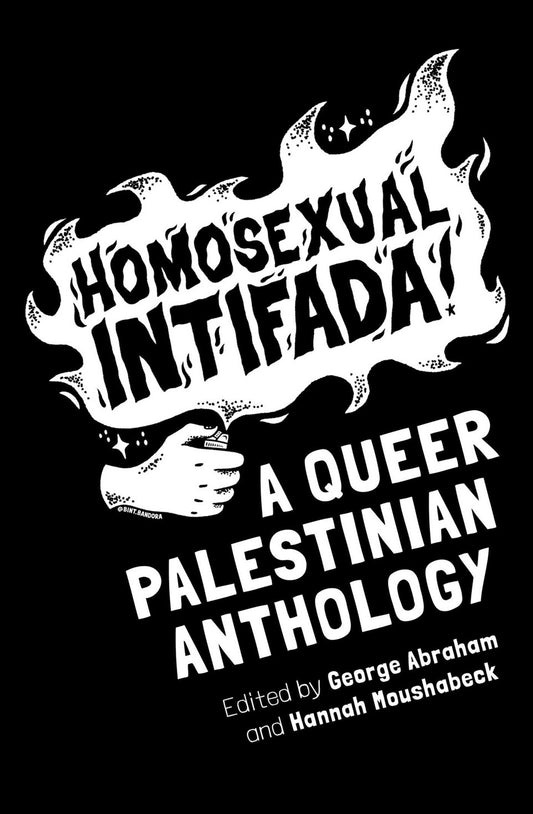
As soon as I saw this book cover, I knew I had to write a review. And the dedication alone had me hooked: “For our Ghazzawi kin, surviving siege after impossible siege, teaching life under the most abject genocidal conditions …
For the martyrs, from every river to every sea,
especially those who died illegible deaths
For those whose queerness was erased from the pages of
history & the ancestors queered on their own terms
For the queer living, despite the systems that
attempt to annihilate Palestinians everywhere
George Abraham (he/they), one of the editors of the anthology, writes in his introduction about “writing from within the dying days of western empire and racial capital”. And so this is a hopeful book:
Contextualized within this interconnected settler genocidal regime, it is unsurprising to witness a rise of queer and trans insurgence, both globally and domestically in the US, standing in solidarity with Palestinians against the very regimes that dispose of all of our bodies without hesitation or consequence.
This rising up is leading to something extremely worthwhile – the “genocidal moment is changing our community’s understanding of queerness”. A friend of Abraham’s says that her [their?] homophobic, transphobic parents are “starting to unlearn these harmful views because of this notable queer solidarity”.
It’s too bad it took a genocide to get people to change their minds but “pessoptimistically, it is a testament to the living power of organized people”. I don’t know about you, but I’m starting to think pessoptimistically: Are minds really being changed in Gaza? Is Hamas starting to “unlearn these harmful views” because of the queers marching in western streets?
Unfortunately, the “transphobic attacks” right here in the west are “the ruling class’s efforts to reconstitute the gender binary, which has always been at the heart of its colonial hegemony”. And so the community’s rage and despair leads to what Abraham calls the “Homosexual Intifada”.
We come to think about the ways queer and Palestinian identities might co-resist, pushing each other to horizons of resistance, knowing that our entangled fight is one against an entire world order, and one that carries many universes of grief.
Thankfully, editing this anthology has connected Abraham “with queer Palestinians all over the world, across generations and transnational contexts”. The contributions of the various authors and poets “treat queer Palestinian life on our own terms, give you clarity and precision of language that feels dangerous to the imperial English of our daily lives”.
Clarity? There’s one word that appears only once in the entire anthology: Hamas.
Precision of language? Let’s have a look at the “precision of language” in Homosexual Intifada.
From the poem “Further Thoughts on Living” by Noor Hindi (she/they):
I loved pinning her against the wall and fucking until her screams silenced her shame.
Noor Aldayeh (they/them), a self-described non-binary Syrian-Palestinian lesbian contributed “Arab Lesbianism is Not an Oxymoron”.
Similarly, gender diversity (and what we might define as gender-queerness or transness, acknowledging such labeling as inherently colonial in nature) has an even wider and deeper standing within our history. From intersex ancient deities (see: Astarte) to gender-nonconforming djinn, to medieval androgyny to “cross-dressing” AFABs [assigned female at birth] in early 1900s Egypt, Palestine and Lebanon – beyond binary ideas and manifestations of identities – not only exist but are deeply integral to SWANA history as a whole.


