Quotulatiousness

October 17, 2026

Ernst Jünger’s Storm of Steel, the true rival to All Quiet on the Western Front

Filed under: Germany, History, Military, WW1 — Tags: , , — Nicholas @ 05:00

Every year, Scott Alexander invites Astral Codex Ten readers to submit anonymous book reviews, and the most recent contribution is one of Scott’s reader’s review of Storm of Steel:
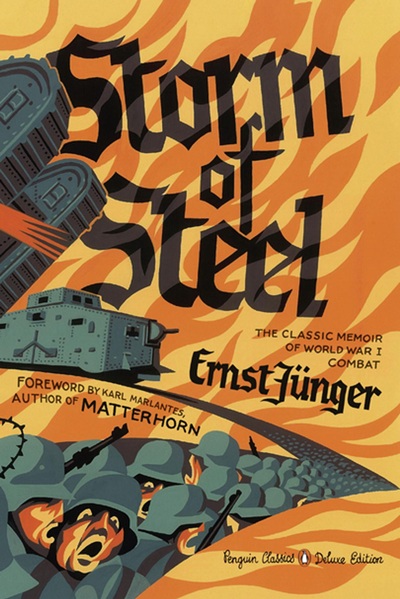
All Quiet on the Western Front ranks as the definitive anti-war novel of World War I, perhaps for all wars, and to some the most important war novel of all time. It was widely banned in the inter-war period yet went on to sell more than 20 million copies and has three film adaptations, the most recent the acclaimed 2022 version. It’s so famous, so prominent, so dominating, that the novel I think is the best war novel ever written can only point back at it from a “see also” link on Wikipedia. That novel is Storm of Steel, by Ernst Jünger.

You may recognize that name from 2023’s ACX book review, On the Marble Cliffs. It was my first serious look at Jünger as well; he is described as a “serial killer” and a “sociopath”, the kind of modern psycho who nowadays would take glee in uploading videos of drones blowing people up, someone perhaps who sees war as the chance to visit death upon human beings with the state’s permission. I had heard of Storm of Steel, heard the acclaim for it, but never read any of his works. What kind of man was this?

The Wikipedia page is light on details, but it’s beyond impressive. Jünger fought throughout World War I in the thick of it, starting as a private and ending as a company-commanding Lieutenant. He saw action at the Somme and Cambrai, the Battle of Arras then the Third Battle of Ypres and finally the Ludendorff Offensive. He was wounded 14 times, sometimes quite severely, and came out of it with the Pour le Mérite (the most prestigious Prussian officer’s decoration) alongside numerous other awards. Storm of Steel is, basically, his diary of his time in the war. After the war he was a very famous writer, and if you want to know more about him you should read the previous ACX review which covers his story more and is interesting in its own right.

So there was nothing to do but read it myself. Storm of Steel is not a very long book by page count. What I will call it is dense. It is not a diary that Jünger used to explain his theories, his ideas or his politics except as cursory asides. It is a book about WAR, hundreds of pages of it, from the mundane to the bloody to the idyllic. Storm of Steel is, in my humble opinion, the best war novel ever written.

I did not say that it is the best _anti-_war novel; I also did not say that it is a _pro-_war novel, although in some places and versions Jünger claims war can be glorious or make someone stronger in a rising-to-the-challenge sense. It is at its core an account of a war, a war more bloody and terrible than any of us could imagine, written by someone intelligent and gifted in writing who happened to see much of it and survive to tell the tale. It is by turns harrowing, riveting, insightful, terrifying, humorous, disgusting and soul-shaking. I had read All Quiet and Storm of Steel years ago, and for this review I read both again, then got a different version and translation of Storm of Steel to read it yet again; I can say that it was all worth it. There is nothing like it, and I hope that nothing like it will come ever again.

The Elephant in the Room

If you will forgive me a meme, if I had a nickel for every German World War I war novel I read that featured a bug-collecting protagonist who drank oily machinegun water during an attack, I’d have two nickels. Which isn’t a lot, but it’s weird that it happened twice.

Now that I’ve gotten that out of my system, let us truly begin. I opened with All Quiet on the Western Front for a reason: you probably know about it, and it’s also a German infantryman’s perspective of World War I. All Quiet also describes the horrors of trench warfare from the perspective of a veteran serving for years, of seeing death and destruction around every corner, breaks up its action with humor and levity, and ends with the war. The comparison is natural.

The truth is that All Quiet on the Western Front is a work of fiction with a thesis. It covers nearly three years, but Remarque was only on frontline duty for about five weeks. It’s unlikely that Remarque ever participated in the actual combat he describes: an article in the Süddeutsche Zeitung describes his service as mostly rear-area construction work; certainly dangerous, he certainly lived through shelling and gas attacks, and it’s a matter of record that he was wounded, but he probably didn’t see the relentless action he describes in All Quiet.

Storm of Steel was first published in 1920, while All Quiet came in 1929. Remarque was aware of this other famous account of World War I in his own language. I open with the bug-collecting and drinking cooling water because it’s those sorts of shared details that popped out to me after reading them both, but Jünger was an independently-famous entomologist and a stormtrooper commander and Remarque was not. He was on the periphery of such things, and between his time at the front and his time in the hospital, I’m sure he experienced enough and met those who did experience the combat he describes to create the agonizing story, but Remarque was justifiably reticent about discussing his own war experiences or explaining himself.

All Quiet intersperses brief periods of combat with long scenes of Paul returning home, of soldiers discussing how it’s really the leaders who should fight, of how training is miserable and the food is lousy and so on. It pontificates about the causes and horrors of war, about the damage it does to one’s psyche and soul, about how it makes men who should be brothers into sincere enemies, how it alienates the soldier from the civilian; it crafts a story for you to do all that. But it is a craft, and I think that detracts from its power.

Storm of Steel is true. It really happened, and it reports those happenings with minimal commentary. Many books start with an idea and write a world around them; Atlas Shrugged is a vehicle for getting the reader to an 80-page monologue about Objectivism. All Quiet is in that vein; it wants you to be anti-war, to feel the horrors of it, to know the unfairness, the blundering and chaos and death. It starts with the conclusion and works its way backwards. Storm of Steel works the other way around, describing it as it happened and drawing conclusions from that, but it barely draws anything itself and instead lets you do it, with barely a suggestive nudge. If you want to be pro-war, Storm of Steel will satisfy you with heroism and duty and camaraderie in the face of noble adversity. If you want to be anti-war, it will satisfy you with horror and futility and bloodiness in the face of a cruel industrial war machine. If you want to know what World War I was like for an infantryman, banally, you will hear about tasteless food and unceasing work and moments of absurdity and silly training. If you want to know what World War I was like for an infantryman, notably, you will hear about impossible situations and near-misses then grievous wounds and feats of daring and moments of sheer, unadulterated terror tempered by steely courage. If you want a few jokes, it even has some of those. But above all, Storm of Steel offers one man’s true and unflinching account of The Great War, and what an account it is!
British disability programs may extend to 25% of the population under current criteria

Filed under: Britain, Bureaucracy, Government, Health — Tags: , — Nicholas @ 04:00

In the above-the-paywall portion of his latest post, eugyppius makes the case that the British social state, along with most other western countries, has metastasized to the point that it is uncontrollable:

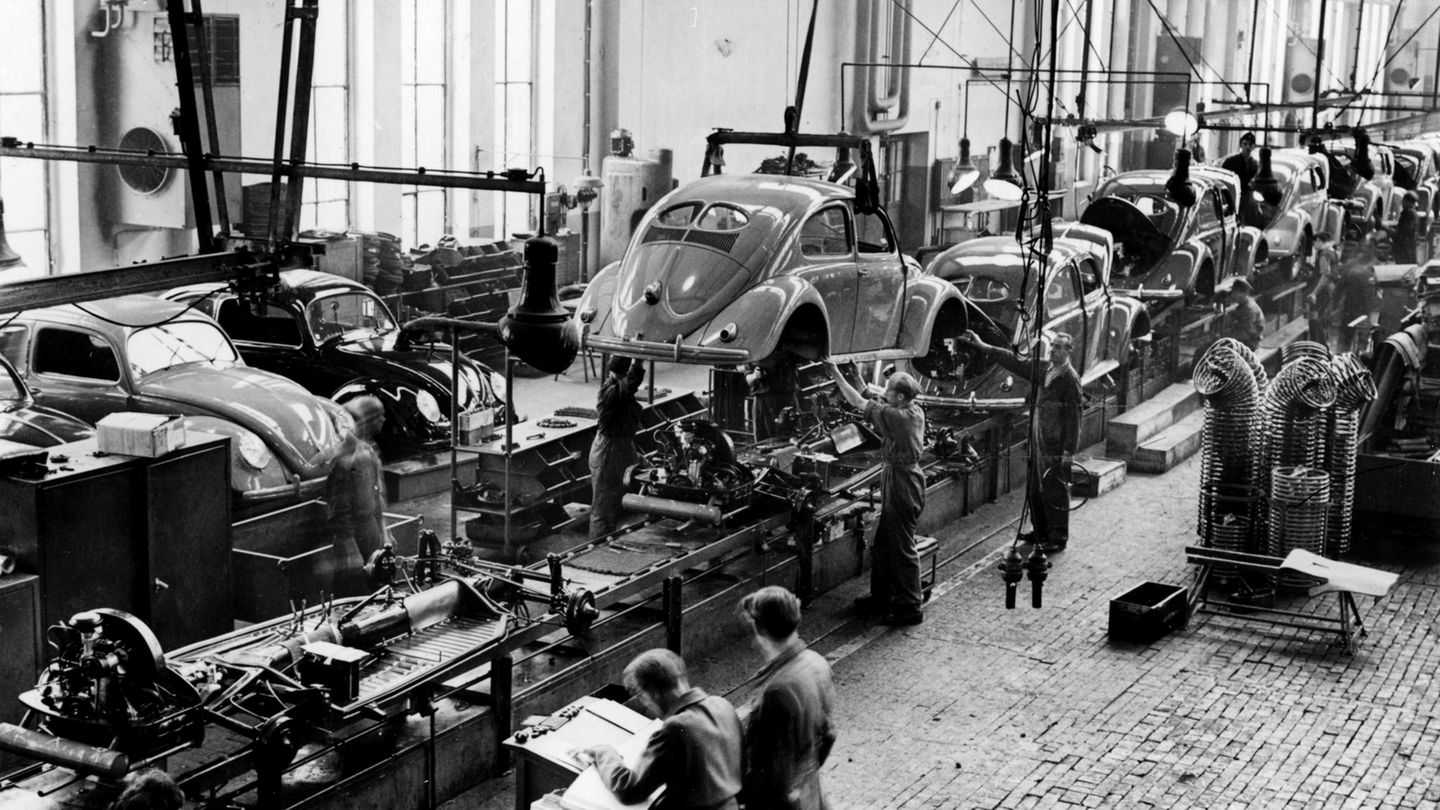
Production line for the VW Beetle – symbol of a happier age, when our politicians forged a new democratic social state in Germany that today can no longer be financed or reformed.
Photo from eugyppius: a plague chronicle

On Sunday the Wall Street Journal published a long article headlined “The Welfare State is Crushing Britain“. It focusses on but one aspect of the UK social system, namely disability and sickness benefits, and its details are equal measures depressing, familiar, predictable and alarming.

Like other European redistributionist schemes, British disability payouts have steadily ballooned in the postwar period – expanding from a niche benefit for those unable to work due to serious illness and on-the-job injuries to a morass of programmes that showers millions of people with billions in pointless, self-defeating subsidies.

A 2024 government survey found that fully 25% of the entire British population might be considered disabled under present inflationary criteria, which adds perspective to the eye-watering figure of 10% presently drawing benefits. The fastest growth in disability claims occurs among working-age demographics, where compensation, once granted, soon becomes a powerful disincentive to work. In this way the British disability system actively cannibalises its own tax base. The total bill for sickness and disability benefits this year will exceed £100 billion, which comes on top of the £280 billion the British taxpayer presently spends on healthcare and which substantially outstrips the £68 billion British defence budget. Disability spending has jumped 25% over the last four years, and without reforms it will rise another 30% over the next four. Fuzzy psychiatric disability claims, from depression to ADHD, drive much of the expansion, as a whole universe of charities and AI-powered chatbots advise ever more able-bodied people on how they might opt in to this wonderful system of free money. Among many crazy details, we learn that those on disability can trade some of their cash benefits for new car leases every three years. This programme now accounts for one in seven automobile sales in Britain and has elevated the company handling these deals (Motability) to the largest automobile leasing concern in the country. The debt required to fund this and the rest of the British social system has driven borrowing costs to rates not seen since the 2008 financial crisis, while high taxes continue to encourage the emigration of the wealthy and productive.

These are the mere symptoms of a sickness that extends well beyond the United Kingdom. We are looking here at a fiscal and also a political crisis afflicting the entire postwar European model. Below the fold I want to explain the nature of this crisis and why our political systems seem powerless to address its fundamental causes – indeed, why many of our politicians seem determined to make it worse. With little chance of reform, we face a future of economic decay and declining living standards, culminating in sovereign debt crises and perhaps even political collapse. The postwar order is slowly dying, in its eighty-first year, of old age. There are no answers and nobody knows what will come next.

John Carter commented on Substack Notes:

The neglect of schools in order to pay for pensions is a particularly poignant phenomenon, a direct illustration of the old devouring the futures of the young. Eugyppius is correct that there’s no electoral solution to this mess. No one will vote to reduce their own benefits, and tax-eaters now comprise such a substantial electorate that any serious discussion of reform is political suicide.

State bankruptcy and economic collapse are real possibilities. Maybe “and then a dictator ends democracy” happens, but maybe not. For the young the all-devouring social state is increasingly unbearable. Polities that make themselves attractive to the young rather than the old could suck in such a large fraction of the youth that by the time collapse arrives, the social states are effectively retirement communities, and it just looks like a humanitarian crisis of starving geriatrics dying in their own unwashed bodily fluids.

Mussolini’s Ethiopian adventure

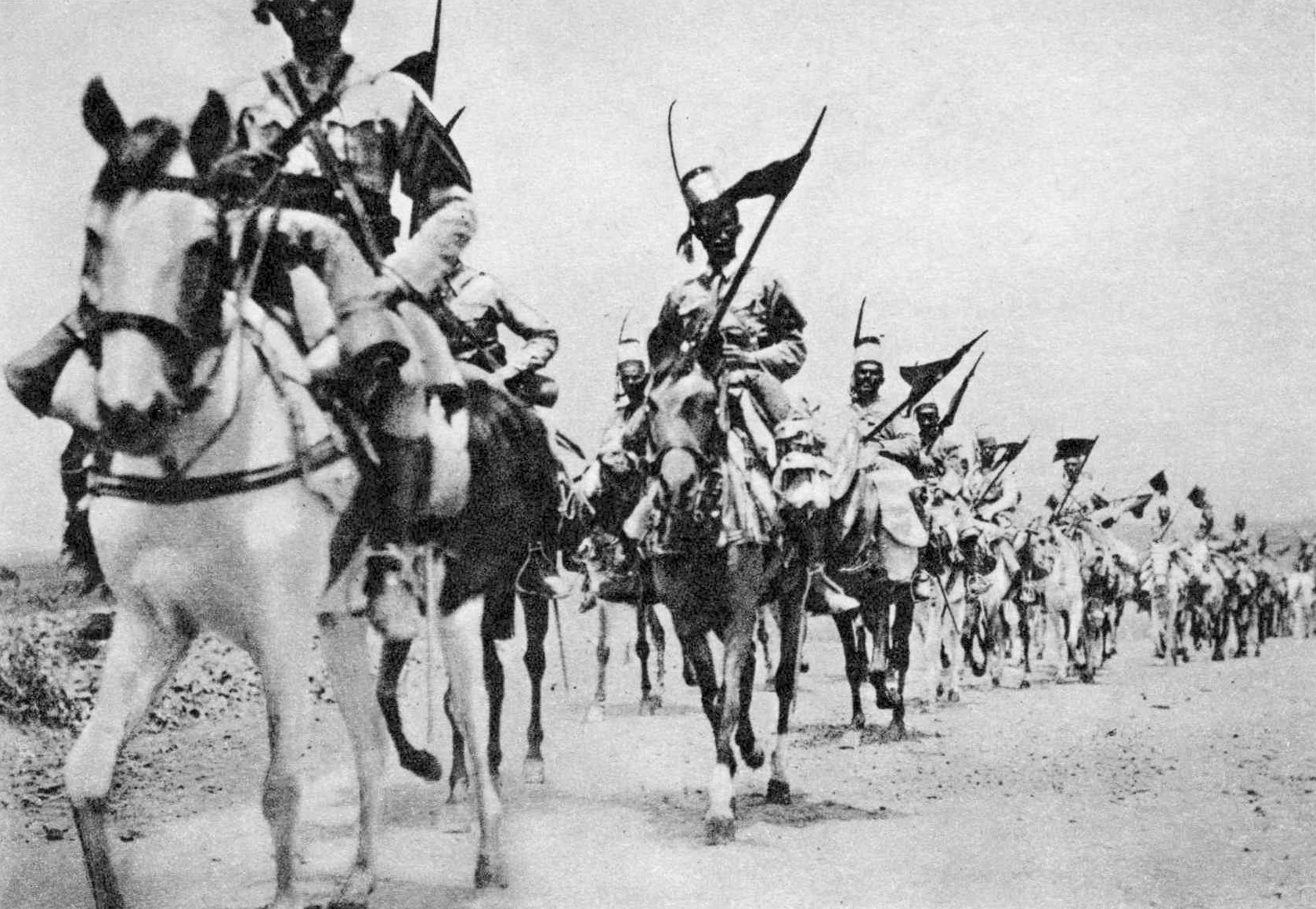
On the social media site formerly known as Twitter, Handre recounts the brutal invasion of Ethiopia by Mussolini’s troops in 1935:

Mussolini invaded Ethiopia in 1935, where Italian forces burned villages, deployed mustard gas banned under the 1925 Geneva Protocol, and slaughtered an estimated 275,000 Ethiopians in the first year alone.

The invasion was economic lunacy, directed by a sociopath seeking imperial glory. Italy’s economy in 1935 was already strangled by Mussolini’s autarky policies: state-controlled prices, forced grain production quotas, and currency manipulation that gutted purchasing power. Ethiopia was supposed to deliver raw materials and lebensraum that central planning couldn’t produce at home. This is the eternal promise of conquest: steal what you cannot generate through voluntary exchange.

It failed completely. The occupation cost Italy roughly 40 billion lire, accelerating debt that Mussolini’s treasury couldn’t service without the printing press. The resource extraction never materialized. Ethiopia’s terrain, infrastructure, and hostile population made profitable colonization impossible. Rome poured capital into a sinkhole while Italian workers at home faced food rationing.

The League of Nations imposed economic sanctions on Italy in November 1935, which Mussolini predictably used as nationalist propaganda. Those sanctions were both too narrow (they excluded oil) and too late to matter strategically.

State violence always carries a price tag nobody budgets for honestly. Mussolini thought he was building an empire; he was actually accelerating Italy’s slide toward the catastrophe of 1943

One of the major contributing factors to Italy’s economic woes was the same problem that all authoritarian regimes encounter: bad news is unwelcome, so fake good news is reported instead. That’s bad enough in the newspapers for general consumption, but it’s fatal in the long term for any centrally planned economy (and pretty much every fascist and communist government loved central planning).

The planners demand X million tons of steel, the steel mills can’t achieve that but they know the penalty for failure, so they … lie. The planners now allocate all that extra steel to manufacture tanks or trucks or planes … and the factories can’t produce their assigned output because they don’t get enough steel, so … they lie. The army doesn’t get as many tanks/trucks/guns/etc. as the planners say they will get, but they can’t tell the planners that they don’t have all the new equipment, so they lie and stage photogenic parades for the leaders and the cameras, cycling the same few dozen working vehicles through the same route again and again to “show their military might” … and to stave off anyone discovering that they don’t have all the new stuff.

The government then goes to war, knowing they have X thousand new tanks, trucks, planes, etc. and are horrified to discover that they don’t just walk over their opponents with sheer military might …

Everyone is Wrong about the Cromwell Tank

Filed under: Britain, History, Military, Weapons, WW2 — Tags: , , , , — Nicholas @ 02:00

The Tank Museum
Published 19 Jun 2026

Lacking firepower. Thin skinned. Many believe it was obsolete before it even went into combat.

Except … that isn’t all true.

Because the Cromwell didn’t just fight its way through Normandy, it was pivotal in the defeat of Nazi Germany.

After that, it held off Soviet expansion in Europe, held ground in Korea, and stayed in British service well into the 1950s.

So how did a tank everyone calls a failure end up doing all that?

In this video, we’re going to wade through the hate mail and see if we can convince you that actually the Cromwell did rather well.

00:00 | Introduction
00:52 | A Dysfunctional Start
04:42 | Built for Speed in a Slow War
09:48 | Failure in the Bocage, Victory in the Breakout
15:44 | The Tank That Wouldn’t Go Away

This video features archive footage courtesy of British Pathé.

In this video, join our historian James Donaldson in defence of the oft-maligned Cromwell. Emerging from troubled development, the Cromwell proved itself in the European theatre as an exceptional reconnaissance tank and continued to be used well beyond the end of the Second World War. It was fast and versatile, utterly devastating when used properly, and stayed in service longer than many of its critics would care to admit.
(more…)

QotD: The original purpose of the European project

Filed under: Europe, France, Germany, History, Quotations — Tags: , , , — Nicholas @ 01:00

Professor Bogdanor tells us that the European project was one of peace, and no doubt, after the second catastrophic war within the space of half a century, this is in part so, at least originally. No one could possibly have wanted yet another Franco-German conflict. But it does not in the least mean that the subsequent peace in Europe was caused by the European project. Other factors were surely far more important, indeed decisive.

First, of course, was the fact that Europe was in no condition to wage another war. The continent was in ruins, the Germans were disarmed, the Americans would not have stood for it, and in any case the Germans had genuinely changed. There was no revanchisme to speak of in Germany, as there had been after the first war. Moreover, to the east was the looming presence of what in the 19th century was called the Russian steamroller, only infinitely worse than that of the time of Alexander I and Nicholas I, with a barbaric ideology that at the time attracted the allegiance of a considerable proportion of the population, especially of that part of it — the intelligentsia — that ought to have known better. Only American power prevented the steamroller from rolling west, and thereby kept the peace in Europe.

Even if the maintenance of peace was one of the original aims of the European project, this is a very weaselly way of putting it. Even without the European Union, Estonia would not attack Portugal, nor would Belgium attack Slovakia. What is meant by keeping the peace is ensuring that Germany does not again attack France (no one thinks that France would attack Germany): in other words, and to put it crudely, without the European Union people thought — even Germans themselves — that Germany would be up to its old tricks again. I do not believe this.

Theodore Dalrymple, “European Empire, Fractured”, Law & Liberty, 2020-11-10.

Powered by WordPress