Quotulatiousness

October 13, 2026

No wonder the wokies hate J.K. Rowling

Filed under: Books, Media, Politics — Tags: , , , , , , , — Nicholas @ 05:00

The Harry Potter books used to be sacred lore to the woke generation until the author committed the unforgivable crime of defending the rights of women against the encroachment of trans-women. Yet, it doesn’t take a very close reading of the texts to discover so many things that appear to have slipped under the notice of the progressives and form the core beliefs of the fictional world she created:

Amelia crossing paths with Harry Potter and the gang seems much more appropriate than it might have in the past

    Potential is largely hereditary, family is most important, the media are lying parasites, the state can’t be trusted with education, and children should be taught armed self-defense.

These are not subversive readings. These are the plot.

The Harry Potter series was the most successful publishing phenomenon of the late twentieth century. It sold half a billion copies. Progressive parents handed it to their children as a parable about tolerance and the courage to stand against prejudice. The movies grossed eight billion dollars. The author became an icon of liberal cultural production and then, by a process that remains opaque to the people who made her famous, a figure of political villainy for holding positions indistinguishable from mainstream liberal feminism circa 2005.

Set aside the author. The books exist independently of whatever J.K. Rowling believes or is believed to believe. Read them for what they actually say. The worldview encoded in the narrative structure, the plot logic, and the moral arc is not the worldview the books were marketed as containing. It is considerably more interesting.

Blood Will Tell

Magic is inherited. This is the foundational premise of the entire fictional world and the premise from which everything else follows.

You are either born a witch or wizard, or you are not. No amount of study, effort, practice, or desire will make a Muggle magical. The reverse is also true: Squibs, born to magical families but lacking the gift, cannot acquire it. They are defective members of magical lineages, pitied and often hidden. Argus Filch, the Hogwarts caretaker, is a Squib. His bitterness and cruelty toward the students is the bitterness of a man who can see the gift in others but will never have it himself.

[…]

Family Carries Everything

Harry survives Voldemort’s killing curse because his mother died to protect him. Not a metaphor. A literal magical mechanism. Lily Potter’s sacrificial love created a protection charm encoded in Harry’s blood that made him impossible for Voldemort to kill directly.

[…]

The Press Are the Enemy

The Daily Prophet is introduced early and is corrupt throughout.

[…]

The State Cannot Be Trusted to Educate Your Children

Dolores Umbridge is a government administrator appointed by the Ministry of Magic to reform Hogwarts.

Her arrival at Hogwarts in Order of the Phoenix is the politicization of education made literal. The Ministry does not trust Dumbledore. The Ministry does not want students to learn Defense Against the Dark Arts. A student body trained in combat magic is a student body that might resist. Umbridge’s curriculum is therefore purely theoretical: no spellcasting, no practical application, only reading approved texts about defensive magic that the students are forbidden to practice.

[…]

The books contain other lessons that the progressive readership tended not to discuss.

House-elves are slaves. They are hereditary servants bound to magical families, forbidden to disobey direct orders, and conditioned to punish themselves for disloyalty. Dobby is freed and becomes a hero. But Dobby is the exception. Most house-elves, including the Hogwarts house-elves, do not want freedom. Hermione’s Society for the Promotion of Elfish Welfare is played for laughs. The elves reject her knitted hats. They are offended by the offer of liberation. Dobby is a weirdo.

The narrative does not resolve this. The house-elves are not freed after Voldemort falls. The epilogue does not mention them. The implication is that hereditary servitude is acceptable if the servants are happy, and these servants are happy. Whatever else this is, it is not an abolitionist text.

[…]

What The Books Actually Taught

The Harry Potter series is a fundamentally reactionary conservative text dressed in the aesthetic of liberal tolerance.

It teaches that ability is inherited and the argument is only about whether pedigree or demonstrated ability should determine status. It teaches that family is the highest loyalty and the source of the most powerful magic. It teaches that the press serves power and the only response is to route around it. It teaches that the state will capture education to produce compliant subjects and that the answer is to arm the children. It teaches that some people are born for greatness and others are born for service, and the main thing is to get the sorting right.

None of this requires reading against the grain. It requires only reading.
The Un-Coupling of Gen Z

Filed under: Britain, Health, USA — Tags: , , , — Nicholas @ 04:00

One of the most obvious demographic shifts in recent years has been the ongoing decline in the birth rate in pretty much the entire western world. But it isn’t surprising in one respect: Gen Z people aren’t forming relationships at the rate of earlier generations and have fewer (if any) sexual partners:

Why are so many Americans not getting married — or not even dating, in the first place?

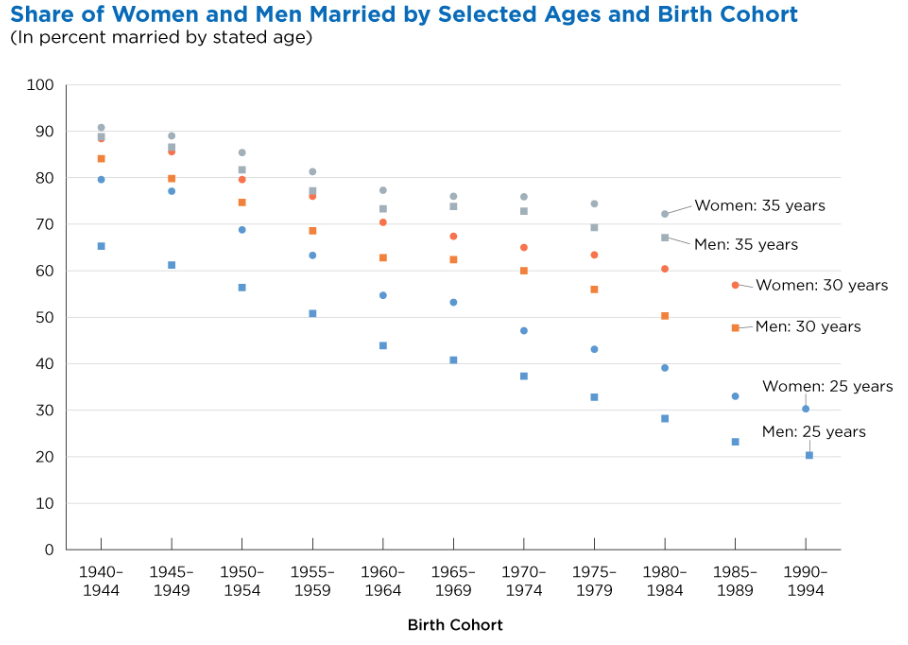
The share of 40-year-olds who have never been hitched has quadrupled since 1980, as Americans get married later, or not at all.

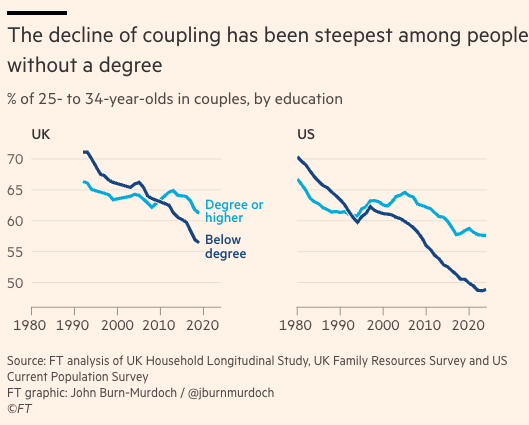
It’s not just marriage that’s declining but rather all forms of cohabitation. An analysis by John Burn-Murdoch found that “coupling” has declined steadily in both the UK and the U.S., especially for those without a college degree. The declining popularity of dating apps suggests that these trends are likely to continue.

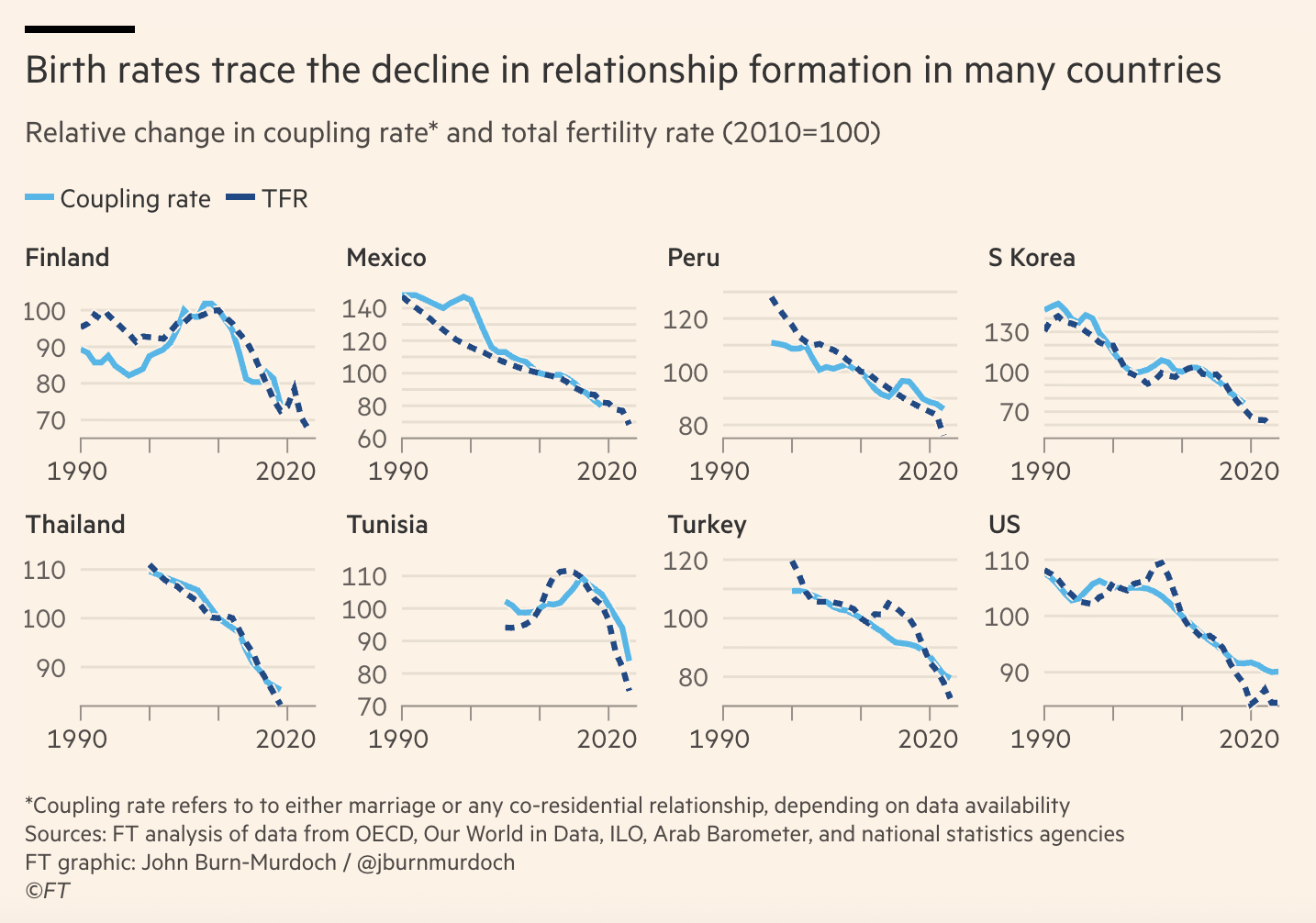
I care about the decline of coupling and marriage not because I consider myself a strict evangelist of matrimony — I think people should do what they can to enjoy themselves without hurting others — but rather because I think it bears on two of the most important questions about the future: (1) How many people exist, and (2) how happy are they? The relationship between romance and births is practically linear. Since 1990, Burn-Murdoch has shown, the decline of births traces the decline of relationship formation across many countries. Fewer relationships mean fewer people, and accelerating population declines around the world are, somewhat like climate change, a slowly accumulating phenomenon that will almost certainly shape the future of economics, technology, and the texture of human existence.

Then, there’s the mushy yet momentous question of whether people actually enjoy their existence. Self-reported happiness is declining in the west, and particularly in the U.S. Reviewing several decades of General Social Survey data, the economist Sam Peltzman came to the conclusion that “most of the overall downturn [in life satisfaction] is attributable to decline in marriage post-2000”. Reviewing Peltzman’s work, The Atlantic‘s Olga Khazan provided some useful context:

    One paper alone might be easy enough to dismiss, but this is a fairly consistent finding dating back decades in social-science research: Married people are happier. Period.

If the decline of coupling is upstream of both falling births and falling happiness, then the most important question is what’s happening at the source. In his new book Generation Uncoupled, Daniel Cox, a public opinion researcher and director of the Survey Center on American Life, considers a range of causes that span technology, culture, media, economics, and politics.

British beer vs. “modern audiences”

Filed under: Britain, Business, History — Tags: , — Nicholas @ 03:00

In The Critic, Henry Jeffreys sings the praises for some of the greatest names in British brewing … while waving goodbye as they disappear one after another into international beverage behemoths who care nothing at all for history and tradition if it doesn’t add value to the stock price:

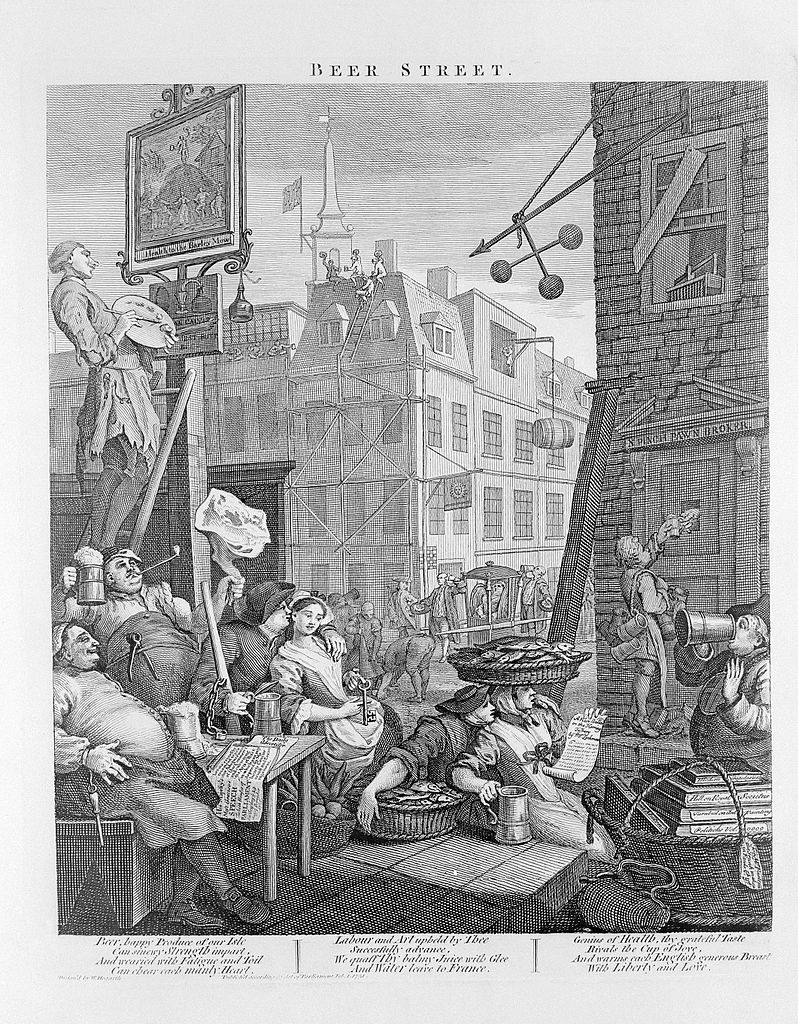
Beer Street, from Beer Street and Gin Lane by William Hogarth. The picture is a counterpoint to the more powerful Gin Lane — Hogarth intended Beer Street to be viewed first to make Gin Lane more shocking — but it is also a celebration of Englishness and depicts of the benefits of being nourished by the native beer.
Wikimedia Commons.

Burton-on-Trent was once the brewing capital of the world, home to such famous names as Bass, Allsopp’s and the famous “Burton snatch”. Stop giggling at the back, Jenkins! I’m talking, of course, about the refreshing sulphurous tang imparted by the high levels of calcium sulphate in the town’s water. By the 1890s, it boasted thirty-one breweries producing over three million barrels a year, providing a quarter of Britain’s beer. Sadly, it has fallen a long way from there.

While Burton’s most famous beer, Bass, is enjoying a modest revival at the moment with increased distribution and marketing, things aren’t looking so rosy for the brewery that makes it, Marston’s. For those not familiar with the Byzantine ways of big beer, a little explainer. Bass the brand is owned by AB InBev, the corporate behemoth behind Budweiser. But the beer is brewed at Marston’s Brewery, owned by Carlsberg Britvic, which has now announced plans to close the historic site, with around 310 jobs at risk.

Carlsberg has a woeful record as a custodian of English beer. In 2024 it removed the traditional wooden Burton Union system from Marston’s, switching to stainless steel for fermentation. In the past 15 years, it has closed Tetley’s in Leeds, ending nearly 200 years of history, Jennings in the Lake District, Ringwood in Hampshire, Wychwood in Oxfordshire, and Banks’s in the West Midlands. A roll call of shame. But Carlsberg is no outlier. The British beer industry has been cannibalising itself for years. Regional breweries were gobbled up by national companies, which in turn were swallowed whole by multinationals. Great names either disappeared or were kept as brands, like Bass, to be shunted around, unloved, on the spreadsheets of companies headquartered in America or Belgium. In 2023 Molson Coors “paused” production of another Burton classic, Worthington’s White Shield, perhaps the greatest of all bottled beers. This year it announced that it will close Sharps and move production of Doom Bar Cornish ale to Hartlepool.

[…]

While we shouldn’t let Carlsberg, Molson Coors and others off the hook for their cavalier attitude to Britain’s great brewing heritage, we are to blame as well. We’re letting a unique beer style die out. Maybe it’s already too late and real ale is already a specialist drink. But there are still great brewers who care, from newer names like Gadds in Ramsgate to historic independents like Harvey’s of Lewes or Timothy Taylor of Keighley. Go to the pub and drink their beers regularly, because if you don’t they will go the way of Worthington’s White Shield and countless others.

MAC 34T Aviation: Interwar French Turret-Mount Aircraft Gun

Filed under: France, History, Military, Weapons — Tags: , , , , , — Nicholas @ 02:00

Forgotten Weapons
Published 15 Jun 2026

During World War One France used the Lewis gun as a flexible aircraft armament, and it was replaced by the Darne in 1922. This was an adoption of convenience, and by 1926 the Chatellerault Arsenal was working on adapting the new Mle 1924 light machine gun for aircraft use. Initial efforts were directed at a wing-mounted model with a high rate of fire and a large (300 rounds) drum magazine. This led in turn to a “turret” model for use in manned flexible mounts.

This gun was designated the Mle 1934 T, and used in several different mounts. Today we are looking at one in the Type 29 mount. It is a sheet metal carriage to enclose the gun, providing a spring counterbalance system for easy maneuvering of the gun and a mount for an early collimator sight.
(more…)

QotD: Jean-Jacques Rousseau, wokester avant la lettre

He invented it. Every premise of contemporary progressive ideology traces directly back to one man who had never met a “noble savage”, never raised a child, and never lived according to a single principle he preached.

1. His foundational claim: man is naturally good and civilization corrupts. This sounds compassionate. It is the most dangerous idea in Western political thought. Because if man is naturally good, then every failure, every crime, every inequality is caused by the system – never by the individual. Responsibility evaporates. The oppressor is always external. The victim is always pure. This is the complete architecture of Woke in one sentence, written in 1755.

2. The “Noble Savage” is Rousseau’s Form – his version of Plato’s ideal. The uncorrupted man, untouched by property, competition, and civilization, living in natural harmony. Rousseau had never met one. He invented him from an armchair in Paris, extrapolating from travel accounts of peoples he had never visited. The Noble Savage is not an anthropological observation. He is a political weapon – a club to beat civilization with, wielded by someone living comfortably inside it.

3. The “General Will” is the most dangerous concept in modern political philosophy. Not the actual expressed will of actual people – but the deeper will, the will people would have if they were “properly enlightened”. Whoever claims to know it can do anything in its name. Robespierre knew it. Every revolutionary vanguard since has known it. Today’s progressive institutions know it – which is why they can override democratic majorities, suppress dissent, and compel speech, all while insisting they represent the people’s true interests. The General Will is the intellectual license for every tyranny that calls itself a liberation.

4. The chain from Rousseau to today is unbroken. Rousseau to Robespierre and the Terror. Robespierre to Marx, who secularized the General Will into historical necessity. Marx to every “liberation” movement that ended in a gulag. And today: replace civilization with white supremacy, replace the Noble Savage with the marginalized community, replace the General Will with lived experience – and you have the complete operating system of contemporary progressivism. The software is the same.

5. Voltaire, his contemporary and rival, saw him quite clearly: Rousseau made primitivism intellectually respectable. He gave the comfortable classes of every generation a way to signal virtue by denouncing the civilization that produced them, from inside it, without cost. The French Left Bank intellectual denouncing capitalism from a café. The Harvard professor deconstructing Western civilization from a tenured chair. The hedge fund billionaire funding the abolition of meritocracy. All of them are living in Rousseau’s armchair.

6. He sent all five of his illegitimate children to a Paris orphanage. Then wrote Émile – one of the most influential books on education in Western history, a detailed guide on how to raise a virtuous child in harmony with nature. He did not find this contradictory. This is not hypocrisy in the ordinary sense – this is obłuda [hypocrisy] (remember the obłuda of communism👇🏻). The defining structural feature of the ideology he invented: the sermon is inversely proportional to the practice. The performance of virtue replaces the exercise of it. Naming the oppressor substitutes for personal accountability. Rousseau didn’t just invent Woke – he lived it, in every detail, before anyone had the word.

7. The original Woke was woke about a fiction he invented – and spent his life performing outrage about a civilization he depended on and never left. Two and a half centuries later, the performance is the same. The noble savages have been updated. The General Will has new names. The orphanages are metaphorical. But the man who sends his children away and then lectures everyone else on how to raise theirs – that man is everywhere.

Krzysztof Szczawinski, The social media site formerly known as Twitter, 2026-07-10. (Auto-translated from the original Polish by X)

Powered by WordPress