
Quotulatiousness

October 9, 2026

Conrad Black on Tucker Carlson

Filed under: History, Media, Politics, USA, WW2 — Tags: , , , , , , — Nicholas @ 04:00

On his (new-ish) Substack, Conrad Black discusses Tucker Carlson’s media career before he unceremoniously left Fox News and what he has been doing since then:

Tucker Carlson talking to Mike Pence, July 2023.

This became a dangerous cycle because the more Tucker forayed into the fringe, the harder he struck a vein of malformed but popular sentiment. Meanwhile, censorship of his relatively tame views only handed him a bigger megaphone and more incentive to go further. His sensible opposition to the Iraq and Afghanistan disasters, and his wariness of another quagmire emerging in Ukraine, curdled into progressively more unhinged forms of isolationism. His legitimate concerns about demographic trends and failed immigration policy curdled into belief in a coordinated conspiracy to erase white people from Europe and North America. Reasonable criticism of Israel and the American role in the Middle East curdled into the quasi-antisemitic trope of AIPAC as the hidden hand controlling U.S. foreign policy. His well-earned distrust of government curdled into various conspiracies involving some mix of extra-terrestrials, the CIA, and the Jews.

The pattern has become so predictable that if there was an effort to block him from praising Brussels sprouts as his favourite vegetable, at least three of his next five interview guests would spend two hours apiece insisting the maligned little cabbage is the victim of a coordinated smear campaign bankrolled by Big Salad. The attempted prohibition becomes the proof.

As a free-speech and free-market advocate, I think Tucker is entitled to say what he wants, and I congratulate him on his commercial success, even while finding many of his views idiotic. What troubles me is not so much the outlandish claims, but the skill atrophy — the phenomenon whereby any skill sharpened by adversarial pressure dulls without resistance. In boxing, the term “ring rust” is sometimes used to describe the way a boxer who stops facing strong opponents loses their timing, power, and urgency, until nothing’s left but a shell of their former selves. Looking back over his podcast guest list, with the exception of this Rees-Mogg segment, Ted Cruz last year, and perhaps a handful of others, it has been a long procession of hundreds of people brought on to confirm his own worldview back to him, in their own words. And the ring rust has set in.

I first noticed it at an event in Edmonton in January 2024, where I sat on a panel with Tucker and Jordan Peterson. I found myself in the awkward position of feeling the need to defend then-Finance Minister Chrystia Freeland in front of a packed arena of anti-Liberal partisans (with whom I would have considered myself somewhat of a kindred spirit). I was booed by parts of the audience for pointing out the fact that while Freeland, whom I know slightly and like personally, was politically hopeless, she was not, as Tucker had claimed, a fascist. The typically leftist habit of reducing every political opponent to a Hitler or Mussolini analog is lazy and obnoxious — not adjectives I would have used to describe the old Tucker. His justification was that he had recently seen a video of reporter David Menzies being detained by the RCMP after a collision with an officer while trying to get his microphone close enough to pick up Freeland’s response (or lack thereof). It was an outrageous overreaction by the officer, but there was no suggestion that Freeland had ordered the arrest. Ironically, Menzies’ question that Freeland was trying to dodge had been about why the Liberal government had gone soft on Iran’s terrorist regime — a question one might well put to Tucker.

The signs of atrophy continued to show up and in ways that, as a former admirer of Tucker’s, became progressively more alarming. At the memorial following the tragic murder of Charlie Kirk, Tucker gave an odd speech in which he claimed that the assassination was reminiscent of his “favourite story”, in which Jesus Christ was killed for telling the truth by a group of shadowy figures “in a lamp-lit room” in Jerusalem, “sitting around eating hummus”. When asked about it a few days later, Tucker employed a variation of the Jon Stewart technique of backing away from his own words to avoid serious scrutiny. With his characteristic forced laugh, he denied any implication that he had echoed the nascent conspiracy theory that Israel had murdered Charlie Kirk. His defense: hummus is a traditional Arab (rather than Jewish) food.

The evident decline grew even more pronounced in his May 2026 New York Times sit-down, when Lulu Garcia-Navarro asked why he had suggested that Donald Trump might be the Antichrist. Tucker insisted he had never said that, wasn’t even sure what the Antichrist was and insisted “those words never left my lips” — then, after he was shown a clip from his own show of the words leaving his lips, he apologized that his remarks from the clip implied “a precision I haven’t arrived at”. In other words, the jury is still out about whether Trump is the Antichrist, and he regretted jumping the gun on the verdict.

Which brings us to the latest instalment. After roughly 200 interviews, each amounting to hours-long sessions of Tucker and his guests regurgitating the same pablum into each other’s mouths, the transformation into a shell of his former self appears to be complete. In this conversation, moments after declaring that killing the innocent is “never justified under any circumstances”, he pivoted almost in the same breath into a full-throated defence of Hitler — history’s single greatest killer of innocents. He argued the invasion of Poland was understandable given that 15% of the country had been German before the Treaty of Versailles. While absurd, at least it is consistent with his position on Russia’s invasion of Ukraine. But even if, for argument’s sake, that justified Poland, Hitler didn’t stop there. What justified the invasions of Belgium and France? After all, France was faithfully adhering to the Tuckerite foreign policy of reluctant rearmament, appeasement, and assuming an entirely defensive posture (behind the Maginot Line). Stretching the flimsy logic further one could argue (feebly) that France had it coming too, since 6% of France (Alsace-Lorraine) was also German before Versailles. But there’s still no justification for the invasions of Denmark, Norway, the Netherlands, Yugoslavia, Greece, or the Soviet Union — with whom Hitler had a signed non-aggression pact. None of those countries were ever German, let alone Libya, Tunisia, and Egypt.

What’s clear is that Hitler used his early invasions to test whether anyone would stop him — and the feedback he got was a green light for more. History keeps teaching the same lesson: appeasement is just expansionism outsourced to your enemies.

Small wonder Tucker hasn’t learned this lesson from history, given that he called Darryl Cooper — a man with zero historical credentials — “the best and most honest popular historian in the United States.” Cooper spent two hours on Tucker’s show in September 2024, arguing Churchill, not Hitler, was the “chief villain” of the war, and that the deaths of millions in Nazi camps owed more to German logistical incompetence than deliberate extermination.
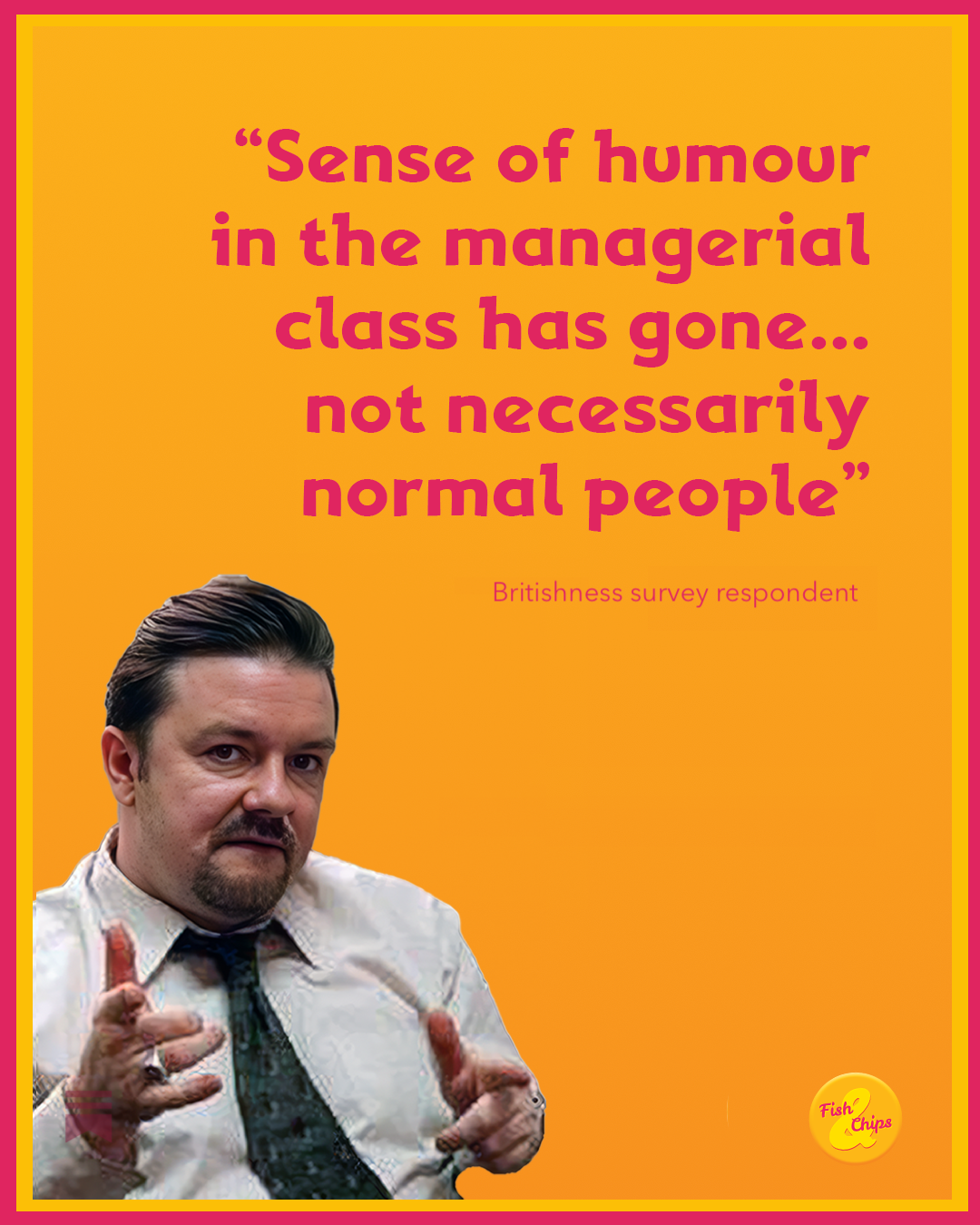

British humour – “there is something unique about ‘taking the mickey'”

Filed under: Britain, Humour, Media, Politics — Tags: , , — Nicholas @ 03:00

This post is from a few months ago, but still seems quite relevant to British society (admittedly, I’m not there and perhaps things are actually better than they appear from across the pond):

Image from Fish & Chips

Last week, the BBC announced it would be axing Live At the Apollo. Its viewing figures have halved since 2018. I turned on the TV to see what we’d be missing. It was compered by a guy whose idea of being droll was to shout. The comedians he introduced were “safe” — in the way that sticking a cork up your bottom is safe.

In order to get BBC Purity Vetting clearance, Apollo ceased to be Comedy.

Wooden jollity, enforced on us by puritans, is not the real Britain. Being sharply satirical, frivolously inane, or anywhere in between — that is who we are and what we want to watch. Rather like Baldrick, it’s all part of a cunning plan. Our humour is conduit for the House Rules of Britishness.

The self-deprecation. The puncturing of pomposity. The airing of societal concerns through a keenly observed joke. The tension-releasing giggle of the naughty-but-nice. The feel-good factor of unadulterated silliness — from Bob Mortimer right back to Saint Eric of Morecambe.

Yes, in its many forms, British humour is the window to our soul. And yet the Pigeons of Political Correctness have come and dropped their payload all over it.

What a mess they’ve made. On our screens and off, the fear of causing offence suppresses our greatest and most cohering natural instinct. In the mini survey I mentioned in Fish & Chips Portion One, we found that humour was by some distance thought to be the most quintessential British trait. Among things like chatting in the pub, walking the dog, respectfully disagreeing and helping a neighbour, “seeing the funny side” came top. It is our coping mechanism; our way of keeping calm and carrying on. It is what we are admired for. In the once noble pursuit of social justice; of balancing things up a bit – our humour police are creating a whole new imbalance. It is topsy turvy social engineering in which only the “weak” are “strong”. There must be a zany new Monty Python sketch in there somewhere.

A respondent in our survey was spot on when he said: “Sense of humour in the managerial/professional class has gone … not necessarily normal people“.

So it’s time that we “normal people” clean all that crap off the window. The pigeons won’t do it, will they? They”re too busy cooing about Diversity, Equity & Inclusion. It is up to us to make the penny drop for them. To see that what they are trying to do is unnatural. Because in Middle England, there will always be the surreal, the satirical, and the smutty innuendo.

CMAR – Canada’s Newest Service Rifle – 2026

Filed under: Cancon, Military, Weapons — Tags: , , — Nicholas @ 02:00

Josh Bortolotti
Published 5 Jun 2026

Connaught Range Primary Training Centre

The Canadian Army is in the final stages of testing for the C25 General Service Rifle, the first weapon being delivered by the Canadian Modular Assault Rifle project. Since awarding the contract to Colt Optics to provide the 1-6x LPVO, key stakeholders are brought out to Connaught Range to fire the weapon from differing distances and provide feedback. Some members of the Army Headquarters also got the opportunity afterwards to have a familiarization shoot with the C25 and C26.

C25 General Service:
Colt MRR 5.56x45mm (13.7″ barrel)
Colt Optics 1-6x Low Power Variable Optic (LPVO)
Millbrook Strategic Sciences Multi-Function Muzzle Device (MFMD)
Magpul Back Up Sights and Furniture

C26 Full Spectrum:
Colt MRR 5.56x45mm (15.7″ barrel)
Colt Optics 1-10x Low Power Variable Optic (LPVO)
Millbrook Strategic Sciences Multi-Function Muzzle Device (MFMD)
Magpul Back Up Sights and Furniture

QotD: Polis magistrates – Archons

We’re going to start with senior magistrates and here we can engage in at least a little bit of cross-polis comparison because these most senior magistrates tend to be the only sort that show up regularly in our sources. As noted last time, the general term for these senior magistrates was archons (ἄρχοντες, archontes, literally “leaders”, from ἄρχω, “to begin, to be first” and thus “to lead, to rule”. Note also ἀρχή, “first, preeminent” but also “power, empire or an office”.), but every poleis‘ archons were likely to be a bit different, with their own particular local terms, numbers and sets of powers.

Numbers however is the first key difference here. Most modern governments have a single magistrate – a president or prime minister – from whom flows all executive power, delegated down to subordinates who are often unelected and whose power thus derives from the one chief magistrate at the top. In some cases, that power is less vested in the person of a prime minister as it is in the collective cabinet (where the cabinet wields power and notionally takes responsibility collectively), but there is still one line of power, reaching from the people, through a single executive person or body, then down to many functionaries whose role is to implement the will of the single executive.

This is not how ancient Greek magistrates (or indeed, ancient magistrates generally) worked.

Instead, Greek magistrates were a product of efforts to weaken royal power by dividing it, which of course only works if executive power was truly divided, that is vested in different autonomous figures. Thus it is important to not to see these magistrates as organized into a “chain of command” or even engaged in collective decision-making. Instead, the best way to understand most magistrates is to imagine them as individual actors whose powers are restricted to a single sphere of action (that is, they have a specific job) and that a city might have many of them. Thus there isn’t one executive power in a polis, but many. Even in cases where magistrates function as a board, it is often the case that each member of that board carries the full power of the magistracy – it is a board of ten magistrates, not a board of ten acting as a magistrate, which means the individuals can act independent of the board.

So instead of one executive, what you have in a polis are many independent, little executives, each with a fragment of the overall executive power. And if you are thinking, “that sounds like an awkward system, since magistrates might be working at cross-purposes with each other”, well, yes. There’s a reason we don’t generally structure governments this way. But the Greeks did and they liked it that way, because this sort of structure keeps the powers of the magistrates in check.

So what might the high magistrates of a polis do exactly? Though there are many different configurations for high magistrates, they tend to do the same basic set of jobs (again, split up usually). You need magistrates to 1) lead the armies and fleets (not usually a distinct job; strategoi are generals and admirals), 2) manage and organize the law courts (which may or may not include making summary judgements in minor cases), and 3) conduct key religious rituals on behalf of the community. Those who have been here a while will note how this maps on neatly to the three roles of kingship (chief general, chief judge, chief priest), though the shift from royal law maker-enforcer-judge to “court scheduling specialist” is a meaningful one.

So at Athens, we have the initial three archons which slot neatly into these roles: the polemarch (πολέμαρχος, polemarchos, lit, “war-leader”) was in charge of the army, the archon basileus (ἄρχων βασιλεύς, lit, “king archon“) who filled in for the king in religious rituals which required his presence but had no broader non-religious powers, and finally the eponymous archon, who lent his name to the year (“in the year of the archonship of so-and-so” being a standard dating form) and ran the courts. It seems fairly clear that early on the eponymous archon often stood as judge and initially also presided over the meetings of the Athenian boule and ekklesia as its chief magistrate (and so supervising the law making process as well).

Over time these offices in Athens were weakened or supplanted, breaking power up further in order to buttress the democracy against both oligarchic power (remember: strong magistrates are a tool of “the few”) and tyranny (strong magistrates have a good position to overthrow the democracy and institute a tyranny). The eponymous archon slowly lost most of his power; the boule came to be a select council which ran the ekklesia and in turn there was an even smaller select council, the prytaneis who acted as a select of the boule and presided over it. Meanwhile, the polemarch became mostly an organizational, “managing the home front” figure, while the war leading role was replaced with a board of ten generals, the strategoi. The strategoi ended up being a pretty key office. As everyone understood you needed generals with expertise, it was an office where one could be elected multiple times in succession and was never determined by lot the way the archonships were; that meant a capable politician could secure a permanent role in the state by getting elected over and over again as strategos; this is for instance the position Pericles held.

As for the courts, these got bigger even as the eponymous archon got smaller and so the Athenians created six lesser archons, the thesmothetai (θεσμοθέται, sing. θεσμοθέτης; “law-giver”) who operated the courts (but did not dispense justice; these are jury courts). Still the eponymous archon kept some vestigial legal powers, like a supervisory role over the epikleroi, sometimes translated as “heiresses” (although that’s not quite right – they weren’t and indeed under Athenian law couldn’t inherit, but rather property was passing through them to legally valid inheritors – they were required to marry into their paternal line in order to generate a husband who could be such a valid inheritor – which in most poleis had to be male.).

At Sparta, the ephors and the two hereditary Spartan kings filled the role of high magistrates; the existence of the two hereditary kings is, we know, quite unusual but the board of ephors is not. We know that several other poleis had ephors and evidently on Crete they had kosmoi (described by Aristotle but epigraphically attested at Eleutherna, Eltynia, Gortyn, Knosos, Lyktos, etc.; Inventory 1159, 1160, 1164, 1169, 1175) whose powers were apparently much like the ephors. Ephors and kosmoi appear invariably as boards of officials with a wide range of executive powers: the Spartan ephors (of whom we are best informed) handled most foreign policy, served as a high court and could propose legislation to the assembly. At Sparta the ephors had the job of making sure the kings did their job, including their religious role, but also had some of their own ritual functions, like the ritual declaring of war on the helots (Plut. Lyc. 28.4). As you might imagine, a board of magistrates with such wide-ranging powers tended to be tools of “the few” and indeed Aristotle notes that the Spartan ephors were easy to bribe (Arist. Pol. 2.1271a) while the Cretan kosmoi monopolized power to produce an effectively hereditary oligarchy (Arist. Pol. 2.1272b). Also notably it seems like one of the ephors or kosmoi was always eponymous, giving their name to the year just like the Athenian eponymous archon.

Athens and Sparta weren’t the only poleis with these kinds of high officials, of course, but as noted the magistrates of other poleis are often very poorly attested. Thebes had an eponymous archon (of unclear powers) and at least two polemarchs by 382 (Inventory, 455); the Boeotian confederation, of which Thebes was the leading power, also had seven Boiotarchs (Βοιωτάρχης, a fusion of βοιωτία (the name of the region) and that ἀρχ- root meaning “leader”), elected for a term of one year who led the combined armies of the Boeotian poleis. Argos’ assembly had a presiding magistrate attested in inscriptions, who was assisted by a secretary with a six month term of office; they also had board of five strategoi who commanded the army reported by Thucydides as well as a board of treasurers (ἀρτῦναι, artunai; Inventory, 604).

Demiourgoi (“public workers”) appear in a number of poleis, often as a board or group of magistrates (Larissa had these, Arist. Pol. 1275b; Inventory 696), though the role of demiourgoi seems to vary from polis to polis as you might expect with so general a name (at Larissa they were apparently able to make new citizens, but the title was also used for the officials of the Hellenistic-era Achaean League (a federal alliance of poleis) and the representatives of the Peloponnesian League (Dem. 18.157) among quite a few others.) That said, demiourgos is a word with a wide range of meanings, to include magistrates but also skilled workers in public employ as well as being used in a philosophical sense to mean a kind of “creator god”, so it’s a tricky word.

All told then what should you expect in terms of the high magistrates of a polis? Well, first that the key jobs here are leading the army, organizing the courts (and/or acting as a court as a board) and filling religious roles; you should expect these jobs to split over multiple magistrates. In democracies, offices that don’t require a lot of technical know-how may be selected by lot, but the rest tend to be elected (in oligarchies often from a subset of the polis, defined by wealth). In either case, magistrates serve relatively short terms, usually just one year (but sometimes a little longer or shorter). It is generally only the “specialist” offices (read: generals) that can be held multiple times consecutively. The more powerful the magistracy, the more likely it is to be organized as a board of magistrates.

Now those are the most important and central magistrates, but a large polis with thousands of politai (and even more non-citizens) is going to need a slew of other state officers to handle a lot of the day to day matters. That brings us neatly to minor magistrates …

Bret Devereaux, “Collections: How to Polis, 101, Part IIb: Archons“, A Collection of Unmitigated Pedantry, 2023-03-24.

Powered by WordPress


