Quotulatiousness

October 24, 2026

Everyone has an opinion on Oliver Cromwell

Filed under: Books, Britain, History — Tags: , , , , , , — Nicholas @ 05:00

On Substack, Charles Haywood reviews The Making of Oliver Cromwell by Ronald Hutton:
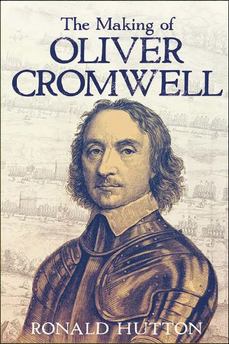
If you know anything about Oliver Cromwell — and few do nowadays — you probably have an opinion about the man. Some vilify him; “A curse upon you, Oliver Cromwell, you who raped our Motherland”, the Irish rock band The Pogues sang. Others praise him as an enemy of arbitrary rule and a proto-republican. Ronald Hutton’s new biography of Cromwell’s early life and his climb to prominence makes no final judgment on the man, but it does offer a nuanced view of this complex historical figure. From Hutton’s excellent book we get not just history but the realization, in this desiccated age, that men such as Cromwell always emerge during great turmoil, rising as if from sown dragon’s teeth.

Hutton wisely focuses on his subject, and makes no attempt to tease out the political and social complexities behind the Civil War. He expertly evokes the England of the mid-seventeenth century, both in politics and the natural world. As to the latter, quite often Hutton describes in detail the flora of the region and season, at the same time he narrates a particular historical event, which makes the reader feel more immersed in the story, as if he were there. It also makes the reader a little sad, though. Why? Because it brings to the mind’s eye a lost time and a lost country, before industrialization, liquid modernity, and alien invitees destroyed both the English landscape and England’s ancient culture.

The short version of Hutton’s biography is that Cromwell “was both godly and wily, and the two at times seem to jar with each other”. No doubt this is often true for a godly man called to be a temporal leader. Hutton believes that most Cromwell biographers focus too much on the godliness and too little on the wiliness. This is not really a popular history; it offers extensive notes, and Hutton often refers to controversies among Cromwell scholars of little interest to the casual reader. Nonetheless, it is very readable, so any reader who is willing to put in a little effort will be rewarded.

Until he was forty, Cromwell lived as an obscure provincial, a collateral descendant of Thomas Cromwell, Henry VIII’s minister who fell from grace. In his thirties, however, he became a devout Puritan, something about which we know very little. (He kept no archive of correspondence, and while he left voluminous public words, he left no record of his own private thoughts other than letters to others.) Hutton fleshes out what we can know about Cromwell’s life prior to 1640, in the East Midlands, in and near Huntingdon. There was no reason to expect great things from Cromwell; he was on the lower border of the gentry, a man of no importance. In fact, for a time until he inherited money from his uncle, he directly worked the land as a tenant farmer.

[…]

For the next two years, relations between Parliament and King deteriorated, and the countryside began to separate into armed factions. When Charles sought to fund himself by asking for donations from Cambridge colleges, Cromwell returned to Cambridge, apparently on his own initiative, and raised a militia, successfully preventing the dispatch of gold and silver to the King. Soon he was formally commissioned a cavalry officer in the army being raised by Parliament, and so he remained for the entire war, rising ever higher in rank.

From 1642 until 1646, the end of the period covered by Hutton’s book, Cromwell alternated vigorous military activity with political activity. He remained a member of Parliament. In 1645 Parliament, in order to resolve a dispute between the Lords and Commons, forbade members to also be military officers. Such a separation was part of creating the famous New Model Army—but Cromwell alone was given a dispensation. This was meant to be very temporary, meeting an immediate critical need, not an acclamation of Cromwell, who had made plenty of internal enemies. But as it happens, Cromwell’s greatest military successes immediately followed, at the most crucial period of this first phase of the Civil War, and so he continued to both lead soldiers and serve in Parliament. This lucky confluence of events was what ultimately made Cromwell.

The Winter War, 1939-40

After joining with Hitler’s Third Reich to dismember Poland, and occupying the Baltic states of Latvia, Lithuania, and Estonia, Stalin turned his attention to Finland. From the Soviet point of view, the Finnish border was uncomfortably close to Leningrad and the fortified defensive lines along the Karelian Isthmus were a reminder that the Finns could cause trouble if a war came. Stalin’s solution was to demand that the Finns give up the region northwest of Leningrad (including the defences), along with several islands in the Gulf of Finland and allow a Soviet naval base to be established on the Finnish coast near Helsinki. All this in exchange for a larger chunk of Soviet territory north of Lake Ladoga and the “firm friendship of the Soviet Union” for whatever that might be worth. The Soviets backed up their claim with an overwhelming military superiority in men, tanks, artillery and air power. The Finns declined the generous offer, which took Stalin aback:

Not actually much of an exaggeration: Finnish snipers were a constant threat to Soviet military operations in Finland during the Winter War and the Continuation War.

On 30 November 1939, the Soviet Union invaded Finland through an immensely samey, tree-covered morass. Across hundreds of miles of deep snow and borderland, the Red Army unleashed 450,000 men, roughly 1,100 tanks, and hundreds of combat aircraft, expecting to overwhelm its smaller neighbour through sheer weight of armour, heavy artillery, and manpower.

Joseph Stalin overturned the original campaign plan, discarding the slower but sounder 4-month plan for a lightning campaign in just two months. Beneath that rigid political deadline lay an atmosphere of terror. No senior Soviet commander dared challenge Stalin, correct his unrealistic timetables, or point out that the Red Army was unready for a winter invasion. Officers who raised logistical concerns risked being branded defeatists or traitors—a real possibility the purges proved.

This fear spread in the ranks.

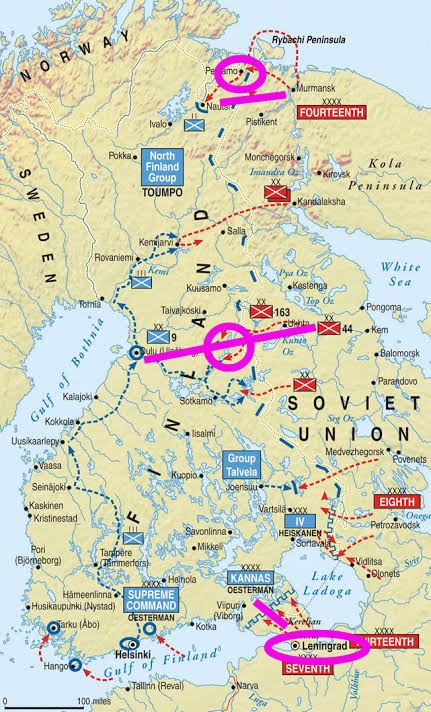
Despite the low state of morale, the Red Army struck along three operational axes:

  • The Southern Main Effort (Karelian Isthmus): The heavy Soviet 7th Army would drive toward Helsinki, intent on punching through the main Finnish defences: the Mannerheim Line.
  • The High North (Lapland & Arctic Coast): The 14th Army would advance across the tundra to seize Finland’s ice-free Arctic port at Petsamo, to cut off fears of foreign supplies inbound to aid the Finns.
  • The Central Thrust (the “Waist” of Finland): The Soviet 9th Army would strike west across the country’s narrowest stretch toward Oulu on the Gulf of Bothnia.

Soviet pressure in three main spots, excuse my art!
Image and caption from WW2 Matters

In the central sector, Soviet planners harboured an ambitious but possible objective: advance west toward Oulu, reach the Gulf of Bothnia, and slice Finland in two.

The plan looked reasonable on map overlays at Leningrad headquarters. The target was Suomussalmi — a quiet logging settlement enveloped by lakes, swamps, and primaeval pine. Its importance lay not in its economic value, but in its position on the regional dirt road network running west toward Oulu. A successful Soviet drive here would sever the rail network connecting northern and southern Finland, cutting the vital land artery to neutral Sweden through which western supplies flowed.

To execute this strategic cut, Soviet planners committed two heavily reinforced divisions under the 45th Rifle Corps — the 163rd Rifle Division and the 44th “Blue” Rifle Division. With their attached tank battalions, corps artillery, and massive logistical columns, this combined force brought nearly 50,000 men into the narrow forest corridors.

In the Suomussalmi sector, the Finns initially faced fewer than 1,000 local Civil Guardsmen, later reinforced into Colonel Hjalmar Siilasvuo’s 9th Division to total 11,000 to 17,000 men. Outnumbered more than four to one, the Finns had no tanks and only 11 outdated artillery pieces — some dating back to the 1904 Russo-Japanese War — and severely rationed shells.

The Soviet plan depended on numerical dominance. But in the dense taiga forests of northeastern Finland, it became a bloody lesson in the difference between possessing a large army and knowing how to use it.

The classic communist mistake: measuring quantity instead of value

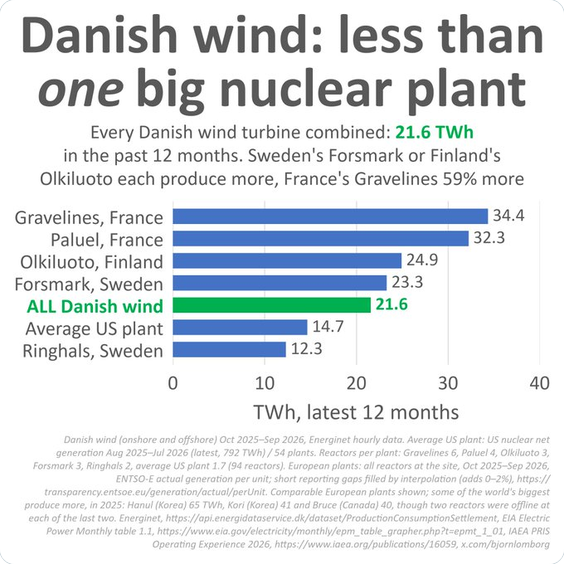
Denmark invested heavily in wind power, on the assumption that they could generate enough electricity from their vast wind farms on the North Sea coast to replace other forms of generation. As Bjorn Lomborg points out, it’s not adding up the way the Danes hoped it would:

Denmark spent decades building nearly 5,000 wind turbines

Together, they produced 21.6 TWh in the last 12 months

One nuclear plant in Sweden made 23.3 TWh

Oh, and nuclear runs 24/7 — wind doesn’t

There’s one big reason Denmark has some of the most expensive electricity in the world

https://transparency.entsoe.eu/generation/actual/perUnit

https://api.energidataservice.dk/dataset/ProductionConsumptionSettlement

https://eia.gov/electricity/monthly/epm_table_grapher.php?t=epmt_1_01

https://iaea.org/publications/16059

Krzysztof Szczawinski explains the mistake is the same one that Soviet bureaucrats made repeatedly:

Counting terawatt-hours is the classic communist mistake: measuring quantity instead of value.

The Soviet Union produced record tonnes of steel nobody needed and millions of left shoes. There’s an old Soviet joke: when the nail factory’s quota was set by weight, it produced one giant nail. When it was set by number, it produced millions of tiny useless ones.

What matters in electricity is not how much – it is when. Electricity when it is needed has value. Electricity when nobody needs it has none. Wind turbines often produce exactly then – on a windy night, when demand is low. The price turns negative: the system is literally paying someone to take it, and the surplus only strains the grid. And when the wind stops, someone else has to keep the lights on.

A price is a message: this is needed, now. A negative price says: please, stop. A system that keeps producing anyway isn’t green. It’s deaf.

That’s mental communism applied to energy: the wish before reality.

Regimes that entertain such delusions end up going broke – and then they collapse.

Paul’s Chisel Choices | Paul Sellers

Filed under: Tools, Woodworking — Tags: , , — Nicholas @ 02:00

Paul Sellers
Published 10 Jul 2026

Many people struggle to work out which general and every-purpose chisel they need because there are too many people out there with their various opinions.

My consideration comes from a lifetime of using chisels, and I think I have used every type or make. In this video, I explain what I am looking for in my day-to-day chisels.

I take no profit from the makers, no freebies or backhanders, not a thing.

This video will take the guesswork out of what to get, whether you are new to woodworking or new to hand tools. Thank you for watching!

For more Information about chisels follow: https://commonwoodworking.com/guides/buying-a-chisel/

QotD: Was Hitler stupid?

Filed under: Germany, History, Quotations, WW2 — Tags: , , , , , , — Nicholas @ 01:00

I used to live with a guy who was smack in the middle of the bell curve, IQ wise. He always seemed just half a step slow to one group of friends … and just a bit quicker on the uptake to another. Fantastic guy, he’d give you the shirt off his back, but he was also an object lesson in what the biology folks call “assortative pairing”. It wasn’t a big deal, but if the quicker-on-the-uptake group knew Jeremy was coming along, you had to be sure to spell out that one extra step that everyone else just took for granted. I imagine the just-under-the IQ-hump group had the opposite issue. It was fascinating, sociologically speaking.

Hitler didn’t have that problem. It’s a mug’s game, trying to tie “measured IQ” to anything, much less to try to retroactively guess any given historical figure’s IQ. But it’s a useful-ish concept, so let’s call that “processor speed”. My buddy Jeremy was right at the apex of the bell curve re: processor speed. Hitler was clearly on the right hand side of that particular curve. Probably a fair ways out there, if the truth be known — no genius, Hitler, but pretty sharp nonetheless.

Unfortunately, that degree of smart makes one especially vulnerable to a certain kind of stupidity — let’s call it “the stupidity of misplaced self-esteem”. Snowflake stupid, maybe, for short. I’m sure we’ve all had the experience of being the smartest guy in the room. I mean clearly, unquestionably the sharpest knife in that particular drawer. If you have too many experiences like that, you start thinking you’re the sharpest knife in every drawer; the smartest guy in any possible room. Which means you veer out of your lane on the regular.

It’s endemic in academia, so I’m particularly sensitive to that kind of stupidity. Most profs actually are fairly bright, processor speed-wise. […] If he’d used those brains to, say, open up a mechanic shop or something, he’d fall victim to Big Man Syndrome — every babymomma’s cousin’s sister’s former roommate would start coming around, expecting him to pimp her ride for free. Since academia produces nothing useful, the homies can’t freeride on you).

Throw in the fact that you control the grade book, and it’s really, really easy to convince yourself you’re the smartest guy in any room. With no one to hold you in check, and in the absence of reality testing — which the entire ivory tower ecosystem is designed to avoid — it’s sometimes a real battle not to let your freak flag fly. Indeed you frequently come to wonder why you bother …

… and that’s the kind of stupid Hitler was. Snowflake stupidity is, obviously, situational. There were lots of legit very smart guys in the Nazi party. I doubt Hitler was ever the processor-speed smartest guy in any room, but he was up there, and in the early days he knew it — both ways. Moreover, he had charisma. What the PUAs study like crazy to learn, he just naturally knew how to do. Even the people who were constitutionally immune to his charm could see how and why so many others fell for it.

That’s the most dangerous combo. He was smart enough to be right in there in most rooms … but he could dominate any room with his charisma. Which leads to another special kind of stupidity, what you might call “messianic stupidity”. Things just kind of work out for that kind of guy; have you noticed? I’m sure everyone has known someone like that — probably not to Hitler’s degree, but I’m sure there’s someone in your life that just seems to catch every possible break, all the time, and when something does start going south for him, he can just turn on those baby blues and it all kinda just … goes away.

That kind of person — and I had a buddy like this; I saw it at close range — “knows better”. In the sense that if you gave him a situation on paper, and had him dope it out Heuer-style, he’d come up with the “correct” choice. Nothing wrong with his decision making process in a vacuum, and of course he was smarter than the average bear, too. If you went to Ross with a problem and pitched it as something that might hypothetically happen to some guy, he’d give you solid to excellent advice.

If, however, you went to him with one of your problems, in a situation involving mutual acquaintances, his advice would be terrible. For instance, he was one of those guys who don’t look like anything special, but every girl in the room starts drooling when he walks in. So you ask him “Hey, what should I do about Jane?” and though he’ll try his best to help, it really just doesn’t compute. Because while whatever he advises would work out great for him — of course it would — for you it’ll be a big mess, even if you do your very best Ross impersonation, because you don’t have that thing he has, the one the Germans call je ne sais quoi.

Hitler did. His successes were due, in large part, to doing zany, completely off-the-wall shit, the kind no rational planner would ever even bother planning against. Which can work out spectacularly well — Joan of Arc had the same gift. Lenin did, too. Combine that with the devil’s own luck (at least initially) and you get the mystique of the messianic leader. He does zany stuff, and it just kinda works out … until it doesn’t.

Combine that with ideological stupidity and you’re bound to have tears before bedtime. The Nazis had absolutely no idea what they were going to do with Grossdeutschland. Not the first clue. There’s a wonderful book on this, by Mark Mazower, called Hitler’s Empire. To say “they had no clue” is actually an understatement. His thesis, which I agree with, is that Hitler — being a 19th century guy — thought of the conquered territories in terms of Germany’s lost colonies in Africa. Really. A kind of Bismarckian Weltpolitik, except in France instead of Tanzania.

That’s just dumb. It’s not processor-speed dumb; it’s a lifetime of mental habit dumb, combined with ideological enstupidation. Add to this Adam Tooze’s The Wages of Destruction, which is buried in my to-read pile somewhere, but you can find good reviews on it with a little googling. Is that IQ-dumb? No. Is it really fucking stupid? Oh yeah.

Severian, “Friday Mailbag”, Founding Questions, 2022-08-12.

Powered by WordPress