
HardThrasher
Published 11 Oct 2026Like many Nazi ideas, what looked good on paper was, in reality, somewhat different. The Rocket craze of the late 1920s led directly to the development of one of Nazi Germany’s most expensive weapon systems, which was technologically astounding, but militarily rubbish.
Today we’re going to look at how that all began, the race to develop the A-4 rocket, the building of a massive test site to create the weapons and talk about what the A-4/V-2 was, how it was supposed to work, how the technical challenges were over come, and ask the question no one did at the time — why bother?
00:00 Big Rockets, Bad Ideas: The V2 Story
00:55 The “So What” Question
03:04 Rocket Fever — the late 1920s
06:51 The Lads in Grey Step in
08:50 von Braun’s Faustian Pact
11:21 Peenemünde: Onwards and Sometimes Upwards
13:42 Size Matters: The A4 Concept
19:26 Getting the Gang Together: The V-2 Engineers Come Together
22:36 A Quick Tea Break and some Blatant Self Promotion
23:51 The A4 and Other Rockets: A Timeline
27:28 Anatomy of the A4
29:26 Guidance and Gyroscopes: Making It Go the Right Way
35:09 The Rocket Engine: Controlled Fire and Clever Plumbing
38:36 The V-2 Turbopump: The Wolverine
46:54 Survivor’s ClubNotes
[1] Guy Walters, Stealing Hitler’s Rocket, Head of Zeus, 2026 p.27 (Kindle ed)
[2] Tooze, Wages of Destruction p. 750 gives German GDP in 1937 as RM73.757bn, approximate cost of the V2 programme whilst Neufeld, The Rocket and the Reich: Peenemünde and the Coming of the Ballistic Missile Era, p.273 gives the total cost of the A4/V2 project, excluding vehicles, warhead and guidance systems as RM900m
[3] Michael J. Neufeld, The Rocket and the Reich: Peenemünde and the Coming of the Ballistic Missile Era (New York: Free Press, 1995), Kindle Edition pp. 122–124
[4] Stephen Ransom & Hans-Hermann Cammann, Me163 Rocket Interceptor, Crecy Publishing, 2021, pp.30–32
[5] Micheal Nuefled, Von Braun, 2007, Smithsonian (Kindel Ed), p.50
[6] Neufeld, The Rocket and the Reich: Peenemünde and the Coming of the Ballistic Missile Era, pp. 19–21.
[7] Neufeld, The Rocket and the Reich: Peenemünde and the Coming of the Ballistic Missile Era, p. 23.
[8] Neufeld, Von Braun, p.55
[9] Neufeld, Von Braun, p.61
[10] Neufeld, The Rocket and the Reich: Peenemünde and the Coming of the Ballistic Missile Era, p. 32.
[11] Neufeld, Von Braun, pp.64–65
[12] Neufeld, The Rocket and the Reich: Peenemünde and the Coming of the Ballistic Missile Era, p. 50
[13] Neufeld, The Rocket and the Reich: Peenemünde and the Coming of the Ballistic Missile Era, p. 51
[14] Neufeld, The Rocket and the Reich: Peenemünde and the Coming of the Ballistic Missile Era, p. 52.
[15] Neufeld, The Rocket and the Reich: Peenemünde and the Coming of the Ballistic Missile Era, p. 179
[16] Neufeld, The Rocket and the Reich: Peenemünde and the Coming of the Ballistic Missile Era, p. 59.
[17] Neufeld, The Rocket and the Reich: Peenemünde and the Coming of the Ballistic Missile Era, p. 98 & 121 – A-9 development stopped in 1942, A-10 was never more than a paper study
[18] As above, worth picking out the A-10 proposals as theoretical
[19] A4/V2 Rocket in detail: Turbopump “V2 Turbo Pump Part 1”
[20] Neufeld, The Rocket and the Reich: Peenemünde and the Coming of the Ballistic Missile Era, p.65 and on
[21] For those who’re so minded there’s a complete explanation of the V2 engine systems here: John A. Halchak, James L. Cannon and Corey Brown, “Materials for Liquid Propulsion Systems,” in Aerospace Materials and Applications (AIAA, 2018), p.15 and onward
[22] “Analysis and Evaluation of German Attainments and Research in The Liquid Rocket Engine Field. Volume 4. Propellant Injectors”, which you can get in pdf form online has a really good description of how this works.
[23] Walters, Stealing Hitler’s Rocket, p.27
[24] Neufeld, The Rocket and the Reich: Peenemünde and the Coming of the Ballistic Missile Era, p. 80.
[25] A4 / V2 Rocket in detail: Turbopump – I make no apologies for referencing the same YT video here, it is art, go and watch it
[26] Neufeld, The Rocket and the Reich: Peenemünde and the Coming of the Ballistic Missile Era, p. 88
[27] Neufeld, The Rocket and the Reich: Peenemünde and the Coming of the Ballistic Missile Era, p. 85
October 12, 2026
The V2 Story: 1934-1940, A Pact with the Devil
Australia’s first military action in WW1
Australian troops got into action much earlier in 1914 than most people might remember, acting to shut down German wireless stations and coaling facilities in the south Pacific islands and invading the German colony of Neu Guinea in September:
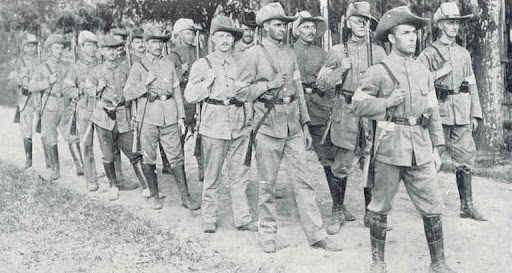
German reservists at Neu Guinea
Photo from Chris’s Naval History Substack
On the 11th September 1914 the Australian army launched its first campaign of the Great War and it was pretty much as far away from the Dardanelles that you could possibly get which is where many people think their War began. The first Australian Expeditionary force were walking up the beaches of German Neu Guinea towards an undefended shoreline.
But why are the Australians fighting there?
Officially these were moves to neutralise the Wireless stations and possible bases for von Spee’s Cruiser squadron which would then mean Allied shipping was secure. However Australia had long coveted the German colony of Neu Guinea since before it was a German colony. When Germany finally made a move to establish itself on the island, they really wanted it and the British Crown was not too bothered about the malarial jungle that was too thick to really carve a niche out. If Germany wanted to pour money and resources into such a backward colony for little return then they were welcome to it. The rest of the island was owned by the Dutch East Indies and the British, soon to be Australian Papua Guinea in the south looking over their border jealously. The First World War offered the Australians a chance to absorb the territory without any repercussions.
Defensive measures
As War commenced, German colonies around the world had to try and figure out what the best course of action was. Togoland made a bid for neutrality, Sud West Afrika got ready for invasion and Tsingtau began fortifying itself.
But for the German island colonies there was not much in the way of defences and out on the “Australian Station” the majority of defence was supposed to be carried out by the Ostasiengeschwader‘s ships, sailors or marines. For local issues each colony had local armed police officers led by a German officer which could hold down local problems until the cruisers arrived as they had during Sokeh’s rebellion in 1910. In Neu Guinea there were 125 Melanesian policemen backed up by a small group of German reservists amongst the colonists under a regular Army officer who had been sent out by the Colonial Office. By the 6 August the Colony had put out the call for assistance and managed to swell the force to two regular Army officers, seven reservist officers, fifty-two reservist soldiers and 240 native soldiers.
Defending the beaches against an armed invasion would be a really poor decision as the Australian navy’s guns would decimate their trenches and positions as well as the nearby town drawing death to the civilian population. The Germans knew that the main target of the Australian Naval and Military Expeditionary Force would be the wireless station. Ultimately, they could not stop the colony;s eventual fall but they could make the Australians pay for the advance and try and buy as much time as they could for transmission time and setting demolition charges. The pathway through the jungle would be defended by snipers, trenches and hit and fade attacks against an enemy who wouldn’t know the terrain.
The Great Game for Asia 1894-1905
Real Time History
Published 15 May 2026The 19th century is a time of violent global imperial competition. The Scramble for Africa and the Great Game between the Russian and British Empires over influence in Central Asia are among the best-known examples. But the 2nd half of the century also involved another Great Game – the Great Game for Asia.
00:00 Intro
05:35 1st Sino-Japanese War 1894-95
30:02 Boxer War 1900-01
55:40 Russo-Japanese War 1904-05
01:22:14 Conclusion
(more…)
QotD: Blame the “Silent generation” for The Sixties™, not the Boomers
I’ve written many times that the real culprits here aren’t the Boomers, but the Silents. Pick any obnoxious “Boomer” who did whatever in The Sixties™, and it’s Build Back Brandon to one that the “Boomer” in question was born in the 1930s. Which makes sense for a lot of historical reasons, but simple chronology will do: If we take as read that The Sixties™ started with the Port Huron Statement, then The Sixties™ started in 1962. The Baby Boom started in 1945, meaning that the very oldest Boomers were still in high school in 1962. They might’ve enthusiastically embraced every word — then again, they might not — but they surely didn’t write one letter of it.
Further, what could they really do? The voting age was 21 until 1971, and as hard as this is to hear, voting was just as pointless back then as it is now. St. Kennedy only won through massive voter fraud, and that was 1960. As John Derbyshire used to say, if the American People had been consulted on anything of importance since then, the USA would still be a White Christian nation … and yet, here we are.
Tweedledum and Tweedledee put on a better show back in the days, but the Uniparty was still the Uniparty. America’s ruling caste caught religion back in the 1920s, and on the long view, you could make a pretty robust argument that Mustache Guy and the Anime Club actually did us a huge fucking favor — left to his own devices, President-for-Life Roosevelt would’ve ushered in the USSA by the late 1930s, with the enthusiastic support of all the Beautiful People on both sides of the Uniparty.
… hats off to you [Isoroku Yamamoto] — you and your dipshit friends bought us a few decades. Decades we squandered, of course, but that’s not your fault. It’s not anyone’s fault, unless you think the boys on the Higgins boats should’ve shot their officers, turned the ships around, and conducted a massive air, land, and sea invasion of every faculty lounge and radio station in America … and even if you do think that, what are you going to do about it?
As for Gen X, we were no better. I can’t blame the Boomers for running with it, any more than I can blame myself for running with our thing. I spent most of college, for instance, getting drunk and chasing tail. Chasing tail is bad, full stop — I should’ve been saving it for marriage, with all that implies — and while getting drunk isn’t bad every now and again, I didn’t do it every now and again. I lived a life as dissolute as any Boomer’s, and while I was equally powerless to change anything in the broader culture, I could’ve been a much better person … but I wasn’t.
Severian, “Friday Mailbag”, Founding Questions, 2022-09-23.


