Quotulatiousness

October 22, 2026

The Cold War era research grant model has been a disaster for universities

Before the Second World War, governments generally did not directly sponsor research in their universities. With the example of the Manhattan Project and other less-well-known directed research efforts, western governments all accepted the notion that it was part of their national defence mandate to push research efforts by way of indirect or direct funding. This spread from the STEM fields directly related to weapon development to pretty much every area of academia. Lorenzo Warby explains why this has been a major contributor to the decline of western universities and the quality of research they undertake:

By “crank the handle” notions, I mean analyses that focus so much on resources that they end up massively underestimating the importance of information — and information landscapes — in understanding human social dynamics, given that we are biological beings who use information and resources to maintain ourselves. So, a “just add capital” approach to foreign aid is a “crank the handle” approach. Attempted analysis of long-term economic growth based on some derivation of a Cobb-Douglas production function is a “crank the handle” approach. (The disastrous — and revealing — limitations of such production functions will be discussed further in the next post in the series.)

One of the many problems with the “crank the handle” approaches that the terms capitalism and capitalist so encourage — by implying use and control of capital is the crucial thing, regardless of information landscapes and reality-tests — is the innovation-is-good cargo cult that has generated disastrous incentives in and for academe. Like all cargo cults, the innovation-is-good cargo cult mimics some of the surface appearance of successful innovation without replicating (or understanding) any of the substance.

Yes, it is absolutely true that technological innovation generated mass prosperity. But there are several key features to note.

  1. Most new ideas are crap. (So are a lot of old ideas: especially those repackaged by folk who don’t have to make things work.)
  2. Technological innovation is not merely a process of invention, it also requires successful implementation.
  3. Commercial innovation has a strong reality-test: does it make a buck? The profit/loss continuum tests ideas (both old and new) and their implementation.
  4. The energy take-off that we call the Industrial Revolution arose from Britain being the first society to adopt learning-by-experiment at scale; so learning via inherent feedbacks from what did, or did not, work.
  5. That energy use take-off occurred because no elite coalition vetoed it.

The post-1945 adoption of the bureaucratically-delivered research grant system was a reaction in part to the Second World War — which was so much a technological war — and to the pressures of Cold War geopolitical competition with the Soviet Union. War generates serious reality-tests for weapons and other military technology. This reality-testing of weapons continued throughout the Cold War, as both Western and Soviet weapons were used in various conflicts.

The bureaucratised research grant model — whether government or non-profit — used to fund “innovation” within academe fails to grapple with what made either industrial innovation (with its commercial reality-tests) or military innovation (with rather brutal reality-tests) work. There also turn out to be major problems with trying to bureaucratise the Scientific Revolution.

Bureaucratised research grants treat innovation as presumptively good, when most new ideas are crap. It treats mere invention as some achievement, when inventing new ideas is hardly difficult or reliably useful. Such invention is even less difficult if there is no reality tests; if those propagating and judging those ideas do not have to make anything work in any practical, seriously-constrained-by-reality — not-just-performative — sense.

Outside the military realm and STEM (Science Technology Engineering Medicine), there are no reality-tests systematically built into the research grant process: only what plays to academic status games due to academic approval becoming the operative test. Academic approval is an amazingly weak filter. Consider Adam Smith’s famous remark about English universities:

    An English university is a sanctuary in which exploded systems and obsolete prejudices find shelter and protection after they have been hunted out of every corner of the world.

Marxism and its derivatives (e.g. Critical Theory) come to mind. Any use of Marxism — or its derivatives — requires massive discounting and rationalising away of tens of millions of deaths and a couple of dozen tyrannies. (So, of course, does any use of Left as a positive moral category, given that being Left includes Lenin, Stalin, Mao, Pol Pot, Mengistu, Kim il-Sung …)

Moreover, across much of academe, we do not see the use of experimentation or observation to test claims, but rather “findings” baked into the “research”. “Findings” that are validated precisely because they garner academic approval.


Street theatre with a niqab and a prayer mat

Filed under: Media, Politics, Religion, USA — Tags: , , — Nicholas @ 04:00

On Substack Notes, Dan Burmawi discusses the recent phenomenon of Muslims choosing to performatively pray on the public streets:

Photo from Dan Burmawi’s note on Substack.

Tonight, as I was leaving a restaurant on 14th Street in New York around 10 p.m., this Muslim woman took a prayer rug and a niqab out of the trunk of her car, put the niqab on, laid the prayer rug down, and started praying on the street.

I grew up as a Muslim in the Islamic world, and let me tell you: this is absolutely part of an organized effort to flood the public square in the West with Islamic symbolism.

First of all, there is no Islamic prayer at 10 p.m. Even if she missed the Isha prayer, which takes place earlier in the evening, she has until dawn to make it up. So why choose to pray on the street at 10 p.m.?

Second, a Muslim woman who does not wear a niqab or hijab in her daily life would never normally have a niqab sitting in the trunk of her car.

She is clearly not strict enough to wear it every day, so why would she suddenly be so strict about missing a prayer that she carries a niqab in her trunk specifically for this purpose?

Third, in almost any Islamic country, you would never see a woman praying on the street at 10 p.m. This would be completely unacceptable.

If she were genuinely worried about praying, she could simply wait until she got home, especially since a missed Isha prayer can be made up before dawn.

I can tell you with full confidence that these scenes we keep seeing of Muslims praying in the streets of the West are intentional.

They serve to assert dominance, normalize Islam in the public square, seize ground, and demand exceptional treatment that immediately turns into claimed rights.

Bad-faith acts like this are signals of the same project that turned many cities in Europe into shitholes.

Exceptional threats demand exceptional measures.

Islam must be banned in the West because it is not a religion; it is a hostile political ideology.

Until that happens, the West will continue losing ground to this ideology every single day.

“Insurgent math”

Filed under: Military, USA — Tags: , , , , , — Nicholas @ 03:00

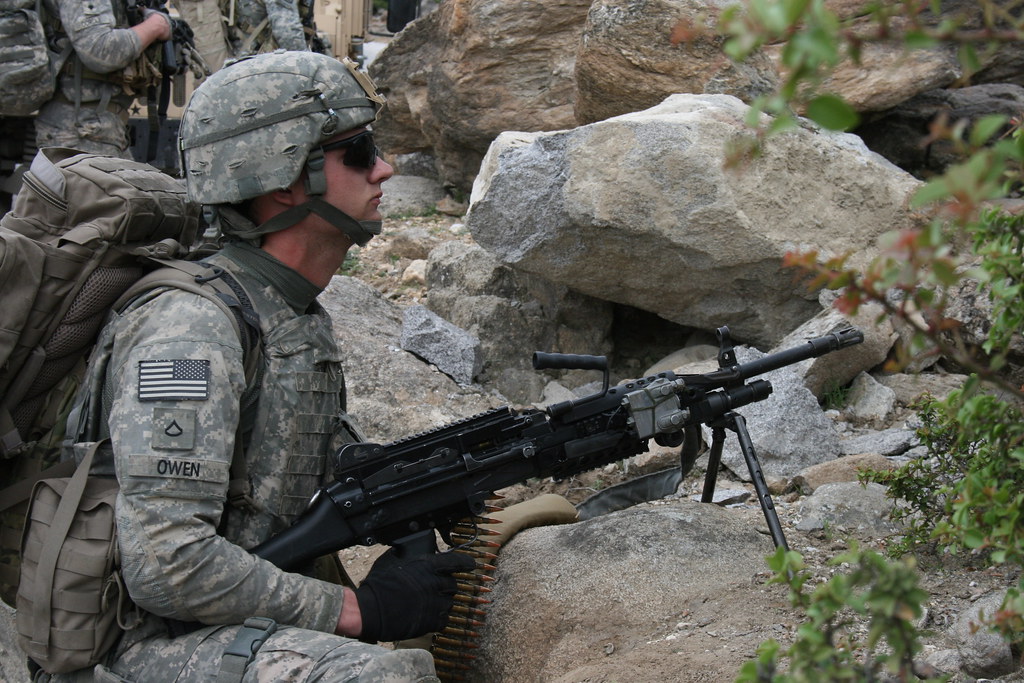
On the social media site formerly known as Twitter, InfantryDort recalls the promotion of “insurgent math” — deterring American troops from killing enemy forces as if they were hydra heads made real:

“Afghanistan 2010 43” by david_axe is licensed under CC BY-NC 2.0

Do you guys remember the “insurgent math” the generals taught us in GWOT? “If you kill an enemy, you’ll make 10 more.” Remember that? Another in a long list of points to make us practice “courageous restraint” and be reluctant to pull the trigger.

What fascinates me is how full of shit they were. Because many of those retired leaders and the politicians they back today advocate for doing the EXACT opposite within the borders of their own country.

They don’t all wish death. Some do. But the same principles apply to lawfare and harassment against people they disagree with.

So why was “insurgent math” created to give compassion to 80IQ Taliban retards but the exact opposite is given to 100IQ+ innocent Americans who are far more dangerous when they get mad enough to band together?

What even is this? Another stunning failure and hypocritical point of the War on Terror and the national lesson over the last 2 decades as a whole.

There is a large number of influential “Americans” who’d rather bow to their enemies and put the boot to their own countrymen.

They fear the wrong people. If they casually mention ruining the lives of innocent people simply because they disagree with them, then they have no fear.

When the people fear the government, there is tyranny. When the government fears the people, there is liberty.

America is the greatest result of successfully insurgency in human history. This country literally has insurgency in its blood. That’s how we started. Stunning to believe some think it’s wise to poke that bear.

The stupidity is off the charts. Truly.

Update, 23 October: Welcome, Instapundit readers! Have a look around at some of my other posts you may find of interest. I send out a daily summary of posts here through my Substack – https://substack.com/@nicholasrusson that you can subscribe to if you’d like to be informed of new posts in the future.

The Oldest Recipe in History – Hammurabi’s Kanasu Stew

Filed under: Food, History, Law, Middle East — Tags: , , , , — Nicholas @ 02:00

Tasting History with Max Miller
Published 28 Apr 2026

Lamb stew garnished with fresh leek and mint

City/Region: Babylon
Time Period: c. 1740 B.C.E.

Since this recipe is one of the oldest in the world, it’s bound to have some parts that are a little unclear. For starters, what does “prepare water” mean? Did they have to purify it? Add salt or something else to it? Was it maybe a more complicated process that was commonplace back then, but a mystery to us now? No one knows. Also, the ingredients kanasu, samídu, and šuhutinnu haven’t been definitively translated, so for this recipe, I’m going with what most scholars agree on, and also what I think will taste best.

With recipes this old, I think it’s important to not take it too seriously. It’s impossible to get it 100% right because we just don’t know enough about the language and the exact cooking processes they used. So for me, it’s less important that this dish is exactly what they’d be eating in Hammurabi’s time, and more important that it’s delicious. The meat is super tender, the flavors are well balanced, and the fresh leek gives it a nice crunch. Make this dish into a thinner broth-like soup, a thick stew, or thickened even further so that it’s like meat with a sauce. Any way is as accurate (or not!) as the next.

    Kanasu Stew
    Leg of mutton is used. Prepare water, add fat. Samídu; coriander; cumin; and kanasu. Assemble all the ingredients in the cooking vessel, and sprinkle with crushed garlic. Then blend into the pot šuhutinnu and mint.
    — Yale Babylonian Tablets, c. 1740 B.C.E.

(more…)

QotD: The “numbers fallacy” in World War II

Filed under: Australia, Britain, China, Germany, History, Japan, Military, Russia, USA, WW2 — Tags: , , , — Nicholas @ 01:00

Some historians, and many politicians, have simplified World War Two into a few stupid statements. “The war in the west was won on the Russian steppes” is one that springs to mind. They usually base such statements on traditional political incompetence — bad use of statistics. The truth is that numbers have rarely overthrown a technological edge (though the Americans under Custer and the British at Isandhlwana might have reservations on this), and World War Two is certainly not the best sample case to argue such a thing.

During the war the smaller campaigns tended to get less credit — though it is sometimes suspicious that numbers are valued in some circumstances, and area in others. The Mediterranean Front against the Axis was an extraordinarily long campaign over an extremely large area, yet many – particularly Americans who often fail to understand the Mediterranean’s importance to intercontinental strategy – discount its scale and significance. (A British general visiting the Soviets responded to toasts about the battles of Stalingrad and Moscow by offering a toast to El Alamein. The bemused Soviets asked how big the battle was, and then commented “we would call that a skirmish” – a point which emphasises the fact that the hundreds of Soviet divisions embraced by historians of the Eastern Front were rarely as big as a British brigade or American Regimental Combat Team. To get a real comparison western divisions should be compared to Soviet corps.)

Similarly the Burmese and New Guinea theatres are incredibly undervalued in their role against Japan. There were more Japanese divisions fighting longer and harder in either place than everywhere that American troops fought the Japanese put together. (The fact that in New Guinea it was Australians rather than Americans who did most of the successful fighting – the American troops first assigned disappointed their vainglorious Füaut;hrer MacArthur enormously at first – might have had an influence on this ranking.)

By contrast the Western Front against Germany in 1944 to 45 is overstated both in the area it covered, and in the number of troops involved (almost half the US troops listed for that campaign did not arrive until it was already almost over. A dozen divisions had barely landed in France before the Germans surrendered.) Which puts it in the same category as the Pacific campaign, which, if the allied troops are discounted – as they so often were by the Americans – rarely saw more than a couple of American divisions at a time engaged anywhere.

The confusion is added to by the enigma that remains China, which is simultaneously undervalued and overvalued. It is undervalued in that China and Manchuria occupied the attention of 80% of the Japanese army throughout the war. Which means that by the standards applied by some historians, China was the Soviet Union of the East, and deserves all the glory that was lavished on communist Russia by the trendy historians of the last generation. On the other hand it was overvalued, in that China achieved virtually nothing in the war against the Japanese apart from occupying large numbers of very low-grade garrison troops. In fact when the US Air Force in one of its fits of vainglory, attempted to bomb Japan into submission from bases in China: the Japanese garrison troops stirred themselves enough to sweep forward and conquer – without any trouble at all – the provinces being used as bases (Operation Ichi-Go).

Nigel Davies, “Oversimplification: The Numbers Fallacy in WWII”, rethinking history, 2009-03-08.

Powered by WordPress