Quotulatiousness

October 11, 2026

The end of colonial Africa

Filed under: Africa, Britain, Europe, History, Italy — Tags: , , , , , , — Nicholas @ 05:00

Celina reviews a 1960s film I’d never heard of, and having read her review I can understand why it has been forgotten because it tells a brutal tale as the colonial European powers withdrew from their former colonies in Africa far too often leaving the newly independent peoples to settle old scores in bloody civil conflicts:
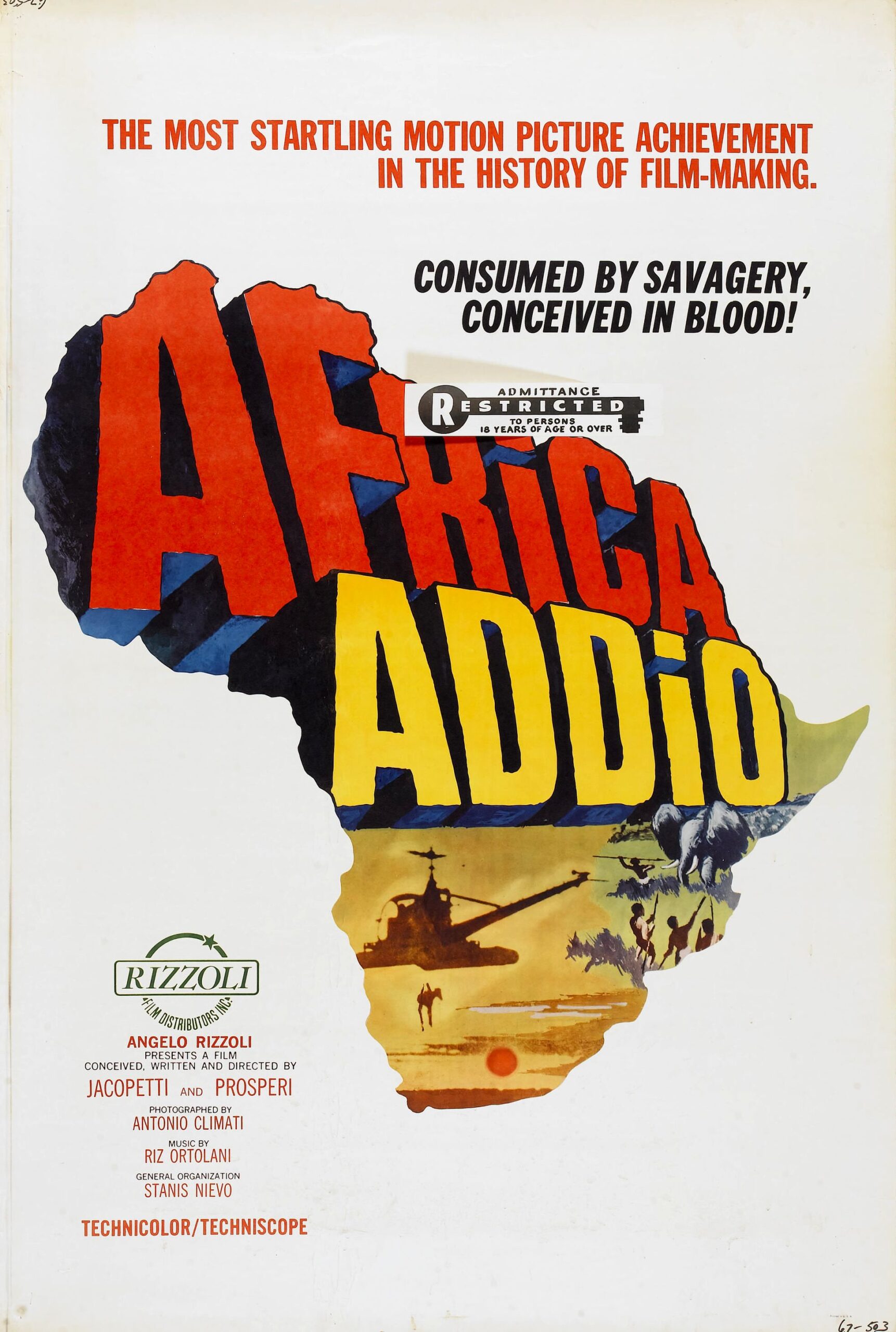
The 1966 Italian documentary Africa Addio (Goodbye Africa), directed by Gualtiero Jacopetti and Franco Prosperi of Mondo Cane fame, is a must-see for absolutely anyone who wants to understand the realities of African governance. Filmed in Kenya, Tanganyika, Zanzibar, Rwanda, Angola, the Belgian Congo, and South Africa between 1963 and 1965, Africa Addio captures the bloody upheavals accompanying the end of White colonial rule across much of the continent. It chronicles the withdrawal of the British and Belgian colonial powers, alongside Portugal’s efforts to retain its African colonies and White South Africans’ determination to preserve their rule.

The film itself is bewildering at moments, for much of the film a camera is mounted in a light aircraft, capturing the serenity of the azure waters and brilliant white sands of the Zanzibar archipelago. The visual splendour of the landscape is overwhelming in its beauty, it evokes the pristine imagery of a mid-century travelogue designed for European consumption.

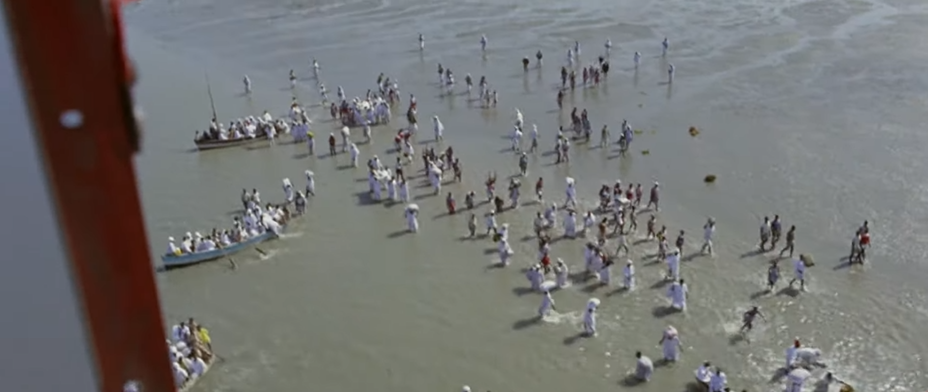
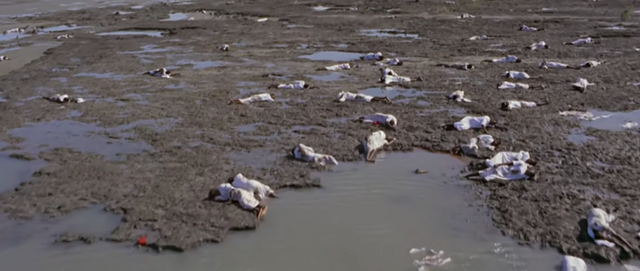
Nevertheless, as the aircraft gradually descends, the white sands are revealed to be peppered by dark, irregular shapes. As the telephoto lens finds its focus, the visual abstraction resolves into a horrifying, incontrovertible reality. The idyllic beaches are entirely strewn with the corpses of hundreds of Arab and Indian civilians, the victims of the January 1964 Zanzibar Revolution.

Screenshot from the film Africa Addio. 19 January 1964. Arab civilians attempting to flee revolutionaries.

Screenshot from the film Africa Addio. 20 January 1964. Bodies of Arab civilians at low tide, caught while trying to flee Zanzibar.

Accompanying this almost god-like, detached aerial survey of mass slaughter is the melancholic, and achingly beautiful orchestral score of the celebrated Italian composer Riz Ortolani.

This startling juxtaposition, which is only one of many in the film, feels immensely unsettling with the sheer, unfathomable scale of human atrocity paired with the romantic elegance of European orchestration. It encapsulates the disturbing essence of Africa Addio.

The opening sections focus primarily on Kenya. We see a series of trials of Mau Mau terrorists and their accomplices, who massacred White families and mutilated their cattle, and for some inexplicable reason also tortured and hung wild baboons. Most were sentenced to life in prison for these egregious crimes. A few years later, Jomo Kenyatta, the anti-colonial activist who served as Kenya’s Prime Minister from 1963 to 1964, pardoned the Mau Mau criminals.

[…]

If you decide to watch Africa Addio today, you will subject yourself to a gruelling, psychologically taxing endurance test of historical horror. The film explicitly positions itself as a visual archive of decolonisation in motion, capturing the violent and often utterly merciless transition from European empire to African independence.

After watching this film, you realise that it is a genuine civilisational artefact, yet somehow it still feels wrong to watch. It forces the viewer to confront the terrifying speed with which order can evaporate when a European hegemon suddenly withdraws. Through its seemingly endless catalogue of massacres, mercenary warfare, political assassinations, and ecological devastation, Africa Addio becomes an uncompromising mirror of the anxieties surrounding the collapse of the European imperial order.

[…]

The film highlights the horrific brutality of the new African order emerging across the continent. In conflicts such as the Congo rebellion, insurgents receiving Soviet-bloc or Communist Chinese support terrorised White civilians. Nevertheless, the violence depicted in Africa Addio does not end with Whites fleeing for safety from the militant communist backed African hordes: it extends to the massacre of other ethnic and political enemies.

In Zanzibar, the targets were Arabs who were associated collectively with the island’s history of slavery and Arab domination. In January 1964, the newly independent government was overthrown in a revolution involving pro-communist forces, followed by the massacre of thousands of Arab civilians. Some estimates place the death toll as high as 20,000, although the precise number remains disputed. Historian Abdullahi Ali Ibrahim explicitly argues that these killings constituted genocide, and that their recognition has been obstructed by the political narratives surrounding African liberation.
One Artillery Piece for the Road! – StuG III – Nazi Rearmament 09

Filed under: Germany, History, Military, Weapons, WW2 — Tags: , , , — Nicholas @ 04:00

World War Two
Published 10 Oct 2026

The StuG III was built to support infantry. It became one of Germany’s most important tank killers. How did the Sturmgeschütz III go from mobile artillery to a mainstay of German armored warfare?

Built on the Panzer III chassis, the StuG traded a revolving turret for a low silhouette, strong frontal protection, and a fixed gun. Originally designed to destroy machine-gun nests and fortifications, it gained a long-barreled 75 mm gun as Germany confronted the T-34 and other Soviet tanks.

In “One Artillery Piece for the Road”, Spartacus Olsson follows the StuG III from Manstein’s assault-artillery concept through its development, production, and combat service. We examine its strengths, mechanical limitations, and the struggle between the artillery and Panzer branches over its expanding role.

Germany’s most numerous fully tracked armored fighting vehicle also exposes a larger contradiction: Nazi Germany could build practical, economical weapons, yet repeatedly burdened its war effort with costly complexity. What made the StuG different, and why could its battlefield successes never solve Germany’s strategic problems?

“Reconciliation should never mean suspending critical thinking”

Filed under: Cancon, History, Media, Politics — Tags: , , , — Nicholas @ 03:00

L. Wayne Mathison on the social media site formerly known as Twitter:

I watched this video about Indigenous education and reconciliation in BC schools. It raises some questions we should be asking across Canada.

Schools should teach history, including residential schools, treaties, colonization and the treatment of Indigenous people. But history should be taught honestly, with evidence, context and room for disagreement.

When students hear slogans like “Indigenous brilliance” and “land back”, are they being encouraged to examine what those terms mean, or simply expected to agree?

Orwell warned us about political language that substitutes slogans for clear thinking. Sowell taught us to judge policies by their results rather than their intentions. Hayek warned against assuming anyone possesses all the necessary knowledge. Bastiat reminded us to consider the costs nobody bothers to mention.

Those principles belong in every classroom.

Reconciliation should never mean suspending critical thinking. Historical injustices deserve examination, but so do competing historical accounts, modern treaty obligations, property rights, individual responsibility and the consequences of government policy.

Students should be free to question every claim, including those made by teachers, politicians and Indigenous leaders.

If a historical claim is true, it should withstand scrutiny. If a political proposal is sound, it should withstand debate.

Education should produce independent thinkers, not obedient political activists.

We owe young Canadians an honest education, not a preferred political narrative dressed up as unquestionable truth.

In The Country of the Blind: A Tale of Applied Cliology and Incompetence

Filed under: Books — Tags: , , , — Nicholas @ 02:00

Feral Historian
Published 5 Jun 2026

Michael Flynn’s In The Country of the Blind gives us a mystery wrapped around an examination of the idea of predictive history. Sort of Foundation with more laughs and cynicism.

I’ve been sitting on this one for some time now, hoping to think of some good b-roll to cut in. But I got nothing, so here it is. For those that listen to these while driving, this one’s for you.

I haven’t found the study I mentioned that isn’t paywalled, but here’s a link so you know which one I’m talking about. https://muse.jhu.edu/pub/1/article/92…

00:00 Intro
04:50 Results, Not Intentions
10:43 Technopeasants
13:21 Scientific Management
16:33 Back to Now
18:43 Power Structures

🔹 Patreon | patreon.com/FeralHistorian
🔹 Ko-Fi | ko-fi.com/feralhistorian
🔹 and Merch! | feral-shop.fourthwall.com

QotD: The history of New Harmony, Indiana

Robert Owen paid around $150,000 for the town of Harmonie, Indiana. He got 20,000 acres, more than 160 buildings, working mills, and farms already producing food. He renamed it New Harmony. Close to a thousand people arrived in the first year.

Owen already ran successful textile mills in New Lanark, Scotland, where he was famous for treating workers well and running a profitable business at the same time. He believed that if you removed private property and paid everyone equally, cooperation would naturally replace competition.

In January 1826, William Maclure sailed a riverboat full of scientists, teachers, and geologists down the Ohio River to New Harmony. Historians call it the “Boatload of Knowledge”. Thomas Say, the father of American entomology, was on it. So was Charles-Alexandre Lesueur, one of the most respected naturalists of the era. This was the most educated, best-funded, best-equipped socialist community ever attempted on American soil. If cooperation could beat markets anywhere, it should have worked here.

It collapsed almost immediately.

The hardest workers were feeding, housing, and clothing neighbors who did nothing while receiving the same food, the same shelter, and the same rewards. So they stopped working too. Why wouldn’t they?

Production dropped and food ran short. Buildings decayed because no one owned them and no one was responsible for maintaining them. Endless meetings replaced actual work. Owen wrote seven different constitutions in two years trying to fix it. None of them worked.

American inventor Josiah Warren, one of the country’s earliest libertarian thinkers, was there. He watched the community fail from the inside and later wrote about why. His conclusion: “The difference of opinion, tastes and purposes increased just in proportion to the demand for conformity”. The more the community demanded unity, the more it fractured. Warren identified the deeper problem almost a century before Ludwig von Mises and Friedrich Hayek made it famous in academic economics.

When everyone owns everything, no one owns anything. When labor earns the same reward regardless of effort, effort disappears. When prices vanish, no one knows what anything is worth.

Owen finally admitted defeat in 1827. In his farewell address, he blamed the settlers themselves, saying they were “unprepared to be members of the community of common property and equality”.

Translation: the system would have worked if only people had been different.

Every socialist regime since has offered some version of that excuse.

His own son, Robert Dale Owen, put it plainly years later: “All cooperative schemes which provide equal remuneration to the skilled and industrious and the ignorant and idle must work their own downfall”. He had lived through the collapse. He knew what killed it.

Every socialist experiment since New Harmony has ended the same way, and for the same reasons.

Prices communicate what things are worth. Ownership creates responsibility for maintaining them. When both are abolished, production collapses because no one can calculate what to make or repair.

Tom Kratman, The social media site formerly known as Twitter, 2026-07-09.

Powered by WordPress